
International Research Journal of Engineering and Technology (IRJET) e-ISSN:2395-0056
Volume: 11 Issue: 04 | Apr 2024 www.irjet.net p-ISSN:2395-0072

International Research Journal of Engineering and Technology (IRJET) e-ISSN:2395-0056
Volume: 11 Issue: 04 | Apr 2024 www.irjet.net p-ISSN:2395-0072
K.G.VENKATA KRISHNA1, B.LAVANYA2, K.SRAVANI3, K.JAGADEESH4
1 Assistant Professor , Dept of ECE , Krishna University College of Engg & Tech, Machilipatnam , Krishna-521004 , AP , India
2,3,4 UG Students , Dept of ECE, Krishna University College of Engg & Tech, Machilipatnam , Krishna-521004 , AP , India
Abstract - In the interest of technological scalability, bit mistakes caused by single occurrences or repeated cell disruptions by environmental elements like cosmic radiation, alpha and neutron particles, or the highest temperature in space can cause on-chip memory in a die to corrupt data. Through a communication channel, error detection and correction algorithms (ECC) identify and fix faulty data. This work proposes an enhanced divide-symbol based error correcting 2-dimensional code to decrease radiation-induced MCUs in memory for space applications. The XOR technique was used to examine the diagonal, parity, and check bits used in the data encoding process. Once more, an XOR operation was carried out between the encoded bits and the recalculated encoded bits in order to retrieve the data. Following analysis, there is a procedure of verification, selection, and correction. Xilinx Vivado, which was built in Verilog HDL, was used to simulate and synthesize the suggested methodology. In contrast to established techniques, this encoding and decoding procedure uses less energy, takes up less space, and requires lesstime.
Key Words: Error Correction Code, Multiple Cell Upsets, Encoder, Parity, Decoder, Memory
1.INTRODUCTION
Anearliererrordetectionapproachrequireda parity.Each character was processed by appending an additional bit. Many factors, including the type of parity and the amount of logic-one bits in the data character, make the bit stubborn.
Alliteration code is an additional code structure that provides error detection information. The code doodle displays a bit across channel to achieve error-free communication.Dataareseparatedintodatabitsanddata blocks in a data stream. Each block is sent out for the predetermined amount of times. It is ineffective as parity since the same mistakes cause greater issues. They are straightforward and utilized in the number station transmission process. The process of identifying mistakes and transforming the original data into error-free data is known as error correction. The ability of a system to
continue operatingas intended even when one ormoreof its component parts fail is known as fault tolerance. A methodcalled"hammingcode"usesasetofECCtoidentify andfixbitmistakesindatatransmissionandstorage.
2.1 R. C. Baumann (2005), “Soft errors in advanced computer systems,” IEEE Des. Test. Comput., vol. 22, no. 3, pp. 258-266.
Due to the reduction in device feature size and supply voltage, achieving soft error reliability in sub-micrometer digital circuits is becoming extremely challenging. We consider the problem of choosing the gate sizes in a combinational logic circuit in order to minimize the soft error rate(SER)ofthecircuit. This problemcan besolved usingtheheuristicaswellasthegreedy-basedapproaches for small-size problems; however, when the circuit size increases,thecomputationaltimegrowsexponentially,and hence, the previous methods become impractical. This paper proposes a novel technique for soft error tolerant design of large-scale combinational circuits using a coneorientedgatesizing.Circuitpartitioningisusedtosplitthe circuit into a set of small sub-circuits. The gates of subcircuits are resized, such that the entire circuit SER is reduced based on a new soft error descriptor metric. The proposed cone-oriented gate sizing framework is used for selectivegatesizing,leadingupto31%SERreductionwith less than 17% area overhead when applied to large-scale benchmarks. The results also show that the proposed method is 21% more efficient and up to 292 times faster when compared with that obtained using a similar work basedonthesensitive-basedgatesizingscheme
2.2 C. L. Chen and M. Y. Hsiao (1984), “Errorcorrecting codes for semiconductor memory applications: A state-of-the-art review,” IBM J. Res. Develop., vol.28, no. 2, pp. 124-134.
This paper presents a state-of-the-art review of errorcorrecting codes for computer semiconductor memory applications. The construction of four classes of errorcorrecting codes appropriate for semiconductor memory
International Research Journal of Engineering and Technology (IRJET) e-ISSN:2395-0056
Volume: 11 Issue: 04 | Apr 2024 www.irjet.net p-ISSN:2395-0072
designs is described, and for each class of codes the number of check bits required for commonly used data lengths is provided. The implementation aspects of error correction and error detection are also discussed, and certainalgorithmsusefulinextendingtheerror-correcting capability for the correction of soft errors such as αparticle-inducederrorsareexaminedinsomedetail.
2.3 E. Ibe, S. Chung, S. Wen, H. Yamaguchi, Y. Yahagi, H. Kameyama, S. Yamamoto and T.Akioka (2006), “Spreading diversity in multi-cell neutron-induced upsets with device scaling,” in Proc. IEEE Custom Integrated Circuit Conf., pp. 437-444.
Becauseoftechnologicalscaling,on-chipmemoriesinadie experiencebiterrorsasaresultofsingleeventsormultiple cell disruptions caused by environmental factors like cosmicradiation,alphaandneutronparticles,orthespace environment'smaximumtemperature.This resultsindata corruption. The damaged data over a communication channel is identified and corrected by error detection and correctiontechniques(ECC).Itissuggestedinthisresearch to weaken radiation-induced MCUs in memory for space applications by using an enhanced error correction 2dimensional coding based on the divide-symbol. The XOR operationwasusedtoassess the diagonal bits,paritybits, andcheckbitsfordataencoding.Theencodedbitsandthe recalculated encoded bits were again XOR ed in order to extractthedata.Followinganalysis,thereisaprocedureof verification, selection, and correction. Xilinx Vivado was usedtosimulateandsynthesisthesuggesteddesign,which was then implemented in Verilog HDL. As compared to well-known existing approaches, this encoding-decoding procedure uses less power, takes up less space, and has shorterlatency.
2.4 P. Reviriego, J.A. Maestro and C. Cervantes (2007), “Reliability analysis of memories sufferingmultiplebitupsets,”IEEETrans.Device Mater. Rel., vol. 7, no. 4, pp. 592- 601.
In space missions, boot software is in charge of the initialization sequence of flight computers. The processor module in which it runs has a high tolerance to radiation, although not all devices have the same tolerance level. A boot software design capable of recovering from errors in the most vulnerable devices shall provide greater system reliability.Thisworkhasbeencarriedoutinthecontextof the boot software development for the control unit of the Energetic Particle Detector instrument on-board the Solar Orbiter mission. This mission operates close to the Sun where high-energy particles can cause single event effects on electronic devices, especially SDRAM and EEPROM, which show lower radiation tolerance than the other devices.
2.5 G. C. Yang (1995), “Reliability of semiconductor RAMs with soft-error scrubbing techniques,” IEEE Proc. Computers and Digital techniques, vol. 142, no. 5, pp. 337- 344.
This article presents an analysis of the reliability of memories protected with Built-in Current Sensors (BICS) and a per-word parity bit when exposed to Single Event Upsets(SEUs).ReliabilityischaracterizedbyMeanTimeto Failure (MTTF) for which two analytic models are proposed. A simple model, similar to the one traditionally used for memories protected with scrubbing, is proposed forthelowerrorratecase.AmorecomplexMarkovmodel isproposedforthehigherrorratecase.Theaccuracyofthe models is checked using a wide set of simulations. The results presented in this article allow fast estimation of MTTFenablingdesignofoptimalmemoryconfigurationsto meet specified MTTF goals at minimum cost. Additionally the power consumption of memories protected with BICS iscompared to that ofmemories usingscrubbing interms ofthenumberofreadcyclesneededinbothconfigurations.
1) A method for determining the many cell disturbances in memory is the Punctured DifferenceSet(PDS)coding.
2) The interleaving approach, which has been employed to restrict numerous cell disruptions, divides bits bythe samelogical word into distinct physicalwords.
3) In order to provide fortification against multiple celldisruptions,built-incurrentsensors(BICS)are slatedforreinforcementoncorrectivesingleerror detectionanddoubleerrordetection.
4) 2-Dimentational matrix codes, in which a word is split into several rows and columns, have the potentialtoconductivelyrepairseveralcellupsets perwordwithashortdecodingtime.
1) PDS codes have higher space, power, and delay overheads due to the complexity of their coding anddecodingcircuitry.
2) Tworeasonswhytheinterleavingapproachwould not be feasible in content-addressable memory (CAM) are the close connection of comparison circuit topologies and hardware structures from bothcells.
3) Awordcanonlyhavetwofaultscorrectedbythe BICSapproach.
International Research Journal of Engineering and Technology (IRJET) e-ISSN:2395-0056
Volume: 11 Issue: 04 | Apr 2024 www.irjet.net p-ISSN:2395-0072
4) Inanysituation,2DMCcanonlyfixtwomistakes.
The new method known as FUEC-triple adjacent error correction (TAEC) may identify and repair burst mistakes of up to four bits, or it can correct errors in one bit, two adjacent bits, or three adjacent bits. Just one more bit of code will do this. In this instance, the FUEC–TAEC coding requireseightcodebitsfora16-bitdataword.Thiscode's paritycheckmatrix,H,isshown.CiarethecodebitsandXi are the principal data bits, much like in the FUEC-DAEC. Similar to this, designing the encoder/decoder circuitry is rather simple starting from H. However, this method will be regarded as having less precision and being unable to correctahugenumberofdatapoints.
Inordertoimprovememoryreliability,wepresentanovel technique in this study called Data Segmentation Section Code (DSSC), which is based on the divide-symbol. This low-costimplementationapproachmaybeusedtoidentify andrectifynumeroustransientdefectsinvolatilememory.
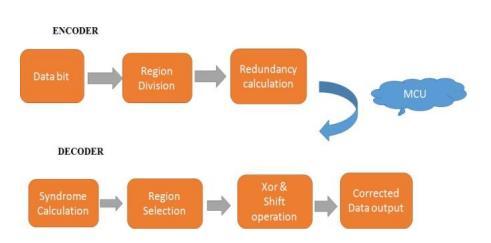
Anerrorcorrectioncodebasedonatwo-dimensionalcode is found in the Data Segmentation section code. This code converts 16 data bits into 32 bits of information. In order to minimize the area and time conception, only paritybits areemployedfordatabitencoding
4.1 Data Segmentation Section Code Encoding Process:
The 32 bits of data that the Data Segmentation Section Code has encoded are shown in Fig. 2. Data bits were represented by the gray pixels,which were separated into fourgroups(A,B,C,D).
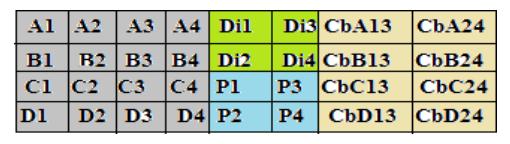
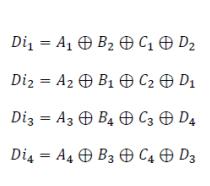
The green cells represent the diagonal bits (Di) that were examinedusingXORoperationsincertaindatabits:
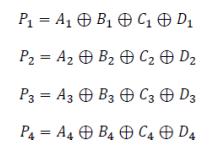
Parity bits (P) were analyzed using XOR operations in the databitscolumnsofthecellthatwascoloredblue:
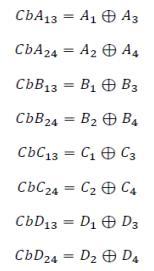
4.2 The decoding process of DSSC is divided into three steps:
I. Syndrome appraisal of the redundancy bits - The syndrome appraisal consists of a XOR operation between the redundancy data stored and the recalculated redundancy bits (RDi, RP, and RCb) SothevaluesfortheSyndromeofDiagonal,Parity andCheckbitsareestimatedby:
International Research Journal of Engineering and Technology (IRJET) e-ISSN:2395-0056
Volume: 11 Issue: 04 | Apr 2024 www.irjet.net p-ISSN:2395-0072
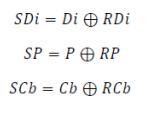
II. Verification of error decoding conditions: One of thesetworequirementsmustbemetfollowingthe analysis of the syndromes in order for the error correctiontobeexecuted.(i)Atleastonevaluein the SDiandSP vectors issimilar toone;(ii)Many SCb values were comparable to one. The criteria alter the method used to determine the error for theareaofdatabits.
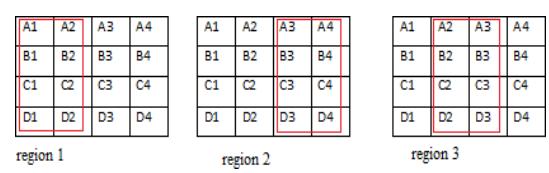
III. The decoding process involves the selection and repair of an incorrect data area. Specifically, a specific region within the data bit is rectified. The regions that make up the region are displayed below.It was revealed that they divided the data bits into three areas in order to choose a specific set of bits for the repair procedure. This lessens theideaoftimeandspace.
The conventional approach to electrical design involves developing from the bottom up, starting with transistors and working up to gates and, eventually, the system. However, when design complexity rises, new structural, hierarchical design techniques must replace conventional bottom-updesigns.
5.4
Itisstraightforwardandefficienttoadaptthisdesign-style for HDL representation. Among its numerous benefits are early testing, fabrication technology independence, structured system design, and more with a true top down design.Butadheringtoastrictlytop-downdesignisrather challenging. Because of this, the majority of designs combinepartsofbothdesignstylesandmethodologies.
5.5 Features of Verilog HDL
Verilogissensitivetocase.
The freedom to combine various degrees of abstraction.
A single language for all design, verification, and testingneeds.
Lowercase definitions of keywords are used in Verilog.
The majority of Verilog's syntax is derived from the"C"language.
5.1
VerilogwasfirstdevelopedbyGatewayDesignAutomation Inc.in1984asaproprietaryhardwaremodelinglanguage. Therearerumorsthattheoriginallanguagewascreatedby incorporating elements from both conventional computer languages like C and the most well-liked HDL language at the time, HiLo. Verilog was not standardized at the time, and the language changed in practically every update that was released between 1984 and 1990. The Verilog simulator was initially put to use in 1985 and underwent significant expansion until 1987. Gateway's Verilog simulator served as the implementation. The first significant addition was Verilog-XL, which included a few new capabilities including the "XL algorithm," a very effectivewaytosimulategatesatthehardwarelevel.
There are two approaches to designing a hardware description language such as Verilog: top-down and bottom-up.
Aformalspecificationofa VLSIchipisthefirststepinthe VLSI design cycle, which proceeds through several stages togenerateapackagedchip.
International Research Journal of Engineering and Technology (IRJET) e-ISSN:2395-0056
Volume: 11 Issue: 04 | Apr 2024 www.irjet.net p-ISSN:2395-0072
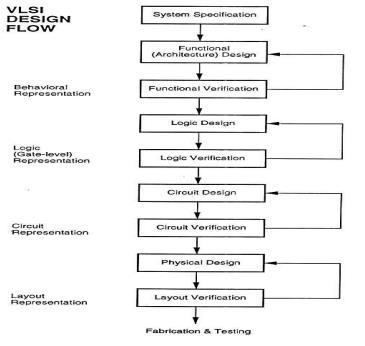
:FlowOfVlsiDesign
RESULTS
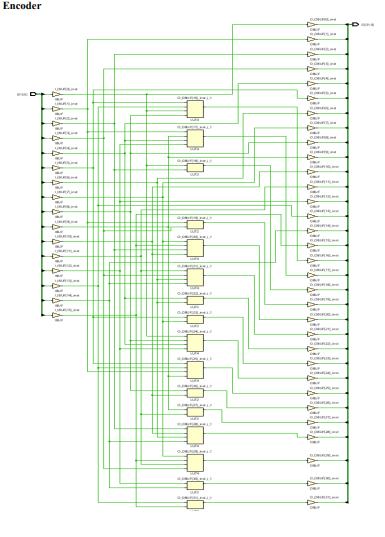
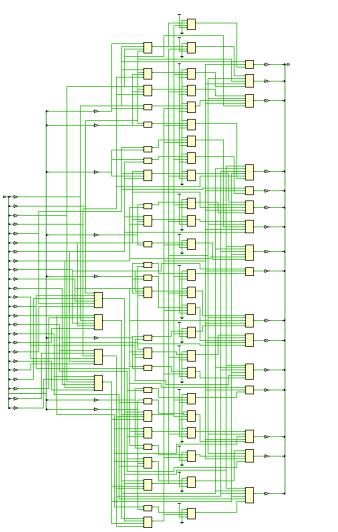
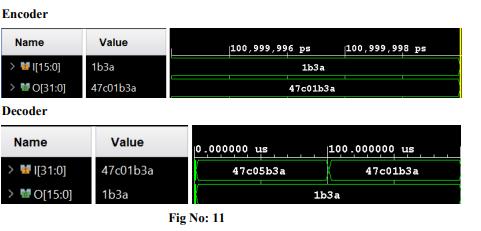
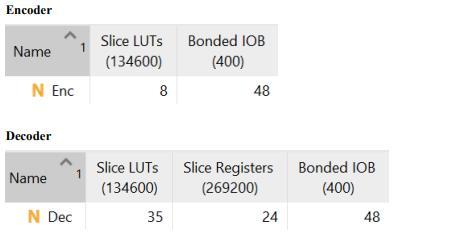
International Research Journal of Engineering and Technology (IRJET) e-ISSN:2395-0056
Volume: 11 Issue: 04 | Apr 2024 www.irjet.net p-ISSN:2395-0072
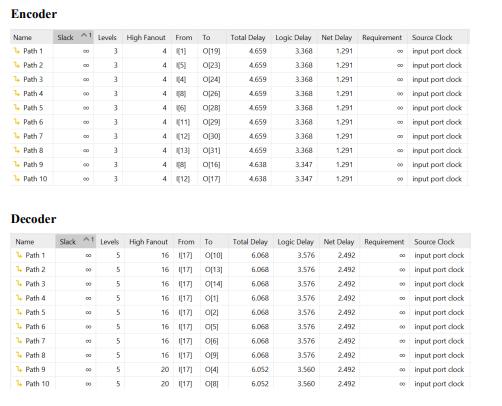
Fig -8:Delayresultsforbothencoderanddecoder
This work suggests a novel error correction algorithm (ECC) to lessen data corruption in volatile memory systems.XilinxVivido,whichwasbuiltinVerilogHDL,was usedtosimulateandsynthesizethesuggesteddesign.The amount of energy used to encode and decode process is, respectively, 0.167W and 0.127W. In contrast to established techniques, this encoding-decoding procedure uses less power and requires less space and time. This method will also be expanded in order to lower the area, latency,andpowerusage.Incomparisontootherexisting approaches, the decoder area rises since the zones were specifically chosen. Using the advanced region selection criteriafurtherreducesthis.
[1] R. C. Baumann (2005), “Soft errors in advanced computer systems,” IEEE Des. Test. Comput., vol. 22, no.3,pp.258-266.
[2] ] C. L. Chen and M. Y. Hsiao (1984), “Error-correcting codes for semiconductor memory applications: A state-of-the-art review,” IBM J. Res. Develop., vol.28, no.2,pp.124-134.
[3] E. Ibe, S. Chung, S. Wen, H. Yamaguchi, Y. Yahagi, H. Kameyama, S. Yamamoto and T.Akioka (2006), “Spreading diversity in multi-cell neutron-induced upsets with device scaling,” in Proc. IEEE Custom IntegratedCircuitConf.,pp.437-444.
[4] P. Reviriego, J.A. Maestro and C. Cervantes (2007), “Reliabilityanalysisofmemoriessufferingmultiplebit upsets,” IEEE Trans. Device Mater. Rel., vol. 7, no. 4, pp.592-601.
[5] G.C.Yang(1995),“ReliabilityofsemiconductorRAMs with soft-error scrubbing techniques,” IEEE Proc. Computers and Digital techniques, vol. 142, no. 5, pp. 337-344.




K.G.VENKATAKRISHNA, AssistantProfessor,Krishna UniversityCollegeofEngineering &Technology,KrishnaUniversity, Machilipatanam
BOTCHU.LAVANYA,Studentof DepartmentofElectronicsand CommunicationEngineering, KrishnaUniversity, Machiliptanam.
KODAVALI.SRAVANI,Studentof DepartmentofElectronicsand CommunicationEngineering, KrishnaUniversity, Machiliptanam.
KUNCHEPUJAGADEESH,Student ofDepartmentofElectronicsand CommunicationEngineering, KrishnaUniversity, Machiliptanam.