
International Research Journal of Engineering and Technology (IRJET) e-ISSN: 2395-0056
Volume: 11 Issue: 04 | Apr 2024 www.irjet.net p-ISSN: 2395-0072
International Research Journal of Engineering and Technology (IRJET) e-ISSN: 2395-0056
Volume: 11 Issue: 04 | Apr 2024 www.irjet.net p-ISSN: 2395-0072
R.
Karthikeyan1, C. Abirami2 ,R. Ramya3, B. Sneha4,U. Uma Azhagu Sudha5
12345Dept. of Computer Science and Engineering, Government College of Engineering Srirangam, TamilNadu, India
Abstract - Phishing is a kind of worldwide spread cyber crime that uses disguised websites to trick users into downloading malware or providing personally sensitive information to attackers. With the rapid development of artificial intelligence, researchers in the cyber security field utilize machine learning algorithms to classify phishing websites. To track the phishing websites the machine learning algorithm Random Forest is used because it gives high accuracy as compared to other machine learning algorithms. The dataset is collected which contains both the malicious and legitimate url to train Machine Learning models using Random Forest Classifier and predict the websites in order to identify and prevent users from falling victimtoonlinescams.
1.INTRODUCTION
In today's digital world, where the internet is an integral part of our daily lives, online security has become an importantconcern.Phishingisaformofcybercrime,poses a significant threat to individuals, businesses, and organizations worldwide. Phishing attacks involve fraudulentattemptstoobtainsensitiveinformationsuchas usernames,passwords,andfinancialdatabymasquerading asatrustworthyentityinelectroniccommunication.
The consequences of falling victim to phishing can be severe, ranging from financial loss and identity theft to compromised personal and corporate data. With the advancement of technology, phishing techniques have become increasingly sophisticated, making it more challenging to distinguish between legitimate and maliciouswebsites.
Therefore, the ability to detect phishing websites accurately and efficiently is crucial in safeguarding against cyberthreats.Thisdetectionprocessinvolvesanalyzingthe lexical features and characteristics of websites to identify indicatorsofphishingorothermaliciousactivity.
In this paper, we analyze into the methodologies and techniquesemployedinthedetectionofphishingwebsites. Byunderstandingthestrategiesutilizedbycybercriminals and leveraging innovative detection techniques, we aim to empower users and organizations to mitigate the risks posedbyphishingattacks.
[1]Researchershaveinvestigateddifferentfeaturesetsand selection techniques to improve the performance of phishing detection systems. Studies have explored the importanceoffeaturessuchasURLcharacteristics,domain registration information, website content analysis, SSL certificate attributes, and user-related factors in distinguishing between phishing and legitimate websites. Featureselectionmethods,includinginformationgain,chisquare test, and recursive feature elimination, have been employed to identify the most discriminating features for classification.[2]Some research focuses on analyzing the dynamicbehaviorofwebsiteinteractions,includingmouse movements, keystrokes, and navigation patterns, to detect phishing attempts in real-time. These approaches aim to capture subtle indicators of malicious intent that may not be apparent from static website features alone, enhancing theadaptabilityandresponsivenessofdetectionsystemsto evolving phishing tactics.[3]Hybrid and multi-modal detection systems integrate multiple sources of information, such as website content, network traffic, user behavior, and reputation data, to improve the comprehensiveness and effectiveness of phishing detection. These approaches combine the strengths of differentdetectiontechniquesanddatasourcestoenhance detection accuracy and resilience to evasion strategies employed by cyber criminals.[4]With the growing sophistication of phishing attacks, researchers have explored adversarial machine learning techniques to enhance the robustness of detection systems against evasion attempts. Adversarial training, robust feature representation learning, and generative adversarial networks(GANs)areamongtheapproachesinvestigatedto defend against adversarial manipulation and stealthy phishingtactics.
By building upon and extending the insights gained from related works in the field, the proposed system aims to advance the state-of-the-art in phishing website detection, addressing key challenges and limitations to enhance cybersecurityresilienceinthefaceofevolvingthreats.
Volume: 11 Issue: 04 | Apr 2024 www.irjet.net
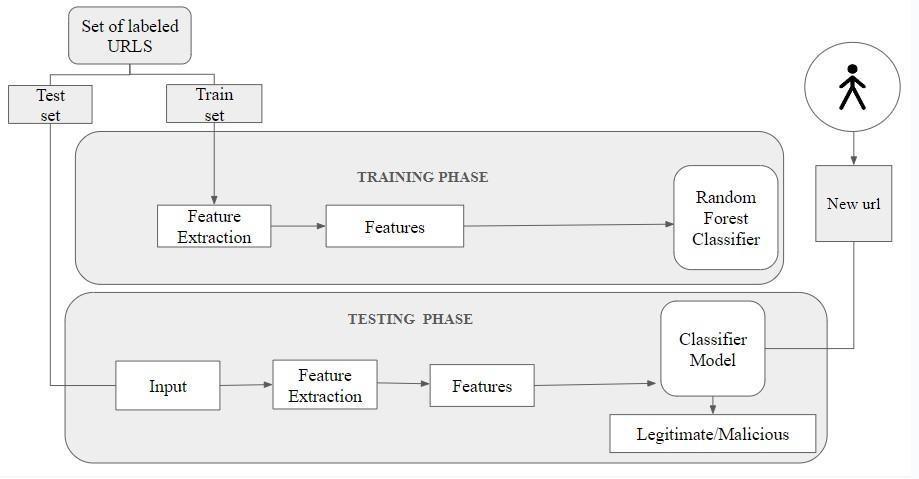
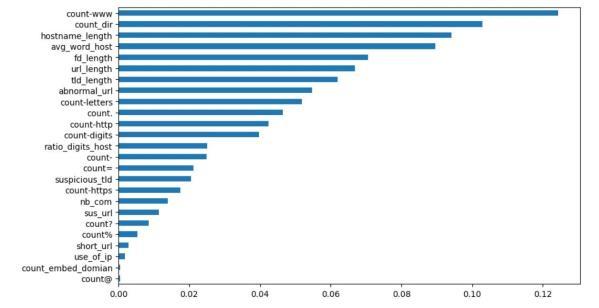
In the Proposed system, the ensemble learning method Random Forest is used to train the model and predict the websiteswhetheritismaliciousorlegitimatewebsite.The datasetusedcontainsmorerecordsaround6,51,191URLs, out of which 4,28,103 are safe URLs, 96,457 are defacement URLS, 94,111 are phishing URLS and 32,520 are malware URLS. There are 26 lexical features are extracted from the urls in the dataset to build the model. The features includes check for Having ip address, Abnormal url, Google index, Count of dot, Count of www, Count of @,Count of directory, Count embedded domain, SuspiciouswordsinURL,Shorturl,Countofhttps,Countof http,Countof%,Countof?,Countof-,Count of =, Url length, Hostname length, Firstdirectory length, Length of top-level domains, Count of digits, Count of letters, Count the number of .com, Average length of word inhostname,ratioofdigitsinhostname. Notonlyphishing URLSarepredictedandotherMaliciousURLsaredetected. The System Architecture diagram of our proposed system isgiveninfig.1
4.1
ThedatasetiscollectedfromtheKagglewebsite.Itcontains a total of 6,51,191 URLs, out of which 4,28,103 are safe URLs, 96,457 are defacement URLS, 94,111 are phishing URLSand32,520aremalwareURLS.
Data preprocessing is the first and crucial step after data collection.Therawdatasetobtainedforphishingdetection was prepared by removing redundant and irregular data. The dataset contains some irrelevant columns such as checking websites, date and unwanted type of target variable. These are rectified and makethe dataset suitable forbuildingthemodel.
-ISSN: 2395-0072
Feature extraction is the process of transforming raw data into numerical features that preserve the information in theoriginal data set.It'sa wayofidentifyingandselecting the most important information or characteristics from a data set, while filtering out less significant details. In this step,thefeaturesareextractedfromtherawURLs,asthese features will be used as the input features for training the machine learning model. The features are Having ip address,Abnormalurl,Googleindex,Countofdot,Countof www,Countof@,Countofdirectory,Countembeddomain, SuspiciouswordsinURL,Shorturl,Countofhttps,Countof http, Count of %, Count of ?, Count of -, Count of =, URL length, Hostname length, First directory length, Length of top-leveldomains,Countofdigits,Countofletters.
The data visualization method was employed to analyze, explore and summarize the dataset. These visualizations consist of histograms, box plots, scatter plots, catplot and count plots to uncover patterns and insights within data. The google index feature denotes if the URL is indexed in google search console or not. As a result of this step, the google index features were dropped because In this dataset,alltheURLsaregoogleindexedandhaveavalueof 1.
The model is developed using tree-based ensemble machine learning method include Random Forest. Model Evaluationinvolvesassessingtheperformanceofa trained model on unseen data to understand how well it generalizes to new, unseen urls. The model is evaluated basedon theperformancemetricsincludeaccuracy, precision,recallandF1score.
After the model has been trained and evaluated, it can be used to make predictions on new, unseen websites. When presentedwiththefeaturesofawebsite,themodelapplies the decision rules learned during training to classify the website as either phishing or legitimate. In the context of RandomForests,prediction involvesaggregating the predictions of multiple decision trees to arrive at a final classification. Each tree in the forest independently classifies the input data, and the final prediction is determined by a majority vote of the individualtreepredictions.
Volume: 11 Issue: 04 | Apr 2024 www.irjet.net p-ISSN: 2395-0072
MachineLearning(ML)isa branchofartificial intelligence (AI)wherecomputersystemsaretrainedtolearnpatterns and make decisions based on data without explicit programming instructions and accurately process large volumes of data, generating insights and predictions with minimal human intervention. ML enables organizations to streamline decision-making processes, improve productivity, and achieve better outcomes across various domains.MLincludesmanytechniquesthatallowsoftware applications to improve their performance as time progresses. It requires understanding mathematical and statistical concepts to select appropriate algorithms and training them with sufficient data to achieve accurate results. Prediction techniques leveraging machine learning involvetheapplicationofcomputational algorithmsacross various industries to anticipate future outcomes, trends, andpatternsbasedonhistoricaldataanalysis.
Machine learning for phishing detection is like teaching a computertorecognizethedifferencebetweenrealandfake websitesbyshowingitlotsofexamplesandlettingitlearn fromthem.
Ensemble learning is a machine learning technique that combines multiple base models to produce a stronger predictive model. Instead of relying on the output of a single model,ensemblemethodsaggregatethepredictions of multiple models to make more accurate and robust predictions. Ensemble learning can be applied to both classification and regression tasks, and it is particularly effective when individual base models have different strengthsandweaknesses.
Random Forest belongs to the family of ensemble learning methods. Ensemble learning is a machine learning technique that combines multiple base models to produce a stronger predictive model. Instead of relying on the output of a single model, ensemble methods aggregate the predictionsofmultiplemodelstomakemoreaccurateand robust predictions. Ensemble learning can be applied to both classification and regression tasks, and it is particularly effective when individual base models have differentstrengthsandweaknesses.
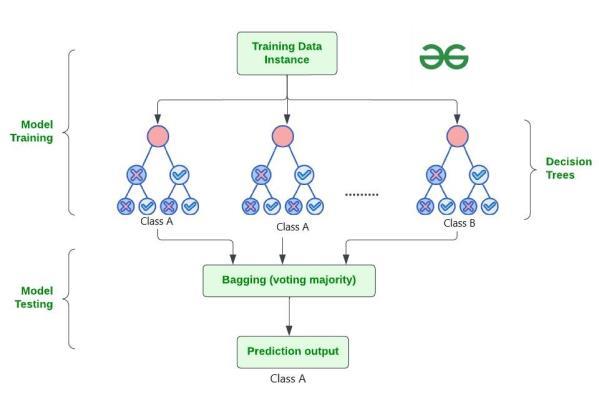
Random Forest works by creating a number of Decision Trees during the training phase. Each tree is constructed using a random subset of the data set to measurearandomsubsetoffeaturesineachpartition.This randomness introduces variability among individual trees, reducing the risk of overfitting and improving overall prediction performance. In prediction, the algorithm
aggregates the results of all trees by voting classification tasks. This collaborative decision-making process, supportedbymultipletreeswiththeirinsights,providesan example of stable and precise results. Random forests are widely used for classification and regression functions, which are known for their ability to handle complex data, reduce overfitting, and provide reliable forecasts in different environments. Random Forest tends to achieve high accuracy in classification tasks, even with relatively littletuning.Itsabilitytohandlehigh-dimensionaldataand capture complex relationships makes it well-suited for a wide range of applications. By aggregating the predictions of multiple decision trees trained on random subsets of data and features, Random Forest mitigates the risk of overfittingandgeneralizeswelltounseendata.
5.1.1
Random Forest gives the power of ensemble learning by constructinganarmyofDecisionTrees.Thesetreesarelike individual experts, each specializing in a particular aspect of the data. Importantly, they operate independently, minimizingtheriskofthemodelbeingoverlyinfluencedby thenuancesofasingletree.
5.1.2
To ensure that eachdecision treein the ensemble bringsa unique perspective, Random Forest employs random feature selection. During the training of each tree, a random subset of features is chosen. This randomness ensures that each tree focuses on different aspects of the data, fostering a diverse set of predictors within the ensemble.
The technique of bagging is a Random Forest training strategy which involves creating multiple bootstrap samplesfromtheoriginaldataset,allowinginstancesto be sampledwithreplacement.Thisresultsindifferentsubsets
International Research Journal of Engineering and Technology (IRJET) e-ISSN: 2395-0056
Volume: 11 Issue: 04 | Apr 2024 www.irjet.net p-ISSN: 2395-0072
ofdataforeachdecisiontree,introducingvariabilityinthe trainingprocessandmakingthemodelmorerobust.
Whenitcomestomakingpredictions,eachdecisiontreein the Random Forest casts its vote. For classification tasks, the final prediction is determined by the mode most frequentpredictionacrossallthetrees.Thisinternalvoting mechanism ensures a balanced and collective decisionmakingprocess.
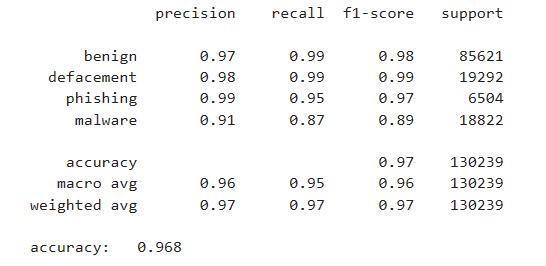
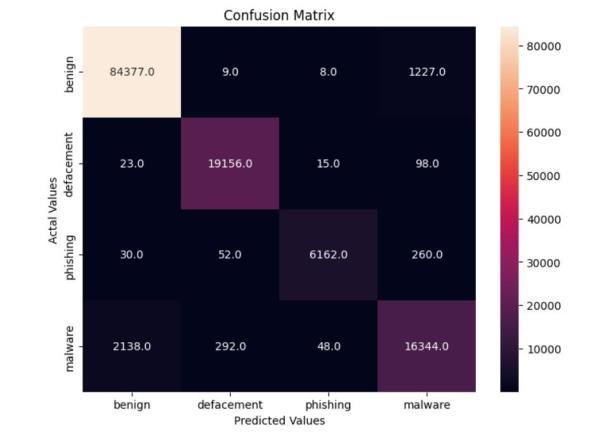
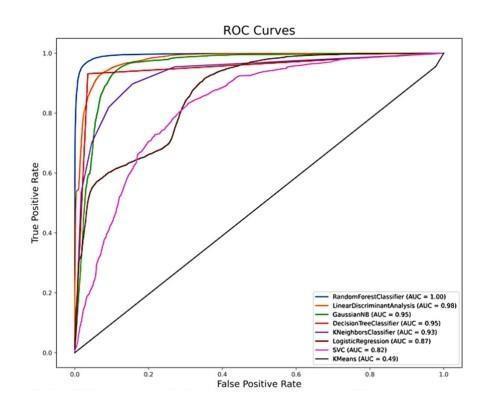
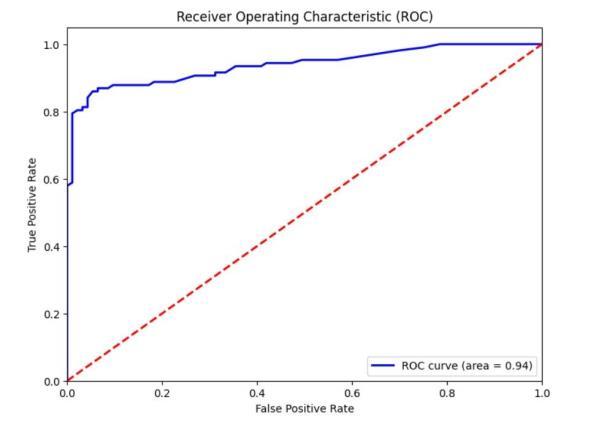
We presented a comprehensive approach for detecting phishingwebsitesusingmachinelearningtechniques,with afocusontheRandomForestalgorithm.Throughextensive experimentation and analysis, we have demonstrated the effectiveness of our proposed methodology in accurately identifyingphishingwebsitesandmitigatingpotentialrisks to users' online security. Our study involved the collection of a diverse dataset comprising both legitimate and phishing websites, followed by feature extraction and model training using the Random Forest algorithm. We evaluated the performance of our detection model using standard evaluation metrics and conducted crossvalidation to ensure its robustness and generalization capability.Theresultsofourexperimentsindicatethatour Random Forestbased approach achieves high levels of accuracy, precision, recall, and F1-score in distinguishing between legitimate and phishing websites. Furthermore, comparative analysis with other machine learning algorithms highlights the superiority of our proposed methodology in terms of detection performance and
International Research Journal of Engineering and Technology (IRJET) e-ISSN: 2395-0056
Volume: 11 Issue: 04 | Apr 2024 www.irjet.net p-ISSN: 2395-0072
efficiency. Overall, our research contributes to the advancement of web security by offering a practical and effective solution for detecting phishing websites using machine learning techniques. By leveraging the power of the Random Forest algorithm and feature engineering strategies, we have developed a robust detection system capable of effectively identifying and mitigating phishing threatsinrealworldscenarios.
[1] AndrewJ.Park,RuhiNaazQadri,and Herbert H. Tsang developed a “Phishing website detection frameworkthroughwebscrapinganddatamining”, in2017.
[2] Chen, Kai, et al. "PhishDetect: Real-Time Phishing Detection Using Machine Learning and URL Analysis." IEEE Transactions on Dependable and SecureComputingin2021.
[3] K.L.Chiew,C.L.Tan,K.Wong,K.S.C.Yong,andW.K. Tiong, ‘‘A new hybrid ensemble feature selection framework for machine learning-based phishing detectionsysteminMay2019.
[4] C. Emilin Shyni, Anesh D. Sundar, and G.S. Edwin Ebby proposed “Phishing detection in websites usingparsetreevalidation”,in2018.
[5] Gao, Xin, et al. "Enhanced Phishing Website Detection Using Machine Learning and Feature Engineering."IEEEAccess8in2020.
[6] Gupta, Ananya, and Rajesh Kumar. "Phishing Detection using Ensemble Learning and Feature Fusion." International Journal of Computer Applications10.7in2020.
[7] Jhen-Hao Li and Sheng-De Hang proposed “PhishBox-An approachfor phishing validationand detection”,in2018.
[8] Li, Wei, et al. "Phishing Website Detection Using Feature Fusion and Deep Learning." Proceedings of the ACM Conference on Computer and CommunicationsSecurity(CCS).2020.
[9] U. Ozker and O. K. Sahingoz, ‘‘Content based phishing detection with machine learning,’’ in Proc.Int.Conf.Electr.Eng.(ICEE),Sep.2020.
[10] Patel, Priya, and Arjun Sharma. "Web Phishing Detection using Machine Learning and Natural Language Processing Techniques."
Proceedings of the IEEE International Conference onCybersecurityandPrivacy(ICCSP).2021.
[11] Patel, Sanjay, and Ritu Gupta. "A Novel Approach to Phishing Website Detection Using Neural Networks and Behavioral Analysis." International Journal of InformationSecurityin2021.
[12] Peng Yang, Peng Zeng, and Guangzhen Zhao introduced “Phishing website detection method basedonmultidimensionalfeaturesdrivenbydeep learning”,in2019.
[13] V. Shahrivari, M. M. Darabi,and M. Izadi, ‘‘Phishing detection using machine learning techniques in 2020.
[14] Singh,Rahul,andPriyaSharma."DetectingPhishing Websites Using Machine Learning and Feature Engineering." Journal of Cybersecurity Research in 2020.
[15] S. Wang, S. Khan, C. Xu, S. Nazir, and A. Hafeez, ‘‘DeepLearning-based efficient model development for phishing detection using random forest and BLSTMclassifiers,’’Complexity,Sep.2020.
[16] Wang, Xiaoyong, et al. "Deep Learning for Phishing Website Detection." IEEE Transactions on InformationForensicsandSecurityin2019.
[17] Yongjie Huang, Qiping Yang, Jinghul Qin, and Wu Shao Wen developed a method for “Phishing URL detection via CNN and attentionbased hierarchical RNN”,in2019.