
International Research Journal of Engineering and Technology (IRJET) e-ISSN:2395-0056
Volume: 11 Issue: 04 | Apr 2024 www.irjet.net p-ISSN:2395-0072
International Research Journal of Engineering and Technology (IRJET) e-ISSN:2395-0056
Volume: 11 Issue: 04 | Apr 2024 www.irjet.net p-ISSN:2395-0072
Ms. Mauli Bodiwala1, Dr. Margie Parikh2
1Research Scholar, B.K. School of Business Management, Gujarat University, Ahmedabad, Gujarat 2Professor, B.K. School of Business Management, Gujarat University, Ahmedabad, Gujarat.
Abstract
Credit scoring is a crucial aspect of retail lending, influencing loan approval decisions, interest rates, and credit limits. Understanding the parameters that contribute to credit scores is essential for effective risk assessment and loan management. This study investigates the important parameters for credit scores in the generation of retail loans in Gujarat State, focusing on the cities of Ahmedabad, Surat, Vadodara, and Rajkot. A sample size of 110 bankers from these cities was selected using stratified random sampling, ensuring representation across various demographics. The research design employed a crosssectional approach to capture a snapshot of credit scoring perceptions and practices. Through a mixed-methods approach, including literature review, surveys, and statistical analysis, key parameters influencing credit scores were identified and analysed. The findings shed light on the nuanced factors shaping creditworthiness assessment in the retail lending landscape of Gujarat State. The study's implications extend to lenders, policymakers, and consumers, offering insights to enhance credit risk management and financial inclusion efforts.
Key Words: Credit Score, Lending facility, factors for the credit lending facility, Banks, Financial institutions.
In today's dynamic financial landscape, retail loans play a pivotal role in fulfilling diverse consumer needs, ranging from purchasing homes and vehicles to funding education and personal expenses. At the heart of retail lending lies the assessmentofcreditworthiness,aprocesswhereinfinancialinstitutionsevaluatetheriskassociatedwithextendingcredit to individual borrowers. Central to this assessment is the concept of credit scores, numerical representations of an individual'screditworthinessderivedfromvariousfinancialdatapoints.
The importance of credit scores in the retail lending processcannot be overstated. They serveas key determinants in loan approvaldecisions,interestratecalculations,andcreditlimitassignments.Ahighercreditscoretypicallytranslatestobetter loantermsandlowerborrowingcosts,whereasalowerscoremayresultinlimitedaccesstocreditorhigherinterestrates. Therefore,understandingthefactorsthatinfluencecreditscoresisparamountforbothlendersandborrowersalike.
Despitethewidespreadacknowledgmentofthesignificanceofcreditscores,thepreciseparametersthatcontributetotheir generationremainasubjectofongoingresearchanddebate.Whiletraditionalmetricssuchasincomelevel,paymenthistory, and debt-to-income ratio are well-established factors in credit scoring models, emerging trends and evolving consumer behavioursnecessitateadeeperexplorationintoadditionalvariablesthatmayinfluencecreditworthiness.
Thisresearchpaperaimedtocontributetothisongoingdiscoursebyidentifyingandexaminingtheimportantparameters forcreditscoresinthecontext of retail loans. Through a comprehensiveanalysisof existing literature, empirical data,and expert insights, this study seeks to shed light on the multifaceted nature of credit scoring and its implications for retail lendingpractices.
(Shankar, S., 2019) mentioned that with an emphasis on the credit rating system put in place in 2000, this chapter discusses the typical funding issues that micro, small, and medium-sized companies in India confront as well as some significant steps made to solve them. Based on interviews with rating agencies and MSMEs, it analysed the scheme's benefitsanddrawbacks.Accordingtothereport,thegovernmentsubsidiesofferedundertheplanhaveplayedasignificant rolein encouragingMSMEs toobtaincredit ratings, whichhastheeffectof decreasinginformationasymmetry with banks andfacilitatingloanavailability.Thisisbecausecreditratingisacostlyprocess.Makinguseoftheinformationgatheredfrom MSMElendingandcreditratinginthenationbybuildingacreditriskdatabaseisessentialgiventhesubstantialamountof
International Research Journal of Engineering and Technology (IRJET) e-ISSN:2395-0056
Volume: 11 Issue: 04 | Apr 2024 www.irjet.net p-ISSN:2395-0072
unbanked MSMEs in the nation. Without depending on subsidies, lenders will then have access to the aggregated data producedtomakebetterlendingdecisionsforMSMEs.
(Abdou, H. A., & Pointon, J., 2011) defined that in recent decades, credit scoring has gained widespread recognition as a fundamental instrument for evaluating various organizations and has been extensively studied across several domains, including banking and accounting.In domains such as categorization and prediction, where statistical methods have traditionally been applied, alternative scoring approaches are being employed.The literature looks into performance evaluation criteria as well as advanced and conventional methods.In general, this paper's main goal was to conduct an exhaustive analysis of 214 books, papers, and theses that deal with credit scoring applications in a variety of fields, but mostly in banking and finance.Using a thorough analysis of various statistical methods and performance evaluation standards, this study also sought to understand how credit scoring has grown in significance and to pinpoint the crucial factors in the creation of a scoring model. Their review of literature revealed that there was no overall best statistical technique used in building scoring models and the best technique for all circumstances does not yet exist. Also, the applicationsofthe scoring methodologieshave been widely extended toinclude different areas,and this subsequentlycan helpdecisionmakers,particularlyinbanking,topredicttheirclients'behaviour.
(Karlan, D., & Zinman, J., 2010) examinedthatoneofthemaincomponentsoffinancialdevelopmentstrategyisincreasing the availability of commercial credit. There isn't as much agreement on whether giving more people access to consumer creditbenefitsborrowers especiallywhenthoseloanshavehighinterestrates.Researchdemonstratingbehavioralbiases that may lead to overborrowing is a major source of the public's mistrust over "unproductive," "usurious" lending. By conductingafieldexperimentandgatheringotherdata,wecalculatetheeffectsofincreasingconsumerloanavailabilityata 200%annualpercentagerate(APR).Forborrowers,therandomlyassignedmarginalloansresultedinsubstantialnetgains inavarietyofoutcomes.Additionally,thereissomeproofthattheloanswerelucrative.
3.1. Problem Identification
Inthis research,theresearcherhas basicallymadea sincere attempt fortheidentification ofthe important factors forthe credit score evaluation for the disbursement of the loan for the needy people who are visiting to the banks and financial institutions for their requirement of generation of credit for their own purpose either for the buying the real estate property, buying long term projects or might me for the meeting past obligations for the individual residing in the major citiesofGujaratstatesi.e.Ahmedabad,Vadodara,SuratandRajkotintheopinionofthebankersofthepublicsector,private sector,co-operativebanks,RegionalRuralbanksandotherfinancialinstitutions.
3.2. Research
Here,theresearcherhasmadeasincereattemptfortheidentificationfortheimportantfactorforthegenerationoftheloan facilitiesbasedonthecreditabilityoftheindividualwhoarelookingforthefinancialhelpforanyreason.Basedonthis,the objectivesoftheresearcharementionedbelow:
To study the demographic profile of the individual who are looking for the credit facilities for the loans from the selectedcitiesofGujaratstate.
To find out the important factors for the generation of the credit facilities for the individuals by the banks and financialinstitutionsfromtheGujaratStateaspertheopinionofthebankers
3.3. Sample Size of the Research
To find out the important factors for the generation of the credit facilities for the individuals by the banks and financial institutions from the Gujarat State as per the opinion of the bankers, total 100 samples from the selected cities i.e. Ahmedabad,Surat,RajkotandVadodara.
3.4. Sampling Techniques of the Research
Heretheattemptwasmadebytheresearcherfortheidentificationofthe importantfactorsforthecreditscoregeneration from the credit lending facilities that have been processed from the banks and financial institutions from the individuals fromtheselectedcitiesofGujaratState,theresearcherneedtheexperiencedbankersforthesampleselectiontogivetheir opinion on this topic and due to which the researcher has adopted stratified random sampling where the group of experiencedbankershavebeenselectedforthereceivingtherealtimeresponsefortheiropiniontowardsit.
International Research Journal of Engineering and Technology (IRJET) e-ISSN:2395-0056
Volume: 11 Issue: 04 | Apr 2024 www.irjet.net p-ISSN:2395-0072
Tofindouttheimportantparametersfortheevaluationofcreditgenerationactivitiesforthegrantingtheloanfacilities for theindividualswhoarevisitingtothebanksandotherfinancialinstitutionsfromtheGujaratState,theresearcherhasused the descriptive cross-sectional study as a part of the collection of the samples from the experienced bankers who are workingintheloandisbursementdepartment.
Table 1: Demographic Profile of the Bankers from the Gujarat State
Demographic Profile (Bankers: Gujarat State)
(Rs.)
of Residence
(Source: Research Result)
ThetablementionedaboveistherepresentationofthedemographicprofileofthebankersfromtheselectedcitiesofGujarat Statei.e.Ahmedabad,Surat,VadodaraandRajkotfromtheGujaratState.FromthepointofviewofGender,ithadbeennoted that the majority of bankers in the sample are male, comprising 59.09% of the total respondents, while females constitute 40.90%.Thisindicatesa genderimbalancein the bankingprofessioninGujaratState,withmalesbeingmorerepresented. From the point of view of age parameters of the bankers, the largest proportion falling in the age range of 30-45 years (32.73%), followed closely by those aged 46-60 years (30.91%) which suggested a mix of experienced professionals and mid-careerindividualsinthebankingsector.Fromthepointofviewofeducationalqualificationparametersofthebankers, majorityofbankershaveattainedpost-graduationqualifications(49.09%),followedbygraduation(19.09%).Thissuggests a high level of educational attainment among bankers in Gujarat State, with a significant proportion holding advanced degrees.Fromthepointofviewofmonthlyincomeparametersofthebankers,highestproportionfallsintheincomerange ofRs.25,000-Rs.50,000(30.91%),followedcloselybyRs.50,001-Rs.1,00,000(25.46%).Thisindicatesadiverserangeof incomelevelsamongbankersinthestateandincaseof thecityofresidenceforthebankers,highestresponses havebeen takenfromthetwometropolitancitiesofGujaratStatei.e.AhmedabadandSuratwiththe30(27.27%)fromeachofthecity andfromtheVadodaraandRajkot25(22.73%)responsesrespectivelyfromeachofthecityseparately.
Table 2: Statements for the Important Factors for the generation of credit Scores on the Generation of Retail Loans
International Research Journal of Engineering and Technology (IRJET) e-ISSN:2395-0056
Volume: 11 Issue: 04 | Apr 2024 www.irjet.net
Stability in the applicant's employment status positively impacts theircreditscore.
A higher income level positively affects the applicant's credit score.
The applicant's debt-to-income ratio is a crucial factor in determiningtheircreditworthiness
The length of the applicant's credit history is an important considerationfortheircreditscore.
Having a diverse credit mix, including both revolving and instalmentaccounts,improvesthecreditscore.
The utilization rate of the applicant's available credit lines affects theircreditscore.
The presence of any outstanding debts negatively impacts the applicant'screditscore.
Consistentlymakingminimumpaymentsoncreditaccountshelps maintainagoodcreditscore. 3.65
Thenumberofrecentcreditinquiriescanhaveanegativeimpact onthecreditscore. 2.25
Any history of bankruptcy significantly lowers the applicant's creditscore. 3.22
Demonstrating responsible credit management, such as avoiding maxingoutcreditcards,positivelyinfluencesthecreditscore.
The presence of any delinquent accounts negatively affects the creditscore.
A long-standing relationship with a financial institution can positivelyimpactthecreditscore.
Regularly monitoring and reviewing one's credit report helps maintainahealthycreditscore.
Being listed as an authorized user on a credit account can positivelyimpactthecreditscore.
The frequency of credit utilization, such as monthly credit card balances,affectsthecreditscore. 2.47
The applicant's ability to manage and pay off multiple debts simultaneouslyaffectstheircreditscore. 3.96
The frequency of credit applications within a short period can negativelyimpactthecreditscore. 3.32
(Source: Research Result)
The table mentioned above represents the Statements for the Important Factors for the generation of credit Scores on the GenerationofRetailLoans.Ithasbeennotedthat,
Thestatementswhichhavereceivedthehighestimportanceintheopinionofthebankersarementionedbelowinthetable
International Research Journal of Engineering and Technology (IRJET) e-ISSN:2395-0056
Volume: 11 Issue: 04 | Apr 2024 www.irjet.net p-ISSN:2395-0072
Table 3: Highly Important Statements for the Bankers for the generation of credit Scores on the Generation of Retail Loans
Highly Important Statements Mean Score
Ahigherincomelevelpositivelyaffectstheapplicant'screditscore 3.47
The applicant's debt-to-income ratio is a crucial factor in determiningtheircreditworthiness 3.78
The utilization rate of the applicant's available credit lines affects theircreditscore 3.96
The presence of any outstanding debts negatively impacts the applicant'screditscore 3.57
Consistentlymakingminimumpaymentsoncreditaccountshelps maintainagoodcreditscore 3.65
A long-standing relationship with a financial institution can positivelyimpactthecreditscore 4.11
Regularly monitoring and reviewing one's credit report helps maintainahealthycreditscore 3.59
Being listed as an authorized user on a credit account can positivelyimpactthecreditscore 3.65
The applicant's ability to manage and pay off multiple debts simultaneouslyaffectstheircreditscore 3.96
(Source: Research Result)
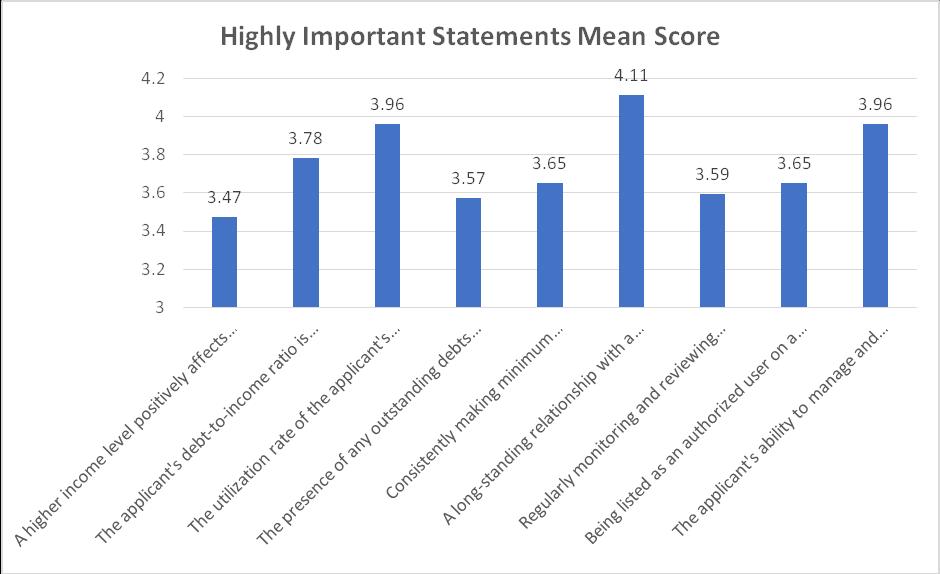
Figure 1: Highly Important Statements for the Bankers for the generation of credit Scores on the Generation of Retail Loans
(Source: Research Result)
International Research Journal of Engineering and Technology (IRJET) e-ISSN:2395-0056
Volume: 11 Issue: 04 | Apr 2024 www.irjet.net p-ISSN:2395-0072
Fromtheabovetable andchartsforthehighlyimportant StatementsfortheBankersforthegeneration of credit Scoreson the Generation of Retail Loans, it had been noted that the highest number of weightages that have been given from the bankers from the selected cities of Gujarat State i.e. Ahmedabad, Surat, Vadodara and Rajkot to the “A long-standing relationship with a financial institution can positively impact the credit score” followed by the “The applicant's ability to manageandpayoffmultipledebtssimultaneouslyaffectstheircreditscore”.
Table 4: Moderately Important Statements for the Bankers for the generation of credit Scores on the Generation of Retail Loans
Moderately Important Statements Mean Score
The applicant's credit history strongly influences their credit score 3.33
Demonstrating responsible credit management positively influencesthecreditscore 3.24
Any history of bankruptcy significantly lowers the applicant's creditscore 3.22
The frequency of credit applications within a short period can negativelyimpactthecreditscore 3.32
(Source: Research Result)
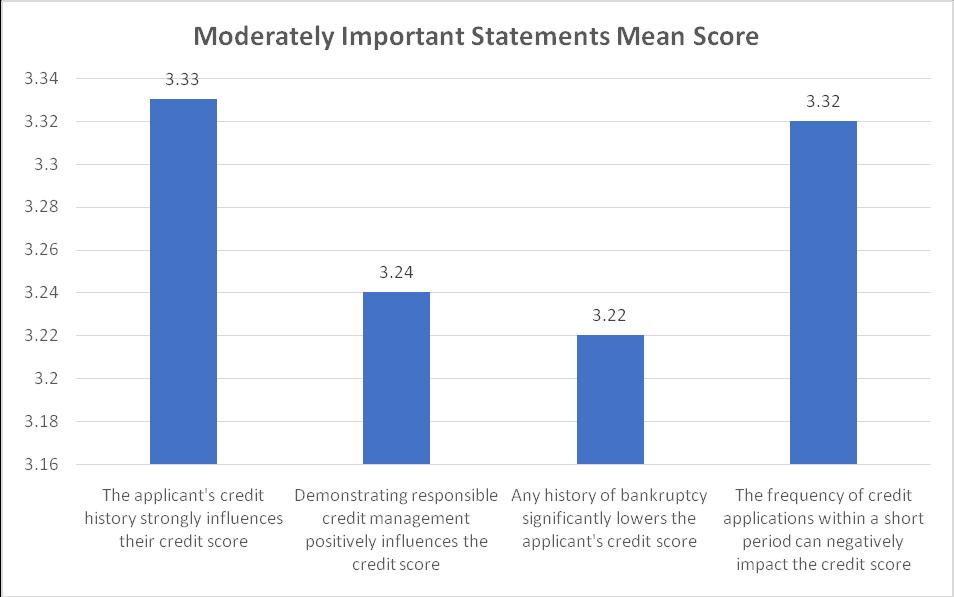
Figure 2: Moderately Important Statements for the Bankers for the generation of credit Scores on the Generation of Retail Loans
(Source: Research Result)
Fromtheabovetable andchartsforthehighlyimportant StatementsfortheBankersforthegeneration of credit Scoreson theGenerationofRetailLoans,ithadbeennotedthatthemoderatelynumberofweightagesthathavebeengivenfromthe bankers from the selected cities of Gujarat State i.e. Ahmedabad, Surat, Vadodara and Rajkot to the “The applicant's credit history strongly influences their credit score” followed by the “The frequency of credit applications within a short period cannegativelyimpactthecreditscore”.
International Research Journal of Engineering and Technology (IRJET) e-ISSN:2395-0056
Volume: 11 Issue: 04 | Apr 2024 www.irjet.net p-ISSN:2395-0072
Table 5: Low Important Statements for the Bankers for the generation of credit Scores on the Generation of Retail Loans
Low Important Statements Mean Score
Timely repayment of previous loans significantly enhances an applicant'screditworthiness
Stability in the applicant's employment status positively impacts theircreditscore 2.48
The length of the applicant's credit history is an important considerationfortheircreditscore
Thenumberofrecentcreditinquiriescanhaveanegativeimpact onthecreditscore
Demonstrating responsible credit management, such as avoiding maxingoutcreditcards,positivelyinfluencesthecreditscore
The frequency of credit utilization, such as monthly credit card balances,affectsthecreditscore 2.47
(Source: Research Result)
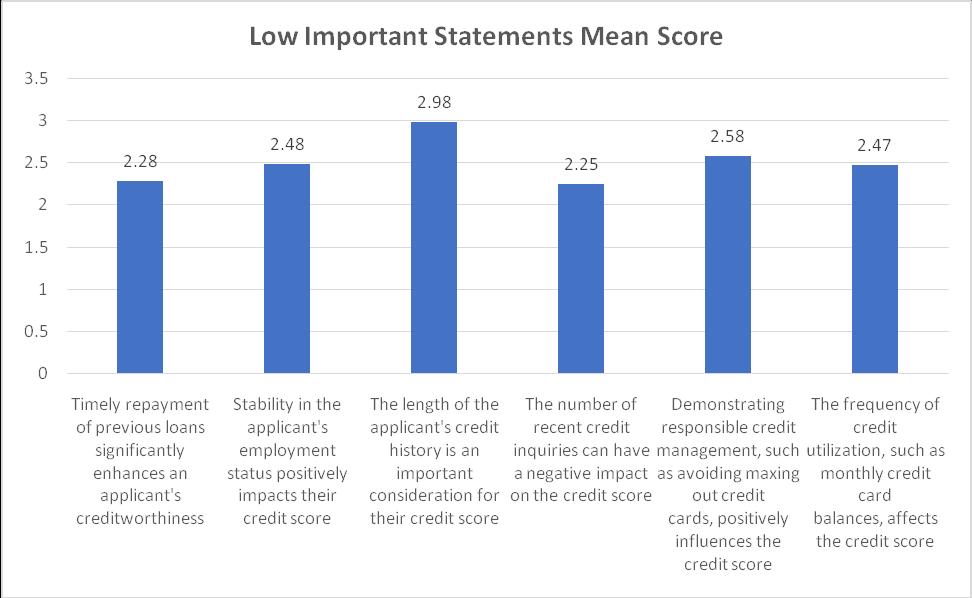
Figure 3: Low Important Statements for the Bankers for the generation of credit Scores on the Generation of Retail Loans
(Source: Research Result)
Fromtheabovetable andchartsforthehighlyimportant StatementsfortheBankersforthegeneration of credit Scoreson theGenerationofRetailLoans,ithadbeennotedthatthelownumberofweightagesthathavebeengivenfromthebankers from the selected cities of Gujarat State i.e. Ahmedabad, Surat, Vadodara and Rajkot to the “The length of the applicant's credit history is an important consideration for their credit score” followed by the “Demonstrating responsible credit management,suchasavoidingmaxingoutcreditcards,positivelyinfluencesthecreditscore”.
International Research Journal of Engineering and Technology (IRJET) e-ISSN:2395-0056
Volume: 11 Issue: 04 | Apr 2024 www.irjet.net p-ISSN:2395-0072
Fromtheabovestudyfortherevelationfortheimportantfactorsforthebankersfortheconsiderationofthecredit limitof anindividualfromtheselectedcitiesofGujaratStatei.e.Ahmedabad,Surat,VadodaraandRajkot.Ithadbeennotedthatthe highestnumberofresponsesthathavebeenreceivedfromthemalebankerswhoarehavingthematurityagerangingfrom the30to50yearswiththemoderatelevelofincomestatusi.e.fromtheRs.50,000toRs. 1,00,000andresidingmajorlyin thetwometropolitancitiesofGujaratStatei.e.AhmedabadandSurat.Withtheconsiderationoftheimportantfactorsforthe bankers for the taking into consideration of the credit facility for the individuals for the granting the loans to them, the highestamountofimportancehasbeengivenbythebankingsystemtothelongtermsrelationshipoftheconsumerswith thebankandfinancialinstitutionsandapplicant'sabilitytomanageandpayoffmultipledebtssimultaneouslyintheGujrat state.Hence,ithasbeenobservedthatthemajorityofthelendingfacilitiesthathavebeenprovidedbythebankerstotheir consumersthroughtheirpersonalcontactandbyknowingtheirfinancialstabilityasapartofmeasuringtheircreditability.
Shankar, S. (2019). The Role of credit rating agencies in addressing gaps in micro and small enterprise financing: The Case of India. In Unlocking sme finance in asia (pp. 72-87). Routledge.
Abdou, H. A., & Pointon, J. (2011). Credit scoring, statistical techniques and evaluation criteria: a review of the literature. Intelligent systems in accounting, finance and management, 18(2-3), 59-88.
Karlan, D., & Zinman, J. (2010). Expanding credit access: Using randomized supply decisions to estimate the impacts. The Review of Financial Studies, 23(1), 433-464.
Hurley, M., & Adebayo, J. (2016). Credit scoring in the era of big data. Yale JL & Tech., 18, 148.
Aduda, J., Magutu, P. O., & Wangu, G. M. (2012). The relationship between credit scoring practices by commercial banks and access to credit by small and medium enterprises in Kenya.
Soni, K., & Desai, M. (2019). Behavior of Investor’s towards Different Investment Boulevard in the Market: Surat City, Gujarat, India. Emerging Trends in International Business and Commerce, 209.
DeYoung, R., Glennon, D., & Nigro, P. (2008). Borrower–lender distance, credit scoring, and loan performance: Evidence from informational-opaque small business borrowers. Journal of Financial Intermediation, 17(1), 113-143.
Berger, A. N., Frame, W. S., & Miller, N. H. (2005). Credit scoring and the availability, price, and risk of small business credit. Journal of money, credit and banking, 191-222.
Abdullah, M. A., Ahmad, A., Nayan, N. A. M., Azhar, Z., & Ahmad, A. R. (2020). Credit risk assessment models of retail microfinancing: The case of a Malaysian national savings bank’s branch. International Journal of Financial Research, 11(3), 73-83.
Crook, J. N., Edelman, D. B., & Thomas, L. C. (2007). Recent developments in consumer credit risk assessment. European Journal of Operational Research, 183(3), 1447-1465.
Jacobson, T., Lindé, J., &Roszbach, K. (2005). Credit risk versus capital requirements under Basel II: are SME loans and retail credit really different?. Journal of Financial Services Research, 28, 43-75.
Leyshon, A., & Thrift, N. (1999). Lists come alive: electronic systems of knowledge and the rise of credit-scoring in retail banking. Economy and society, 28(3), 434-466.
Siddiqi, N. (2012). Credit risk scorecards: developing and implementing intelligent credit scoring (Vol. 3). John Wiley & Sons.
Soni, K. (2017). Impact of foreign direct investment in India on insurance industry. International Journal of Emerging Research in Management & Technology, 6(6), 1-12.
Karlan, D., & Zinman, J. (2011). Microcredit in theory and practice: Using randomized credit scoring for impact evaluation. Science, 332(6035), 1278-1284.
Anderson, R. A. (2022). Credit intelligence and modelling: Many paths through the forest of credit rating and scoring. Oxford University Press.
Kennedy, K. (2013). Credit scoring using machine learning.