
International Research Journal of Engineering and Technology (IRJET) e-ISSN: 2395-0056
Volume: 11 Issue: 04 | Apr 2024 www.irjet.net p-ISSN: 2395-0072
International Research Journal of Engineering and Technology (IRJET) e-ISSN: 2395-0056
Volume: 11 Issue: 04 | Apr 2024 www.irjet.net p-ISSN: 2395-0072
Vanlalrinchhani1 , Dr. Vandana Sehgal2
1M.Arch student, Interior Design, Faculty of Architecture and Planning, Dr. A.P.J. Abdul Kalam Technical University, Lucknow, Uttar Pradesh, India
2Professor, Principal and Dean, Faculty of Architecture and Planning, Dr. A.P.J. Abdul Kalam Technical University, Lucknow, Uttar Pradesh, India ***
Abstract - Culture is an important aspect when relating to one’s identity. It involves the past, what had been there and what has evolved for the people to be in their presentscenario. It creates a unique identity withdeepmeaningsandnarratives from the past. Nowadays, cultural identity has been more acknowledged as people are more interested in cultural exchange and is now used as an experiential characteristic. The first step in experiencing one’s culture is in hospitality properties, especially hotels. As the first steps of a visitor is taken in hotels, it is safe to say that it also becomes the first impression. Seasoning the hotel interiors with a little bit of culture elevates the experience and brings deeper connection to the place of stay. Thus, knowing how to keep the culture alive using design is important. It requires the knowledge of successful designs and the strategies of implementing culture and traditions and how much extent it is used. In the contemporary world, mix of culture and modern has been a practice that has been quite successful as people have a natural tendency to like the modern trends, but also want to experience culture. Therefore, knowing how much to what, and how in designing these cultural experiential spaces is essential.
Key Words: Culture,craftsmanship,modern,hotelinteriors, symbolism,traditionaltechniques,localmaterials,cultural narratives.
The hospitality industry has evolved to cater diverse and culturallyrichclienteleintheincreasinglyglobalizedworld. One of the major aspects of creating an exceptional experienceisthroughtheinteriorspacesanddesign.Their interiorsaremerelyfunctional,butcreatesanopportunity forculturalexchange.
This dynamic relationship between interior design and culturalexchangeinhospitalityinteriorsisafascinatingand evolving field that warrants exploration and analysis. Hospitality interiors encompass a wide range of spaces, including hotels, restaurants, bars, resorts, and other accommodations.Thesespacesarewheretravelers,tourists, and locals converge, seeking not only comfort and conveniencebutalsoauniqueandmemorableexperience. Successful interior design in this context goes beyond aesthetics;itincorporatesculturalsensitivity,storytelling,
andtheabilityto bridgethe gapbetweenthehostculture andtheguest'sexpectations.
Thisresearchexplorestheintegrationofculturalelements and traditional techniques in contemporary hotel interior design, aiming to foster cultural exchange and create authentic,immersiveexperiencesforguests.Byinvestigating successfulstrategiesemployedinvariouscontexts,thestudy seeks to provide insights and guidelines for designers to harmoniously blend tradition and modernity, promoting culturalappreciationandsustainability.
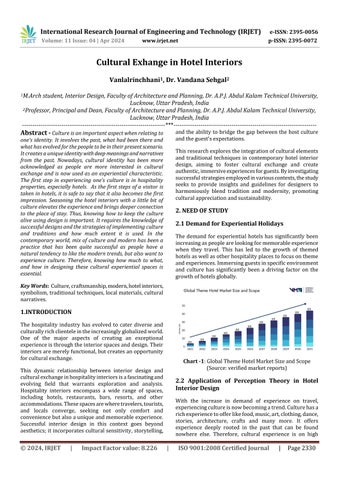
The demand for experiential hotels has significantly been increasingaspeoplearelookingformemorableexperience when they travel. This has led to the growth of themed hotelsaswellasotherhospitalityplacestofocusontheme andexperiences.Immersingguestsinspecificenvironment and culture has significantly been a driving factor on the growthofhotelsglobally.

Chart -1:GlobalThemeHotelMarketSizeandScope (Source:verifiedmarketreports)
With the increase in demand of experience on travel, experiencingcultureisnowbecomingatrend.Culturehasa richexperiencetoofferlikefood,music,art,clothing,dance, stories, architecture, crafts and many more. It offers experience deeply rooted in the past that can be found nowhere else. Therefore, cultural experience is on high
International Research Journal of Engineering and Technology (IRJET) e-ISSN: 2395-0056
Volume: 11 Issue: 04 | Apr 2024 www.irjet.net p-ISSN: 2395-0072
demandasithasstartedtobegloballyacknowledged and appreciated.
Hotelsarethebaseforanytouristsandtravellers,andthey givethefirst-handexperienceoftheplace.
Immersing these visitors in the local culture as a first experience can have a positive impact on elevating the culture and sustaining its existence. Also, in the growing demand of experience in any place, employing cultural experienceisoneofthebasicyethavingahighsuccessrate.
Thisresearchemployedaqualitativeapproach,conducting an in-depth analysis of four pictorial case studies from diverse cultural contexts: Dolkhar in Leh, Ladakh (India), HotelRiomarinIbiza(Spain),TreeofLifeResortinJaipur (India, live study), and Maison Perumal in Pondicherry (India). These case studies were selected based on their exemplaryintegrationofculturalelementsandtraditional techniquesinhotelinteriordesign.
Theanalysisfocusedontwosetsofparameters:qualitative parameters,encompassingculturalnarratives,symbolism, materials, crafts, and colors, and quantitative parameters, including flooring, ceilings, walls, upholstery, fabrics, paintings, furniture, and accessories. By examining these elements,theresearchaimedtounderstandthestrategies employedtocreateculturallyimmersiveandauthentichotel interiors.
4.1 Application of Perception Theory in Hotel Interior Design
The article highlights the consideration of the geographic environment,localculturalthemes,andtheuseofmaterials, finishes,andtechniquesinhoteldesign.
In hotel interiors, visuals can be achieved using elements such as component modeling, decoration, materials, and colors. These elements enhance visual stimulation, allow customerstoexplorethespace,andenhancethevisualand aestheticexperience.
Logicalawarenesscanbeachievedthroughassociation,use, andreasoning.Thisincludescreatingspacesthatencourage users to think about and relate to their environment. grammar:
Thearticledescribestheapplicationoftraditionalculturein interior design and emphasizes the importance of incorporatingregionalcharacteristicsandculturalelements.
First, symbols evoke a sense of familiarity and nostalgia, providing a connection to cultural roots and residents. Secondly,theuseoftraditionalcraftsmanshipandmaterials givesthespaceasenseofuniquenessandauthenticity.
Traditional cultures are often in harmony with nature. Incorporating elements such as natural materials, organic shapes, and natural light can create an atmosphere of tranquility and peace that promotes well-being. Furthermore,traditionalculturescarrydeepphilosophical andspiritualmeaningsandcreateimmersiveexperiences.
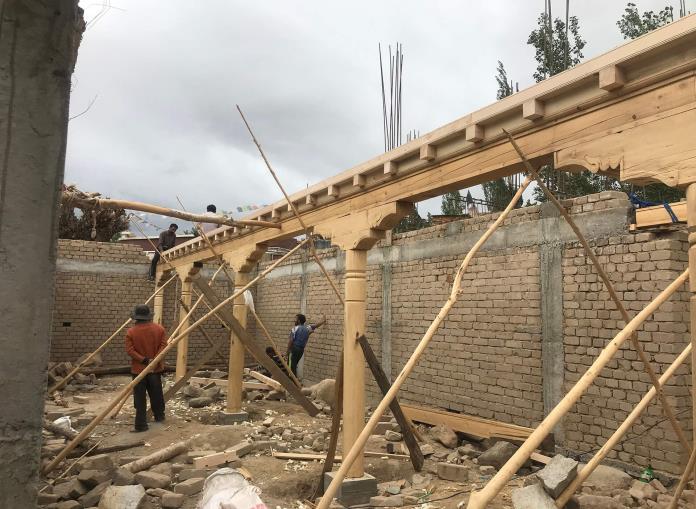
Dolkhar is a boutique hotel in Ladakh that seamlessly integratesthelocalcultureandarchitecturaltraditionsinto its design. The project extensively employed local craftspeople and materials, with the building and interior elementscraftedusingindigenoustechniques.
The hotel's design celebrates the aesthetic of Ladakhi architecture in a minimalistic and modern perspective, featuring raw textures, natural materials, and clean lines. Theinteriorspacesareadornedwithlocallywovenfabrics, intricately carved wooden lintels, and decorative arches inspiredbyTibetanarchitecturalmotifs.
While the design embraces a contemporary and minimal approach,it pays homage to the region’s cultural heritage throughtheuseoftraditionalconstructionmethods,suchas exposed wooden beams and compacted earth walls. The overallaestheticstrikesabalancebetweenmodernityand tradition, creating a unique and authentic experience for guests.
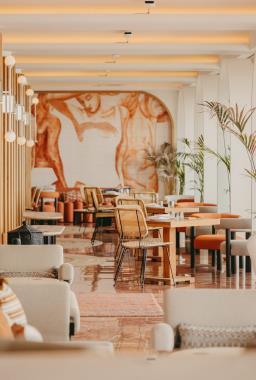
Hotel Riomar is a lifestyle boutique hotel located in the island of Ibiza, known for its vibrant nightlife and party scene. The hotel’s interior design incorporates abstract interpretationsoftraditionalSpanisharchitecturalelements, creatingasubtleculturalnarrative.
Oneofthemostprominentfeaturesistheuseofarchedwall elements, derived from Spanish architectural styles. The hotel also features mural tile walls depicting local scenes, suchaspeoplesunbathingonthebeach,addingatouchof storytellingtothedesign.
International Research Journal of Engineering and Technology (IRJET) e-ISSN: 2395-0056
Volume: 11 Issue: 04 | Apr 2024 www.irjet.net p-ISSN: 2395-0072
WhiletheoverallaestheticofHotelRiomarleanstowardsa contemporary and minimalist approach, with modern furnitureandtheincorporationofculturalelementsthrough architecturaldetailsandartworkcreatesauniquesenseof placeandconnectiontothelocalcontext.
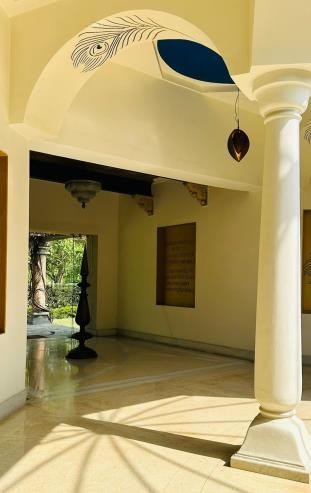
TheTreeofLifeResort,locatedontheoutskirtsofJaipur,isa prime example of integrating traditional Rajasthani crafts andmotifsintoa contemporaryluxury resort setting.The design showcases a harmonious blend of local materials, symbolism,andcraftsmanshipwithmodernaesthetics.
Theresort extensivelyincorporatestraditional motifsand symbolism,suchasinlaidfloralpatterns,peacockmotifs,and intricatestonecarvings,throughoutitsinteriorspaces.Local crafts, including bone inlay work, stone crafts, and cotton fabrics, are prominently featured, creating a sense of authenticityandculturalimmersion.
The resort’s design also pays homage to the construction process by displaying photographs of the buildings being constructed by local craftsmen, further emphasizing the importanceoftraditionaltechniques.
Maison Perumal is a heritage hotel located in the French QuarterofPondicherry,celebratedforitsseamlessblendof FrenchcolonialandTamilarchitecturalinfluences.Thehotel is housed in a restored 130-year-old Chettiar mansion, preservingthebuilding’shistoricalcharacterwhileadapting itformodernhospitalitypurposes.
Theinteriordesignreflectstheharmoniousfusionofthese twodistinctarchitecturalstyles,withteakwoodcolumnsand stained glass features representing the French colonial influence,whiletheTamilarchitectureelementsareevident intheornatewoodenfurnitureanddecorativedetails.The overall design celebrates the rich cultural heritage of Pondicherry, creating an immersive and authentic experienceforguests.
6.1
Acommonpracticeobservedacrossthecasestudieswasthe useofasingleculturalparameterasafocalelement,serving as the primary means of cultural representation. For instance,intheDolkharhotel,locallysourcedmaterialsand traditional crafts took center stage, with the building and interiorelementscraftedbylocalartisansusingindigenous techniques. Similarly, the Tree of Life Resort in Jaipur prominentlyfeaturedtraditionalmotifsandsymbolism,with inlaid floral patterns and elements like peacock motifs adorningvarioussurfaces.
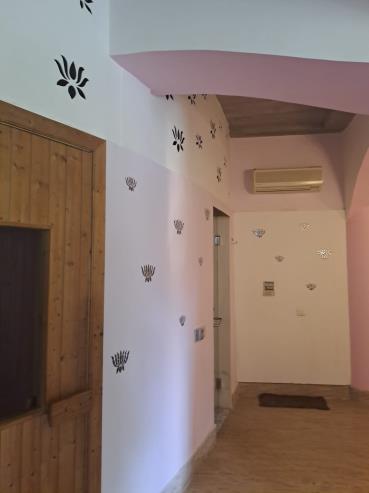
Likewise, Hotel Riomar uses a color as a primary theme which is rooted to Spanish culture. All the spaces has this colorintegratedonewayoranotherintheinteriorelements, tyingthewholeplacetogether.
International Research Journal of Engineering and Technology (IRJET) e-ISSN: 2395-0056
Volume: 11 Issue: 04 | Apr 2024 www.irjet.net p-ISSN: 2395-0072
Maison Perumal in Pondicherry showcased a harmonious blendofFrenchcolonialandTamilarchitecturalelements, with teakwood columns and stained glass features complementingthetraditionalfurniturestyles.
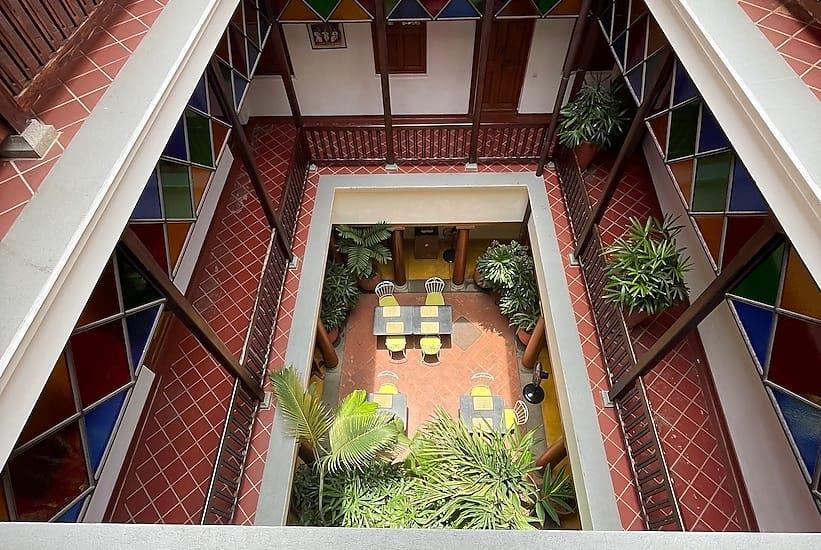
Fig -4:TeakwoodandcourtyardfromTamilarchitecture andstainedglassfromFrenchcolonialinfluenceinMaison Perumal,source:tripadvisor.
Whileasingleculturalelementactedasthefocalpoint,the case studies incorporated secondary cultural references throughotherdesignelements.TreeofLifehasmostofits materialsbeingsourcedlocallyandmadebylocalcraftsmen. HotelRiomarinIbizaincorporatedabstractinterpretations of Spanish architectural elements, such as arched wall features and mural tile walls, creating a subtle cultural narrative.MaisonPerumalhasitsfurnituremadeinalocal styleandmaterial,i.e.,darkwood
Arecurringthemeacrossthecasestudieswasthesuccessful integrationoftraditionalandcontemporarydesignelements, catering to modern sensibilities while preserving cultural authenticity.TheDolkharhotelexemplifiedthisbalanceby combiningraw,minimalisticfurnitureformswithtraditional constructiontechniquesandlocallycrafteddecorelements.
Severalcasestudiesdemonstratedthepowerofstorytelling throughdesign,usingarchitecturaldetails,photographs,and artworks to convey cultural narratives and histories. For instance,theTreeofLifeResortdisplayedphotographsof the construction process, highlighting the involvement of localcraftsmenandtheuseoftraditionaltechniques.Maison Perumal, a restored heritage property, celebrated its rich history through the preservation of architectural features and the incorporation of local artworks. Hotel Riomar
celebrates its contextual identity by adding tile mural of peoplesunbathingatbeaches.
The successful integration of cultural elements in hotel interiors required a deep understanding and sensitivity towards the local culture, traditions, and techniques. The case studies highlighted the importance of sourcing local materials,collaboratingwithlocalartisans,andrespecting cultural symbolism and narratives. By embracing these practices, the hotel interiors not only celebrated cultural heritage but also contributed to the sustainability of local communitiesandtraditionalcrafts.
Thisresearchhashighlightedthesignificanceofintegrating culturalelementsandtraditionaltechniquesinhotelinterior design as a means of fostering cultural exchange and creatingimmersiveexperiencesforguests.Byunderstanding the successful strategies employed in the case studies, designerscandevelopculturallysensitiveandsustainable approachestohospitalityinteriors.Thefindingsemphasize theimportanceofbalancingtraditionandmodernity,using focal cultural elementssupported byminor elements,and embracingstorytellingtechniquestocelebratelocalheritage. Ultimately,theintegrationofcultureinhotelinteriorshas thepotentialtopromoteculturalappreciation,supportlocal communities,andcontributetothepreservationofcultural identitiesinanincreasinglyglobalizedworld.
[1] H.Yu,G.Bai,L.Wu,ApplicationofPerceptionTheoryin HotelDesign,OpenJournalofAppliedSciences,8,285295,2018.
[2] Y. Zhang, The Application of Traditional Culture in InteriorDesign,ESSAEME2016.
[3] S.V. Maju, Z. Khan, Dolkhar: the story of creating a boutiquehotelfromLadakh'scultureandarchitecture, 23Nov.2022 https://www.stirworld.com/see-features-dolkhar-thestory-of-creating-a-boutique-hotel-from-ladakhsculture-and-architecture
[4] B.Thomas,HotelRiomaropensinSantaEulalia,Ibiza, 31 Aug. 2021, https://www.sleepermagazine.com/stories/projects/ho tel-riomar-opens-in-santa-eulalia-ibiza/
[5] https://www.lifeisoutside.com/maison-perumalpondicherry/