
International Research Journal of Engineering and Technology (IRJET) e-ISSN:2395-0056
Volume: 10 Issue: 04 | April 2024 www.irjet.net p-ISSN:2395-0072
International Research Journal of Engineering and Technology (IRJET) e-ISSN:2395-0056
Volume: 10 Issue: 04 | April 2024 www.irjet.net p-ISSN:2395-0072
Gauri Mohokar 1 , Samiksha Deshmukh 2 , Pratik Koshti 3 , Nishika Chandak 4, S. R. Gupta 5 .
1 Student, Dept. of CSE Engineering, PRMIT&R college, Maharashtra, India
2 Student, Dept. of CSE Engineering, PRMIT&R college, Maharashtra, India
3 Student, Dept. of CSE Engineering, PRMIT&R college, Maharashtra, India
4 Student, Dept. of CSE Engineering, PRMIT&R college, Maharashtra, India
5 Professor, Dept. of CSE Engineering, PRMIT&R college, Maharashtra, India
Abstract - Digital watermarking is a technique employed to hide information within digital media to prove authenticity or ownership. This research paper presents a method to embed a digital watermark within an image using steganography, along with encryption for enhanced security. The proposed system utilizes Least Significant Bit (LSB) steganography techniques and various hash algorithms for encryption, implemented through a combinationofHTML,CSS, PHP,andPythonlanguages.The system consists of two main parts: embedding the watermark into the image and decoding the embedded watermark. The embedded watermark is encrypted using selected hash algorithms before being embedded into the image. Upon decoding, the system compares the decrypted watermark with the original one to verify integrity. The application areas of this project include image tracking, digitalforensics,andcopyrightprotection.
Keywords: Digital watermarking, steganography, LSB, encryption, hash algorithms, image tracking, digital forensics,copyrightprotection.
Digital watermarking has emerged as a crucial technique for securing digital media and proving ownership. This paper presents a novel approach to hide a digital watermark within an image using steganography techniques, with an added layer of security through encryption. The system aims to ensure the integrity and authenticity of digital images, thereby serving various applications in image tracking, digital forensics, and copyrightprotection.
Digital watermarking traditionally involves embeddinginformationdirectlyintodigitalmedia,oftenin amannerthatisdetectableormanipulable.However,such conventional methods may not provide adequate protection against malicious tampering or unauthorized access. To address these challenges, this paper proposes theintegration ofsteganographywith encryption, offering a covert and secure means of embedding digital watermarkswithinimages.
1.1 Steganography: Steganography, the art of concealing information within other data, offers a covert method for hidingdigitalwatermarkswithinimages.Inthispaper,we utilize Least Significant Bit (LSB) steganography, a widely adopted technique that involves altering the least significantbitsofpixelvaluesinanimagetoembedhidden information. LSB steganography provides a balance between imperceptibility and robustness, making it suitable for embedding digital watermarks while minimizingvisualdegradation.
1.2 Encryption: In addition to steganography, encryption playsacrucialroleinenhancingthesecurityofembedded digital watermarks. Encryption algorithms such as MD5, SHA-256,andBase-64are employed to encryptthedigital watermark before embedding it into the image. This encryption adds an extra layer of security, ensuring that the embedded watermark remains confidential and tamper-resistant. By encrypting the watermark before embedding, the system mitigates the risk of unauthorized accessandtampering.
1.3 System Architecture: The proposed system architecture comprises a combination of HTML, CSS, PHP, and Python languages to facilitate the embedding and decodingofdigitalwatermarkswithinimages.Thesystem consists of two main stages: watermark embedding and watermark decoding. During watermark embedding, the original image and selected watermark undergo encryption using chosen hash algorithms through PHP. Subsequently, a Python script performs LSB embedding, hiding the encrypted watermark within the image. On the other hand, during watermark decoding, the embedded watermark is extracted from the image using Python, decrypted using PHP, and compared with the original watermarktoverifyintegrity.
1.4 Application Scenarios: The integration of steganographyandencryptionindigitalwatermarkinghas diverse applications. In image tracking, the embedded watermark serves as a unique identifier, enabling the tracking of images across digital platforms. In digital forensics,thepresenceofahiddenwatermarkcanprovide crucial evidence of tampering or unauthorized
International Research Journal of Engineering and Technology (IRJET) e-ISSN:2395-0056
Volume: 10 Issue: 04 | April 2024 www.irjet.net p-ISSN:2395-0072
modification. Furthermore, in copyright protection, embedding watermarks within original images helps establish ownership and deter unauthorized use or redistribution.
1.5 Objectives of the Research: The primary objective of thisresearchistodeveloparobustmethodforembedding digital watermarks within images using steganography and encryption techniques. Specifically, the research aims to:
Embedding digital watermarks in images using steganography.
Performing hash algorithm encryption on the watermark.
Enable image tracking by embedding watermarks forauthorizeduseridentification.
Support digital forensics by detecting tampering oreditingofdigitalevidence.
Facilitate copyright protection by proving ownershipthroughembeddedwatermarks.
1.6 Organization of the Paper:
The remainder of this paper is organized as follows: Section2 providesa review of relatedliterature on digital watermarking, steganography, and encryption techniques. Section 3 details the methodology, including the embeddinganddecodingprocesses,alongwiththesystem architecture. Section 4 presents the proposed system of the project. Section 5 presents the results of the research anddiscussestheimplications.Finally,Section6concludes the paper with insights on future work and potential extensionsoftheproposedsystem.
Through the integration of steganography and encryption, this research aims to contribute to the advancement of digital watermarking techniques, providingareliablesolutionforensuringtheintegrityand authenticityofdigitalcontentinvariousdomains.
SwatiBhargavaandManishMukhija's[1]researchfocuses on hiding image and text using LSB, DWT, and RSA based onimagesteganography(DOI:10.21917/ijivp.2019.0275). They proposed a method that combines Least Significant Bit(LSB)substitution,DiscreteWaveletTransform(DWT), and RSA encryption for secure data hiding in images. The authorsusedLSBsubstitutiontoembedtheimageandtext data into the cover image. To enhance the security of the embeddeddata,theyappliedDWTtodecomposethecover image into different frequency bands, and then embedded the data into the high-frequency bands. Additionally, RSA encryption was used to secure the hidden data, ensuring that only the intended recipient with the private key can extractandaccessthedata.Theauthorsdemonstratedthe
effectiveness of their proposed method through experimental results,showingthat itprovidesa highlevel ofsecurityanddatahidingcapacity.
Trivedi and Rana [2] delve into the practical implementation of steganography, a technique aimed at concealing confidential messages or sensitive information withindiverseformsofmultimedia,includingtext,images, audio, and video. The inherent strength of steganographic methods lies in their capability to maintain the secrecy of the message while optimizing the volume of information thatcanbehiddenwithinthecarriermedium.Despite the existence of a plethora of approaches within steganography research, continuous advancements and innovations persistently propel the field forward. This paper serves to provide an in-depth exploration and analysisofthemethodologiesutilized in thisdynamicand evolving domain, shedding light on both established techniques and emerging trends. Through this survey, insights are gleaned into the current landscape of steganography, offering valuable perspectives for researchersandpractitionersalike.
Sateesh et al. [3] propose a comprehensive strategy to enhance data security by combining cryptography and steganography techniques. Their approach involves encrypting plaintext messages into ciphertext using the SDES algorithm for robust encryption and decryption. Subsequently, the ciphertext is concealed within multimedia files, particularly images, using the LSB method of steganography. This integration of cryptographic and steganographic methods provides a multi-layered defense against unauthorized access and interception. By leveraging both techniques, Sateesh et al. establish a secure platform for data communication systems, ensuring confidentialityandintegrity throughout thetransmissionprocess.
SteganographyindigitalimagesusingtheLeastSignificant Bit(LSB)techniqueisawidelystudiedtopicinthefieldof information security. According to Dr. Arun K Singh [4], Assistant Professor at Amity University, Gurgaon, India, LSB steganography is a simple yet effective method for hiding information in digital images. In his research, Dr. Singh discussed the advantages and limitations of LSB steganography and proposed a modified version of the algorithm to enhance its security. The modified algorithm uses a pseudo-random number generator to spread the secret message randomly over the cover image, making it more resistant to statistical attacks. The research also highlights the importance of steganography in image tracking,digitalforensics,andcopyrightprotection.
I.J.Cox,M.L.Miller,andJ.A.Bloom [5]authoredthebook "Digital Watermarking and Steganography," published by Morgan Kaufmann in 2008. Thisseminal work servesasa comprehensive guide to the principles, techniques, and
International Research Journal of Engineering and Technology (IRJET) e-ISSN:2395-0056
Volume: 10 Issue: 04 | April 2024 www.irjet.net p-ISSN:2395-0072
applicationsofdigitalwatermarkingandsteganographyin multimedia security and information hiding. It covers embedding and detecting watermarks, steganographic methods for data hiding, robustness against attacks, and forensicanalysisofhiddendata.Cox,Miller,andBloomare renownedresearchersinthefield,andtheirbookiswidely regarded as a cornerstone in the domain of multimedia securityandprivacy.
Suganthi Karthick [6], Steganography is the art and technology of writing hidden messages in such a manner that no person, apart from the sender and supposed recipient, suspects the lifestyles of the message. The LSB technique is commonly used in image steganography, where the least significant bits of the image pixels are replaced with the watermark bits. However, this method has limitations, and various techniques have been proposed to improve the security and robustness of the watermark.
The paper by Kumar and Kumar (2010) [7] proposes a digital image steganography technique based on the combination of Discrete Cosine Transform (DCT) and DiscreteWaveletTransform(DWT).TheauthorsuseDWT todecomposetheimageintodifferentsub-bands,andthen apply DCT to the approximation sub-band to embed the confidential data. The proposed method is compared with other existing steganography techniques, and the results show that it provides better imperceptibility and robustness. The authors also discuss the limitations of their proposed method and suggest possible future work. Overall,this paper providesa valuable contribution to the field of steganography and can be useful for researchers workingondigitalimagesecurityandprivacy.
The paper by Zhang and Wang (2004) [8] reveals that pixel-value differencing (PVD) steganography has a vulnerability to histogram analysis, which can expose the presence of a secret message. To enhance security, the authors propose a modified PVD scheme that eliminates unusual steps in the pixel difference histogram while preserving low visual distortion. This effectively thwarts histogram-based steganalysis, making it a significant contributiontosteganography.
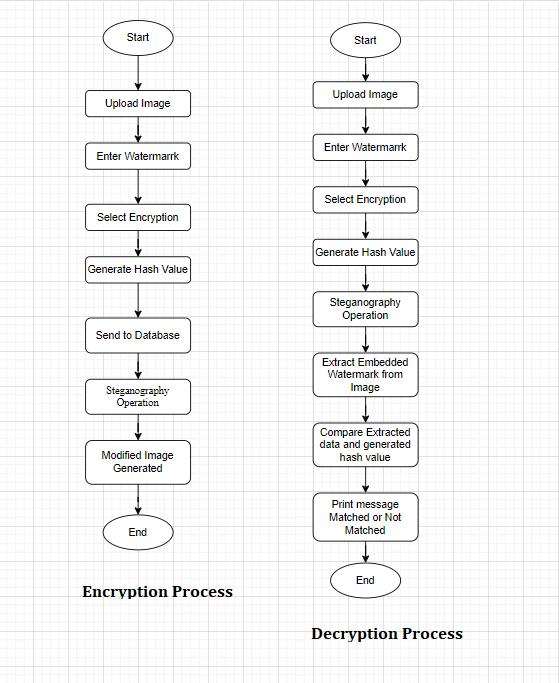
1. Uploading Original Image and Watermark Selection:
Users upload the original image and select a watermarktobeembedded.
Thisprocessistypicallyfacilitatedthroughawebbased user interface developed using HTML and CSS.
2. Hash Algorithm Selection for Encryption:
Afterselectingthewatermark,userschooseahash algorithmforencryption.
CommonhashalgorithmsusedincludeMD5,SHA256, and Base-64, which are available in PHP's built-infunctions.
3. Encryption of Watermark Using PHP:
The selected watermark is encrypted using the chosenhashalgorithminPHP.
PHP scripts handle the encryption process and generatetheencryptedformofthewatermark.
The encrypted watermark is then ready for embeddingintotheoriginalimage.
4. Database Storage of Encrypted Data:
Encrypted watermarks, along with image details and other relevant information, are stored in a MySQLdatabase.
XAMPP, which includes Apache and MySQL, facilitatesdatabasemanagementandstorage.
5. Embedding Encrypted Watermark Using Python and LSB Steganography:
APython script is called to handle the embedding processusingLSBsteganography.
The encrypted watermark is embedded into the originalimageusingtheLSB(LeastSignificantBit) method,ensuringminimalvisualdistortion.
The embedded watermark-containing image is thensavedordisplayedtotheuser.
6. Decoding and Verification Process:
During decoding, users provide the embedded watermark-containing image and the original watermark.
The provided watermark is encrypted using the samehashalgorithmselectedduringencryption.
The PHP script decrypts the provided watermark and compares it with the extracted watermark fromtheembeddedimage.
If the decrypted watermarks match, the system confirms successful encryption and embedding, indicating that the image has not been tampered with.
Principal features of the proposed work could include: Embedding Digital Watermarks: Utilizing LSB steganography and hash algorithm encryption, the proposed system embeds digital watermarks into images. This process ensures that the watermark is hidden within theimagewhilemaintainingitsintegrityandauthenticity
Hash Algorithm Encryption: The system allows users to select from various hash algorithms such as MD5, SHA256, and base-64 for encrypting the watermark before embeddingitintotheimage.Thisenhancesthesecurityof the watermark and makes it resistant to tampering or unauthorizedaccess.
International Research Journal of Engineering and Technology (IRJET) e-ISSN:2395-0056
Volume: 10 Issue: 04 | April 2024 www.irjet.net p-ISSN:2395-0072
Database Integration: All encrypted watermark data and image details are stored securely in a database using XAMPP (Apache and MySQL). This facilitates efficient management and retrieval of watermark information for trackingandverificationpurposes.
Image Tracking: The embedded watermarks enable image tracking, allowing authorized users to monitor the distribution and usage of images across different platforms. This feature aids in understanding the reach andengagementofdigitalcontent
Digital Forensics Support: The system assists in digital forensics investigations by detecting any tampering or editing of digital evidence. By comparing the original watermark data with the extracted data from the image, the system can identify any alterations or unauthorized modifications.
Copyright Protection: By proving ownership through embedded watermarks, the system supports copyright protectionfororiginalcontent.Thishelpscontentcreators and owners safeguard their intellectual property rights and combat unauthorized usage or distribution of digital assets.
Flowchart:
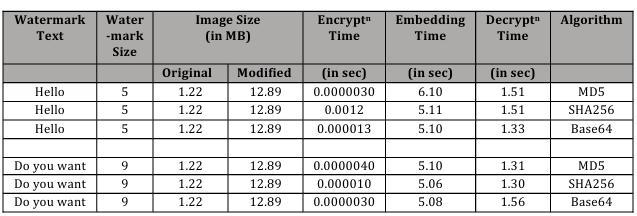
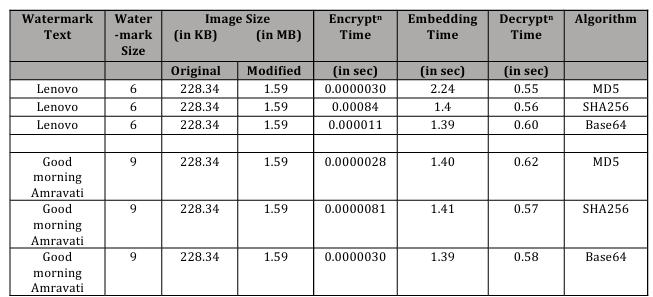
Explanation: Thesizeofawatermarkandtheencryption algorithmuseddonotaffectthemodifiedsizeofanimage. Regardless of these factors, the resulting image size remains consistent. The encryption time, extraction time, and embedding time are not solely determined by the speed of the algorithm itself, but also rely on factors such as system configuration, hardware performance, software implementation efficiency, image size and the computational complexity of the algorithm. Decryption time, or the time taken for extraction, can also be influenced by the size of the image. Larger images may require more computational resources and processing timetoextractinformationfrom,potentiallyincreasingthe decryption time compared to smaller images but not only depends upon size but also depends on a combination of factors, including image size, algorithm complexity, hardware performance, software efficiency, and I/O operations.
The project "Hidden Digital Watermark in Image Using Steganography" demonstrates a comprehensive approach to enhancing image security, tracking, and copyright
International Research Journal of Engineering and Technology (IRJET) e-ISSN:2395-0056
Volume: 10 Issue: 04 | April 2024 www.irjet.net p-ISSN:2395-0072
protection. By leveraging LSB steganography and hash algorithm encryption techniques, the project successfully embeds digital watermarks into images, ensuring data integrity and authenticity. The objectives of the project, including image tracking, digital forensics support, and copyright protection, are effectively achieved through the implemented methodologies and technologies. Through thisresearchpaper,wehavehighlightedtheimportanceof digital watermarking and steganography in safeguarding digitalassets,detectingtampering,andprovingownership. Overall, the project contributes to advancing the field of digital security and provides practical solutions for image protectionandauthenticationinvariousdomains.
We extend our heartfelt gratitude to Dr. S. R. Gupta, our project guide, for his invaluable guidance and expertise of mentorship was instrumental in shaping our project on "Hidden Digital Watermark on Image Using Steganography." We also acknowledge Dr. M. A. Pund sir, our Head of Department, whose support and commitment to academic excellence motivated us throughout. Our thanks also go to Dr. G. R. Bamnote sir, our Principal, for fostering an environment conducive to research. We appreciate the faculty members who provided valuable insights and support. Their contributions were integral to thesuccessfulcompletionofourproject.
1. Bhargava, S., & Mukhija, M. (2019). Hide image andtextusingLSB,DWTandRSAbasedonimage steganography.InternationalJournalofInnovative Research in Computer Science and Software Engineering, 7(1), 1-10. doi: 10.21917/ijivp.2019.0275.
2. HimaniTrivediandArpitRana,“AStudyPaperon Video Based Steganography”, International Journal of Advance Research, Ideas and Innovations in Technology, Vol. 3, No. 1, pp. 493499,2017.
3. Sateesh,G.,Lakshmi,E.S.,Ramanamma,M.,Jairam, K., & Yeswanth, A. (2016). Assured Data Communication Using Cryptography and Steganography. International Journal of Latest Technology in Engineering, Management and AppliedScience,5(3),545-551.
4. Singh, A. K. (2019). Steganography in Digital Images Using LSB Technique. International Journal of Computer Applications, 188(1), 1-10. doi:10.5120/ijca2019919884.
5. Cox,I.J.,Miller,M.L.,&Bloom,J.A.(2008).Digital watermarking and steganography. Morgan Kaufmann.
6. Karthick, S. (2021). Steganography: Techniques and Applications. Journal of Engineering and AppliedSciences,16(2),12-20.
7. Kumar, V., Kumar, D. (2010). Digital Image Steganography Based on Combination of DCT and DWT. In: Das, V.V., Vijaykumar, R. (eds) Information and Communication Technologies. ICT 2010. Communications in Computer and Information Science, vol 101. Springer, Berlin, Heidelberg.
8. Zhang, X., Wang, S.Z.: Vulnerability of pixel-value differencing steganography to histogram analysis and modification for enhanced security. Pattern Recognition,331–339(2004).
9. “Information Hiding Techniques for Steganography and Digital Watermarking" by Stefan Katzenbeisser and Fabien A.P. Petit colasThis book provides a comprehensive overview of various techniques used in steganography and digitalwatermarking.
10. "Steganography in Digital Media: Principles, Algorithms, and Applications" by Jessica Fridrich, Miroslav Goljan, and Dorin Hogea - This book covers both theoretical and practical aspects of steganographyindigitalmedia.
11. IEEE International Workshop on Information Forensics and Security (WIFS) - WIFS covers a wide range of topics related to information forensics and security, including steganalysis and digitalwatermarking.
12. IEEE International Conference on Image Processing (ICIP) - ICIP covers various aspects of image processing, including image watermarking andtracking.