
International Research Journal of Engineering and Technology (IRJET) e-ISSN: 2395-0056 p-ISSN: 2395-0072
Volume: 11 Issue: 04 | Apr 2024 www.irjet.net
International Research Journal of Engineering and Technology (IRJET) e-ISSN: 2395-0056 p-ISSN: 2395-0072
Volume: 11 Issue: 04 | Apr 2024 www.irjet.net
Sankalp Sambhus1 , Aditya Wani2 , Prathamesh Shinde3 , Hrushikesh B. Kulkarni4
1-4
School of Mechatronics Engineering, Symbiosis Skills and Professional University, Kiwale, Pune
Abstract - In today's dynamic manufacturing landscape, optimizing line feeding processes is crucial for ensuring operational efficiency and cost-effectiveness. This paper presents a comprehensive exploration of how the integration of Electronic KANBAN (E-KANBAN) with QR code technology and Excel automation can significantly enhance line feeding efficiency. The methodologyinvolvesleveragingaGoogleForm to scan QR codes, each containing 11-digit encoded data specifying precise line locations. Additionally, an encoding process appends initial part numbers to these QR codes, enabling seamless real-time data entry into Excel sheets. Through the utilization of VLOOKUP formulae within Excel, the system efficiently retrieves part store locations, thereby optimizing the retrieval process. The digitallygeneratedExcel sheets are then distributed to handlers responsible for overseeing part delivery to production lines, ensuring adherence to Production and Feeder Point (PFEP) guidelines. By conducting meticulous case studies, this paper demonstrates tangible improvementsinlead timesandoverall operational efficiency, providing manufacturers with actionable insights for fostering lean, agile, and responsive operations. Ultimately, these enhancements contribute to bolstering competitiveness and augmenting customer satisfaction within the manufacturing domain.
Key Words: Manufacturing optimization, E-KANBAN, QR code technology, Excel automation, Google Forms.
In the rapidly evolving landscape of modern manufacturing, the efficient management of linefeeding processesemergesasafundamentalpillar,criticalnotonly for bolstering productivity but also forensuring effective cost management and customer satisfaction. Across a spectrum of industries, spanning from automotive to electronics, the seamless delivery of components to production lines holds paramount importance for sustaining operations and meeting the ever-shifting demandsofconsumers.However,
conventionalmethodsof line feeding grapple with formidable obstacles, encompassing delays, errors, and inefficient resource allocation. These challenges underscore an urgent call for pioneering solutions capable of revolutionizing line feeding operations, thereby optimizing efficiency, responsiveness, and cost-effectiveness.
Respondingtothisurgentmandate,thisresearchembarks on a transformative journey aimed at redefining line feeding efficiency within the realm of manufacturing. Through the integration of Electronic KANBAN (EKANBAN) with cutting-edge QR code technology and the adaptable functionalities of Excel automation, this study unveils a paradigm shift in inventory management and material flow control. Theconvergenceoftheseinnovative technologiespromisestotranscendthelimitationsinherent in traditional methods, endowing manufacturers with unparalleledlevels of visibility, control, andadaptabilityin theirlinefeedingprocesses.
At the core of this integrated approach lies the conceptof Electronic KANBAN, representing a digital evolutionof the esteemed leanmanufacturing principle. Byharnessingthe capabilities of digital platforms and automated data capture, E-KANBAN facilitates real- time monitoring and management of inventory levels, thereby streamlining replenishmentprocessesandcurbingwastage.Augmented byQRcodetechnology,whichfurnishesastandardizedand machine-readable format for data encoding, and Excel automation, which empowers users with robust data managementandanalysiscapabilities,thiscohesivesystem promises to revolutionize the modus operandi of manufacturersinapproachinglinefeedingtasks.
Through a comprehensive exploration, our research endeavorstoilluminatetheintricaciesofimplementingand harnessing the potential of E-KANBAN integratedwith QR codetechnologyandExcelautomation.By delvingintothe practicalities, challenges, and tangible benefits of this integratedapproach, weaimto equip manufacturers with actionableinsightsandempirical
evidencetonavigatetheir journey toward heightened operational efficiency and competitive prowess. Embracing the opportunities afforded by emerging technologies, we envision a future where line feeding operations serve not merely as operational necessities but as strategic assets driving continuous improvement and innovation across manufacturingenterprises.
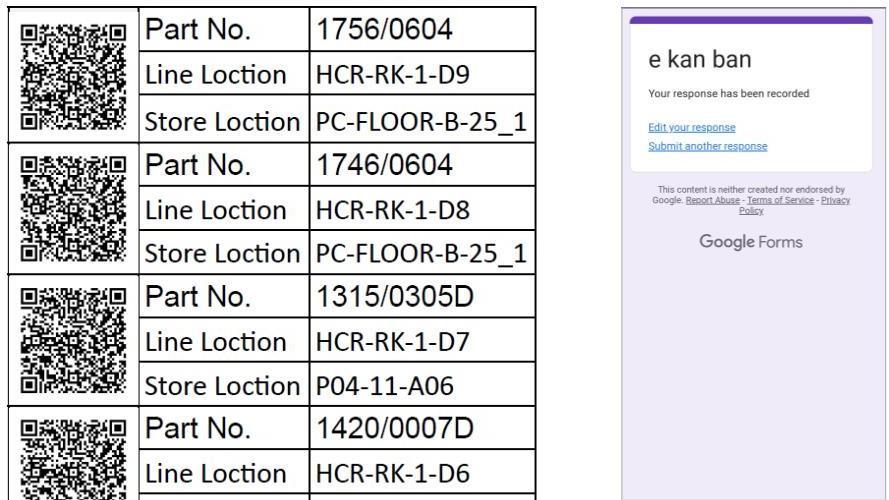
This research paper introduces a comprehensive methodology aimed at establishing an efficient inventory managementsystembyseamlesslyintegratingExcel,Google Forms, and QR codes. The materials utilized in this study include Excel spreadsheets, Google Forms, and QR code generationsoftware.Excelservesastheprimarytoolfordata managementandanalysis,providingacentralizedrepository for inputting relevant data such as part numbers and line locations. Google Forms, a user-friendly platform for data collection,is employed tocaptureadditional detailsabout each part, such as quantities, timestamps, and relevant comments, facilitating real-time data acquisition and inventorytracking.QRcodegenerationsoftwareisutilizedto generateuniqueQRcodesforeachpartbasedontheinput data.These QRcodesserve asdigital identifiers, encoding criticalinformationsuchaspartnumbersanddescriptionsin aconciseandmachine-readableformat,ensuringaconsistent andsystematicapproachtopartidentificationandtracking.
The methodology involves several sequential steps to establish the proposed inventory management system. Initially, relevant data, including part numbers and line locations,isinputtedintoanExcelspreadsheet.Sophisticated formulas and functions within Excel are then applied to generatedistinctQRcodesforeachpart,encodingessential information for efficient identification and tracking. Subsequently, the generated QR codes are seamlessly integratedintoGoogleForms,allowingstakeholderstoinput additional details about each part in real-time. By leveraging QR codes, stakeholders can efficiently scan and update inventory information using mobile devices or barcode scanners,therebyminimizingmanualdataentryerrorsand enhancingoveralldataaccuracyandreliability.Furthermore, filtering options within Excel enable efficient retrieval of parts based on line and part center locations, optimizing operationalefficiencyandreducingdowntime.
Additionally, to ensure the seamless integration and functionalityoftheproposedinventorymanagementsystem, rigoroustestingandvalidationprocedureswereconducted. Thisinvolvedsimulatingvariousscenariosandusecasesto assess the system's performance under different conditions. Any identified issues or discrepancies were addressed throughiterativerefinementofthesystemcomponentsand processes.Moreover,extensivetrainingandsupport were provided to stakeholders to ensure their proficiency in utilizing the system effectively. By prioritizing robust testing and user training, the implementation of the integrated methodologywasexecutedwithprecision,ultimatelyleading tothesuccessfulestablishmentofanefficientandresponsive inventory management system within the manufacturing environment.
2395-0072
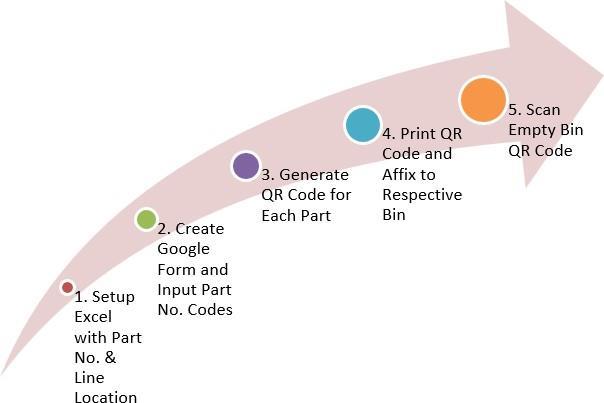
Overall,thisintegratedapproachoffersapracticalandcosteffective solution for establishing an efficient inventory management system within manufacturing environments. Through the utilization of modern tools and technologies, suchasExcel,GoogleForms,andQRcodes,manufacturers can enhance their inventory control processes, minimize disruptions, and ultimately improve overall productivity and profitability.
Our E-KANBAN implementation offers valuable insights into inventory management and line feeding dynamics. By recordingtimestampsmeticulously,thesystemprovidesa comprehensiveoverviewofpartcall-offs,enablingdetailed analysisofmaterialrequisitions.Thischronologicalrecord helpsmonitormaterialdemandsandidentifybottlenecksor inefficienciesintheorderingprocess,enhancingoperational efficiency.
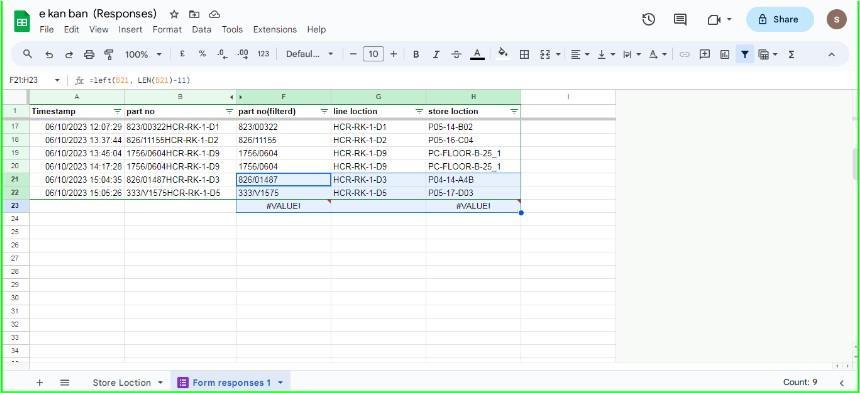
Furthermore, the E-KANBAN system's ability to capture detailedpartstorelocationshasoptimizedmaterialhandling processes.Byprovidingreal-timedataonpartwhereabouts, itrevolutionizesinventorymanagement,reducingtimeand
International Research Journal of Engineering and Technology (IRJET) e-ISSN: 2395-0056 p-ISSN: 2395-0072
Volume: 11 Issue: 04 | Apr 2024 www.irjet.net
resourcesspentonsearchingforcomponents.Eliminating manual tracking and guesswork, the system streamlines inventory replenishment, enhancing productivity and minimizingdisruptions.
Additionally, data on line locations offers precise insights into consumption points along the assembly line. This granularityenablesprecisecoordinationbetweenmaterial supplyandproductiondemand,ensuringtimelydeliveryand minimizing delays. Seamlessly integrating different productionstages,theE-KANBANsystemfostersefficiency andreduceswaste.
These findings highlight how the E-KANBAN system has significantly improved our manufacturing operations. It boostsefficiency,minimizeswaste,andlaysthegroundwork for continuous improvement. By providing real-time insights, it helps us spot optimization opportunities and adapttomarketchangesswiftly.Thisadaptabilityiscrucial forstayingcompetitive.Overall,integratingtheE-KANBAN system ensures our sustained excellence andfuture growth.
Whileourcurrentstudyhasprovidedvaluableinsightsinto theimplementationandimpactoftheE-KANBANsystemon inventorymanagementandlinefeedingprocesses,several avenues for future research warrant exploration. Firstly, furtherinvestigationintothelong-termeffectsofE-KANBAN adoptiononorganizationalperformancemetricssuchascost savings, throughput, and customer satisfaction would be beneficial. For instance, a comparative case study examining the outcomes of E-KANBAN implementation in different manufacturing environments, such as the automotive industry,coulddrawfromtheexampleofToyota'ssuccessful application of Kanban principles in its production system. Similarly,astudyexploringthescalabilityoftheE-KANBAN system across different manufacturing contexts and industriescouldlooktoexamplessuchasFlexLtd(formerly Flextronics),whichhaseffectivelyimplementedE-KANBAN solutions across its global network of manufacturing facilities. Furthermore, investigating the integration of
advanced technologies such as artificial intelligence and machine learning algorithms into the E-KANBAN framework couldbenefitfromcasestudieslikeSiemensAG,whereAIdrivenpredictiveanalyticshavebeenleveragedtooptimize inventorymanagementandproductionplanningprocesses. Moreover,comparativestudiesevaluatingtheefficacyofEKANBANsystemsagainsttraditionalKanbanapproachesor other inventory management methodologies could draw on case studies such as those conducted by General Electric, whichhasevaluatedtheperformanceofvariousinventory management systems across its diverse portfolio of manufacturing operations. By addressing these areas in future research endeavors and drawing on relevant case studies, we can continue to advance the field of manufacturing operations management and drive continuousimprovementinsupplychainpractices.
Inconclusion,theimplementationof ourKANBAN system has yielded significant findings that have reshaped our approach to inventory management and line feeding practices.Throughmeticulousutilizationoftimestampsto track call-off times and the integration of comprehensive knowledge regarding part store locations, our system has provided us with invaluable insights into streamlining replenishmentprocesses.Theseinsightsnotonlyfacilitate the timely delivery of parts, minimizing downtime and enhancing operational efficiency but also offer a deeper understandingofourmanufacturingoperations.
FindingsfromourKANBANsystemimplementationreveal that our enhanced visibility into line locations has empowered us to optimize workflows and mitigate waste effectively. By ensuring timely part delivery and reducing operational disruptions, we have been able to bolster productivitylevelswithinourmanufacturingenvironment significantly.
Furthermore,thestrategicinsightsgainedfromourKANBAN system have bolstered our competitiveness within the industrylandscape.Aswecontinue torefineandleverage our system, we are well-positioned to drive continuous improvements that propel our organization towards sustainedsuccessandprominenceinthemarketplace.
These findings underscore the transformative impact of embracing innovative technologies like E-KANBAN, not only as operational tools but also as strategic assets driving ongoing improvement and innovation across manufacturing enterprises.Byremainingdedicatedtoleveragingemerging technologiesandrefiningourprocesses,wearecommitted to maintaining our position as leaders in operational excellence and driving continuous innovation in the manufacturing sector, ensuring sustained growth and competitiveness.
International Research Journal of Engineering and Technology (IRJET) e-ISSN: 2395-0056 p-ISSN: 2395-0072
Volume: 11 Issue: 04 | Apr 2024 www.irjet.net
Weextendheartfeltgratitudetothosewhosecontributions andsupportwerevitalinrealizingthisresearchon"Efficient Line Feeding via E-KANBAN." Foremost, we deeply appreciateDr.HrushikeshB.Kulkarni,ouresteemedguide, whose mentorship and unwavering support have been foundational. His expertise and encouragement have inspired excellence in our academic pursuits. We also thank our research team for their collaborative efforts and commitment to conducting empirical investigations and analyzingdata.Theiruniqueskillsandinsightsenrichedour study. We acknowledge Symbiosis Skills and Professional Universityfor providing resources andfostering aconducive researchenvironment.Additionally,weappreciateallwho offered assistance and feedback, refining our ideas and methodology. Lastly, we express gratitude to our families andfriendsfortheirconstantsupportandencouragement. Theirbeliefinourabilitieshasbeenasourceofmotivation throughoutthisjourney.
Zhang,C.,&Lu,Y.(2015).ResearchonE-KANBAN technology in supply chain management. In 2015 InternationalConferenceonLogistics,Informatics andServiceSciences(LISS)(pp.1-4).IEEE.
Tan, X., & Chen, L. (2013). Research on electronic KANBAN and its application in inventory management.In2013InternationalConferenceon Management Science & Engineering 20th Annual ConferenceProceedings(pp.1017-1021).IEEE.
Hopp,W.J.,&VanOyen,M.P.(2004).Supplychain physics:usingphysics-basedanalyticstoconstruct empirical supply chain theory. Production and OperationsManagement,13(3),313-322.
Nguyen, L., Sridharan, U., & Bentz, E. (2015). Development of a just-in-time inventory control modelusingRFIDtechnology.JournalofIndustrial EngineeringandManagement,8(4),1387-1403.
Shimizu, Y., & Kajihara, K. (2011). Study on the improvementofsupplychainmanagementbythe introduction of electronic kanban systems. Procedia-SocialandBehavioralSciences,25,54-69.
Hu, X., Liu, Z., & Wang, J. (2010). Modeling and optimization of kanban system in supply chain management with cloud manufacturing. In 2010 International Conference on E-Business and EGovernment(Vol.2,pp.195-198).IEEE.
Kim, J. K., Kim, Y. B., & Lee, H. H. (2014). Development of the smart kanban system for implementingleanproduction.ProcediaCIRP,17, 318-323.
Zhong, Y. F., Huang, G. Q., Fan, K. Q., & Zhao, P. (2008). On the development of web-based electronic Kanban (eKanban) system forpull-based
supplychainmanagement.InternationalJournalof ProductionResearch,46(3),667-693.
Jiménez,J.F.R.,&Romero,D.(2015).Anontologybased decision support system for selecting lean tools in supply chain design. Expert Systems with Applications,42(3),1600-1613.
Yu, J., Han, S., Kim, Y. D., & Lee, K. (2008). Implementation of a real-time RFID-based manufacturingexecutionsysteminaTFT-LCDfab. RoboticsandComputer-IntegratedManufacturing, 24(3),391-398.




Sankalp Santosh Sambhus, a final year B. Tech student in Mechatronics Engineering at Symbiosis Skills and Professional University
AdityaSantoshWani,afinalyearB Tech student in Mechatronics Engineering at Symbiosis Skills andProfessionalUniversity
Prathamesh Shailesh Shinde, a final year B. Tech student in Mechatronics Engineering at Symbiosis Skills and Professional University
Dr Hrushikesh B. Kulkarni holds 15 years of experience in Academics and Research. He has published more than 50 research papers, 2 book chapters having international reputeand received more than 400 citations He has participated in more than 20 facultydevelopmentprogramand online courses conducted by NPTEL/ATAL/AICTE/Udemy.Heis reviewer of many SCOPUS/UGC indexedjournal.Heislifemember of many professional bodies like ISRD (UK), IAE (Hong Kong), ISAMPE (India) and IFERP Association (India) His area of interestisinthefieldofDesignand developmentofrenewableenergy systems, thermal systems, nanomaterials, polymer composites, mechatronics systems etc.