
International Research Journal of Engineering and Technology (IRJET) e-ISSN: 2395-0056
Volume: 11 Issue: 04 | Apr 2024 www.irjet.net p-ISSN: 2395-0072
International Research Journal of Engineering and Technology (IRJET) e-ISSN: 2395-0056
Volume: 11 Issue: 04 | Apr 2024 www.irjet.net p-ISSN: 2395-0072
Deepika Singh NS1 , Likitha DP2 , Manasa M3, Tejaswini MR4, Mrs. Padmaja K5
1,2,3,4BE, Information Science and Engineering, GSSS Institute of Engineering and Technology for Women-Mysuru, Karnataka, India
5 Associate Professor, Dept. of Information Science and Engineering, GSSS Institute of Engineering and Technology for Women-Mysuru, Karnataka, India
Abstract - This project presents an innovative approach to tomato(biologicalname:Solanumlycopersicum)planthealth monitoring,leveragingasynergyofimageprocessing,IoT,and cloudtechnologies.ThesystemcentersaroundaRaspberryPi equipped with a webcam and a DHT11 temperature sensor, enabling users to capture crucial leaf images and environmentaldata. Through secure transmission to a cloudbased infrastructure, the collected data undergoes comprehensiveanalysis.Initialimagepre-processingenhances the quality of leaf images, followed by feature extraction and classification usinga VGG19 deep learningmodel. The system adeptly identifies potential diseases affecting tomato plants, providing users with actionable insights. A unique feature of this project is its closed-loop functionality, as feedback, including disease classification and recommended pesticide options, is seamlessly relayed back to users via the Raspberry Pi. The cloud infrastructure, designed for scalability and reliability, ensures efficient data processing and model execution. By offering an accessible interface for farmers to monitor and address tomato plant health, this system contributes to improved crop management practices. The project's holistic integration of cutting-edge technologies is poised to empower agricultural stakeholders with timely, accurate, and actionable information, ultimately fostering sustainable farming practices and enhancing tomato crop yield
Key Words: IoT, Cloud technologies, Raspberry Pi, DHT11 temperature sensor, Data analysis, Image preprocessing, Feature extraction, VGG19 deep learning model
In most African and Asian nations, agriculture has historicallybeenthemainsourceofwealth.Theextensive commercializationofagriculturehashadaprofoundeffect ontheenvironment.Identifyingplantdiseasesisoneofthe mosturgentproblemsrelatedtoagriculture.Earlydisease identificationhelpsstoptheillnessfromspreadingtoother plants,whichcouldcausesignificantfinanciallosses.Plant diseases can have a wide range of effects, from mild symptomstothecompletelossofplantations,whichhasa bigeffectontheagriculturaleconomy.
This project addresses the pressing need for efficient and proactivemonitoringoftomatoplanthealthinagricultural settings. With the increasing challenges posed by plant diseases and the imperative to enhance crop yield, a comprehensive solution integrating cutting-edge technologies is proposed. The central components of the systemincludeaRaspberryPiequippedwithawebcamand a DHT11 temperature sensor, providing a user-friendly platformforcapturingvitalleafimagesandenvironmental data.LeveragingtheInternetofThings(IoT),thecollected information is securely transmitted to a cloud-based infrastructure, where a robust pipeline involving image processing and deep learning unfolds. The project's innovation lies in its utilization of a VGG19 deep learning model for disease classification, ensuring accurate and reliableidentificationofpotentialailmentsaffectingtomato plants. This integrated approach fosters a closed-loop system, as insights derived from the analysis, including diseasecategorizationandrecommendedpesticideoptions, are promptly communicated back to users through the Raspberry Pi interface. By seamlessly merging IoT, image processing, and cloud computing, this project aims to empower farmers with timely, actionable information to make informed decisions about crop management. The overarching goal is to contribute to sustainable farming practices and optimize tomato crop yield in the face of evolvingagriculturalchallenges.
Givenadatasetoftomatoleafimages,thetaskistodevelopa machine learning model that can accurately classify the imagesintodifferentdiseasecategories.Thegoalistohelp farmersquicklyidentifyand treatdiseased tomato plants, therebyimprovingcropyieldandreducinglosses
The proposed system builds upon the foundation of the existingframeworkaimingtofurtherenhanceitscapabilities and usability. It focuses on refining the image processing algorithmstoimprovediseasedetectionaccuracy,exploring additional IoT sensors for capturing more comprehensive environmentaldata,andoptimizingthecloudinfrastructure for scalability and efficiency this will incorporates a
International Research Journal of Engineering and Technology (IRJET) e-ISSN: 2395-0056
Volume: 11 Issue: 04 | Apr 2024 www.irjet.net p-ISSN: 2395-0072
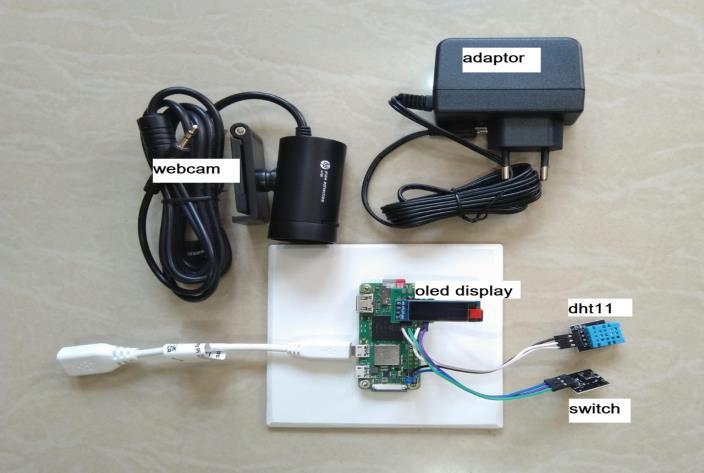
sophisticatedapproachtotomatoleafdiseasedetectionand remedy, leveraging image processing, IoT, and cloud computing. It utilizes a Raspberry Pi equipped with a webcam and a DHT11 temperature sensor to capture leaf images and environmental data, which are then securely transmitted to a cloud-based infrastructure. Through comprehensiveanalysisusingaVGG19deeplearningmodel, potential diseases affecting tomato plants are accurately identified, and actionable insights, including disease classification and recommended pesticide options, are relayed back to users via the Raspberry Pi interface. This closed-loop system ensures timely and effective management of tomato plant health, contributing to sustainablefarmingpracticesandenhancedcropyield.
Thesysteminitiateswiththeactivationtrigger,leadingto thewebcamcapturinganimageoftheplantleaf.Thisimage data is seamlessly transmitted to the cloud through NodeMCU, establishing a crucial connection for further
processing. In the cloud, a specialized VGG19 model processesthecapturedimagetoidentifypotentialdiseases affectingtheplant.Upondiseaseidentification,thesystem seamlessly suggests appropriate remedies based on a comprehensive database. The remedy suggestions aim to assist users in effectively addressing and mitigating the identified plant diseases. Users can provide feedback, creating a valuable loop for system improvement and enhancingaccuracyovertime. Thisautomatedplanthealth monitoring system integrates image capture, cloud computing,andmachinelearningtoofferacomprehensive solution for plant disease identification and remedy suggestions. The feedback loop ensures continuous refinement, making the system adaptive and efficient in safeguardingplanthealth.Theprocessconcludes,providing userswithactionableinsightsformaintainingthewell-being oftheirplants.
K.DeviPriyankaapproachedadevelopmentofplantdisease recognitionmodel,basedonleafimageclassification,using deepnetworks.Novelwayoftrainingandthemethodology usedfacilitatea quick and easysystemimplementation in practice.Thedevelopedmodelcanrecognizedifferenttypes of plant diseases out of healthy leaves, with an ability to distinguishplantleavesfromtheirsurroundings.Beginning with acquiring photographs to build a database that is reviewedbyagriculturalprofessionals[1].
Laeeq Sana contributed the field by offering a practical solutionforautomatingthedetectionoftomatoleafdiseases, leading to enhanced disease management and more sustainable agricultural practices. The results underscore the potential of modern technology to revolutionize crop healthmonitoringandensurefoodsecurity[2].
Akshay Misal provided an overview of the use of deep learninginplantprotection,specificallyintheidentification of crop leaf diseases. By applying deep learning to plant disease identification, it can provide more objective and efficient extraction of disease characteristics and improve research efficiency and technology transformation. our research aims to summarize recent advances in deep learningresearchrelatedtocropleafdiseaseidentification, highlightingcurrenttrendsandchallengesinthisarea,and servingasausefulresourceforresearchersstudyingplant pestdetection.WeareusingCNNalgorithmwhichprovided 97%accuracytodetectdisease[3].
AnmolSinhadiscussedanumberofmethodsforidentifying and categorizing plant diseases using image processing, includingtheextractionoftexture-basedfeatures,machine learning algorithms, convolutional neural networks, and deep learning-based methods. These methods produce accuratefindingsinthedetectionandclassificationofmany plantleafdiseases.Theproposedmethods'accuracyvaries
International Research Journal of Engineering and Technology (IRJET) e-ISSN: 2395-0056
Volume: 11 Issue: 04 | Apr 2024 www.irjet.net p-ISSN: 2395-0072
depending on the disease type, dataset, and experimental designused.Byincreasingcropproductivityandlowering theusageofdangerouspesticides,thesemethodshavethe potential to completely transform the agricultural sector. Theissueswithimagequality,lighting,andtheintricacyof plantdiseasesymptoms,however,stillneedtobeaddressed throughadditionalresearch[4].
VenkateshShankar presentedamethodtodetecttheplant disease using machine learning under which using CNN algorithm can be found. The main focus is to develop a diseasedetectionsystemforfindingthedisease.Therefore under CNN algorithm this paper have basically used MobileNet Architecture. Few parameters have been considered inorder to find the result. This paper have considered 38 different leaves to find the disease. By capturingtheimageandbyextractingthefeaturesofitwe get the disease. In this papers results shows the better accuracythantheotherpapers[5].
Jayashree Pasalkar presented an efficient approach to identifyhealthyanddiseasedorinfectedleavesusingimage processing and machine learning techniques. Various diseasesdamageleafchlorophyllandcausebrownorblack spotsontheleafsurface.Thesecanbedetectedusingimage preprocessing,imagesegmentation,featureextraction,and classification using machine learning algorithms. A convolutionalneuralnetwork(CNN)improvedtheaccuracy ofdetection[6].
HShivareddyintroducedtheconceptofinternetofthings and discusses the role of IOT in agricultural disease and insectpestcontrolandgivesthoughtregardingestimationof diverseclimaticparametersofplant.Thesensorsintegrated helps in detecting the moisture and humidity in soil and atmosphere.Thesefactorshelpsinidentifyingtheclimatic conditionswheretheplantgrowsandthediseasesthatcan be attacked for the plant. In this work wedevelop a userfriendly IOT architecture to provide on-field disease detectionandsprayingofrecommendedpesticides[7].
Gautam Lambe et al proposed a framework is to achieve moreconsistentexecutioninthedetectionofinfections.In themiddleofseveralplantdiseasesthataffectleaves,such as Late scourge, bacterial, and viral infections, it has been chosentoseparatecontaminatedleavesfromhealthyleaves, whichincludesLatescourge,bacterial,andviralinfections. Usingalargedataset,theproposedapproachisdesignedto successfully discriminate specified illnesses that affect tomatoplantleaves.WeproposedusingCNNtechniquesto predicttomatoleafdisease[8].
SanmatiRMetalproposedthetechniqueofConvolutional Neural Network using Keras which uses the concept of hiddenlayerstoclassifythedifferentdiseasesthataffectthe plants. Their model is success fully able to classify the diseases mentioned in the Potato, Pepper and Tomato
subsetsofthePlantVillagedatasetwithanaccuracyrateof 95.8%[9].
Naresh K. Trivedi proposed the Early Detection and Classification of Tomato Leaf Disease Using HighPerformance Deep Neural Network uses the The ConvolutionalNeuralNetwork(CNN)isusedtoeffectively defineandclassifytomatodiseases.GoogleColabisusedto conductthecompleteexperimentwithadatasetcontaining 3000 images of tomato leaves affected by nine different diseasesandahealthyleaf[10]
Thedatasetassembledfortrainingpurposesinthisproject comprises 1000 high-resolution images for each of the followingtomatoplantdiseases:Dependingonthedisease, fungi,bacteria,mold,virusesormitescanbeblamedforit. Therearefourtypesofdiseases:fungicauseearlyblight,late blight, leaf spot, and target spots, bacteria cause bacterial spot,moldcausesleafmold, virusescausetomatomosaic and tomato yellow leaf curl, and mites cause spider mite disease.
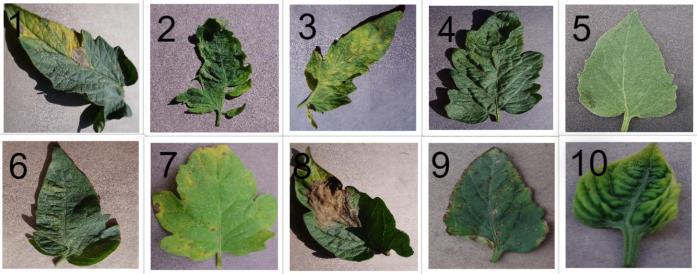
Bacterial spots cause water-soaked patches on leaves, leading to necrotic areas and leaf loss, making fruit vulnerabletosunburn.Lesionscanbecometranslucentor oily,eventuallydryingupandfallingout,leavingtheplant withablightedappearance.
Early blight first manifests as oval-shaped lesions with a yellow chlorotic area running the length of the lesion; infectedleavesmayalsoshowconcentricleaflesions
healthytomatoleafappearsvibrantgreenwithnosignsof discolorationorlesions.Itssurfaceissmooth,firm,andfree fromanyspotsorblemishes.
Lateblight,afungalinfection,affectsallpartsofthetomato plant, showing as water-soaked areas on leaves that turn brownrapidly.Whitefungalgrowthmayappearoninfected areasduringwetweather
Leafmoldfunguscreatespalegreen-yellowspotsonupper leaveswithgreen-brownvelvetygrowthbelow.Spotsmerge,
International Research Journal of Engineering and Technology (IRJET) e-ISSN: 2395-0056
Volume: 11 Issue: 04 | Apr 2024 www.irjet.net p-ISSN: 2395-0072
turning brown, causing leaves to wither while staying attached.
Septorialeafspot,afungaldisease,presentsassmallwatersoakedorgrayish-whitespotsonoldertomatoleaves.These spotsdevelopgraycentersanddarkmargins,oftenmerging asthediseaseprogresses.
Spidermitescauseyellowstipplingonleaves,oftenbronzing themandcreatingwebbing.Infestationmaybeidentifiedby tiny moving dots on webs or leaf undersides, leading to yellowingandleafloss.
Targetspot,afungalinfection,affectsallpartsoftheplant, causingsmallwater-soakedspotsonleavesthatenlargeinto necrotic lesions with concentric circles. Fruits develop brown,slightlysunkenflecksinitially,laterprogressingto large,pittedlesions
Tomato mosaic virus, a viral infection, causes dark green mosaicpatternsonleaves,sometimeswithyellowmottling. Itcanstuntgrowth,distortleaves,andcreateraisedgreen areas,withnecroticstreaksonpetioles
Tomatoyellowleafcurldisease.Thediseasedleavesshrink in size, curl upward, resemble crumpled leaves, and have yellowedveinsandleafmargins.
7. SYSTEM ARCHITECTURE
7.1. IMAGE ACQUISITION
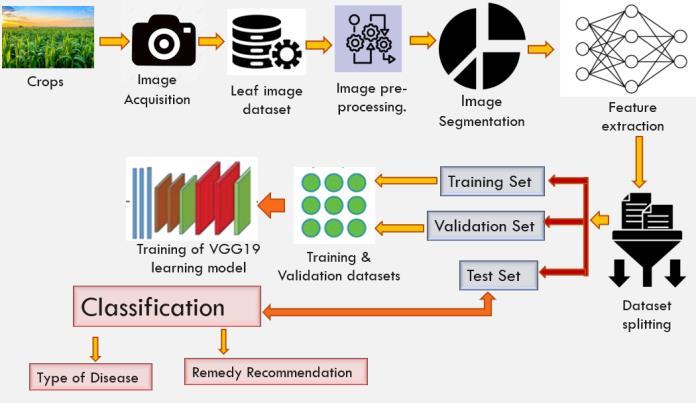
The first step in plant disease detection using machine learning is to acquire images of plant leaves that are both healthyanddiseased.Imagescanbecapturedusingcameras, smartphones, or drones,andcanbetakenin a controlled environment, such as a greenhouse, or in the field. It is importanttoensurethattheimagesareofhighquality,with good resolution and color accuracy, to ensure accurate diseasedetection.
7.2. DATASET PREPARTION
TheDatasetcollectedfromopensourcewebsite“Kaggle”.
7.3.
Weloadthedatasetandpreprocesstheimagestoprepare them for training. This includes resizing the images to a consistent size and normalizing the pixel values. We also splitthedatasetintotrainingandvalidationsetstoevaluate themodel'sperformance.
Afterpreprocessing,theimagesaresegmentedtoseparate theplantleavesfromthebackground.Imagesegmentation involves dividing the image into multiple regions, each of whichcontainspixelswithsimilarproperties.
Once the plant leaves are segmented, the next step is to extractfeaturesfromtheimagethatcanbeusedtotrainthe machinelearningmodel.Thesefeaturesmightincludecolor histograms,texturefeatures,orshapedescriptors.
7.6.
Thepreprocessedimagesarelabeledashealthyordiseased and used to create a dataset. The dataset is divided into training,validation,andtestingsets.
Fittingthemodelwiththedataandfindingouttheaccuracy ateachepochtoseehowourmodelislearning.Thetrained model is then tested on a separate dataset of images to evaluateitsaccuracyindetectingplantdiseases.
The methodology for tomato leaf disease detection and remedyencompassesasystematicprocessinvolvingimage processing, IoT, and cloud computing. Users initiate the system by capturing leaf images through a webcam connected to a Raspberry Pi, simultaneously recording temperaturedatawithaDHT11sensor.Thisdataissecurely transmittedtoacloudserver,wherethecentralprocessing unitexecutesaseriesofsteps.Uponarrivalatthecloud,the inputimagesundergopre-processing,optimizingthemfor subsequent analysis. Relevant features are then extracted fromthepre-processedimages,andaVGG19deeplearning model is utilized to compare and classify these features, identifying the specific disease affecting the tomato plant. Thisphaseensuresaccurateandreliablediseasedetection. Subsequently, a database mapping disease to suitable pesticides is consulted, and the system suggests tailored remediesbasedontheidentifieddisease.
International Research Journal of Engineering and Technology (IRJET) e-ISSN: 2395-0056
Volume: 11 Issue: 04 | Apr 2024 www.irjet.net p-ISSN: 2395-0072
We use VGG19 deep-learning neural network with 19 Connection layers, including 16 convolution layers and 3 fullyconnectedlayerstolearnfeaturesfromtheimagesand classifythemintodiseasecategories.
Wetrainthemodelusingthetrainingdataset,adjustingthe model'sweightsbasedonthedifferencebetweenpredicted andactual disease categories Duringtraining, wemonitor the model's performance on the validation set to avoid overfitting.
Aftertraining,weevaluatethemodel'sperformanceonthe validation set to assess its ability to generalize to new, unseendata.weusemetricssuchasaccuracytomeasurethe model'sperformance
The experiment involved training and evaluating the performanceoftheintegratedtomatoleafdiseasedetection andremedysystem.TheVGG19modelwastrainedonthe curated dataset containing 1000 images for each of the targeteddiseases.Thetrainingprocessutilizedabalanced dataset with careful splits for training, validation, and testing.Duringexperimentation,thesystemprocessedrealworlddatacapturedbyusersusingawebcamandDHT11 sensor on the Raspberry Pi. The cloud infrastructure executed image pre-processing, feature extraction, and VGG19 model comparison for disease identification. Pesticidesuggestionsbased ondiseaseclassificationwere thenrelayedtousersviatheRaspberryPiinterface.
Discussion revolved around the system's accuracy, efficiency, and practical usability. Key points included the
model's ability to accurately identify various diseases, the impact of dataset diversity on generalization, and the effectiveness of the closed-loop system for real-time feedback to users. Considerations were made for system scalability and potential improvements, fostering an insightfuldiscourseonthesystem'soveralleffectivenessin contributing to timely and accurate tomato plant health management.
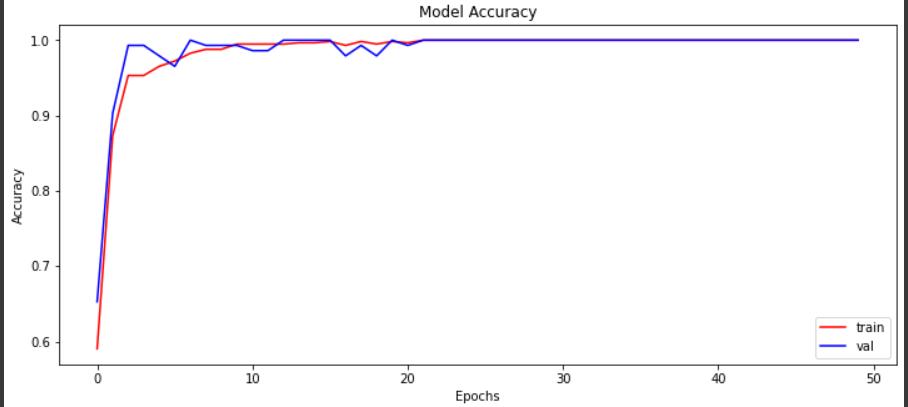
Inconclusion,theintegratedsystemfortomatoleafdisease detectionandremedy,utilizingimageprocessing,IoT.and cloudcomputing,presentsapromisingsolutionformodern agriculture.Therobustmethodology,incorporatingaVGG19 deep learning model trained on a diverse dataset, demonstrated accurate disease identification. The closedloopsystem,fromdatacapturetoreal-timefeedbackviathe RaspberryPiinterface,enhancesitspracticalityforfarmers. The experiment showcased the system's proficiency in processingreal-worlddata,leveragingcloudresourcesfor efficient image analysis and classification. The discussion highlighted the importance of dataset diversity, model generalization,andtheeffectivenessoftheproposedclosedlooparchitecture. Thesystem'sabilitytosuggest targeted pesticideremediesbasedondiseaseclassificationsignifiesa valuable tool for crop management. While achieving commendableresults,continuousupdatestothedatasetand modelfine-tuningcanfurtheroptimizeitsperformance.In essence, this project offers a comprehensive approach to address tomato plant health issues, empowering farmers withtimelyinsightsforeffectivediseasemanagement.The successful integration of emerging technologies reflects a positivestridetowardssustainableandefficientagricultural practices. As technology evolves, this system provides a foundation for future enhancements in crop health monitoringandcontributestotheongoingadvancementof precisionagriculture.
International Research Journal of Engineering and Technology (IRJET) e-ISSN: 2395-0056
Volume: 11 Issue: 04 | Apr 2024 www.irjet.net p-ISSN: 2395-0072
WewouldliketothankMs.PadmajaKfromthebottomof our hearts for all of his help and support during this endeavor.WealsothankGSSSInstituteofEngineeringand Technology for Women for supplying the facilities and resources that were required. We also acknowledge the contributions of our friends and colleagues, who offered insightfulcriticismandhelpfulideasthroughoutthewriting anddevelopmentphases.Thispublicationwouldnothave beenfeasiblewithouttheirassistance.
[1] Zaagueri,T.;Mnari-Hattab,M.;Moussaoui,N.;Accotto, G.P.;Noris,E.;Marian,D.;Vaira,A.M.ChickpeaChlorotic Dwarf Virus Infecting Tomato Crop in Tunisia.Eur. J. PlantPathol 2019,154,1159–1164.[Google Scholar] [CrossRef]
[2] Bai,Y.;Im,P.;In,L.;Ut,D.O.DomesticationandBreeding ofTomatoes:WhatHaveWeGainedandWhatCanWe Gain in the Future?Ann. Bot. 2007,100, 1085–1094. [Google Scholar][CrossRef]
[3] Blanca,J.;Montero-Pau,J.;Sauvage,C.;Bauchet,G.;Illa, E.;Díez,M.J.;Francis,D.;Causse,M.;vanderKnaap,E.; Cañizares, J. Genomic Variation in Tomato, from Wild AncestorstoContemporaryBreedingAccessions.BMC Genom. 2015,16, 257. [Google Scholar] [CrossRef] [Green Version]
[4] Sladojevic, S.; Arsenovic, M.; Anderla, A.; Culibrk, D.; Stefanovic,D.DeepNeuralNetworksBasedRecognition ofPlantDiseasesbyLeafImageClassification.Comput. Intell. Neurosci. 2016,2016, 1–11. [Google Scholar] [CrossRef][Green Version]
[5] Panno, S.; Davino, S.; Caruso, A.G.; Bertacca, S.; Crnogorac,A.;Mandić,A.;Noris,E.;Matić,S.AReviewof theMostCommonandEconomicallyImportantDiseases ThatUnderminetheCultivationofTomatoCropinthe Mediterranean Basin.Agronomy 2021,11, 2188. [Google Scholar][CrossRef]
[6] Gilardi,G.;Matic,S.;Guarnaccia,V.;Garibaldi,A.;Gullino, M.L.FirstReportofFusariumClavumCausingLeafSpot andFruitRotonTomatoinItaly.PlantDis. 2021,105, 2250.[Google Scholar][CrossRef]
[7] Durmus,H.;Gunes,E.O.;Kirci,M.DiseaseDetectionon theLeavesoftheTomatoPlantsbyUsingDeepLearning. InProceedingsofthe20176thInternationalConference onAgro-Geoinformatics,Fairfax,VA,USA,7–10August 2017;IEEE:Piscataway,NJ,USA,2017;pp.1–5.[Google Scholar][CrossRef]
[8] Hu,J.;Shen,L.;Sun,G.Squeeze-and-ExcitationNetworks. In Proceedings of the IEEE Conference on Computer VisionandPatternRecognition,SaltLakeCity,UT,USA, 18–23 June 2018; pp. 7132–7141. [Google Scholar] [CrossRef][Green Version]
[9] Rangarajan, A.K.; Purushothaman, R.; Ramesh, A. TomatoCropDiseaseClassificationUsingPre-Trained Deep Learning Algorithm.Procedia Comput. Sci. 2018,133, 1040–1047. [Google Scholar] [CrossRef]
[10] Karthik, R.; Hariharan, M.; Anand, S.; Mathikshara, P.; Johnson, A.; Menaka, R. Attention Embedded Residual CNNforDiseaseDetectioninTomatoLeaves.Appl.Soft Comput. 2020,86, 105933. [Google Scholar] [CrossRef]