
International Research Journal of Engineering and Technology (IRJET) e-ISSN: 2395-0056 p-ISSN: 2395-0072

Volume: 11 Issue: 04 | Apr 2024 www.irjet.net

International Research Journal of Engineering and Technology (IRJET) e-ISSN: 2395-0056 p-ISSN: 2395-0072
Volume: 11 Issue: 04 | Apr 2024 www.irjet.net
1234Dept. of Computer Science and Engineering, Government College of Engineering Srirangam, Tamil Nadu, India
Abstract - Ensuring road safety stands as a global priority, particularly given the serious dangers posed by fatigue-related accidents. This study introduces an innovative Real-Time Driver Fatigue Detection System that utilizes computer vision and machine learning techniques. The system integrates a camera to capture live facial imagery, specifically focusing on eye movements for blink rate analysis and mouth actions for yawn detection. Employing Facial Landmark Detection and Convolutional NeuralNetworks(CNNs),ourapproachaccuratelyidentifies key facial features and computes Eye Aspect Ratio (EAR) and Mouth Aspect Ratio (MAR). Through continuous monitoringandanalysisoftheseratios,thesystempromptly detectssignsofdrowsinessandalertsthedriveraccordingly. Remarkably, it operates effectively under varying lighting conditions and provides real-time monitoring capabilities while functioning offline for enhanced reliability. Experimental findings confirm the system's effectiveness in mitigating the dangers associated with driver fatigue, thus advancingroadsafetystandards.
Key Words: Drowsy Driver Detection System, Facial Landmarks, Driver Safety, alert system, Alert System, Eye Tracking,BlinkRateAnalysis
Driver fatigue presents a significant global challenge to road safety, highlighted by the United States recording approximately 100,000 incidents annually, leading to 1,500 fatalities and 71,000 injuries. In addressing this issue, drowsiness detection systems have emerged as essential tools. These systems delicately monitor eye and mouthmovements,leveragingadvancedmachinelearning algorithms to detect signs of fatigue. By analyzing metrics such as EAR (Eye Aspect Ratio) and MAR (Mouth Aspect Ratio), they prompt drivers to take breaks, thus reducing accident risks. We aim to develop a machine-learning modelcapableofcontinuouslymonitoringtheseindicators in real time. Utilizing Python, OpenCV, and Keras, this model will discreetly alert drivers upon detecting fatigue, potentiallypreventingaccidentsandensuringthesafetyof all road users. This proactive approach not only enhances roadsafety butalsofosters a cultureof responsibilityand care among drivers, contributing to a harmonious and securetransportationenvironment.
This section aims to review the existing techniques for drowsiness detection systems Vedant Kaushish et al. [1] presentedaDriverDrowsinessDetectionSystemthatuses OpenCVandKerastodetermineifadriverissleepybased on eyelid movements. The system processes images of eyes under various conditions, totaling around 9,723 images.Thedatasetiscategorizedintothreeparts:frontal face detection, left eye detection, and right eye detection. The model built with OpenCV and Keras showcases high precisionandaccuracyindetectingdriverfatigue,whichis crucial for preventing accidents caused by drowsiness. X. G. S. H. X. Zhu et al. [2] authored a paper titled "Real-time Driver Drowsiness Detection Based on Machine Learning Techniques”, which proposes a method for real-time drowsiness detection in drivers using machine learning techniques. The approach likely involves steps such as data collection from various sources like video feeds and EEG signals, and steering wheel movements followed by feature extraction to identify indicators of drowsiness. R. P. Ashish Kumar et al. [3] investigated drowsiness detection using a camera to monitor eye blink rate and eyeball size. Employing CNN-based machine learning for real-time monitoring, it effectively integrates visual cues with advanced techniques. The literature also highlights machine learning algorithms like CNNs for accurately predicting drowsiness levels S. K. Kushwaha [4] reviews driver drowsiness detection systems, focusing on methodologies like monitoring physiological signals and analyzing driving behavior patterns. The study underscores the importance of these systems in preventing accidents caused by fatigued driving and evaluates various approaches' effectiveness and limitations B. K. A J. R. S. Padamata [5] proposes a machine-learning framework for detecting driver drowsiness based on the eye state while driving. The systemutilizestheViola-Jonesfacedetectionalgorithm to identifythefaceandextracttheeyeregionfromimages.A stackeddeepconvolutionalneuralnetwork(CNN)extracts featuresfromkeyframesandclassifiesthedriverasasleep orawakewithaSoftMaxlayer
3.1
International Research Journal of Engineering and Technology (IRJET) e-ISSN: 2395-0056 p-ISSN: 2395-0072
Volume: 11 Issue: 04 | Apr 2024 www.irjet.net
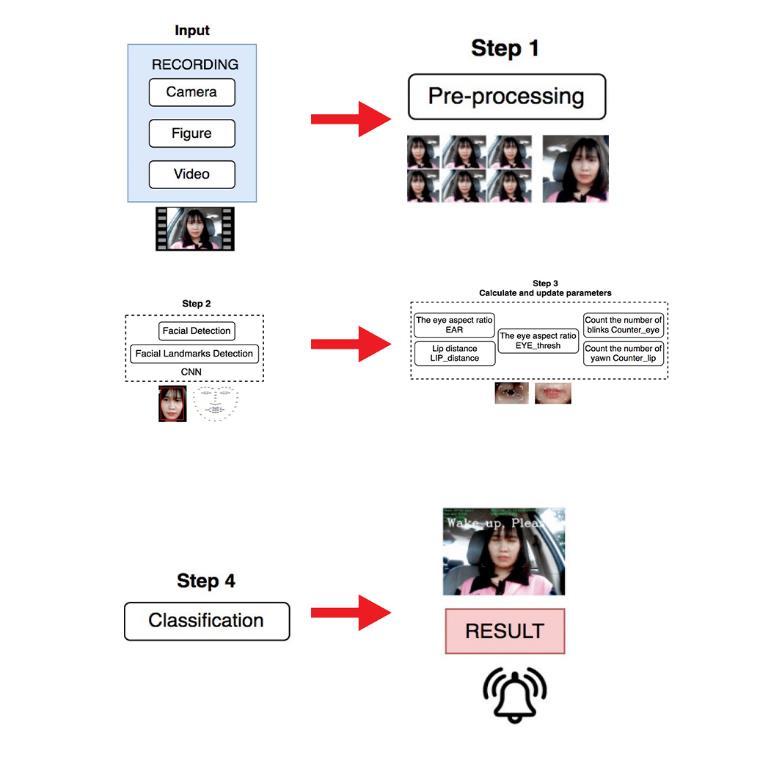
Figure 1 illustrates the systematic process of the driver drowsiness detection system. It begins with capturing video footage using a camera, followed by pre-processing to enhance image clarity through adjustments in contrast and brightness. Subsequently, facial detection algorithms are employed to identify facial landmarks such as eye corners, mouth, and nose, which are crucial for assessing drowsiness. The system calculates the Eye Aspect Ratio (EAR)tomeasurethedegreeofdrowsinessandtheMouth AspectRatio(MAR)todetectyawning,anadditionalsignof drowsiness.UtilizingpredefinedthresholdsforEARandlip distance, if either falls below or exceeds the threshold, respectively, the system classifies the driver as drowsy. Finally, based on the extracted facial features, the system outputs a classification between "drowsy" and "not drowsy," enablingtimelyinterventiontopreventpotential accidentsandensureroadsafety
3.2 Methodology
A webcam captures real-time video of the driver, disintegrating it into frames for analysis. OpenCV detects faces, then DLIB locates facial landmarks using a 68-point approach,extractingtheeyesandmouthasmainfeatures. Facial landmark metrics are used in an EAR formula to calculate drowsiness, comparing it with subsequent frames.IftheEARfallsbelowathresholdforasettime,an alert sounds trigger. DLIB provides 68 face landmarks,
including eye, mouth coordinates, crucial for monitoring EAR and MAR values. To enhance detection, a CNN Keras model processes eye and mouth regions, learning drowsiness-specific patterns like eyelid drooping. This integration improves fatigue detection, enhancing system performance.
In assessing drowsiness, facial landmarks guide the calculationofEARandMAR,enablingpreciseanalysis ofeye closureandmouthmovements.
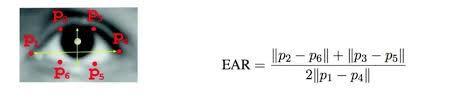
It is a computer vision technique used in drowsiness detectionsystems.Whensomeoneisdrowsy,theireyelids droop, causing the EAR value to decrease. Conversely, a wide-open eye will result in a higher EAR value. By monitoring EAR over time, a system can estimate drowsinessbasedonchangesintheeye'saspectratio.
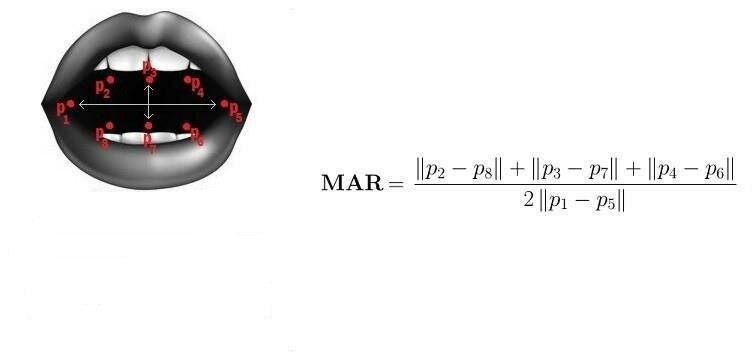
Itfocusesonthewidthofthemouthtoidentifyyawning,a telltale sign of drowsiness. During a yawn, the mouth widenssignificantly,causingtheMARvaluetoincrease.A closed or neutral mouth will result in a lower MAR. By trackingMAR alongwithotherdrowsinessindicatorslike EAR, the system can build a stronger case for detecting fatigue
OpenCV(Open-SourceComputerVisionLibrary)providesa comprehensive toolkit for computer vision applications. With OpenCV, capturing video from webcam is straightforward. The process involves creating a
International Research Journal of Engineering and Technology (IRJET) e-ISSN: 2395-0056 p-ISSN: 2395-0072
Volume: 11 Issue: 04 | Apr 2024 www.irjet.net
VideoCapture object using the cv2.VideoCapture() function in Python, specifying the video source as an integer index for webcams. Once the VideoCapture object iscreated,itattemptstoopenthespecifiedvideosource.If successful, it returns the VideoCapture object; otherwise, it returns None. Within a loop, frames can be read from the video source using the read() method of the VideoCapture object, which returns a tuple indicating the status and the captured frame. Processing of frames can be done based on application needs, utilizing OpenCV's rich set of image processing functions. Displaying frames inwindowsforvisualizationpurposesusingfunctionslike cv2.imshow() is optional. Finally, it's essential to release the VideoCapture object using the release() method to properly close the video stream or file and release resources.
In the proposed driver drowsiness detection system, a Convolutional Neural Network (CNN) is utilized. CNNs require fixed-size images as input, necessitating preprocessing. Keyframesare extracted fromvideos based on temporalchangesandstoredinadatabase.Featurevectors are generated from these stored images in the CNN's convolution layers. CNN includes convolutional layers, pooling layers (max, min, and average), ReLU layers, and fully-connected layers. The convolutional layer uses kernels (filters) with width, depth, and height, producing featuremapsbycalculatingthescalarproductbetweenthe kernels and local image regions. Pooling layers minimize feature map size for faster calculations, with Max or Average pooling selecting maximum or average values from different regions. The ReLU layer applies the max function to convert all negative values to zero, acting as a non-linear layer. Fully connected layers produce class scores for classification. The proposed method employs 2 convolutional layers and one fully connected layer. Key images sized 24x24 are input to Conv2d_1, which convolves the image with 32 filters of size 3x3. Batch Normalization,ReLUtransformation,andMaxpoolingover 1x1 cells follow, with a 0.25% dropout. The output feeds intoConv2d_2,whichconvolveswith32filtersofsize3x3, followed by similar operations and a 0.25% dropout. Conv2d_2requires9248parameters.Theoutputisfedinto a fully connected layer with two outputs for the two-state classifier. Adam’s method is used for optimization, and SoftMax classifier for classification. The final outputs are linear combinations of deep features. Additionally, dlib is usedforaccuratefaciallandmarkdetection,enhancingthe system'scapability.
The dataset comprises 2900 training samples and 433 test samples, gathered for driver drowsiness detection. Each sample features characteristics extracted from
webcam-captured video frames, categorized based on the driver'scondition:eyesclosed,eyesopen,withorwithout yawning. In the training set, 726 instances display closed eyes, 725 exhibit open eyes without yawning, 726 depict openeyeswith yawning,and723showcaseyawningwith open eyes. In the test set, there are 109 samples each for closed eyes, open eyes without yawning, and open eyes with yawning, while yawning with open eyes is representedby106samples.
The experimental evaluation of the driver drowsiness detection system was aimed at assessing its performance across various components and functionalities. By conducting rigorous experiments, the effectiveness, efficiency, and usability of the system in facilitating job matching and talent recommendation processes were sought to be evaluated. In this section, the findings and outputs obtained from the experimental analysis are presented, starting with an overview of the system architectureandmethodologyperformance.
On the homepage given in Figure 2, visitors will find a carefullycuratedlistofinformativealertmessagesaimedat promoting road safety awareness. Additionally, the site provides an in-depth statistical analysis of road accidents, offeringvaluableinsightsintotrendsandpatternsobserved in various countries, thus fostering a deeper understanding ofroadsafetyissuesonaglobalscale
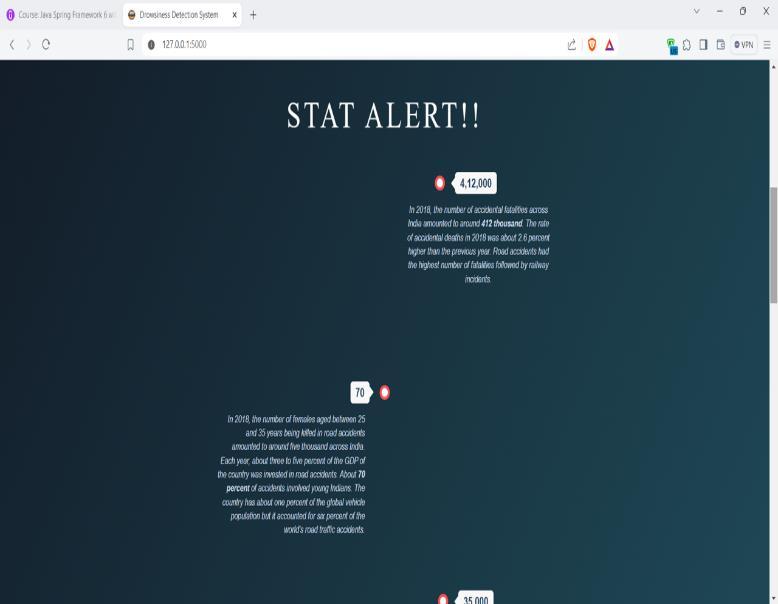
Fig.2Homepage
The start button on the home page is used to initiate the system to capture the video using the dashboard camera anddetectthedriver’sdrowsinessFigure5.
p-ISSN: 2395-0072 Volume: 11 Issue: 04 | Apr 2024 www.irjet.net
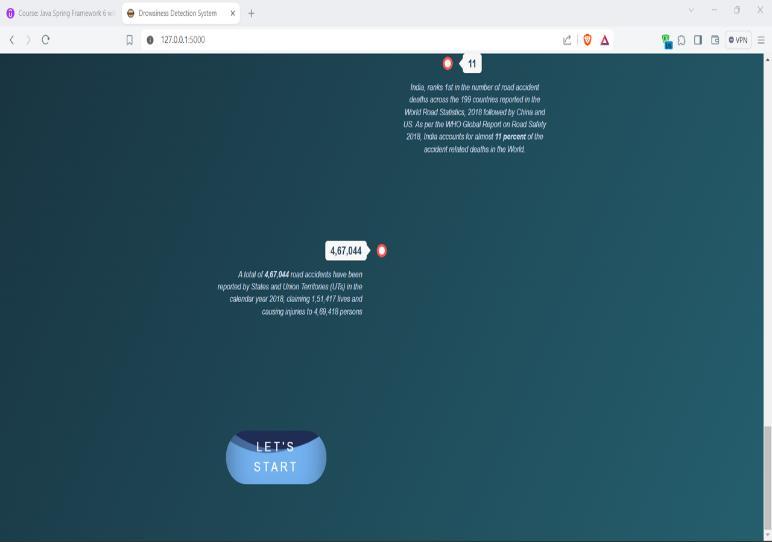
Fig.3Startbutton
Figure4depictsthenon-drowsystateofthepersoninthe video frame, characterized by open eyes and a closed mouth. In this state, no alert is prompted regarding the person'sdrowsiness.
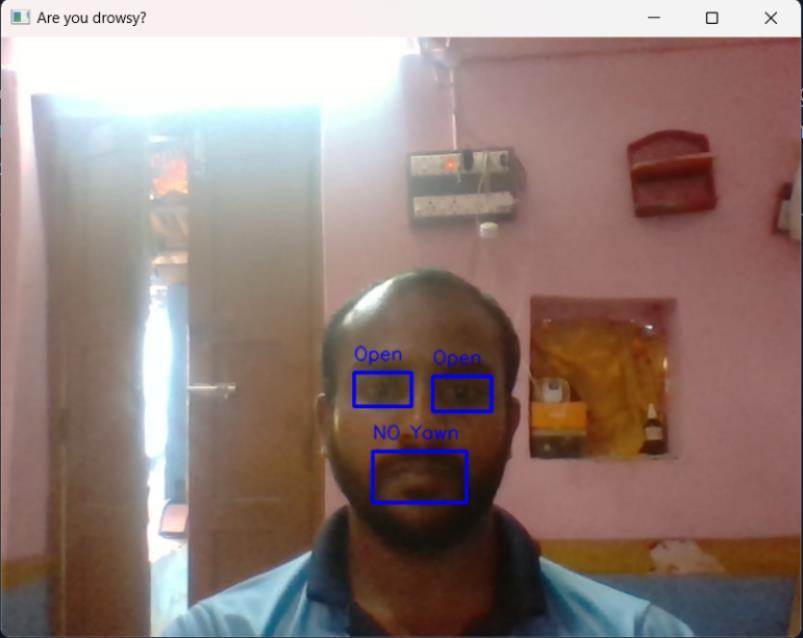
Fig.4Eyeopenstate
In Figure 5, the person's eyes are closed, but there is no indication of yawning. The model prompts an alert about theperson'sclosed-eyestate.
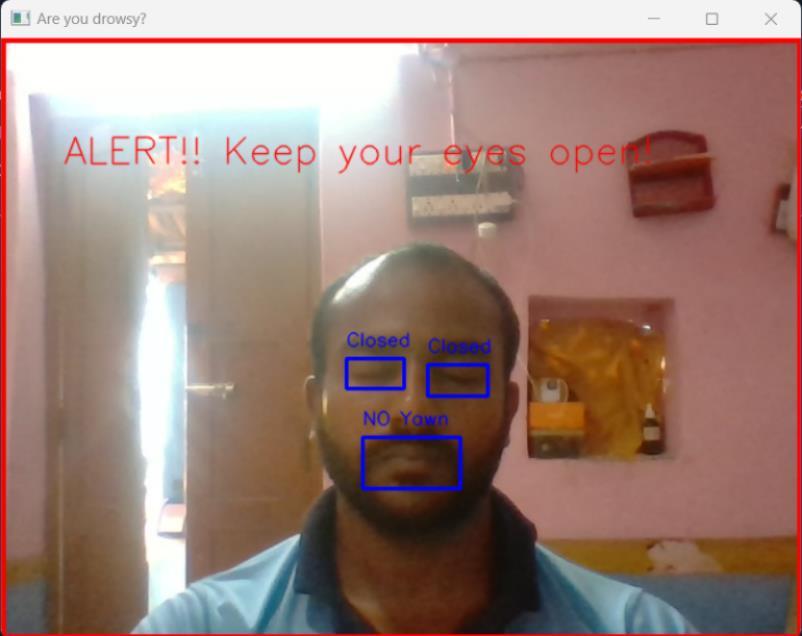
Fig.5Eyeand
InFigure6,thepersoninthevideoframeyawns,resulting in the detection of the yawning (mouth open state) by the model,whichpromptsanalert.
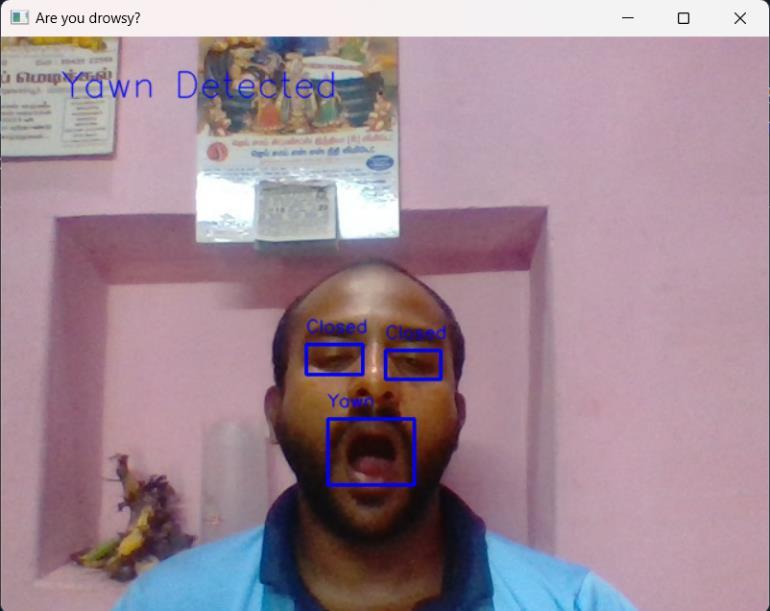
Fig.6Mouthopenstate
Whenthedriverisfoundtobenotdrowsy,thesystemwill notdisplayanytextasitcouldbedistractingtotheuser.It will continue in this waiting and detecting loop until drowsiness is detected. When drowsiness is detected, the system will display an alert message in red color to draw theattentionoftheuserandmakethemawareoftheneed tobemorecarefulandtakeabreakiftheymust.
International Research
Volume: 11 Issue: 04 | Apr 2024 www.irjet.net
of Engineering and Technology (IRJET) e-ISSN: 2395-0056 p-ISSN: 2395-0072
Performance metrics introduced, such as precision, recall, F1 score, and accuracy, are pivotal in assessing the effectiveness of our driver drowsiness detection system. Analyzing these metrics ensures accurate and impactful recommendations, elevating the user experience. Continuous optimization based on these evaluations underscores our commitment to delivering reliable solutions.
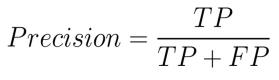
Precision: Precision tells you how good your model is at identifying actual drowsy drivers. It focuses on the proportion of identified drowsy drivers who are truly drowsy.
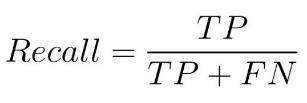
Recall: Recall indicates how well your model finds all the actualdrowsydrivers.Itfocusesontheproportionoftruly drowsydriverswhowerecorrectlyidentified
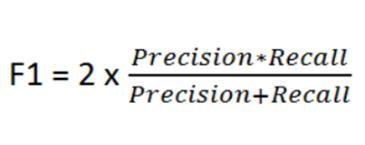
F1 Score: Balancesprecisionandrecall,providinganoverall measure of the system's effectiveness. It is calculated as
Accuracy: The accuracy of a classification model is calculatedastheratioofthesumofTruePositives(TP)and True Negatives (TN) to the total number of predictions made,whichincludesTruePositives,TrueNegatives,False Positives(FP),andFalseNegatives(FN).Mathematically,it canberepresentedas:
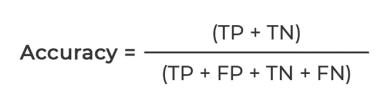
performance metrics of the driver drowsiness detection project, including precision, recall, F1 score, and accuracy, offer comprehensive insights into the effectiveness of our drowsiness detection system. Through rigorous experimentation and analysis, drowsiness of a driver is deteted with an accuracy of 989%.
This work provided the promising result in drowsiness detection and enhanced road safety by integration of driver drowsiness detection system utilizing facial recognition and machine learning. By monitoring the eye states and detecting yawning in real time, this system offers timely alerts, potentially reducing fatigue-related accidents.Futureadvancementsmayimproveadaptability to varied driving conditions and integration with other intelligent vehicle technologies by improving the safety of passenger or driver further Ongoing research aims to optimize the accuracy, reliability, and user-friendliness and it is crucial for widespread adoption and significant reduction of traffic accidents globally. It ultimately saves livesandreducesthesocialandeconomiccostsassociated withthedevelopmentofsuchsystems
Future enhancements to the drowsiness detection system could include integrating hazard light warnings to alert other drivers, seamlessly integrating with the digital clusterof thecar to provide immediatevisual feedback to the driver, implementing auto slow-down features for severe cases of drowsiness, and incorporating mobile notifications to the vehicle owner in instances where the driver fails to respond to alerts. These additions would further enhance the system's effectiveness in addressing driverfatigueandpromotingroadsafety.
[1] Vedant Kaushish, Nitesh Singh, Kunal Maggo, Preeti Nagrath, Rachna Jain, "Driver Drowsiness Detection SystemwithOpenCVandKeras,"inProceedingsofthe International Conference on Innovative Computing & Communication(ICICC),2021.
[2] X. G. S. H. X. Zhu, "Real-time driver drowsiness detection based on machine learning techniques.," IEEE Transactions on Intelligent Transportation Systems,vol.21,no.4,pp.1524-1533,2020
[3] R. P. Ashish Kumar, "Driver Drowsiness Monitoring System using Visual Behaviour and Machine Learning,"IEEEConference,2018
[4] S. K. Kushwaha, " A review on driver drowsiness detection system. International Journal of Computer Sciences and Engineering," vol. 6, no. 1, pp. 16-21, 2018
[5] B. K. A. J. R. S. Padamata, "A machine learning approach for driver drowsiness detection," International Journal of Engineering Research and Applications,vol.10,no.11,pp.58-65,2020