
International Research Journal of Engineering and Technology (IRJET) e-ISSN: 2395-0056
Volume: 11 Issue: 04 | Apr 2024 www.irjet.net

p-ISSN: 2395-0072

International Research Journal of Engineering and Technology (IRJET) e-ISSN: 2395-0056
Volume: 11 Issue: 04 | Apr 2024 www.irjet.net
p-ISSN: 2395-0072
Mrs. Hilda Kanaga V1 , Aishwarya B2 , Ashika T3 , Sandhiya R4 , Synthavi R A5
1 Assistant Professor ,Department of Information Technology, Meenakshi Collegeof Engineering , K K Nagar , Chennai.
2,3,4,5 UG Student , Department of Information and Technology , Meenakshi Collegeof Engineering , K K Nagar , Chennai.
Abstract - Marginalized communities often face barriers in accessing legal assistance due to various factors including language barriers, lack of resources, and limited accessibility to legal services. In this paper, we propose the design and development of a comprehensive legal chatbot tailored to address the needs of marginalized communities. Our chatbot incorporates voice recognition capabilities and language selection features to enhance accessibility for users with diverse linguistic backgrounds. Drawing upon advances in natural language processing (NLP) and machine learning, we outline the architecture, functionalities, and ethical considerations of the chatbot. Additionally, we discuss the importance of community engagement and user-centered design in ensuring the effectiveness and inclusivity of the chatbot. Through the integration of voice recognition, language selection, and a user-centric approach, this paper aims to empower marginalized communities by providing them with accessible and reliable legal assistance.
Key Words: Artificial Intelligence (AI), Machine Learning, Courts of India, Lawyers, IPC, Legal, Judgements, TF-IDF Algorithm, SVMAlgorithm,RandomForestetc.
Inmanypartsoftheworld,marginalizedcommunitiesface significant challenges in accessing legal assistance and understanding their rights. Language barriers, financial constraints, and geographical limitations often exacerbate these difficulties, leading to a lack of access to justice. As technology continues to advance, there is a growing opportunity to barriers and improve legal access for marginalizedpopulations.
One promising approach is the development of chatbot applicationsthatprovidelegalinformationandassistancein auser-friendlyandaccessiblemanner.
Chatbots,poweredbyartificialintelligence(AI)andTF-IDF ,SupportVectorMachine,RandomForesttechnologies,have the potential to interact with users conversationally, understandtheirqueries,andproviderelevantinformation andguidance.By integratingvoice recognitiontechnology

and offering multi-language support, these chatbots can furtherenhanceaccessibilityandcatertothediverseneeds ofmarginalizedcommunities.
Inthispaper,wepresenttheconceptofachatbotapplication designedspecificallyformarginalizedcommunities,aiming tobridgethegapinlegalaccess.Thechatbotwillserveasa virtuallegalassistant,offeringinformationonvariouslegal topics,guidingusersthroughlegalprocesses,andconnecting themwithrelevantresourcesandservices.Throughauserfriendlyinterfaceandintuitiveinteraction,thechatbotseeks toempowerindividualstonavigatethelegalsystemmore effectivelyandasserttheirrights.
FollowingaretheAIandMachinelearningtechniquesthat areusedforbuildingalegalassistant.
• TF-IDF
• SupportVectorMachine
• RandomForest.
The motivation of this research is to empower marginalizedcommunitiesinIndiabyprovidingaccessible legal aid.With languageselection andcategorizedchatbot supportforcivil,immigration,LGBTQ,andsocio-economic issues,theprojectensuresequitableaccesstojustice.
One of the critical components of this project is its emphasis on language selection. India is a linguistically diverse country, with numerous regional languages spoken across its vast landscape. By offering virtual lawyer consultations and centralizing legal resources, it reducesbarrierstolegalrepresentation
Financial obstacles prevent marginalized communities from accessing legal representation. To empower them in advocatingforsystemicreforms,structuralbiaseswithinthe legalsystemmustbeaddressed.Leveragingtechnologyto disseminatelegalinformationcanbridgegapsforthosewith limited access. Language barriers hinder communication, presenting challenges for clients and legal professionals alike.

International Research
of
and Technology (IRJET) e-ISSN: 2395-0056 p-ISSN: 2395-0072 Volume: 11 Issue: 04 | Apr 2024 www.irjet.net
PythonisusedforthedevelopmentofMachinelearning and Artificial Intelligence project because of its massive libraries thatareusefulfordataanalysis,datamanipulation, easier implementation ofMachinelearningandAI models etc.Pythonframeworksarereferredinthisresearchwork for the implementation of different techniques used by a legalassistant.
TF-IDF(TermFrequency-InverseDocumentFrequency)is anumericalstatisticusedininformationretrievalandtext miningtoevaluatetheimportanceofawordinadocument relativetoacollectionofdocuments.Inthecontextofalegal aidchatbot,TF-IDFcanplayacrucialroleinanalyzingand categorizing legal documents, assisting users in finding relevantinformation,andimprovingtheoveralleffectiveness ofthechatbot.Here'showTF-IDFworksanditsapplication inalegalaidchatbot.
TermFrequency(TF)measuresthefrequencyofaterm (word) within a document. It reflects how often a word appearsinadocumentrelativetothetotalnumberofwords inthatdocument.
Inverse Document Frequency (IDF) measures the importance of a term across a collection of documents. It assignshigherweightstotermsthatappearlessfrequently acrossalldocumentsinthecorpus.
TheTF-IDFscoreforaterminadocumentiscalculatedby multiplyingitsTermFrequency(TF)byitsInverseDocument Frequency(IDF).
ThefeaturesextractedfromlegaldocumentsusingTF-IDF fortextanalysisareasfollows:-
• DocumentRetrieval
• KeywordExtraction
• TopicModeling
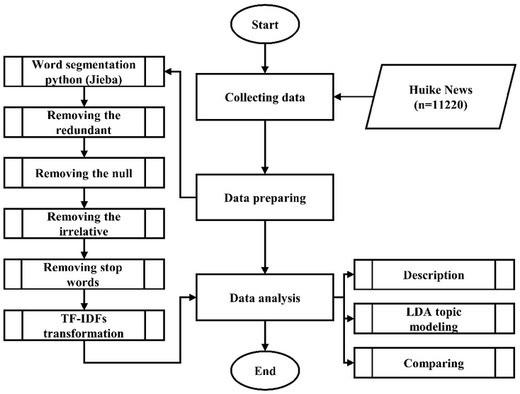
Figure1.Dataprocessingflowchart.
TF-IDF can be used to rank legal documents based on theirrelevancetoauserquery.Documentscontainingterms thatarebothfrequentwithinthedocumentandrareacross theentiredocumentcollectionareconsideredmorerelevant. TF-IDFiswidelyusedininformationretrievalsystemslike searchengines,documentclustering,andrecommendation systems.Ithelpsineffectivelyidentifyingrelevantdocuments by considering both the local importance of terms in documentsandtheirglobalrarityacrosstheentirecorpus.
Keyword extraction techniques aim to distill the most salient information from a given text, aiding in summarization,categorization,andsearch.Thesemethods oftenleveragestatistical andlinguisticanalysistoidentify wordsorphrasesthatcarrysignificantmeaningwithinthe contextofthedocument.Onecommonapproachisbasedon frequencyanalysis,wheretermsappearingmorefrequently areconsideredmoreimportant.Additionally,algorithmssuch asTF-IDF(TermFrequency-InverseDocumentFrequency) assesstherelevanceoftermsbyconsideringtheiroccurrence notonlywithinthedocumentbutalsoacrossacollectionof documents.
International Research Journal of Engineering and Technology (IRJET) e-ISSN: 2395-0056 p-ISSN: 2395-0072
Volume: 11 Issue: 04 | Apr 2024 www.irjet.net
Another method involves graph-based algorithms like TextRank,whichtreatthetextasanetworkofinterconnected terms and rank them based on their centrality within the network.Keywordextractionplaysa crucialroleinvarious applications,includingdocumentsummarization,information retrieval, content recommendation, and search engine optimization (SEO), facilitating efficient access to and understanding of largevolumesoftextualdata.
Topicmodelingisapowerfultechniqueusedinnatural languageprocessingtouncoverthelatentthemesor topics present in a collection of documents. While TF-IDF is traditionallyassociatedwithdocument retrieval and term weighting,itcanalsobeleveragedfortopicmodeling.Inthe context of TF-IDF, topic modeling involves identifying clustersoftermsthatfrequentlyco-occuracrossdocuments, indicatingtheirassociationwithspecifictopicsorconcepts.
OncetheTF-IDFmatrixisdecomposed,theresultingtopic matrix can be interpreted toextract the underlying topics presentinthecorpus.Termswithhighweightswithinatopic indicatetheirimportanceindefiningthatparticulartopic.By examining thesetop- weightedterms,human interpreters canassignmeaningfullabelstoeachtopic,providinginsights intothemainthemesrepresentedinthedocumentcollection.
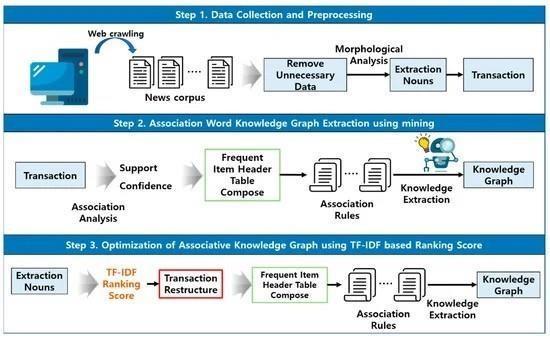
Figure3.Optimizingprocessofassociationgraphusing TF-IDFrankingscore.
Associationgraphsrepresentrelationshipsbetweenitemsin a dataset, where nodes represent items and edges denote associations between them. TF-IDF, a statistical measure, quantifies the importance of terms in documents within a corpus.ByintegratingTF-IDFrankingscoresintoassociation graphs, we refine the graph structure, facilitating more accurateanalysisandextractionofmeaningfulassociations.
Support Vector Machines (SVM) is a supervised learning algorithmthatcanbeusedforclassificationandregression tasks. In thecontextofalegalsupportchatbot,SVMcanbe employed for various tasks such as text classification, documentcategorization,andcaseprediction.SVMisbased ontheconceptoffindingtheoptimalhyperplanethatbest separates the data points into different classes in a highdimensionalspace.Thehyperplaneischosensuchthatthe margin,whichisthedistancebetweenthe hyperplane and the nearest data point from each class (called support vectors),ismaximized.
SVMworksbytransformingtheinputdataintoahigherdimensional space using a kernel function. In this transformed space, SVM finds the hyperplane that best separates the data points into different classes. The hyperplane is chosen such that it maximizes the margin betweentheclosestpoints(supportvectors)oftheclasses. The hyperplane in SVM is the decision boundary that separatesthe classes. Itisdefinedbytheequationw*x-b= 0,wherewistheweightvector,xistheinputvector,andbis the bias term. The margin is the distance between the hyperplaneandthenearestdatapointfromeitherclass.SVM aimstomaximizethismargin.
International Research Journal of Engineering and Technology (IRJET) e-ISSN: 2395-0056 p-ISSN: 2395-0072
Volume: 11 Issue: 04 | Apr 2024 www.irjet.net
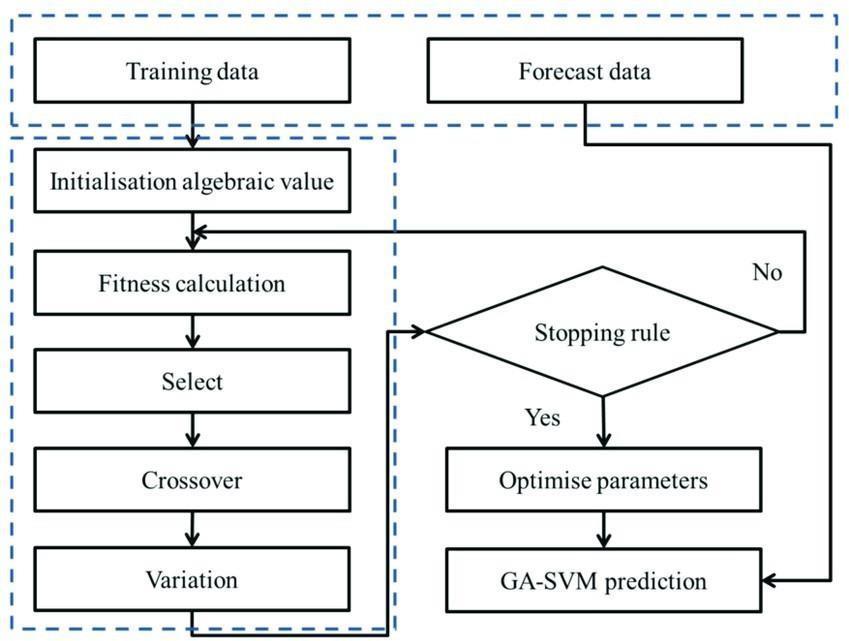
Figure 4. Flowchart of genetic algorithm-support vector machine
Thetrainingprocessinvolvesoptimizingacostfunction thatpenalizesmisclassificationsandadjuststhepositionof thehyperplanetomaximizethemargin.SVMaimstofindthe optimaldecisionboundarythatseparatesthedatapointsinto differentclasseswiththelargestpossiblemargin.
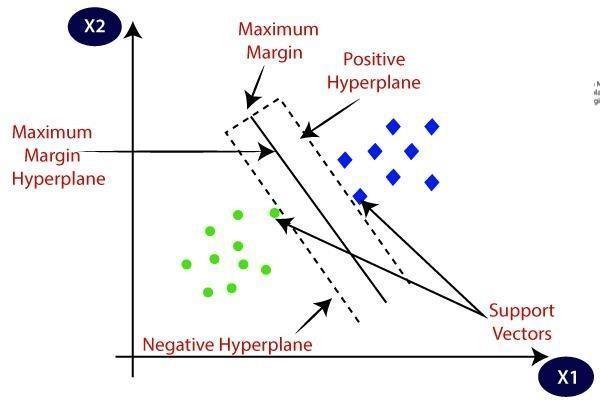
Figure5.SVMGraphPlot
Random Forest is a versatile and powerful ensemble learningmethodusedforbothclassificationandregression tasks. It belongs tothefamilyoftree-basedalgorithmsand isrenownedforitsrobustnessandeffectivenessinvarious machinelearningapplications.
RandomForestisbuiltuponthe concept ofdecisiontrees, whicharesimpleyet effectivemodelsforclassificationand regression.However,decisiontreesareproneto overfitting, especiallyoncomplexdatasetswithnoise.RandomForest addressesthisissuebycombiningmultipledecisiontrees, thus improving the overall predictive performance and generalizationability.
KNNcanbeusedasacrimepredictiontoolthatcanhelplaw enforcement. The prediction accuracy is significantly increased.[17]ThereisamodelthatusestheKNNsystemto traversethroughthecrimedatatofinddifferentreasons.
Each decision tree in the Random Forest is built independently using a subset of the training data and a randomselectionoffeatures. Decisiontreesareconstructed byrecursivelysplittingthedatabasedonfeaturevaluesto createbranchesandmakepredictionsattheleafnodes.
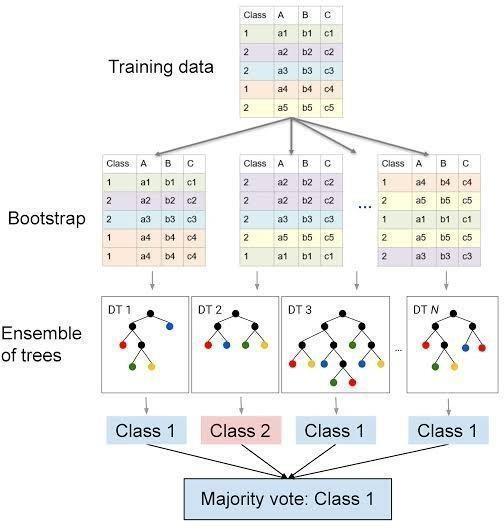
Figure6.FlowProcessofRandomForest
International Research Journal of Engineering and Technology (IRJET) e-ISSN: 2395-0056 p-ISSN: 2395-0072
Volume: 11 Issue: 04 | Apr 2024 www.irjet.net
RandomForestemploysa technique calledbagging,where multiple decision trees are trained on different random subsetsofthetrainingdatawithreplacement.Thissampling with replacement ensures that each decision tree in the forest sees a slightly different perspective of the data, reducingtheriskofoverfitting.
At each node of the decision tree, a random subset of featuresisconsideredforsplitting.Thisrandomnesshelps decorrelate the trees in the forest and ensures that each treemakesdecisionsbasedondifferentsubsetsoffeatures.
4.5
For classification tasks, each decision tree in the Random Forestindependentlypredictstheclasslabelofasample.
Thefinalpredictionisdeterminedbymajorityvotingamong thepredictionsofalldecisiontrees.Forregressiontasks,the final prediction istypicallytheaverageofthepredictions madebyalldecisiontrees.
Theproposeddesignanddevelopmentofacomprehensive legal chatbot tailored to serve marginalized communities representsasignificantsteptowardsaddressingthebarriers they face in accessing legal assistance. By incorporating voice recognition capabilities and language selection features,thechatbotaimstoenhanceaccessibilityforusers withdiverselinguisticbackgrounds.
Theprojectwillinvolvethedevelopmentofanarchitecture that supports voice recognition and multi-language capabilitieswhileensuringdataprivacyandsecurity.Ethical considerations will be paramount throughout the developmentprocess,withmeasuresinplacetosafeguard user confidentiality and prevent biases in the chatbot's responses. Community engagement will be central to the project,withmarginalizedcommunitiesactivelyinvolvedin the design and testing phases to ensure that the chatbot effectivelymeetstheirneedsandpreferences.
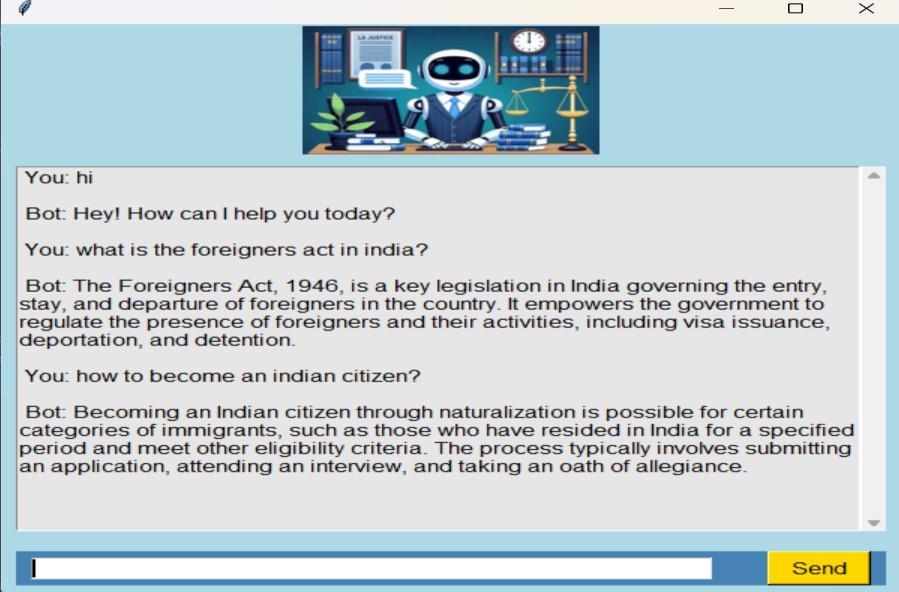
Uponcompletion,theprojectaimstodeliverauser-friendly andinclusivelegalchatbotthatservesasareliableresource for marginalizedcommunitiesseekinglegal assistance. By breakingdownlanguagebarriersandprovidingaccessible support,thechatbothasthepotentialtopromoteequityand justice within the legal system, ultimately empowering marginalizedindividualstoasserttheirrightsandaccessthe legalresourcestheyneed.
In conclusion, the development of a chatbot application tailored to the needs of marginalized communities represents a significant step towards bridging the gap in legalaccess.Byleveragingvoicerecognitiontechnologyand offeringmulti-languagesupport,thechatbotaddresseskey barrierssuchaslanguageproficiencyandliteracy,making legalassistancemoreaccessibleandmoreinclusively.
Through a user- friendly interface and personalized interaction,thechatbotempowersindividuals to navigate the complexities of the legal system with confidence and clarity.
International Research Journal of Engineering and Technology (IRJET) e-ISSN: 2395-0056 p-ISSN: 2395-0072
Volume: 11 Issue: 04 | Apr 2024 www.irjet.net
The potential impact of such a chatbot application is profound. By providing timely and accurate legal information, guiding users through legal processes, and connectingthemwithrelevantresources and services, the chatbot has the potential to empower marginalized communities to assert their rights, address injustices, and seekredressforgrievances.Moreover,bypromotinglegal literacy and awareness, the chatbot can contribute to the overallempowermentandwell-beingofthesecommunities.
[1] AnApproachtoGetLegalAssistanceUsingArtificial Intelligence IEEE 2022 Nishant Jain,Gaurav Goel | TransactionPaper|Publisher:IEEE
[2] Masha Medvedeva, Michel Vols and Martijn Wieling."Usingmachinelearningtopredictdecisionsofthe EuropeanCourtofHumanRights".PublishedonSpringeron 26 June 2019 open access, Creative Commons Attribution4.0InternationalLicense.link.springer.com/article /10.1007/s10506-019-09255-y.
[3] Sandeep Bhupatiraju, Daniel L, Chen and Shareen Joshi." The Promise of MachineLearning for the Courts of India".ThePromiseofMachineLearningfortheCourts of India. National Law School of India Review, 2021, 33 (2), pp.462-474.⟨hal-03629734⟩
[4] Jonathan Brett Crawley and Gerhard Wagner. "Desktop Text Mining for Law Enforcement".2010 IEEE International Conference on Intelligence and Security Informatics. 10.1109/ISI.2010.548476.
[5] Jane Mitchell, Simon Mitchell and Cliff Mitchell. "Machine learning for determining accurate outcomes in criminaltrials".Law,ProbabilityandRisk,Volume19,Issue 1,March2020.
[6] Riya SilandAbhishek Roy."ANovel Approachon Argument based Legal Prediction Model using Machine Learning".ProceedingsoftheInternationalConferenceon Smart Electronics and Communication (ICOSEC 2020). 10.1109/ICOSEC49089.2020
[7] Huseyin Umutcan Ay, Alime Aysu Oner and Tolga Kaya."AMachineLearning-BasedDecisionSupportSystem Design for Restraining Orders in Turkey".2021 IEEE 45th AnnualComputers,Software,andApplicationsConference (COMPSAC).10.1109/COMPSAC51774.2021.00226
[8] V Gokul Pillai and Lekshmi R Chandran. "Verdict Prediction for Indian Courts Using Bag of Words and Convolutional Neural Network". Proceedings of the Third International Conference on Smart Systems and InventiveTechnology(ICSSIT2020).
[9] HuiWang,TiekeHe,ZhipengZou,SiyuanShenand YuLi".UsingCaseFactstoPredictAccusationBasedonDeep Learning".2019 IEEE 19th International Conference on SoftwareQuality,ReliabilityandSecurityCompanion(QRSC).10.1109/QRS-C.2019.00038
[10] HaithamHmoudAlshiblyandMohammadatwahAlma'aitah. "Artificial Intelligence in Law Enforcement". InternationalJournalofAdvancedInformationTechnology (IJAIT)Vol.4,No.4,August2014. 10.1109/5254.653229
[11] Kevin D, Ashley." Artificial Intelligence and Legal Analytics (New Tools for Law Practice in the Digital Age) MachineLearningwithLegalTexts".UniversityofFlorida, Book-ArtificialIntelligenceandLegalAnalytics(NewTools forLawPracticeintheDigitalAge)MachineLearningwith LegalTexts
[12] HemlataSharma,Aakanksha."ArtificialIntelligence and Law: An Effective and Efficient Instrument".2021 9th International Conference on Reliability, Infocom Technologies and Optimization (Trends and Future Directions) (ICRITO).10.1109/ICRITO51393.2021.9596503
[13] Vishu Madaan, Subratho Kumar Das, Prateek Agrawal, Charu Gupta and Dhruv Goel. "Fusion of Sexual Harassment Cases".2021 International Conference on ComputingSciences(ICCS). 10.1109/ICCS54944.2021.00058'
[14] FloraAmato,AntoninoMazzeo,AntonioPentaand Antonio Picariello. "Using NLP and Ontologies for Notary DocumentManagementSystems".2008 19thInternational WorkshoponDatabaseAndSystemsApplications. 10.1109/DEXA.2008.86
[15] Suncana Roksandic, Nikola Protrka and Marc Engelhart."TrustworthyArtificialIntelligence anditsuseby Law Enforcement Authorities: where do we stand?" 2022 45th Jubilee International convention on information communication and electronict echnology (MIPRO). 10.23919/MIPRO55190.2022.9803606
[16] AkashKumar,AniketVerma,GandhaliShinde,Yash SukhdeveandNidhiLal."CrimePredictionUsingK-Nearest NeighboringAlgorithm".2020InternationalConferenceon Emerging Trends in Information Technology and Engineering(ic-ETITE).10.1109/ic-ETITE47903.2020.155
[17] SaqueebAbdullah,FarahIdidNibir,SuraiyaSalam, Akash Dey, Md Ashraful Alam and Md Tanzim Reza. "Intelligent Crime Investigation Assistance Using Machine LearningClassifierson CrimeandVictimInformation".2020 23rdInternationalConferenceonComputerandInformation Technology(ICCIT).10.1109/ICCIT51783.2020.9392668
International Research Journal of Engineering and Technology (IRJET) e-ISSN: 2395-0056 p-ISSN: 2395-0072
Volume: 11 Issue: 04 | Apr 2024 www.irjet.net
[18] JishithaKuppala,K.KalyanaSrinivas,P.Anudeep,R. Sravanth Kumar and P. AHarshaVardhini."Benefitsof Artificial Intelligence in the Legal System and Law Enforcement".2022 International Mobile and Embedded TechnologyConference(MECON). 10.1109/MECON53876.2022.9752352
BIOGRAPHIES


Mrs.HildaKanagaV AssistantProfessor MeenakshiCollegeOf Engineering
AishwaryaB Student MeenakshiCollegeOf Engineering
AshikaT Student MeenakshiCollegeOf Engineering
SandhiyaR Student MeenakshiCollegeOf Engineering
SynthaviRA Student MeenakshiCollegeOf Engineering