
International Research Journal of Engineering and Technology (IRJET) e-ISSN:2395-0056
Volume: 11 Issue: 04 | Apr 2024 www.irjet.net p-ISSN:2395-0072

International Research Journal of Engineering and Technology (IRJET) e-ISSN:2395-0056
Volume: 11 Issue: 04 | Apr 2024 www.irjet.net p-ISSN:2395-0072
Al Arsh Rehman , Abdul Rahman , Abhishek Pathak , Abhishek Singh , Mridul kumar
This study acquaints another way with fabricate a soundbased wellspring in Python 3.8 with the assistance of the Sound Implanted C library for AI. High level sound examination and ongoing control of wellspring highlights are made conceivable through the reconciliation of the adaptableprogramminglanguagePythonwiththespecific abilities of the SoundEmbedded C library. The project's overarching objective is to investigate the possibility of combining interactive fountain design and machine learning techniques to provide customers with an immersive and engaging experience. The task's solid and adaptable stage for building the wellspring control framework isgiven bythePythonprogramminglanguage, which goes about as the premise. Handling music, investigating information, and creating control calculations are only a couple of the many purposes for Python's many devices and structures. Due to its readability and simplicity, Python facilitates rapid prototyping and experimentation, streamlining the developmentprocess.TobalancePython'sarrangementof highlights, the SoundEmbedded C library gives broad sound examination abilities intended for inserted frameworks. The library's sound processing-specific machine learning algorithms can be used to identify patterns, frequencies, and other features in audio signals. Based on this intricate analysis, decisions about the fountain's actions are made in real time. The plan and execution of the sound-based wellspring is made simpler by incorporating Python with the SoundEmbedded C library. Handling hear-able information, removing highlights, preparing an AI model, and controlling a wellspring are fundamental pieces of the undertaking. Python is utilized to handle sound signals that are gotten by sensors or amplifiers. Significant highlights are then removed and used to prepare AI models with the assistanceoftheSoundEmbeddedClibrary. Viapreparing these models to perceive and comprehend various sound examples, the wellspring can adjust its conduct progressively to a great many hear-able sources of info. Using Python and the SoundEmbedded C library, it is possible to dynamically control the fountain's height, water flow, and patterns. Because of perceptible signs, AI models guess which wellspring designs are most fitting and set them in motion continuously. With the assistance
of these related programming parts, the wellspring's activities might be unequivocally organized with the encompassing commotion, making a hypnotizing visual andhear-ableexhibition.Discoveriesfromthisstudyshow thatapowerfulstrongbasedwellspringmightbemadeby joining Python 3.8 with the AI bundle SoundEmbedded C. The project opens up new possibilities for interactive fountain design by combining the library's expertise in audio analysis with the adaptable Python programming language, providing users with an engaging multimodal experience.
Keywords:- Sound-based fountain, Interactive installation, Audio-visual synchronization, Sensor technology, Immersive experience, Python 3.8, Machine learning
Experiencesthatareextraordinaryandoutoftheordinary canbecreated whenartandtechnologymeet.Thesoundbased wellspring epitomizes this kind of combination; it ablymixesvisualandauralcomponents,andwatcherswill becaptivatedbytheinteractionbetweenthewaterandthe music. In this introductory section, we examine the ground-breaking combination of the machine learning package SoundEmbedded C and the flexible programming language Python 3.8. Our primary objective is to create a sound-basedinteractivefountain
Wellsprings have a rich history of being venerated as images of effortlessness, serenely, and excellence. From antiquateddevelopmentstocurrentmetropolitansettings, these building wonders have graced public regions, gardens, and dignified chateaus. The hypnotic cadence of classical fountain performances has captivated audiences for ages. In any case, with the assistance of present day innovation, wellsprings have developed into something more much the same as intuitive establishments, animating many faculties. The consideration of sound parts in sound-based wellsprings is a contemporary illustration of this pattern towards upgrading the crowd's tangible experience. These water highlights can facilitate water shows that blend consistently with foundation commotion,respondingprogressivelytohear-ablesources
International Research Journal of Engineering and Technology (IRJET) e-ISSN:2395-0056
Volume: 11 Issue: 04 | Apr 2024 www.irjet.net
of info. The research and development of sound-based fountains is driven by the goal of creating dynamic, immersive environments that engage the senses. Because they include parts for sound and movement, these works ofartare more thanjust fountains. They allowthe viewer toactivelyparticipateinthecreativeprocess.Sound-based fountains allow designers and artists more creative freedom because they can experiment with light, water, andsound.
Making a powerful strong based wellspring isn't without itsupsidesanddownsides.Buildingstrongsoundhandling strategies is fundamental for continuous examination of complex soundscapes. It is essential for sound-based fountainstobeabletodistinguishbetweenadiverserange of frequency, pattern, and intensity-based audio inputs in orderforthemtofunction.Inordertocontrolthepatterns, water flow, and height of the fountain, both the software and hardware components must work perfectly together. Getting the wellspring's controls, AI calculations, and acoustic investigation to all play pleasantly together is a major innovative obstacle. Indeed, even with these difficulties,therearecaptivatingopendoorsforinnovative work in the field of sound-based wellsprings. Implanted gadgets and AI permit planners to push the limits of customary wellspring plan. Public spaces, exhibition halls, and diversion settings can go through an extreme change withtheestablishmentofsound-basedwellsprings.People of all ages can have amazing experiences thanks to these fountains.
p-ISSN:2395-0072
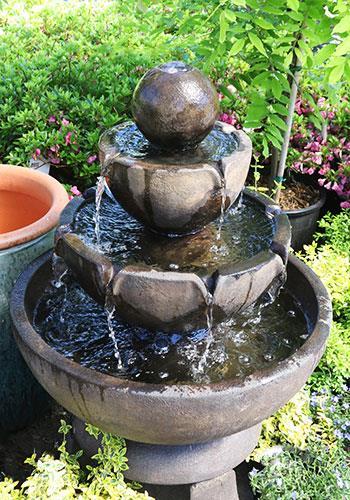
The essential goal of this undertaking is to investigate the chance of dynamic control of sound-based wellsprings utilizing the SoundEmbedded C AI module related to Python 3.8. Our goal is to create a system that can handle fountain management, real-time sound analysis, and pattern recognition by combining Python's computational capabilities with those of the SoundEmbedded C library. While planning, carrying out, and assessing a model sound-based wellspring, we focused on significant perspectives including sound information handling, highlight extraction, preparing AI models, and wellspring control systems. Our goal is to show that our method can produce aesthetically pleasing sound-based fountain installations through potential analysis, creative experimentation,andexperimentalvalidation..
The joining of Python 3.8 and SoundEmbedded C offers a promising road for the progression of sound-based wellspring plan. We strive to create captivating, allencompassing experiences that arouse awe and joy by pursuing new creative expression avenues using technology and imagination. We welcome you to go along with us as we investigate the interesting interchange of water, code, and sound by making intelligent wellsprings thatutilizationsound.
International Research Journal of Engineering and Technology (IRJET) e-ISSN:2395-0056
Volume: 11 Issue: 04 | Apr 2024 www.irjet.net p-ISSN:2395-0072
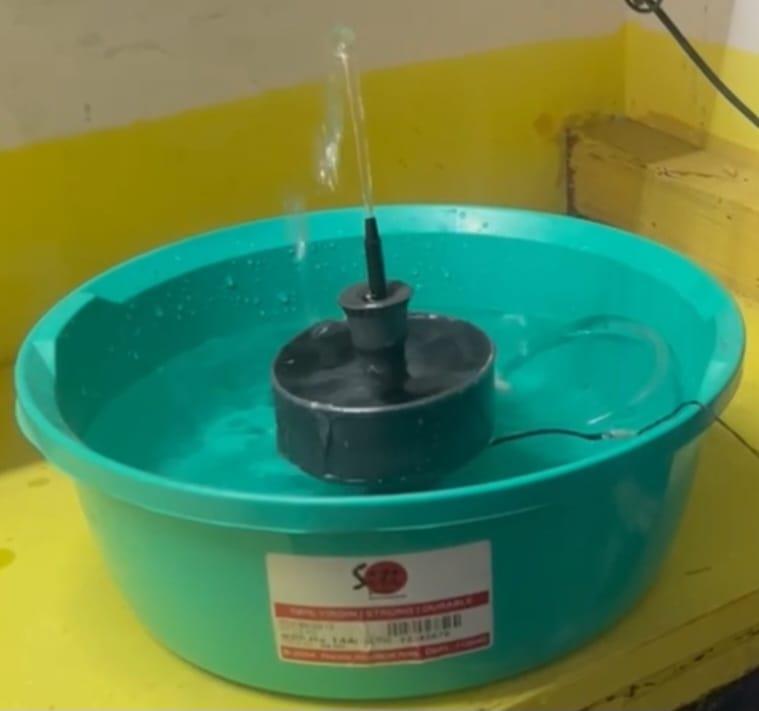
ThegoalistoshowhowtheSoundEmbeddedClibraryand Python 3.8 can work together to make interactive sound fountains that people can really feel. The study's overarching goal is to provide fresh possibilities for creativeexpressionandsensoryengagementbyexpanding the limits of conventional fountain design using Python's computational powerandSoundEmbeddedC'sspecialised audio processing capabilities. This research aims to investigate the possibility of controlling sound-based fountains dynamically using Python 3.8 in conjunction with the SoundEmbedded C machine learning package. Thestudy'sspecificobjectivesareto:-
To create an audio analysis system that can work in real-time, you'll need to write some algorithms in Python to handle audio signals that are picked up by microphones or sensors and identify important characteristics like patterns, intensities, and frequencies.
ApplyMLtopatternrecognitionThisresearchintends to use the SoundEmbedded C library to create ML models that can recognise audio patterns and categorisevariousaudioinputs.
Developing and implementing control algorithms that convert the results of audio analysis and machine learning into real-time modifications of fountain elements like water flow, height, and patterns is the purpose of implementing dynamic control mechanismsforthefountain.
The purpose of this study is to evaluate the soundbased fountain prototype's performance, accuracy,
and user experience through a mix of theoretical analysis, experimental validation, and creative exploration. This will help determine the system's effectivenessandfeasibility.
By expertly integrating these hardware components, the dynamic sound-based fountain can produce a captivating multisensoryexperience.Thewellspringmightrespondto its hear-able climate and charm crowds with facilitated water shows and visual effects.Inorder to make a unique sound-based wellspring, the accompanying equipment partsarefundamental:
Enhancement gadgets for Sound waves from the environmental elements can be caught by these advances. It is normal practice to utilize omnidirectional amplifiers, MEMS mouthpieces, or condenser receivers for sound information. Checking Gadgets Then again, you can utilize accelerometers or piezoelectric sensors to gauge vibrationsorsoundstrain
A microcontroller Many individuals decide to control the wellspring's highlights utilizing stages like Small or Arduino.Theycanprocessdatainrealtimeandconnectto a wide range of sensors and actuators. For further developed sound handling and communication capacities, think about utilizing a Solitary Board PC (SBC) like a Raspberry Pi or a BeagleBone board. These sheets offer additionalhandlingpowerandadaptability.
Hydrostatic Siphons To drive the wellspring's showers, submarine siphons are used. With variable speed pumps, you can precisely adjust water flow rates. Valves controllingtheprogressionofwaterortweakingitsstrain is made conceivable by solenoid valves. To additionally tweaktheheadingofwaterstream,mechanizedvalvesare accessible.
Powerful Light Emitting Diodes Using RGB Driven lights either introduced around the wellspring's edge or submergedinthebowl,thewaterjetsareenlightenedwith astonishing shades. You can create a variety of lighting effectswithaddressableLEDstrips.
International Research Journal of Engineering and Technology (IRJET) e-ISSN:2395-0056
Volume: 11 Issue: 04 | Apr 2024 www.irjet.net p-ISSN:2395-0072
Display Devices to make the fountain more eye-catching, you can employ projectors to show moving pictures or patternsonwaterscreensorothernearbysurfaces.
Thecomponentsofthefountaincannotfunctionwithouta steadyanddependablepowersource.Thiscouldconsistof solar panels, batteries, AC mains converters, or DC power supply.
The electrical components are shielded from dust, water, and physical harm by means of an enclosure or housing. The system's lifespan is guaranteed, particularly in outdoor installations, by waterproof enclosures built of metalorplastic.
Physical Buttons/Keypad Give consumers direct control over the fountain's functions, letting them adjust the settingsoractivateindividualeffects.
Interactive Screen To easily change settings, choose audio tracks, or start preset sequences, interactive displays are available.
Connectivity for Wireless Devices Modules that allow for wireless communication with smartphones or other devices, such as Bluetooth, Wi-Fi, or RF, improve the capabilitiesofuserengagementandcontrol.
Withtherightcombinationofthesesoftwarecomponents, we can create a dynamic sound-based fountain that respondstotheambientnoiseandimmersesconsumersin theexperience.Severalsoftwarecomponentsareessential for the building of a dynamic sound-based fountain using Python 3.8 and the SoundEmbedded C machine learning library.Themainpartsoftheprogrammearethese:-
Python version 3.8.0
When designing the fountain's control system, Python is thelanguageofchoice.Pythonisa greatchoicefor a wide range of applications, such as control algorithms, data analysis, and audio processing, thanks to its rich libraries, readability, and versatility. You can use the following Pythonmodules:-
Use NumPy to do numerical calculations and work witharrays.
Use SciPy for signal processing and other scientific computerjobs.
Visualisation tool Matplotlib To aid in the analysis of auditoryaspectsthroughdatavisualisation.
Learn with Scikit-Alex For developing machine learningalgorithmsforpatternrecognition.
The SoundEmbedded C class library for machine learning:-
With regards to installed frameworks, the SoundEmbeddedClibraryisyoursmartestoptionfor particular sound investigation. Utilizing this library, one might prepare and convey ML models explicitly intended to deal with sound handling position. Include extraction, model preparation, and induction are all essential for it, and it's enhanced for use on installedframeworks
The audio input processing is a component of the systemthatisinchargeoftransformingsoundwaves received from sensors or microphones in real time. PyAudio and SoundDevice are two examples of Python packages that allow you to connect to audio devices and record their streams. Additionally, the audio data may undergo signal processing preprocessingpriortofurtherinvestigation.
The process of removing useful information about sound patterns from audio sources is known as feature extraction. This step is essential for machine learningmodelstoreceiveinput.Pythonlibrarieslike SciPy and LibROSA can be used to extract characteristics like spectrograms, statistical characteristics, and Mel-frequency cepstral coefficients(MFCCs)fromaudiodata.
Educating Machine Learning Models ML models are taught to recognize patterns in the extracted audio features. The SoundEmbedded C machine learning library has capabilities for neural networks, support vector machines (SVMs), and decision trees, all of whichcanbeusedtotrainmodels.
Part of the framework that controls the wellspring is theapparatus thattakesthe aftereffectsoftheAIand sound examination and transforms them into signals that the wellspring's elements can answer. Python scripts can alter the actions of physical devices in response to the analyzed audio data by interacting withthem,suchaspumps,valves,andlights.
Integration of the various software components is necessary to ensure efficient communication and cooperation. To work the wellspring and trade information with the SoundEmbedded C library, it very well might be important to make application programming points of interaction (APIs) or correspondenceconventions.
International Research Journal of Engineering and Technology (IRJET) e-ISSN:2395-0056
Volume: 11 Issue: 04 | Apr 2024
www.irjet.net p-ISSN:2395-0072
By tackling these issues with fresh ideas and working together across disciplines, the dynamic sound-based fountain has the potential to become a revolutionary artistic medium, providing audiences all over the world with unforgettable experiences. Using Python 3.8 and the SoundEmbedded C machine learning package to innovate the dynamic sound-based fountain brings both obstacles andpotential.Overcomingtheseobstacles whichinclude creative, practical, and technical factors could result in revolutionary changes to the design of interactive fountains. Some important obstacles and ways they could spurinnovationareasfollows:-
Test Your Skills in Real-Time Audio Processing A major technological hurdle is the processing of audio signalsinreal-timewithminimal delayandmaximum precision. Fountain answers must be synchronised with the audio input, which requires real-time processing.
Possibility of Innovation Improving code execution and creating efficient methods to process audio in real-time. Finding fresh answers sometimes requires venturing into uncharted territory, like hardware accelerationorparallelcomputing.
Hard Problem with Complex Sound Analysis Robust algorithms that can capture subtle audio properties arenecessaryforcomplexsoundscapeanalysis,which includes variable frequencies, amplitudes, and temporaldynamics.
Plausibility of Advancement Enhancements in AI calculations and sign handling techniques for removing helpful data from sound sources of info. Experimenting with hybrid models that incorporate various signal processing algorithms or deep learning architectures is one strategy for enhancing both flexibilityandaccuracy
IssuewithOptimisingMachineLearningModelsWhen applied to embedded systems with limited resources, the three aspects of model size, computational efficiency, and power consumption of machine learningmodeloptimisationmaypresentchallenges.
TheDifficultyofHardwareControlandIntegrationTo operatethefountain'sfeatures,likepumpsandvalves, software and hardware must be integrated. Perfect synchronization and communication are required for thisintegration.
Innovation Possibility Developing modular and adaptable control systems that are able to communicate with a variety of hardware. To make things more adaptable and versatile, you could
investigate appropriated control frameworks or remotecorrespondenceconventions
Issue with Client Collaboration and Experience Establishing an inviting and energizing climate for clients to investigate and cooperate with is the objectiveofclientexperienceplan.
Plausibility of Advancement To increment client commitment, intuitive highlights like voice control, signal discovery, or versatile application association areutilized.Assumingyou'researchingforavividand extraordinary experience, take a stab at trying differentthingswithARorVRinterfaces.
Issue with Trustworthiness and Wellbeing Ensuring the wellspring establishment is secure and dependable, particularly in open air regions or public places where individuals and the climate could create someissues.
Innovation Possibility Making use of strong safety mechanisms and fail-safe methods to lessen the impactofpotentialdangers.Exploringnewunderlying models, coatings, or materials that increment climate obstructionandlifespancansupporttrustworthiness.
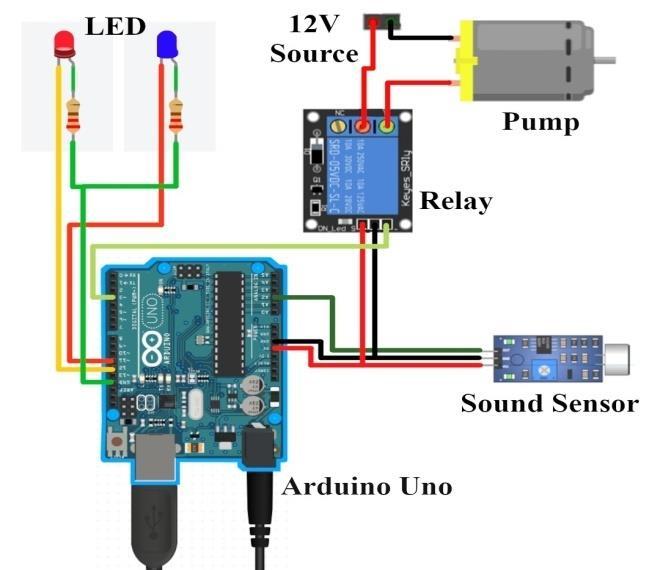
By utilising these software components to their full potential,onemaycreateadynamicsound-basedfountain that combines visual and aural aspects in a seamless display, offering consumers an immersive and participatoryexperience.Theearliermiscommunicationis myapologies.Asound-basedfountaincanbebuiltwiththe following software components: Python 3.8, the SoundEmbedded C machine learning package, and the followingcode:
International Research Journal of Engineering and Technology (IRJET) e-ISSN:2395-0056
Volume: 11 Issue: 04 | Apr 2024 www.irjet.net p-ISSN:2395-0072
For most system-related tasks, including data processing,integration,andcontrol,Pythonwillbethe languageofchoice.
When it comes to scientific computing, data visualisation, and numerical computations, libraries like SciPy, Matplotlib, and NumPy will be indispensable.
Awebinterfacetoremotelyinteractwiththefountain system can also be developed using frameworks like FlaskorDjango.
AI model preparation, sound examination, and element extraction are completely canvassed in this particular library's devices and strategies. .Aural Data Processing
The sound signs from sensors or mouthpieces will be caught progressively utilizing Python mIodules like PyAudioorSoundDevice.
It is feasible to preprocess sound information before include extraction by applying signal handling methods, which can be achieved utilizing NumPy or SciPy.ExtractionofFeatures
We will utilize libraries like SciPy or LibROSA to separate valuable viewpoints from sound sources, including spectrograms, measurable highlights, or Mel-recurrencecepstralcoefficients(MFCCs).
Calculations for highlight extraction can be utilized to find characteristics and examples in the sound informationthataddressdifferentsortsofsounds.
Design acknowledgment and grouping undertakings canbeachievedutilizingdifferentstrategies,including brain organizations, support vector machines (SVMs), andchoicetrees
To make it simpler to prepare ML models utilizing extricated sound elements, the SoundEmbedded C libraryisaccessible.
Python scripts will communicate with the fountain's valves, pumps, and lights in response to the audio inputthatwasanalyzed.
A hardware communication library or framework, such as RPi.GPIO for the Raspberry Pi or AdafruitCircuitPython, can be used to connect to sensorsandactuators.
The seamless operation of communication and collaboration necessitates the integration of software components.
The different pieces of the framework can impart information to one another utilizing standard correspondenceconventionslikeMQTTorWebSocket
Middleware solutions or APIs can be utilized to make it simpler for the Python control system, machine learning models, and fountain hardware to communicatewithoneanother
This cutting edge intelligent sound wellspring is an illustration of how craftsmanship, innovation, and configurationaremeetingup.Throughthecoordinationof stateoftheartinnovationwithcreative ways todeal with wellspring plan, we have made an entrancing tactile exhibition that leaves observers in wonderment. The unique sound-based wellspring can alter public spots, upgrading metropolitan scenes and empowering more noteworthy human-climate linkages as we continue advancing and working on our strategy. Utilizing Python 3.8 and the SoundEmbedded C AI bundle, a powerful strongbasedwellspringwascreated,denotingasignificant step in the right direction in the field of intelligent wellspringplan.Wehavespentthisentiretaskresearching howcraftsmanshipandinnovationmightcooperatetogive another sort of tactile experience that will spellbind watchers in manners they have never seen. On account of the mix of Python 3.8 and the SoundEmbedded C library, we had the option to vanquish different deterrents and find new roads for wellspring plan. Utilizing Python's adaptability and huge library, we constructed a strong control framework that can dissect sound progressively, perceive designs utilizing AI, and oversee dynamic wellsprings. The SoundEmbedded C library's specialized audio processing capabilities have greatly improved our system's efficiency and accuracy. A significant accomplishmentofthisprojectwastheflawlessoperation of the fountain control and sound analysis mechanisms. Ourabilitytochangeoverconfoundedhear-ablesignsinto constant varieties in wellspring attributes like water stream, level, and examples has been demonstrated throughfastidiouspreparationandexecution.Bytimingits developments fitting together with the surrounding commotion, the wellspring turns into a captivating visual andhear-ableshowthatliftsthe spiritsofthepeople who join in. The ever-evolving nature of the sound-based fountain also opens up new opportunities for creative expression.By experimenting with various soundscapes,
International Research Journal of Engineering and Technology (IRJET) e-ISSN:2395-0056
Volume: 11 Issue: 04 | Apr 2024 www.irjet.net p-ISSN:2395-0072
designers and artists can build one-of-a-kind installations that explore the interplay of sound, water, and light. The interactivedesignofthefountainfurtherinvitesspectators to join in the artistic experience by interacting with the artwork.Inthefuture,thereareanumberofwaystheidea ofasound-basedfountainmightbedevelopedfurther.Itis possibletoimprovethesystem'srecognitionandresponse tocomplicatedsoundpatternsbyusingadvancedmachine learning algorithms. The precision and responsiveness of the fountain's behaviour could be even enhanced by including more advanced algorithms for audio processing andsensortechnology.
T.R.Langlois,C.ZhengandD.L.James,“Towardanimating waterwith complex acoustic bubbles,” ACM Transactions onGraphics(TOG),Vol.35,No.4,2016
S. J. Miklavcic, A. Zita and P. Arvidsson, “Computational real-timesound synthesis of rain,” In Proc. of the 7th Int. Conference onDigital Audio Effects (DAFx’04), Naples, Italy,Oct.5-8,2004
W. Moss, H. Yeh, Mi. C. Lin and D. Manocha, “Sounding liquids:Automatic sound synthesis from fluid simulation,” ACMTransactionsonGraphics(TOG),Vol.28,No.4,Art.110, Dec.2009.
K. van den Doel, “Physically-based models for liquid sounds,”ACM Transactions on Applied Perception (TAP), Vol.2Iss.4,Oct.2005,pp.534-546
J. L. Toole, “Experiments in splashing,” BSc thesis, UniversityofMichigan,2009
D. Marshall and K. Sidorov, “Digital audio synthesis.” in LectureNotes, School of Comp. Science & Informatics, Cardiff Univ., UK[Online]. Available: http://users.cs.cf.ac.uk/Dave.Marshall/Multimedia/PDF/0 5_Audio_Synthesis.pdf[AccessedMar.10,2019].
C. Roads and J. Strawn, The computer music tutorial, Cambridge,Mass.,MITPress,1996.
M. Russ, Sound Synthesis and Sampling, 3rd Ed., Elsevier, 2009
S. Pigeon, “White Noise & Co., Colored Noise Generator,” 2019.[Online]. Available: https://mynoise.net/NoiseMachines/whiteNoiseGenerato r.php[AccessedMar.10,2019].
R. Whittle, “DSP generation of Pink (1/f) Noise,” 2007. [Online].Available: http://www.firstpr.com.au/dsp/pinknoise/[AccessedMar.10,2019].
GitHub, “PinkNoiseGeneratorAudioSource,” 2019. [Online].Available: https://github.com/klangfreund/Choreographer/blob/ma ster/Audio%20Engine/Source/PinkNoiseGeneratorAudio Source.cpp[AccessedMar.10,2019].
Liao C 2006 Question and answer of PLC application technology(Beijing:MachineryIndustryPress)pp111-118
Liu L 2009 Research on music fountain intelligent control system based on music featurerecognition Journal of BeijingInstituteofTechnology42-3
Wang X 2008 extraction and research of emotional featuresinmusicinformationFujianComputer1030-31
Liu G, Zhang H, Jia A. 2003 Research on windowing in digital signal processing Journal ofChangsha University 4 61-62
Liu D, Zhang N Y, Zhu H 2002 A review of music feature recognitionComputerEngineeringandApplication24
Li R 1999 Intelligent control theory and method (Xi'an University of Electronic Science andTechnology Press) pp 133-155
PanS,ZhaoM,ChenS,PangY,TianZ1999Theapplication of computer digital processingtechnology in music fountain lag problem Northeast Water Conservancy and Hydropower743-44
Zhou B, Zhang F. 1999 Application and development of computer integrated control of MusicFountain Water SupplyandDrainage467-69
Zhang Y 1998 Fountain engineering development and designproblems(I)WaterSupplyandDrainage747-50
Zhang Y 1998 Fountain engineering development and designproblems(Part2)WaterSupplyandDrainage84346
Aures, W. (1985).“Berechnungsverfahrenfür den sensorischenwohlklangbeliebigerschallsignale” (“Calculation methods for perceived quality of sound signals”),Acustica59,130–141.GoogleScholar
Axelsson, Ö., Nilsson, M. E., Hellström, B., and Lundén, P. (2014).“Afieldexperimentontheimpactofsoundsfroma
International Research Journal of Engineering and Technology (IRJET) e-ISSN:2395-0056
Volume: 11 Issue: 04 | Apr 2024 www.irjet.net p-ISSN:2395-0072
jet-and-basin fountain on soundscape quality in an urban park,” Landscape Urban Plann.123, 49–60.https://doi.org/10.1016/j.landurbplan.2013.12.005Go ogleScholarCrossref
Coxon, A. P. M. (1999). Sorting Data: Collection and Analysis(Sage,London),pp.1–98.GoogleScholarCrossref
Galbrun, L., and Calarco, F. M. (2014). “Audio-visual interaction and perceptual assessment of water features usedoverroadtrafficnoise,”J.Acoust.Soc.Am.136,2609–2620.https://doi.org/10.1121/1.4897313Google
ScholarCrossrefPubMed
10.Gerzon, M. A. (1973). “Periphony: With-height sound reproduction,”J.AudioEng.Soc.21,2–10.GoogleScholar
.Jeon,J.Y.,Lee,P.J.,You,J.,andKang,J.(2010).“Perceptual assessment of quality of urban soundscapes with combined noise sources and water sounds,” J. Acoust. Soc. Am.127, 1357–1366.https://doi.org/10.1121/1.3298437Google
ScholarCrossrefPubMed
Jeon, J. Y., Lee, P. J., You, J., and Kang, J. (2012).“Acoustical characteristics of water sounds for soundscape enhancement in urban open spaces,” J. Acoust. Soc. Am.131, 2101–2109.https://doi.org/10.1121/1.3681938Google
ScholarCrossrefPubMed
Nilsson, M. E., Alvarsson, J., Rådsten-Ekman, M., and Bolin, K. (2010). “Auditory masking of wanted and unwanted sounds in a city park,” Noise Control Eng. J.58, 524–531.https://doi.org/10.3397/1.3484182Google ScholarCrossref
Nilsson,M.E.,Botteldooren, D.,Jeon, J. Y.,Rådsten-Ekman, M., De Coensel, B., Joo, Y., Maillard, J., and Vincent, B. (2014). “Perceptual effects of noise mitigation,” in Environmental Methods for Transport Noise Reduction, edited by M. E.Nilsson, R.Klæbo, and J.Bengtsson (Taylor &Francis,NewYork),pp.195–219.GoogleScholarCrossref
Poletti, M. A. (2005). “Three-dimensional surround sound systems based on spherical harmonics,” J. Audio Eng. Soc.53,1004–1025.GoogleScholar
Puckette, M. (1996). “Pure data: Another integrated computer music environment,” in Proceedings of the Second Intercollege Computer Music Concerts, pp. 37–41.GoogleScholar
Rådsten-Ekman,M.,Axelsson,Ö.,andNilsson,M.E.(2013). “Effects of sounds from water on perception of acoustic environmentsdominatedbyroadtrafficnoise,”ActaAcust. Acust.99, 218–225.https://doi.org/10.3813/AAA.918605Google ScholarCrossref
22.Russel, J. A. (1980). “A circumplex model of affect,” J. Pers. Soc. Psychol.39, 1161–1178.https://doi.org/10.1037/h0077714 GoogleScholarCrossref
23.Russel, J. A., and Mehrabian, A. (1978). “Approachavoidance and affiliation as functions of the emotioneliciting quality of an environment,” Environ. Behav.10, 355–387.https://doi.org/10.1177/0013916578103005 GoogleScholarCrossref
24.Spors,S.,Wierstorf,H.,Raake,A.,Melchior,F.,Frank,M., and Zotter, F. (2013). “Spatial sound with loudspeakers and its perception: A review of the current state,” Proc. IEEE101, 1920–1938.https://doi.org/10.1109/JPROC.2013.2264784 GoogleScholarCrossref
25.Västfjäll, D., Gulbol, M.-A., Kleiner, M., and Gärling, T. (2002). “Affective evaluations of and reactions to exterior and interior vehicle auditory quality,” J. Sound Vib.255, 510–518.https://doi.org/10.1006/jsvi.2001.4166 GoogleScholarCrossref
26.Watts, G. R., Pheasant, R. J., Horoshenkov, K. V., and Ragonesi, L. (2009). “Measurement and subjective assessment of water generated sounds,” ActaAcust. Acust.95, 1032–1039.https://doi.org/10.3813/AAA.918235 GoogleScholarCrossref
27.White,M.,Smith,A.,Humphryes,K.,Pahl,S.,Snelling,D., and Depledge, M. (2010). “Blue space: The importance of waterforpreference,affect, andrestorativenessratings of natural and built scenes,” J. Environ. Psychol.30, 482–493.https://doi.org/10.1016/j.jenvp.2010.04.004 GoogleScholarCrossref