
International Research Journal of Engineering and Technology (IRJET) e-ISSN: 2395-0056
Volume: 11 Issue: 04 | Apr 2024 www.irjet.net p-ISSN: 2395-0072
International Research Journal of Engineering and Technology (IRJET) e-ISSN: 2395-0056
Volume: 11 Issue: 04 | Apr 2024 www.irjet.net p-ISSN: 2395-0072
Priyanka
Manke1 , Samit Shivtarkar2 , Vaibhav Kundekar3 , Hrishikesh Prabhu4 ,Divesh Masurkar5
1Professor, Dept. of Information Technology, Vasantdada Patil Pratishthan’s College of Engineering Mumbai, India 2-5Student, Dept. of Information Technology, Vasantdada Patil Pratishthan’s College of Engineering Mumbai, India
Abstract - The Image-to-Recipe Generator is a revolutionary advancement in culinary technology that uses artificial intelligence and computer vision to bridge the gap between visual stimuli and culinary competence. This technology offers a game-changing answer for both pros and foodiesinanincreasinglydigitalizedworldwhereconvenience and innovation coexist. The generator uses state-of-the-art deep learning algorithms to evaluate food photographs and determine ingredients, quantities, and cooking methods with remarkable precision. This complete approach integrates imageprocessing,contextualcomprehension,recipesynthesis, and item identification to smoothly convert photos into detailed culinary instructions. The generator uses a large dataset of food photographs and recipe cards to mimic populardishesandpromotecreativityandexperimentationin the kitchen. The generator can be applied to more than just meal planning and recipe discovery; it can also be helpful for cultural exchange, nutrition management, and culinary instruction. This innovative instrument, which sits at the intersection of technology and gastronomy, marks the progressofAI-poweredculinarysolutionsandushersinanew era of accessibility, innovation, and involvement for the food industry.
Key Words: Deep learning, computer vision, artificial intelligence, image-to-recipe generator, and culinary technology.
Atthenexusofartificialintelligenceandculinaryarts,this Image-to-recipecreationoffersauniqueandintriguingtake oncooking.Thiscreativenotiongoesagainstthegrainofthe conventionalcookingprocedure,whichstartswitharecipe. Using sophisticated machine learning techniques deep learningandcomputervisionbeingtwoofthemostnotable image-to-recipegenerationstartswithanimageofafinished dishandbreaksdowntherecipethatproducedit.Withthe use of this state-of-the-art technology, it is possible to precisely inspect a picture of food and determine the individual ingredients, preparation techniques, and steps requiredtoaccuratelyrecreatethedish.It'ssimilartohaving your own private chef investigator, exposing every gastronomicmysterycontainedinasinglepicture.Thereare manydifferentconsequencesforimage-to-recipegeneration. Itmightmakefoodmoreaccessible,streamlinetheprocess of preparing meals, and create new opportunities for
creative cooking. This technological breakthrough helps professional chefs looking for inspiration as well as home cooks who wish to produce meals that rival those seen in fine dining establishments. It also reduces food waste, contributessignificantlytonutritionalplanninginitiatives, and even aids in the preservation of local and traditional culinarytraditions.
As we explore the realm of image-to-recipe generation further, we find a point of confluence between AI and creativecookingthatoffersafreshandinsightfulperspective onhowweperceive,comprehend,andsavourtheculinary delightsthatareallaroundus.Thiscombinationgivesusa freshviewpointthatenablesustoappreciateandcherishthe manydifferentculinaryexperiencesthatenhanceourlife.
Designing, creating, and testing a sophisticated Image-toRecipe Generation system using the latest Convolutional Neural Networks (CNN) in combination with JSON data format is the main goal of this project. The system is designed to handle incoming photos with ease, taking advantageofCNNs'capabilitiestoextractpertinentfeatures andpatterns.ThenextstepistouseawellselectedJSONfile database to reverse engineer these visual clues into structuredrecipedata.
the IMDb ratings they give. This correlation can help us predictIMDbratingsbasedoncomments.Theresearchaims to showcase the effectiveness and resilience of machine learning methods in automating the creation of recipes based on visual inputs, utilizing this novel approach. The research also aims to evaluate the system's scalability, accuracy,andefficiency,whichwillfurtherthedevelopment of natural language processing and computer vision technologies in the field of culinary arts and recipe recommendationsystems.
Inaworldwhereconvenienceandcreativityarebecoming more and more important, technology is also having a disruptive effect on the culinary industry. Conventional approaches to finding and developing recipes frequently dependontext-basedsearches,whichcanbelaboriousand restrictiveforpeoplelookingforideasorwhohavecertain dietaryrequirements.
International Research Journal of Engineering and Technology (IRJET) e-ISSN: 2395-0056
Volume: 11 Issue: 04 | Apr 2024 www.irjet.net p-ISSN: 2395-0072
Our desire to transform the way consumers engage with culinarymaterialiswhatinspiredustotakeonthisproject. To bridge the gap between visual signals and recipe production, we intend to leverage structured data representationwithJSONfilesandthepowerofstate-of-theart Convolutional Neural Networks (CNNs). This method offers a more user-friendly and effective way to find and createrecipes,inadditiontopleasingthesenseofsight.
Inaddition,thegoalofthisprojectistofurtherthecurrent progressincomputervisionandmachinelearning.Ourgoal istopushthelimitsofwhatisachievablewithAItechnology byinvestigatingtheinteractionof thesedomainswith the culinaryarts.Wewanttoopenupnewavenuesforcreative applications in personalized culinary assistance, recipe recommendation systems, and other areas through our researchanddevelopmentwork.
Our ultimate objective is to enable people from diverse culinarybackgroundstoconfidentlyandcreativelyexplore, experiment,andenjoytheartofcooking.Weforeseeafuture where everyone can unleash their culinary potential and enjoy the thrill of producing excellent meals by democratizingaccesstoculinaryknowledgeandutilizingthe mostrecentdevelopmentsinAI.
1.Recipe 1M dataset: TheRecipe1Mdatasetisanextensive collectionof overa million cookingrecipesgatheredfrom different web sources. A list of ingredients, written directions,andpicturesshowingthefinaldishareincluded with every recipe. With the use of this dataset, machine learning models can be trained to comprehend the connectionbetweenwrittenrecipesanddishvisualsabout films and then provide their opinions, which are often subjective
2.Models for Generating Recipes: A number of studies have concentrated on creating models that can produce recipesusingwritteninstructionsorvisualaids.Toproduce coherentandrealisticrecipes,forinstance,modelsbasedon transformerarchitectures,generativeadversarialnetworks (GANs),andrecurrentneuralnetworks(RNNs)havebeen used. Usually, these models acquire the ability to create recipes through conditioning on textual inputs, like ingredient lists or textual descriptions. To enhance the qualityofthecreatedrecipes,theymayintegratemethods from computer vision and natural language processing (NLP).
3. Recipe Retrieval Systems: Thesesystemsaremadeto retrievepre-existingrecipesusingverbalorvisualqueries, inadditiontocreatingrecipesfromscratch.Thesesystems employ similarity metrics to identify recipes in a big databasethatmatchuserqueries,souserscanfinddishes thatfittheirdietaryrequirementsortastes.
TheImagetoRecipeGeneratorisaweb-basedapplication thatusesreverseengineeringtoexplorethecurrentstateof research and projects in this field. This particular reverse engineeringproject'smainobjectiveistoidentifythemost recentdevelopmentsinfoodtechnologythroughimage-torecipegeneration.Thiscutting-edgefieldturnsfoodphotos intocomprehensiverecipesbyfusingcomputervisionand machine learning. The inherent ambiguity and variety in bothphotosandrecipesisoneofthesystem'smainissues. Consequently, the creation of an efficient image-to-recipe generator depends on tackling these issues through sophisticatedmachinelearningstrategies,datapreparation approaches,andalgorithmicadvancements.[1]
Thegoalof"Imagetorecipegeneration"istogivepeople including tourists a quick and easy way to recognize ingredientsandcookingmethodsfrompicturesoffood.With thehelpofsophisticatedmachinelearningalgorithms,the system will examine the user's visual input and produce preciseandcomprehensive recipesin return.Thisfeature makes it easier for users to find the components and preparation directions for a recipe, which improves their culinaryexplorationandcookingexperience.Furthermore, theapplicationwillbemulti-userfriendly,enablingusersto bothexploreandfindthemostpopulardishesinaparticular locationaswell asstreetfoodina givenlocality.Withthe helpofthisfunction,usersmayexplorethemanyculinary landscapes without being restricted by geography and discover iconic dishes as well as undiscovered gems. The project's ultimate goal is to offer a simple and convenient wayforpeopletoexperimentwithandcookawiderangeof dishes, expanding their culinary skills and gastronomic adventure.Intermsofimplementation,thesurveylooksinto machinelearningmodelconstructionwithPythonlibraries such as TensorFlow and PyTorch. It also emphasizes Streamlitforfrontenddevelopment,whichcombinesHTML andCSSelementstocreatebetteruserexperiences.[2]
The core of the system is suggested to be a Convolutional NeuralNetwork(CNN)systemthatanalyzesfoodphotosand extracts pertinent data for recipe generation. To be more specific,thesystem'sCNNswillbetrainedonacollectionof food photos in order to identify important visual cues including ingredients, preparation techniques, and dish compositions.CNNsaretrainedbyprovidingthemlabeled samplesoffoodphotosalongwiththerecipesthatgowith them. In order to reduce the discrepancy between the expectedandactualrecipeoutputs,theCNNswillthereafter iteratively modify their internal parameters. After being trained, the CNNs will be able to recognize and extract relevantinformationfromfreshphotosoffood.Afterthat, thesecharacteristicswillbefedintoanotherneuralnetwork component. This part will finish the image-to-recipe generating process by producing detailed cooking instructions based on the features that were retrieved.
International Research Journal of Engineering and Technology (IRJET) e-ISSN: 2395-0056
Volume: 11 Issue: 04 | Apr 2024 www.irjet.net p-ISSN: 2395-0072
Through the provision of an easy interface for creating networktopologies,generatingmodels,andtrainingthemon accessible data, Keras will support the neural network models' implementation and training throughout this process. The suggested method intends to improve users' culinaryexperiencesandexplorationbyutilizingCNNsand Kerastogeneratepreciseandcomprehensiverecipesfrom foodphotos.[3]
The"Imagetorecipegeneration"projectaimstocreatean image-to-recipegeneratorsystemthatanalyzesfoodphotos andproducesmatchingrecipesusingmachinelearningand neuralnetworktechniques.Topreciselyidentifyingredients, cookingtechniques,anddishcompositionsfromimages,the systemmayuseconvolutionalneuralnetworks(CNNs)for imageprocessingandpotentiallyrecurrentneuralnetworks (RNNs) for recipe generation. This will enable users to receive comprehensive, step-by-stepcooking instructions. BycombiningtheKerasdeeplearningframework withan intuitiveuserinterface,thesystemaimstoprovideasmooth training and implementation process for neural network models, which will ultimately improve users' culinary experiencesbylettingthemexperimentandeasilyrecreatea broadrangeofrecipes.[4]
Anessentialcomponentofthisendeavorislocatingtheright foodandconfirmingthatitmatchestheonewhosepictureis being taken. Due to differences in food photographs' presentation, lighting, and angle, users may have trouble locatingfoodthatseemssimilar.Toguaranteethatusersget accurateresultsInordertosolvethisproblem,thesystem couldneedtoincludestrongimageprocessingmethodsand giveuserstheabilitytofocustheirsearchresultsaccording to particular visual characteristics or preferences. This would increase the relevancy and accuracy of the user's results..Userscanalsoindicatetheirpreferencesbyusinga dropdown box for flavor and overall appearance of food, whichhelpstofurthercategorizeandimprovethesystem's recommendations based on personal preferences. The technology improves culinary research and cooking by utilizingimagerecognitionanduserpreferences,enabling userstoeasilyfindandcomprehendavarietyofcuisines.[5]
Thisproject'suseofneuralnetworksandmachinelearning hasthepotentialtocompletelytransformthefoodsectorby bringinginnovelapproachestorecipediscovery,culinary exploration, and customized eating experiences. The technology makes it simple for users to recognize componentsandcookinginstructionsfromfoodphotosby utilizingsophisticatedimagerecognitionalgorithms,which expedites the process of finding recipes and organizing meals. Moreover, the utilization of machine learning methodologiesenablesthesystemtoadjustandcustomize suggestions according to personal inclinations, dietary limitations, and cultural heritages, augmenting user contentment and cultivating patronage for food-related enterprises. This study proposes a deep neural network-
basedmethodtocreateasystemforindividualsbelongingto variousomnivoregroups.Themulti-layeredneuralnetwork isusedtogatherandprocessthedata.Theproposedmodel isnovelbecause,basedontheuser-takenphotoofthemeal, it is a generalized machine learning model that can be trainedonanyinputdata.[6]
ProposedSystemforImagetoRecipeGenerator
The combination of image processing and artificial intelligencehascreatedintriguingnewopportunitiesinthe field of culinary innovation. The creation of an Image to RecipeGenerator,asystemthatcaninterpretvisualinputsof foodproductsandproduceassociatedrecipes,isonesuch fascinatingproject.DuringtheinitialphasesoftheImageto Recipe Generation project, obtaining and preparing food photosisessentialtoensuringdataconsistencyandquality.
Gatheringabroadrangeofinformationfrommanysources, such as recipe websites, user-contributed sources, and databases of food photography, is the initial step in this process. The dataset encourages a comprehensive understandingofculinaryvariationbecauseitwascarefully chosentocontainawiderangeofcuisines,meals,andfood categories. Next, duplicates and superfluous pictures are eliminated,alongwithanypotentialsourcesofnoise,using datacleaningtechniques.Therigorouscurationprocedure ensures the integrity and dependability of the dataset, offeringasolidfoundationforadditionalresearchandmodel training.
Feature extraction and representation are crucial to the picturetorecipegenerationprojectbecausetheyenablethe conversion of unprocessed image data into useful representations that are then utilized for recipe creation. Convolutional neural networks (CNNs), pretrained on big datasetslikeImageNet,facilitatetheextractionofhigh-level informationfromfoodphotos.Usingtheknowledgeencoded inthesepretrainedmodels(e.g.,VGG,ResNet,orInception), transfer learning is one method for efficiently extracting significantfeatures.
Thesegatheredfeaturesarethentransformedintosuitable representation forms, such as feature vectors or embeddings,inordertoreducedimensionalityandmaintain crucial information. This technique ensures accurate mappingtorelevantrecipeslaterintheprojectbymaking sure the extracted features successfully capture the importantcharacteristicsof the inputphotographs.As we map the recipe to the database, we begin to extract and represent it. Recipe database mining and generation encompassthesystematicextractionofculinaryknowledge fromvastrecipedatabasestofacilitatethecreationofawide rangeofdeliciousdishes.Curatingalargedatabasewitha varietyofcuisines,ingredients,andcookingmethodsforms thefoundationofthisprocess.
International Research Journal of Engineering and Technology (IRJET) e-ISSN: 2395-0056
Volume: 11 Issue: 04 | Apr 2024 www.irjet.net p-ISSN: 2395-0072
Advancedtechniquessuchasnatural language processing (NLP) and data mining are employed to categorize and arrange the recipes based on their attributes. Effective mapping techniques are used to correlate the returned picturequalitieswithappropriaterecipesinthedatabase, allowingforthecreation of personalized andcontextually relevant dishes that are tailored to the user's dietary requirementsandpreferences.
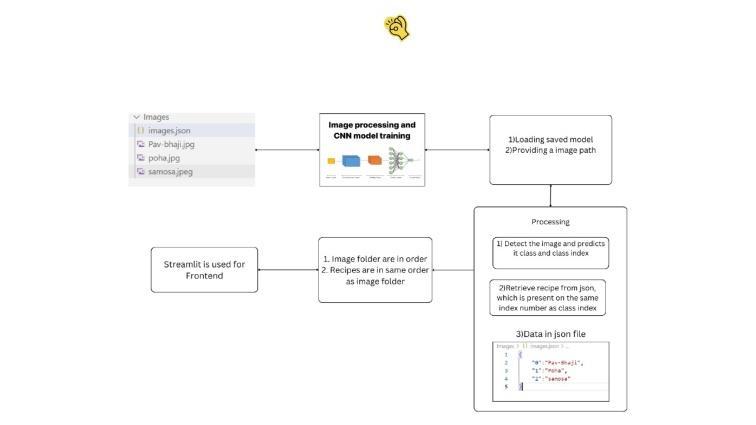
Creatinganeasy-to-useuserinterface(UI)andfacilitating smooth communication with Streamlit are essential to improvinguserexperienceandinvolvementintheImageto RecipeGenerationproject.StreamlitisaPythonmodulefor buildinginteractivewebapplications,anditmaybeusedto constructaninterfacethatissimpleenoughforbothnovice and expert users to navigate. The process of producing recipesisinitiatedbyusersenteringfoodimages,whichis made easier by the user interface (UI). The developed recipes are presented in an easy-to-understand manner. With interactive features like amount adjustment, component replacement, and dietary restriction filtering, usersmaycustomizetheirmealrecommendationsbasedon their individual dietary needs and preferences. Comprehensiveassessmentmetricsareemployed,suchas ROUGEscore,BLEUscore,andhumanevaluationstudies,to measuretheperformanceofthegeneratedrecipes.Through systematic testing and validation, the system's ability to provide coherent and contextually relevant recipes is thoroughlyinvestigated.Usertestingandfeedbackgathering significantly improve and develop the model's practical usability. The model architecture, training data, and user interface may be continuously iterated depending on evaluationresultstoenhanceoverallperformanceanduser satisfactionwiththegeneratedrecipes.
Ensuring the usability and accessibility of the Image to RecipeGenerationsystemforendusersrequiresaseamless transitionfromdevelopmenttoproduction.Aspartofthis process,thefinishedapplicationisdeployedliveonaweb serverorcloudcomputingplatform,ensuringscalabilityto accommodate fluctuating user traffic. Integrating with an extensiverecipedatabaseiscrucialforprovidingimmediate accesstoa multitude ofculinaryknowledge.Reactiveness and data integrity are ensured by efficient database management, enabling the timely retrieval of relevant recipesuponuserinput.Robustsecuritymeasuresarealso included to preserve the integrity of the system and safeguard sensitive user data. Through continuous monitoring and adjustment, the deployed system remains adaptable to evolving user needs and technological advancements, ensuring a consistent and flawless user experience.
Ourdevelopmentstrategyismethodicalandfocusedonthe needsoftheuser,withseveralstagestoguaranteeanappfor boththeuserandvariousserviceproviders.Userneedsand in-depthmarketresearcharepartofthefirststep.layingthe
groundworkforconceptanddesignoffeaturesThecreation and prototyping of the app then follow, iteratively incorporating user feedback to improve functionality and usability. A flawless user experience is guaranteed by meticulous testing and quality control procedures.
Determiningprojectgoals,analyzingrequirements,designing the system, choosing the technology stack, integrating document verification, putting user registration and authentication into place, developing service booking and management features, guaranteeing data security and privacy, carrying out quality assurance and testing, and deploying theapplication with continuous monitoringand iterativeimprovementsareallpartofthedevelopmentplan for a local service web application with document verification. The market for on-demand services has expandeddramaticallyduetoariseincustomerdemandfor a dependable and easy way to access a large selection of services.
This review of the literature delves into the complex world of service marketplaces, concentrating on how document verification is incorporated into sites like UrbanClap. These marketplaces now heavily rely on document verification, which improves user safety, confidence,andplatformefficacyoverall.Throughareviewof the literature, this survey seeks to clarify the extent, importance, and technological developments in this field, providing insight into the development of this novel methodology.
Valuableinsightsfrommoviecommentsandmakeinformed decisionsaboutpredictedIMDbratings.
3.1.
International Research Journal of Engineering and Technology (IRJET) e-ISSN: 2395-0056
Volume: 11 Issue: 04 | Apr 2024 www.irjet.net p-ISSN: 2395-0072
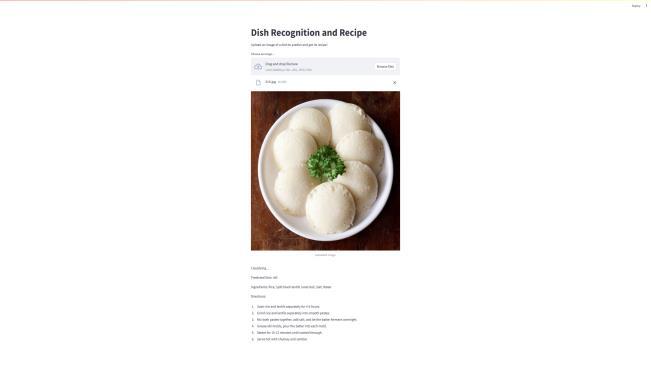
Fig.2OutputScreenShot
Predicted Dish: Idli
Ingredients:
Rice
Splitblacklentils(uraddal)
Salt
Water
Directions:
1. Soak rice and lentils separately in water for 4-6 hours.
2. Drain the soaked rice and lentils and grind them separately into smooth pastes using a blender or wetgrinder,addingwaterasneeded.
3. Combine both pastes in a large bowl, add salt to taste,andmixwell.
4. Coverthebowlandletthebatterfermentovernight inawarmplace,allowingittodoubleinvolume.
5. Grease idli molds with oil or ghee and pour the fermentedbatterintoeachmold,fillingthemabout three-quartersfull.
6. Steamtheidlisinasteamerfor10-12minutes,or untiltheyarecookedthroughandfirmtothetouch.
7. Removetheidlisfromthesteamerandletthemcool slightly before unmolding them using a spoon or knife.
8. Servetheidlis hotwithchutneyandsambarfora deliciousandwholesomemeal.
Enjoyyourhomemadeidlis,aclassicSouthIndiandelicacy lovedforitssofttextureandcomfortingflavor!
An inventive and promising use of computer vision and artificial intelligence is the Image to Recipe Generator. It might completely change how people find, make, and distribute recipes. In this project, we have shown how to turnafoodphotographintoacomprehensiverecipeusinga combinationofdeeplearningmodels,imagerecognition,and naturallanguageprocessing.Therearenumerousimportant advantagestothistechnology'ssuccessfuldevelopment.A largergroupofpeople,includingthosewhomightlackthe abilitiesorexpertisetofollowtraditionalrecipes,mayfind cooking more approachable as a result. It may also be a source of inspiration for amateur cooks and professional chefs alike, offering recipes that utilize ingredients you alreadyhaveandhelpingyoureducefoodwaste.
ThepotentialfortheImagetoRecipeGeneratortochange the culinary scene is enormous. Primarily, improving recognition and recipe conversion accuracy from food photos is still an important objective. More accuracy and dependability in the outcomes will be facilitated by developmentsindeeplearningandcomputervision.
Bycombiningtextandpictureinputs,multimodallearning willincreasethesystem'sadaptabilityanduser-focus.Itmay matchrecipestospecificdietaryrequirementsandtastesby usinguserdescriptionsandpreferences.
Byallowingthesystemtocommunicatecookinginstructions directlytoovensorcookers,integrationwithsmartkitchen applianceswillexpeditethecookingprocess.
Providing multiple language support, dietary preferences, and recipe modifications will increase the system's adaptability and worldwide reach. Working together with the food industry grocery stores, food delivery services, and the like can lead to new opportunities, such recipe recommendationsbasedonsalesatnearbygrocerystores. Tosumup,theImagetoRecipeGeneratorisgoingtobea valuable resource for a wide range of users, providing convenience,mealideasthatarehealthy,andinspirationfor cooking.
[1]KaushikMishra,AdityaSharma,MohakGund."Image-toRecipe Generation: Bridging Culinary Art and Artificial Intelligence."Published inInternationalJournalofTrendin Scientific Research and Development (ijtsrd), ISSN: 24566470,SpecialIssue.InternationalConferenceonAdvancesin Engineering,ScienceandTechnology–2021,May2021,pp. 29-41.
International Research Journal of Engineering and Technology (IRJET) e-ISSN: 2395-0056
Volume: 11 Issue: 04 | Apr 2024 www.irjet.net p-ISSN: 2395-0072
[2] Anusha M and Kiran Kumar. "Innovative Approach to Image-to-Recipe Generation." 2022. Department of BCA1 Assistant Professor, Department of BCA2 BMS College of CommerceandManagement,Bengaluru,India,pp.212-215.
[3] Y. Wei, Y. Qi, Q. Ma, Z. Liu, C. Shen and C. Fang. "Advancements inImageProcessingTechniquesforRecipe Generation."20202ndInternationalConferenceonMachine Learning, Big Data and Business Intelligence (MLBDBI), Taiyuan,China,2020,pp.101-115.
[4] Ms. Vishakha Mahakalkar, Ms. Chetna Hajare, Ms. Vaishnavi Kamde, Ms. Minakshi Sonkusale, Prof. Saervesh Warzurkar."RevolutionizingCulinaryExploration:Image-toRecipe Generation System." 2022 Asst. Professor, DepartmentofInformationTechnology,TulsiramjiGaikwadPatilCollegeofEngineeringandTechnology,Nagpur,India, pp.486-490.
[5]V.Velasco,K.DedySetiawan,R.RobertSanjaya,M.Susan Anggreainy and A. Kurniawan. "Exploring AI-driven Solutions in Culinary Arts: A Review of Image-to-Recipe GenerationSystems."20234thInternationalConferenceon Artificial Intelligence and Data Sciences (AiDAS), IPOH, Malaysia,2023,pp.97-101.
[6] P. Kumar, M. Sharma, S. Rawat and T. Choudhury. "Integrating Machine Learning Techniques for Image-toRecipe Generation: A Comprehensive Review." 2018 International Conference on System Modeling & Advancement in Research Trends (SMART), Moradabad, India,2018,pp.87-91.