

International Research Journal of Engineering and Technology (IRJET) e-ISSN:2395-0056
Volume: 11 Issue: 04 | Apr 2024 www.irjet.net p-ISSN:2395-0072
DEVELOPING AN INTELLIGENT SYSTEM FOR MULTILINGUAL VISUAL TO AUDIO CONVERSION FOR PERSONS WITH VISUAL IMPAIRMENTS USING ARTIFICIAL INTELLIGENCE
Dr. S RAJAN1 , Ms. P SUBHAVARSHINI2 , Ms. A SOUNDARYA3, Mr. S SAKTHIVEL4 , Mr. J VIJAYAKUMAR5
1 Professor, Dept. of ECE, Velalar College of Engineering and Technology, Thindal, Erode, Tamilnadu, India. 2,3,4,5 B.E Final Year Students, Dept. of ECE, Velalar College of Engineering and Technology, Thindal, Erode, Tamilnadu, India.
ABSTRACT
According to the World Health Organisation, around 40 million people in the world are blind, while another 250 million have some visual impairments. Readingposesasignificant challengeforthem.Toaddress this, an automatic reader for Visually Impaired People is developed. It works by capturing text from documents using a webcam and converting it into digital format through Optical Character Recognition (OCR). The text is extracted from the visual image and converted to audio output,inwhichonecanhearthroughthespeaker.Inthis, itproposedanintelligentsystemformultilingualvisual-toaudio conversion to facilitate audio accessibility for persons with visual impairments. It aims to serve both visually impaired people and illiterate people. The system can process visual images in multiple languages and generate audio descriptions in the user’s preferred language. The audio descriptions are designed to be concise, descriptive, and accurate, providing users with a detailedunderstandingofthevisualimagecontent.
KEYWORDS
Raspberry Pi 4 Model B, Optical Character Recognition, OpenCV, Raspbian, Python, Pytesseract, Real VNC Viewer App
1. INTRODUCTION
Visual impairment is a condition that affects a significantpercentageoftheglobalpopulation.Peoplewith visual impairmentsfacesignificantchallengesinaccessing andinterpretingvisualinformation,particularlyinaworld that relies heavily on visual communication. To address this challenge, intelligent systems for multilingual visualto-audionatural language processingtechnologiesanalyze visual media and provide audio descriptions of their content.Byconvertingvisualinformationintoaudio,these systems enable visually impaired people to access and understand visual media content that would otherwise be inaccessible to them. Many individuals with visual impairmentsareproficientinmultiplelanguages,andthey
deserve equal access to information in all of them. Moreover, the internet has enabled global connectivity, making it imperative for assistive technologies to break down language barriers. This project aims to provide an overview of intelligent systems for multilingual visual-toaudioconversionforpersonswithvisualimpairments.
2. PROPOSED SYSTEM
An intelligent system for visual-to-audio conversion for persons with visual impairments is a technology that converts visual information, such as images, graphs, and videos, into audio signals, so that individuals with visual impairments can comprehend the visual information through sound. The system uses computer vision and machine learning algorithms to analyze the visual content and generate a corresponding audiodescriptionthatdescribestherelevantdetailsofthe visualinformation.
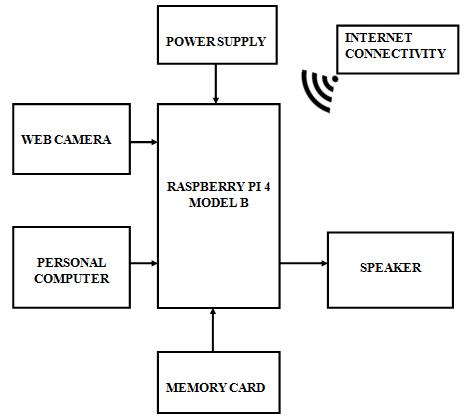
The above Figure 1 shows the Block Diagram of thesystem,theimageinputisgiventothewebcamerathe
International Research Journal of Engineering and Technology (IRJET) e-ISSN:2395-0056
Volume: 11 Issue: 04 | Apr 2024 www.irjet.net p-ISSN:2395-0072
CapturedImageisstoredinthememorycardandthePCis used to run the output using theReal VNC Viewer App to avoid such hardware components like keyboard, mouse, etc., There is a Power Supply for the Raspberry pi to engage with the kit. There is an Internet Connection for Text to Speech Conversion through wireless connection. The conversion of text to speech is observedthrough the speakersorheadphones.
A. Raspberry Pi 4 Model B:
The Raspberry Pi 4 Model B is a credit card-sized single-board computer developed by the Raspberry Pi Foundation. It features a quad-core ARM cortex-A72 processor, up to 8GB of RAM, Multiple USB ports, HDMI output, Ethernet connectivity, GPIO pins, Wi-Fi, and Bluetooth capabilities. It supports Operating Systems like Raspberry Pi OS, Ubuntu, Linux distros, and third-party systems like Windows 10 IoT core. The below Figure 2showstheRaspberryPi4ModelB,

B. Web Camera:
ThebelowFigure3belowshowstheWebCamera, itisalsoknownasawebcam,itisadigitalcameratypically connected to a computer via USB or built directly into a device, such as a laptop or smartphone. It is used for capturingimages,videos,livestreaming, etc.,Itconsists of a lens, image sensor, and electronics for processing and transmitting video data. Webcams vary in resolution, typically ranging from low-definition (480p) to highdefinition (720p, 1080p or even 4k). Higher-resolution webcamsofferbetterimagequality.

C. Power Supply:
The Figure 4 below shows the USB cable to connect to Power. The Raspberry Pi 4 Model B typically requires a 5V DC power supply. The recommended power supplyfortheRaspberryPi4ModelBprovidesaminimum of3amps (3000 mA) ofcurrent. The most common power connector for the Raspberry Pi 4 Model B is USB Type-C. The features built-in power management circuitry to protect against over-voltage, over-current and overtemperatureconditions.

Card:
The Raspberry Pi 4 Model B supports microSD cards, including 32GB variants. It provides ample storage space for operating system files, applications, and data on the Raspberry Pi 4 Model B. Below Figure 5 shows the 32 GBmemorycard,

E. Personal Computer:
A personal computer or PC is a computing device designedforgeneralpurposes,intendedforindividualuse. It consists of a Central Processing Unit (CPU), Memory, Storage, Input / Output devices (such as a keyboard, mouse,andmonitor),andvariousperipheraldevices.Here, thePCisusedtoruntheoutputusingtheRealVNCViewer App to avoid such hardware components like keyboard, mouse,etc.,
F. Speaker:
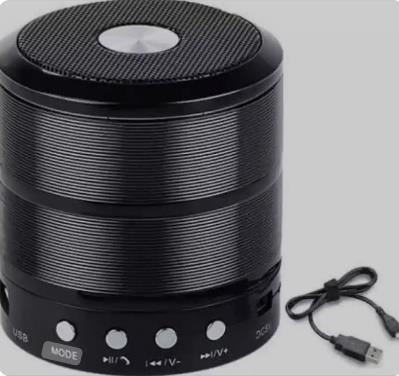
The Figure 6 Shows the mini speaker, which is a device thatconverts electrical signals intosound waves. It consists of one or more transducers that vibrate in
International Research Journal of Engineering and Technology (IRJET) e-ISSN:2395-0056
Volume: 11 Issue: 04 | Apr 2024 www.irjet.net p-ISSN:2395-0072
response to the electrical signals received from an audio source. These vibrations generate sound waves that propagatethroughtheairandcanbeheardbyhumans.
G. Internet Connection:
To establish an internet connection with a RaspberryPi4ModelBwehaveseveraloptions,inthatwe use Wi-Fi Connection. It has built-in Wi-Fi connectivity, whichallowsyoutoconnectittoawirelessnetwork.
3. RESULTS AND DISCUSSIONS
The results of our project are shown below: First, we type a code - (sudo python3 code.py) in the page of Real VNC Viewer App, then the code works and it asks us to choose a specified language in the given 3 languages (English, French, Russian) in a specified number given for the three languages. Then the capturing page is opened and we click a picture like a language we selected before through a web camera, then it converts to Tamil language intextformatandfinally,weobservethroughaspeakeror headphones.
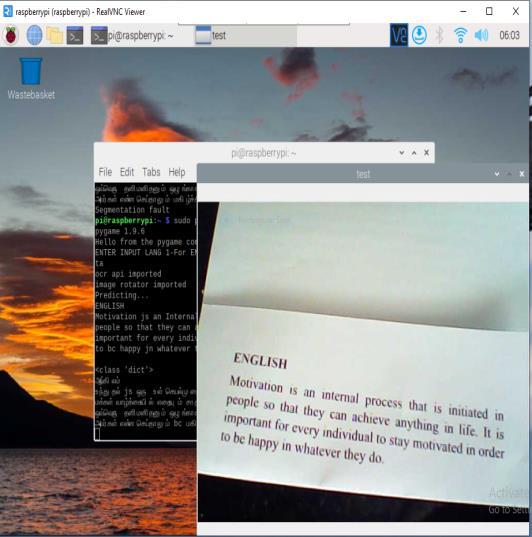
The above Figure 7 shows the translation of the English language to the Tamil language, for the English languagethespecifiednumberis1,firstofall,theimageis
successfully captured by the web camera and it saves the image.TheCapturedimageisconvertedtotextformatand thetextisconvertedtospeechbygTTS.TheSpeechcannot bedisplayedsoitisnotattachedhere.

The above Figure 8 shows the translation of the French language to the Tamil language, for the French languagethespecifiednumberis2,firstofall,theimageis successfully captured by the web camera and it saves the image.TheCapturedimageisconvertedtotextformatand thetextisconvertedtospeechbygTTS.TheSpeechcannot bedisplayedsoitisnotattachedhere.

The Figure 9 shows the translation of the Russian language to the Tamil language, first of all, the image is successfully captured by the web camera and it saves the image.TheCapturedimageisconvertedtotextformatand thetextisconvertedtospeechbygTTS.TheSpeechcannot bedisplayedsoitisnotattachedhere
International Research Journal of Engineering and Technology (IRJET) e-ISSN:2395-0056
Volume: 11 Issue: 04 | Apr 2024 www.irjet.net p-ISSN:2395-0072
4. CONCLUSION
In conclusion, the development of intelligent systems for visual-to-audio conversion for persons with visual impairments has significant potential to improve accessibility and inclusivity for individuals with visual disabilities. Such systems can provide a more immersive and engaging experience for visually impaired individuals byconvertingvisualcontentintoaudioformatsthatcanbe moreeasilyunderstoodandconsumed.
REFERENCES
1. Chetana Thaokar, Hema Amlani, Nutan Rathod, Pooja Bodkhe, Pradnya Kolhe, Ujwalla Gawande, "Novel Machine Learning based Text-To- Speech Device for Visually Impaired People", 2023 2nd International Conference on Smart Technologies and Systems for NextGenerationComputing(ICSTSN),(2023),pp.1-5.
2. Abbineni Charishma, Alla Amrutha Vaishnavi, D.Rajeswara Rao, Tirumalasetti Teja Sri, "Smart ReaderforVisuallyImpaired",20239thInternational Conference on Advanced Computing and Communication Systems (ICACCS),(2023),vol.1,pp.349-352.
3. B.J.Komathi,V.Kiruthika,C.Nithiya,J.Pavithra,N.G. Praveena,P. Samuda and"ArduinobasedCustomized Smart Glasses for the Blind People", 2022 Second InternationalConferenceonArtificialIntelligenceand SmartEnergy(ICAIS),(2022),pp.1136-1141.
4. N.Kasthuri, S.Naveen Kumar, A.Nethra Krupa, R.Madhavan, "Finger Vision for Visually Impaired", 2021InnovationsinPower andAdvancedComputing Technologies(i-PACT),(2021),pp.1-6.
5. T.Asha, T. N. S. Joshna, P.G. Jyothirmai, S.Khasimbee andRavi,"RaspberrypibasedSmartReaderforBlind People",2020InternationalConferenceonElectronics and Sustainable Communication Systems (ICESC),(2020),pp.445-450.
6. AkshayAkole,PallaviAngnani,SangeetaKumari,Yash Bhamare, Zaid Naikwadi, "Enhanced Braille Display Use of OCR and Solenoid to Improve Text to Braille Conversion", 2020 International Conference for EmergingTechnology(INCET),(2020),pp.1-5.
7. F. Al-Muqbali, K. Al- Kiyumi, N. Al-Tourshi and F. Hajmohideen, "Smart Technologies for Visually Impaired: Assisting and conquering infirmity of blind people using Al Technologies", 2020 12th Annual Undergraduate Research Conference on Applied Computing (URC), (2020), +pp.1-4.
8. Rajan S, Abinaya S, Dharanidevi V, Dharanitharan V, Dharani B, “Intelligent Shopping Cart with Online Payment for Futuristic Shopping Experience”, International Research Journal of Engineering and Technology,Vol.7,Issue5,May2020,pp:405-409.
9. K.Kaushik, S.Kumar, K.Rao, S.Rao, S.Santhosh, "Smart Reader for Visually Impaired", 2020 Fourth International Conference on I-SMAC (IoT in Social MobileAnalyticsandCloud)(I-SMAC),(2020),pp.846850.
10. V.Ghiye and S.Musale "Smart reader for visually impaired", 2018 2nd International Conference on Inventive Systems and Control (ICISC),(2018),pp. 339-342.
11. M.H.Ashmafee and S.A.Sabab, "Blind Reader: An intelligent assistant for blind", 2016 19th International Conference on Computer and InformationTechnology(ICCIT),(2016),pp.229234.