
International Research Journal of Engineering and Technology (IRJET) e-ISSN: 2395-0056
Volume: 11 Issue: 04 | Apr 2024 www.irjet.net p-ISSN: 2395-0072
International Research Journal of Engineering and Technology (IRJET) e-ISSN: 2395-0056
Volume: 11 Issue: 04 | Apr 2024 www.irjet.net p-ISSN: 2395-0072
1Surabhi Jain, 2Rashmi Sahu, 3Dr. A.K. Dubey
1Research Scholar, M.Tech. (Structural Engineering)
2Research Scholar, M.Tech. (Structural Engineering)
3Professor & Principal, Dept. Of Civil Engineering, Jhada Sirha Government Engineering College, Jagdalpur, C.G.
Abstract -Since the late 20th century, the debate over renovating existing dwellings versus demolishing and constructing anew has intensified, driven by the need to revitalize urban centres. Despite its benefits, rehabilitation is not always the most cost-effective choice, andsometimes, demolition followed by new construction proves more advantageous. In the specialized field of repairs and rehabilitation engineering, expertise goes beyond conventional construction skills, requiring a delicate balance of advanced technology, trends, management, feasibility, and economy. Innovative methods aim to enhance the stiffness of steel members without increasing their weight, with the steel frame construction technique utilizing a grid of vertical columns and horizontal I-beams tosupportabuilding'sfloors,roof,andwalls
Key Words: Rehabilitation,STAADpro,Utilizationratio
1.
Repair and Rehabilitation in Civil Engineering is a skillful practiceaimedatextendingtheservicelifeofstructures.It involves restoring a structure to its original state when facing defects, deterioration, or destruction. The ultimate goal is to maximize the functional utility of the structure, even allowing for modifications to meet new requirements. Structures may undergo Repair and Rehabilitation for reasons such as environmental deterioration, changes in functional or loading requirements, or damage from accidents. The process employs systematic approaches aligned with various strategiestoachieveadesiredlevelofstructurallongevity. The lifespan of a structure isgenerally influenced by factors like location, building material, technology, and workmanship
Demolition means tearing down a structure, while rehabilitation involves preserving and renovating it. The choicedependsonfactorslikecost,environmentalimpact, andhistoricalsignificance.Rehabilitatingabuilding,based onitshistorical orarchitectural value, cost efficiency,and environmental sustainability, can be faster and integrate
with the community. Adaptive reuse, regulatory incentives,reducedconstructionrisks,andaestheticvalue also favour rehabilitation. The decision considers specific project needs, with site conditions like cost-efficiency, sustainability,quickercompletion,communityintegration, adaptive reuse, reduced construction risks, and aesthetic appealinfluencingthechoice.
1.2REHABILITATION
Building rehabilitation involves repairing or modifying a structure to restore its usefulness, extending its service life. Advantages of rehabilitation include environmental sustainability by reducing CO₂ emissions compared to complete demolition and reconstruction. It also lowers costs, minimizes the need for new materials, enhances productivity, safety, and health, attracting investor interest. Rehabilitation can result in a higher-quality product and breathe new life into historic city centres by offeringmodernapartmentsinreconstructedbuildings.In the construction sector, rehabilitation is expected to becomeincreasinglyrelevantforpeople,theeconomy,and theplanet'ssustainability.
The rehabilitation of a building involves restoring or renovating it to meet current safety, functional, and aesthetic standards while preserving its historical or architectural significance. This typically includes structural repairs, upgrades to mechanical and electrical systems, accessibility improvements, and cosmetic enhancements. The goal is to extend the lifespan of the building, enhance its usability, and maintain its value for futuregenerations.
1.3STIFFENER
Stiffeners, crucial in engineering and construction, reinforce structures and prevent deformation. Used in various industries, they add rigidity and prevent buckling orflexing.Availableindifferentformsandmaterialsbased on the application, stiffeners ensure structures withstand loads without excessive deflection or deformation. Their design, tailored to project requirements, enhances overall stabilityandintegrity.
International Research Journal of Engineering and Technology (IRJET) e-ISSN: 2395-0056
Volume: 11 Issue: 04 | Apr 2024 www.irjet.net p-ISSN: 2395-0072
In order to improve stability and load capacity during retrofitting, channel sections are frequently utilized to reinforcestructures.Installedatrightanglestoimportant structural components, such as beams or columns, they are placed carefully to reinforce weak spots. Because of their high strength-to-weight ratio, they have the advantage of being able to increase stiffness and strength without adding a lot of weight. These sections are readily and securely joined to the main structural members after being preciselyproducedto meetthespecificationsof the project. Because of their design flexibility, engineers can best arrange them depending on the properties of the structure. All things considered, retrofitting with channel sections is more affordable and enhances structural performance, guaranteeing safety and resistance to loads andchangesintheenvironment
STAAD. Pro, developed by Bentley Systems, is a widely used structural analysis and design software for civil and structural engineers. Originally standing for "STA tic A nalysis and Design," it is employed in various industries, including civil engineering, construction, and infrastructure development. STAAD. Pro offers tools for structuralanalysis,design,anddocumentation,cateringto complex structures with a focus on precision and safety. The software can generate wind and earthquake loads, design steel and concrete structures in compliance with country codes and perform both linear and nonlinear dynamic analysis. It features a user-friendly interface for quicklearning.
1.6
The usage ratio in STAAD.Pro is a measure of a structural member's suitability or efficiency in supporting applied loads. It is the ratio of the member's actual load to its capacityormaximumpermittedload,andisusuallystated asapercentage.Autilizationratioover100%impliesthat thememberisbeingoverworkedandmaybeindangerof failing, whereas a ratio below 100% shows that the member is not being fully utilized and has more capacity to carry more weight. Utilization ratios are a tool used by engineers to evaluate the safety and performance of structural parts, spot possible problems with the design, andmaketherequiredcorrectionstoguaranteethatevery componentperformstoitsintendedcapacity.
1. The project aims to enhance the functionality, safety, andaestheticsofanexistingstructurethroughrestoration, renovation,oradaptation.
2.Whenabuildingisstructurallyunsoundorposessafety risks,theprimarygoalistoreinforcethestructure,repair damage, and ensure compliance with current safety standards.
3. Retrofitting a building for improved energy efficiency and environmental sustainability is a common project objective.
4 Thegoalistomaximizeprojectvaluewithinthebudget, avoidingunnecessaryexpenses.
5.Commercial properties may undergo rehabilitation projects to increase asset value, enhancing marketability andpotentialreturnoninvestment.
6. Opting for a rehabilitation project over new construction is preferable for factors such as timesaving, costefficiency,andoveralleconomy.
3.1BUILDING REHABILITATION LIFE CYCLE ASSESSMENT METHODOLOGY–STATE OF THE ART by Charles Thibodeaua,b , Alain Bataillea,⁎ , Marion Siéc,d
In the quest for more sustainable construction practices, life cycle assessment (LCA) is acknowledged as a crucial method for exploring the potential environmental effects of materials, products, systems, or entire buildings. When applied to buildings, LCA typically aims to quantify the potential environmental impacts associated with various stages of a building's life cycle, including raw material supply, product manufacturing, construction-installation, building use, and end-of-life considerations. Recent reviews reveal that, since the late 1990s, 42 LCA studies have been conducted assessing both residential and commercial buildings. These studies utilize at least two midpoint indicators and consider manufacturing and building operation stages, although the focus is predominantlyonnewbuildings.
3.2AN ENVIRONMENTAL AND ECONOMIC SUSTAINABILITY ASSESSMENT METHOD FOR THE RETROFITTING OF RESIDENTIAL BUILDINGS by Ikbal
Cetiner , Ecem Edis
Duetotheprofoundimpactofabuilding'sentirelifecycle processes on both the environment and the economy, thereisa growinginterestinevaluatingthesustainability of both new and existing constructions. In Turkey, a significant portion of the building stock predates the implementationoflegislativemeasuresaddressingenergy efficiency. This article presents a method for assessing environmental and economic sustainability, specifically focusing on the effectiveness of retrofits in existing residential buildings. The primary aim is to reduce space heating energy consumption and associated emissions The proposed method, based on the life cycle assessment
International Research Journal of Engineering and Technology (IRJET) e-ISSN: 2395-0056
Volume: 11 Issue: 04 | Apr 2024 www.irjet.net p-ISSN: 2395-0072
approach, evaluates the environmental and economic sustainability performance of retrofits, concentrating on the building envelope. This includes actions such as incorporating thermal insulation and replacing windows. Thegoalistoassistbuildingowners,users,orarchitectsin decision-making by identifying the most advantageous retrofit alternatives in the Turkish context. Currently, the databaseestablishedusingthismethodologyistailoredto detached buildings in Istanbul equipped with a natural gas-firedcentralheatingsystem.
3.3USING STADD PRO: BUILDING DESIGN AND ANALYSIS by J. Mohan1 C. Selin Ravikumar2 and T.S. Thandavamoorthy3 (2017): -
Theplanningofcontemporarycivilengineeringstructures is highly intricate, with fundamental design playing a crucial roleinvariousaspects.Thisdesignprocessentails manual loadcalculationsanda comprehensiveanalysis of the entire structure using STAAD Pro. The structure is exposedtoself-weight,deadload,liveload,andwindload as stipulated under various load cases outlined in the paper.Theauthorsalsoverifiedthedeflectionofdifferent members under the specified loading combinations. The design of the building is based on the minimum requirements specified in Indian customary codes. These requirements, essential for the structural safety of buildings,areestablishedbydeterminingminimumdesign loads for dead loads, imposed loads, and other external loads that the structure must withstand. Strict adherence to loading standards recommended by the IS codes was maintained.
3.4BUILDING REHABILITATION VERSUS DEMOLITION AND NEW CONSTRUCTION: ECONOMIC AND ENVIRONMENTAL ASSESSMENT by Mª. Desirée AlbaRodrígueza,⁎ , Alejandro Martínez-Rocamorab , Patricia González-Vallejoa , Antonio Ferreira-Sáncheza , Madelyn Marreroa
Regardingthetopicinvestigatedinthisstudy,ourfindings suggest that the primary factors influencing the decisionmakingprocessbetween renovation,demolition,and new constructionarethreefold:investmentcosts,thecondition of the building, and regulatory compliance. Other considerations, such as environmental, economic, and socialprinciples,wereregardedashavingalesssignificant impact. Our evaluation of the environmental aspects of a building'slifecycleledtotheconclusionthat,inascenario where a building has a lifespan of 100 years, the total energy consumption over the building's lifetime is higher ifthestructureiseithermaintainedinitsoriginalstate or completely demolished and reconstructed. In contrast, ‘refurbishing the building results in lower energy consumption. Although reconstruction has a notable environmental impact, it also provides an opportunity to enhancetheenergyefficiencyofthestructure.
Eight blocks with two storey make up a module that is usedtoanalyzethestructure. Differentchannels sections are used to stiffen the walls and the structure as a whole. Additionally, the combination with the best utilisation ratioistakenintoaccount.
Utilization ratios of various channel section combinations arecompared,andtheresultsaredisplayedinatable.
Now, STAAD Pro software is used to compare the utilizationratio.Herearetheactionstotake:
Step1-Modellingofstructure
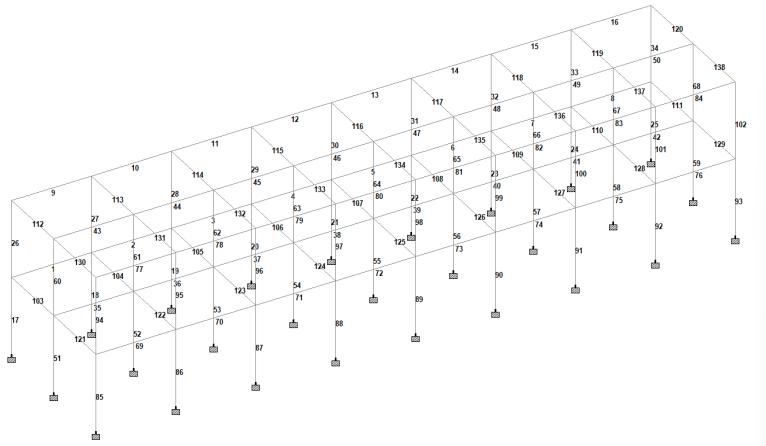
Fig.1–model
Step2-Loadcalculation
Loads applied to the structure is taken as live load, existing slab load and new slab load. Calculation of load canbedoneasfollows:-
Existing slab Dead load:
Thicknessofslab=200mm
UnitweightofRCC=25KN/m3
Floorloadduetoslab=25*0.2
=5KN/m2
New slab Dead load:
Thicknessofnewslab=200mm
UnitweightofRCC=25KN/m3
Floorloadduetoslab=25*0.2
=5KN/m2
International Research Journal of Engineering and Technology (IRJET) e-ISSN: 2395-0056
Volume: 11 Issue: 04 | Apr 2024 www.irjet.net p-ISSN: 2395-0072
Cover in slab
Atbottom=1inch=25.4mm
Attop=1inch=25.4mm
DeadLoad=25*0.254*2
=1.27KN/m2
Total dead load =5+5+1.27 =11.27KN/m2
Liveload=3KN/m2
Floorfinish=1KN/m2
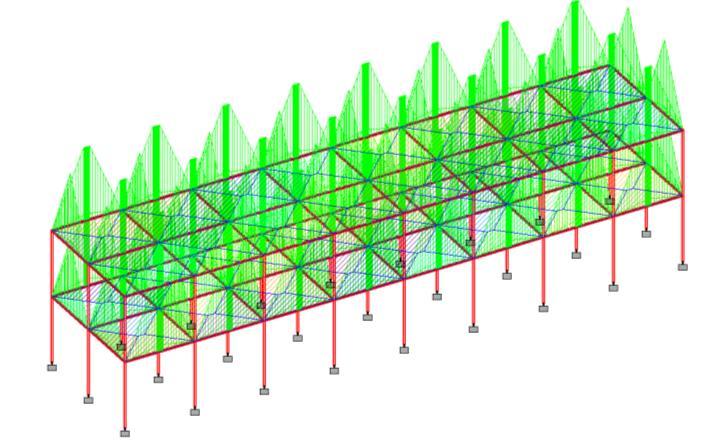
–Deadload
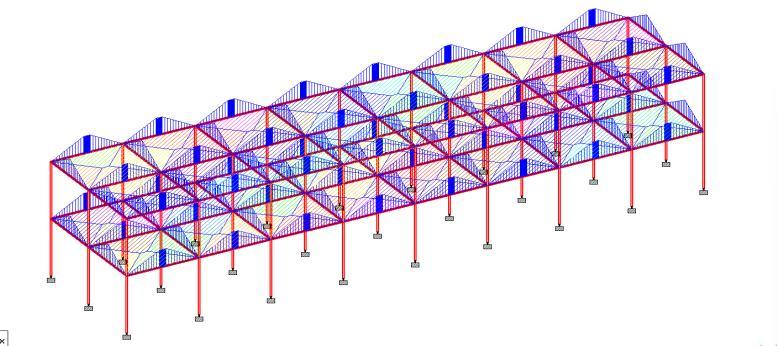
Fig.3–Liveload
5. RESULT AND DISCUSSION
The structure is analyzed using an eight block module in STAADPro software, and the 233tilization ratio comparisonofthevariouschannelsectioncombinationsis showninthetablebelow:-
Table-1
Volume: 11 Issue: 04 | Apr 2024 www.irjet.net p-ISSN: 2395-0072
The combination of ISMC 150 and ISMC 200 has the most efficient utilization ratio when compared to the other sections, as can be seen in the above table. Additionally, theratiodecreasesasonemovesupthesections,butfrom an economic perspective, ISMC 150 and ISMC 200 are the mostefficientandcanbeusedtostrengthenthestructure inthisproject
In summary, using channel sections as stiffeners in a rehabilitation project can significantly improve the current structure's structural stability and load-bearing ability. It is possible to successfully strengthen important components like beams, columns, and load-bearing walls by carefully incorporating channel sections into the framework. In addition to redistributing loads, this reinforcement minimizes structural flaws, lowering the chanceoffailureorcollapse.Furthermore,theadaptability of channel sections enables tailored solutions to handle certain structural issues, guaranteeing top performance and security. Furthermore, compared to other retrofitting techniques, the installation of channel sections as stiffeners is frequently a more economical and effective solution, minimizing interruption to continuing activities. Allthingsconsidered,addingchannelsectionsasstiffeners to rehabilitation projects is a dependable and useful way to increase the longevity and structural integrity of infrastructureandstructures.
International Research Journal of Engineering and Technology (IRJET) e-ISSN: 2395-0056
Volume: 11 Issue: 04 | Apr 2024 www.irjet.net p-ISSN: 2395-0072
[1] J. Mohan1 C. Selin Ravikumar2 and T.S. Thandavamoorthy3. Using Stadd Pro: Building Design And Analysis, Journal of Science and Technology (JST) Volume2,Issue3,May-June2017,PP27-33.
[2] Jiří Sedlák*, Petr Jelinek, Zuzana Stránská", Karel Struhala**, Environmental Aspects Of RenovationsCase Studies,6th International Building Physics ConferenceIBPC2015.
[3] Charles Thibodeaua,b , Alain Bataillea,⁎ , Marion Siéc,d, Building Rehabilitation Life Cycle Assessment Methodology–State Of The Art , https://doi.org/10.1016/j.rser.2018.12.037 , 16 December2018
[4] Beata Nowogo´nska, A Methodology For Determining The Rehabilitation Needs Of Buildings, http://dx.doi.org/10.3390/app10113873 , Appl. Sci. 2020,10,3873.
[5] Alem R.S Ghdoura1 , Vikas Srivastava2, Analysis of Steel Framed Structure using STAAD Pro and ROBOT Software,InternationalJournalofScientificEngineering and Technology Research, Volume.05, IssueNo.07, March-2016,Pages:1442-1449
[6]Gomasa Ramesh, Design and Analysis of Residential Building using STAAD-Pro, Indian Journal of Engineering,2021,18(49),185-190
[7]A.D.Bhosale, 1 Archit Pradip Hatkhambkar, 2Rupesh Vinayak Katkar, 2 Shubham Balasaheb Babar, 2 Sunny Pramod Gorivale, 2 ; Analysis and Design of MultiStorey Building by using STAAD-Pro V8i, International JournalofInnovativeScienceandResearchTechnology, Volume3,Issue4,April–2018
[8] By T. D. Bush,1 E. A. Jones,2 Behavior Of RC Frame Strengthened Using Structural Steel Bracing, Journal of StructuralEngineering,Vol.117,No.4,April,1991
[9] Ikbal Cetiner∗, Ecem Edis , An environmental and economic sustainability assessment method for the retrofitting of residential buildings , http://dx.doi.org/10.1016/j.enbuild.2014.01.020 , Accepted9January2014.
[10] S.S. Chandar1, Rehabilitation of Buildings, International Journal of Civil Engineering Research ,ISSN 2278-3652 Volume 5, Number 4 (2014), pp. 333338©ResearchIndiaPublications.
[12] Khalid Heiza, Ahmed Nabil, Nageh Meleka, and MagdyTayel,State-of-theArtReview:Strengtheningof Reinforced Concrete Structures – Different Strengthening Techniques , https://www.researchgate.net/publication/260991475 ,·March2014
[13] 1Mohamed Hamud Mohamed, 2Hanad Muse Ali, 3Abdikadir Hassan, 4Abdiaziz Abdillahi Elmi, 5AbdihakimLibanAbdi,6MonikaVerma, AREVIEWON DESIGN AND ANALYSIS OF MULTI-STOREY BUILDING BY STAAD.PRO , https://www.researchgate.net/publication/353917670 ,April2021
[14] Tejashree Kulkarni1 , Sachin Kulkarni2 , Anjum Algur3 , M. H. Kolhar4 , Analysis And Design Of High Rise Building Frame Using Staad Pro , International Journal of Research in Engineering and Technology , Volume:05Issue:04|Apr-2016
[15] AndreiM.Reinhorn1,Stefania Viti2andGianPaolo Cimellaro3 , Retrofit Of Structures: Strength Reduction WithDampingEnhancement
[16] by Rui Marques a, Paula Lamegoa,b, Paulo B Lourenço a, and Maria L Sousac,d , Efficiency And Cost- Benefit Analysis Of Seismic Strengthening Techniques For Old Residential Buildings In Lisbon , http://dx.doi.org/10.1080/13632469.2017.1286616 , Publishedonline:24Apr2017.
[11] Mª. Desirée Alba-Rodrígueza,⁎ , Alejandro Martínez-Rocamorab , Patricia González-Vallejoa , Antonio Ferreira-Sáncheza , Madelyn Marreroa , Building rehabilitation versus demolition and newconstruction: Economic and environmental assessment , http://dx.doi.org/10.1016/j.eiar.2017.06.002 , ; Accepted11June2017