
International Research Journal of Engineering and Technology (IRJET) e-ISSN: 2395-0056
Volume: 11 Issue: 04 | Apr 2024 www.irjet.net p-ISSN: 2395-0072
International Research Journal of Engineering and Technology (IRJET) e-ISSN: 2395-0056
Volume: 11 Issue: 04 | Apr 2024 www.irjet.net p-ISSN: 2395-0072
Sagar Datta1 , Dr. D.K. Bhalla2
1B.Tech. Mechanical Engineering (Evening) Scholar, School of Mechanical Engineering, Lingaya’s Vidyapeeth, Faridabad, Haryana, India
2Professor and LEET Coordinator B.Tech., M.Tech., PhD, FIE in Lingaya’s Vidyapeeth, Faridabad, Haryana, India ***
Abstract -Aluminiumalloythatisutilisedintheautomobile sector is used to process Resistance Spot Welding (RSW). The challenge of adjusting RSW parameters results in unevenweldquality.Theweldingcurrent,electrodeforce, and welding duration are critical RSW characteristics. An furtherRSWparameterthatisthoughttoberequiredisthe aluminium alloy's electrical resistance, which changes according to the material's thickness. When working with aluminium alloy, the RSW process's parameters are very sensitive to precise measurement. It was looked at if parameter prediction could be done by using an artificial neural network (ANN)todiscoverthe optimal parameter. Usingtheparametersandthealuminiumalloy'stensileshear strength as the input and output data, respectively, the artificialneuralnetwork(ANN)wascreatedandevaluated for predicted weld quality. The RSW procedure is implementedusingtheresultsoftheestimatedparameter optimisation and the tensile shear strength testing. The meansquarederror(MSE)andaccuracyofthetensileshear strength output were 0.054 and 95%, respectively. This suggeststhattheuseofartificialneuralnetworks(ANNs)in welding machine control has been very effective in determiningtheweldingparameters.
Key Words: RSWProcess,ANN,MSE,Aluminumalloyetc.
Every vehicle in production contains between 7,000 and 12,000 spot welds. A computer-controlled robotic welder usestheResistanceSpotWelding(RSW)methodtocomplete thewelds.RSWisbeingappliedtolighteraluminiumalloys moreoften[1,2].Intheprocessofproducingautomobiles, thinshellcomponentsareoftenjoinedusingthefastjoining method (RSW). Using lightweight materials to maintain robuststructuralvehiclebodieswhileconservingenergyand naturalresourcesisanessentialtask[3].Sincesteelisnow the main manufacturing material for vehicles, aluminium alloys,whichhavesubstantialmechanicalqualitiesandlow densities,arepredictedtobewidelyemployedinthefuture [4].Thisstudyisinterestedinthemechanicalcharacteristics and light weight of the 6061-T6 aluminium alloy. For the automobilesector,theRSWprocess'sweldqualityhasbeen a major issue. The accuracy and correctness of welding parameters have not always been achieved by manual computation, operator experience, or technician ability in alteringtheparametersettings.Previously,ithasnotbeen
possibletoverifythecomputationsusingidealparameters [5]. There are several sensitive aspects, making it challenging to adjust the parameters of each welding equipment. Due to this, testing several specimens of the building material in order to get sufficient findings from experimentstodetermineidealparametervalues.Thereare morethan200weldingmachinesineveryautobodyplant. The expense of modifyingtheparametersettingsfor each uniqueweldingmachinetype,forvariousmaterials(suchas thickness),forreplacementelectrodes,andotherfactorshas increased in an effort to achieve standard weld quality overall [6–8]. Thus, it's critical to comprehend the RSW process's parameter connections, quality-improvement strategies,evaluationandefficiencyforecasting,andsuitable parameteroptimisation.
Thisresearch,officiallynamed"parameteroptimisationfor resistancespotweldingof6061-T6aluminiumalloybased on artificial neural network," was prompted by the aforementioned issues. Using ANN will result in more accurate and efficient RSW parameter estimation. Particularly in the automotive sector, the ANN shown efficacy in solving both linear and nonlinear functions neededtomodifytheRSWparametersettingsofcomputer operatedroboticwelders.
The RSW procedure aims to minimise heat conduction to coldersurroundingmaterialwhileproducingheatquicklyin
International Research Journal of Engineering and Technology (IRJET) e-ISSN: 2395-0056
Volume: 11 Issue: 04 | Apr 2024 www.irjet.net p-ISSN: 2395-0072
thejointsofthematerialbeingwelded.Thisproductionof heatmaybestatedas
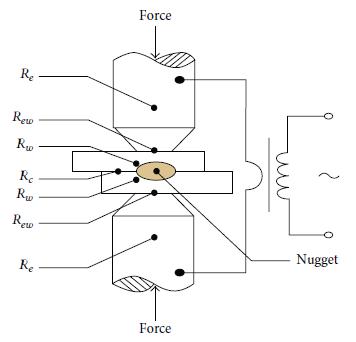
whereAisthetimeinseconds,Bistheresistanceinohms,C isthecurrentinamperes,andDistheheatenergyinjoules [9]. Figure 1 displays the resistances that the secondary circuit resistance welding equipment provided. AccordingtoFigure1,theoverallresistance,whichmaybe representedasfollows,determinestheresistanceintheRSW process.
��=����+2����+2������+2����, (2)
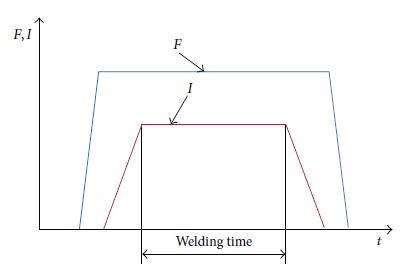
whereristhespecimen'scontactresistance,r'sisitstotal resistance,r'sisitselectroderesistance,r'sisitsspecimen resistance, and r's is its specimen electrode contact resistance.Themeltingtemperatureinthespotweldduring the RSW process and the material's weldability are both impacted bytheresistancetransformationofthematerial work piece [11, 12]. When smelting materials, optimal electrodeforceisrequiredfortheexplosivesolutions[13, 14], and the electric welding current's strength plays a significant role in influencing the heat production that causes smelting. The spot weld will produce intense heat whentheelectricintensityisstrong.Thiswillhaveanimpact ontheweldjoint'sstrengthandnuggetsize[15].Thelength oftheweldingprocessaffectsthemechanicalcharacteristics of the weld joints as the resistance and welding time determinethenuggetsizeandweldjointstrength[16,17] AsshowninschematicdiagramRSWcycleFigure2,where�� isweldingcurrent,��isweldingtime,and��iselectrodeforce, melting results from the link between welding current, weldingtime,andelectrodeforce.
Scholarshaveexamined the correlation between theRSW parameters and have confirmed that the welding process parameterssignificantlyimpactthequalityoftheweld[18, 19].Furthermore,thelargernuggetdevelopmentinthicker partscomparedtothinpiecesindicatestheimportance of thematerialresistancecausedbythethicknessofthework piece.Asuitablenuggetwillbeproducedinmaterialswith
lesser heat conductivity or those with high resistance conductivity [20].As a result, this research includes resistanceasacomponent.
This study examined the RSW procedure in a real-world automotive body plant using gun welds managed by an MFDCRexrothBoschwelder.Specimensofaluminiumalloy (6061-T6)withthicknessesof1and2mmwereweldedat threedifferentresistancelevels.Thethreeresistancelevels for the 2-2, 2-1, and 1-1 mm material thicknesses at high, medium,andlowthicknessesareshowninFigure3.
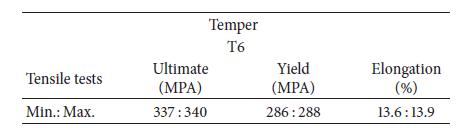
Tables1and2,respectively,illustratethemechanical and chemicalcharacteristicsbasedonKAISERALUMINIUM[21]. 6mm copper alloy electrode tips were employed in this study. Complete factorial analysis was included into the experimental design based on 34×3 = 243 runs were obtainedwhenallparametervalueswereadjustedonlow, medium, and high thicknesses of material. The welding current, electrode force, welding duration, and resistance settingsareasfollows:2-2,2-1,and1-1mm;20,28,and36 kA;2,4,and6kN;100,150,and200ms;andsoon.Welding experiments were then conducted once the welding parameters were entered in accordance with the experimental design. Testing and recording were done on thecompletedweldjointsandthemaximumtensileshear strength. As shown in Figure 4, the tests were conducted withtheHOUNSFIELD50kNatmaximumload.
Table1:Chemicalcharacteristicsofaluminiumalloy6061T6

Table2:Mechanicalcharacteristicsofaluminiumalloy 6061-T6.
International Research Journal of Engineering and Technology (IRJET) e-ISSN: 2395-0056
Volume: 11 Issue: 04 | Apr 2024 www.irjet.net p-ISSN: 2395-0072
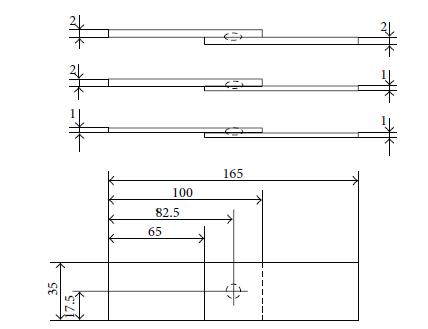
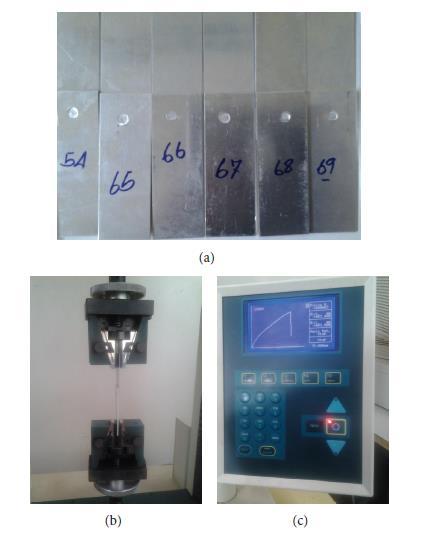
Figure4:showsthetestedclamping,thevisualmonitor, andtheweldjointin(a),(b),and(c)
Inthisstudy,theroboticweldersweretrainedusing75%of the 243 ANN trial findings. To evaluate and compare the experimental shear strength findings with the projected shearstrength,25%oftheresultswerechosenatrandom. The artificial neural network models were designed to determinethecorrelationbetweentheshearstrengthand theweldingsettings.AsFigure5illustrates,theANNmodel isamultilayeredfeed-forwardalgorithm.
Threelayersmakeupthealgorithm:thehiddenlayerthat sitsbetweentheinputandoutputlayers,theinputlayer,and theoutputlayer.Shearstrengthistheoutputlayer,andthe numberofinputneuronsintheinputlayerissettothelevel ofweldingparametersineachrunorder.
Usingthemultilayeredfeed-forwardapproach,theANNwas trainedusingthebackpropagationtechniqueandevaluated forpredictingshearstrengthusingtheweldingparameters as input data and the shear strength as output data. The ultimate transfer function was a pure linear sigmoidal function.
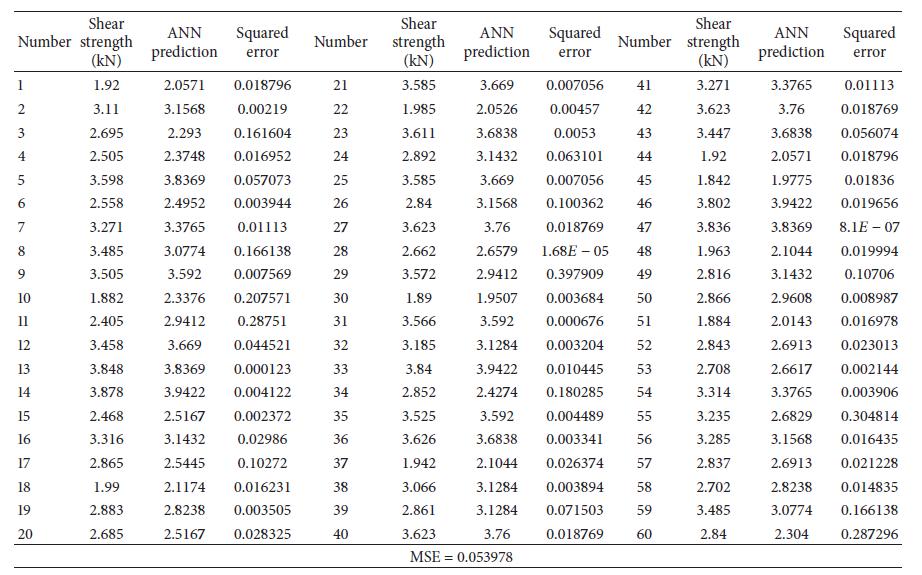
Inthisstudy,theuseofartificialneuralnetworks(ANNs)to computeoptimalparametersforweldingrobotcontrolwas investigated.TheANN-calculatedtensileshearstrength,or meansquarederror(MSE)oftheshearstrength,isshownin Table 3 after the experimental data have been used in practice. A MSE of 0.05 is the result. These findings demonstratethattheANNidentifiedtheproperparameter optimisation with acceptable outcomes. Using the ANN's experimental findings, the shear strength is determined. Figure6illustrateshowusingtheANNcomputationsleads toeffectiveparameteroptimisation.
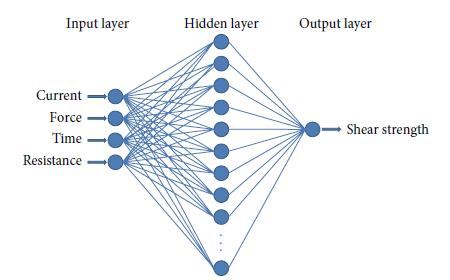
5:TheANNstructureforpredictingshearstrength
International Research Journal of Engineering and Technology (IRJET) e-ISSN: 2395-0056
Volume: 11 Issue: 04 | Apr 2024 www.irjet.net p-ISSN: 2395-0072
Table3:Themeansquarederror(MSE)computationis shown
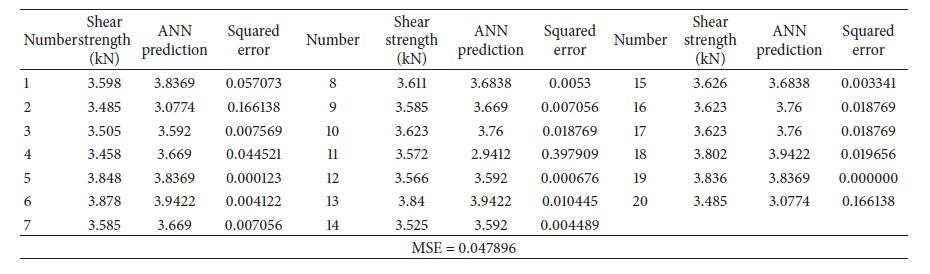
Therefore, ANN is seen to be a suitable optimisation approach for obtaining a solution that is both linear and nonlinear.Theinputlayer,hiddenlayer,andoutputlayerare thethreelayersthatmakeuptheANNmodel.Whiletraining and using the back propagation technique, the ANN was employed to determine the RSW parameters at the input layerandtheshearstrengthattheoutputlayer.25%ofthe 243 data values from the entire factorial experiment outcomes were used for assessing the correctness of the values computed by the ANN, and 75% of the data values were utilised for training. The findings indicate that the maximumlearningperiod,learningrate,MSEobjective,and hidden nodes are, in that order, 30, 0.001, 0.04, and 3,000,000. Twenty samples were evaluated and the mean squared error (MSE) was determined to be 0.047896 kN. This suggests that the ANN model can forecast the shear strength needed to change the RSW parameters that are beingtestedusingasmallsample,asTable4andFigure7 illustrate,respectively.ThisresearchsuggeststhattheRSW operatormayselecttheoptimisationparametersbyusinga smallsamplesetthatissuitableasinputintotheANNmodel. However, additional variables not covered by the ANN, including the specific model of welding machine, the specimen material's surface condition, the environment's coolingeffect,andelectrodewear,mayhaveanimpacton theparameters'correctness.
Table4:Meansquarederror(MSE)calculationfora20unitexperiment
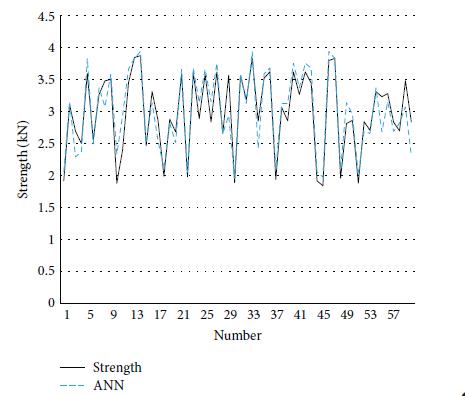
6:ANNpredictions
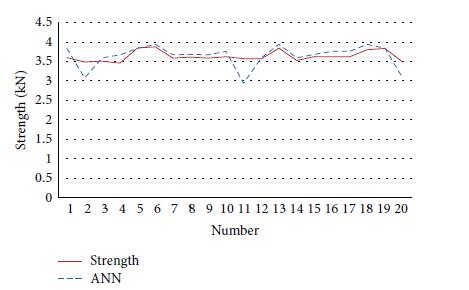
Figure7:The20-unitexperiment'sANNprediction scenario
In a Thai car body industry facility, the complete factorial experiment results and ANN were constructed and successfully tested. MSE and accuracy were found to be 0.054and95%,respectively.Reducingsampletestingand setuptimeprocesseswhile achievinggoodweldqualityis madepossiblebycalculatingatrustworthyestimateofshear strength. In order to compare the accuracy of different algorithms,futureresearchshouldevaluatetheprecisionof otheralgorithmsthatareusedtocomputetheseparameters.
International Research Journal of Engineering and Technology (IRJET) e-ISSN: 2395-0056
Volume: 11 Issue: 04 | Apr 2024 www.irjet.net p-ISSN: 2395-0072
[1]H.HuhandW.Kang,“Electrothermalanalysisofelectric resistance spot welding processes by a 3-D finite element method,” Journal of Materials Processing Technology,vol.63, no.1–3,pp.672–677,1997.
[2] W. Li, S. Cheng, S. J. Hu, and J. Shriver, “Statistical investigationonresistancespotweldingqualityusingatwostate, sliding level experiment,” Journal of Manufacturing Science and Engineering, Transactions of the ASME,vol.123, no.3,pp.513–520,2001.
[3]J.A.Khan,L.Xu,Y.-J.Chao,andK.Broach,“Numerical simulation of resistance spot welding process,” Numerical Heat Transfer Part A: Applications, vol. 37, no. 5, pp. 425–446,2000.
[4]J.Zhu,L.Li,andZ.Liu,“CO2anddiodelaserweldingof AZ31magnesiumalloy,” Applied Surface Science,vol.247,no. 1–4,pp.300–306,2005.
[5] H.-L. Lin, T. Chou, and C.-P. Chou, “Optimation of resistancespotweldingprocessusingTaguchimethodanda neuralnetwork,” Experimental Techniques,vol.31,no.5,pp. 30–36,2007.
[6] K. D. Weiss, “Paint and coatings: a mature industry in transition,” Progress in Polymer Science, vol. 22, no. 2, pp. 203–245,1997.
[7]X.Deng,W.Chen,andG.Shi,“Three-dimensionalfinite elementanalysisofthemechanicalbehaviorofspotwelds,” Finite Elements in Analysis and Design,vol.35,no.1,pp.17–39,2000.
[8]S.-H.Lin,J.Pan,T.Tyan,andP.Prasad,“Ageneralfailure criterionforspotweldsundercombinedloadingconditions,” International Journal of Solids and Structures,vol.40,no.21, pp.5539–5564,2003.
[9]N.T.WilliamsandJ.D.Parker,“Reviewofresistancespot weldingofsteelsheets:part2 factorsinfluencingelectrode life,” International Materials Reviews,vol.49,no.2,pp.77–108,2004.
[10] Y. Luo, J. Liu, H. Xu, C. Xiong, and L. Liu, “Regression modelingandprocessanalysisofresistancespotweldingon galvanizedsteelsheet,” Materials and Design,vol.30,no.7, pp.2547–2555,2009.
[11]P.H.Thornton,A.R.Krause,andR.G.Davies,“Contact resistancesinspotwelding,” Welding Journal,vol.75,no.12, pp.402.s–412.s,1996.
[12]A.G.Livshits,“Universalqualityassurancemethodfor resistance spot welding based on dynamic resistance,” Welding Journal,vol.76,no.9,pp.383–390,1997.
[13] R. B. Hirsch, “Making resistance spot welding safer,” Welding Journal,vol.86,no.2,pp.32–37,2007.
[14]J.Senkara,H.Zhang,andS.J.Hu,“Expulsionprediction inresistancespotwelding,” Welding Journal,vol.83,no.4,p. 123-S,2004.
[15]S.Satonaka,K.Kaieda,andS.Okamoto,“Predictionof tensile shear strength of spot welds based on fracture modes,” Welding in theWorld, vol. 48, no. 5-6, pp. 39–45, 2004.
[16]S.Aslanlar,A.Ogur,U.Ozsarac,andE.Ilhan,“Welding timeeffectonmechanicalpropertiesofautomotivesheetsin electricalresistancespotwelding,” Materials and Design,vol. 29,no.7,pp.1427–1431,2008.
[17] F. Hayat, “The effects of the welding current on heat input, nugget geometry, and the mechanical and fractural properties of resistance spot welding on Mg/Al dissimilar materials,” Materials and Design, vol. 32, no. 4, pp. 2476–2484,2011.
[18]T.Kim,H.Park,andS.Rhee,“Optimizationofwelding parametersforresistancespotweldingofTRIPsteelwith response surface methodology,” International Journal of Production Research,vol.43,no.21,pp.4643–4657,2005.
[19]R.S.Florea,D.J.Bammann,A.Yeldell,K.N.Solanki,and Y.Hammi,“Weldingparametersinfluenceonfatiguelifeand microstructure in resistance spot welding of 6061-T6 aluminumalloy,” Materials and Design,vol.45,pp.456–465, 2013.
[20]C.TsaiandJ.Papritan,“Modelingofresistancespotweld nuggetgrowth,” Welding Journal,vol.71, no.2, pp. 47–54, 1992.
[21]KAISERALUMINUM,“TrentwoodWorks WA99215 CERTIFIED Serial Number 4315467,” Article ID 4315467, TESTREPORT,December2013