
International Research Journal of Engineering and Technology (IRJET) e-ISSN: 2395-0056
Volume: 11 Issue: 04 | Apr 2024 www.irjet.net p-ISSN: 2395-0072
International Research Journal of Engineering and Technology (IRJET) e-ISSN: 2395-0056
Volume: 11 Issue: 04 | Apr 2024 www.irjet.net p-ISSN: 2395-0072
Manoj Kumar Bhati1 , Dr. D.K. Bhalla2
1B.Tech. Mechanical Engineering (Evening) Scholar, School of Mechanical Engineering, Lingaya’s Vidyapeeth, Faridabad, Haryana, India
2Professor and LEET Coordinator B.Tech., M.Tech., PhD, FIE in Lingaya’s Vidyapeeth, Faridabad, Haryana, India
Abstract- Thisessayoffersanassessmentoftheelectrical machineneedsforautomobiles,bothintermsofexistingand futuretechnology.Initially,10distinctelectrical machines are compared using market-available electric and hybrid automobilesasthe basis.Thecomparison'sobjective isto assessthevariouselectricalmachinetopologies,structures, operationalenvironments,andperformance.Severalcuttingedge electrical machine design methodologies have been investigated and researched by using them in the 10 machines that are being compared, and the future design needsofelectricalmachinesinautomotiveareoffered.The study'sresultdemonstratesthat,amongthemanyelectrical machinetopologies,permanentmagnettopologiesperform thebestandmaybeabletoaccommodatefuturedemands. Additionally,inordertoenableelectricaldevicestorunwith the necessary power density aim, aggressive cooling techniques like as spray, dripping, semi- or completely flooded,arerequired.Lastly,itseemsthatfutureelectrical machines may adopt the design to recycle principle with littletonoperformanceloss.
Key words: Electric vehicle, automobile, and electrical machineelectricvehicle
EversincetheGMEV1introducedelectricalcars(EVs)tothe marketin1996,theautomobileindustryhasacknowledged the potential of this technology to replace internal combustion engines (ICMs). However, the EV1's performanceandcostwereincomparabletothoseoftheICM cars because to the infancy of the electrical motor and battery technology at the time. However, because of the worrisome rates of climate change and the ensuing regulations, electrification of transport became a requirement rather than a choice. In order to prevent a drasticshiftandtoallowfortheadvancementofbatteryand motortechnologies,theautomobileindustryhasintroduced engineelectrificationandhybridelectricalvehicles(HEVs) asameansofmakingincrementalprogresstowardsclean vehicletechnology.UponexaminingEVandHEVproducts from their launch in 1996 until the late 2010s, all of the established topologies DC field rotor (DC), induction machine (IM), switching reluctance (SR), and permanent magnet(PM) havebeenfoundinautomotiveapplications [1].Asfarastheauthorisaware,SRisthefirsttopologyto
withdrawfromtherace;apartfromHolden-ECO,SRhasnot beenusedinthisapplication.Thisisduetothefactthatthe primary difficulties with SR machines are poor power densityandtorqueripple,bothofwhicharenecessaryfor the automobile industry, as well as the demand for an unusual converter, which raises the drive's overall cost. Additionally, the IM and DC have decreased; at this point, theyareonlyfoundinTeslaandRenault,respectively.With themajorityofelectricmotors,includingthoseseeninthe mostrecent2016ModelSfromTesla,thePMhasdominated theautomobileindustry.Automotiveapplicationshaveused a variety of PM machine topologies, including as internal (IPM), surface-mounted (SPM), and PM-assisted synchronousreluctance(SynRel-PM)[1].TheneedforPM materialisasignificantobstacleevenwiththewidespread use of PM equipment in the automobile industry. Consequently,decreasedPMdesignstrategieshavebeenput outandusedinthemostrecenttechnology.Forautomotive applications,otherpermanentmagnettypesasferriteand AlNiCo have also been thoroughly investigated [2]. As a result,10distinctelectricalmachinedesignsthatarebased on machines found in various EVs and HEVs have been chosenforcomparisoninthisresearch.Thepurposeofthe research is to assess the various electrical machines' topologies,structures,operatingenvironments,andoverall performance. Apart from electromagnetic performance, comparisonshavealsobeenmadebetweenmechanicaland thermal outcomes. Furthermore, by using them in the contrasted machines, many cutting-edge design strategies have been investigated and researched. In order to fulfil futureautomotiveobjectives,thisresearchinvestigatesthe feasibility of pushing the existing boundaries of electrical machinery.
2. A review of various electrical machine kinds based on market research
Ten cars, including hybrids and fully electric models, are showninTable1;theirelectricmotorshavebeenchosenfor comparisoninthissection. Thecross sectionand winding arrangementofthe10machinesareshowninFigure1.The selection of the machines was based on the availability of their information in the literature [3–15]. The chosen machinesfeaturerotortopologieswithDC,IM,andPM,SPM, IPM,andSynRel-PMforPMmachines,andonedesign(based ontheChevroletVolt2)withferrite.TheANSYSpackageis
International Research Journal of Engineering and Technology (IRJET) e-ISSN: 2395-0056
Volume: 11 Issue: 04 | Apr 2024 www.irjet.net p-ISSN: 2395-0072
usedtoperformtheanalyses.HondaCivic(HC)andAccord (HA) models have a focused winding in a traditional SPM arrangement.IntheHA,thePMsaremechanicallyburiedin therotorcoreframe,whereasintheHC,aretainingsleeveis used.Becausesegmentedstatorteethwithfocusedwinding arethedesigns'meritapproaches,automatedwindingwitha high impact factor is advantageous [3]. Nevertheless, in addition to the intricate previously described design elements buried PM and sleeve that are necessary for mechanicalsafety,theSPMstructureusesalargeamountof PM.Oneofthemostoftencomparedelectricalmachinesis the2010ToyotaPrius(TP1),whichhasbeenthesubjectof several articles serving as a standard for vehicle design research [4]. This is because the car is successful and the motor's information is publicly accessible. The IPM construction provides a broad power-speed range, high torque per magnet volume, and reluctance torque [5, 6]. Comparably,theIPMrotorconstructionofthe2014Toyota Prius (TP2) has a new magnet placed close to the rotor surface. To preserve strong mechanical performance and provide rotor cooling channels, the rotor's mechanical designhascomplexlyformedgaps.Theaxial lengthofthe twoChevroletVoltmotors(C1)and(C2)issmallerinCV2, despite having separate rotors and the same stator. Both motors are SynRel-PM, with CV2 being one of the few automotivemotorshavingferriteandCV1beingconstructed withamodestamountofNdFeB.Largearc-shapenumbers are used in the design to take advantage of ferrite's mass densityandinexpensivecost[7-9].BoththeBMWi3(BI)and the Nissan Leaf (NL) are electric vehicles that are being compared in this research. Both motors have a lower PM amountandaSynRel-PMstructure.BIwithcuttingdesign methods that emphasise the low magnetic amount advantage of the reluctance torque [10, 11]. NL has an unusualrotorconfiguration,withsmallermagnetsarranged in a V shape near the inner radius and larger magnets towardstheoutsiderotorradius[12,13].Lastbutnotleast are the non-PM Renault Zoe (RZ) and Tesla Model S (TS) machines,whichhaveanIMframeworkandaconventional DCrotor(fieldwound,FW)[12,13].It'simportanttonote that the RZ rotor is made up of a traditional commutated field winding rotor; all of Renault's HEVs and EVs are DC rotorvehicles[14].
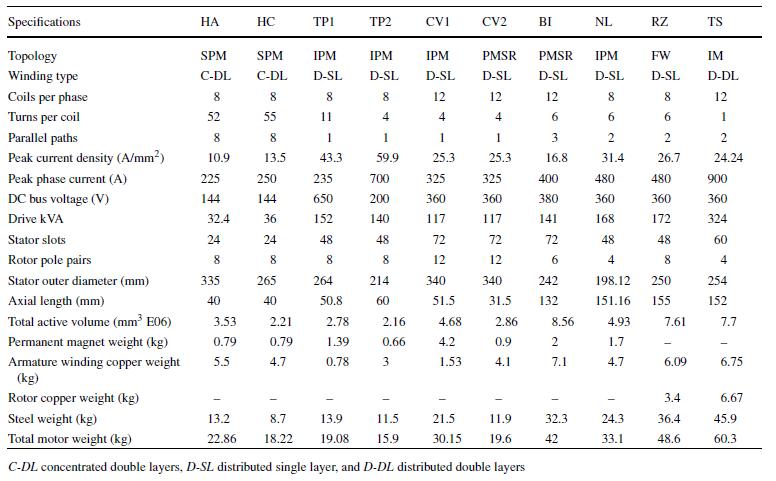
Withasophisticatedbutcreativerotorcoolingsystem,TSIM hasaddressedtheproblemofrotorheating[15].Theeight machines'primarydesignparametersareshowninTable2. All dispersed windings (DW) and concentrated windings (CW) are assumed to have packing factors of 0.6 and 0.4, respectively.Aoverviewofthe10machines'electromagnetic load and open circuit findings is shown in Table 3. The torquedensityinthePMtopologiesiscomparable,almost doublethatofthenon-PMtopologies.Similartrendsareseen inpowerdensity,withPMtopologieshavingvaluesthatare threetofourtimeshigherthanthoseofnon-Mtopologies. Due to its many low mass density ferrite particles and
severalfluxroutesthatprovideincreasedreluctancetorque, theCV2ferritearchitecturestandsout.
Themachine'sestimatedcostisdeterminedbycriteriasuch astorqueandpowerpermagnetweight.InadditiontoSPM topologies, which make the optimal use of PM material, SynRel topologies outperform IPM in terms of torque and power per magnet weight. Furthermore, because of their largenumberofturnsandlowvoltageinput,HAandHCare shown to be the best when using the inverter kVA, which measurestorqueperkVAandpowerperkVA.Ontheother hand, SynRel topologies have the maximum power per currentdensitywhencomparedtonon-PMtopologies,when consideringtheutilisationofcurrentdensity.Thereisalso moretorque percurrent densityintheSynRel topologies. This demonstrates how the SynRel uses the reluctance torquemorethantheIPM.
An overview of the machines under comparison's performance:
•WhencomparedtootherPMmachines,NLhasthegreatest power density, the most mild current density, and a temperatureriseasaresult.However,itfallsshortinterms oftorquedensityandtorquepervolume.
•BecauseCV2isthesoletopologyusingferritemagnets,it providesahighpowerdensityandpowerpervolume.The ferrite'slowmassdensityresultsinamodestoverallweight. TheincreasedpowercapacityofCV2isalsoattributedtoits high current density and the intense cooling that is necessaryforit.TheTP1andTP2aresmallandhencelightweightmachines, but the speedcapability ismechanically limitedbyhighstressresultingfromtherotorshape.High powerandtorquedensityaswellashighpowerandtorque per volume are the results of this. These devices are susceptible to rapid temperature increase, nevertheless, because of their compact size and high power density. Because of the tiny rotor diameter, which has a positive effect on mechanical performance and reduces stress, greaterspeedoperationispossible.
•Themaximumpowerdensity,torquedensity,andtorque pervolumearefoundinPMtopologieswithIPMandPMSR rotorconfigurations.Withrigorouscoolingtechniques,the performances'moderatetohighcurrentdensityallowsfora controlled temperature increase. Furthermore, these topologies offer high power and torque utilisation per current density, meaning they make effective use of the currentdensity.Unfortunately,thehighmechanical stress causedbytherotordesignincertainPMmachinesrestricts thespeedrange.
International Research Journal of Engineering and Technology (IRJET) e-ISSN: 2395-0056
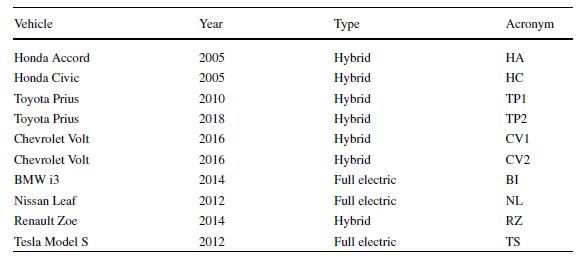
Table1liststheelectricmotorsforthestudy'shybridand electriccars.
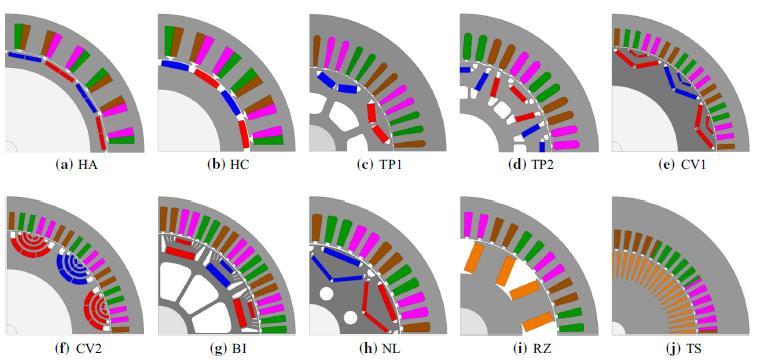
1:Crosssectionsofthemachinesunderstudy.(a)
Table2:StudyMachineDesignParametersand Specifications
RZ and TS, two magnet-less topologies, are capable of achievinghighpowerandtorquedensities.However,since these machines use rotors with active copper, rotor temperature is a problem. However, the variable field currentoftheRZwrappedfieldmachineprovidessuperior fieldweakeningcapabilities,althoughattheanticipatedcost ofcommutatorcomplexityandlosses.
Table3:Performanceoverviewofthedevicesunderstudy
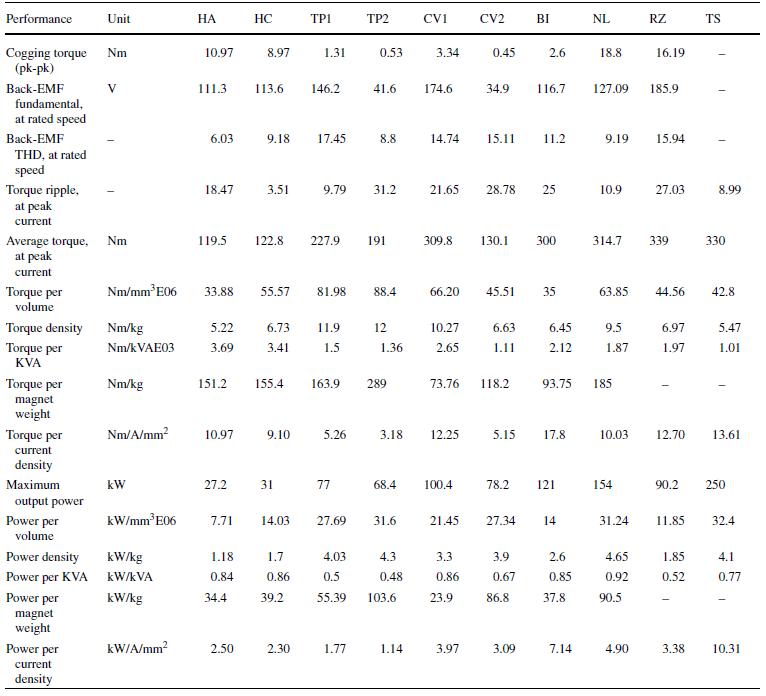
•Machinesthatarenaturallycooled(HC)andlesscomplexly cooled (HA) have poor torque and power densities. SPM topologiesarealsounsuitableforapplications requiring a broad speed range due to their poor field weakening capacity.
•TheBImachineislesscomplexlycooledbecauseofitslow currentdensity.Ontheotherhand,themachine'sincreased activematerialhasallowedforthehighpowerandtorque. Additionally, to sum up the results of the compared. The torquedensity,powerdensity,rotorperipheralspeed,rotor mechanicalstress,andnecessarycoolingtechniquesunder standardandhairpinwindingconfigurationsareshownin research, Fig. 2. The mechanical stress is estimated at a speedof15krpm,whereastheperipheralspeediscomputed at the machine's base speed. The torque and power densities' current limits are 13 Nm/kg and 4.5 kW/kg, respectively, as shown in Fig. 2. Additionally, when more aggressivecoolingtechniquesareused,torqueandpower densityriseintandemwithtime.Inasimilarvein,thetorque and power densities correlate with increases in the rotor mechanical stress and peripheral speed throughout the timeline.
Volume: 11 Issue: 04 | Apr 2024 www.irjet.net p-ISSN: 2395-0072 © 2024, IRJET | Impact Factor value: 8.226 | ISO 9001:2008
International Research Journal of Engineering and Technology (IRJET) e-ISSN: 2395-0056
Volume: 11 Issue: 04 | Apr 2024 www.irjet.net p-ISSN: 2395-0072
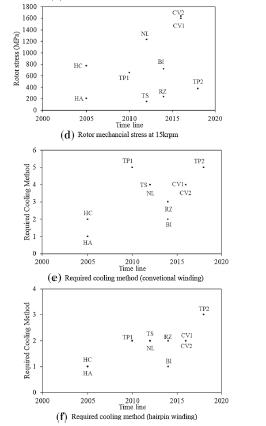
Figure 2: Electrical machine trend in both HEVs and EVs. Rotor peripheral speed at machine base speed (d) Motor density (a), power density (b), and torque density (c). Mechanical load on the rotor at 15 krpm (e) (f) Required coolingmethod(hairpinwinding)Neededcoolingmethod (conventionalwinding)
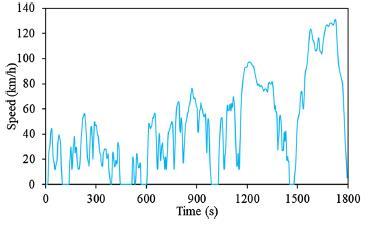
3 WLTPdrivingcycle
Table 4 ElectricalmachinetargetsbytheAPCandFC[17, 18]
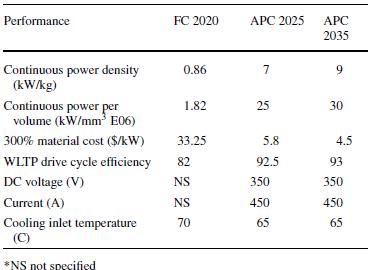
ThenewEuropeandrivingcycle(NEDC)willbereplacedby theglobalharmonisedlightvehicletestprocedure(WLTP) driving cycle by the end of 2019 for light-duty cars registered in the EU, Switzerland, Norway, Iceland, and Turkey.InFigure3,theclass3WLTPisshown.drivingcycle [16].AsshowninTable4[17],theUKAdvancePropulsion Centre (APC) has compiled the specifications for electric motorsinautomobilestosatisfythelegalrequirementsof 2025 and 2035. In a similar vein, Freedom-Car (FC), the counterpart in the USA, released the 2020 requirements [18].Givena 100kW maximumoutputpower, the torquespeedcharacteristicneededtosatisfythecriteriahasbeen estimatedforvariousgearboxratiosandisshowninFigure 4.Thegoalsforelectricalmachinedesignintheautomobile industrytofulfiltheperformancerequirementby2035are outlinedbelow.Ontheotherhand,costrequirementsand materialappropriatenessarehardertomeasure;still,when designing electric machines for the automobile industry, low-cost,rare-earthsteelgradesandminimalcopperusage shouldbetakenintoaccount.
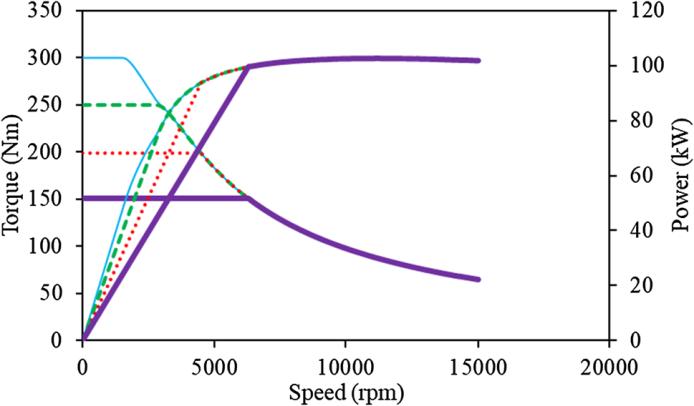
Fig. 4 Predictedtorque-speedcharacteristicsforfuture electricalmachinesinautomotive
International Research Journal of Engineering and Technology (IRJET) e-ISSN: 2395-0056
Volume: 11 Issue: 04 | Apr 2024 www.irjet.net p-ISSN: 2395-0072
Eventhoughthishasn'tbeenmadea requirementforEVs, optimising electric vehicles aims to minimise energy use while simultaneously improving driving performance, lowering expenses, and remaining light in weight. It is essentialthattheproblembephrasedtoconsiderallofthese conflicting aims simultaneously, since there isn't a single optimumsolution thatcan meetthemall."Multi-objective optimisation" describes a technique that assists in identifying the best solutions that trade off a number of objectives.Multi-objectiveoptimisationisyetanotherarea of intense investigation. Finite element analysis (FEA) combined with optimisation algorithms like the genetic algorithm (GA), particle swarm optimisation (PSO) algorithm, non-dominated sorting genetic algorithm-II (NSGA-II),fuzzymethod,andsequentialTaguchimethodis the most popular and extensively used technique for optimising electrical machines. Furthermore, a potential technique for effective multi-objective optimisation is the implementation of multilevel optimisation approach, particularly for optimisation techniques that must successfully address multi-parameter and multi-objective optimisationissues.Thepreviouslyoutlinedtechniqueshold promise for the efficient multi-objective optimisation of electricaldeviceswithlargedimensionsintendedforusein theautomobilesector.
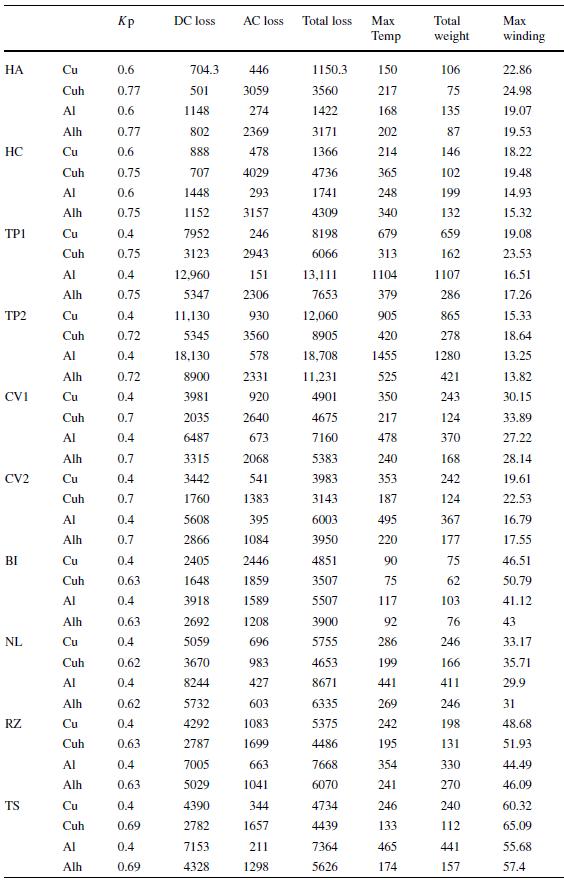
Table10comparestheAClossat5000rpmofstandard copper/aluminumwindings(Cu/Al)versushairpin copper/aluminumwindings(CuH/Alh).Theweight(kg), temperature(C),ACandDCloss(W)
Inthisarticle,cutting-edgeautomobileelectricalmachinery anddesignmethodologiesarecompared.Tendesignswith varyingtopologiesandparametersthatwerebasedonthe literatureavailableonthemarkethavebeencompared.In this comparison, the machines that use PM aided SynRel topologieshavethegreatesttorquedensityandtorqueper volume together with the highest power density. By outlining the Advanced Propulsion Centre (APC) ambitionsfor2035,projectingatorque-speedprofile,and workingtowardstheWLTPdrivingcycle,thefuturegoalsfor electrical motors in automotive applications are shown. Moreover, cutting-edge design methodologies have been
International Research Journal of Engineering and Technology (IRJET) e-ISSN: 2395-0056
Volume: 11 Issue: 04 | Apr 2024 www.irjet.net p-ISSN: 2395-0072
examined by using them in diverse topologies to demonstrate the impact of these methods and their capacity to advance the designs towards future goals. Hairpin winding, complicated cooling, rotor mechanics, recyclabledesign,andreducedandrare-earthfreemachines are among the strategies under investigation. Higher heat dissipation and a notable decrease in the winding's loss density are two benefits of hairpin winding. Hairpin winding may thus be used to create a reduced temperature increase, smaller size, and greater power density.Semi-floodedcomplexcoolingremovesalotofheat fromthestatorwinding,increasingcurrentdensityand,in turn,powerdensity.Ontheotherhand,problemswiththe airgapsleeveandsealingimpairmachineperformanceand increase assembly complexity. Ferrite, a rare-earth free machine, has potential applications in the automobile industry. Less weight is possible because to the low mass density; nevertheless, the ferrite's poor coercivity makes fieldweakeningsimpler.Asaresult,afieldweakeningmore than1isoftenseen,whichlowersthebroadpowercapacity throughout the speed range. Lastly, aluminium hairpin winding offers the advantages of reduced AC loss, less weight,andcost-effectivenesscombinedwitha promising designthatcanberecycled.
1. Zeraoulia M, Benbouzid MEH, Diallo D (2006) Electric motordriveselectionissuesforHEVpropulsionsystems:a comparative study. IEEE Trans Veh Technol 55(6):1756–1764
2.KimiabeigiMetal(2018)Productionandapplicationof HPMS recycled bonded permanent magnets for a traction motor application. IEEE Trans Ind Electron 65(5):3795–3804
3.OlszewskiM(2006)Evaluationofthe2005HondaAccord hybridelectricdrivesystem.Oakridgenationallaboratory, ORNL/TM2006/535.
4.OlszewskiM(2011)Evaluationofthe2010ToyotaPrius hybridsynergydrivesystem.Oakridgenationallaboratory, ORNL/TM-2010/253.
5.ZhuZQ,ChuWQ,GuanY(2017)Quantitativecomparisonof electromagnetic performance of electrical machines for HEVs/EVs.CESTransElectrMachSyst1(1):37–47
6. . Guan Y, Zhu ZQ, Afinowi IAA, Mipo JC Farah P (2014) Design of synchronous reluctance and permanent magnet synchronous reluctance machines for electric vehicle application. 201417th InternationalConferenceonElectrical Machines and Systems (ICEMS),Hangzhou,2014,pp.1853–1859.
7.MomenF,RahmanK,SonY(2019)Electricalpropulsion systemdesignofchevroletboltbatteryelectricvehicle.IEEE TransIndAppl55(1):376–384
8. Jurkovic S, Rahman K, Bae B, Patel N and Savagian P, (2015) "Next generation chevy volt electric machines; design,optimizationandcontrolforperformanceandrareearthmitigation," 2015IEEEEnergyConversionCongressand Exposition (ECCE),Montreal,QC,2015,pp.5219-5226
9.Anwar,Mohammad,etal.(2015)PowerDenseandRobust Traction Power Inverter for the Second-Generation Chevrolet Volt Extended-Range EV. SAE Int J Altern Powertrains JSTOR
10.MerwerthJ(2014)Thehybrid-synchronousmachineof the new 642 BMW i3 and i8. BMW group. https://www.speakev.com/20140404_bmw-pdf
11. BMW (2017) Specifications. The new BMW i3. BMW MediaInformation.https://www.press.bmwgroup.com
12.StatonDandGossJ,(2017)OpenSourceElectricMotor ModelsforCommercialEV&HybridTractionMotors,"2017 CWIEME,Berlin,2017.
13.RoggiaSand.Iacchetti M,(2016)Opensourceelectric motormodelsforcommercialEV&hybridtractionmotors. International conference on electrical machines ICEM, Lausanne,
14.FedoseyevL,PearceE(2016)Rotorassemblywithheat pipecoolingsystem.U.S.Patent2014036806A1
15. Kane M (2015) Renault electric motor production at Cleon.RenaultGroup.
16.WLTP Facts, What is WLTP. https://www.wltpfacts.eu/what-iswltp-how-will-it-work/
17. APC (2020) Electric Machines Roadmap. APC. https://www.apcuk.co.uk/app/uploads/2021/09/https___w ww.apcuk_.co_.uk_app_uploads_2021_02_Exec-summaryTechnology-Roadmap-Electric-Machines-final.pdf
18. US Department of Energy (2011) Hybrid and Electric Propulsion.https://www1.eere.energy.gov/vehiclesandfuels /pdfs/mypp/3-2_hybr_elec_prop.pdf
19.StatonD(2018)Electricmotordesign:trade-offanalysis. CWIEME,Berlin
20.AfinowiIAA,ZhuZQ,GuanY,MipoJCandFarahP(2014) Performanceanalysisofswitched-fluxmachineswithhybrid NdFeB and ferrite magnets. 2014 17th International Conference on ElectricalMachines and Systems (ICEMS), Hangzhou,pp.3110–3116.