
International Research Journal of Engineering and Technology (IRJET) e-ISSN: 2395-0056
Volume: 11 Issue: 04 | Apr 2024 www.irjet.net p-ISSN: 2395-0072
International Research Journal of Engineering and Technology (IRJET) e-ISSN: 2395-0056
Volume: 11 Issue: 04 | Apr 2024 www.irjet.net p-ISSN: 2395-0072
Dev Prakash Tiwari1 , Suraj2, Aditya Mishra3
1B.Tech. Mechanical Engineering (Evening) Scholar, School of Mechanical Engineering, Lingaya’s Vidyapeeth, Faridabad, Haryana, India
2B.Tech. Mechanical Engineering (Evening) Scholar, School of Mechanical Engineering, Lingaya’s Vidyapeeth, Faridabad, Haryana, India
3B.Tech. Mechanical Engineering (Evening) Scholar, School of Mechanical Engineering, Lingaya’s Vidyapeeth, Faridabad, Haryana, India ***
Abstract – One significant way to cut greenhouse gas emissionsisbyusingelectriccars.Inadditiontolowering relianceonfossilfuels,electriccarshelplessentheeffectsof compoundsthatdepletetheozonelayerandencouragethe widespread use of renewable energy sources. Electric car manufacturing and network models are still limited and evolving despite extensive study on the features and propertiesofelectricvehiclesaswellasthenatureoftheir charging infrastructure. The study addresses the various modellingapproachesandoptimisationmethodsusedinthe studiesofthemarketpenetrationratesofelectricvehicles, hybridelectricvehicles,plug-inhybridelectricvehicles,and batteryelectricvehicles.Thereportisdistinctiveinthatit addresses the fundamental obstacles and inadequate charging infrastructure for a developing nation like India. When renewable energy sources are unavailable, there is nowanadditionalpowersourcethankstothedevelopment oftheinnovative Vehicle-to-Gridconcept. We cometo the conclusionthatconsideringtheuniquequalitiesofelectric carsiscrucialtotheirmobility.
Keywords: Optimisation methods, E-Vehicle, Charging, Hybridvehicleetc.
1. INTRODUCTION
Electricvehicles(EVs)areemergingasapossibleavenuefor enhancing air quality, energy security, and economic opportunityduetothefastgrowthoftheIndianautomobile sector.TheIndiangovernmentunderstandshowimportant itistoinvestigatesustainablemobilityoptionsinorderto lessen reliance on foreign energy sources, cut greenhouse gasemissions,andlessenthenegativeeffectsoftransport, suchasglobalwarming.Byadoptingpreventativestepsto lessen the catastrophic climate change that threatens the planet's biodiversity, carbon dioxide emissions may be decreased.Significanteffortshavebeenmadetoreducethe amount of fossil fuels used for energy production, transportationpropulsion,energyconsumption,andcarbon sequestration protection. An approach to reduce carbon dioxidepetrolemissionsmightbeelectricvehicles[1].Even ifEVadoptionhasstarted,peoplestillrelyoncarsthatrun onfossilfuels.Incontrasttotraditionalfossilfuel-powered cars,electricvehicles(EVs)havedifficultieswithlifecycle
assessment (LCA), charging, and driving range. The manufactureofelectricvehiclesemits59%moreCO2than thatofinternalcombustionengines.Fromatanktowheel perspective,theICEVemits120g/kmofCO2,butfroman LCAperspective,thisrisesto170–180g/km.AlthoughCO2 emissionsfromEVsarezerofromtanktowheel,weestimate thataverageCO2emissionsareassessedacrossthecar'slife cycleratherthanjustonevehicle.Dependingonthepower sourceusedwhenthecarismadeandoperated,theoverall CO2outputduringitslifetimevariesgreatly[2].Duetothe transportationsector'sharmfulemissionsandvariousOEM investments,thereisarisingworryabouttheneedformore affordableandefficientelectricvehiclesintheyearstocome. TheadoptionofEVsinIndiamaybeinfluencedbyanumber ofvariables,includingimprovementsintechnology,falling carprices,governmentpolicysupport,incentivesforbuying new cars, parking benefits, and well-developed public charging infrastructure. Since there is relatively little manufacturingofEVs,theirentiremarketshareinIndiais quite small. Electric vehicles (EVs) may be classified into threecategories:i)three-wheelers,suchase-rickshaws;ii) four-wheelers,whichincludeelectricautomobiles.TheReva ElectricCar,thecountry'sfirstelectricvehiclemanufacturer, wasfoundedintheearly2000swiththegoalofproducing automobilesatareasonablepricepointusingcutting-edge technology. Mahindra Electric Mobility Ltd., the only producerofBEVs,isatthetopoftheIndianmarket.Honda Motors Co. Ltd., BMW AG, Volvo Car Corporation, Toyota Kirloskar Motor Pvt. Limited, and other significant HEV manufacturers are also present in the Indian market. The Mahindrae2oPlus,Mahindrae-Verito,Mahindrae-KUV100, Eddy Controls Love Bird, Atom Motors Stellar, and Tata Tiago Electric were a few of the other models [3]. 3202 million metric tonnes of carbon dioxide equivalent were India'stotalgreenhousegasemissionsin2014,makingup 6.55% of the world's total emissions. The energy sector accountsfor68%ofgreenhousegasemissionsinIndia.Then come improvements in land use and forestry, waste, manufacturing, agriculture, and 6.0%, 3.8%, and 1.9% of emissions,respectively[4].Forthepurposeofstandardising the grid with a significant portion of variable renewable energyoutput,anelectriccarmaybeusedasaflexibleload [5]. Because a single transaction has little influence, the owners of electric vehicles do not engage in the energy
International Research Journal of Engineering and Technology (IRJET) e-ISSN: 2395-0056
Volume: 11 Issue: 04 | Apr 2024 www.irjet.net p-ISSN: 2395-0072
market [6]. A contemporary approach for estimating exogenous smart policies which were predetermined in anticipation of changing scenarios was examined by certainwriters[7–12].Itisimportanttohavevariableload andintelligentchargingproceduresinordertofullyusean electricvehicle.Accordingtoadifferentresearchby[13],EV usersbandedtogethertoinformtheaggregatorabouttime andenergyrequirements. Whilethe batterylevel satisfies theenergyneed,thetimelinessrequirementestablishesthe deadlineforfinishingachargingprocedure.Accordingtoa relatedresearchby[14],ownersofelectriccarsshouldget price signals from both a central and a decentralised framework,withtheexpectationthatthetwowouldoverlap. Thestochasticsimulationapproachofanelectricvehiclewas examinedbyBradyandMahony,2016[15]inordertocreate adynamictripitineraryandchargingprofileforthepurpose of EV propulsion in the actual world. They came to the conclusion that both the accuracy of the parking time distribution and the model as a whole would rise with greaterparkingtimedistributioncircumstances.According to a study conducted by Morrissey et al., 2016 [16], a number of electric vehicle owners choose to charge their carsathomeintheevening,whendemandforpowerisatits highest. Peak charging is more harmful than off-peak charging,accordingtoresearchbyFoleyetal.,2013[17]on the effects of EV charging in a single, large Irish energy market under peak and off-peak charging conditions. In order to determine the carbon dioxide emission levels of BEVs and PHEVs, Doucette and Mc Culloch, 2011 [1] compared their findings with the CO2 emissions of Ford Focus vehicles. Steinhilber et al., 2013 [18] examined the mainobstaclestoanEVintwonationsinordertostudythe necessary instruments and approaches for bringing new technology and innovation. A driving pattern recognition methodwaspresentedbyYuetal.,2012[19]toassessthe EVs' driving range using the trip segment partitioning algorithm.Bydevelopingavehiclemodel,Hayesetal.,2011 [20]lookedintovariousdrivingsituationsandtopographies.
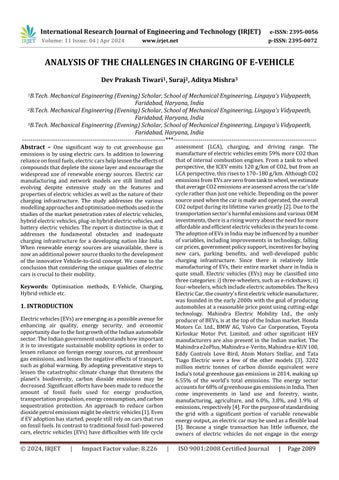
We haveresearched theseveral kindsof electriccarsthat are now on the road worldwide. In addition, we have identified the obstacles facing EVs in the Indian market. Additionallycoveredareseveraloptimisingstrategies.Fig.1 presents the comprehensive overview of electric vehicles thatwasexamined.Thisessayisdividedintomanysections, including:TheprocessisexplainedinSection2.Asummary of all the different configurations for electric vehicles is provided in Section 3, and then in Sections 4 and 5, the chargingscenarioandtheelectriccarbarrierarediscussed. InSection6,theEVandV2Goptimisationapproachisgiven, andinSection7,itisconcluded.
Theholygrailofelectricvehiclesistoswapouttheirinternal combustion engine with an electric motor that runs on
batteryenergyviaapowerelectronictractioninverter.The electricmotorisveryefficientsinceitonlyutilises90–95% of the input energy to power the vehicle. The battery, chargingport,charger,DC/DCconverter,powerelectronics controller, regenerative braking,and drive systemarethe essential parts of an electric vehicle. The electric motor's function is to use the electrical energy that is kept in batteries to power the electric vehicle. Since they are recharged using power sources with less emissions, EVs becomemoreenvironmentallybeneficial.Theelectricalgrid provides the cells with power. The main purpose of the battery is to provide the electric automobile with enough electricity to start it. Since lithium-ion batteries are lightweightandneedverylittlemaintenance,theyareoften used in electric vehicles (EVs). Comparing the production costofLi-ionbatteriestolead-acidandnickel-metalhydride batteries, they are a little more. Li-ion batteries have a lifespanofeighttotwelveyears,dependingontheclimate andmaintenanceregimen.
Thechargingportisthelocationwherethecarmayconnect to an external power source so that the battery can be chargedusingacharger.Usingachargeport,thecharger's job is to accept the AC power from the power source and transform it into DC power so that the battery may be charged.Whilethebatteryisbeingcharged,italsokeepsan eyeonitsvoltage,current,temperature,andlevelofcharge. To power the car accessories, the DC/DC converter transformshighvoltageDCpowerfromthebatteryintolow voltageDCpower.Byregulatingtheflowofelectricalenergy fromthetractionbattery,thepowerelectronicscontroller regulates the torque and speed of the traction motor. Regenerativebrakingiscrucialforpreservingthestrengthof thevehicleandproducingmoreenergy.Usingthemotor's mechanical energy, this braking technique transforms kineticenergyintoelectricalenergytoreplenishthebattery. Regenerativebrakingisoftenusedinallhybridandbattery electricvehicle(BEV)typessinceitextendstheEV'srange. Here, the automobile travels ahead thanks to the electric motor'sforwardmotion,andwhenthebrakeisapplied a processknownasregenerativebraking themotormaybe utilisedtochargethebatteries.15%oftheenergyconsumed
International Research Journal of Engineering and Technology (IRJET) e-ISSN: 2395-0056
Volume: 11 Issue: 04 | Apr 2024 www.irjet.net p-ISSN: 2395-0072
for acceleration may be recovered. Despite being a useful part, it cannot completely recharge the electric car. By delivering mechanical energy into the traction wheel, the drivesystem'sjobistocreatemotion.Theelectriccarhas severalinternallayoutsdependingonhowthecomponents areused,anditdoesn'tneedatraditionalgearbox.Certain designs,forinstance,makeuseofmanytinymotorsthatare meanttopowereachwheelseparately.
AlthoughEVshavebeencreatedinmanynations,China,the UK,theUSA, and Germanyaccountforthe majorityof the globalEVmarket.Globally,theEVmarketisexpandingquite quickly.HybridElectriccars(HEV),Plug-inHybridElectric Vehicles(PHEV),andBatteryElectricVehicles(BEV)arethe threecategoriesintowhichthecarsmaybedivided.
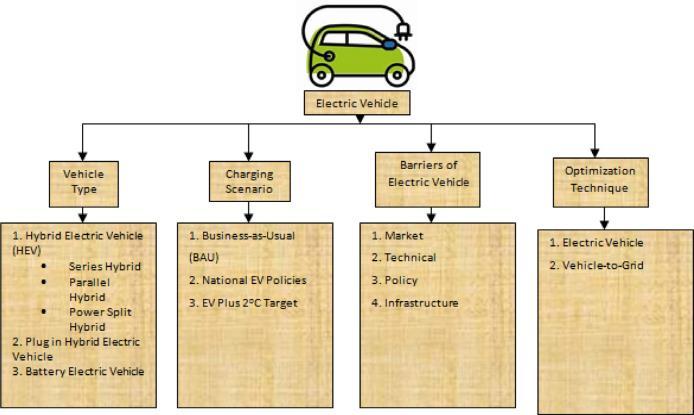
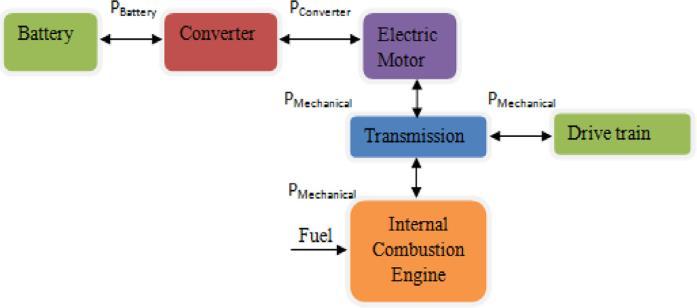
Anelectricmotorandaninternalcombustionenginemake up a hybrid electric car. Here, the engine and the energy produced during braking and deceleration are used to chargethebatteries.Becausetheycombineanelectricmotor as a power converter with a combustion engine, they are knownashybridcarsinthemoderncontext.Thetechnology of hybrid electric vehicles is being used all over the globe becauseofitsnumerousbenefits,which includeproviding modern performance without requiring a charging infrastructure.Theycanalsosignificantlyreducefuelusage by electrifying the power train. Depending on the kind of hybridsystem,thereareseveraltopologiesinwhichtheHEV maybelinked.Thesethreetypesofhybridsarepower-split, parallel,andseries.Theelectricmotorinaserieshybridis thesolesourceofpowerforthewheel.Eitherthegenerator orthebatteryprovidesthemotorwithpower.Here,anIC engine is used to charge the batteries so that an electric motorcanrun.Thecomputerdetermineshowmuchpower comesfromtheengine/generatororthebattery.Thebattery packisenergisedbyboththeengine/generatorandtheuse ofregenerativebraking.Largerbatterypacks andmassive motors paired with tiny internal combustion engines are typical features of the HEV series. They are supported by ultra-caps,whichwork toincreasethe battery's efficiency and reduce loss. They absorb regenerative energy during stopping and release their maximum energy when accelerating.
Anelectricmotorandaninternalcombustionenginemake upaplug-inhybridelectricvehicle(PHEV).Thesecarsrun onpetrolandfeaturealargerechargeablebatterythatisfed energytochargeit.Plug-inhybridelectricvehiclesprovide thefollowingadvantages:ReduceduseofpetroleumAbout 30–60%lessoilisusedbyPHEVsthanbyconventionalcars. Plug-in hybrids lessen reliance on foreign oil since the majorityofpowerisgenerateddomestically.greenhousegas emissions PHEVs often produce less greenhouse gas emissionsthanregularcars.However,themethodusedto generate power affects how much gas is released. For instance, power plants using hydropower and nuclear energy are cleaner than those using coal. It takes time to recharge.A240Vhomeor publicchargermayrechargea deviceinonetofourhours,buta120Vdomesticoutletmay takemanyhours.Inaslittleas30minutes,thebatterymay be quickly charged to 80% of its capacity. But these cars don'tneeda plugtooperate.Theycanonlyrunonpetrol, andtheywon'tgetthemostrangeorfuelefficiencyifthey aren'tcharged.CalculatingfuelefficiencySinceaplug-inmay operate on electricity, petrol, or a mix of the two, the Environmental Protection Agency gives a fuel efficiency estimateforcombinedcityhighwaytravelforpetrolsolely, electriconly,andgasandelectricoperation.
Acompletelyelectriccarisabatteryelectricvehicle,orBEV. Itispoweredbylargecapacityrechargeablebatterypacks that may be charged externallyinstead of a petrol engine. The internal electronics and electric motor of a batteryelectric vehicle are powered by chemical energy that is storedinrechargeablebatteries.AccordingtoAndwarietal. (2017),theBEVhasthepotentialtodecreasecarbondioxide emissions from light-duty vehicle fleets while simultaneouslydecreasing relianceonfossil fuel-powered cars.According to reports, BEVs contributed over 70% of commercein2017andarepredictedtocontinuegrowingin thenextyears,givingthemthegreatestshareoftheIndian market. Even though BEVs outsold PHEVs in several countriesuntil2014,PHEVsaleshaveincreasedsignificantly overtheprevioustwoyearstoalmostmatchBEVsales.The typesofbatteriesusedintheIndianmarketmaybedivided
International Research Journal of Engineering and Technology (IRJET) e-ISSN: 2395-0056
Volume: 11 Issue: 04 | Apr 2024 www.irjet.net p-ISSN: 2395-0072
intothreecategories:lithium-ion,lead-acid,andnickel-metal hydride. Maharashtrais the stateinIndia where themost electric vehicles were sold in 2017. Similar types of publicationscomparethemethodsusedtoestimatetheSOC andSOHofbattery-electricandhybridcars.
Thedevelopmentofefficientbatteriesisprioritisedsincethe usageofelectricvehicles(EVs)isexpectedtoriseinthenear future.BetterBTMSshavesignificantchallengesbecauseto battery thermal deterioration, which reduces EV range. Controllingthebatterycell'stemperatureinordertoprolong itslifeistheprimarygoaloftheBTMS.Inelectricvehicles, Li-ion batteries are often used for their energy storage capabilities. Numerous difficulties exist, including poor efficiency at high and low temperatures, a reduction in electrodelifeathightemperatures,andadirectimpacton the vehicle's protection, cost, performance, and dependability.Therearealsosafetyconcernswiththermal runaway in lithium ion batteries. For an electric car to succeed in the long run, one of the most important technologies is an efficient thermal battery management system. The ideal operating temperature range for Li-ion batteriesistypicallybetween25and40degreesCelsius.The lifeofthesebatteriesisshortenedwhentheirtemperature risesover50°C.
InIndiafornow,theEVmarketisminuscule.Forthelasttwo years,salesofelectricautomobileshaveplateauedat2000 unitsannually.However,thegoal isforall electric vehicle sales to reach 100% by 2030; as of 2020, the compound annualgrowthrateisat28.12%.Sinceits2001introduction, India'sfirstelectricvehicle,theMahindraReva,hasmanaged tosellasmallnumberofvehicles.ToyotadebutedthePrius hybrid in 2010 and the Camry hybrid in 2013. In several places,theusageofhybridandelectricbusesasatestproject hasbegun.Recently,electrictransitwasmadeavailableona busy city corridor by the Bangalore Municipal transit Corporation. A poll conducted in the city of Ludhiana revealed that 36 percent of those who now own cars and two-wheelerswereeagertoswitchtoelectricvehicles.The stategovernmentofTelenganaisalsopromotingtheusage of EVs and has declared that owners of EVs would not be requiredtopayroadtaxes.TheTelenganaStateElectricity RegulatoryCommission(TSERC)authorisedanINR6charge rateforelectricvehiclesin2018.Additionally,theTSERCset thestate-widecostofserviceatINR6.04/kWh.Additionally, PowerGridCorporationofIndiaLtd.andHyderabadMetro Rail have partnered to provide EV charging stations. The Hyderabadmetrorailissettobecomethefirstinthenation to have electric vehicle (EV) charging stations that are controlled and monitored by the power grid. The governmentofHyderabadisalsoconsideringswitchingto electric public transport vehicles from diesel ones. The governmentofNewDelhiwasgrantedpermissionthisyear
to install 131 public charging stations across the nation's capital.TheDelhigovernmentunveileda draftstrategy in November2018withthegoalofconverting25%ofitscars toelectricvehicles(EVs)viaavarietyofincentivesandthe installationofcharginginfrastructureinbothresidentialand non-residentiallocations.Byprovidinga100%subsidy(up toINR30,000)andwaivingtheroadtax,parkingfees,and registrationcostforelectricvehicles,thisprogrammeaims to provide a charging station every three km by 2023. A privatecompanycalledMagentaPowerisalsoplanningto provideEVcharginginfrastructurealongtheMumbai-Pune motorway.
India's state and federal governments have introduced a numberofprogrammesandincentivestoencouragetheuse of electric vehicles.The following listincludesa fewofthe schemes.TheGovernmentofIndiaannouncedtheNational ElectricMobilityMissionPlan(NEMMP)2020withtheaim of improving the country's energy security, reducing the negativeenvironmentalimpactoffossilfuel-poweredcars, andfosteringthegrowthofindigenousmanufacturingskills (GoI,2012).TheNEMMP2020maycontributetothesaleof 6–7 million electric cars, which might result in the conservation of 2.2–2.5 million tonnes of fossil fuel. Accordingtothisnewproposal,vehicleemissionsandCO2 emissionsmaybereducedto1.3-2.5%in2020.Thisstrategy callsforthedeploymentof 5-7millionelectriccarsbythe end of 2020. It also highlights how crucial government incentives are, as well as how business and academics shouldworktogether.Additionally,theIndiangovernmentis planningtogenerate100GWofelectricityfromsolarpower by 2022. This might increase the dependability and efficiencyofrenewableenergy,whichwouldbebeneficialfor EV charging stations. To facilitate the faster adoption of electric and hybrid vehicles, the Indian government has introduced the Faster Adoption and Manufacturing of ElectricVehicles(FAMEII)strategy. Thisprogrammealso promotes the purchase of electric vehicles by offering a number of incentives and putting up infrastructure for chargingthem.Cabinetapproved10,000croreforFAMEIIin February2019withtheintentionofimplementingitonApril 1st,2019forathree-yearterm[88].Theimplementationof thisunifiedregulatoryscheme,togetherwithmanufacturing incentivesandcharginginfrastructure,ishighlyanticipated byEVmanufacturerssinceitwillprovidearoadmapforthe EVecosystem.
International Research Journal of Engineering and Technology (IRJET) e-ISSN: 2395-0056
Volume: 11 Issue: 04 | Apr 2024 www.irjet.net p-ISSN: 2395-0072
5. Barriers for EVs in the Indian market
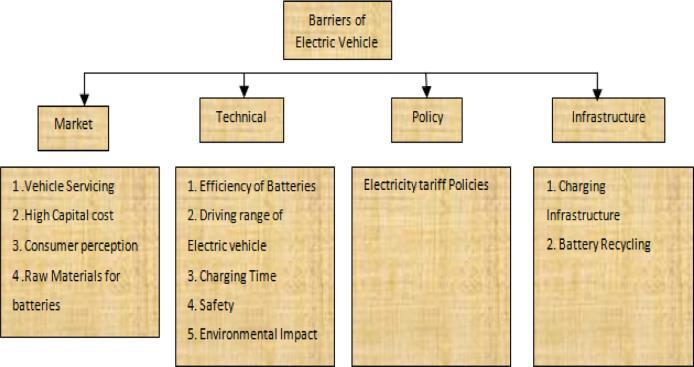
Therearea numberofwaystosolveobstaclesforelectric vehicles in the Indian market, including lack of infrastructure,legislativeobstacles,andtechnicalobstacles. TheseareseeninFigure3.
5.1. Market
5.1.1. Vehicle Service
An experienced technician should be on hand to fix, maintain,andtroubleshoottheelectriccarinordertoensure thatitisproperlycaredfor.Theyneedtobeabletousetheir abilities to solve the issue as soon as feasible.
5.1.2. Exorbitant initial investment
An electric vehicle's battery packs are costly and need replacement many times over the course of its lifespan. Whencomparedtoelectricautomobiles,gas-poweredcars arelessexpensive.
5.1.3. Perception among consumers
Customer impression is essential for drawing in new businessandkeepingholdofcurrentclientele.Evenifthe selectionofelectriccarsonthemarketisexpandingandis predictedtodosoforsometime,purchasinganelectriccar isstillnotaseasyasitoncewas.Therefore,theyhavetobe aware of what the business offers to customers via social media, advertising, or other channels. Research indicates that the adoption of electric vehicles may be directly impactedbyone'signoranceofthegovernmentprogramme, thefinancialadvantages,andthestateofcartechnology.
5.1.4. Battery-related raw materials
Therareearthelementsmanganese,graphite,cobalt,nickel, phosphate, and lithium are used as basic materials in EV batteries.Aninternalcombustionengineneedssteel,copper, and aluminium. Palladium, rhodium, and platinum are needed by combustion car catalysers in order to filter harmfulgases.Theseareallscarcematerials,andtheremay
not be enough of them to be able to produce enough batteries. The lithium-ion batteries alone use five million tonnes of nickel annually, which might result in a future whenlithiumandcobaltareusedtentotwentytimesmore often.
5.2.1.
The fuel tank and gasoline engine of a normal vehicle are oftenreplacedwithelectricmotors,batteries,chargers,and controlstomakeelectricautomobiles.SinceEVbatteriesare intended to last a long period, wear and tear occurs eventually.Fortheirbatteries,themajorityofmanufacturers nowprovidewarrantiesofeightyearsor100,000miles.
The primary obstacle to electric vehicles is often their driving range, since EVs have a lower range than their equivalentinternal combustionengine(ICE)vehicles.One majorbarriertothewidespreadadoptionofelectricvehicles (EVs)intheworldwidemarketisthelimitedrangethatthey cancoverwhenfullychargedorwhentheirtankisempty. Lessthan250kmmaybedrivenbetweenrechargesforthe majorityofBEVs.Someofthenewestversions,nevertheless, may provide up to 400 km. Because internal combustion enginesthatrunonliquidgasolinearenowavailable,plug-in hybrid electric vehicles (PHEVs) may go 500 km or more. The choice to take a long-distance journey may not be available to the driver, therefore they must carefully plan theirroute.Asaresult,the drivingrange'ssizebecomesa barrier.
5.2.3.
Driving range is a closely connected problem to charging time.TheEVmaytakeupto8hourstofullychargefroman emptystatewhenutilisinga7kWslowcharger.Thesizeof the battery is the primary factor influencing the charging time. The time it takes to recharge an automobile battery from empty to full capacity increases with battery size. Additionally,thebattery'schargingtimeiscloselycorrelated withthechargepoint'srateofcharging.Thelongerittakes the battery to charge completely, the more expensive the charging station is. In the present situation, the car is charged more quickly thanks to rapid chargers, which cut downontheamountoftimeneeded.Themaximumcharge rate that the commercially available electric vehicles can withstandmaybereachedbythematchargingstations.This suggeststhatthebatterymaybechargedtoitsfullcapacity without experiencing any issues. Nevertheless, as the temperature drops or when the battery is cold, the quick charger'schargingratedecreasesaswell.TheEVchargers are divided into several categories based on how quickly their batteries can be charged. Three basic methods of chargingelectricvehiclesexist:DCfast,Level1,andLevel2.
International Research Journal of Engineering and Technology (IRJET) e-ISSN: 2395-0056
Volume: 11 Issue: 04 | Apr 2024 www.irjet.net p-ISSN: 2395-0072
Throughtheuseofanon-boardconverter,Level1charging makes use of a conventional 120 V output. The EV can be chargedin8hoursusing120Voutlets,givingitarangeof around 120–130 kilometres. Generally, level 1 charging takesplaceathomeorattheoffice.Usually,240Voutletsare availableforcharginginpublicspacesorworkplaces,where level2chargersareinstalled.Thebatterymaybechargedin 4 hours for a 120–130 km range. When using DC fast charging,thechargingstationwiththefastestfastcharging setup is where the AC to DC conversion takes place. This enablesstationstoprovidemorepower,enablingfastercar charging.Witha145kmrange,thebatterycanbechargedin 30minutes.
5.2.4.
Thestateormunicipalregulation'ssafetycriteriamustbe met bythe electric vehicle.Inaddition,the batteriesmust pass the testing criteria that include exposure to various environmental factors such as vibration, humidity, water immersion,temperature,shortcircuit,overcharge,andfire impact. These cars have to be built with safety features including collision detection, short circuit protection, and insulationagainsthigh-voltagepowerlines.5.2.5.Theeffect on the environment Although the components of electric cars don't usually harm the environment, they are taken frombrineorminesinthedesert.Theminingindustryisnot significantlyimpactedbythisextraction.
5.3.
TheGovernmentofIndiaintendstosubsidisethenation'sEV charginginfrastructureinanefforttohastentheelectriccar revolutioninthatnation.Recently,theministryofelectricity made it clear that an EV charging station does not need a licence to operate in India, which might improve the infrastructureofEVchargingstationsaroundthecountry.In addition to offering incentives and exemptions to EV consumers and reducing the relevant rate of Goods and ServicesTax(GST)onLi-ionbatteries,thegovernmentneed alsoprovideincentivestoencouragethetransitionofpublic transporttoelectricvehicles.
5.4. Facilities
5.4.1. Infrastructure for charging
Moreinfrastructureforchargingisneededasthenumberof electric cars rises, increasing the need for electricity. The poorsalesofelectricvehiclesmaybeattributedtoIndia's lack of current infrastructure for charging them. From an engineering perspective, EV makers should recognise the valueofchargingbatteriessothatdischargebatteriesmay beswappedoutforfullychargedones.Thechargingstation mayschedulethebatterychargingtooccurduringoff-peak hoursatadiscountedpowerrate.Sinceownerswouldneed tochargetheirelectricvehicleathomebeforeleavingforthe day,thereneedtobeawaytosetupachargingstationfor
thiscar.Peoplewouldprefertochargetheircarsatworkor atadedicatedchargingstation,wheretheyhavetostopfor two to three hours or more, if they don't have access to charging infrastructure at home. Places like homes and workplaces are perfect for slow charging, whereas rapid charging is great in areas like highways and business complexeswherevehiclesstopforbriefperiodsoftime.It should be mentioned that in order for an EV to charge quickly inlessthan30minutes itmustbeabletohandle highvoltageand/orhighcurrent.Thiswillnotonlymakethe EV more expensive, but it will also shorten the battery's lifespan.Thus,theidealchoiceforEVsmaybeamixofslow andrapidcharges.
Althoughtheyaretypicallydesignedtolastjustaslongas thevehicle,electriccarbatteriesultimatelyrunoutofpower. When a battery has to be replaced after its warranty has expired,replacingtheoldbatterywithanewoneincreases costs. However, manufacturers do not provide accurate information on replacement battery price. Batteries' chemical components, such as lithium, nickel, cobalt, manganese, and titanium, not only make the supply chain more economical but alsopose environmental riskswhen thebatterypiecesarescrapped.
Inthisarticle,multipleframeworksindifferentgeographical regions are used to characterise the charging needs of electric vehicles. The framework comprises the following: forecastingmodel;distributedoptimisation;hybridparticle swarmoptimisation;antcolonyoptimisationandhousehold activity pattern; driving pattern recognition; stochastic model; trip prediction model; probabilistic model; fuzzy based model and data mining model; Particle swarm optimisation; linear programming; multi-objective and adaptivemodel.Thepurposeofthisresearchwastolookat thepossibleadvantagesofallEVs'chargingfeatures.Many investigations carried out globally by many authors in an efforttodeterminethebestmethodforoptimisingelectric vehicles.
WhentheV2Gideawasoriginallypresented,Accordingto this idea, an electric vehicle that is parked may both send electricity to the grid and act as a bidirectional charger, meaning it can be used to charge the battery or deliver powertothegrid.Ithasbeensuggestedthatbidirectional chargingofLi-ion cellsin V2GandGridtoVehicle may be usedtodeterminecellperformance.Anoverviewoftheuse ofenergystoragetechnologiesindistributionsystemdesign andoperationisprovided.Fig.4depictstheVehicletoGrid chargingmechanism
International Research Journal of Engineering and Technology (IRJET) e-ISSN: 2395-0056
Volume: 11 Issue: 04 | Apr 2024 www.irjet.net p-ISSN: 2395-0072
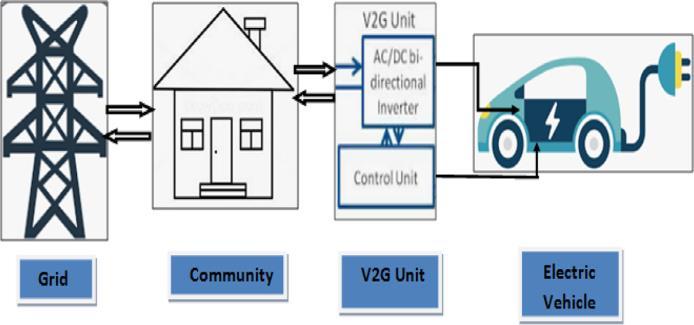
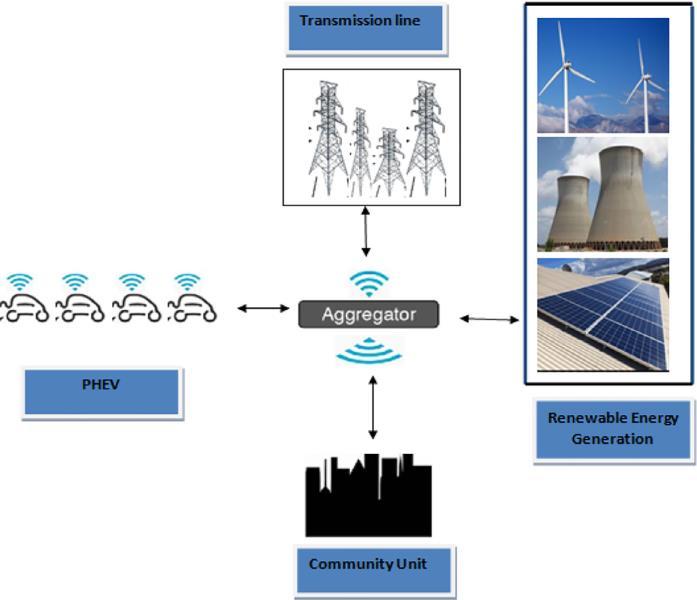
Arangeofcontrolapproachesaresuggestedtoprovidethe bestpossibleV2Gperformance.Numerouswritersfromall aroundtheworldhavelookedatV2Gdifficultiesandvarious optimisation strategies. The approach that has been published by several writers worldwide is examined. In terms of carbon dioxide emissions and associated costs, Tulpuleetal.(2013)demonstratedthefeasibilitystudyina parking lot at a workplace in the USA, OH, Columbus, Los Angeles,andCA,andcontrasteditwiththehomecharging system.Inarelatedresearch,parkinglotsintheUSA,NJ,and NJweretakeninto account. Asimple method wasused to determine which driving demands might be satisfied by solarpowerinthesummerbutnotinthewinter.Numerous writershaveexaminedtheEVfleetsona local orregional scale. In one such study,[125] in the Kansai Area of Japan pairedonemillionelectricvehicles(EVs)withonemillion heatpumpsinordertoreducesurplussolarpowerbythree TWhviatheuseofsmartchargingtechniques.Duetotheir modestsize,thebatteriesusedinEVshavenodiscernible effect on the grid. Fig. 5 depicts the aggregator of a V2G system.
Whencomparedtoconventionalcars,hybrid,plug-inhybrid, andelectricvehiclesmayboostavehicle'sfuelefficiency,but thecostofownership will goup.Generallyspeaking,over time,consumers,society,automakers,andlegislatorswillall profit economically from their lower petroleum use and higherproduction.
Thisdocumentoffersrecommendations,a comprehensive review of the literature, and penetration rate studies for BEV, PHEV, and HEV in the Indian market. The Indian government's latest efforts and different incentives will accelerate the country's e-mobility push. When nonconventionalenergysourcesareunavailable,thecreationof a new vehicle-to-grid idea may be employed to either provide electricity to the grid or charge the battery. This technology has a significant lot of potential for addressing global warming challenges and is a crucial component of renewable energy and energy security. The primary originality of this research is an overview of the obstaclesandissuesrelatedtoelectricvehiclesintheIndian setting.
[1]R.T.Doucette,M.D.McCulloch,Modelingtheprospectsof plug-in hybrid electric vehicles to reduce CO2 emissions, Appl.Energy88(2011)2315–2323.
[2]https:www.goldmansachs.com/insights
[3]https://en.wikipedia.org/wiki/Electric_vehicle_industry_i n_India
[4] https://www.climatelinks.org/resources/greenhousegas-emissions-factsheet-india
[5] W. Kempton , J. Tomi ć, Vehicle-to-grid power implementation: from stabilizing the grid to supporting large-scale renewable energy, J. Power Sources 144 (1) (2005)280–294.
[6] R.J. Bessa , M.A. Matos , Economic and technical managementofanaggregationagentforelectricvehicles:a literature survey, Eur. Trans. Electr. Power 22 (3) (2012) 334–350.
[7]N.Daina,A.Sivakumar,J.W.Polak,Modellingelectric vehicles use: a survey on the methods, Renew. Sustain. EnergyRev.68(2017)447–460.
[8]F.Koyanagi,Y.Uriu,Modelingpowerconsumptionby electric vehicles and its impact on power demand, Electr. Eng.Jpn.120(4)(1997)40–47.
[9]J.E.Kang,W.W.Recker,Anactivity-basedassessmentof thepotentialimpactsofplug-inhybridelectricvehicleson
International Research Journal of Engineering and Technology (IRJET) e-ISSN: 2395-0056
Volume: 11 Issue: 04 | Apr 2024 www.irjet.net p-ISSN: 2395-0072
energyandemissionsusing1-daytraveldata,Transp.Res. PartD:Transp.Environ.14(8)(2009)541–556.
[10]J.Dong,C.Liu,Z.Lin,Charginginfrastructureplanning for promoting battery electric vehicles: an activity-based approach using multiday travel data, Transp. Res. Part C: Emerg.Technol.38(2014)44–55.
[11]C. Weiller , Plug-inhybrid electricvehicleimpacts on hourlyelectricitydemandintheUnitedStates,EnergyPolicy 39(6)(2011)3766–3778.
[12] J. Axsen , K.S. Kurani , Anticipating plug-in hybrid vehicle energy impacts in Califor- nia: constructing consumer-informedrechargeprofiles,Transp.Res.PartD: Transp.Environ.15(4)(2010)212–219.
[13]O.Sundström,C.Binding,Chargingserviceelements for an electric vehicle charg- ing service provider, in: ProceedingsofthePowerandEnergySocietyGeneralMeeting,2011,IEEEIEEE,2011,pp.1–6.
[14]M.D.Galus ,M.G.Vayá,T.Krause,G.Andersson, The role of electric vehicles in smart grids, Wiley Interdiscip. Rev.:EnergyEnviron.2(4)(2013)384–400.
[15]J.Brady,MO’Mahony,Modellingchargingprofiles of electric vehicles based on real-world electric vehicle chargingdata,Sustain.CitiesSoc.26(2016)203–216.
[16] P. Morrissey , P. Weldon , M. O Mahony , Future standard and fast charging infras- tructure planning: an analysisofelectricvehiclechargingbehaviour,EnergyPolicy 89(2016)257–270.
[17]A.Foley,B.Tyther,P.Calnan,B.O.Gallachoir,Impacts of electric vehicle charging under electricity market operations,Appl.Energy101(2013)93–102.
[18]S.Steinhilber,P.Wells,S.Thankappan,Socio-technical inertia: understanding the barriers to electric vehicles, EnergyPolicy60(2013)531–539.
[19]Y.Hai,T.Finn,M.Ryan,Drivingpatternidentification for EV range estimation, in: Proceedings of the IEEE InternationalElectricVehicleConference(IEVC),2012,pp. 1–7.
[20] G. Hayes John , R.P.R. Oliveira de , V. Sean , G Egan Michael,Simplifiedelectricve-hiclepowertrainmodelsand rangeestimation,in:ProceedingsoftheIEEEVehiclePower andPropulsionConference(VPPC),2011,pp.1–5.