
International Research Journal of Engineering and Technology (IRJET) e-ISSN: 2395-0056
Volume: 11 Issue: 04 | Apr 2024 www.irjet.net p-ISSN: 2395-0072

International Research Journal of Engineering and Technology (IRJET) e-ISSN: 2395-0056
Volume: 11 Issue: 04 | Apr 2024 www.irjet.net p-ISSN: 2395-0072
Aishwarya N, Roopa, Sushma B
1 Asst.Professor (M.Sc), Dept of Computer Science, JSSCACS, Mysuru, Karnataka, India.
2Asst.Professor (MCA), Dept of Computer Science, JSSCACS, Mysuru, Karnataka, India.
3Asst.Professor (MCA), Dept of Computer Science, JSSCACS, Mysuru, Karnataka, India.
ABSTRACT - A notion called "airborne internet" applies computer network theory and ideas to the field of transportation. Enabling a multi-purpose, all-purpose data channel for individuals traveling is the aim in order to establishinformationconnectivity. Theidea is togiveaircraft access to a high-speed, all-purpose digital network. By allowing the unification of numerous operations into a single data channel, it can do this and potentially save the FAA and aircraft operators a significant amount of money. One data channel can be used by many applications. The fact that it functions similarly to the actual internet gives it its name.
Key Words: Wi-Fi,Flight, floating on Air, modem, Internet, Satellite.
Anenvisionednetworkforuseinaircraftcommunications, navigation,andsurveillanceiscalledtheAirborneInternet (CNS).TheairborneInternet,commonlyreferredtoasAI,isa communication network that is intended to incorporate nodes,pointsofcontact,orinteractivityonvariousaircraft kinds.
The commercial Internet's technology is also used by the Airborne Internet, a peer-to-peer, private, secure, and dependable aircraft communications network. This implementationtransfersthedatathatistransferredover thiscommunicationlinkbetweenanairplaneandagroundbasedInternetaccessnode.Itoffersaccesstoanabundance ofonlinedataandresourceswhileintheair.Itisusefulfora varietyoftasks,includingtravelplanning,reservationsmade whileenroute,andflightscheduling.Itishelpfulforaircraftto-aircraftcommunicationsaswellasforsupplyingweather andadjacentairspaceenvironmentinformation.Voiceand video recording in the cockpit, in-flight video monitoring, and flight tracking/deviation monitoring are some of the securityapplications.
There is a huge demand for broadband, high data rate serviceduetothegrowingdemandforInternetservices.It's anticipated that hundreds of millions of people will need Internetaccessgloballyverysoon.Theneedforbroadband serviceswillincreaseduetotheriseinelectroniccommerce andWorldWideWebusage.
This idea, called the Airborne Internet, is being promoted with assistance from the Airborne Internet Consortium (AIC).
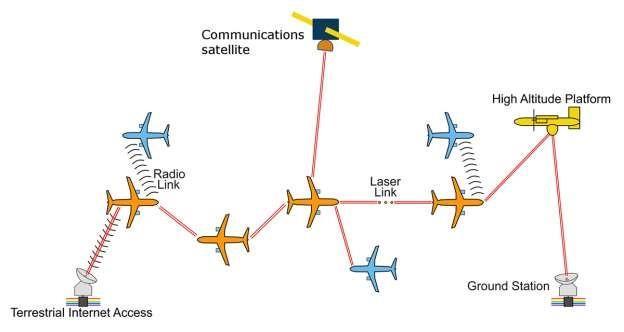
Satelliteimplementationofairborneinternetsystem
AngelTechnologiesisdevelopinganaerialInternetnetwork dubbedHighAltitudeLongOperation(HALO),whichwould employ light aircraft to fly overhead and offer businesses quicker data transfer than a T1 connection. Customers wouldhavea connectionsimilartoDSL.Asolar-powered, unmanned aircraft that functions similarly to the HALO network isbeing developed byAeroVironmentandNASA, whileSkyStationInternationalispreparingaprojectalong theselinesthatwilluseblimpsratherthanairplanes.
Atthemoment,landcablesareusedfornetworkorinternet connectivity.The data transmitted by land-based cables is restrictedintermsofphysicalcapacity;theamountofdata they can carry is determined by the cable's width. The physical limits on data transmission are absent from the aviationinternet.
While airborne internet is a network in the air, current internet services are provided by installing cables underground, which requires labor-intensive earth excavation.
International Research Journal of Engineering and Technology (IRJET) e-ISSN: 2395-0056
Volume: 11 Issue: 04 | Apr 2024 www.irjet.net p-ISSN: 2395-0072
2.1
ThesignalstrengthofWi-Fi(WirelessFidelity)will be weaker when it goes past a metal barrier, a concretewall,oracelling.
A company's budget will increase if extra access pointsneedtobeboughtandmountedonthewalls in order to connect tens of meters away from the Wi-Firouter,whichcanonlycoverafewmeters.
Ourslowmodemsarebeingoverloadedwiththeamountof data we need to send and receive these days, including images, videos, and audio files. In order to boost their bandwidth, a lot of Internet users are moving to cable modemsanddigitalsubscriberlines(DSLs).Anovelservice category is now under development that aims to elevate broadbandtoahigherlevel.
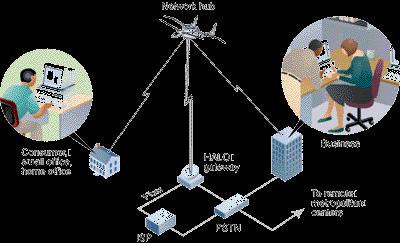
This figure illustrates how a high-speed wireless Internet connection will be made possible via the HALO Network.
Byarrangingairplanesinregularpatternsoverhundredsof cities, at least three companies intend to offer high-speed wirelessInternetaccess.AngelTechnologiesisdeveloping an aerial Internet network dubbed High AltitudeLong Operation(HALO),whichwouldemploylightaircrafttofly overheadandofferbusinessesquickerdatatransferthana T1connection.Customerswouldhaveaconnectionsimilar toDSL.Asolar-powered,unmannedaircraftthatfunctions similarly to the HALO network is being developed by AeroVironmentandNASA,whileSkyStationInternationalis preparing a project along these lines that will use blimps ratherthanairplanes.We'llnowexaminethenetworksthat are being developed, the aircraft, and the potential residentialapplicationsforconsumersofthistechnology.
ItisnotentirelywirelesswhenusingtheInternet whenintheair.AllairborneInternetnetworkswill havecomponentslocatedontheground.
It will be necessary for customers to install an antenna at their residence or place of business in order to receive signals from the network hub overhead.
Additionally, existing Internet service providers (ISPs) will collaboratewith thenetworks,lending theirhigh-capacityterminalsfornetworkuse.
ThecreationoftheAirborneInternetcan beattributed to twokeyfactors.They're:
Small Aircrafts Transportation System
Need For a Higher Bandwidth
AngelTechnologiesisusingitsHALONetworktocreatean aerialinternetnetwork.TheProteusplane,thefocalpointof thisnetwork,willliftwirelessnetworkinggearintothesky. Long wings and low wing loading are features of Scaled Composites' Proteus aircraft, which is intended for prolonged high-altitude flying. The entire plane's mass dividedbytheareaofitswingsisthewingloading.Upto75 miles (120.7 km) in diameter, Proteus can cover ground whileflyingataltitudesof9.5and11.4miles(15.3and18.3 km).
Theone-tonairbornenetworkhub,atthecenterofAngel's Proteusaircraft,enablestheaircrafttotransmitdatasignals fromgroundstationstoresidencesandplacesofbusiness. Theelectronicsforwirelessconnectionandantennaarray makeuptheAInetworkhub.Inordertoservicethousands of customers, the antenna array generates hundreds of virtualcells similartocellphones ontheground.
High-speeddatasignalsfromagroundstationarereflected ontoyourPCviaan18-footdishlocatedbelowtheaircraft. TherewillbethreepilotedProteusaircraftassignedtoeach cityintheHALONetwork.Everyaircraftwilltakeoffandfly foreighthoursbeforebeingreplacedbyanother.Onceinthe air, it will climb to a safe altitude above any inclement weatherandcommercialtrafficbeforestartinganeight-mile circuitaroundthecity.
High-speeddatasignalsarereflectedfromabasestationto yourPCviaan18-footdishlocatedbelowtheaircraft.Inthe HALO Network, three piloted Proteus aircraft will be assignedtoeachcity.Aftereighthoursofflight,eachplane willbereplacedbyanother,whichwilltakeoffandcirclethe city eight miles at a safe altitude above any inclement weatherorcommercialtraffic.
International Research Journal of Engineering and Technology (IRJET) e-ISSN: 2395-0056
Volume: 11 Issue: 04 | Apr 2024 www.irjet.net p-ISSN: 2395-0072
SkyplaceInternationalreferstoitsblimpsas"lighter-thanairplatforms"andintendstoplaceoneoftheseairshipsover each city in the race to provide high-speed Internet connectivityfromhighaltitudes.Wirelessservicewouldbe availabletoanarea ofaround7,500squaremiles(19,000 squarekm)fromeachstation,whichwouldflyataheightof 13miles(21km).
Sky Station Blimp
Diameter 203ft(62m)
Length 515ft(157m)
Width approx.300ft(91m)
Power Solarandfuelcells
6.3
Additionally,NASAisinvolvedinAeroVironment'spossible aerialInternetsystem.
TheHeliosprototypeismadeofcarbonfiber,graphiteepoxy, Kevlar, and Styrofoam, and it has a thin, translucent skin coveringitall.Toaccommodatethecontinualbendingthat occursduringflight,thecarbonfibermainpolethatsupports thewingisthickeratthetopthanthebottom.
Belowisasummaryofthemaincharacteristicsofthe AirborneInternetNetwork.
Smooth,widelyavailablemultimediaservices.
Conformitytofinalusercontexts
Improveduserconnectivitythroughouttheworld.
Quicklydeployabletopotentiallocations.
Trustworthyandsafeinformationexchanges.
Utilizing available spectrum efficiently is made possiblebybandwidthondemand.
It could result in financial savings for aircraft owners.
AIdoesnotrequirealicenseforfrequencybands.
Can service hundred-thousand of broadband subscribers
Therangeofsinglelink delays isaround60msec belowtheairplaneand200msecatthesignaledge.
AI service Satellite
Time delay Smalldelay Bigdelay
Frequency 8-38GHz 4-6GHz 9-13GHz
Power LowPower HighPower
Cost LowCost HighCost
Smallnumberofmovingpartsmeanslow maintenancecosts.
High degrees of redundancy (for example, an airplane can lose several motors and still land safely; most failure modes don't call for a quick responsefromthegroundoperator)
Apart from the time delay, the functioning of the airborneInternetwillbesimilartothatofsatellitebasedInternetaccess.SatelliteandaircraftInternet connectivity usually have the same bandwidth, however because aircraft Internet is lower in the atmosphere,datatransmissiontimesarefaster.A few hundred miles above Earth is the orbit of a satellite.Ataheightofbetween52,000and69,000 feet(15,849and21,031meters),theaerialInternet aircraft will fly in a circle above the ground. The aircraft will be flying considerably above commercial air traffic at this level, untouched by badweather.
Ifnetworkconnectivitywasavailable,peoplecould use their time in travel for more productive activities.
Afastdigitalnetworkwouldbeinvolved.Becauseit enablestheconsolidationofnumeroustasksintoa singledatachannel,ithasthepotentialtosavethe FAAandaircraftoperatorsasignificantamountof money.
InordertocreateoptionsfortheAirborneInternet,evaluate the benefits and drawbacks of each option, and make a recommendation,weplantokeepusingtheaboveexplained technique. The architecture will then be improved and documentedforsystemdeveloperstoutilizeincollaboration withotherSATSorganizations.
Tofurtherunderstandthearchitecture'skeycomponents' relevancetoSATS,prototypesofthesecomponentswillbe assessed. Cost and performance estimates will be made. Therewillbeadifferentsecurityevaluationcreated.
International Research Journal of Engineering and Technology (IRJET) e-ISSN: 2395-0056
Volume: 11 Issue: 04 | Apr 2024 www.irjet.net p-ISSN: 2395-0072
For aviation services like traffic management and craft surveillance, among others, aircraft internet is incredibly useful. At extremely high altitudes, it enables web connectivity for travelers in aircraft. Dedicated ships stationed within the oceans to function as base stations (BSs) will be connected to the web via already-deployed underwater cables. Compared to the previously planned options,theprojectedresolutionisbetterbecauseitavoids usingcostlyandslowsatellitelinks.
Therefore, this aerial internet technology has many applicationsinthefieldofaviationservices,suchasweather updates,aircrafttracking,andairtrafficcontrol.Italsogives passengers the chance to access the internet at extremely high altitudes, i.e., in aeroplanes, and other traditional services. Hence, creating a network in the air to establish connectivityisyetanothernewtrendinourmobileera.
[1]NeetuGupta,AbhishekAggarwal,“AirborneInternet TheInternetintheair”,Volume1,Issue08June2017.
[2]SyedJunaidNawaz,NoorM.Khan,”Airborne
[3]www.airborneinternet.org
[4]airborneinternet.pbwiki.com