
International Research Journal of Engineering and Technology (IRJET) e-ISSN: 2395-0056
Volume:11Issue:04|Apr2024 www.irjet.net p-ISSN: 2395-0072
International Research Journal of Engineering and Technology (IRJET) e-ISSN: 2395-0056
Volume:11Issue:04|Apr2024 www.irjet.net p-ISSN: 2395-0072
Manjula Khandekar1, Mrs. Madhulika Malviya2
1Research Scholar, M. Tech (Structural Engineering)
2Assistant Professor, Dept. of Civil Engineering, Jhada Sirha Government Engineering College, Jagdalpur, C.G.
ABSTRACT - Concrete is the most widely used construction material globally, owing to its versality, durability, and relatively low cost. However, despite its numerous advantages, concrete exhibits certain limitations, such as low tensile strength and brittleness. Fiber reinforced concrete has emerged as a promising solution to improve the performance of conventional concrete. This present paper deals with the addition of 1% of sisal fiber by the weight of cement to improve tensile strength of the concrete. Sisal fibers are the natural plant-based fiber which are produced from the Agave Sisalana plant. Research methodology involves the preparation, curing and testing of cylindrical specimens at7,14and28days.
Key Words: Conventional concrete, Sisal fiber, Sisal fiber reinforcedconcrete, tensilestrength.
1.INTRODUCTION
Concrete is a composite mixture which includes cement, sand, coarse aggregate, and water. It acts good in compression than tension. Due to its high compressive strength and durability, many structures are constructed by concrete such as roads, buildings, tunnels, bridges, dams etc. Concrete structures can resist heavy load for long period of time without getting failure early. Fresh concretecanbecastedintoanyshapeandsize.
The main drawback of using concrete is its comparatively low tensile strength, to overcome this problem reinforcement is provided in the plain cement concrete. Mainlysteelbarsareprovidedasareinforcementmaterial to take loads in the tension zone. Plain cement concrete with steel reinforcement is provided is known as reinforcedcementconcrete(RCC).
Evenbeforeloadingsomeinternalmicrocracksarealready presentintheconcretethesearemainlyduethechangein volume and drying shrinkage. The presence and development of these microcracks are responsible for inherent weakness of concrete. For the purpose of minimizing microcracks fibers are introduced in the concrete.
Fiber-reinforced concrete is a composite material that consists of conventional concrete which is reinforced by fibers.Fibersarethesmallreinforcingmaterialthatactsas a crack arrester for concrete. They can be uniformly or randomly distributed into the cement concrete matrix. There are different types of fibers available in the market based on their origin, shapes, sizes, etc. After the addition offibersinconcretemixthesefibersinterlockandentangle around the aggregate’s particles. Addition of fibers provides good interlocking bond between ingredients of concrete or mortar so that chances of segregation of aggregates are reduced while placing and workability is reduced.Theyarewidelyusedinprovidingstrengthtothe civilstructuressuchasbeams,columns,slabs,wallsetc.
Therearesomefactorsthatmayaffectsthepropertiesof fiber-reinforcedconcrete(FRC)
1. Typesoffibersused.
2. FiberGeometry
3.Amountoffibersused.
4.Aspectratiooffibers
5.Distributionoffibers
6.Mixingandcompactionofconcrete
AspectRatioistheimportanttermwhenwetalkabout FRC.Thisistheratiooflengthoffiberstoitsdiameter
1. Providesstiffnesstothestructure.
2. Maintenanceandrepaircostislow.
3. Itgiveshighstrengthtoconcrete.
4. Gooddurability.
5. Resistancetocorrosionandfire.
6. Resistancetowearandtear.
7. IncreasesToughness.
8. Provideslongservicelifetothestructure.
International Research Journal of Engineering and Technology (IRJET) e-ISSN: 2395-0056
Volume:11Issue:04|Apr2024 www.irjet.net p-ISSN: 2395-0072
Sisal fiber reinforced concrete consists of plain cement concrete or mortar with the addition of sisal fibers in it. Sisal fibers are plant-based natural fibers that are extracted from the leaves of the Agave Sisalana plant. These fibers are considered as hard fibers which is creamy white in color. Agave Sisalana plants can be easilycultivatedandgrowsrapidlyinashortdurationof time. These plants can be easily seen in the hedges of field and railway tracks. Cellulose is the major constituent of plant fibers. It may find that there can be some variations in the properties of fibers due to variations in climatic conditions, age of the plant, methodsusedforfiberextraction.
Additionofthesefiberscanimprovecrackingperformance and toughness of the concrete mix. These fibers are the commonly used fiber because of its low cost and availability.Sisalfiberplantcangrowinveryhardtypesoil where normal plantsmay notbegrown. Sisal fiber isused in construction industries as well as also used in making ropes and other home essentials such as bag, napkin, and carpetetc.
2.1. STRENGTH OF SISAL FIBER CONCRETE WITH FINE CONSTRUCTION WASTE AGGREGATE By Raghu Yadav Golla (2015)
The paper discusses the development of sustainable and environmentally friendly concrete using fine aggregate from demolition waste with sisal fiber, which improves concrete properties without affecting workability. Concrete mixes with demolition waste and sisal fiber improvedconcreteproperties,withstrengthenhancement up to 50% replacement of natural sand. - Sisal fiber and demolitionwastehadnoimpactonworkability,andnearly equalstrengthasnormalconcretewasachievedupto80% replacement. The methodology involved replacing natural sand with construction waste, adding sisal fiber, conducting compressive and split tensile strength tests, and assessing stress-strain behavior. Mixing, testing, and analysisweredonefollowingspecificstandards.
2.2. CONCRETE REINFORCED WITH SISAL FIBERS (SSF): OVERVIEW OF MECHANICAL AND PHYSICAL PROPERTIES ByAhmedetal(2022)
The paper provides an overview of the mechanical and physicalpropertiesofconcretereinforcedwithsisalfibers, highlighting their potential in enhancing strength and durability while affecting flowability, and suggests areas for further research. The main findings include the variation in physical characteristics of SSF based on plant age,decreasedflowabilitywithSSFaddition,andthe
increase in strength properties of concrete up to a limit with SSF. The methodology involves examining the mechanical and physical properties of concrete reinforced with sisal fibers (SSF), including analyzing the qualities of SSF, the interface between SSF and the matrix, and the properties of SSF-reinforced concrete such as fresh properties, mechanical strength, and durability. The study evaluateshow SSF enhancesstrengthanddurability while impacting flowability and provides recommendations for futureresearch.
2.3. STUDY ON PROPERTIES OF SISAL FIBER REINFORCED CONCRETE BY ADDING OF DIFFERENT PERCENTAGES AND DIFFERENT SIZES OF SISAL FIBER byDilipKumaretal(2018)
The paper discusses the use of sisal fiber reinforced concrete to enhance workability and strength properties, highlighting its reliability for structural elements in construction, along with improvements in compressive strength, tensile strength, and water absorption. It also mentions the significance of compressive strength in concreteandthepotential useofMetakaolinasa concrete constituent with pozzolanic properties. Sisal fiber reinforced concrete is a reliable material for structural elements, with 2.5% fiber addition showing better strength.Themethodologyinvolvedhandmixingmaterials with different percentages of sisal fiber in the M25 mix design, casting specimens in cubes and cylinders for testing, conducting slump cone tests for workability assessment, and evaluating strength and durability by addingvariouspercentagesofsisalfiberwithcement.
2.4. A COMPARATIVE PERFORMANCE OF SISAL AND POLYPROPYLENE FIBERS IN ENHANCING TENSILE STRENGTH OF CONCRETE by Srinivasa Rao Naraganti et al(2017)
The paper compares the performance of polypropylene (PP) fibers and sisal fibers in enhancing the tensile strength properties of concrete, confirming a good correlation between PFRC and SFRC, and suggesting sisal fibers as a potential alternative to PP fibers. Further research is being conducted to assess the durability propertiesofthefiber-reinforcedconcretes.Polypropylene (PP) fibers have been effective in improving various engineering properties of concrete, while sisal fibers showed potential asanalternativebutdid not achieve the same strength levels as PP fibers. The methodology involvedusingmanuallyextracted12mmlongsisal fibers at different dosages to evaluate their influence on the tensile strength properties of M30 grade concrete. Split tensile and flexural strength of PFRC and SFRC were assessed at various ages, with a focus on establishing a correlation between the tensile strength properties of the twotypesofconcrete.

International Research Journal of Engineering and Technology (IRJET) e-ISSN: 2395-0056
Volume:11Issue:04|Apr2024 www.irjet.net p-ISSN: 2395-0072

Waterabsorptionforcoarseaggregate=1.0
Waterabsorptionforfineaggregate=1.16
1) Target mean strength
f’ck=fck+1.65×S OR
f’ck=fck+X
a) f’ck=30+1.65×5=38.25N/mm2
where,S=standarddeviation(table2,clauseno
4.2.1.3IScode10262-2019)
b) f’ck=30+6.5=36.5N/mm2
where,X=factorbasedongradeofconcrete(Table1, clause4.2,ISCode10262-2019)
Thehighervalueoftheabovetwowillbeadoptedfor thetargetmeanstrengththatis38.25N/mm2
2) approximate air content
Theapproximateamountofentrappedairtobeexpectedin normalconcreteis1%for20mmnominalmaximumsizeof aggregate.(Aspertableno3,clause5.2,IScode10262–2019)
3) Selection of water cement ratio
Stipulations for proportioning
Gradeofconcrete=M30
Gradeofcement=OPC53
Maximumsizeofaggregate=20mm
Exposurecondition=severe
Fineaggregate=zoneII
Slump=75mm
Test data recorded
Specificgravityofcement=3.15
Specificgravityofcoarseaggregate=2.73
Specificgravityoffineaggregate=2.6

According to table no 5 of IS code 456 – 2000, for RCC worksmaximumwatercementratioforextremeexposure conditionis 0.45, but as per chart givenin page no 4 ofIS code10262–2019estimatedwatercementratiofortarget meanstrength38.25N/mm2is0.48. Hence,adoptedwatercementratiowillbe0.45.
4) Water content
Fromtable4,clause5.3,IScode10262–2019
Water content = 186 kg, for 50 mm slump for 20 mm aggregate.accordingtocodeincrease3%watercontentfor everyadditionalincreaseof25mmslumpvalue.
5) Calculation of cement content
Watercementratio=0.45
Watercontent=191.58kg
Cementcontent=191.58/0.45=425.73kg/m3 425.73kg/m3 >320kg/m3 (ok)

International Research Journal of Engineering and Technology (IRJET) e-ISSN: 2395-0056
Volume:11Issue:04|Apr2024 www.irjet.net p-ISSN: 2395-0072
6) Adding 1 % sisal fiber by the weight of cement
Cementcontent=425.73kg/m3
1%ofsisalfiberbytheweightofcementcontent= 1/100×425.73=4.2573kg/m3
Actualcementcontent=425.73–4.2573=421.478 kg/m3
421.47kg/m3 >320kg/m3 (ok)
7) proportion of volume of coarse and fine aggregate
Aspertableno5,clause5.5,ISCode10262–2019
Theproportionatevolumeofcoarseaggregate correspondingto20mmsizeofaggregateandfine aggregate(zoneII)forwatercementratioof0.50=0.62
Inthepresentcasewatercementratiois0.45,then accordingtothecoderecommendationthevolumeof coarseaggregateisrequiredtobeincreasedtodecreasethe fineaggregatecontent.
Watercementratioisdecreasedby0.50–0.45=0.05
Theproportionofvolumeofcoarseaggregateisincreased by (0.02/0.05)×0.05=0.01
So,thecorrectedproportionofvolumeofcoarseaggregate forthewater
Cementratioof0.45=0.01+0.62=0.63
Volumeoffineaggregatecontent=1–0.63=0.37
(8) Mix calculations
a) Totalvolume=1m3
b) Volumeofentrappedair=0.01m3
c) Volumeofcement = massofcement ×1000 Sp.gravityofcement = 421.478/3.15×1000 =0.133m3
d) Volumeofsisalfiber = massofsisalfiber×1000 Sp.gravity = 4.2573/0.7×1000 = 0.0061m3

e) volumeofwater = massofwater×1000 sp.gravity =191.58/1×1000 =191.58/1×1000 =0.1915m3

i) volumeofallinaggregate=[(a-b)–(c+d+e)]=[(10.01)–(0.133+0.0061+0.1915)] = 0.66m3
j) Massofcoarseaggregate=vol.ofallaggregate×vol. ofCA×sp.gravityofCA×1000=0.66×0.63×2.73 ×1000=1135.134kg
k) Massoffineaggregate=vol.ofallaggregate×vol.of FA×sp.gravityofFA×1000=0.66×0.37×2.6× 1000=634.92kg
(9) Site corrections
l) Absorptionoffineaggregate=1.16% =1.16/100×634.92=7.36liter
m) Absorptionofcoarseaggregate=1% =1/100×1135.134=11.35liter
n) Totalabsorption=18.71liters
o) Actualamountofwatertobeused=191.58+18.71 =210.29liters
p) Actualweightoffineaggregatetobeused= 634.92–7.36=627.56kg
q) Actualamountofcoarseaggregate=1135.13411.35=1123.784kg
5.
Fromthe belowtestresults itisclearlyseen thatthereis anincreaseinsplittensilestrengthafteraddingsisalfiber intheconcretemix.
At 7 days of testing the increase in tensile strength is about 20.77%, at 14 days increased strength is about 12%andafter28daysoftesting11.84% increaseinsplit tensilestrength.
Thesplittensilestrengthofconcretecanbecalculatedby formula=2P/3.14LD
Where,P=Appliedload,L=Lengthofthespecimen, D=diameterofspecimen
SplittensilestrengthforM30gradeconventionalconcrete areasfollows–
International Research Journal of Engineering and Technology (IRJET) e-ISSN: 2395-0056
Volume:11Issue:04|Apr2024 www.irjet.net p-ISSN: 2395-0072

1. Raghu Yadav Golla. “Strength of Sisal Fiber ConcretewithFineConstructionWasteAggregate.” International Journal of Research in Engineering and Technology 04, no. 14 (April 25, 2015): 5–8. https://doi.org/10.15623/ijret.2015.0414002
2. Ahmad, Jawad, Ali Majdi, Ahmed Farouk Deifalla, Nabil Ben Kahla, and Mohammed A. El-Shorbagy. “Concrete Reinforced with Sisal Fibers (SSF): Overview of Mechanical and Physical Properties.” Crystals 12, no. 7 (July 7, 2022): 952. https://doi.org/10.3390/cryst12070952
Table 5.1- Split tensile strength for M30 grade conventional concrete
SplittensilestrengthforM30gradeconcretewhen1%sisalfiber isaddedistabulatedbelow–

2. 14days
Table 5.2- Split tensile strength for M30 grade concrete when 1 % sisal fiber is added
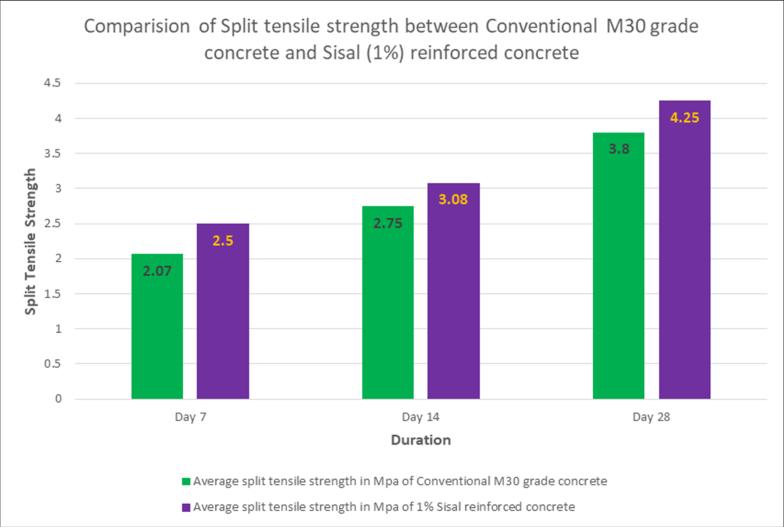
Comparison of Split tensile strength between Conventional M30 grade concrete and Sisal (1%) reinforced concrete
3. Kumar, Dilip, and N. Victor Babu. “Study on Properties of Sisal Fiber Reinforced Concrete by AddingofDifferentPercentagesandDifferentSizes of Sisal Fiber.” International Journal of Management Technology and Engineering 8, no. 8 (December2018):11.
4. Naraganti, Srinivasa Rao, Rama Mohan Rao Pannem, and Jagadeesh Putta. “A Comparative Performance of Sisal and Polypropylene Fibers in Enhancing Tensile Strength of Concrete.” International Journal of Engineering and Technology 9, no. 2 (April 30, 2017): 1475–83. https://doi.org/10.21817/ijet/2017/v9i2/170902 055