
International Research Journal of Engineering and Technology (IRJET) e-ISSN:2395-0056
Volume: 11 Issue: 04 | Apr 2024 www.irjet.net p-ISSN:2395-0072
International Research Journal of Engineering and Technology (IRJET) e-ISSN:2395-0056
Volume: 11 Issue: 04 | Apr 2024 www.irjet.net p-ISSN:2395-0072
Smt B Sridevi1, G Kavya2, K Pavan Santosh Kumar3 , K Divya Kalyan4, K Anil Uday Kiran5
1Assistant Professor, Dept. of CSE, GITAM (Deemed to be University), Visakhapatnam, Andhra Pradesh, India. 2,3,4,5Student, GITAM (Deemed to be University), Visakhapatnam, Andhra Pradesh, India.
Abstract – In this paper an innovative system that accurately predicts the value of used vehicles is presented By utilizing machine learning algorithms linear regression, decision tree and random forest on a comprehensive dataset of Indian car sales prices collected from Kaggle, our system provides precise and well-informed pricing decisions. It takes into account various influential factors such as brand, model, kms driven, fuel type, and year, enabling users and dealers to make informed choices. In contrast to manual valuations that are susceptible to biases and inaccuracies, this system offers a reliable framework for determining fair market values. Also, dealers can strategically set competitive prices, optimizing their buying and selling decisions in the ever-changing used car market. To further enhance user interaction with the predictive models and provide a smooth and user-friendly experience, an intuitive user interface is designed. The findings show that although all the algorithms are capable of forecasting used car prices, the Random Forest model performs better in terms of prediction accuracy. Additionally, the interactive user interface improves the system's usability and accessibility by enabling users to enter vehicle characteristics and get realtime price estimates. Overall, by combining machine learning algorithms with an interactive user interface, this project advances used car price prediction systems and provides a useful resource for both buyers and sellers in the automotive sector.
Key Words: Price prediction, Regression, Predictive model, Linear Regression, Decision Tree Regression, RandomForestRegression
1.INTRODUCTION
Rapid technology breakthroughs and changing consumer demands have led to a major change in the automotive industryinrecentyears.Theused-carmarketsegmenthas grownsignificantlyand nowmakesupa sizeableshareof the entire automotive industry, which is one of the most remarkable changes. The reason for the recent rise in popularityofusedcarsistheiraffordabilityaswell asthe chance they present to purchase excellent pre-owned automobiles. But for both buyers and sellers, understandingthecomplexitiesoftheusedcarmarketcan be a difficult task. The principal aim of our project is to provide details of the used car market by providing readers with extensive knowledge on a range of topics,
including anticipated prices, evaluations of vehicle conditions, and forecasts of forthcoming market patterns Given the dynamic nature of the used automobile market and the need for increased clarity and guidance, the proposed methodology aims to give users a deeper understandingofthefactorsinfluencingusedcarvalues.
A game-changing development in the used car sector has been the creation of prediction systems that combine machine learning, data analysis, and real-time market trends in response to the growing demand for tools that support informed decision-making. These kinds of tools might completely change the way consumers make judgments about what to buy, help sellers fine-tune their pricingpolicies,andprovidecarenthusiastsawaytolook atalloftheiralternativeswhenitcomestolocatingaused automobile that fits their needs and budget. This project aims to close the gap between consumers and sellers in the used car industry by utilizing cutting-edge technologies and data-driven insights. It does this by providing a dependable and user-friendly platform for navigating the difficulties of purchasing and selling preowned vehicles. This system aims to equip users with the necessary knowledge and tools to make educated decisions.
Amachinelearningmodelforestimatingusedautomobile values based on a variety of variables, including mileage, manufacture year, fuel consumption, and more, is presented in this paper. Several regression techniques were employed to the dataset, which was collected from used car listings Random forest regression produced the best results, with an R-square of 0.90416. In comparison to earlier studies, the model offers a more thorough and precise prediction, which is beneficial for manufacturers, buyers,andsellersintheusedautomobilemarket. [1]
In their 2018 study, Monburinon and colleagues accumulated a broad dataset comprising 304,133 lines fromaconspicuousGermane-commercestage,enveloping 11 unmistakable properties. Their essential objective was to figure utilized car costs utilizing different prescient strategies. For strong comparison, indistinguishable datasetswereutilizedforbothpreparingandtestingover all models inspected. Strikingly, the investigation
International Research Journal of Engineering and Technology (IRJET) e-ISSN:2395-0056
Volume: 11 Issue: 04 | Apr 2024 www.irjet.net p-ISSN:2395-0072
uncovered that the slope boosted relapse tree demonstrate defeated others, showing an outstandingly cruel supreme blunder(MAE)of0.28.Indifferentiate,the MAE for different straight relapse models stood at 0.35 and 0.55, separately. These discoveries underscored the viability of progressed outfit procedures like slope boostedrelapsetreesinpreciselyanticipatingutilizedcar costs, advertising important experiences for the applicationofmachinelearningwithinthecarspace. [2]
In their study conducted in 2019 at the Worldwide Burch College in Sarajevo, Gegic, Isakovic, Keco, Masetic, and Kevric investigated the expectation of utilized car costs utilizing three conspicuous machinelearning calculations. Their ponder included the utilization of 797 car tests extricated through fastidious pre-processing methods frominformationscratchedfromanoticeableBosniansite specializing within the deal of utilized cars. The analysts utilized a differing set of calculations counting Bolster Vector Machines (SVM), Arbitrary Woodlands, and Fake NeuralSystems(ANN)toanalyseandestimatethecostsof these vehicles. By leveraging these strategies, the team aimed to reveal the foremost viable prescient models for evaluating the costs of utilized automobiles based on the collected dataset qualities, contributing important experiencestothespaceofcarcostestimating. [3]
The study investigated the use of machine learning algorithms to forecast Melbourne, Australia, real estate prices. Using data engineering techniques, it explored several machine learning approaches to create predictive models. The study offered ramifications for real estate markets by providing insights into how well various algorithms anticipate property values. Through the use of these methods, the paper gave important resources that helps decision-makers in the housing market, including investors,homeowners,andlegislators. [4]
Intheirstudyin2020,K.SamruddhiandKumarproposed leveraging an administered machine learning approach, particularly utilizing the K-Nearest Neighbors calculation, to anticipate utilized car costs. Their examination utilized aKaggledatasetcomprising14particulartraitsrelated to utilized cars. Through experimentation with diverse values of K and altering the extent of preparing information apportioned for testing, they accomplished eminent precision rates of up to 85%. Strikingly, their discoveries proposed a positive relationship between the rate of testing information and the exactness of expectations, showing that higher extents of tried information tended to surrender made strides exactness comes about. This underscores the viability of their strategyinpreciselyforeseeingutilizedcarcostsbasedon thegivendatasetproperties. [5]
3.1
ThedatasetwascollectedfromanonlinesourceKaggleto buildtheintelligentmodel Thisextensivedatasetenables the prediction algorithm to generate well-informed estimationsbasedonmultiplerelevantcarattributes.
3.2
Thedatasetcomprisesofrangeoffeaturessuchasnameof the car model, manufacturing company, manufacturing year, kilometers driven by car, fuel type and corresponding car price The "name" column helps to differentiatebetweendistinctcarsbyprovidingthemodel or variation of the car. The manufacturer is shown in the "company"column,whichprovidesinformationonmarket influence and brand reputation. The age of the car is recorded in the "year" column and is an important aspect in calculating its depreciation and total value. "Kms driven" measures the level of usage, which affects price changes due to wear and tear. The type of gasoline the vehicle runs on is indicated in the "fuel type" column, which has an impact on both market demand and operating expenses. In order to accurately estimate the priceofusedcars,theregressionanalysisusesthe"price" column as the dependent variable, representing the goal variableforprediction.
Aftercollectingthedataset,datapreprocessingstepswere implemented A critical stage in machine learning is data preprocessing, which is converting unprocessed data into a format better suited to the model. In this step, data sampleswithmissingvalues areremoved,rowswithnonnumericvaluesinyear,kmsdrivenandpricecolumnsare removedandtheattributesthatdoesn’taffectthepriceof the car are removed to reduce the complexity of the model.
Volume: 11 Issue: 04 | Apr 2024 www.irjet.net
Inordertoexamineandcomprehendthepropertiesofthe dataset, data visualization is an essential tool in our used vehicle price prediction project. Key factors like car age, kilometresdriven,andpricearedistributed,andwelearnt more about this by using different visual representations like box plots, scatter plots, and histograms. With the use of scatter plots, we investigated the relationship between continuous variables and identified possible patterns and correlations.
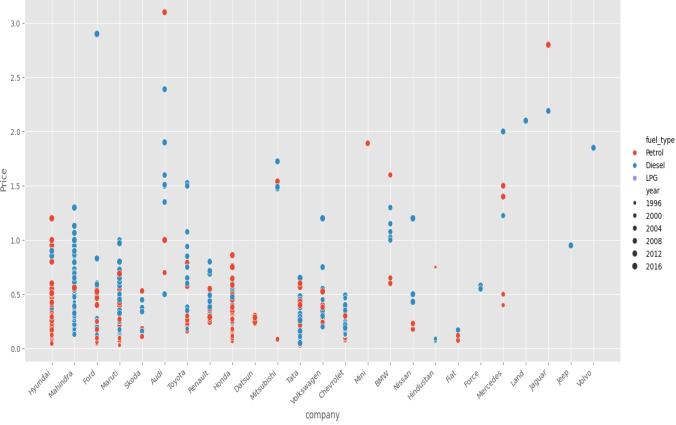
The objective of this project is to estimate a continuous numerical value that is, the price of a used car. The used car price prediction problem is usually formulated as a regression problem. The output variable, sometimes referredtoasthedependentvariableinregressionissues, iscontinuous,whichmeansitcanhaveanyvaluewithina givenrange.Thepriceofthecaristhetargetvariable This pricemightfluctuateovertimedependingon anumberof variables,includingthecar'sage, kilometresdriven,make and model, fuel type, and other attributes. The goal is to develop a predictive model that, given a used car's attributes,canreliablyforecastitsprice.
Toevaluatetheefficacyandprecisionofmachinelearning models,modelevaluationisnecessary.Regressionmodels used in this project are assessed using the assessment metric,R-squared(R2)score
R-squared calculates the percentage of the target variable'svariance(usedcarprices)thatcanbeaccounted for by the model's independent variables, or features. It hasarangeof0to1,where1denotesaperfectfitthatis,a model that perfectly captures all of the variability in the target variable. A model that fits the data better is indicatedbyahigherR2score.
p-ISSN:2395-0072
One of the simplest and most widely applied machine learning methods for predictive problems is linear regression.Byfittingalinearequationtoobserveddata,it is used to determine the relationship between independentvariables(features)andadependentvariable (goal). Simple linear connections between relevant car features andtheassociatedcarpricescanbecapturedvia linear regression. It is helpful in stating how different variables affect price since it highlights the strength and directionoftheinteractions.
It is a machine learning method used for forecasting continuous variables. Decision tree regression divides the featurespaceintoregionsandpredictsthetargetvariable byaveragingtheresponsesofthetraininginstancesinside each zone. As decision trees are good at capturing these kinds of patterns, this strategy is especially helpful when there are complex or non-linear correlations between features and the target variable. Decision tree regression enables more precise pricing forecasts by handling complicated relationships between information like car brand,model,andmiles.
During training, Random Forest builds a large number of decision trees and produces the mode of the classes for classification or the average prediction for regression. In ordertodecreaseoverfittingandincreasegeneralization, itintegratesthepredictionsofseveraldifferentindividual trees Random forest is resilient to outliers, which are common in real-world datasets like those in the used car market and also to irrelevant features because it can handle noisy data and high-dimensional feature spaces Additionally, it offers a feature importance metric that helpsindeterminingthekeyvariablesinfluencingthecost ofusedcars.
Table -1: Performanceevaluationofmodels
Model R2 Score LinearRegression 0.8991 DecisionTreeRegression 0.9270
RandomForestRegression 0.9314
Asrandom forest hashighr2score and bestperformance itischosenfortheimplementationofoursystem. International Research Journal of Engineering and Technology (IRJET) e-ISSN:2395-0056
International Research Journal of Engineering and Technology (IRJET) e-ISSN:2395-0056
Volume: 11 Issue: 04 | Apr 2024 www.irjet.net p-ISSN:2395-0072
6.1 User Interaction
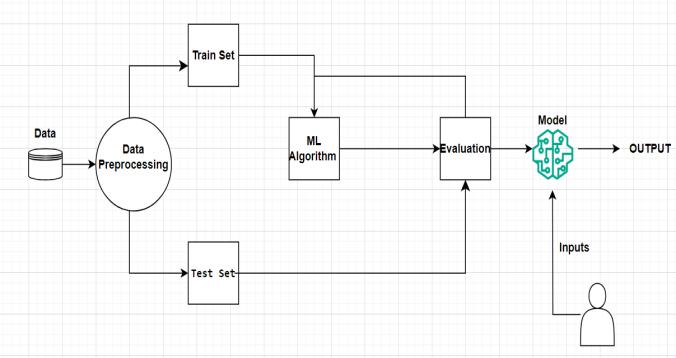
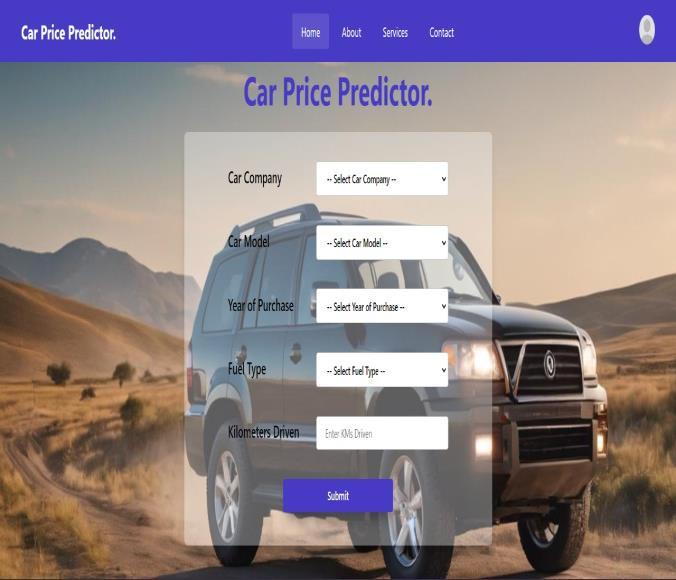
The user engages with the user interface (UI) to provide required data about the used car, including its make, model,year,kilometresdriven,fueltype,andotherdetails by selecting from the dropdown menu. Upon filling all mandatoryfields,theusersubmitstheform.
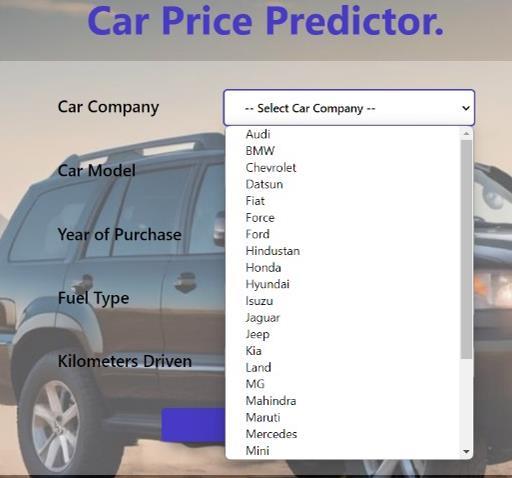
6.2 Data Submission to Flask Server
When a form is submitted, the user's data is sent as a request to the Flask server. The user-provided input data about the cars is given in the form of JSON or form data, andtherequestissubmittedviatheHTTPPOSTmethod.
6.3 Model Retrieval
The Python pickle module is used by the Flask server to retrieve the machine learning model that has been saved in response to a request. This model is previously trained
onhistorical data to make price predictions. Themodel is thenloadedintomemoryafterbeingdeserializedfromthe savedfileinordertomakepredictions.
6.4 Data Preparation
TheUIdataisfirstprocessedtoensurethatitconformsto the format required by the machine learning model. Following processing of data, the data is sent to the machine learning model that has been previously loaded.
6.5 Prediction
The trained machine learning model predicts the used car's price based on the input data. Based on the relationshipsandpatternsthemodelhaslearnedbetween theinputfeatures andthetargetvariable(carprice) from trainingdata,itmakesaccuratepricepredictions.
6.6 Response Generation
The Flask server predicts a price and then produces a response.This responseispresentedasaplaintextstring orasJSONdata.
6.7 Displaying Response
Atlast,theuserinterfaceshowstheanticipatedpriceafter receivingtheresponsefromtheFlaskserver.This isdone bydisplayingtheanticipatedpriceasapop-upmessage
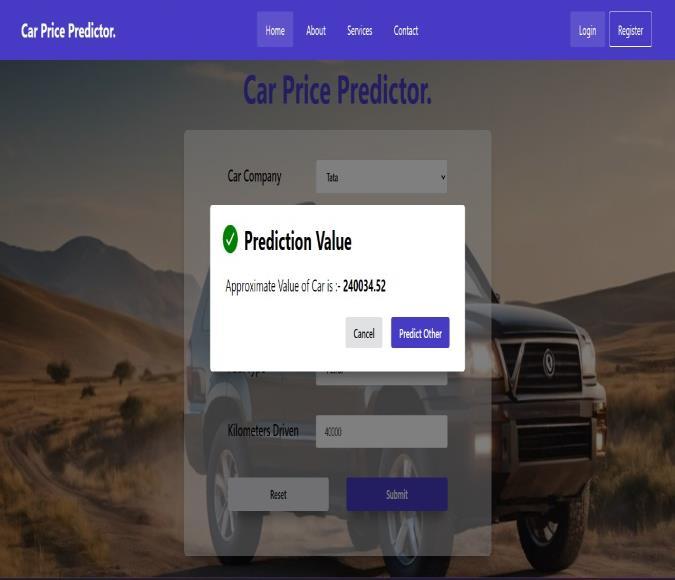
-5:Responsedisplayedtogivenuserinputs
6.8 Services
User can check the services section which aims on educatingtheuserwholackknowledgeaboutusedcarsby providing review videos from popular reviewers in automotivesector.
7. CONCLUSION
In conclusion, the creation of a machine learning-based usedcarpredictionsystemoffersaviablewaytoimprove
International Research Journal of Engineering and Technology (IRJET) e-ISSN:2395-0056 Volume: 11 Issue: 04 | Apr 2024 www.irjet.net p-ISSN:2395-0072
the decision-making process in the automobile industry. Thisprojecthasshownthatitispossibletoestimateused car pricing properly based on a variety of parameters, suchascarcompany,productionyear,fueltype,andmore, by experimenting with several regression techniques like linear regression, decision tree regression and random forest regression. It also shed light on the efficacy and performance of various regression algorithms in used car pricepredictionthrough evaluationbyutilizingimportant metric,R-squared(R2)score.
This project highlights the importance of using machine learning methods in conjunction with an interactive user interface to provide people more control over the decision-making process. Through the addition of interactive features to the user interface, such as dropdownmenusandinputfields,itiseasierfortheusers toreadilysubmitrequiredinformationabouttheusedcar and receive real-time price forecasts. In addition to improving user experience, this smooth combination of interactive UI and machine learning enables better informed decisions to be made while buying and selling usedcars.
[1] C. Jin, "Price Prediction of Used Cars Using Machine Learning," 2021 IEEE International Conference on Emergency Science and Information Technology (ICESIT), Chongqing, China, 2021, pp. 223-230, doi: 10.1109/ICESIT53460.2021.9696839.
[2] A Study on used Cars Price Prediction using Regression Model with Reference to Cartrade.com by International Journal of Trend in Scientific Research and Development - ISSN: 2456-6470 - Issuu. (2022, November11).Issuu.com. https://issuu.com/ijtsrd.com/docs/99_a_study_on_us ed_cars_price_prediction_using_reg
[3] Gegic, E., Isakovic, B., Keco, D., Masetic, Z., & Kevric, J. (2019). Car Price Prediction using Machine Learning Techniques. TEM Journal, 8(1), 113–118. https://doi.org/10.18421/TEM81-16.
[4] T. D. Phan, "Housing Price Prediction Using Machine Learning Algorithms: The Case of Melbourne City, Australia,"2018International ConferenceonMachine Learning and Data Engineering (iCMLDE), Sydney, NSW, Australia, 2018, pp. 35-42, doi: 10.1109/iCMLDE.2018.00017.
[5] K.Samruddhi,&Kumar,D.R.(2020,September).Used Car Price Prediction using K-Nearest Neighbor Based Model.InternationalJournalofInnovativeResearchin Applied Sciences and Engineering (IJIRASE), 4(3), 686-689.
[6] Publication, I. (2022). Price Prediction of Used Cars Using Machine Learning. International Journal for Research in Applied Science & Engineering Technology (IJRASET). https://www.academia.edu/81961391/Price_Predicti on_of_Used_Cars_Using_Machine_Learning.
[7] Y. Li, Y. Li and Y. Liu, "Research on used car price prediction based on random forest and LightGBM," 2022 IEEE 2nd International Conference on Data Science and Computer Application (ICDSCA), Dalian, China, 2022, pp. 539-543, doi: 10.1109/ICDSCA56264.2022.9988116.
[8] Tin Kam Ho, "Random decision forests," Proceedings of3rdInternationalConferenceonDocumentAnalysis and Recognition, 1995, pp. 278-282 vol. 1, doi: 10.1109/ICDAR.1995.598994.
[9] Jingna, Wang. "Research on used car valuation model based on random forest algorithm [D]." Beijing JiaotongUniversity(2019).
[10] RICHARDSON, M., 2009. Determinants of Used Car ResaleValue.Thesis(BSc).TheColoradoCollege.
[11] Sameerchand Pudaruth, “Predicting the Price of Used Cars using Machine Learning Techniques”;(IJICT 2014)