
International Research Journal of Engineering and Technology (IRJET) e-ISSN: 2395-0056
Volume: 11 Issue: 04 | Apr 2024 www.irjet.net p-ISSN: 2395-0072
International Research Journal of Engineering and Technology (IRJET) e-ISSN: 2395-0056
Volume: 11 Issue: 04 | Apr 2024 www.irjet.net p-ISSN: 2395-0072
ASST. PROF M.KAVITHA1, V. HARSHAN2, M. PRAVEEN KUMAR3, A. RAHUL4
Abstract - This paper presents anenhancedsystemfor realtime facial emotion detection, aiming to improve efficiency and accuracy through deep learning. The proposed approach utilizes VGG-19 transfer learning, a pre-trained convolutional neural network (CNN) architecture known for its depth and strong performance in image classification. VGG-19's pretrained weights contribute to improvedefficiencycomparedto simpler CNNs, allowing for effective feature extraction and classification of emotional expressions in real-time. This approach has the potential to benefit various applications in human-computer interaction and psychology by enabling accurate and timely emotion recognition
Key Words: FacialEmotionDetection,DeepLearning,VGG19 Transfer Learning, Real-Time Emotion Recognition, Efficiency,Human-ComputerInteraction,Psychology
1.INTRODUCTION
Human communication encompasses speech, gestures,andemotions,vitalforinterpersonalinteractions. AIsystemscapableofunderstandinghumanemotionsare crucial, especially in healthcare, and e-learning where emotionalunderstandingisparamount.Traditionalemotion detection methods often fall short in real-time scenarios, necessitatingmodelsthatcancontinuouslyinterpretfacial expressionsfordynamicemotionalassessment.
This paper proposes a real-time facial emotion recognition model leveraging AI and computer vision advancements.Themodelaimstoenhancehuman-computer interactions across diverse applications by dynamically detecting and responding to emotions. Automatic Facial ExpressionRecognition(FER)hasgainedtraction,drivenby itspotentialinhuman-computerinteractionandhealthcare. WhileEkman'sdiscretecategorizationmodeliswidelyused, itslimitationinhandlingspontaneousexpressionsprompts theneedformorecomprehensiveapproaches.
Our focus is on categorical facial expression classificationusingtheVGG-19model,knownforitsdepth andperformanceinimagetasks.Byemployingpre-trained weights, our system achieves efficiency and accuracy for real-timeemotionrecognition.ThisworkexploresVGG-19 transferlearning'spotentialforfacialemotionrecognition while remaining adaptable to other models with suitable data.
SharmeenM.SaleemAbdullahand AdnanMohsin Abdulazeez[13]addressedthelatestFERanalysis.Numerous CNN architectures have been identified that have recently been proposed. They have provided various databases of random photographs obtained from the actual world and otherlaboratoriestodetecthumanemotions.
Hussein, E. S., Qidwai, U. and Al-Meer, M. [4] recommended a CNN model to understand face emotions with three continuum emotions. This model uses residual blocks and depth-separable convolutions inspired by Xception to minimize the sum of parameters to 33k. They use a convolutional neural FER network for emotional stabilityidentification.CNNusesconvolutionoperationsto learnextractfeaturesfromtheinputimages,whichreduces the need to extract features from images manually. The proposed model offers 81 percent total precision for invisibleresults.Itsensesnegativeandpositive emotions, respectively,withaprecisionof87%and85%.However,the accuracyofneutralemotiondetectionisjust51%.
Jiang,P.,Liu,G.,Wang,Q.,andWu,J[5]introduceda new loss feature called the advanced softmax loss to eradicate imbalanced training expressions. The proposed losses guarantee that any class would have a level playing field and potential using fixed (unlearnable) weight parametersofthesamesizeandequallyallocatedinangular space.Theresearchshowsthatproposed(FER)methodsare better than specific state-of-the-art FER methods. The proposed loss can be used as an isolated signal or used simultaneouslywithotherlossfunctions.Tosumup,detailed studiesonFER2013andthereal-worldpracticalface(RAF) databaseshaveshownthatASLisconsiderablymoreprecise andeffectivethanmanystate-of-the-artapproaches.
ThisapproachutilizestheVGG19architectureforFacial EmotionRecognitionbypreprocessingthedataset,training the model, and validating it for real-time deployment. It includesimplementingauserinterfaceforinteractionand feedbackloopsforcontinualimprovement.
CNNs, or Convolutional Neural Networks, are crucial in deeplearningandparticularlyeffectiveincomputervision tasks.Theyautomaticallylearnrelevantfeaturesfromraw input data, making them ideal for image and video recognition.Structuredtomimichumanvisualprocessing,
International Research Journal of Engineering and Technology (IRJET) e-ISSN: 2395-0056
Volume: 11 Issue: 04 | Apr 2024 www.irjet.net p-ISSN: 2395-0072
CNNsconsistoflayerslikeinput,convolutional,activation, pooling,fullyconnected,andoutputlayers,eachextracting increasinglyabstractrepresentationsfrominputdata..
2.2. Preprocessing Images:
Thepixelvaluesofgrayscaleimagesareconverted fromstringformattonumpyarraysandreshapesthemtoa consistent size of 48x48 pixels. These processed image arraysarethenstackedtogetheralongthe0thaxistocreate a 4D numpy array representing the entire dataset, where each image is now in a standardized format suitable for further processing. Additionally, the grayscale images are converted to RGB format using OpenCV's `cv2.cvtColor` function to meet the input requirements of the VGG19 model.Followingthisconversion,thepixelvaluesoftheRGB imagesarenormalizedtoarangeof[0,1]bydividingeach pixel value by 255.0. This normalization step ensures uniformityandprovidesoptimaltrainingconditionsforthe deep learning model, enhancing its ability to learn meaningfulpatternsandfeaturesfromtheinputimages.
2.3.
To assess the performance and generalization capabilitiesoftheCNNmodels,cross-validationisemployed. The dataset is divided into multiple folds or subsets. The training and evaluation procedure is reiterated numerous times, with every fold being utilized as the validation set once.Thisapproachensuresacomprehensiveevaluationof theCNNmodels'performanceacrossdifferentsubsetsofthe data. Cross-validation helps in validating the model's performancerobustnessandensuresthatitcangeneralize well to unseen data, reducing the risk of overfitting and providingmorereliableperformancemetrics.
The pre-trained VGG-19 model is loaded usingTensorFlow'sKerasAPI,initializedwithweightspretrained on the ImageNet dataset. Figure 1 illustrates the systemarchitecture,showcasingtheloadingprocesswithout the fully connected layers typically used for ImageNet classification. These layers will be replaced with custom onesfortheemotionrecognitiontask.Afterloading,youcan use`model.summary()`toexaminethemodel'sarchitecture, layer types, output shapes, and trainable parameters. Understanding these details is crucial for customizing the modelandpreparingitfortrainingonyourspecificdataset.
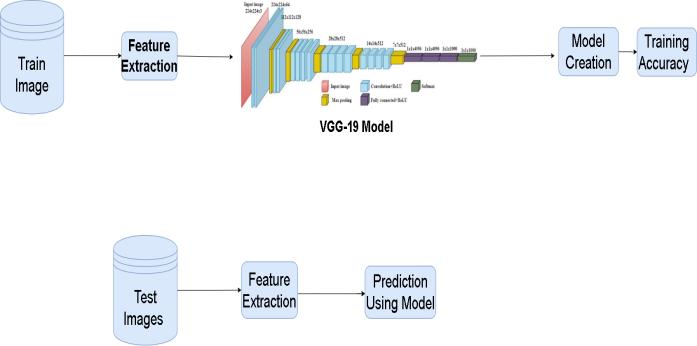
1. SystemArchitecture
The module accesses the intermediate features learned by the VGG19 model, specifically targeting the second-to-last layer before the classification layers. These intermediatefeaturescapturerichrepresentationsoffacial expressions and features crucial for emotion recognition. After obtaining the intermediate features, global average poolingisappliedtosummarizeandcondensethefeature maps into a fixed-length feature vector for each image. A custom output layer, typically a Dense layer with softmax activation,isaddedtomaptheextractedfeaturestodifferent emotionclasses,facilitating emotion recognition based on the VGG19-derived features. This approach leverages the poweroftransferlearning,usingpre-traineddeeplearning modelstoextractmeaningfulfeaturesandthencustomizing theoutputlayersforspecifictaskslikeemotionrecognition.
Theprocessofemotionpredictionusingthetrained model involves several steps. Initially, the preprocessed sample image data is fed into the trained model using `model.predict(input_data)`,wherethemodelcalculatesthe probabilitiesassociated witheach emotion classbased on the image features learned during training. Subsequently, thepredictedprobabilitiesarrayisexaminedtodetermine theemotionwiththehighestprobability,whichservesasthe predicted emotion label. This label is then mapped to a human-readable emotion category using a dictionary, providingthefinalpredictionoftheemotionalstatedepicted inthesampleimage.Finally,thepredictedemotionlabelis extracted and displayed alongside the original image, offering a clear representation of the model's prediction regardingtheemotionalstateconveyedintheimage.This comprehensive process allows for accurate and interpretableemotionrecognitionoutcomesbasedondeep learningtechniquesandmodelpredictions
International Research Journal of Engineering and Technology (IRJET) e-ISSN: 2395-0056
Volume: 11 Issue: 04 | Apr 2024 www.irjet.net p-ISSN: 2395-0072
3.1 Environment Specifications:
Table 1 outlines the experimental configuration employedinthestudy.Theresearchworktakesplaceonan AMD Ryzen 5 3500U CPU with 12GB of RAM and an integratedgraphicscard.Themodelsareconstructedusing Pythonandexecutedusingdeeplearningframeworkssuch asKerasandTensorFlow.
Processname S.N Action
Input 1. Collected images of 10 classes of facial expressions, including 7 classes representing different emotions
Environment
Configuration 2. Anaconda,JupyterNotebook
3. Import all necessary libraries and packages
3.2 Dataset:
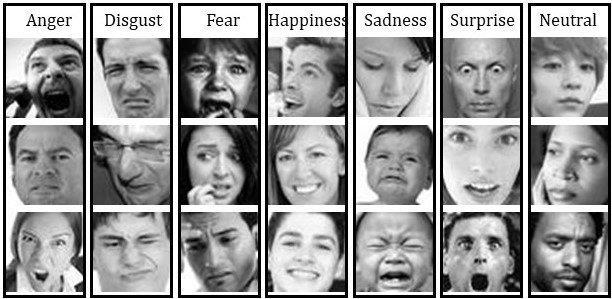
A carefully curated dataset of human facial expression images is collected. The dataset comprises labeled images depicting a range of facial expressions, includinghappiness,sadness,anger,andothersasinfig.2. These images are utilized as input data for training and evaluatingconvolutionalneuralnetwork(CNN)models.The Fer2013datasetstandsasawidelyemployedresourcefor facial expression recognition tasks.. The dataset contains 35,887 grayscale facial images containing 7 different emotions(anger,disgust,fear,happiness,neutral,sad,and surprise).
Directories
Configuration 4. Loadtheimages
5. Load the directories for training, testing and create validation on 20%trainingdata
Training and Testing
Model Compilation
6 Developedtransferlearningmodels trainedontheImageNetdatasetand CNNmodels
7 Fine-tuned by adding the fully connected (FC) layer with SoftMax activation for face emotion detectionusingVGG19.
8 The model complies with Adam optimizerandalearningrate0.001
9 Set70epochsformodeltraining
model checkpoint, use the validationlosstomonitor
3.3 Result Analysis:
Uponthoroughanalysisoftheresults,itisapparent that the VGG19 model achieved the highest accuracy of 88%, surpassing both the custom CNN model with 76% accuracy as shown in Fig6. All models were trained using dataaugmentationtechniquestoenhancetheirperformance. Despite the computational resources required by VGG19 compared to CNN, its deeper architecture and feature extraction capabilities contribute significantly to its performance. Therefore, based on these findings, the proposed system opts for VGG19 as the preferred model, prioritizing accuracy over computational efficiency in this scenario.
Predict the type of Emotions and generatesolutionclass.
TABLE1ExperimentalSetup
TheaccuracyandlossgraphsforVGG19modelalongwith confusionmatricesaidinginidentifyingcorrectpredictions foreachemotionclass,areprovidedherein.RefertoFig.3for theaccuracyandlossgraphsofVGG19.RefertoFig.4forthe confusion matrix of VGG19 Additionally, the classification reportcorrespondingtoeachmodelisincludedwithinthe Fig.5, facilitating a detailed assessment of the model's performanceacrossdifferentemotionclasses.Thesevisual representationsserveasvaluabletoolsforcomprehensively evaluatingandcomparingtheefficacyofeachmodelinthe contextoffacialemotionrecognition.
International Research Journal of Engineering and Technology (IRJET) e-ISSN: 2395-0056
Volume: 11 Issue: 04 | Apr 2024 www.irjet.net p-ISSN: 2395-0072
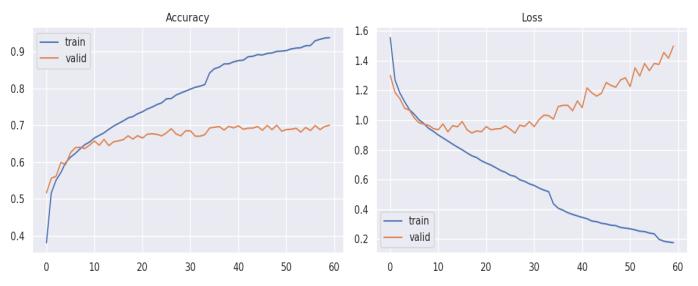
Fig.3. AccuracyandLossGraph.
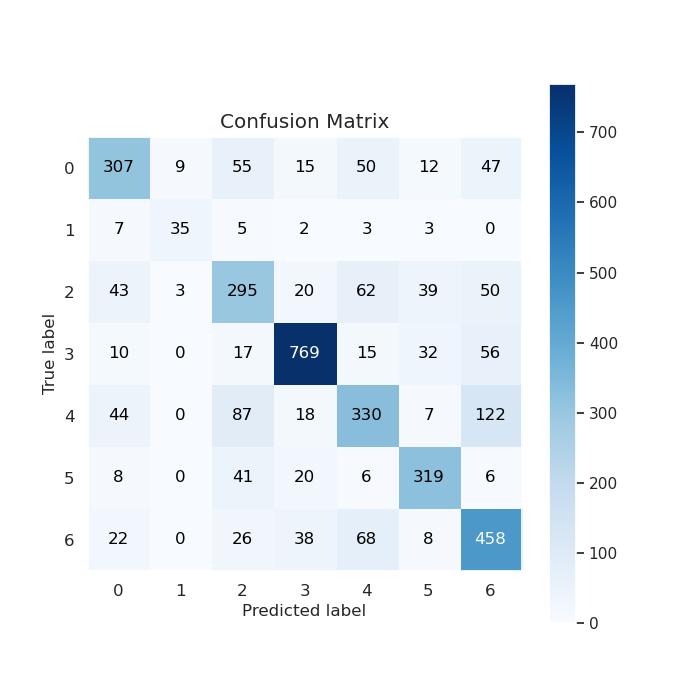
Fig.4. Confusionmatrix
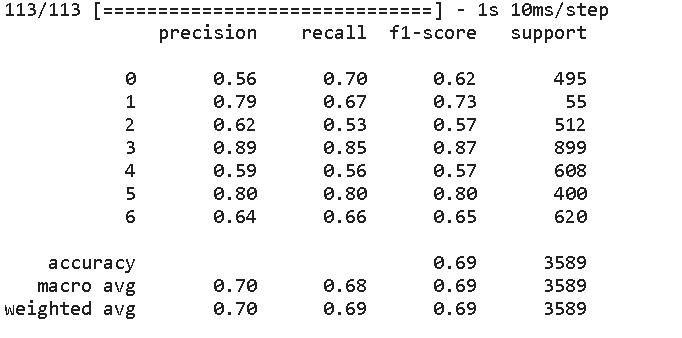
Fig.5.ClassificationReport
Thefacialemotionrecognitionprojectisdeployed viaaweb-basedplatformbuiltontheFlaskframeworkand integrated with React and OpenCV. Users access the applicationthroughawebbrowser,wheretheycanupload images for emotion analysis. The Flask backend handles image processing tasks using the trained VGG19 model, while the frontend displays results such as predicted
emotionsandconfidencescores.UtilizingFlask,React,and OpenCVenablesseamlessinteractionbetweenusersandthe application,providingauser-friendlyinterfaceforemotion recognitiontasks
In this system implementing face emotion recognitionusingdeeplearningwiththeVGG19architecture presentsapromisingapproachforaccuratelydetectingand classifying emotions from facial images. By following a systematic approach that involves data collection, preprocessing, model architecture selection, transfer learning,training,evaluation,anddeployment,it'spossible to develop a robust and effective emotion recognition system.Transferlearning withpre-trained VGG19models enables leveraging knowledge learned from large-scale imageclassificationtasks,whichcansignificantlyenhance the performance of the emotion recognition model, especially when training data is limited. Throughout the development process, careful attention should be paid to datapreprocessing,augmentation,hyperparametertuning, andmodelevaluationtoensurethemodelgeneralizeswell to unseen data and accurately predicts emotions across various facial expressions and environmental conditions. Ultimately, the successful deployment of a face emotion recognitionsystemcanopenuppossibilitiesforapplications in diverse fields, including human-computer interaction, healthcare, entertainment, and security, contributing to advancements in technology and enhancing user experiences.
[1] Sharmeen M. Saleem Abdullah, Adnan Mohsin Abdulazeez.Facial ExpressionRecognition BasedonDeep Learning Convolution Neural Network: A Review in JOURNALOFSOFTCOMPUTINGANDDATAMININGVOL.2 NO.1(2021)53-65.
[2] Hussein, E. S., Qidwai, U. and Al-Meer, M. Emotional Stability Detection Using Convolutional Neural Networks, 2020IEEEInternationalConferenceonInformatics,IoT,and EnablingTechnologies(ICIoT),136-140.
[3] Jiang,P.,Liu,G.,Wang,Q.andWu,J.(2020).Accurateand Reliable Facial Expression Recognition Using Advanced Softmax Loss with Fixed Weights. IEEE Signal Processing Letters,27,725-729.