
International Research Journal of Engineering and Technology (IRJET) e-ISSN:2395-0056
Volume: 11 Issue: 04 | Apr 2024 www.irjet.net p-ISSN:2395-0072
International Research Journal of Engineering and Technology (IRJET) e-ISSN:2395-0056
Volume: 11 Issue: 04 | Apr 2024 www.irjet.net p-ISSN:2395-0072
Mr. S. S. Magade
1,
Prof. S. S. Kale2
,
Dr. S. S. Gawade
3
1PG Student of Mechanical Department, N. K. Orchid College of Engineering & Technology, Solapur 413002, India
2Asst. Professor of Mechanical Department, N. K. Orchid College of Engineering & Technology, Solapur 413002, India
3Professor of Mechanical Department, RIT Rajaramnagar affiliated to Shivaji University, Kolhapur, India
Abstract – In the realm of industrial operations, heat exchangers serve a pivotal function. Improving their efficiency can be achieved through the utilization of heat transfer enhancement methods. These techniques find widespread application across various sectors including chemical processing, evaporator heating and cooling, thermal power generation, air conditioning, refrigeration, and automotive radiator systems, among others. Heat transfer enhancement techniques are typically categorized as active, passive, or compound. This research focuses on exploring passive techniques for enhancing heat transfer. Specifically, this study conducts a comprehensive review of recent advancements in heat transfer enhancement utilizing non-metallic inserts. The analysis encompasses a survey of various research endeavors, methodologiesemployed,andresultantfindingsinthisdomain. Furthermore, the investigation delves into the discussion of diverse insert types, their geometries, and the influence of such geometriesonheattransferrates.
Key Words - Forcedconvection,Heattransferaugmentation, FlowDividerInsertinserts.
Intoday'scontemporarylandscape,theefficientutilizationof available energy while minimizing material usage and process costs has become a paramount concern post the industrial revolutions. Ensuring the effective use of energy with minimal environmental impact has emerged as a significant imperative towards sustainable development, particularlyinthedesignofdevicesaimedatfacilitatingheat energyexchangebetweentwoormorefluids.Toaddressthis imperative,extensiveresearchhasbeenundertakenglobally, exploring various methodologies for optimizing energy utilization. Augmentation techniques for heat exchangers, includingactive,passive,andcompoundmethods,havebeen proposedandimplementedtoenhanceperformance.
Heat transfer, defined as the movement of energy from one region to another due to temperature disparities, is integral to numerous industries such as food and beverage processing, chemical manufacturing, automotive, and thermal sectors, directly impacting their economic viability. Improvingtheefficacyofheattransferdevicesnotonlyleads to energy, material, and cost savings but also contributes to environmental sustainability. The study of enhancing heat transfer performance is commonly referred to as heat transfer augmentation, with a primary focus on elevating convectiveheattransfercoefficients.
Passivetechniques for heat transferaugmentation, whichdo not require external power sources, have garnered significant attention due to their cost-effectiveness and performance efficiency compared to active methods. This paper delves into a detailed examination of heat transfer augmentation utilizing passive techniques. In passive methods, convective heat transfer coefficients are enhanced by minimizing thermal resistance, thereby facilitating improved heat transfer. This can be achieved through methods such as increasing effective heat transfer area or inducingturbulenceinthefluidflowwithinthedevice.
Enhancingeffectiveheattransferareainvolvesmodifications within the conduit, such as introducing rough or extended surfaces. Turbulence generation, on the other hand, can be accomplishedusinginsertsorturbulators.Forcedconvection heattransfer,amechanismwherefluidmotionisinducedby anexternalsourcesuchasapumporfan,playsacrucialrole in facilitating efficient heat transfer. This mechanism finds widespread application in everyday scenarios including air conditioning, central heating, steam turbines, and various industrial processes, highlighting its significance in enabling efficientenergytransfer.
International Research Journal of Engineering and Technology (IRJET) e-ISSN:2395-0056
Volume: 11 Issue: 04 | Apr 2024 www.irjet.net p-ISSN:2395-0072
Heattransferaugmentationmethodsarebroadlycategorized into three main types: active, passive, and compound techniques. Active techniques require external power input to function, while passive techniques operate without the need for additional energy, thereby enhancing thermohydraulic performance. Compound techniques combine two or more passive and/or active methods simultaneously to achieve even greater augmentation comparedtousingindividualtechniquesindependently.
Passive techniques, which operate without external power, involve altering the geometry or surface of the flow channel to improve system performance. This often includes the use ofinserts,ribs,orroughsurfacestopromotefluidmixingand turbulence,consequentlyincreasingtheoverallheattransfer rate. Passive techniques offer several advantages, including cost-effectiveness, ease of production, and simplified installationprocedures.
In contrast, active techniques are more intricate in design and application due to their reliance on external energy sources to manipulate fluid flow and improve thermal efficiency. The practical implementation of active techniques isoftenchallengingduetothedifficultyinprovidingexternal energy,limitingtheirwidespreadadoptioninscientificfields.
Compoundtechniques,whichcombinemultipleheattransfer enhancement methods, offer promising avenues for enhancing the thermohydraulic performance of heat exchangers. Preliminary studies on compound passive augmentationtechniquesshowencouragingresults.
Forced convection, commonly employed in various applications including heat exchangers, air preheaters, and coolingsystems,utilizesexternalmechanismssuchasfansto inducefluidmotion,facilitatingefficientheattransfer.
Heattransferaugmentationmethodsarebroadlycategorized into three classifications: active, passive, and compound techniques.
A. Active Method: Active methods require external power input to operate. In contrast, passive methods do not need additional energy to improve the thermohydraulic performance of the system. Additionally, combining two or more passive and active techniques is termed a compound technique, used to achieve greater augmentation compared tousingasinglepassiveoractivetechniqueindependently.
B. Passive Method: Passive methods operate without relying onexternal powersources;instead,theyinvolvealteringthe geometry or surface of the flow channel to enhance thermohydraulic performance. Inserts, ribs, and rough surfaces are commonly utilized to induce fluid mixing and turbulence, resulting in an overall increase in the heat transfer rate. Passive techniques offer several advantages over other heat transfer enhancement methods, including low cost, ease of production, and installation. Conversely, activetechniquesaremoreintricateindesignandapplication due to their dependency on external energy sources to manipulate fluid flow and improve thermal efficiency. Overcoming the challenges associated with providing external energy poses limitations, thereby restricting the widespreaduseofactivetechniquesinscientificfields.
C. Compound Method: Compound techniques involve combining multiple heat transfer enhancement methods, including bothactiveandpassivetechniques,toimprovethe thermohydraulic performance of heat exchangers. These techniques can be employed simultaneously to generate augmentation that enhances the system's performance beyond the capabilities of individual techniques operating independently. Preliminary studies on compound passive augmentation techniques have shown promising results. In thecontextofthecurrentglobalenergycrisis,exacerbatedby continuousconsumptiongrowth,heattransferaugmentation hasthepotential to enhancedevice performance and reduce devicesize.
Advantages of heat transfer augmentation techniques such as
Increase the heat flow transferred in the heat exchanger.
Reducethesurfaceareaoftheheatexchanger
Reduce the driving temperature difference across thetubewall.
Forcedconvectioniscommonlyusedinapplicationssuchas
HeatExchanger
Heating Ventilation and Air Conditioning (HVAC) Systems
AirPreheater
Economizer
AutomotiveRadiators
AerospaceApplications
DryingProcesses
PowerGeneration
Volume: 11 Issue: 04 | Apr 2024 www.irjet.net p-ISSN:2395-0072
SolarCollectors
Coolingofelectroniccomponentsbyfans
Heatingofhomesusingforcedairblowers
Heattransferaugmentationtechniquesofferseveral advantages,including:
Enhancement of heat flow transferred within the heatexchanger.
Reduction of the surface area required by the heat exchanger.
Decrease in the driving temperature difference acrossthetubewall.
Forcedconvectionfindswidespreadapplicationinvarious sectors,including:
HeatExchangers
Heating, Ventilation, and Air Conditioning (HVAC) Systems
AirPreheaters
Economizers
AutomotiveRadiators
AerospaceApplications
DryingProcesses
PowerGeneration
SolarCollectors
Coolingofelectroniccomponentsbyfans
Heatingofhomesusingforcedairblowers
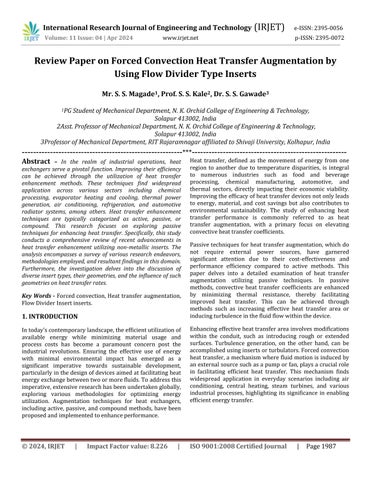
D. R. Hase et al. [1] conducted experimental investigations into heat augmentation employing non-metallic flow divider type inserts in forced convection. Their research focused on passive techniques for enhancing heat transfer, particularly utilizing Nylon flow divider inserts. These non-metallic inserts were designed to induce turbulence, thereby increasing heat transfer rates. The experiments involved externally heating a horizontal tube fitted with various inserts, including the Nylon flow divider insert featuring a 90-degree angle between consecutive blades. The study applied constant heat flux to a plain tube and conducted experiments at different mass flow rates of air to determine Nusselt number and friction factor. Initially, experimental data from the plain tube were compared with established correlationssuchasDittus-BoelterandBlasiustovalidatethe experimental setup. Once validated, experiments were conducted with the Nylon flow divider insert, and the
obtained values of Nusselt number and friction factor were compared. The study observed a significant 70% increase in Nusselt number, with an overall enhancement ratio exceedingunityandenhancementefficiencyrangingfrom1.5 to2.0.
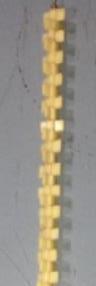
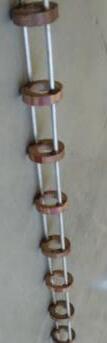
S. G. Mushan et al. [2] investigated heat augmentation using non-metallic inserts in forced convection, employing two distincttypesofinserts:Bakelitedifferential AnnularInserts and Acrylic Twisted Tape. The experimental data for the plain tube were meticulously compared with established correlationssuchasDittus-BoelterandPetukhov,revealinga satisfactory agreement. For the Differential Annular Type insert,aremarkablemaximumincreaseinNusseltnumberof 112% was observed, accompanied by an overall enhancement ratio ranging from 0.54 to 1.12. The friction factor, which is directly related to pressure drop, was found to range from 0.5 to 0.6. On the other hand, for the Nonmetallic Acrylic Twisted Tape Insert, an impressive maximum increase in Nusselt number of 187% was noted, alongwithanoverallenhancementratiorangingfrom1.10to 1.58.Thefrictionfactorrangedfrom0.06to0.08.
Sandeep P. Nalavade et al. [3] undertook experimental and numerical investigations into friction factor and forced convective heat transfer characteristics for air flow in a heated pipe using innovative flow divider type turbulators. Their experiments delved into exploring the impact of pitch to diameter ratio and twist angle of turbulators on heat transfer and friction factor. The study encompassed a comprehensive Reynolds number range of 7000 to 21000, investigating various parameters to elucidate their influence on convective heat transfer and pressure loss in fluid flow behavior. To complement their experimental endeavors, Computational Fluid Dynamics (CFD) simulations were meticulouslyconductedtoscrutinizetheeffectofalteringthe angle of twist of turbulators. The experimental setup involved applying a constant heat flux to the test section (GI pipe), meticulously recording temperature data, air flow rates,andpressuredifferentialsacrossthetestsection.
A.H.Dhumaletal.[4]delvedintoinvestigatingheattransfer enhancement for tube-in-tube heat exchangers through the utilization of twisted tape inserts. Their study primarily entailed a theoretical investigation into the convective heat transfer performance and flow characteristics of fluids in double pipe heat exchangers. The findings underscored critical observations regarding the impact of Reynolds number on heat transfer performance and flow behavior. Emphasizingthesignificanceofselectingappropriateinserts based on specific requirements, the study shed light on the delicate balance between heat transfer enhancement and pressuredrop.
International Research Journal of Engineering and Technology (IRJET) e-ISSN:2395-0056
Volume: 11 Issue: 04 | Apr 2024 www.irjet.net
Sahil Sunil Patil et al. [5] meticulously analyzed forced convection heat transfer to enhance thermal performance using pipes equipped with triangular fin inserts. Their study meticulously delved into experimentally investigating the heat transfer performance of copper tubes fitted with triangular fin inserts. The findings highlighted substantial enhancements in heat exchanger effectiveness, with critical conclusions drawn regarding the effects of mass flow rate and fin spacing on heat transfer and pressure drop. Proposing new correlations for Nusselt number and heat transfer coefficient based on their experimental data, the studyprovidedvaluableinsightsforpracticalapplications.
H. V. Chavan et al. [6] ventured into exploring heat transfer enhancement utilizing twisted tape inserts, ultimately identifying the twist ratio yielding the highest heat transfer rate.Theirstudyconclusivelydemonstratedthattwistedtape inserts significantly amplify heat transfer rates compared to plain tubes within a specific Reynolds number range. With meticulous observationsmadeonNusseltnumbervariations and friction factors for different twist ratios, the study underscored the intricate relationship between these parameters.
A.M.Rathodetal.[7]conductedanexhaustiveexperimental study focusing on heat transfer augmentation by forced convection from various ribbed surfaces. Their study meticulously investigated the heat transfer characteristics over ribs in turbulent boundary layers under varying Reynolds and Nusselt numbers. Observing a significant enhancement in turbulent heat transfer due to the presence of ribs, the study drew valuable conclusions regarding the effectivenessofdifferentribarrangementsandmaterials.
N. C. Kanojiya et al. [8] meticulously reviewed enhancement techniques in heat transfer using inserts, with a particular emphasis on the utilization of nanofluids. Their comprehensive review highlighted various passive methods for enhancing heat transfer rates, with a specific focus on twisted tape inserts. The review meticulously documented observationsregarding theimpactof perforationsintwisted tape inserts on heat transfer rate and pressure drop. The review concluded by underscoring the potential of twisted tape inserts for future applications, particularly in laminar flowscenarios.
S. Naga Sarada et al. [9] undertook an in-depth investigation into the enhancement of heat transfer using varying width twistedtapeinserts.Theirstudyexperimentallyexploredthe potential of reduced width twisted tape inserts to enhance heat transfer rates in a horizontal circular tube. Observing critical effects of modified twist ratio and Reynolds number on heat transfer and overall enhancement ratio, the study
p-ISSN:2395-0072
concluded by proposing correlations for practical use, sheddinglight.
Name of Author Geometric View of Insert Observation & Comment
D.R.Haseetal. [1]
Nylonflow dividerinsert
Nu increased and decreased with increase in Re. Nu is increasedby70%
S. G. Mushan et al.[2]
Bakelite Differential Annular Insert
Nu increased and decreased with increase in Re. Nu is increasedby12%
S. G. Mushan et al.[2]
Acrylic TwistedTape Insert
Nu increased and decreased with increase in Re. Nu is increasedby87%
International Research Journal of Engineering and Technology (IRJET) e-ISSN:2395-0056
Volume: 11 Issue: 04 | Apr 2024 www.irjet.net p-ISSN:2395-0072
Sandeep P. Nalavade et al. [3]
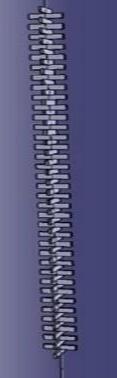
AlInsert mountedon rod
H.A.Dhumalet al.[4]
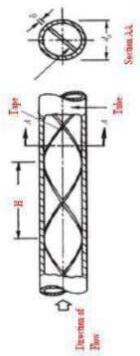
Lowcarbon steel
ANSIAS-177 helical twistedtapes
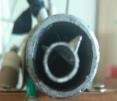
SahilSunilPatil etal.[5]
The turbulator with pitch to diameter ratio (��⁄��) 0.54 and 30° angle of twist (��) performsbetter.
For the Nylon flow divider insert, the Nusselt number (Nu) exhibited an increase followed by a decrease with the rise in Reynolds number (Re). Notably, Nu experienced a significant increase of 70%.
Similarly, in the Bakelite Differential Annular Insert, Nu displayed a similar trend of increasing and then decreasing with rising Re, resulting in a 12% increase.
In the case of the Acrylic Twisted Type Tape, Nu demonstrated a similar behaviour withvariationsin Re,showinganimpressiveincreaseof87%.
Withincreaseintwist ratio,Nusselt’sNumber decreases but at the same time pressure drop also decreases.
It was observed that with an increase in twist ratio, Nusselt'sNumber(Nu)decreased,accompaniedbya decreaseinpressuredrop.
[1] D.R. Hase, N.K. Sane, D.V. Ghewade, March 2017, “Heat Augmentation Using Non-metallic Flow Divider Type Inserts in Forced Convection”, IOSR Journal of Mechanical and Civil Engineering (IOSRJMCE) e-ISSN: 2278-1684, p-ISSN: 2320-334X PP. 62-67
[2] S. G. Mushan, B. E. Patil, N. K. Sane, D. V. Ghewade. “Heat Augmentation using non-metalic insert in forced convection”. IOSR Journal of Mechanical and Civil Engineering (IOSR-JMCE) e-ISSN: 2278-1684, p-ISSN:2320-334X.PP.81-88

AL Pipe with GI Triangular FinInsert.
The heat transfer coefficient demonstrates an upward trend with the escalation of the Reynolds number. Meanwhile, the friction factor exhibits a declining pattern with the increment of the Reynolds number, whereas in the finned tube, it gradually diminishes as the gap between two fins increases (with a spacingof160mm).
[3] P. Nalawade Sandeep, L. Prabhune Chandrakant, K. Sane Narayan. “Effect of Novel Flow Divider Type Turbulator on Fluid Flow and Heat Transfer”. Thermal Science and Engineering Progress PII: S2451-9049(18)30390-1
[4] A. H. Dhumal, G. M. Karkal, K. T. Pawale. “Heat Transfer Enhancement for Tube in Tube Heat Exchanger Using Twisted Tape Inserts”. International Journal of Advance Engineering Research and Science (IJAERS). Vol-4, Issue-5, May 2017,ISSN:2349-6495(P),2456-1908(O)
[5] Sahil Sunil Patil, Shivayogi Ashok Shetty, Amol Dhumal,“Analysisofforcedconvectionheattransfer to improve the thermal performance by using pipe with triangular fin inserts” International Research Journal of Engineering and Technology (IRJET) eISSN:2395-0056,p-ISSN:2395-0072.
International Research Journal of Engineering and Technology (IRJET) e-ISSN:2395-0056
Volume: 11 Issue: 04 | Apr 2024 www.irjet.net p-ISSN:2395-0072
[6] H.V.Chavan,PrathameshA.Tapdiya,S.S.Birvatkar, S. U. Mundhe, V. S. Sharma. “Heat Transfer Enhancement by Using Twisted Tape Insert”. Volume 04 Issue :05 May 2017. International Research Journal of Engineering and Technology (IRJET)e-ISSN:2395-0056,p-ISSN:2395-0072.
[7] A. M. Rathod, B. K. Khot, U. S. Bongarde. “Heat Transfer Augmentation by Forced Convection from Varies Ribbed Surfaces”. Volume: 07 Issue: 05, 05 May 2020. International Research Journal of Engineering and Technology (IRJET) e-ISSN:23950056,p-ISSN:2395-0072.
[8] N. C. Kanojiya, V. M. Kriplani, P. V. Walke. “Heat Transfer Enhancement in Heat Exchanger with Inserts: A Review” International Journal of Engineering Research & Technology (IJERT) ISSN:2278-0181.Vol3Issue10Oct2014.
[9] S. Naga Sarada, A. V. Sita Rama Raju, K. Kalyani Radha, L. Shyam Sundar. “Enhancement of Heat TransferUsingVaryingWidthTwistedTapeInsert”. International Journal of Engineering, Science and Technology.Vol2,No.6,2010,pp107-118.
[10] G. S. Bhosale, S. S. Kale, Dr. Bimlesh Kumar. “A Review on Convective Heat Transfer Augmentation Using Non-Metallic Insert” International Research Journal of Engineering and Technology (IRJET) e-ISSN:2395-0056, pISSN:2395-0072.
[11] Bishal Bhandari, Madhav Rijal. “Evaluation ofConvectiveHeatTransferCoeffientofAirFlowing ThroughanInclinedCircularDuct”.
[12] Vol-7, Issue 9 Sept. 2018. International Journal of Engineering Research & Technology (IJERT)https.//ssrn.com/abstract=3256827
[13] S.K.Saha,A.Dutta,B.S.K.Dhal,Frictionand heat transfer characteristics of laminar swirl flow through a circular tube fitted with regularly spaced twisted tape elements. International journal of heat masstransfer,2001.
[14] Eiamsa-ard, N. Piriyarungroj, C. Thianpong, S.Eiamsa-ard,Acasestudyonthermalperformance assessment of a heat exchanger tube equipped with regularly-spaced twisted tapes as swirl generators. [3]ELSEVIER,CaseStudies inThermal Engineering, 2014.
[15] Smith Eiamsa-ard, Chinaruk Thianpong, Pongjet Promvonge, Experimental investigation of heat transfer and flow friction in a circular tube fitted with regularly spaced twisted tape elements. [4] ELSEVIER International Communication in Heat andMassTransfer,2006.
[16] Kumbhar D. G. and Dr. N. K. Sane, Exploring Heat Transfer and Friction Factor Performance of a Double Tube Equipped with Regularly Spaced Twisted Tape Inserts [5] ELSEVIER Procedia EngineeringJournal,2015.
[17] S.Eiamsa-ard, K.Wongcharee, P.Eiamsa-ard, C. Thianpong, September 2009, “ Heat transfer enhancement in a tube using delta-winglet twisted tapeinserts”1359-4311/2009ElsevierLtd
[18] Pravin S. Nikam, R. Y. Patil , D.A. Patil ,S.G.Chaudhari, August 2016, “Heat Transfer Enhancement through a Pipe by Inserting V-Shape Aluminium Turbulator” , International Journal of Engineering and Techniques, ISSN: 2395-1303 Volume2Issue4,pp.54-61
[19] A.R. Martin, C. Saltiel, J. Chai, W. Shyy, January 1998, “Convective and radiative internal heat transfer augmentation with fiber arrays”, International Journal of Heat and Mass Transfer 41(1998)3431-3440



Mr.MagadeS.S.
(M-Tech Student, Mechanical Dept.) N.K. Orchid College of Engineering & Technology Solapur, Maharashtra,India.(413002)
Mr.KaleS.S.
Research Scholar, Department of Technology Shivaji University Kolhapur and Asst. Prof. N. K. Orchid College of Engg. And Tech. Solapur, Maharashtra, India (413002)
Dr GawadeS.S.
Professor, RIT Rajaramnagar affiliated to Shivaji University Kolhapur,Maharashtra,India