
International Research Journal of Engineering and Technology (IRJET) e-ISSN:2395-0056
International Research Journal of Engineering and Technology (IRJET) e-ISSN:2395-0056
Shraddha Trivedi1 , Hrishika Singh2 , Aryan Pal3, Saumya Thacker4 , Smita Bansod5 , Pranali Vhora6 ***
Abstract - Strong Network Intrusion Detection Systems (NIDS)arenowessentialforprotectingsensitivedataand guaranteeing the integrity of network infrastructures due to the exponential growth of digital data and the rising sophisticationofcyberattacks.Using avarietyofmachine learning methods, such as Logistic Regression, Ridge Classifier, K-Nearest Neighbours, Linear Discriminant Analysis, Quadratic Discriminant Analysis, and Decision Tree Classifier, this study suggests a novel method for network intrusiondetection.The study employs a diverse set of machine learning techniques to enhance the accuracy and reliability of intrusion detection, addressing the limitations of traditional rule-based systems. Each algorithmcontributesuniquecapabilitiesincapturingand understanding patterns within network traffic data, therebyimprovingtheoveralldetectionperformance.
The dataset used for training and evaluation is a representativecollectionofnetworktraffic,encompassing both normal and anomalous activities. Features extracted from the network traffic data include packet headers, payload characteristics, and temporal information. The proposed system incorporates pre-processing techniques to handle imbalanced datasets and optimize feature selection,ensuringthemodelsarerobustandefficient.
The findings of the study enable network managers and cybersecurityspecialiststosafeguardagainstawiderange of online threats and contribute to the advancement of intrusion detection methods. Enhancing threat detection accuracy and offering scalability and adaptability to changing network conditions make the recommended NIDS an effective weapon in the ongoing battle against cyberadversaries.
Key Words: Network Traffic Patterns, Anomalous Activities, Network Traffic Data, Packet Headers, Online Threats
In the contemporary landscape of interconnected digital ecosystems, the proliferation of cyber threats has grown exponentially,posingsignificantchallengestothesecurity and integrity of network infrastructures. As organizations increasingly rely on digital communication and data exchange, the need for robust Network Intrusion Detection Systems (NIDS) becomes paramount. Traditional rule-based systems, while effective to some extent, struggle to keep pace with the evolving
Volume: 11 Issue: 04 | Apr 2024 www.irjet.net p-ISSN:2395-0072 © 2024, IRJET | Impact Factor value: 8.226 | ISO 9001:2008 Certified Journal | Page1961
sophistication of cyber threats. To address this challenge, this research endeavors to present an innovative and comprehensive approach to network intrusion detection, harnessing the power of various machine learning algorithms. The key to our suggested NIDS is the applicationofavarietyofmachinelearningmethods,each of which brings a special set of advantages to the job of differentiating between abnormal and typical network activity. The techniques used are Decision Tree Classifier, Linear Discriminant Analysis, Quadratic Discriminant Analysis, K-Nearest Neighbours, Ridge Classifier, and Logistic Regression. Our goal in merging these algorithms istobuildanadaptableandsynergisticintrusiondetection system that can effectively respond to the ever-changing landscape of cyber threats. The significance of this researchextendsbeyondthemereapplicationofmachine learning in intrusion detection; it addresses the pressing need for a holistic and versatile solution that can detect a wide range of cyber threats. The study explores the intricate relationship between different machine learning algorithmsandtheirefficacyincapturingandinterpreting patterns within network traffic data. Through rigorous experimentation and comparative analyses, we aim to provideinsightsintothestrengthsandweaknessesofeach algorithm, facilitating an informed selection based on specific intrusiondetectionrequirements. Usinga variety of machine learning methods, the main goal of this research is to create a reliable and flexible Network Intrusion Detection System (NIDS). In light of changing cyberthreats, the study attempts to improve intrusion detection effectiveness and solve the shortcomings of conventionalrule-basedsystems.
1. Algorithmic Integration: To take advantage of eachmachinelearningalgorithm'sspecialabilities in identifying a variety of patterns in network traffic data, combine Logistic Regression, Ridge Classifier, K-Nearest Neighbours, Linear Discriminant Analysis, Quadratic Discriminant Analysis,andDecisionTreeClassifierintoasingle NIDSframework.
2. Comprehensive Evaluation: Conduct a rigorous evaluation of the proposed NIDS using representativedatasetsencompassingnormaland anomalousnetworkactivities.Assessthesystem's performance across various metrics such as precision,recall,F1-score,andthearea underthe receiver operating characteristic curve to ensure
International Research Journal of Engineering and Technology (IRJET) e-ISSN:2395-0056
Volume: 11 Issue: 04 | Apr 2024 www.irjet.net p-ISSN:2395-0072
a comprehensive understanding of its effectiveness.
3. Adaptability: Evaluate the adaptability of the NIDS to dynamic and evolving cyber threats, considering scenarios where traditional rulebased systems may struggle. Investigate the system'sabilitytoautonomouslylearnandadjust to new threat patterns without constant manual ruleupdates.
Several research studies explore the realm of AI-based intrusion detection systems, employing various methodologies and datasets for evaluation. Techniques such as deep belief networks (DBN), autoencoders (AE), and ensemble learning are examined, with datasets like KDD CUP 99 and NSL-KDD. While these studies provide valuable insights into the use of AI mechanisms for intrusion detection, some limitations emerge, including a focus on performance rather than attack classification, insufficient discussion on time complexity and CPU utilization, and limited evaluation of different AI-based mechanisms. Additionally, challenges related to datasets andreal-worldmodelsremainunder-addressed.
Efforts to enhance intrusion detection systems continue with innovations like the Dynamic Intrusion Detection System (DIDS), boasting high performance accuracy and detection rates. Utilizing techniques such as Principle Component Analysis (PCA) and Multiclass Support Vector Machine (m-SVM), DIDS demonstrates improved capabilities. However, studies like the hybrid CNN+LSTMbased system for industrial IoT networks also exhibit limitations, emphasizing performance over attack classification and lacking in-depth discussion on certain technical aspects. Similarly, advancements like the bianomaly-basedintrusiondetectionsystemforIndustry4.0 aim to reduce false positives and enhance security, but challenges with existing signature-based systems persist. Overall, while these studies push the boundaries of intrusion detection, they underscore the need for comprehensive evaluations anddiscussions onscalability, datasetchallenges,andreal-worldapplicability.
The contemporary surge in sophisticated cyber threats challenges the efficacy of traditional Network Intrusion Detection Systems(NIDS),predominantlyreliantonstatic rule-based approaches. These systems face difficulties in adapting to dynamic threat landscapes, leading to increased false positives and negatives. The lack of autonomous adaptability, optimized feature extraction, and scalability hampers their effectiveness in real-time networkdefense.
1. Adaptability: Current NIDS lack autonomous adaptability, requiring manual rule updates and makingthemlesseffectiveindynamicenvironments
2. False Positives and Negatives: Rule-based systems have a harder time telling the difference between typical and unusual network behaviour, which raises thepossibilityoffalsepositivesandnegatives.
3. Algorithmic Integration: Absence of a unified framework integrating machine learning algorithms hinders the development of an adaptive NIDS capable ofaddressingabroadspectrumofintrusionscenarios.
4. Feature Optimization: Inefficient feature extraction techniques limit NIDS accuracy in identifying and classifying intrusions by overlooking critical information.
5. Scalability: Many existing NIDS encounter challenges inscalingefficientlytodiversenetwork environments and varying data loads, limiting their applicability in large-scalescenarios.
IntruShield, a smart intrusion detection system that can handle all of these issues, is what we are creating as a solutiontothisissue.
1. Dataset Selection: Locate and obtain representative datasets that cover a variety of simulated cyberthreats in addition to typical network behaviour. To improve the proposed Network Intrusion Detection System's (NIDS) generalizability,makesurethedatasetsincludereal-world scenarios.
2. Data Pre-Processing: To address problems like imbalanced datasets, missing values, and outliers, thoroughly preprocess the data. For class imbalances, apply methods such as oversampling or undersampling; formissingornoisydata,employsuitableapproaches.
3. Feature Extraction: Explorevariousfeatureextraction techniques to optimize the representation of network traffic data. Considering extracting features from packet headers, payload characteristics, and temporal information to improvise the discriminative power of the NIDS.
4. Algorithm Selection and Integration: Implement and integrate machine learning algorithms including Logistic Regression, Ridge Classifier, K-Nearest Neighbors, Linear Discriminant Analysis, Quadratic Discriminant Analysis, and Decision Tree Classifier. Tailor the integration to exploitthestrengthsofeachalgorithmforspecifictypesof intrusionpatterns.
International Research Journal of Engineering and Technology (IRJET) e-ISSN:2395-0056
Volume: 11 Issue: 04 | Apr 2024 www.irjet.net p-ISSN:2395-0072
5. Training and Cross-Validation: To enable reliable model evaluation, split the dataset into training and testing sets using cross-validation technique. Utilising the trainingset,instructeachmachinelearningalgorithmand fine-tunethehyperparameterstoenhanceperformance.
6. Algorithmic Comparison: Compare each machine learning technique to understand its advantages and disadvantages. Examine their performance in a range of intrusion scenarios, including details about the optimal conditions for each algorithm as well as the conditions underwhichitunderperforms.
7. Adaptability Testing: EvaluatetheNIDSadaptabilityto evolving cyber threats by simulating real-world scenarios with novel attack patterns. Assess its ability to autonomously adapt without manual intervention, highlightingitseffectivenessindynamicenvironments.
8. Scalability Testing: Testthescalabilityoftheproposed NIDS by actually assessing its performance under varying network loadsand configurations.Ensurethat the system can efficiently scale to handle diverse network environments, demonstrating its practical applicability in huge-scalescenarios.
9. Ethical Considerations: Throughout the process, keep privacy and data security ethical considerations as the major objectives. Follow ethical standards for gathering, processing, and reporting data to guarantee the responsibleandopendevelopmentofthesuggestedNIDS.
The proposed methodology aims to systematically overcomethedifficultiesstatedintheProblemstatement, giving a structured approach to the Development and EvaluationofanAdvancedIntruShield:NetworkIntrusion DetectionSystem.
5. ALGORITHMS USED AND THEIR ACCURACY
1. Logistic Regression:
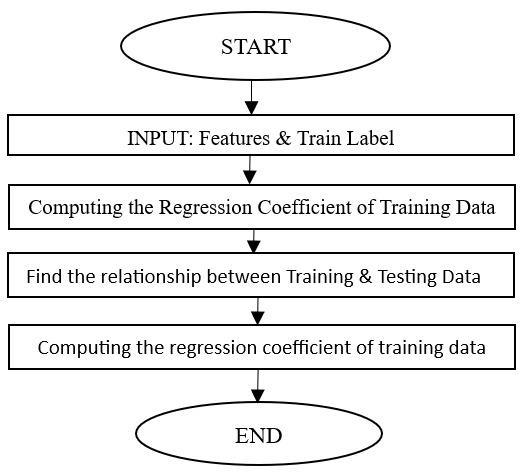
As shown in Figure 1, Logistic regression is used statistically to overcome problems with binary classification.Itmimicsthelikelihoodthataninstancewill belong to a particular class. The approach determines the coefficients for each feature after using the logistic functiontoprovideprobabilitiesbetween0and1.
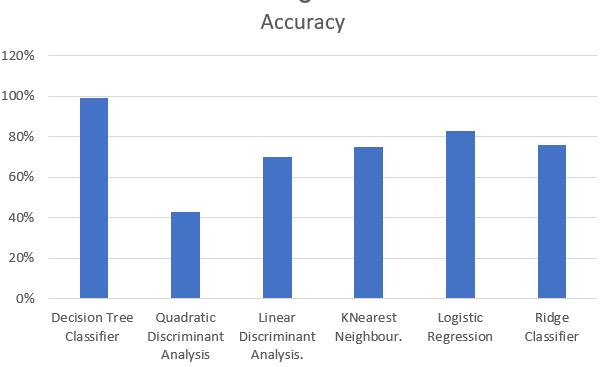
Application in NIDS: Because it can capture linear relationships in feature space, logistic regression is a valuable technique when intrusion patterns exhibit clear separability. The accuracy of the Logistic Regression algorithminoursystemis83%.
2. Ridge Classifier:
As Described in Figure 2, Ridge Classifier is a regularization technique applied to linear classifiers, introducingaregularizationtermtopreventoverfitting.It adds a penalty term to the standard linear regression objective,helpingtostabilizetheestimates.
Application in NIDS: Ridge Classifier can be beneficial in scenarios where the dataset hasmulticollinearity orhighdimensional feature spaces, promoting stability and preventingoverfitting.Ithasanaccuracyof76%.
International Research Journal of Engineering and Technology (IRJET) e-ISSN:2395-0056
Volume: 11 Issue: 04 | Apr 2024 www.irjet.net p-ISSN:2395-0072
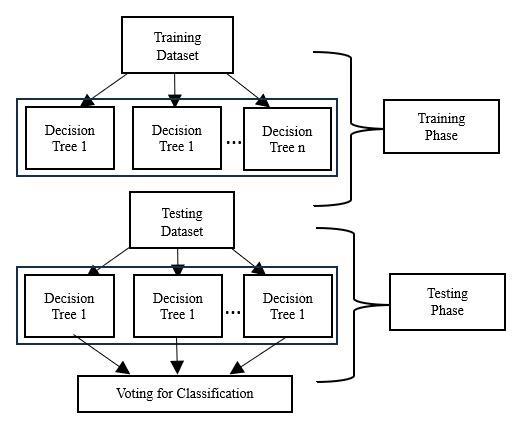
As represented in Figure 3, KNN is a non-parametric, instance-based learning algorithm. It classifies instances basedonthemajorityclassoftheirk-nearestneighborsin featurespace.
ApplicationinNIDS:KNNissuitablefordetectinglocalized anomalies or intrusions by considering the similarity of network traffic instances. It is particularly useful in scenarioswherethedistributionofnormalandanomalous instances varies across the feature space. This has an accuracyof75%.
5. Quadratic Discriminant Analysis (QDA):
4. Linear Discriminant Analysis:
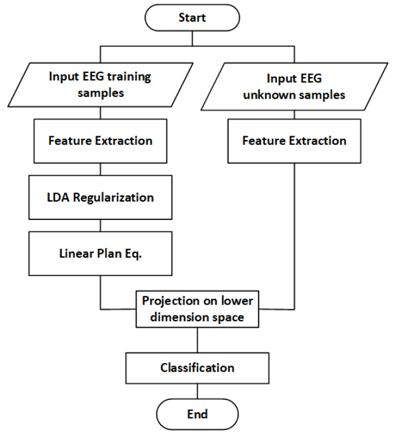
AS shown in Figure 4, LDA is a linear classification algorithm that finds the linear combinations of features that best separate multiple classes. It maximizes the distance between class means while minimizing the spreadwithineachclass.
ApplicationinNIDS:LDAis effectivewhen thereareclear separationsbetweennormalandintrusivepatterns.Itcan beparticularlyusefulinscenarioswheretherearedistinct clusters of network traffic associated with different types ofactivities.Thishasanaccuracyof70%.
As represented in Figure 5, QDA is similar to LDA but allows for different covariance matrices for each class, providing moreflexibilityin modeling non-linear decision boundaries.
Application in NIDS: QDA is suitable for scenarios where the relationship between features and class labels is nonlinear or exhibits varying covariance structures across classes. This particular algorithm has an accuracy of 43% inourproject.
International Research Journal of Engineering and Technology (IRJET) e-ISSN:2395-0056
Volume: 11 Issue: 04 | Apr 2024 www.irjet.net p-ISSN:2395-0072
6. Decision Tree Classifier:
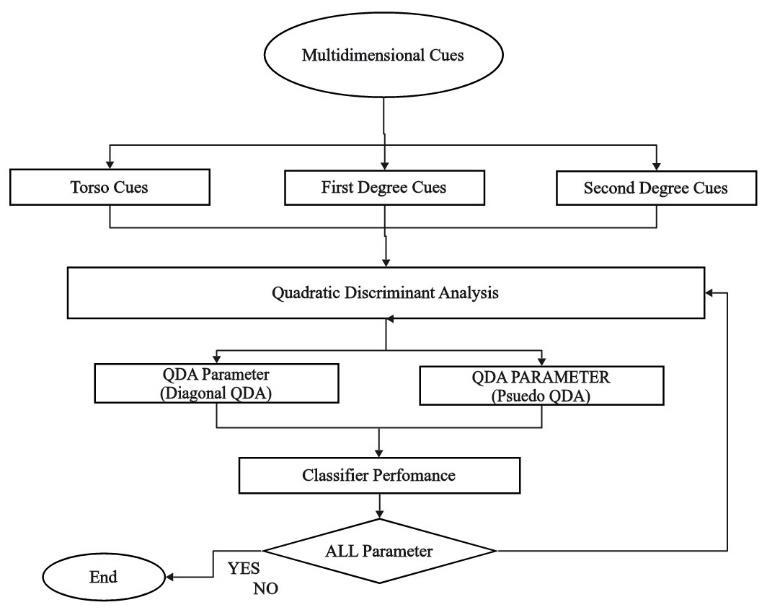
As represented in Figure 6, Decision Tree Classifier is a tree-structured model where internal nodes represent decisionsbasedonfeatures,andleafnodesrepresentclass labels. It recursively splits the data based on the most discriminativefeatures.
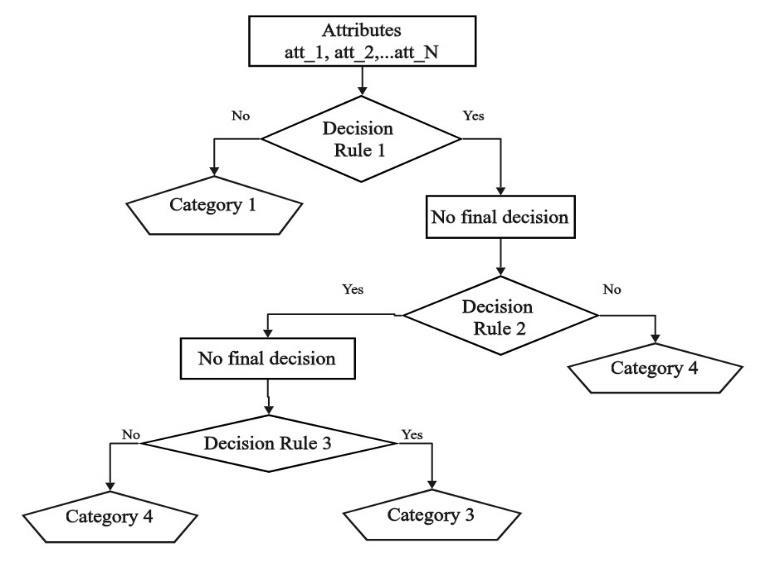
Application in NIDS: Decision Tree Classifier is adept at capturing non-linear relationships and can effectively model complex decision boundaries in network traffic data.Ithasanaccuracyof99%.
6. NETWORK ATTACK TYPE ANALYSIS:
1. Normal: SafeState
2. DOS: DenialofService
3. Probe: in which an attacker scans a target network or systemto gatherinformation about itsvulnerabilitiesand potentialweaknesses
4. R2L(Remote to Local) : involveanattackerattempting to gain unauthorized access to a system by exploiting vulnerabilitiesinremoteservicesorapplications.
5. U2R (User to Root) : more advanced form of attack where an attacker seeks to gain superuser or root-level accessonatargetsystem.
7. FLOWCHART:
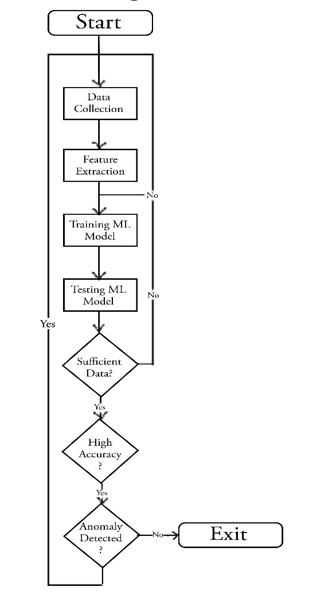
Flow Chart of the Proposed System
Considering the steps taken into consideration in the Proposed methodology the flowchart has been constructedandbasedontheflowchartwehaveexecuted theproject.
International Research Journal of Engineering and Technology (IRJET) e-ISSN:2395-0056
Volume: 11 Issue: 04 | Apr 2024 www.irjet.net p-ISSN:2395-0072
The Network Intrusion Detection System (NIDS) demonstrated robust performance, with algorithms like Logistic Regression and K-Nearest Neighbors showcasing adaptability to emerging threats. Decision Tree Classifier excelled in handling non-linear relationships and largescale datasets. Quadratic Discriminant Analysis exhibited improved sensitivity to rare intrusion patterns, reducing false negatives. Feature extraction techniques played a pivotal role in enhancing overall accuracy. Ensemble methods,combiningLogisticRegressionandDecisionTree Classifier, showed promise for further improvement. Ethical considerations were prioritized throughout the researchprocess,ensuringresponsibledatahandling.The results offer valuable insights for deploying an effective NIDSindynamiccybersecuritylandscapes.

Each of these algorithms brings unique strengths to the proposed NIDS, and their integration allows for a comprehensiveapproachtointrusiondetection,capturing diverse patterns and adaptively responding to the evolving nature of cyber threats. The systematic evaluation and comparative analysis of these algorithms aim to provide insights into their performance characteristicsacrossvariousintrusionscenarios.

International Research Journal of Engineering and Technology (IRJET) e-ISSN:2395-0056
Volume: 11 Issue: 04 | Apr 2024 www.irjet.net p-ISSN:2395-0072


In conclusion, the integration of diverse machine learning algorithms in the proposed Network Intrusion Detection System has yielded promising results, showcasing the system's robustness and adaptability. The nuanced analysis of algorithmic strengths and weaknesses, along with considerations for scalability and ethical principles, providesvaluableinsightsforreal-worlddeployment.The demonstrated effectiveness in handling various intrusion scenariosunderscoresthepotentialofthiscomprehensive approach in bolstering cybersecurity defenses. As the threat landscape evolves, the insights gained from this research offer a solid foundation for enhancing intrusion detection capabilities and empowering cybersecurity professionalswithaversatiletoolsettomitigateemerging risks.
We will try implementing this on various other type of networks and will try to create aa ML Based Dashboard wherewecandolivemonitoringoftheattacks.
1. T. Sowmya, E.A. Mary Anita,”A comprehensive review of AI based intrusion detection system”, Measurement:Sensors,Volume28,2023,100827,IS SN2665-9174
2. A. O. Adejimi, A. S. Sodiya, O. A. Ojesanmi, O. J. Falana, C. O. Tinubu, “A dynamic intrusion detection system for critical information infrastructure”, Scientific African, Volume 21, 2023,e01817,ISSN2468-2276
3. Monika Vishwakarma, Nishtha Kesswani,”A new two-phase intrusion detection system with Naïve Bayesmachinelearningfordataclassificationand elliptic envelop method for anomaly detection”, Decision Analytics Journal, Volume 7, 2023, 100233,ISSN2772-6622
4. Shiming Li, Jingxuan Wang, Yuhe Wang, Guohui Zhou, Yan Zhao,” EIFDAA: Evaluation of an IDS with function-discarding adversarial attacks in the IIoT”, Heliyon, Volume 9, Issue 2, 2023, e13520,ISSN2405-8440
5. Nuno Prazeres, Rogério Luís de C. Costa, Leonel Santos, Carlos Rabadão, “Engineering the application of machine learning in an IDS based on IoT traffic flow, Intelligent Systems with Applications”, Volume 17, 2023, 200189, ISSN 2667-3053
6. P. Sanju, Enhancing intrusion detection in IoT systems: “A hybrid metaheuristics-deep learning approach with ensemble of recurrent neural networks”, Journal of Engineering Research,Volume 11, Issue 4, 2023, Pages 356361,ISSN2307-1877
7. Md. Alamgir Hossain, Md. Saiful Islam,”Ensuring network security with a robust intrusion detection system using ensemble-based machine learning”, Array, Volume 19, 2023, 100306, ISSN 2590-0056
8. Pooja TS, Purohit Shrinivasacharya, “Evaluating neural networks using Bi-Directional LSTM for network IDS (intrusion detection systems) in cyber security”, Global Transitions Proceedings, Volume 2, Issue 2, 2021, Pages 448-454, ISSN 2666-285X
International Research Journal of Engineering and Technology (IRJET) e-ISSN:2395-0056
Volume: 11 Issue: 04 | Apr 2024 www.irjet.net p-ISSN:2395-0072
9. Zhao, Shuang & Li, Jing & Wang, Jianmin & Zhao, Zhang & Zhu, Lin & Zhang, Yong. (2021). “attackGAN: Adversarial Attack against Black-box IDS using Generative Adversarial Networks”. ProcediaComputerScience
10. Satish Kumar , Sunanda Gupta, and Sakshi Arora, “Research Trends in Network-Based Intrusion Detection Systems: A Review”, IJTRA ,November 22,2021
11. Aan Erlansari, Funny Farady Coastera, Afief Husamudin, “Early Intrusion Detection System (IDS)usingSnortand Telegramapproach”, IEEE, June2020
12. Thien Duc Nguyen, Phillip Rieger, “Poisoning Attacks on Federated Learning-based IoT Intrusion Detection System”, IJTRA, February 2020
13. Taoufik Elmissaoui , Okoronkwo, Ihedioha Uchechi , Chikodili H.Ugwuishiwu , Okwume .B. Onyebuchi, “ Signature based Network Intrusion Detection System using Feature Selection on Android”, IJACSA,January2020
14. Ansam Khraisat , Iqbal Gondal, Peter Vamplew and Joarder Kamruzzaman, “Survey of intrusion detection systems: techniques, datasets and challenges”, IEEE 2020
15. Zakiyabanu S. Malek , Bhushan Trivedi, “User Behaviour based Intrusion Detection System”, IEEE ,October2018
16. Abhishek Kajal ,Sunil Kumar Nandal, “A Hybrid ApproachForCyberSecurity:ImprovedIntrusion Detection System Using ANN & SVM”, IEEE , February2018
17. Mr Mohit Tiwari, Raj Kumar, Akash Bharti, Jai Kishan, “Intrusion Detection System”, IEEE April 2017
18. A. Kiran, S. W. Prakash, B. A. Kumar, Likhitha, T. Sameeratmaja and U. S. S. R. Charan, "Intrusion DetectionSystemUsingMachineLearning," 2023