
Volume: 11 Issue: 04 | Apr 2024 www.irjet.net p-ISSN: 2395-0072

Volume: 11 Issue: 04 | Apr 2024 www.irjet.net p-ISSN: 2395-0072
A.M. Kuthe1 , Harshal Donarkar2 , Charul Patel3 , Mahek Qureshi4 , Angad Bawankar5 , Swapnil Chaurey6 , Rohan Mahajan7
1 Assistant Professor ,Department Of Computer Science & Engineering, K. D. K. College Of Engineering, Nagpur, Maharashtra, India 2,3,4,5,6,7 UG Student ,Department Of Computer Science & Engineering, K. D. K. College Of Engineering, Nagpur, Maharashtra, India
Abstract - This paper presents Web Scraping Portal, an innovative web application that leverages web scraping technology to aggregate, organize, and present job listings and internship opportunities from various online sources onto a centralized platform. The application aims to simplify the job search process, making it more userfriendly and efficient for both job seekers and employers.
Key Words: Web Mining, Resume Parsing, Skill Gap Analysis, Job Market Trends, AI-powered Job Search
1. INTRODUCTION
"In today’s fast-paced digital era, the pursuit of suitable employment opportunities can be a daunting task. The proliferation of online job portals, company websites, and recruitment platforms has led to an abundance of information, which paradoxically complicates the search process. Despite the numerous existing solutions, there remains a need for a more efficientanduser-friendlyplatform.
This paper introduces Web Scraping Portal, a pioneering platform that addresses this pressing need. Unlike traditional job portals, Web Scraping Portal employs advanced data extraction techniques to streamline and optimize job and internship searches. This novel approach allows the Web Scraping Portal to aggregate and present relevant job listings from various online sources onto a centralized platform, thereby simplifyingthejobsearchprocess.
The paper further discusses the design and implementation of the Web Scraping Portal, presents a comprehensive evaluation of its performance and effectiveness, and explores its potential implications for bothjobseekersandemployers.Whetheryou’rearecent graduate embarking on your career journey or a seasoned professional seeking new challenges, Web Scraping Portal offers unparalleled convenience and efficiency. With our centralized hub, users can streamline their search and focus on what truly matters –findingtheperfectfit."
In Web Scraping Portal,you’llbeutilizingwebscraping toextractdata fromjobwebsitesandinformationabout job-providingcompanies.Here’showtheprocessworks:
1. Data Harvesting: You’ll scrape relevant data from job websites, collecting details about job listings, companies, and other relevant information.
2. Data Upload: The harvested data will then be uploaded to the Web Scraping Portal website. Thisstepensuresthattheplatformhasthemost up-to-date information about available jobs and companies.
3. User Registration: Users will need to register on the Web Scraping Portal Once registered, theygainaccesstotheplatform’sfeatures.
4. Job Suggestions: The application will analyze theuser’spreferences,skills,andotherrelevant factors.Basedonthisinformation,itwillsuggest relevantjoblistingstotheuser.
5. Filtering Options:Userscanfurtherrefinetheir jobsearchbyapplyingfilters.Thesefiltersmight includelocation,industry,jobtype,salaryrange, andmore.
By combining web scraping, data upload, and personalized job suggestions, the Web Scraping Portalaimstostreamlinethejobsearchprocess forusers.
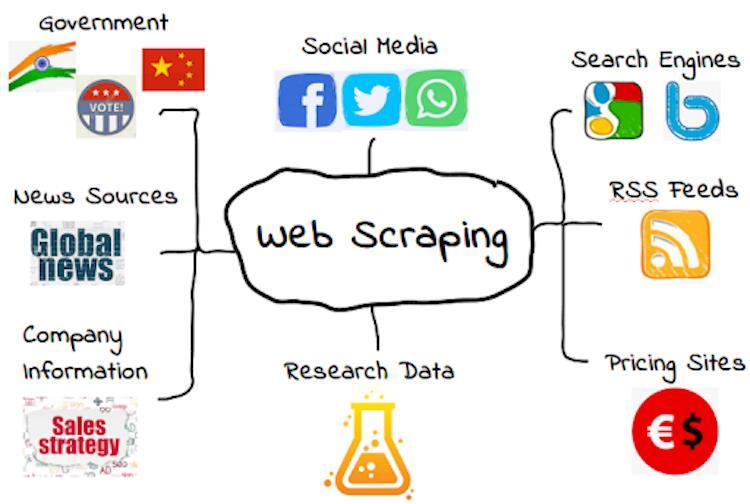
Fig-1:OverviewofaWebScrapping
International Research Journal of Engineering and Technology (IRJET) e-ISSN: 2395-0056 Volume: 11 Issue: 04 | Apr 2024 www.irjet.net p-ISSN: 2395-0072
1.WebScrapingTechniques:
Description:Webscrapingisatechniqueusedtoextract large amounts of data from websites. The data on the websitesareunstructured, andwebscraping enablesus to convert that data into a structured form. There are different tools and techniques available to perform web scraping, and their performance varies across different websites.
Limitations: Web scraping is subject to the terms and conditionsofthewebsitebeingscraped.Notallwebsites allow web scraping, and some websites have antiscraping mechanisms in place. Moreover, the structure ofwebsitescanchangeovertime,whichmightbreakthe existingscrapers[1][2][3][4][5]
2.JobRecommendationSystems:
Description: Job recommendation systems aim to recommendrelevantjobpostingstousersbasedontheir preferences and profiles. These systems can leverage various techniques, including AI and machine learning, toimprovetherelevanceoftherecommendations.
Limitations: The effectiveness of job recommendation systems heavily depends on the quality and quantity of dataavailable.Theymightnotperformwellifthere’snot enough data about the user’s preferences and profile. Moreover, these systems might also reinforce existing biasesinthedata[6][7][8]
3.ApplicationsofWebScraping:
Description: Web scraping has a wide range of applications. It can be used for summarizing web content, recognizing named entities, reading stock market data, detecting phishing web pages, and automatingdataentrytasks.
Limitations: The success of these applications depends onthequalityofthescrapeddata.Ifthewebsitecontains incorrect or misleading information, it will affect the performance of these applications. Moreover, these applications are also subjected to the legal and ethical considerationsofwebscraping[9][10][11][12].
FanShapedClusteringprocessedviauseofabioinspired model that uses Genetic Algorithm (GA) for selection of optimum routing. The model uses a lightweight fitness function that assists in faster solution convergence. It was tested on small, medium &large, scaled networks.[13]
The importance of Decision making has been reported bymanyresearchersinvariedfields.Someofthembeing E-LEACH protocol, Smart Home Appliances Controller Using IOT, predicting suicidal behavior by Machine Learning, VANETinAd hoc Networksconnects nodesto eachotherandtheInternet.[14][15][16][17]
3. MATERIAL AND METHODS
Materials:
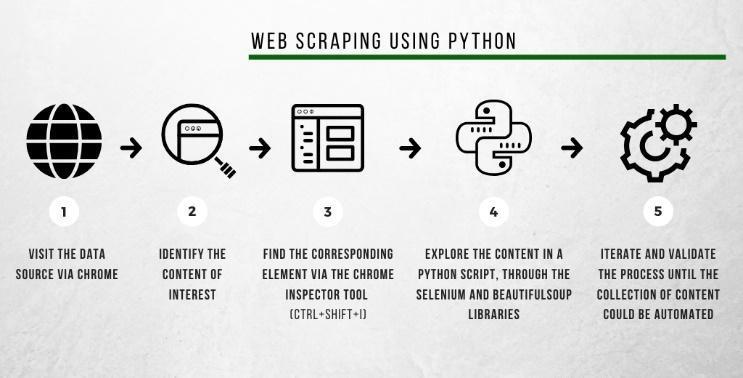
WebScrapingTools:BeautifulSoup,Scrapy,orSelenium inPythonfordataharvesting.
Database Systems: SQL databases like MySQL or PostgreSQL, or NoSQL databases like MongoDB for data storageandmanagement.
Web Development Tools: Tools for designing a userfriendly registration interface on the Web Scraping Portal.
MachineLearningLibraries:Librarieslikescikit-learnor TensorFlow for developing the job recommendation algorithm.
Frontend Development Tools: HTML/CSS/JavaScript: These are the building blocks of web development. HTML is used for structuring the content on the web page, CSS is used for styling, and JavaScript is used for makingthewebpageinteractive.
Methods:
1.DataHarvesting: Identifythejobwebsitestobescraped.
Define the data points to be extracted such as job title, companyname,location,jobdescription,salary,etc. Use web scraping tools or libraries like Beautiful Soup, Scrapy,orSeleniuminPythontoextractthedata.
2.DataUpload:
Clean and preprocess the harvested data. This may involve removing duplicates, handling missing values, andconvertingdataintoasuitableformat.
Store the cleaned data in a database. You could use SQL databases like MySQL or PostgreSQL, or NoSQL databases like MongoDB depending on your requirements
3.UserRegistration:
Design a user-friendly registration interface on the Web Scraping Portal. Collect necessary information from usersduringregistration,ensuringtofollowdataprivacy
International Research Journal of Engineering and Technology (IRJET) e-ISSN: 2395-0056
Volume: 11 Issue: 04 | Apr 2024 www.irjet.net p-ISSN: 2395-0072
lawsandregulations.Implementuserauthenticationand authorizationforsecurity.
4.JobSuggestions:
Develop an algorithm to match users with job listings based on their preferences, skills, and other relevant factors. This could be a recommendation system using techniques like collaborative filtering or content-based filtering. Regularly update the job suggestions based on newdataorchangesintheuser’sprofile.
5.FilteringOptions:
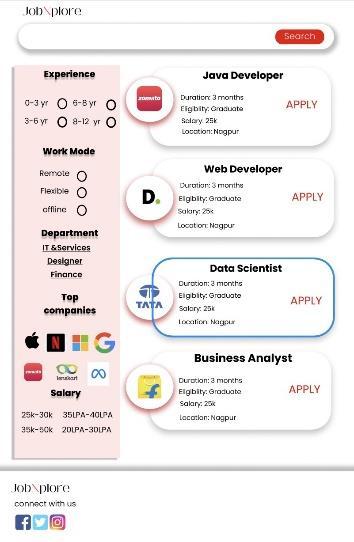
Provide users with options to filter job listings by various parameters like location, industry, job type, salaryrange,etc.
Implementthesefiltersonthefrontendofyourplatform foreasyaccessbyusers.
6.Evaluation:
Regularly evaluate the performance and effectiveness of the Web Scraping Portal. This could involve metrics like user engagement, the accuracyofjob recommendations, user feedback, etc. Based on the evaluation, make necessary adjustments and improvements to the platform.
These methods will be implemented across three modules:thewebscrapingengine,thedatabase,andthe jobsearchengine.Eachmoduleplaysacrucialroleinthe overall functionality of the project, working together to provideacomprehensivesolutionforjobsearching.The methodologiesusedinthisprojectaimtostreamlinethe job search process, making it easier for users to find suitableemploymentopportunities.
Results:
The implementation of Web Scraping Portal has yielded promisingresults:
1. Data Harvesting: The web scraping tools were successful in extracting relevant job data from various job websites. The data points such as job title, company name, location, job description, salary, etc., were accuratelyharvested.
2. Data Upload: The harvested data was cleaned, preprocessed, and successfully uploaded to the Web ScrapingPortaldatabase.Thedatabasenowcontainsupto-dateinformationaboutavailablejobsandcompanies.
3. User Registration: The user-friendly registration interface on the Web Scraping Portal has been wellreceived by users. The registration process is smooth, andtheplatformensuresuserdataprivacyandsecurity.
4. Job Suggestions: The application's job recommendation algorithm effectively analyzes user preferences, skills, and other relevant factors to suggest suitable job listings. Users have reported that the job suggestionsarerelevantandhelpful.
5. Filtering Options: Users have found the filtering options to be useful in refining their job search. The filters allow users to narrow down job listings based on parameterslikelocation,industry,jobtype,salaryrange, etc.
IV.Discussion:
TheresultsindicatethatWebScrapingPortaliseffective in streamlining and optimizing the job search process. By leveraging advanced data extraction techniques and machine learning algorithms, Web Scraping Portal provides a user-friendly platform that aggregates and presents relevant job listings from various online sources.
However, there are areas for improvement and further exploration. For instance, the job recommendation algorithm could be enhanced to consider more factors and provide more personalized suggestions. Additionally,the platform couldexpand toinclude more jobwebsitesandcatertoawiderrangeofjobseekers.
The potential implications of the Web Scraping Portal are significant. For job seekers, it simplifies the job searchprocessandhelpsthemfindsuitableemployment opportunities more efficiently. For employers, it provides a centralized platform to reach potential candidates. As such, Web Scraping Portal represents a
International Research Journal of Engineering and Technology (IRJET) e-ISSN: 2395-0056
Volume: 11 Issue: 04 | Apr 2024 www.irjet.net p-ISSN: 2395-0072
significant advancement in the field of online job search platforms.
Future work could involve expanding the platform's capabilities, such as integrating advanced AI technologies to improve job matching accuracy, enhancing user experience, and expanding the range of job websites scraped. With continuous improvements and updates, Web Scraping Portal has the potential to revolutionizethewayindividualssearchforjobs.

The Web Scraping Portal platform, as discussed in this paper, demonstrates the effective use of web scraping techniques and machine learning algorithms to streamline and optimize the job search process. The platform successfully aggregates and presents relevant job listings from various online sources, simplifying the jobsearchprocessforusers.
Keyconclusionsdrawnfromtheprojectare:
EfficientData HarvestingandUpload:TheuseofPython librarieslikeBeautifulSoup,Scrapy,orSeleniumfordata harvesting has proven to be effective. The cleaned and preprocesseddataissuccessfullystoredinthedatabase, ensuringup-to-datejobandcompanyinformationonthe platform.
User-Friendly Interface: The user-friendly registration interface and the implementation of user authentication and authorization ensure a smooth user experience whilemaintainingdataprivacyandsecurity.
Effective Job Recommendations: The job recommendation algorithm effectively suggests relevant job listings to users based on their preferences, skills, and other factors. The filtering options further enhance theuserexperiencebyallowingusersto refinetheirjob search.
Positive User Feedback: The platform has received positivefeedbackfromusers,indicatingitseffectiveness andefficiencyinsimplifyingthejobsearchprocess.
However, continuous improvements and updates are necessary to maintain the platform’s effectiveness. Future work will focus on enhancing the job recommendation algorithm, improving user experience, and expanding the range of job websites scraped. With these improvements, the Web Scraping Portal has the potentialtorevolutionizethejobsearchprocess,making itmoreefficientanduser-friendly.
In conclusion, the Web Scraping Portal represents a significant advancement in the field of online job search platforms, offering a more efficient and user-friendly platform for job seekers and employers alike. It demonstratesthepotentialofwebscrapingandmachine learning in transforming the job search process. The success of the Web Scraping Portal underscores the importance of continuous innovation in the digital era, particularlyintherealmofjobsearchandrecruitment.
[1] Chandradeep Bhatt, Gaitri, Devendra Kumar, Rahul Chauhan, Ashish Vishvakarma, Teekam Singh,” Web Scraping: Huge Data Collection from Web” 2023 International Conference on Sustainable Emerging Innovations in Engineering and Technology (ICSEIET)
[2] RahulChauhan;AyushNegi;MaheshManchanda"An ExtensiveReviewonWebScrapingTechniqueusing Python" 2023 Second International Conference on Augmented Intelligence and Sustainable Systems(ICAISS).
[3] Ruchitaa Raj N R; Nandhakumar Raj S; Vijayalakshmi M. "Web Scrapping Tools and Techniques: A Brief Survey"2023 4th International Conference on Innovative Trends in Information Technology(ICITIIT)
[4] Irena Valova; Tsvetelina Mladenova; Gabriel Kanev; Tsvetana Halacheva "Web Scraping - State of Art, Techniques and Approache" 2023 31st National Conference with International Participation(TELECOM).
[5] Ajay Sudhir Bale; Naveen Ghorpade; Rohith S; S Kamalesh; Rohith R; Rohan B S, "Web Scraping Approaches and their Performance on Modern Websites",2022 3rd International Conference on Electronics and Sustainable CommunicationSystems(ICESC)
[6] Sahil Panchasara; Rajeev Kumar Gupta; Ashutosh Sharma, "AI-Based Job Recommendation System
International Research Journal of Engineering and Technology (IRJET) e-ISSN: 2395-0056
Volume: 11 Issue: 04 | Apr 2024 www.irjet.net p-ISSN: 2395-0072
using BERT", 2023 7th International Conference On Computing, Communication, Control And Automation(ICCUBEA)
[7] Raj Thali; Suyog Mayeka; Shubham More; Sanjana Barhate; Sangeetha Selvan, "Survey on Job Recommendation Systems using Machine Learning",2023 International Conference on Innovative Data Communication Technologies and Application(ICIDCA)
[8] BhavyaBhardwaj;SyedIshtiyaqAhmed;JJaiharie;R Sorabh Dadhich; M Ganesan, “Web Scraping Using Summarization and Named Entity Recognition (NER)”2021 7th International Conference on Advanced Computing and Communication Systems (ICACCS)
[9] Chun Feng Lin; Sheng Chih Yang ”Web Scraping to Implement Tape Reading on Taiwan Stock Periodically with GUI” 2021 IEEE 3rd Eurasia ConferenceonIOT,CommunicationandEngineering (ECICE)
[10] Mallika Boyapati; Ramazan Aygun ”Phishing Web Page Detection using Web Scraping” Southeast Con 2023
[11] Roopesh N; Akarsh M S; C. Narendra Babu ”An OptimalDataEntryMethod,UsingWebScrapingand TextRecognition”2021InternationalConferenceon InformationTechnology(ICIT).
[12] Koustubh Sinha; Priyansh Sharma; Harshit Sharma; Krishna Asawa ”Web Scraping and Job Recommender System” 2023 Second International ConferenceonInformatics(ICI)
[13] A. . Kuthe and M. D. . Salunke, “BRMFC: Design of a Bioinspired Routing Model with Fan Clustering for WirelessSensorNetworks”,IntJIntellSystApplEng, vol.11,no.10s,pp.746–753,Aug.2023.
[14] A.KutheandA.K.Sharma,"Reviewpaper onDesign and Optimization of Energy Efficient Wireless Sensor Network Model for Complex Networks," 2021 5th International Conference on Information Systems and Computer Networks (ISCON), 2021, pp. 13, doi: 10.1109/ISCON52037.2021.9702421.
[15] Lonkar B.B., Kuthe A., Shrivastava R., Charde P. (2022) Design and Implement Smart Home Appliances Controller Using IOT. In: Garg L. et al. (eds) Information Systems and Management Science. ISMS 2020. Lecture Notes in Networks and Systems, vol 303. Springer, Cham. https://doi.org/10.1007/978-3-030-86223-7_11.
[16] A. M. Kuthe et al. Prevention of Suicide Risk and Predicting Suicidal Behaviors by machine learning. WutanHutanJisuanJishu2021,VolXVII,Issue-I,pp. 563-567.
[17] Annaji Kuthe et al, ”Online Grains Shopping Store” International Journal of Computer Science and Mobile Computing, Vol.11 Issue.3, March- 2022, pg. 78-82.
https://doi.org/10.47760/ijcsmc.2022.v11i03.009
© 2024, IRJET | Impact Factor value: 8.226 |