
International Research Journal of Engineering and Technology (IRJET) e-ISSN: 2395-0056
Volume: 11 Issue: 04 | Apr 2024 www.irjet.net p-ISSN: 2395-0072
International Research Journal of Engineering and Technology (IRJET) e-ISSN: 2395-0056
Volume: 11 Issue: 04 | Apr 2024 www.irjet.net p-ISSN: 2395-0072
Ms. Sharvari Bhaisare1, Ms. Pranali.G. Borkar1 , Mr. Aryan Kollepara1 , Mr. Umesh Nakhate1 , Mr. Harsh Kelzarkar1, Mr. Akshay Akare1 , Mr. Rajat. S. Yadav2
1UG Student Department of Civil Engineering, Kavikulguru Institute of Technology and Science, 2Asst. Professor, Dept of Civil Engineering, Kavikulguru Institute of Technology and Science ***
Abstract - Designing a water distribution system involves meticulousconsiderationsencompassingdiversefactionssuch as investment expansion, current and future water demands, pipe dimensions, and reservoir locations, all within the confines of fixed budget limitations. However, the manual process of designing such a system often results in an overwhelmingworkload.Consequently,theimperativeforthe invention of a water distribution system became pronounced, giventhe outdatednature or unaffordability of many existing solutions. Thus, the genesis of Jaltantrs, an open technology platform, was spearheaded by scholars from IIT Bombay, in collaboration with inputs from engineers at Maharashtra Jeevan Pradhikaran (MJP). The core objective behind Jaltantra`s optimization algorithm intricately factors in pipe and energy costs, with prospective iterations poised to integrate GIS-based demand allocation and a myriad of data visualizations. This research paper elucidates Jaltantra`s prowess through a compelling case study, underscoring its efficacy in efficiently optimizing water distribution systems.
Key Words: Jaltantra, water distribution system, Maharashtra Jeevan Pradhikaran, pipe diameter, cost optimization,waterdemand.
The government of India faces a formidable challenge in ensuring the delivery of high-quality drinking water to citizenswhileadheringtobudgetaryconstraints.Engineers operating under such circumstances often lack adequate tools that prioritize the selection of pipe diameters while neglecting other crucial aspects of water distribution systems.Consequently,muchofthedesignprocessrelieson theadhocmethodortheinstinctsofengineers.Toaddress this issue, Jaltantra was developed to aid government engineers in determining various components of water networks, including tanks, pumps, valves, and pipe diameters.
Byintroducinganintegerlinearprogrammodel,Jaltantrais capable of generating optimized, efficient, and precise results through a streamlined design process. The Maharashtra Jeevan Pradhikaran (MJP), is responsible for developing village pipes and water schemes that significantly impact project costs. With a track record of designing more than 11,000 rural water distribution
schemes,MJPalignseachdesignwithgovernment-mandated budgetstoensureaffordabilityandservicequality.
Typically,gravity-fedbranchednetworksarepreferredover cyclic networks due to their cost effectiveness and the unreliability of electricity supply. Despite decades of research on cost optimization, existing software like BRANCH,EPANET,andWaterGEMSprimarilyfocusonpipe diameterselection,oftenoverlookingcritical components. Jaltantra addresses this limitation by enhancing cost optimization for pipes and tanks, with ongoing improvements aimed at incorporating pumps and valves whileconsideringbothcapitalandoperationalcosts.
[1] Examination and evaluation of data pertaining to the waterdistributioninfrastructureinaspecificregion.
[2]Investigationintothereportdetailingpipesandjunctions withinthesystem.
[3] Familiarize with the operational principles and theoretical frameworks underpinning the modeling and analyticalprocessofJaltantra.
[4] Assessment and security of the current water distributioninfrastructure.
[5] Enhancement and refinement of the prevailing water distributionsystemthroughoptimizationtechniques.
The comprehensive capabilities of Jaltantra extend beyond mere optimization, facilitating the creation of resilient water distribution systems tailored to specific geographical and demographic contexts. By leveraging sophisticated algorithms and incorporating real-world constraints, such as budget limitations and terrain complexities,Jaltantraensuresthattheresultantdesignsare not only cost -effective but also robust and adaptable to evolvingneeds.Moreover,Jaltantra`sinterfaceandanalytical tools empowers users to explore various scenarios and visualize the potential outcomes, enabling informed decision-making throughout the design process. This interactiveapproachfosterscontenuousimprovementand
International Research Journal of Engineering and Technology (IRJET) e-ISSN: 2395-0056
Volume: 11 Issue: 04 | Apr 2024 www.irjet.net p-ISSN: 2395-0072
refinement, ultimately leading to the development of sustainablewaterinfrastructurethatcanwithstand future challengesanduncertainties.Furthermore,bypromotingthe efficient utilization of the resources the maximizing the delivery of the safe and reliable water supplies. Jaltantra contributestobroadenssocio-economicdevelopmentgoals, including public health improvement and environmental sustainability.itsroleintheadvancingwatermanagement practicesunderscoresitssignificanceasthetransformative toolinthepursuitofresilientandequitablewatersystems forcommunitiesworldwide
4.1 AREA OF STUDY
The project focuses on Ramtek, a taluka located approximately50kmnorthwestofNagpurRamtekreceives substantial rainfall, with a maximum recorded amount of 2082.50mm. projections estimate the total population to reach 30,863 by the year 2050. The town1s first regular water supply scheme was inaugurated in 1971, drawing waterfromtherightbankcanalofKhindsiLake,positioned 310 metersawayandabout30 metersupstream fromthe existingcanalgateofthedam.
4.2 DATA COLLECTION
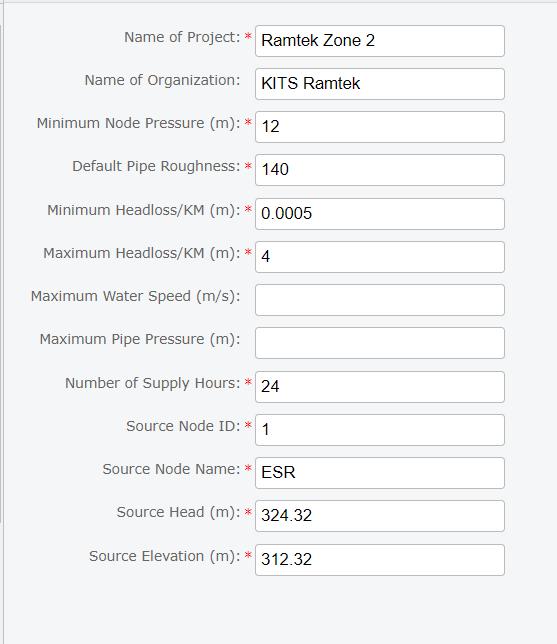
Informationsuchasnodenames,waterdemand,elevation, head pressure, and minimus pressure is input into the jaltantradatabase.Theaccompanyingfigureiluustratesthe waterdistributionmodelinthedesignatedarea.
4.3 DATA ANALYSIS
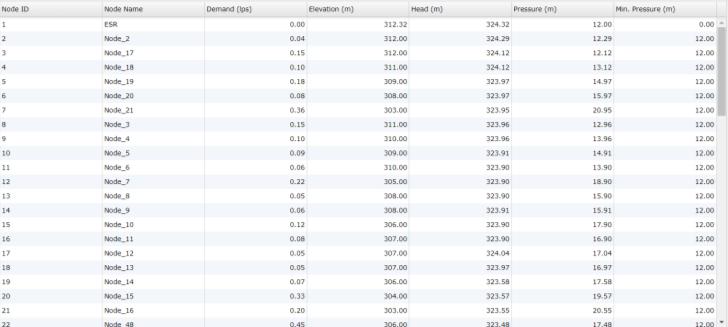
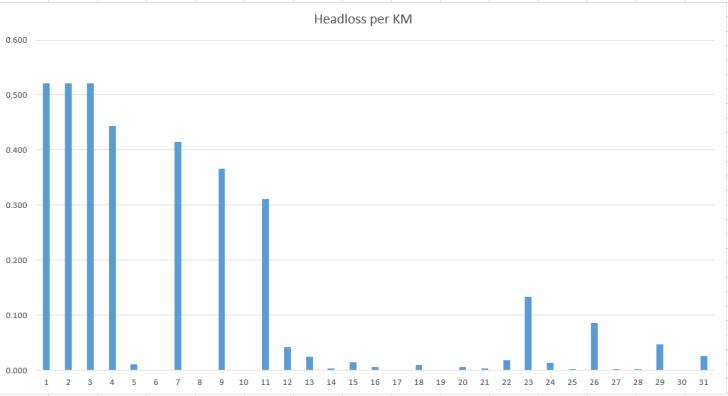
Followingtheinputdata,Jaltantrasimulatestheinformstion andutilizestheHazen Wiliiamsequation to determinethe pipecostsateachnode.Subsequently,Jaltantraanalysesthe
date and presents it in various formats, including graphs depicting head loss and nodes with their corresponding pressure heads . the accompanying images illustrates the simulateddataanalyzedbyJaltantra.Thedatarequiredsuch aspressureateachnodesiscalculatedandpresentedinan graphicalfoemtolettheuserunderstandthesystemmore carefully.Theelevations,head,pressureisalreadygivenand iscollectedfromthegovernmentrecordsofthetalukaplace.
4.4
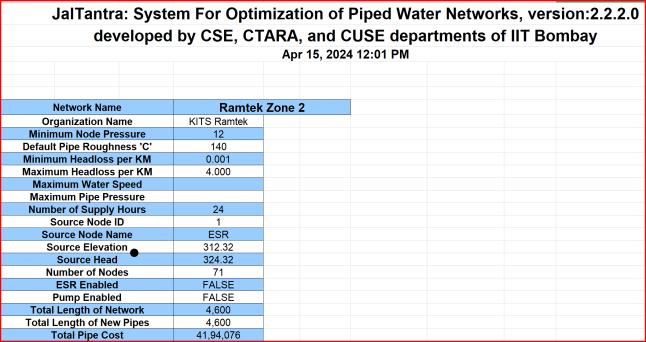
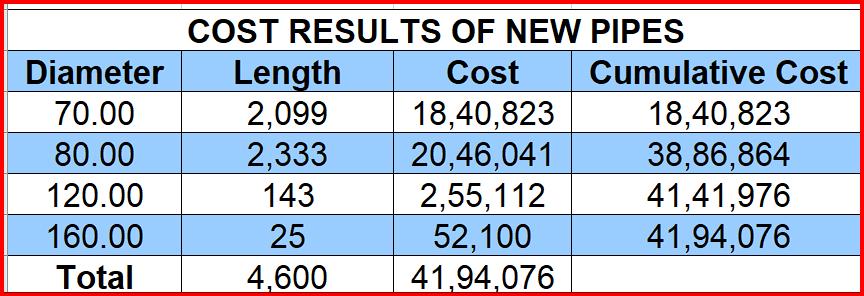
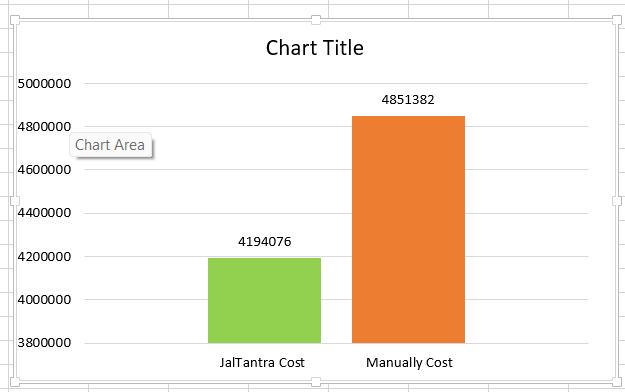
The resultsofthesimulated waterdistributionssystem is alsoprovidedinandetailedtabularformpresentingvarious apectsoftheandfinallygivingthetotaloptimizedcostofthe total project. Under the determining cost of the manually calculatedcostwiththehelpofexcelsheetthefinalcostsof simulatedwaterdistributionsystemiscomparedwitheach othertofindtheconcludingresults.
International Research Journal of Engineering and Technology (IRJET) e-ISSN: 2395-0056
Volume: 11 Issue: 04 | Apr 2024 www.irjet.net p-ISSN: 2395-0072
[1] Followinganintensivecomparativeanalysis,itbecame apparentthatseveralfactorsinfluencetheselectionof anefficientwaterdistributionsystemsoftware.These include software availability, compatibility, userfriendly interface, and the application of the optimal methodologies.
[2] Given the paramount importance of the accuracy and precision,thespeedatwhichtheresultsarecalculated holds equal significance. Hence, there is a growing demandforapplicationswithsuchcapabilities.
[3] While many software options boast nearly all the requisite features for the desigining an optimal water distributionnetwork,theunparalleledadvantageofthe
Jaltantraliesinitsfreeavailabilityinthepublicdomain, renderingitanindispensablechoice.
[4] Thedifferenceinthecostof bothmanuallycalculated waterdistributionssystemandthesamesimukatedon the Jaltnatra gives huge amount of difference of 657306RS.Whichimplies13.54%ofreductionincost.
[1] Dr. G. Venkata Ramana, et al. (2015) “Network analysisofwaterdistributionsysteminruralareas usingEPANET.”
[2] Mr. Mominah Ajaz, et al (2023) “Application of EPANET Software and Jal-Tantra Web System for Optimal Hydraulic Design of Water Distribution SystemforUniversityofKashmir“
[3] Ms. Ashwini Gajbhiye, et al. (2017)” Modeling Leakage in Water Distribution System Using EPANET.”
[4] Ms. Mohini M. Dumane, et al. (2018)” Water distribution network by using WATERGEMS software.”
[5] Ms.G.Anisha,etal.(2016)”AnalysisandDesignof Water Distribution Network Using EPANET for ChiralaMunicipalityinPrakasamDistrictofAndhra Pradesh.”
[6] Mr. Athulya T., et al (2020) “Design of water distributionnetworkusingEPANET.”
[7] Mr. R. R. Bhosale, et al. (2022) “Design of Water DistributionNetworkusingWaterGEMSSoftware.”
[8] Mr.Rai,etal.(2017)“Analysisofhydraulicnetwork usingHARDY-CROSSMethodandEPANET.”
[9] Mr.SuryakantI.Jadhav,etal.(2018)“Experimental investigationbyWaterGEMSsoftwareforredesign ofwaterdistributionsystem.”