
Volume: 11 Issue: 04 | Mar 2024 www.irjet.net p-ISSN: 2395-0072
Volume: 11 Issue: 04 | Mar 2024 www.irjet.net p-ISSN: 2395-0072
Bhalerao Alkesh1 , Agawane Makarand Dashrath2 , Thale Monish Sajjan3 , Sahare Rupesh Gulab4 , Lokhande Yash Kalu5
1Asst Professor, Department of Civil Engineering, New Horizon Institute of Technology and Management, Maharashtra, India
2 B.E Student, Department of Civil Engineering, New Horizon Institute of Technology and Management, Maharashtra, India
3B. E Student, Department of Civil Engineering, New Horizon Institute of Technology and Management, Maharashtra, India
4B. E Student, Department of Civil Engineering, New Horizon Institute of Technology and Management, Maharashtra, India
5B. E Student, Department of Civil Engineering, New Horizon Institute of Technology and Management, Maharashtra, India ***
Abstract –This study presents a comparative analysis between conventional steel beams and glass fiber reinforced polymer (GFRP) Non-prismatic beams using E-Tabs software. The investigation focuses one evaluating the structural performance and behavior of these two types of beams under various loading conditions. The study involves modeling the beams in E-Tabs, incorporating realistic material properties and cross-sectional geometries. Analysis is conducted to assess factors such as deflections, crack formations, and overall load – bearing capacity. Through this comparative study, insights into the advantages and limitations of GFRP Non-prismatic beams and limitations of GFRP Non-prismatic beams compared to conventional steel beams are gained, providing valuable information for structural design and engineering practices. Through a detailed parametric study, the effects of key design parameters such as beam geometry, material properties, and support conditions on the performance of both types of beams are systematically investigated Additionally, considerations are given to practical aspects such as construction feasibility, cost-effectiveness, and sustainability implications associated with the adoption of GFRP nonprismatic beams in real-world structural projects. The findings of this study aim to provide valuable insights into the comparative advantages and limitations of conventional steel beams and GFRP non-prismatic beams, thereby assisting structural engineers, architects, and decisionmakers in making informed choices regarding material selection for structural design and construction projects. Moreover, the research contributes to the ongoing efforts towards advancing sustainable and resilient infrastructure practices inthe construction industry.
Key Words: Deflections,GFRP,Geometries,ETABS.
The use of Glass fiber-reinforced polymer GFRP beams in structural engineering has garnered significant attention due to light-weight corrosion-resistant, and high strength properties. Incomparison,Conventional steel beamshave long been the staple in structural design, known for their durabilityandliability.
Thisstudy aimsto conduct comparativeanalysisbetween conventional steel beam and GFRP non-prismatic beams using E-Tabs software. By evaluating structural performance of this two materials under various loading conditions. This research seeks to provide valuable insights to the advantages and limitations of GFRP nonprismatic beams. In comparison to conventional steel beams.
TheintroductionofGFRPbeampresentsanopportunityto explore innovative solutions for sustainable and resilient in structure designs and this study aims to contribute to thegrowingbodyofknowledgeinthisfield
The ETABS software, renowned for its robust finite element analysis capabilities, serves as the primary tool for conducting this comparative study. Through detailed modeling and simulation, the software enables the examination of various structural parameters, including deflection, bending moment, shear forces, and stress distribution, allowing for thorough assessment of the performanceofbothbeamtypes.
Furthermore, this study takes into account practical consideration such as construction feasibility, cost effectiveness, and sustainability implication associated with the adoption of GFRP non-prismatic beams. By addressingthesefactors,theresearchaimstoofferholistic International Research Journal of Engineering and Technology (IRJET) e-ISSN:2395-0056
International Research Journal of Engineering and Technology (IRJET) e-ISSN:2395-0056
Volume: 11 Issue: 04 | Mar 2024 www.irjet.net p-ISSN: 2395-0072
insights into the viability of GFRP as potential substitute for conventional steel in structural applications, contributing to the advancement of sustainable and resilientinfrastructurepractices.
In summary, this comparative structural analysis seeks to elucidate the comparative advantages and limitations of conventional steel beams and GFRP non-prismatic beams, providingvaluableknowledgetoinformmaterialselection decision and drive innovation in structural engineering practice.
Conventional steel beams are widely used structural elements of composed of steel, known for their strength, durability and versatility. This beams are commonly manufactured from Hot rolled or welded steel sections, offering excellent load bearing capacity and resistance to deformation. They are extensively utilized in various constructions projects, including buildings, bridges and industrial facilities. Conventional steel beams are preferred for their ease of fabrication, availability and cost-effectiveness.
However, they may be susceptible to corrosion in certain environments, requiring maintenance or protective coatings steel beams remain a fundamental component in modern construction due to their reliability and widespreadapplicability
Conventional steel beamsarefundamental components in structuralengineering,embodyingarichblendofmaterial strength, versatility and extensive practical application. Fabricatedprimarilyfromcarbonsteel,thesebeamsboast aformidablearrayofmechanicalpropertiesthatunderpin their structural integrity. High tensile strength ensures their ability to withstand significant loads, while ductility allows for controlled deformation under stress, providing crucial warnings of impending failure and enhancing overallsafety.
Centraltotheversatilityofconventionalsteelbeamsisthe diversity of cross-sectional shapes available, each meticulouslyengineeredtooptimizeloaddistributionand resistance to various forces. The selection of an appropriatecross-sectionalshapeisguidedbymeticulous adherencetoestablishedengineeringcodesandstandards suchasIndianStandardCodes.
Conventional steel beams offer a host of advantages. The widespread availability of steel from a multitude of suppliers further enhances its appeal, simplifying procurement processes and facilitating efficient project execution. Despite their numerous advantages, conventional steel beams are not without challenges. Foremost among these is the susceptibility to corrosion
when exposed to moisture and harsh environmental conditions, necessitating the applications of protective coatings or the exploration of alternative corrosionresistant materials. Moreover, the environmental impact of steel production, including energy consumption and greenhouse gas emission, underscore the pressing need for sustainable alternatives in contemporary construction practices.
In the forthcoming comparative structural analysis utilizingETABSsoftware,thebehaviorandperformanceof conventional steel beams will be meticulously scrutinized and juxtaposed against GFRP (Glass Fiber Reinforced Polymer) non-prismatic beams under a myriad of loading scenario. This rigorous examination aims to provide engineersanddesignerswithcomprehensiveinsightsinto the relative merits, limitations, and applicability of conventional steel beams. GFRP beams, thereby empoweringinformeddecision-makingandfacilitatingthe adoption of sustainable, resilient structural solution in modernconstructionendeavors
Glass fiber-reinforced polymer (GFRP) Beams are structural elements composed of a matrix of polymer resinreinforcedwithglassfibers.
Thesebeamsofferseveraladvantagesovertraditional materials like steel, including high strength-to-weight ratio, corrosion resistance and electromagnetic neutrality.
GFRP beams are light-weight, making them easier to handleandtransportduringconstruction.
They are commonly used in application where corrosions are concern, such as marine structures, bridgesandparkinggarages.
Additionally, GFRP beams are non-conductive and non-magnetic,makingthemsuitableforenvironments where electro-magnetic interference is a consideration.
Overall, GFRP beams provide a durable and sustainablesolutionforvariousstructuralengineering need.
ETABS (Extended Three-Dimensional Analysis of Building System) software stands as a cornerstone in structural engineering, renowned for its advanced capabilities in modeling and analyzing complex structural system. DevelopedbyComputersandStructures,Inc.(CSI),ETABS offers a comprehensive platform for conducting detailed
International Research Journal of Engineering and Technology (IRJET) e-ISSN:2395-0056
Volume: 11 Issue: 04 | Mar 2024 www.irjet.net
comparative analyses, such as the proposed study between conventional steel beams and GFRP nonprismaticbeams.
At the core of ETABS lies its sophisticated finite element analysis(FEA)engine,whichenablesprecisesimulationof structural behavior under diverse loading scenarios. This entails predicting key parameters including deflection, bending moments, shear forces, and stress distribution with a high degree of accuracy. By leveraging FEA techniques,engineerscangaininvaluableinsightsintothe performance of structural systems, aiding in informed decision-makingduringthedesignprocess.
One of the software’s standout features is its robust supportfor3-dimensional modeling.ETABSfacilitatesthe creation of intricate 3D models that faithfully capture the geometry,materialpropertiesandboundaryconditionsof structural elements such as beams, columns and slabs. This capability allows engineers to represent complex architectural and structural configurations accurately, ensuringacomprehensiveanalysisofthesystembehavior
Furthermore,ETABSoffersextensiveflexibilityindefining material properties, critical for conducting comparative analysesinvolvingdifferentmaterialslikesteel andGFRP. Engineers can specify material parameters such as modulus of elasticity, yield strength and density, tailoring theanalysistothespecificcharacteristicsofeachmaterial. This capability enables a detailed examination of how variations in material properties impact the structural response, facilitating a nuanced comparison between conventionalsteelbeamsandGFRPnon-prismaticbeams.
Overall, ETABS serves as a powerful ally in the comparativestructuralanalysis,empoweringengineersto explore the intricacies of structural behavior and make informed decisions regarding material section, design optimization and performance assessment. Through its advanced features and intuitive interface, ETABS continuestobeapreferredchoiceforengineersseekingto pushtheboundariesofstructuraldesignandinnovation.
The structure features a hybrid design incorporating both Glass Fiber-Reinforced Polymer (GFRP) and conventional steel beams. The ground floor layout includes a spacious entrance, the design optimizes natural lightandventilation,creatinga comfortableliving environment. Additionally, the ground floor includes reinforcedareastosupportheavyloadsandaccommodate structuralelements.
The incorporation of GFRP beams ensures enhanced durabilityandresistancetocorrosion,particularlyinareas prone to moisture or environmental factors. Conversely
p-ISSN: 2395-0072
conventional steel beams offer robust support and structural integrity. Complementing the overall design. Together, these beam systems provide a balanced approachtostructuralstabilityandlongevity,contributing tothelongevityandsustainabilityofthestructure.
Table
Buildingdetail Parameters
Plandimension 8mx8m
Eachbaydimension 8m
Earthquakezone 3
ResponseReductionfactor 5
FramingType SMF
Importancefactor 1
Soiltype MEDIUM
Numberofstories G+1
Heightofstories 3m
Heightofbuilding 3m
Beamsize
Columnsize
Beam1:-300x600mm
Beam2:-300x1200
CircularColumn1:-400mm
CircularColumn2:-900mm
RectangularColumn1:400x400mm
Rectanglecolumn2:800x800mm
Characteristic strength of concrete 40Mpa
Liveload
Deadload
UDLonBeam:-1.6kn/m2
UDLonJoint:-1.6kn/m2
UDLonColumn:-7kn/m2
UDLonBeam:-2.8kn/m2
UDLonJoint:-2.8kn/m2
UDLonColumn:-16kn/m2
International Research Journal of Engineering and Technology (IRJET) e-ISSN:2395-0056
Volume: 11 Issue: 04 | Mar 2024 www.irjet.net p-ISSN: 2395-0072
3.MODELLING AND ANALYSIS
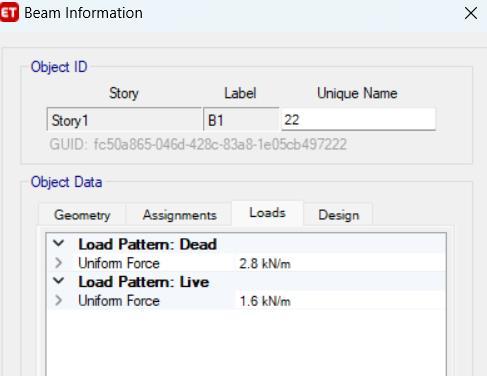
Figure 1: - Load Information
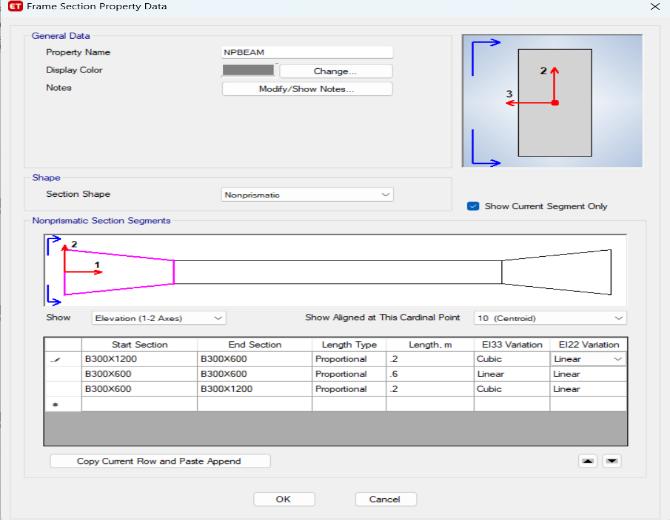
Figure 2:-Non-Prismatic Beam Dimensions
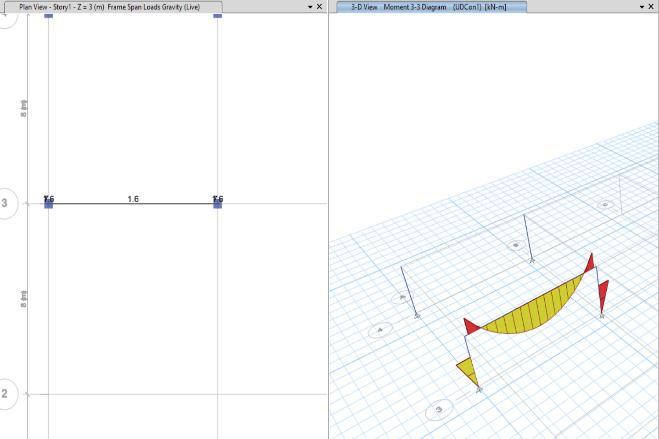
Figure 3: - Moment Diagram
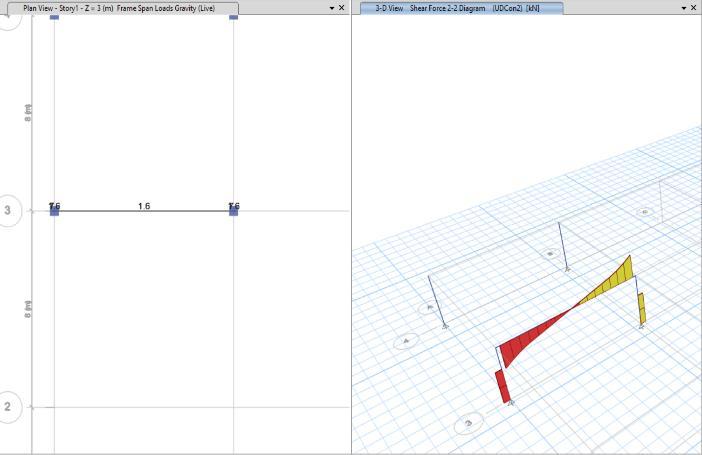
Figure 3: -Shear Force diagram
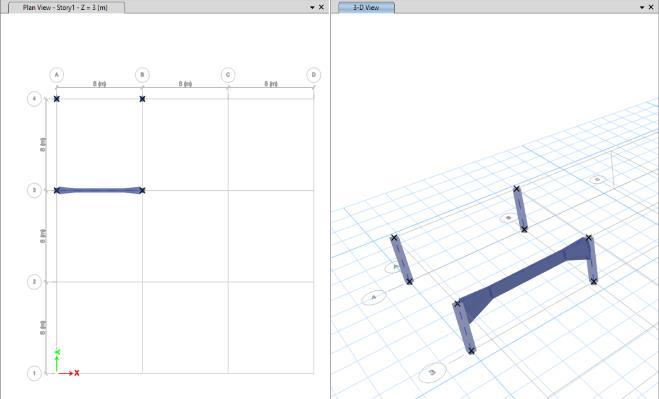
Figure 4: - 3-D Plan in E-Tab.
4. RESULT AND DISCUSSION
Structures
Fig.no. 4.1 Dead Load Graph.
International Research Journal of Engineering and Technology (IRJET) e-ISSN:2395-0056
Volume: 11 Issue: 04 | Mar 2024 www.irjet.net p-ISSN: 2395-0072
were also identify. Nonetheless, the findings of this study underscore the potential of GFRP beams as a viable alternative to conventional steel beams in certain structural applications, particularly in environment prone to corrosion. Moving forward further research and development efforts are warranted to addresses the challenges and capitalize on advantages offered by GFRP beams paving the way for more sustainable and resilient structuraldesignsinfuture.
1. C B Nayak, Tade M.K and Dr. S B Thakare (May 2017)ICMAEM
2. Deepti Hazari, Anurag Shrivastava, Abhinandan Tripathi, Harsh Paraganiha, Siddharth Agarwal, VivekSarthi(April2023)YMER
3. PranodKumarHV,VinodV(June2017)IRJET
4. Subham A. Parmar, Dr. M. M. Mahajan (Jan 2018) IJERCSE
7.BIOGRAPHIES
5.CONCLUSION
In conclusion, the comparative study between conventional steel beams and GFRP non-prismatic beams using E-tabs software has provided valuable insights into the performance and behavior of these two materials in structural engineering application. Through detailed analysisoffactorssuchasdeflection,crackformationsand load bearing capacity, it was observed that GFRP non –prismatic beams exhibit favorable characteristics such as corrosion resistance and high strength-to-weight ratio. However, challenges such as material cost and limited availability of standardize design codes for GFRP beams


Bhalerao Alkesh (Asst. Professor, Department of Civil Engineering, New Horizon Institute ofTechnology and Management Maharashtra, India)


Agawane MakarandDashrath (B.E Student, Department of Civil Engineering, NewHorizon Institute of Technology and Management, Maharashtra, India)


Thale Monish Sajjan (B.E Student, Department ofCivil Engineering, NewHorizon Institute ofTechnology and Management, Maharashtra, India)


Sahare Rupesh Gulab (B.E Student, Department of Civil Engineering, NewHorizon Institute ofTechnology and Management, Maharashtra, India)


Lokhande Yash Kalu (B.E Student, Department of Civil Engineering, NewHorizon Institute ofTechnology and Management, Maharashtra, India)