
International Research Journal of Engineering and Technology (IRJET) e-ISSN: 2395-0056
International Research Journal of Engineering and Technology (IRJET) e-ISSN: 2395-0056
Sowjanya Vuddanti1, Sai Manvitha Reddy Mallireddy2 , Naveen Kumar Reddy Renati3 , Ramineni Udayasai4
1Sr. Assistant Professor, Artificial Intelligence and Data Science Department, LBRCE, Mylavaram, India
2Student, Artificial Intelligence and Data Science Department, LBRCE, Mylavaram, India
3Student, Artificial Intelligence and Data Science Department, LBRCE, Mylavaram, India
4Student, Dept. of ECE, DVR and DR.HS MIC college of technology, Kanchikacherla, India
Abstract - Addressing the challenge of optimizing query and storage efficiency within data management involves focusing on the conversion of CSV data into the Parquet format. This meticulous process aims to streamline data storage while significantly enhancing query performance. Through the seamless integration of AWS services such as Kinesis, Glue, Athena, and Lake Formation, a robust and efficientdataecosystemisestablished.Prioritizingautomation enablestheeffortlesscreationandmanagementofdatalakes, ensuring scalability and adaptability in handling extensive datasets.Empoweringorganizations withreal-timeanalytics, visualizations, and interactive dashboards powered by Quick Sight, the project facilitates informed, data-driven decisionmaking. Furthermore, the cost-effectiveness of AWS underscores the ability for organizations to pay only for the services they utilize. Embracing AWS Data Lake enables organizations to maintain a competitive edge, driving innovation, efficiency, and growth through the strategic utilizationof data. This represents a significant advancement indatamanagementmethodologies,offeringatransformative solutiontomaximizetheefficiencyandvalueofdataresources in today's dynamic data-driven landscape.
Key Words: Query efficiency, data management, data ecosystem, Quick Sight, AWS Data Lake, competitive edge, data-driven decision-making, transformation in data management.
Dataisthesoulofmodernenterprises,andthecapacityto analyzeanddrawinsightsfromdataprovidesasignificant competitive edge. Traditional data storage and analysis methods,ontheotherhand,canbesluggishandinefficient, makingitdifficulttohandleandanalyzemassiveamountsof datarapidlyandefficiently.Manyfirmsareturningtodata lakestomeetthisdilemma,anovelmethodofdatastorage andanalysisthatallowsformoreflexibleandscalabledata management. We investigate the usage of data lakes on AmazonWebServices(AWS),acloud-basedplatformthat offersacomprehensivecollectionoftoolsandservicesfor developingandmaintainingdatalakes.
YoucanutilizearangeofservicesprovidedbyAmazonWeb Services, or AWS, to construct your data lake, such as
AmazonS3,Athena,andAGlue(ETL).AlthoughAmazonS3 isaphysicalstoragefacilitythatcanstoredataofanysize, Amazon Athena is a query tool that makes it simple and effective to query Amazon S3 data. Data is prepped and processed using an extract, transform, and load (ETL) servicecalledAmazonGluebeforebeingloadedintoadata lake. There are numerous advantages to constructing an AWS data lake. Above all, AWS enables scaling data processing and storage capacity simple and reasonably priced, which is crucial for managing massive amounts of data. Additionally, AWS offers a variety of services and resources for data analysis and storage, such as machine learning and artificial intelligence tools for deriving conclusions from data and formulating fact-based judgments.Theaffordabilityofestablishingadatalakeon AWS is one of its main advantages. With AWS, businesses onlypayfortheresourcestheyuse,sotheycanscaleupor downin response tochangesintheirdata processingand storage demands. When extra analysis and storage techniques are used, this might lead to considerable cost savings.
In conclusion, AWS provides a robust and cost-effective platformfordevelopingandmaintainingdatalakes.Witha largechoiceoftoolsandservicesformanagingandanalyzing data, as well as flexible and scalable data storage and processing capabilities, AWS is a perfect platform for enterprises wishing to reap the benefits of data lakes. Businesses may get a competitive edge in today's datadrivenbusinessclimatebyvisualizingdatahousedinadata lake.
In recent years, the proliferation of data warehouses and virtualizationtechniqueshasbeeninstrumentalinenabling organizationstoleveragevastvolumesofdatafordecisionmaking. However, despite their benefits, these traditional approaches come with their own set of limitations, particularly concerning scalability, performance, and adaptabilitytomoderndataformats.Inthisliteraturesurvey, we explore five key papers in the field and discuss their drawbacksincomparisontotheemergingparadigmofdata lakes,focusingontheirchallengesinhandlingCSVdataand the potential for optimization in storage and query performance.
Volume: 11 Issue: 04 | Apr 2024 www.irjet.net p-ISSN: 2395-0072 © 2024, IRJET | Impact Factor value: 8.226 | ISO 9001:2008 Certified Journal | Page1878
International Research Journal of Engineering and Technology (IRJET) e-ISSN: 2395-0056
Volume: 11 Issue: 04 | Apr 2024 www.irjet.net p-ISSN: 2395-0072
The paper titled "Data warehouse and data virtualization comparativestudy"byAyadHameedMousaandNorshuhada Shiratuddinpresentsacomparativeanalysisbetweendata warehouse(DW)anddatavirtualization(DV)techniques[1]. Through their examination,Mousa and Shiratuddinaimto highlight the strengths and weaknesses of each approach, particularly focusing on structured data integration, scalability, schema requirements, storage, and query processing efficiency. However, the paper falls short in providing an in-depth exploration of specific challenges related to handling unstructured or semi-structured data suchasCSVfileswithinDWandDVenvironments.Thisgap leavesroomforfurtherresearchtoaddressthenuancesof queryprocessingandperformanceoptimizationforsuchdata typeswithinDWandDVsystems.
The paper titled "Data warehouse performance: selected techniquesanddatastructures"authoredbyRobertWrembel offers insights intovarious techniques and data structures aimedatenhancingdatawarehouse(DW)performance[2]. Wrembel'sobjectiveistoaddressthechallengesassociated with processing and analyzing data efficiently within DW environments. Through a comprehensive examination, the paperexploreshardwareoptimization,storageschemes,and queryoptimizationmethods.However,despiteitsthorough discussiononimprovingDWperformance,Wrembel'swork does not delve deeply into addressing specific challenges relatedtohandlingunstructuredorsemi-structureddatalike CSVfiles.Thisgapintheresearchleavesanopportunityfor furtherinvestigationintooptimizingqueryprocessingand performanceforsuchdatatypeswithinDWsystems.
Thepapertitled"Selectionofviewstomaterializeinadata warehouse" authored by Himanshu Gupta explores the critical decision-making process of selecting materialized views ina data warehouse (DW) environment[3]. Gupta's objectiveistooptimizequeryresponsetimebystrategically materializingviewsthatarefrequentlyqueried.Throughthis approach, Gupta aims to enhance the efficiency of DW systemsinhandlinganalyticalqueries.However,thepaper doesnotthoroughlyaddressthechallengesassociatedwith managingunstructuredorsemi-structureddatasuchasCSV files within DW architectures. This gap in the research presents an opportunity for further investigation into optimizing materialized views and query performance specificallyforsuchdatatypesinDWenvironments.
Thepapertitled"Well-formeddata warehousestructures" authored by Michel Schneider delves into the modeling of well-structured data warehouse (DW) architectures [4]. Schneider aims to facilitate efficient analysis operations withinDWenvironmentsbyemphasizingtheimportanceof properlydesignedstructures.Throughhiswork,Schneider highlightsthesignificanceofstatichierarchiesandschemas inenablingeffectivedataanalysis.However,thepaperfalls short in addressing the adaptability of traditional DW architecturestohandleunstructuredorsemi-structureddata likeCSVfiles.Thisgapintheresearchleavesroomforfurther
explorationintodesigningDWstructuresthatcanefficiently accommodate evolving data formats and business requirements, particularly in the context of handling such datatypes.
Thepapertitled"DevelopmentofaUniversityFinancialData WarehouseanditsVisualizationTool"authoredbyEarlVon F.Lapuraetal.presentsacasestudyonthedevelopmentofa financial data warehouse tailored for a university setting, alongwithavisualizationtoolfordataanalysis[5].Lapura andhisco-authorsemphasizetheimportanceofvisualization toolsinaidingdataanalysiswithinspecificdomains,suchas university finance. While showcasing the utility of data warehousesinfacilitatinganalysisoperations,particularlyin thecontextofuniversityfinancialdata,thepaperdoesnot thoroughlyaddressthechallengesassociatedwithhandling unstructured or semi-structured data like CSV files within DWarchitectures.Thisgapintheresearchsuggestsaneed forfurtherinvestigationintooptimizingstorageandquery performanceforsuchdatatypeswithinuniversityfinancial datawarehouseenvironments
A data lake is an inventive approach to data storage and analysis that enables enterprises to centrally store and managevastamountsoforganizedandunstructureddata.A data lake,asopposedtotraditional data storagesolutions, whichareoftenisolatedanddifficulttoexpand,providesa flexible and scalable platform for data management and analysis.
Consideradatalaketobeabig,unstructuredbodyofwater withamassivequantityofdata.Insteadoforganizingdata into distinct pools or buckets, a data lake enables organizations to store all of their data in one location and then retrieve the information they want as needed. This methodgivesorganizationsamorecomprehensivepictureof theirdata,allowingthemtodetecttrendsandpatternsand makedata-drivenchoices.
In short, a data lake is a contemporary data storage and analysisplatformthatallowsorganizationstomanageand analyse their data in a flexible, scalable, and cost-effective manner.
The robust Amazon Web Services data Lake enables businessestohandleandstoremassiveamountsofdataina scalableandadaptableway.WithAWSdatalakes,businesses caneasilymanageandanalyzeenormousvolumesofdata, gainingmeaningfulknowledgethatcanhelpwithdata-driven decision-making.
The ability of AWS data lakes to scale up or down as necessarytomeetshiftingbusinessdemandsisoneoftheir biggest advantages. AWS Data Lake can handle storing gigabytes or petabytes of data, depending on your needs.
International Research Journal of Engineering and Technology (IRJET) e-ISSN: 2395-0056
Volume: 11 Issue: 04 | Apr 2024 www.irjet.net p-ISSN: 2395-0072
Additionally, AWS Data Lake provides a broad range of services and tools for organizing and analyzing data, includingartificialintelligenceandmachinelearningfeatures thatcouldaidbusinessesinquicklyandefficientlyderiving insightsfromtheirdata.
In today's data-driven corporate climate, the ability to efficiently handle and analyze data is critical for success. Businesses can remain ahead of the curve with AWS data lakesbyeasilymanagingandanalyzingmassivevolumesof data and getting important insights that can be utilized to drivedevelopmentandinnovation.
To remain competitive in a modern data-driven world, organizations must be able to store, process, and analyse massivevolumesofdata.Standardapproachescanbeslow andinefficient,posingchallengesinhandlingandanalyzing massive datasets. To address this, many companies are turning to data lakes a flexible and scalable approach to datamanagement.
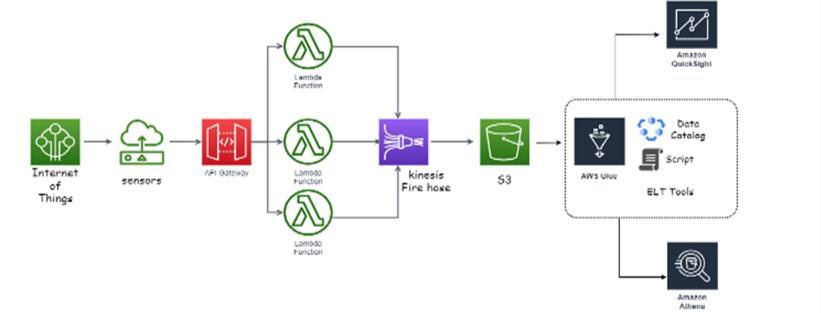
ThisresearchfocusesonleveragingAmazonWebServices (AWS) data lakes for data analytics and visualization. The studybeginsbysettingupanAPIgatewaytosenddatatoa Lambda function. The Lambda function then delivers the datatoKinesisFirehose,whichstoresitinAmazonS3.AWS Glue is used to transform, prepare, and clean the data for analytics using the extraction, loading, and transforming (ELT)approach.Thisenablesthecreationofadatacatalog thatAWSAthenacanutilizetoprovideresults.
AWS provides several benefits when constructing a data lake.Oneimportantadvantageisscalability,whichmakesit easiertohandleenormousdatasetsbyincreasingprocessing power and data storage capacity. AWS facilitates data extraction and data-driven decision-making by offering a variety of services and tools, such as artificial intelligence andmachinelearningtechnology.
Another benefit of using AWS for data lakes is its affordability. Businesses can scale up or down as needed because they only pay for the services they utilize while usingAWS.Whencomparedtomoreconventionalmethods ofdata processing andstorage,thiscanleadtosignificant costsavings.
Forthisproject,AWSGlueisusedtoefficientlytransform, prepare,andcleanthedataforanalysis.Glueisamanaged ETL solution that simplifies data transfer and handles schemaandformatchanges.Thisenablesquickandefficient data preparation, leading to valuable insights that drive informeddecisions.
AWSAthenaisleveragedforqueryingandanalyzingthedata usingstandardSQLqueries.Athenaenablesuserstoanalyze data stored in Amazon S3 buckets swiftly and easily. This
simplifiesthedataanalysisprocessandfacilitatesdecisionmakingbasedoninsightsobtained.
Insummary,thisprojecthighlightsthecapabilitiesofAWSin establishing and managing data lakes. By utilizing AWS services,organizationsgainaccesstoawiderangeoftools and scalable storage and processing capabilities. The ELT approach and AWS Glue enable fast and efficient data analysis, while AWS Athena provides a simple means to query and analyze data. AWS data lakes offer scalability, flexibility,andcost-effectiveness,empoweringorganizations to drive improved decision-making and enhance their overallperformance.
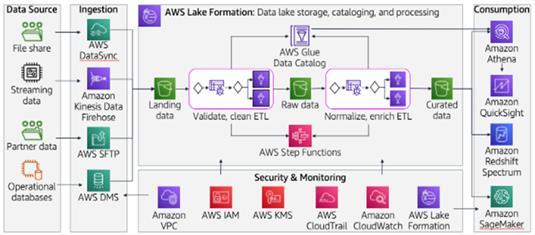
Additionally,it'sworthnotingthatthedataprocessingand cataloginginAWSdatalakescanbeautomated,allowingfor theseamlessintegrationofnewdata.Asdataisaddedtothe datalake,AWSGluecrawlerscanautomaticallydiscoverand catalog the data, ensuring that it is readily available for analysisanddecision-makingprocessesasshowninFigure1 about the architecture of our project. Figure 2 is a representationofanentireautomateddatalakethatgathers datafrommanysourcesisprocessedandanalyzedutilizing differentservices.
3.3 Data analysis, querying, visualizing, and processing
First, we start by taking the New York Taxi Limousine CommissionCSVfileandstoringitinanS3bucket.Next,we utilize the powerful Data Catalog tool called "Crawler" to automatically create a catalogue of the CSV file. This catalogue is given the name "csv_database" and contains valuableinformationaboutthefile'sschemaandmetadata.
International Research Journal of Engineering and Technology (IRJET) e-ISSN: 2395-0056
Volume: 11 Issue: 04 | Apr 2024 www.irjet.net p-ISSN: 2395-0072
Weemploytheefficient"Jobs"featureofthedataintegration tool to enhance our data integration process. These Jobs enableustoconverttheCSVfileintotheoptimizedParquet format, which offers better performance and storage efficiency.
Oncetheconversioniscomplete,theJobautomaticallysends theParquetfiletotheCrawler,whichproceedstogeneratea new data catalogue for it. This catalogue is aptly named "parquet_database" and provides us with essential details about the Parquet file, such as its table definitions and columnnames.
As a result of these steps, we successfully created two databases: "csv_database" for the original CSV file and "parquet_database" for the converted Parquet file. These databasesserveasvaluableresourcesforfurtheranalysis, querying, and data processing, empowering us to derive valuable insights from the New York Taxi Limousine Commissiondataset.
By converting the CSV file into Parquet format, we can leverage these benefits to enhance query performance, optimizestorageutilization,andensurecompatibilitywith populardataprocessingtoolsandframeworks.
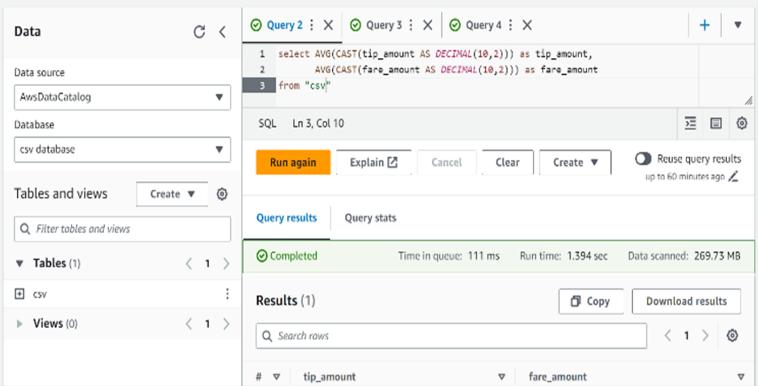
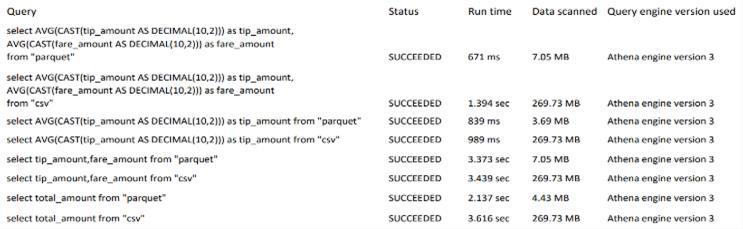
Next, we will evaluate the performance of the databases usingAWSAthenaservice.Wewillexecutequeriesagainst the databases and analyse the resulting output to assess theirperformanceasshownInfigure3and4
Let'scomparetheperformanceofqueryingtheCSVfileand the Parquet file using Amazon Athena. The image visually presents the duration or time taken and amount of Data Scannedforprocessingorexecutingoperationsonboththe CSV and Parquet files. By analyzing the runtimes, we can evaluatetheperformancedifferencesbetweenthetwofile formats.
Quick sight gives us the ability to generate eye-catching visualizationsandinteractivedashboards.Itssimpleinterface and strong features turn raw data into visually appealing charts,graphs,andinteractivecomponents,improvingdata comprehensionandrevealinghiddenpatternsasshownin Figure5
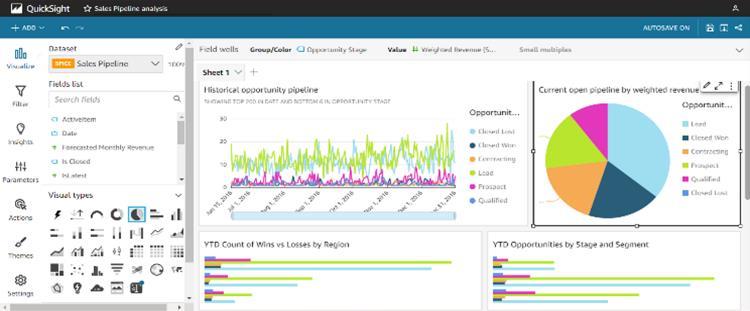
Fig -5:Visualizationofourdata
4.RESULTS AND DISCUSSION
ThestudyfocusedonoptimizingCSVdatawithinAWSData Lakes by converting them into the Parquet format, leveragingAWSservicessuchasS3,Glue,Athena,andLake Formationtocreatearobustdataecosystem.CSVtoParquet conversionwasachievedusingAWSGlue,streamliningthe process and ensuring scalability. Performance evaluation revealedimprovedqueryperformancewithAmazonAthena on Parquet files compared to CSV, resulting in reduced processingtimeanddatascanned.Theresultsunderscored the efficacy of AWS Data Lakes in optimizing CSV data, highlightingcost-effectivenessandscalabilityassignificant advantages over traditional methods. Overall, leveraging AWS Data Lakes and associated services enhances data management, driving informed decision-making and maintaining a competitive edge in today's data-driven landscape.
5.CONCLUSION
Ourprojectrepresentsasignificantmilestoneintherealmof datamanagement.Throughthesuccessfulimplementationof oursolution,convertingCSVdataintotheParquetformat, we've achieved remarkable enhancements in query performance and storage efficiency. This accomplishment underscorestheimportanceofdeliveringpracticalsolutions thatdirectlyaddressthechallengesfacedbyorganizationsin managingandanalyzinglargedatasets.
International Research Journal of Engineering and Technology (IRJET) e-ISSN: 2395-0056
Volume: 11 Issue: 04 | Apr 2024 www.irjet.net p-ISSN: 2395-0072
Furthermore,ourabilitytoseamlesslyintegrateoursolution into AWS Data Lakes alongside key services like Glue, Athena, Simple Storage Service (S3), and Kinesis demonstrates our proficiency in leveraging cutting-edge technologies to drive tangible results. By providing organizations with a robust framework for data management, we've empowered them to make more informeddecisionsandunlockvaluableinsightsfromtheir data
[1] Mousa, Ayad Hameed, and Norshuhada Shiratuddin. "Data warehouse and data virtualization comparative study."2015internationalconferenceondevelopments ofE-systemsengineering(DeSE).IEEE,2015.
[2] Wrembel, Robert. "Data warehouse performance: selected techniques and data structures." Business Intelligence: First European Summer School, eBISS 2011,Paris,France,July3-8,2011,TutorialLectures1 (2012):27-62.
[3] Gupta,Himanshu."Selectionofviewstomaterializeina data warehouse." Database Theory ICDT'97: 6th InternationalConferenceDelphi,Greece,January8–10, 1997Proceedings6.SpringerBerlinHeidelberg,1997.
[4] Schneider, Michel. "Well-formed data warehouse structures."DMDW.2003.
[5] Lapura,EarlVonF.,etal."DevelopmentofaUniversity Financial Data Warehouse and its Visualization Tool." ProcediaComputerScience135(2018):587-595.



SowjanyaVuddanti,Assistant Professor(Senior),Dept.of AI&DS, LakireddyBaliReddyCollegeof Engineering,Mylavaram,India sowji635@gmail.com
SaiManvithaReddyMallireddy, Student,Dept.ofAI&DS, LakireddyBaliReddyCollegeof Engineering,Mylavaram,India manvithamallireddy@gmail.com
NaveenKumarReddyRenati, Student,Dept.ofAI&DS, LakireddyBaliReddyCollegeof Engineering,Mylavaram,India renatinaveen5@gmail.com

RamineniUdayasai,Student, Dept.ofECE,DVRandDR.HSMIC collegeoftechnology Kanchikacherla,India udayasairamineni02@gmail.com