
International Research Journal of Engineering and Technology (IRJET) e-ISSN:2395-0056
Volume: 11 Issue: 04 | Apr 2024 www.irjet.net p-ISSN:2395-0072
International Research Journal of Engineering and Technology (IRJET) e-ISSN:2395-0056
Volume: 11 Issue: 04 | Apr 2024 www.irjet.net p-ISSN:2395-0072
Sahil Sarvankar 1 , Gauri Badade 2 , Krishnaprasad 3 , Prasad Baravkar 4 , Shivapradeep 5
1,2,3,4Student, Dept. of Automobile Engineering, Pillai College of Engineering, New Panvel, India
5Professor, Dept. of Automobile Engineering, Pillai College of Engineering, New Panvel, India
Abstract - The unfortunate reality is that a lot of car owners don't know how well their parts are wearing, which can cause unanticipated breakdowns and expensive repairs as a result. Specifically, it is critical to repair the parts as soon as possible because a single malfunction might have a domino effect that harms other parts. The study's solution to these problems is our ecosystem which is composed of two main components: a data acquisition module and a predictive analytics module. The data acquisition module is responsible for collecting sensor data from various car parts, such as engine temperature, oil pressure, and brake wear. The predictive analytics module uses machine learning algorithms, implemented in Python, to analyze the collected data and identify patterns and anomalies. This work created a system that can precisely forecast when to replace parts by analyzing the relationship between automotive part life cycle data and deceptive reading. This made it possible for car owners to schedule the necessary replacement work ahead of time and track the wear status of their parts in real time. In the long run, it is anticipated that the established system will lessen the financial burden on car owners by greatly increasing the efficiency of vehicle maintenance. This study investigates the viability of real-time component wear prediction systems and builds on previous research on vehicle maintenance. It also outlines the path for further research and addresses the possible effects this system may have on the auto repair sector.
Key Words: Vehicle maintenance, data acquisition module, machine learning algorithms automotive, predictive analytics module
Theprojectwasdevelopedtoaddressthemajorproblems facing vehicle owners regarding vehicle parts wear. In many cases, vehicle owners do not know exactly when their vehicle parts should be replaced. This leads to unexpected vehicle breakdowns, which leads to high cost repairs. To address these issues, the system serves to predicttheexpectedlifeofeachpartbasedonthevehicle's misleading data, and inform the user when to replace it. The core functions of the system are. First, we collect the vehicle's misleading data and the life cycle data for each part. This data is stored in the Googlesheet(Google
Sheets), which facilitates data management and analysis. Second, the collected data is analyzed through a multilogistic regression model. This model uses machinelearning techniques to predict the wear condition and replacementneedforeachpart.Third,theresultsof these analyzes are provided to users through web applications developed using Python(Python) and flask(Flask). Users can check in real time the status of theirvehicle parts and whentheyneedtobereplacedthroughthelandingpageof thiswebapplication.Thedevelopmentofthissystemaims to significantly improve the efficiency of vehicle maintenance. The user can prevent unexpected vehicle failuresandtheresultinghighcostofrepairbymonitoring the wear status of vehicle parts in real time through this system and planning replacement at the right time. In addition, the system opens up the possibility of extending the life of the vehicle by providing economic benefits to vehicleowners. Fortheimplementation of thesesystems, the project team has actively utilized the latest data analysis techniques and web development technologies. Machine-learning algorithms were used for data analysis and predictive modeling, and flask frames optimized for web development were used to provide a user-friendly interface. This technical approach played a keyroleinthe successfulimplementationofthisproject
The project focuses on the development of a system that monitors and evaluates the vehicle's worn parts in real timetoinformthedriver.Thesystemcontinuouslydetects the condition of the main parts of the vehicle through sensors based on IoT technology, and uses data analysis algorithms to assess the degree of wear. This information is communicated to the driver through a user-friendly interface, helping to perform the necessary maintenance tasksinatimelymanner.Themainpurposeoftheproject istoimprovethesafetyofthevehicleandtheefficiencyof maintenance. This project is designed taking into account varioususecases.Forexample,inadditiontoabasicwear detectionsystemforpersonalvehicleusers,itmayinclude advanced monitoring and data analysis services for companies or organizations managing large-scale vehicle operations. This helps to maximize operational efficiency by processing large amounts of vehicle data and quickly
e-ISSN:2395-0056
Volume: 11 Issue: 04 | Apr 2024 www.irjet.net p-ISSN:2395-0072
identifying vehicles that require maintenance. In addition, vehiclemanufacturerscantakeadvantageofthissystemto evaluatethedurabilityoftheirproducts,andgetagreeting for future vehicle designs. Insurance companies can also explore the possibility of developing insurance products basedonthevehicle'sconditionandmaintenancehistory. Various technical, business and legal aspects must be considered for the successful implementation of the project. Technically the development of high-precision sensors,efficientdatacollectionandanalysismethods,and user-friendly interface design are key elements. On the businessside, the development ofa flexibleservice model that can meet the needs of different customers is important, and requires thorough preparation for privacy and data security. Legal regulation is also an important consideration, and must comply with laws specifically relatedtoprivacy.Collectively,theprojecthasthepotential to innovate the way vehicle maintenance is maintained, improve driver safety and convenience, and provide new opportunities for related industries. Systematic project management, continuous technology development, and closecollaborationbetween stakeholdersareessentialfor successfulimplementation.
● Marco Fischer (Germany) and Ana García (Spain) established an IoT-based framework for real-time vehicle condition monitoring in their article "An IoTBased Framework for Real-Time Vehicle Condition Monitoring."Driversandserviceprovidersmayaccess real-timeinformationaboutthestateofthecarthanks to a system that the research built that integrates many sensors and cloud computing. The global efficiency of vehicle maintenance can be improved withthehelpofthisframework.
● The paper "Predictive Maintenance of Vehicles Using Machine Learning Algorithms" by Sarah Johnson (USA), Raj Patel (India) has developed a system that leverages machine learning algorithms to predict whenavehiclewillbemaintained.Thisstudyanalyzes large quantities of vehicle operation data, learns the wearpatternsofvehicleparts,whichsuggestsamodel that informs you in advance when maintenance is needed. This system can play an important role in improving the efficiency of vehicle operations worldwide.
● Thepaper"High-PerformanceSensorTechnologiesfor Detection of Vehicle Part Wear" by Jean Dupont (France), Elena Rodriguez (Mexico) studied how to detect wear on vehicle parts using high performance sensortechnology.Thisstudycoversthedevelopment of sensors that can precisely detect wear that can occur in various parts of the vehicle andthe
implementation of a wear diagnostic system through it.Thistechnologycanhelpimprovevehiclesafetyand operationalefficiency.
● Isabella Rodriguez (Spain) and Takumi Sato (Japan) createddeeplearningbasedvisualrecognitionsystems in their work "Enhancing Autonomous Vehicle Safety through Deep Learning Approaches" to increase the safety of autonomous cars. This study shows how well the deep learning model recognizes and predicts the environment, with an emphasis on enhancing vehicle response times, particularly on intricate roads. The safety and dependability of autonomous driving technology may be improved by the findings of this significantstudy.
● The paper "Predictive Modeling of Electric Vehicle BatteryLifespan"byEleanorThompson(England),Anil Kumar (India) developed a model that predicts the life of an electric vehicle battery using machine learning techniques. This study analyzes battery usage patterns and external environmental factors to predict battery performance degradation, which suggests ways to optimize the electric vehicle's maintenance plan and battery replacement strategy. It provides important research results for the efficient operation and sustainableuseofelectricvehicles.
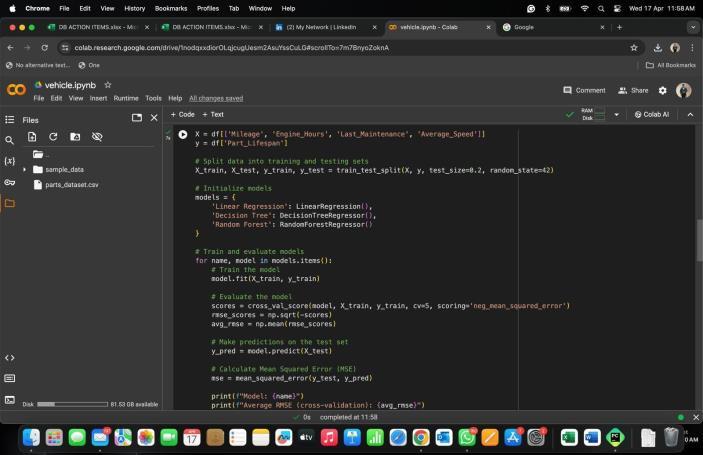
Thesystemsproposedinthisstudyaimtodevelopvehicle data analysis and forecasting models by incorporating Python, Flask, Google Sheets (GSheet), and mechanical lessons utilizing multi-regression analysis. Python is an ideal programming language for data science and mechanics projects thanks to its flexibility and extensive library support. Flask is a Python-based lightweight web framework that is useful for integrating user interfaces anddata processingcapabilities.GoogleSheetsisusedfor data collection and management, and works with Flask applications to enable real-time data analysis. A key component of this system is a mechanical learning model using multi-regression analysis. Multi-regression analysis models the effect of multiple independent variables on dependentvariables,throughwhichpredictionsaremade. In this study, vehicle performance data (e.g. speed, fuel consumption, engine temperature, etc.) are used as independent variables, and the need for maintenance of the vehicle is set as dependent variables. The mechanic model learns this data to accurately predict when the vehiclewillbemaintained.
Theoverallworkingflowofthesystemis.Firstofall,data collected from vehicle sensors is stored in Google Sheets. Flask applicationsperiodicallyreadthis data and perform data preprocessing and purification operations.
International Research Journal of Engineering and Technology (IRJET) e-ISSN:2395-0056
Volume: 11 Issue: 04 | Apr 2024 www.irjet.net p-ISSN:2395-0072
Preprocessed data is entered into the mechanical learning model to proceed with learning above maintenance timing predictions. Finally, the forecast results are visually displayed to the user to help manage thevehicle.
The systems proposed in this study develop vehicle data analysis and forecasting models by incorporating mechanical learning models based on Python, Flask, Google Sheets, and multi-regression analysis. The system leverages the advantages of each component to maximize the accuracy and efficiency of vehicle maintenance forecasts. Below is a detailed description of system integrationanduserelements.
4.1 Google Sheets and Flask:
Google Sheets is a platform that allows you to easily and efficiently collect and manage vehicle sensor data. Flask applications can access and process this data in real time using the Google Sheets API. This allows users to always performanalyticsandpredictionsbasedonthelatestdata.
4.2 Python-based data processing and analysis:
FlaskapplicationsarebasedonPythonandutilizevarious Pythonlibraries(e.g.pandas,numpy,sklearn,etc.)fordata pretreatment, analysis, and mechanic model training. These libraries enable advanced data analysis and modeling.
4.3 Mechanical learning model through multiple regression analysis:
Mechanical models using multi-regression analysis comprehensively take into account the vehicle's various performanceindicatorstopredictmaintenanceneeds.This model can be updated regularly to reflect new patterns thatappearinthedata.
4.4 User interface (UI):
Flask application provides a web-based user interface. This UI is designed to make it easy for users to look up data and check forecast results. In addition, users can performdatafiltering,sorting,etc.operationsasneeded.
4.5 Custom notifications:
The system sends a notification to the user when it identifies a vehicle that needs maintenance. This notification can be configured with email, SMS, or notifications within a web application, and can be set in a user'spreferredway.
4.6 Security and data privacy:
The security and privacy of user data is a key element of system design. The system uses technology such as data encryption,userauthentication,accesscontrol,etc.tokeep userdatasafe.
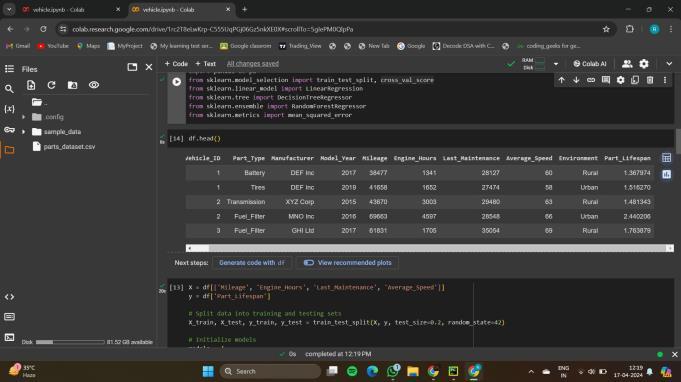
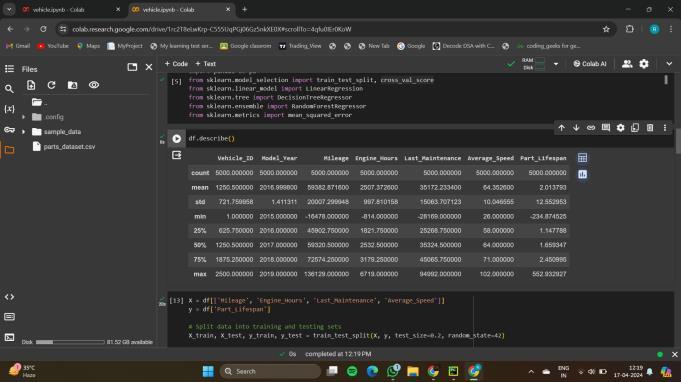
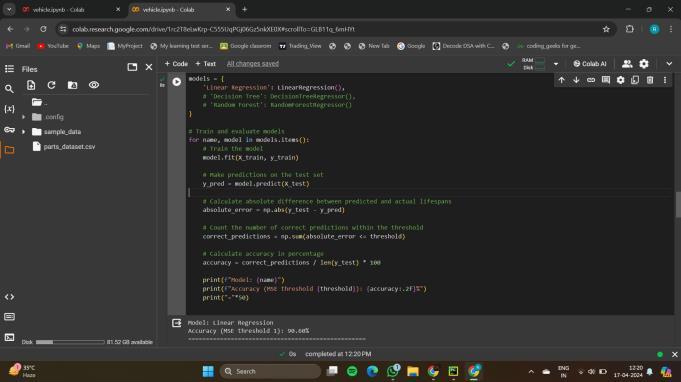
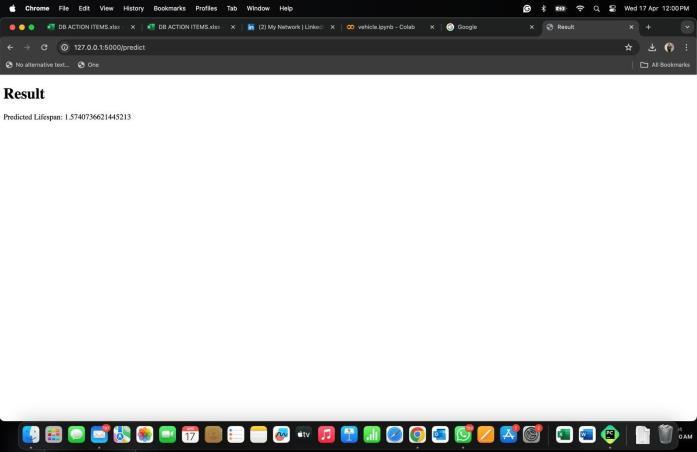
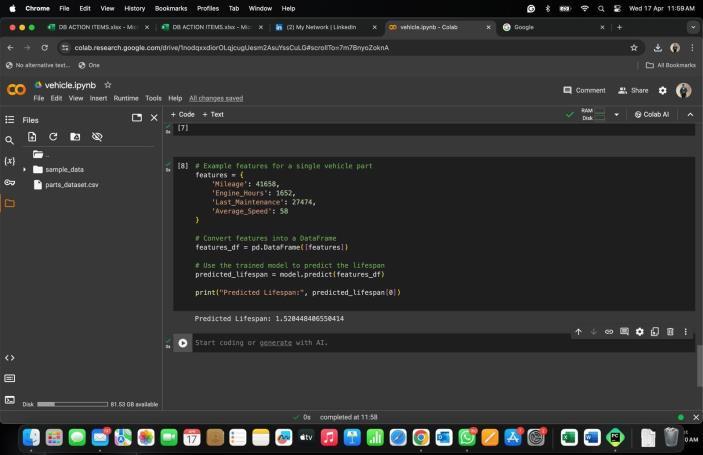
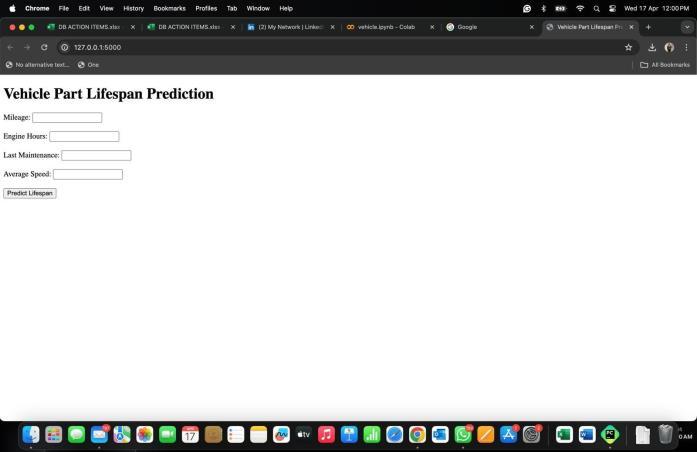
5. MODULE IMPLEMENTATION
6. FUTURE SCOPE
1.Forecastingandreal-timedataanalysis:
Present systems evaluate and forecast data on a regular basis. We are able to deliver immediate prediction and feedbackasthevehicle'sstatechangesbycombining realtime data streaming and real-time prediction capabilities. It makes vehicle management and maintenance more effectiveby beingable toidentifyand addressissues with vehiclesmorequickly.
2.Machinelearningmodeldiversification:
Apart from multi-regression analysis, you can experiment with and use different machine learning methods, such time series analysis models or deep learning models. The system'sutilitycanbegreatlyenhancedbyachievingmore preciseforecastsandthoroughdataanalysis.
3.Extensionofuser-customizedservices:
We are able to offer personalized services according to user preferences, past interactions, car attributes, etc. For instance, having the capacity to suggest the best maintenance schedule for every single person. A better userexperiencecansatisfyawiderangeofuserneedsand raisesystemsatisfaction.
4.Integratedvehiclemanagementsystem:
To create a complete vehicle management solution, integrate this system with other vehicle management features (such as route optimization, fuel usage analysis, etc.). enhance the ease of use and efficiency of vehicle management considerably. Users will have access to a range of vehicle management services via a single platform.
International Research Journal of Engineering and Technology (IRJET) e-ISSN:2395-0056
Volume: 11 Issue: 04 | Apr 2024 www.irjet.net p-ISSN:2395-0072
5.Interfaceandinteractiondesignenhancement:
By making constant improvements to the user interface (UI)anduserexperience(UX)design,youmayputinplace a system that is easier to use and more intuitive. Users interact with the system more frequently and are happier asaresultofitbeingsimplerandmoreefficientforthem.
The study discussed the design and implementation of vehicle data analysis and prediction systems. The system consists of data collection, preprocessing, model learning, prediction and result display, and user interface modules. Each module performs specific functions to increase the efficiencyofvehiclemaintenanceandmanagement,andby integrating them, it provides real value to the user. The main purpose of the system is to accurately predict the timing of maintenance of the vehicle, to prevent unexpected failures and to extend the life of the vehicle. Learn a multi-regression analysis model based on actual vehicle data, which predicts maintenance needs. In this process,theaccuracyofthedataandthepredictivepower ofthemodeldirectlyaffecttheperformanceofthesystem. Inaddition,inthefutureprospects,real-timedataanalysis and forecasting, diversification of machine learning models, user-customer service expansion, integrated vehiclemanagementsystem construction,Italsoprovided ways to expand and improve the functionality of the systemthroughinterfaceandmutualimprovement.Taken together, this study explored the possibilities of systems that utilize vehicle data to predict the timing of maintenance,andpresentedimplementationmethods.The proposed system will be a useful tool to improve the efficiency of vehicle management and reduce the cost of vehicle maintenance for users. Furthermore, with the future prospects presented in the study, the system is expected to develop continuously and provide greater valueinvehiclemanagement.
[1] Weiting Zhang, Dong Yang, "Data-Driven Methods for Predictive Maintenance of Industrial Equipment: A Survey" in IEEE Transactions on Industrial Informatics, vol. 19, no. 4, pp. 1-15, April2023, doi: 10.1109/JSYST.2019.2905565
[2] DazhongWu,ConnorJennings,JanisTerpenny,Robert X. Gao, Soundar Kumara, “A Comparative Study on Machine Learning Algorithms for Smart Manufacturing: Tool Wear Prediction Using Random Forests”, April 18, 2017, MANU-16-1567, doi:10.1115/1.4036350
[3] Sherin Thomas, Abhishek Dubey, Magson Zanette, “Digital Fleet Management: A Scalable Cloud Framework based on Data-driven Prediction Models”, November 2020, doi:10.36001/phmconf.2020.v12i1.1273
[4] Andreas Theissler a, Judith Pérez-Velázquez, “Predictivemaintenanceenabledbymachinelearning: Use cases and challenges in the automotive industry”, ReliabilityEngineering&SystemSafety,2021,Volume 215,doi:10.1016/j.ress.2021.107864
[5] Rohit Dhall, Vijender Kumar Solanki, “An IoT Based Predictive Connected Car Maintenance Approach”, International Journal of Interactive Multimedia and Artificial Intelligence, 2017, pp. 16-22, doi:10.9781/ijimai.2017.433
| Page1840