
International Research Journal of Engineering and Technology (IRJET) e-ISSN:2395-0056
Volume: 11 Issue: 04 | Apr 2024 www.irjet.net p-ISSN:2395-0072
International Research Journal of Engineering and Technology (IRJET) e-ISSN:2395-0056
Volume: 11 Issue: 04 | Apr 2024 www.irjet.net p-ISSN:2395-0072
Y. Angeline Gnana Prakasi1 , A. Nisha Devi2 , V. Nivetha3 , M. Subha Mughisha4 , K. Varushapriya5
1Professor ,Dept. of information technology, Meenakshi college of engineering, Tamil Nadu, India
2,3,4,5 UG Student, Dept. of information technology, Meenakshi college of engineering, Tamil Nadu, India
Abstract - A deep learning based study was used to reduce the COVID effect on education system. Corona virus was identified in 2019 and posed a great challenge to the world since its outbreak. despite of the comment on end of COVID or end of mask wearing era still a report says that there are new 15,000 fresh cases of COVID from January 2024. Even a scientist molly smith stated on wearing mask in 2024 that at certain situation coronavirus epidemics have forced people to wear masks to counteract the transmission of virus, which also brings difficulties to monitor large groups of people wearing masks. In this paper, we primarily focus on the AI techniques of masked facial detection and related datasets by using CNN based deep learning algorithm. The purpose of the proposed system is to protect the students and staff against infectious diseases and increase the student performance during classes by monitoring their facial movements and alert them during drowsy times The paper also works on detecting the use of masks in closed areas like classroom by training a customized deep learning model which also monitors the student’s attendance data just by recognizing their face through a deep learning model.
Key Words: convolutional neural network, automatic attendance, deep learning, masked face , drowsiness alert.
After the attack of COVID a lot has changed in the society especially a diverse effect where caused in the education sector. When the situation turns normal, where a one to one classes started again the students and staffs were insisted to wear face masks and later on which become a mandatory one. Hence in our project a 3 stages of initial test were proposed to examine the student’s state and further a smart attendance could also be done by storing and reporting the student data by facial recognition. Also the student’s facial and eye movements were tracked duringthe classhoursto monitortheirattentiveness.It is alsodesignedtoalertthemincaseofremissness.
Initially the face of the student is analyzed and features are extracted to create a ROI. Next, the student’s face is differentiated from the mask by using a system, which is already trained using the datasets uploaded. After the advent of COVID, there were many datasets developed to work on the project. Further using facial recognition technology, the system can accurately identify individuals
basedontheiruniquefacialfeatures,eliminatingtheneed for manual attendance taking methods which could also vastlyreducetheproblemwithproxyattendance.
The libraries like shutil and pickle could be used to manage the data of the student in the backend of the system. Already enrolled student’s data along with their unique id were refurbished based on their daily attendance. In case of new students, the student is asked to show their face in the camera to train the system freshly.Alsothestudent’sattentivenessintheclassroomis monitored by tracking their eye movements, which could improvisetheproductivityofeducation.
The existing system is the first survey about masked face detection dataset. It works on numerous datasets like around13Datasetsandcomparethosemethodstoensure thebestoutofthem.Initiallytheyareusingtwocategories ofmethods.
(i)Conventionalmethod.
(ii)Neuralnetworkmethod.
The conventional method usually works on hand crafted features, which accounts for a small proportion and the neural network based method are further classified as threepartsaccordingtoprocessingstages.
They have also incorporated ACS (Advanced Card Systems)cardreadertoregistertheunknownstudentsto the system. Additionally, an MQTT (Message Querying Telemetry Transport) broker that is run on the device establishesthedatatransmission.
2.1 Disadvantages of existing system
Here some methods are used to detect only masked and un masked faces and no other advancedfeatures
Some datasets are created by stimulating masks whichcouldnotgivebetterresult
Lackingofthemodelsize
International Research Journal of Engineering and Technology (IRJET) e-ISSN:2395-0056
Volume: 11 Issue: 04 | Apr 2024 www.irjet.net p-ISSN:2395-0072
The proposed system extends the existing system by using the high precise datasets to recognize the masked and unmasked faces in education sector. The same could beusedforattendancetrackingpurposeaswell.Initiallya COVID prediction website is opened to check the health conditionofthestudent.Subsequently,theCOVIDnegative students are allowed to show their face on a camera to detect the mask. In case of mask recognition. they are allowed inside the classroom else a restriction message will be passed. The face mask detection is also achieved with higher accuracy than the existing system using CNN model.
Further, the attendance of the student is updated based on the facial recognition using shutil (Shell Utilities module)algorithmthatwillperformhighleveloperations with automation and a report will be generated on their identity. Finally, an alert system is incorporated into the modeltoobservethestudentsduringtheclasshours.
3.1 Advantages of proposed system
Absolute protection against COVID and air borne diseases.
Reduce the burden on manual attendance maintenanceandreduceproxies.
The student’s attentiveness could be gradually increasedbymonitoringthemduringtheclasshours.
Input:
FaceofthestudentalongwithuniqueID.
Output: Facialrecognitionandupdationofthe attendance.
[1]ImageDataGenerator =1/255, rotation _range = 20, horizontal_flip=True.
[2]model.add(conv2D(filter,kernel_size, padding), model.dense(activation)
[3]startX,startY=max(0,startX),max(0,startY) endX,endY=(min(w-1,endX),min(h-1,endY))
[4]detect_and_predict_mask (frame,faceNet,maskNet)
[5]cv2.face.LBPHFaceRecognizer.create()
[6]defeyeaspectratio(eye):
A=dist.euclidean(eye[1],eye[5])
B=dist.euclidean(eye[2],eye[4])
C=dist.euclidean(eye[0],eye[3])
Ear=(A+B)/(2*C)
4.1. Algorithm Description
The convolutional neural network is used which is a type of artificial neural network used primarily for image
recognition and processing due to facility of recognizing thepatterninimages.
Step 1: Aftergettingtheinput,thedata aretrained using the image data generator method which could zoom , flip horizontallyorverticallytotrainoursystemtopredictthe face.
Step 2: According to our algorithm, we have 3 hidden layersand2denselayerswhichisshownusingthemodel. addandmodel.densemethod.
Step 3: The co-ordinates to determine the ROI of the respectiveregionisgeneratedasXandY.
Step 4: A frame is detected and using that the faces are detectedanddetermineiftheyarewearingafacemaskor not.
Step 5:Incaseofnewstudentsandrealtimedetectionthe system is trained to extract the features from the newly captured student's image. Finally a report will be created usingthecentraldatabase.
Step 6: The eye aspect ratio (EAR) of the student t is extractedtodetecttheattentivenessofthestudentduring theclasshours.
• Download and install Anaconda and get the most usefulpackageformachinelearninginPython.
• Load a dataset and understand its structure using statisticalsummariesanddatavisualization.
• Train the system using the algorithm with many datasetsthathavecollected.
• Once the system gain knowledge on recognizing and differentiating between the images, we could startinsertingourowndata.
International Research Journal of Engineering and Technology (IRJET) e-ISSN:2395-0056
Volume: 11 Issue: 04 | Apr 2024 www.irjet.net p-ISSN:2395-0072
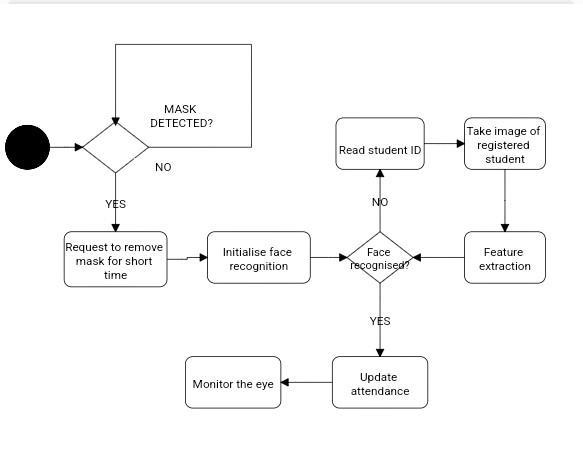
1. Mask Detection
To allow the students to attend the class we have to detectwhetherthestudentwearsthemaskornot.This is done to prevent the students from spread of air bornediseases.
2. Face Recognition
This will check whether the recognized face is already been inmemory.If not,itstartstoextractthefeatures from the new student. It also reads the student id for storingtheirdatawithuniquereference.
3. Monitoring the Eye
Inthistheeyemovementofthestudentischeckedand ifthestudent’sfeeldrowsyorunmindfulintheclasses, analertwillbeproducedtoregainconcentrationofthe student.
As a result a better education environment is adopted to ensure the education continuity after COVID . Literally, better accuracy on facial detection and automated attendance system as compared to the existing system is achieved Additionally, a system to monitor the students during the class hours is developed which could improve theeducationwhichisnotfocusedintheexistingwork
6.1 IMPLEMENTATION
Initially,thestudent’shealthcondition wascheckedusing a website that was created to predict the symptoms of COVID,basedontheparameterscollectedfromthem.
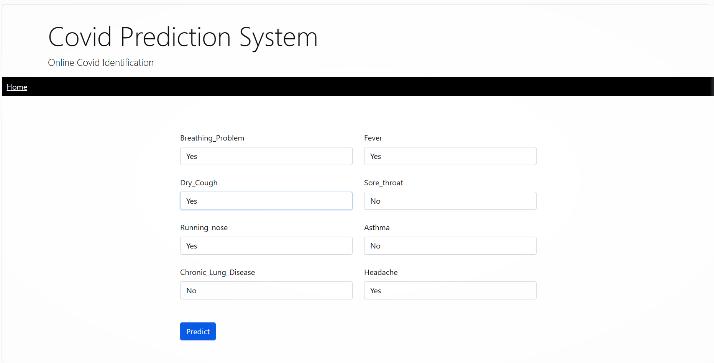
If the parameters did not match then the students were allowedenterthemaskdetectiontest.
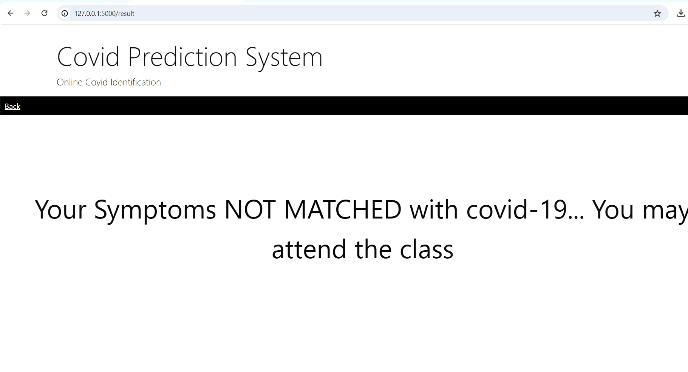
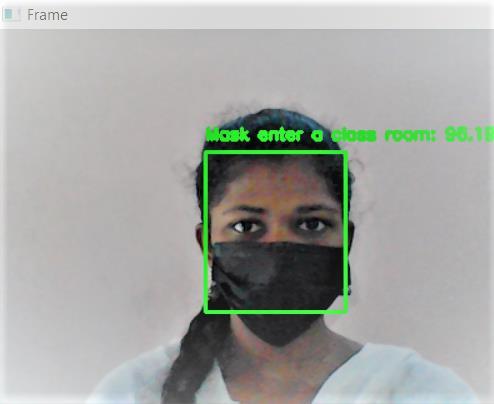
Next, the mask detection was performed. Our system shows the 100% result on detecting the presence or absenceofmask.
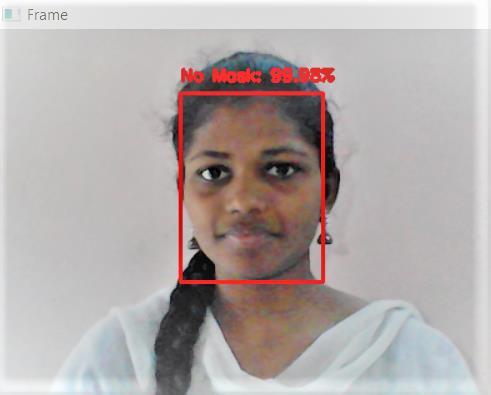
Nomaskwasdetected
When mask was detected, a message will be passed to allowthestudenttoenterintotheclass.
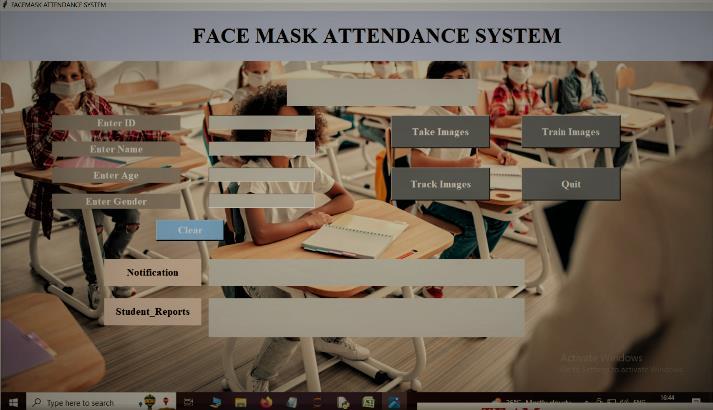
Once the mask was detected, the attendance system page will be opened. By showing the student’s face, the system couldpredicttheiridandupdateitontheattendancelist.
International Research Journal of Engineering and Technology (IRJET) e-ISSN:2395-0056
Volume: 11 Issue: 04 | Apr 2024 www.irjet.net p-ISSN:2395-0072
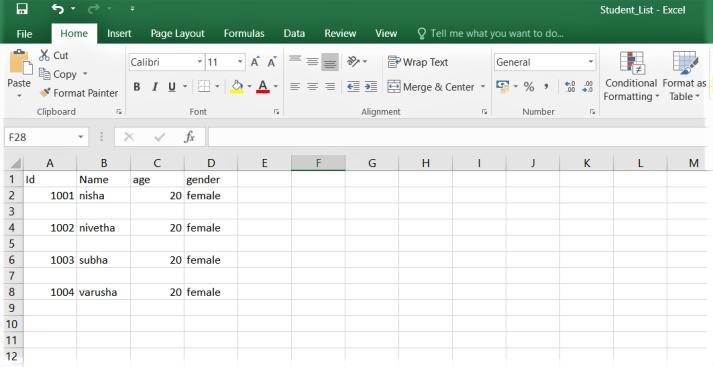
– Attendancedatabase
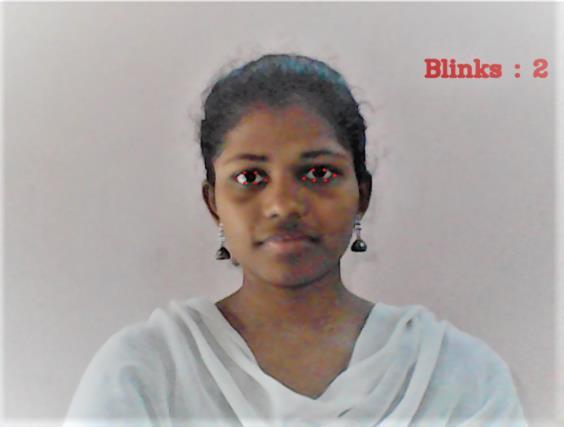
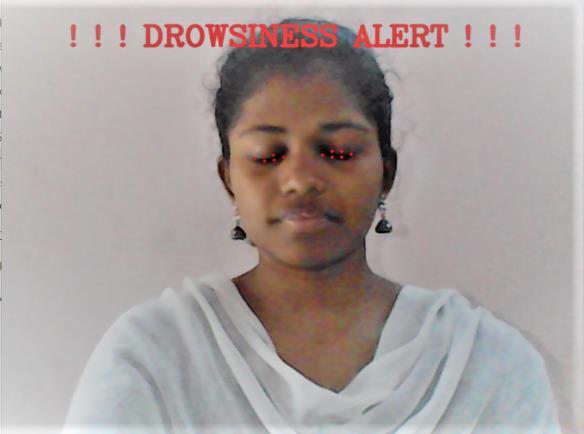
Additionally, the student’s facial movement is also analyzed to predict their attentiveness during the class. Once the blink exceeds continuous 10 counts within the timeintervalof 5secs,thenanalertwillbeproduced.
Alert will also be produced also when the duration of eye closureexceedscertaintimelimit..
7. CONCLUSION
In conclusion, the facial mask detection project has successfullyachieveditsobjectivesofdevelopinga robust system capable of accurately identifying whether individuals are wearing masks in real-time. Through the utilization of deep learning techniques such as
convolutional neural networks (CNNs) and image processing algorithms, we have created a model that demonstrates high accuracy and efficiency in detecting facial masks.
The facial attendance system represents a cutting-edge solution for attendance tracking, offering numerous advantages in terms of accuracy, efficiency, and security. Also, a productive environment is also assured by our model. By harnessing the power of facial recognition technology, we have developed a system that not only meetsthecurrentneedsoforganizationsbutalsolaysthe groundwork for future advancements in workforce management and surveillance technologies. Also, a productiveenvironmentisalsoassuredbyourmodel.
1. In future heart & respiration based rate monitoring, and fever measurement features to the proposed systemcouldbeintegrated.
2. Acompletesolutionwillbedevelopedtomonitorand occurinthefuture.
3. Eventually,analertandnotificationsystemcouldalso be developed based on the student's irregular attendanceorunexcusedabsence.
[1] Firat Aydemir and Seyfullah Arslan (2023) , "A System Design With Deep Learning and IOT to Ensure Education Continuity for Post-COVID" IEEE Trans.ConsElectron
[2] X.Sun,M.Wang,R.Lin,Y.Sun,andS.S.Cheng(2021), “Deep-learned perceptual quality control for intelligent video communication,” IEEE Trans. Consum.Electron.
[3] S. Gupta et al (2021) ., “Novel face mask detection techniqueusingmachinelearningtocontrolCOVID’19 pandemic,”.
[4] M.WangandW.Deng(2020),“Deepfacerecognition: Asurvey,”
[5] Cabani, K. Hammoudi, H. Benhabiles, and M. Melkem, (2020) "Masked face-net–a data set of correctly/incorrectly masked face images in the contextofcovid-19,”.
[6] Anwar and A. Raychowdhury (2020) , “Masked face recognitionforsecureauthentication,”.
[7] J. S. Talahua, J. Buele, P. Calvopina, and J. Varela-Ald (2021) ˜ as, “Facial ´recognition system for people with and without face mask in times of the covid-19 pandemic,”