
International Research Journal of Engineering and Technology (IRJET) e-ISSN: 2395-0056 p-ISSN: 2395-0072

Volume: 11 Issue: 04 | Apr 2024 www.irjet.net

International Research Journal of Engineering and Technology (IRJET) e-ISSN: 2395-0056 p-ISSN: 2395-0072
Volume: 11 Issue: 04 | Apr 2024 www.irjet.net
Prof. Rahul Laxman Thorat1 , Atharva Kadam2 , Aditya Arkasali3 , Makarand Warade4
1Professor, Dept. of Computer Engineering, TSSM Bhivarabai Sawant College of Engineering & Research Pune, India
2 Dept. of Computer Engineering, TSSM Bhivarabai Sawant College of Engineering & Research Pune, India
3Dept. of Computer Engineering, TSSM Bhivarabai Sawant College of Engineering & Research Pune, India
Abstract - Sign language is a vital means of communication for millions of individuals worldwide, particularlythosewhoaredeaforhardofhearing.This software,aptlynamedSignSense,leveragescutting-edge computer vision and machine learning techniques to detectandtranslatesignlanguagegesturesintotextand inrealtime.SignSense'scoreinnovationliesinitsability to bridge the communication gap between the hearing andnon-hearingcommunities.Byharnessingthepower ofcomputervision,itaccuratelyinterpretstheintricate movements and expressions of sign language, transforming them into clear, concise text. Moreover, SignSensecanbeintegratedintovariousplatformsand devices, opening up endless possibilities for communication, from educational settings to daily interactions.
Index Terms: Sign Language, Translation, ASL, Deep Learning.
TheprimaryaimoftheSignSenseprojectistodevelopan advancedsignlanguagedetectionandtranslationsoftware that enhances accessibility and communication for individuals who are deaf or hard of hearing, ultimately fosteringamoreinclusivesociety.SignSense,asignlanguage detectionandtranslationsoftware,isbornoutofadeeply rootedcommitmenttoaddressthecommunicationbarriers faced by individuals who are deaf or hard of hearing. The motivation behind this project stems from a profound understandingofthesignificanceofinclusivity,asweaimto create a world where everyone can participate in conversations, education, and various facets of daily life withoutanyrestrictions.
ThescopeofworkfortheSignSenseprojectencompassesa multifacetedapproachthataimstoachieveacomprehensive andgroundbreakingsignlanguagedetectionandtranslation solution.Theprojectwillcommencewithin-depthresearch intosignlanguagelinguisticsandrecognitionmethodologies, laying the foundation for a robust sign language gesture detection system. This will involve the acquisition of a diversedatasetofsignlanguagegestures,theirannotation,

and the development of machine learning models for real-timegesturerecognition.
Followingtheresearchphase,theprojectwillshiftitsfocus to the development of the software's core components, includingthesignlanguagedetectionmodule,translationto text,andspeechsynthesisfunctionality.Thesoftwarewillbe designedtorunonmultipleplatforms,makingitaccessible toawiderangeofusers.Theproject'sscopealsoextendsto advocacyandawarenessinitiativesaimedatpromotingthe adoption of SignSense in educational institutions, workplaces, and public spaces. This holistic approach underscores the project's ambition to create a more inclusive society by breaking down the communication barriersfacedbythedeafandhardofhearingcommunities. Sign language recognition is an area of research that involvespatternmatching,deeplearning,computervision, natural language processing, and a design module or algorithm to identify sign language. It can be extended further to human-computer interaction without a voice interface.Thissystembelongstomultidisciplinarycontent and the approach can be considered as a part of the Sign LanguageSystem.[1]
The SignSense project anticipates a range of significant outcomesthatwillcontributetoitsoverarchingmissionof enhancingcommunicationandaccessibilityforindividuals who are deaf or hard of hearing. These outcomes include: Effective Sign Language Communication: SignSense will empowerindividualswhousesignlanguagetocommunicate effectively with both the hearing and non-hearing communities,reducingthecommunicationgapandfostering greater inclusivity. Improved Education Access: The software'sintegrationintoeducationalsettingswillenable studentswhoaredeaforhardofhearingtoaccessclassroom discussionsandeducationalresourcesinrealtime,thereby improvingtheireducationaloutcomes.
Enhanced Workplace Inclusivity: By providing a tool for clearcommunication,SignSensewillfacilitatetheinclusion ofindividualswithhearingimpairmentsintheworkplace, expandingtheiremploymentopportunitiesandcontributing todiverseandproductiveworkenvironments.

International Research Journal of Engineering and Technology (IRJET) e-ISSN: 2395-0056 p-ISSN: 2395-0072
Volume: 11 Issue: 04 | Apr 2024 www.irjet.net
Increased Social Participation: Deaf and hard of hearing individuals will be able to actively participate in social interactions, contributing to a more inclusive society and reducingsocialisolation.
SL recognition systems on movies typically comprise a temporal model that maps sequential representations to labels and a feature extraction module that extracts sequential representations to characterize gesture sequences.Byusingsequencelearningmodels,signlanguage recognitionseekstounderstandtherelationshipsbetween input sequences and sign labels. Vision-based continuous sign language recognition systems often learn to automatically output the gloss labels in the correct order usingimagesequencesofsigners'performancesasinput.
Deep et al. [1] have researched on deep learning-based Indian sign language recognition system with processed static images implemented on Indian Sign Language gestures.Theproposedmethodologyhasachieved99.29% accuracy over the 36 image-based Indian sign language classes.Theproposedmethodologyhasachievedsignificant accuracyusingasmallernumberofattentionlayersinthe encoding component of the transformer as well as a very smallnumberoflearningcycles.
Runpengetal.[2]utilizedDeepFlowmethodforcomputing opticalflow.Ininstanceswheretheoriginaldatabasesdonot provideinformationaboutthedominanthandlocations,the fasterR-CNNframeworkisemployedtodetectthedominant handineachframeofthevideo. For training the feature extraction module based on alignmentproposals,theydividedthepairsofsegmentsand gesturallabelsintotrainingandvalidationsetsataratioof 10:1. They utilized Adam as their stochastic optimization approach,maintaininga fixedlearningrateof5× 10^(-5) and a mini-batch size of 20. The neural architecture is implementedinTheano,andexperimentsareconductedon NVIDIATitanXGPUs. It'snoteworthythattheirclassifier,usingcolorimagemodal, achievesatop-1accuracyof63.70%andatop-5accuracyof 86.37%. Additionally, the classifier combining color and opticalflowachievesatop-1accuracyof75.70%andatop-5 accuracyof91.93%across450gesturalclasses.
Jyotishmanetal.[3]Thisworkattemptstoprovideavisual solution for the sign language recognition problem in the regionalIndianlanguage,wheredifferentsetsofalphabets exist for each. A state-of-the-art methodology has been adaptedtoimplementthesolutionusingadvancedtoolslike MediaPipe. Both real-time and static gestures have been triedtoberecognizedbytrainingaself-generated3Dand2D imagedatasettoaFeedForwardNeuralNetwork.94data points has been generated, including nine static gestures with vowels and consonants from the Assamese Sign Language. The dataset was used for training of a feed-
forwardneuralnetwork.Themodelyieldedanaccuracyof 99%.
Prakhyathetal[4]employedthe"SupportVectorMachine" (SVM),asupervisedmachinelearningapproachfrequently utilizedfortacklingclassificationproblems,thoughit'salso adaptableforregressiontasks.WithinSVM,eachdatapoint is depicted as a point within a multi-dimensional space, wherethenumberofdimensionsalignswiththenumberof featuresinthedataset.Thevalueofeachfeatureservesas the coordinate for that point. Subsequently, the algorithm discerns a hyperplane that proficiently distinguishes betweenthevariousclassespresentinthedataset.
RomalaSriLakshmiMuralietal[6],Themodelisevaluated basedon10alphabeticAmericansignlanguageincluding:A, B,C,D,H,K,N,O,TandY.Theyhaveuseda total of2000 images to train the Convolutional Neural Network. The datasetissplitintheratioof80:20fortrainingandtesting respectively. The results used in this paper gives us an accuracyofover90%.
Ravikiran[5]etal.usedaneffectiveandrapidalgorithmfor determining the number of fingers displayed in a gesture representing a letter of American Sign Language. They achievefingerdetectionbyemployingBoundaryTracingand FingerTipDetectiontechniques.
Hee-Deok Yang[7], In this paper, a novel method for recognizingsignlanguagehandgestureswasproposed.In order to detect 3D locations of the hands and face, depth informationgeneratedwithMicrosoft’sKinectwasused.A hierarchicalthresholdCRFisalsousedinordertorecognize meaningful sign language gestures using continuous hand motions. Then, the segmented sign was verified with the BoostMapembeddingmethod.Experimentsdemonstrated that the proposed method recognized signs from signed sentence data at a rate of 90.4%. Near-term future work includesimprovingthedetectionaccuracyoftheupperbody components.
Aman et al [8] utilized Convolutional Neural Networks (ConvNet/CNNs),whichareatypeofDeepLearningsystem, to analyze images and assign significance to different featureswithinthem.Heaccomplishedthisbytrainingthe networktolearnweightsandbiasesassociatedwithvarious aspectsorobjectsintheimage.
ConvNets have the ability to learn filters and features automatically, removing the necessity for manual filter engineering. Designed as multilayer artificial neural networks,ConvNetsaretailoredtoprocesseither2Dor3D data inputs. Within each layer of the network, there are multiple planes, which may be either 2D or 3D, and each plane holds numerous independent neurons. Neurons in adjacentlayersareinterconnected,whilethosewithinthe samelayerarenotlinked.
Volume: 11 Issue: 04 | Apr 2024 www.irjet.net
The proposed architecture uses a machinelearning based classification methodology to effectively implement the project requirements. The project consists of three major parts:Detection,Identification&Translation.
MediaPipe framework is used to build machine learning pipelines for time-series data such as video, audio, etc. Google first introduced it to perform real-time video and audio analysis on YouTube. In 2019, MediaPipe’s public releaseenabledresearchersanddeveloperstointegrateand use this framework in their projects. Unlike most high computingpowerdemandingmachinelearningframeworks, MediaPipecanrunefficiently,maintainingitsaccuracyand robustnessondeviceswithlowcomputingpower,suchas androidsandembeddedIoTdevices[3].
Fig.1–LocalizedHandLandmarksbyMediaPipe
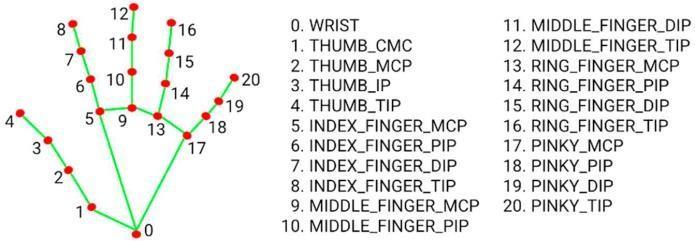
This project used pictures of hand signs to infer hand landmarksusingtheMediaPipetechnology.Asitissimpler toidentifystiffitemslikefistsandpalmsthanentirehands,a palmdetectionmodelfirstidentifiesthepalmsofthehands inthepictures.TheHandLandmarkModelisthenextmodel that receives cropped palm photos from this one. Approximately29,000handannotatedreal-worldphotosare used to train the entire model. Since the model is highly reliable and well-trained, it can reliably identify and map handlandmarklocations,evenonhandsthatareoftenonly partiallyvisible.
MediaPipe employs compartmentalization techniques to isolatespecifichandpoints,enablingprecisesegmentationof handfeatures.Thesesegmentedpointsarethensubjectedto a mapping process, yielding a comprehensive set of coordinates representing the hand's spatial configuration. Duetothedynamicnatureoftheinputmethod,thisdataset ofcoordinatesisextensive,capturingdiversehandgestures and positions. The set is then cleaned, transformed and normalizedtoimprovethetrainingefficiency.
2395-0056 p-ISSN: 2395-0072
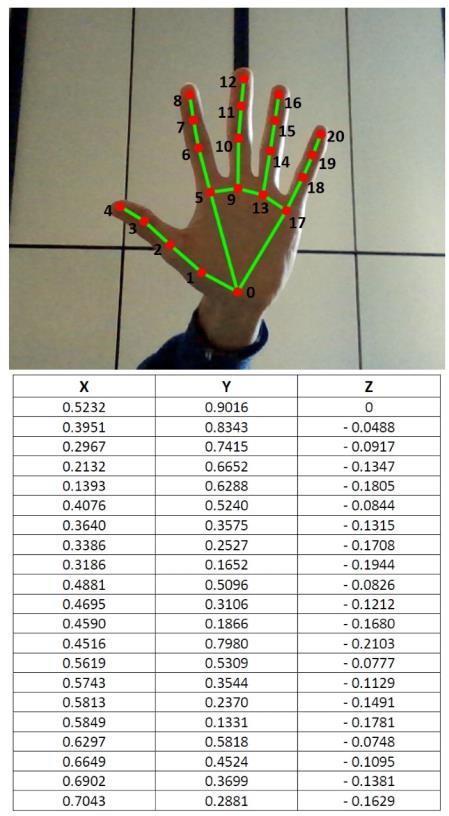
–HandLandmarksextractedbyMediaPipeand coordinates
Thesecoordinatesetsaresubsequentlytransmittedtothe model for further translation and analysis, facilitating accurateinterpretationofhandmovementsandgestures.
Thedatasetcoordinates,extractedfromtheinputdata,serve asinputsforthemachinelearningmodel.
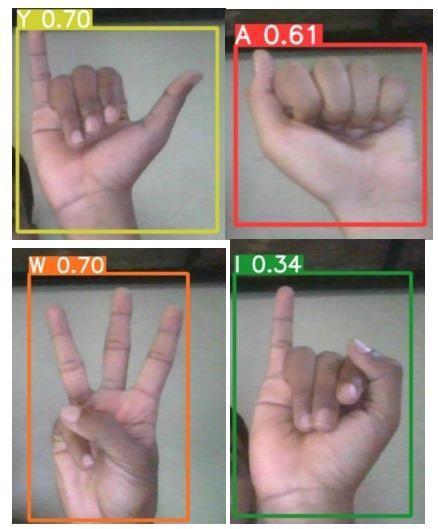
Fig.2–SignLanguageTranslationResultsandProbability
International Research Journal of Engineering and Technology (IRJET) e-ISSN: 2395-0056 p-ISSN: 2395-0072
Volume: 11 Issue: 04 | Apr 2024 www.irjet.net
This model has undergone rigorous training, involving extensiveexposuretovarioushandgesturesandpositions duringthelearningprocess. Finally, this character is transmitted back to the display screen,whereitisrenderedandpresentedtotheuser.
Thesystemarchitecturecomprisesofdatacollection,model training,testing,classification,andwebplatformutilization. Beginningwithdatacollection,rawinputdataisgathered, processed, and prepared for subsequent stages. Model traininginvolvestheextensivetrainingofmachinelearning models using the collected data to learn patterns and relationships. Following training; testing and validation procedures are conducted to assess the performance and robustnessofthetrainedmodels.Classificationalgorithms arethenemployedtointerpretnewdatainputsandmake predictionsorclassificationsbasedonthelearnedpatterns. Finally,thetrainedmodelisintegratedintoawebplatform, allowinguserstointeractwiththesystemviaauser-friendly interface,enablingreal-timedataanalysisandvisualization.
3. 1. 1. Data Collection –
In the data creation phase, a multi-frame video feed is utilizedtocaptureimagesforanalysis.Thedataacquisition process involves utilizing OpenCV to interface with a webcam,enablingreal-timecaptureofvideofeedinput.This feedisthenprocessedtoextract
individualframes,whicharesubsequentlystoredasdatafor furtheranalysis.Throughthismethod,thesystemgenerates over1000imagesforeachcharacter,ensuringadiverseand extensivedataset.


The images are generated from varied angles and different distances in order to randomize the model and providebetteraccuracy.
3.2.2 – Image Processing & Dataset CreationIntheimageprocessinganddatasetcreationphase,aseries ofstepsareundertakentopreparethecollectedimagesfor analysis.Initially,theimagesundergoconversionfromBGR toRGBcolorspaceasOpenCVimagesareloadedinBGRbut
other standard libraries including Matplotlib only accept imagesinRGBformat,soconversionoftheimageensures compatibility.
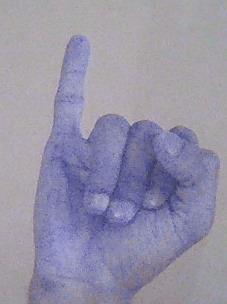

Fig.4–BGRtoRGBImageConversion
UtilizingMediaPipe,specificsectionsoftheimages,primarily focusing on hands and fingers, are targeted for further processing. Hand landmarks are detected within these isolated regions, and their coordinates are mapped accordingly. These coordinates are then organized into a labeled dataset, where each sample corresponds to a particularcharacter.Finally,tofacilitateconvenientstorage andaccessibility,thedatasetisserializedintoapicklefile, ensuring integration into the subsequent stages of the pipeline.
In sign recognition, the choice of classification algorithm significantly impacts performance. The Classification algorithmmostsuitableforprocessingandpredictedhigh dimensional data and the ones considered before training the model are – Convolutional Neural Networks, Support VectorMachine,&RandomForest.
Convolutional Neural Networks –
CNN or Convolutional neural network is a deep learning neuralnetworki.e.,wecanthinkCNNasamachinelearning algorithmthatcantakeaninputimage,assignanimportance toanobjectandthentobeabletodifferentiatebetweenone object and others. CNN works by extracting features from theimages.AnyCNNconsistofthreethingswhichare–an input layer which is a grey scale image, then output layer which is the binary or multiclass labels and third hidden layers which contain convolution layer, RELU and then poolinglayersandfinallythereisartificialneuralnetworkto performtheclassification[9].
International Research Journal of Engineering and Technology (IRJET) e-ISSN: 2395-0056 p-ISSN: 2395-0072
Volume: 11 Issue: 04 | Apr 2024 www.irjet.net
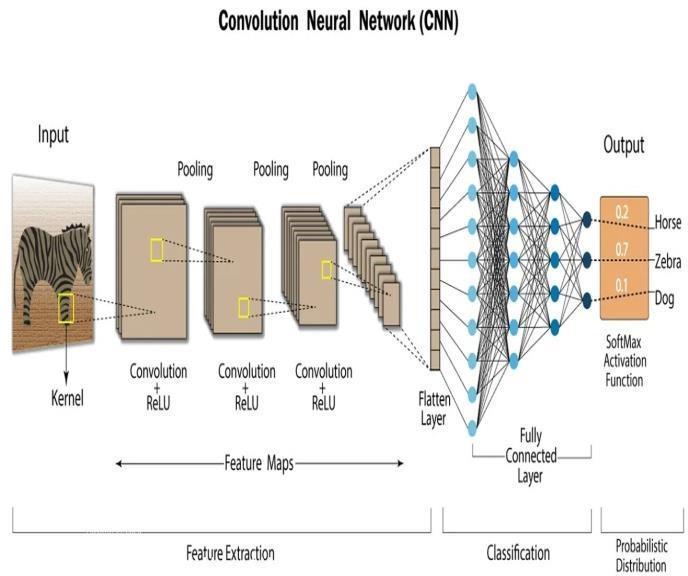
Fig.5–ConvolutionalNeuralNetworks
However, training a Convolutional Neural Network (CNN) requirescopiousamountsoflabeledtrainingdatatocapture intricatepatternsdirectlyfromrawinput,suchasimages. Moreover,thecomputationaldemandsofCNNtrainingare significant, owing to the numerous matrix operations involvedinboththeforwardandbackwardpassesthrough thenetwork.Thisnecessitatesaccesstopowerfulhardware, such as GPUs or TPUs, to expedite computations and mitigatelengthytrainingtimes.Duringinference,CNNsmay also exhibit longer detection times, particularly for deep architectures processing high-resolution images, as each layersequentiallyprocessestheinputdata.Therefore,while CNNsofferstate-of-the-artperformanceinvariouscomputer vision tasks, their data, computational, detection, and learning requirements make them resource-intensive solutionsthatmaynotalwaysbefeasibleinenvironments withlimitedresourcesandforrealtimeimageprocessing.
SupportVectorMachines(SVMs)offerseveral advantages over deep learning models like Convolutional Neural Networks (CNNs). They are lightweight in terms of computational resourcesandboasta simpler architecture with fewer parameters to tune, facilitating easier training and deployment. Moreover, SVMs can yield satisfactory performance even with smaller datasets, which proves advantageouswhendataavailabilityislimited.
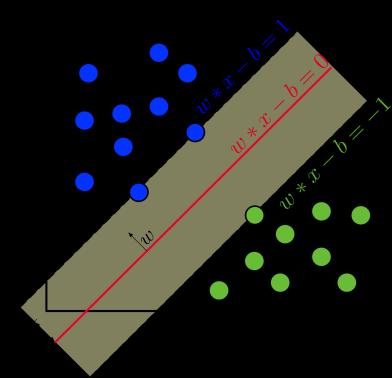
However, it's important to consider that SVM training time may increase with dataset size, albeit remaining generally faster than training deep learning models. Additionally, while SVMs typically require fewer computational resources than CNNs, the choice of kernel function and hyperparameters can still impact training efficiency. Despite these considerations, SVMs remain a viable option for classification tasks, particularly in scenarios where computational resources are constrained or datasets are modestinsize.
Random Forest –
Random Forest is a versatile machine learning algorithm that belongs to the family of ensemble methods. It is widely used for classification, regression, and anomaly detection Random Forest operates by constructing multiple decision trees during the training phase. Each decision tree is built using a random subset of the training data and a random subset of the features, which introduces diversity among the trees.
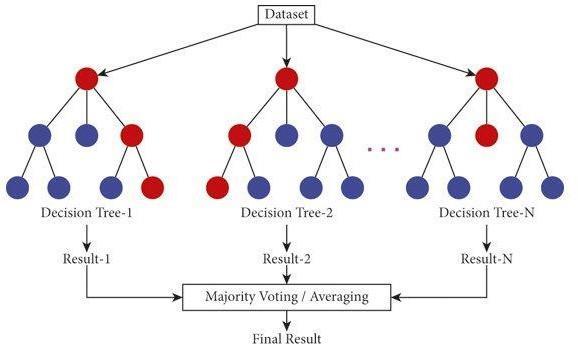
During prediction, the output of each decision tree is aggregated to make the final prediction. For classification tasks,theclasswiththemostvotesfromtheindividualtrees ischosen,whileforregressiontasks,theaverageprediction of all trees is taken. Random Forest is relatively easy to implementandlesssensitivetohyperparameterscompared tosomeothermachinelearningalgorithms.Italsohandles missingvaluesandoutlierswell,makingitsuitableforrealworlddatasetswithnoisyorincompletedata.
Random Forests, compared to deep learning models like Convolutional Neural Networks (CNNs), offer distinct advantages that make them favorable choices for classification tasks. One significant advantage is their computational efficiency, as they require fewer computational resources and boast a simpler architecture withfewer parametersto fine-tune. Additionally,Random Forestsexcelinhandlingsmallerdatasets,deliveringrobust performance even with limited data availability. Unlike SVMs, Random Forest training time remains consistently manageable, irrespective of dataset size. While SVMs may require careful selection of kernel functions and hyperparameters,RandomForestsdemonstratereliability
International Research Journal of Engineering and Technology (IRJET) e-ISSN: 2395-0056 p-ISSN: 2395-0072
Volume: 11 Issue: 04 | Apr 2024 www.irjet.net
withoutextensiveparametertuning,furtherunderscoring theirefficiencyandeffectiveness.
Overall, Random Forests present are better alternative to deep learning models, particularly in scenarios where computational resources are limited or datasets are relativelymodestinsize.
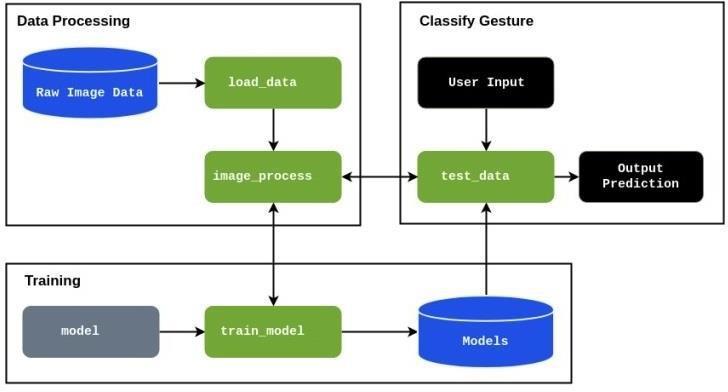
3.3
In the model training and testing phase, the process commenceswiththeloadingofthepickledatasetcontaining coordinates onto the designated machine learning model. Followingthis,apivotalstepinvolvesthepartitioningofthe datasetintotrainingandtestingsubsets,adheringtoan8020splitratio.Thissplitensuresthatbothsubsetsrepresent the overall dataset adequately, with the 80% training portionutilizedformodelparameteroptimizationandthe remaining 20% reserved for evaluating the model's generalizationcapability.
Tomitigatetheriskofoverfitting,thedataisshuffledprior to splitting. This randomization process disrupts any inherentsequenceorpatterninthedataset,preventingthe model from memorizing specific instances and instead encouraging it to learn generalizable patterns. Moreover, during this phase, the character data is encoded into numerical representations. This encoding enhances the model's ability to learn and generalize from the data by providingastructurednumericalformatforanalysis. Duringthetestingphase,dataisretrievedfromtheloaded file, and the model's predictions are checked. Each inputoutput relationiscarefully assessedtodecidethe model's accuracy and effectiveness in predicting sign language gesturespositions.Thisevaluationprocessaimstouncover anyinaccuraciesbetween themodel'spredictionsand the ground truth, leading to the optimization of the model's parameters.
Finally,uponsuccessfultestingandvalidation,thefinalized trained model is stored in the form of a .p file for future utilization.Thisfileencapsulatesthelearnedpatternsand relationshipsacquiredduringthetrainingphase,ensuring the model's portability and accessibility for subsequent deployments. Furthermore, the evaluation of the model revealsanimpressiveaccuracyrateof87%, underscoring efficiencyinaccuratelypredictingsignlanguagegestures.
In the development of a web platform for deploying the machinelearningmodel,Flaskservedasthebackbonefor seamlessly integrating the browser interface with the underlyingmachinelearningcapabilities.LeveragingFlask's flexibility, the .p file containing the trained model was seamlessly incorporated, ensuring easy accessibility and utilizationofthemachinelearningfunctionalitieswithinthe webenvironment.
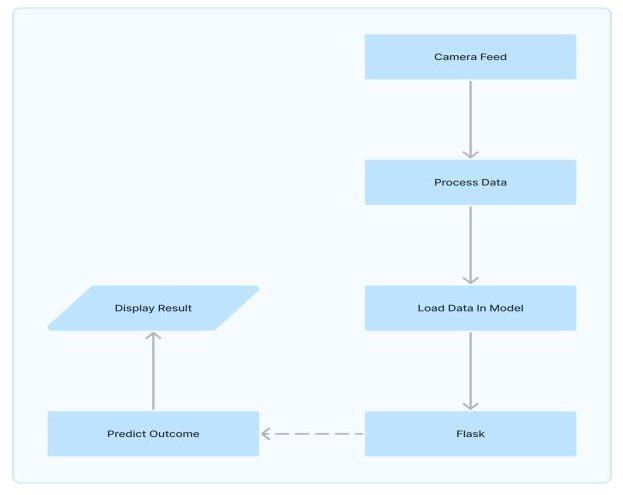
Fig.9–DeploymentFlowChart
Platform’s compatibility with a wide range of browsers improvestheoverallaccessibilityoftheuser,allowingthem to interact with the machine learning model effortlessly acrossdifferentbrowsingenvironments.Byintegratinglive feedinputandimmediatedisplayofpredictedcharacters,the platform offers real-time feedback, further enhancing the userexperienceandusability.
Theclassification_reportlibraryfrompython'sscikit-learn toolkitwasusedforquantitativeanalysisofthetestdataset. The classification_report library produces an evaluation report of our model with matrices - accuracy, precision, recall and F1 score. Along with them, the matrix 'support' represents the performance of the model in real-time recognition. The accuracy matrix measures correctly predictedlabelsbythemodelfromthecompletedataset.The accuracymatrixmeasurescorrectlypredictedlabelsbythe modelfromthecompletedataset.

International Research Journal of Engineering and Technology (IRJET) e-ISSN: 2395-0056 p-ISSN: 2395-0072
Volume: 11 Issue: 04 | Apr 2024 www.irjet.net
Theprecisionmatrixmeasuresthemodel'saccuracyoutof the predicted positives. It calculates the number of actual positives in the predicted positives. It is an excellent measure to consider when the False Positive (FP) cost is high.

Therecallmatrixmeasureshowmanypredictionsourmodel labelscorrectlyaspositives.Itisameasureconsideredwhen thehighcostisassociatedwithFalseNegatives(FN).

F1scoreprovidesacumulativemeasurebycombiningrecall andprecision.[3]

Thefollowingtabledepicts theAccuracy,Precision, Recall andF1ScoreofthedevelopedModel.
Theadvancementofsignlanguagerecognitiontechnologies holdsgreatpromiseforenhancingcommunicationbetween the visually impaired and those with normal hearing. Throughtheincorporationoftechniquessuchasbrightness andangleadjustment,thesystemgainsgreaterversatility. Therearestillissues,though,suchreal-timesignrecognition in various contexts. Work is in progress to expand the system's understanding of continuous sign language and regional variances, as well as to remedy these concerns. HandtrackingismadesimplerbyprogramslikeMediaPipe, which guarantees precise recognition on a range of platforms.Deeplearningadvancementsanddatasetgrowth will make these systems increasingly more efficient as research progresses, enabling improved communication amongpeoplewithdifferentlinguisticbackgrounds.
Communication between the visually impaired and those with normal hearing could be greatly enhanced by the developmentofsignlanguagerecognitiontechnologies.To identifystaticsignmotions,onemethodusestransformerbasedmodels,whichhasdemonstratedencouragingresults with little training. The system gains versatility by integratingmethodssuchasmodifyingangleandbrightness. Therearestilldifficulties,though,likeidentifyingindications invarioussettingsandinrealtime.Inordertoexpandthe system to comprehend continuous sign language and regionalvariances,effortsarestillbeingmadetoovercome theseproblems.Accuratedetectionacrossseveraldevicesis ensured using hand tracking tools such as MediaPipe. Research on deep learning and dataset growth will make these systemsincreasingly more efficientastime goes on, facilitatingimprovedcommunicationbetween peoplewith differentlinguisticbackgrounds.
Table1–PerformanceMetricsoftheModel
Opportunities for additional development and integration into other applications are presented by the created web platform. First, it may develop into a browser plugin that would increase its application and accessibility on many websites. Furthermore, because of its real-time nature, integrationwithvideoconferencingsoftwaremaybeableto
provide smooth sign language interpretation for online meetings, improving accessibility to communication for thosewithhearingdifficulties.Additionally,byutilizingits interactivecharacteristics,theplatformmayprovideabasis forthedevelopmentofcutting-edgeinstructionalmaterials forthestudyofsignlanguage.Toengageusersandpromote successful learning, these technologies could include interactive lessons, quizzes, and gamified aspects. Additionally, investigating ways to include gesture recognition technology could improve the platform's functionality and enable uses outside of sign language interpretation.
Theseissuesarestillbeingworkedoninordertoexpandthe system to understand continuous sign language and
geographical variations. Hand tracking solutions like MediaPipe guarantee accurate detection across several devices. Over time, these systems will get more and more efficient due to research on deep learning and dataset expansion, which will increase communication amongst peoplewithspecialneeds.
[1] Deep R. Kothadiya, "SIGNFORMER: DeepVision Transformer for Sign Language Recognition," IEEE Explore,p.10,2022.
[2]RunpengCui,"ADeepNeuralFrameworkforContinuous Sign Language Recognition by Iterative Training," IEEE, p. 12,2018.
[3] Jyotishman Bora, Saine Dehingia, Abhijit Boruah* Anuraag Anuj Chetia, Dikhit Gogoi, "Real-time Assamese
International Research Journal of Engineering and Technology (IRJET) e-ISSN: 2395-0056 p-ISSN: 2395-0072
Volume: 11 Issue: 04 | Apr 2024 www.irjet.net
Sign Language Recognition using MediaPipe and Deep Learning"ScienceDirect,p.10,2023
[4]PrakhyathRai,AnanyaAlva,GautamiK.Mahale,Jagruthi S.Shetty,ManjushreeA.N.,“GestureRecognitionSystem”, IJCSMC,p.12,2018
[5] Ravikaran J, Kavi Mahes, Suhash Mahishi, Dheeraj R, Sudheender S, Nitin V Pujari, “Finger Detection for Sign LanguageRecognition,IMECS, p.5,2009
[6]RomalaSriLakshmiMurali,L.D.Ramayya,V.AnilSantosh, " Sign Language Recognition System Using Convolutional NeuralNetworkAndComputerVision”,IJEIAT,p.6,2022
[7] Hee-Deok Yang, “Sign Language Recognition with the KinectSensorBasedonConditionalRandomFields”,MDPI, p.13,2014
[8]AmanPathak,AvinashKumar,Priyam,PriyanshuGupta, GunjanChugh,“RealTimeSignLanguageDetection”,IJMTST p.7,2022
[9]SanketBankar,TusharKadam,VedantKorhale,Mrs.A.A. Kulkarni,“RealTimeSignLanguageRecognitionusingDeep Learning”,IRJETp.5,2022