
International Research Journal of Engineering and Technology (IRJET) e-ISSN: 2395-0056
Volume: 11 Issue: 04 | Apr 2024 www.irjet.net p-ISSN: 2395-0072

International Research Journal of Engineering and Technology (IRJET) e-ISSN: 2395-0056
Volume: 11 Issue: 04 | Apr 2024 www.irjet.net p-ISSN: 2395-0072
Devansh Singh1 , Yash Sharma2 , Roop Singh3
1 Student, Dept of CSE-AI, NIET Greater Noida, Uttar Pradesh, India,
2 Student, Dept of CSE-AI, NIET Greater Noida, Uttar Pradesh, India,
3 Professor, Dept. of CSE-AI, NIET Greater Noida, Uttar Pradesh, India
Abstract - Self-driving cars powered by AI face a range of challenges. Ensuring safety and reliability in all conditions is paramount, requiring robust decision-making capabilities in complex situations. Regulatory and legal hurdles vary widely between jurisdictions, while concerns over data privacy and security must beaddressedto safeguardsensitiveinformation and prevent cyberattacks. Ethical dilemmas, such as prioritizing passenger safety versus pedestrian well-being, pose complex moral questions. Building public trust and acceptance, interfacing with legacy infrastructure, and minimizingenvironmentalimpact are criticalconsiderations. Using cutting-edge technology like Python, PyTorch, TensorFlow, andUnity's ML-Agents,thisprojectdelvesintothe fascinating realm of self-driving cars. We examine the underlying principles of autonomous cars, their AI-powered powers, andthe transportationpossibilitiestheypresentinthe future. The project's goal is to analyse several self-driving car models that can navigate a simulation environment built in a safe and effective manner. We work to advance AI in autonomous drivingbyintegratingcomponentsofperception, decision-making, andcontrol. The reasonforthereviewpaper is that the existing review papers don't summarize all the types of techniques in a single paper; therefore, this paper represents a comprehensive review of self-driving cars using artificial intelligence.
Key Words: Traditional Driving, Self Driving Car, Radar, Sensors,Unity,Realtime,Cameras
1.INTRODUCTION
Traditionaldrivingreferstomanualoperationofavehicleby ahumandriver,usingphysicalcontrolslikesteeringwheels and pedals, as opposed to autonomous driving where vehiclesoperatewithoutdirecthumaninput.Agnihotrietal. [1] proposed Self-driving vehicles are a bright example of humancreativityandinnovationintherapidlydeveloping fieldsofartificial intelligenceandtechnology.Thisproject usesmoderntechnologieslikeTensorFlow,PyTorch,Python, and ML-Agents in the Unity game engine to explore the worldofautonomousautomobiles.
Kudakaetal.[2]introduceaboutthespecificsofself-driving cars,investigatetheunderlyingtechnologythatallowthem to function safely and effectively, and dive into the revolutionary potential they hold for the future of
transportationaswenavigatethisfascinatingtopicasseen inFig.1below.
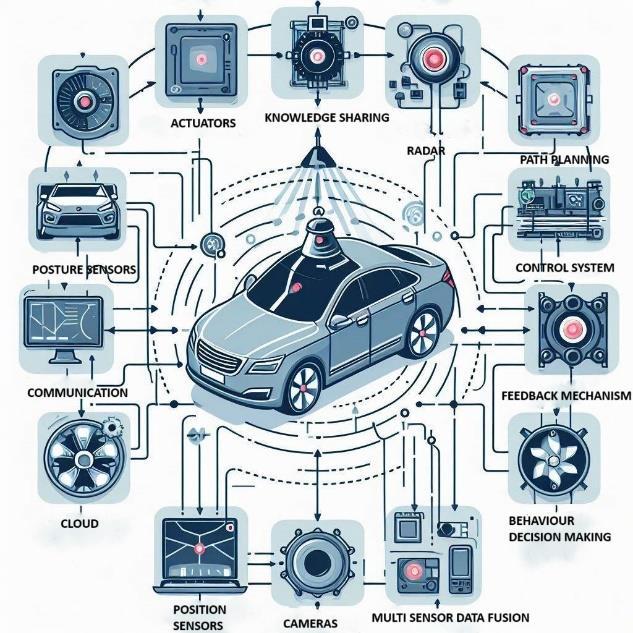
Alheeti et al. [3] presented Autonomous vehicles, or selfdrivingcars,markarevolutionaryparadigmchange.Kanget al.[4]deliveredthatInthecarindustry,thesevehiclesare equipped with advanced sensors, AI algorithms, and a plethoraofcomplextechnologiesthatenablethemtosense theirenvironment,makejudgmentsinrealtime,anddrive themselvesoverroads.
Soares et al. [5] presented Science fiction fans have been fascinatedwiththeconcept ofdriverlesscarsfordecades, butnewdevelopmentsinartificialintelligenceandmachine learninghavemadethisgoalmoreattainablethaninthepast Soaresetal.
TheconvergenceofPython,PyTorch,TensorFlow,andMLAgentswithintheUnityenvironmentisthecentralideaof this project. Mihalea et al. [6] developed the core programming language used to create the AI algorithms requiredforself-drivingcarsisPython,whichisalsovery adaptableMihaleaetal Gandhietal.[7]proposedtwowellknowndeeplearningframeworks,PyTorchandTensorFlow, offerthetoolsandresourcesneededtoconstructandtrain complex neural networks, allowing the car to sense its environmentandmakejudgments.
International Research Journal of Engineering and Technology (IRJET) e-ISSN: 2395-0056
Volume: 11 Issue: 04 | Apr 2024 www.irjet.net p-ISSN: 2395-0072
Rassõlkin et al. [8] with the help of Unity Technologies' cutting-edge ML-Agents framework, we can simulate and train autonomous agents inside the Unity game engine, providing a realistic setting for testing and improving the capabilitiesofourself-drivingautomobileRassõlkinetal
Novickisetal.[9]introducedthetechnicalnuancesofselfdriving automobiles as we set out on our adventure, covering everything from sensor fusion and perception to controlanddecision-making.Wewillexplorethedifficulties inteachingneuralnetworkstounderstandsensordataand guaranteesafenavigation.Dongetal.[10]introducedabout themoralandlegalissuesrelatedtodriverlesscars,which will help us understand the wider ramifications of this innovativetechnology.
Korkmazetal.[11]proposeddelveintothetechnicaldetails of self-driving cars, covering everything from vision and sensorfusiontocontrolanddecision-making.Byeloborodov et al. [12] presented the ethical and legal concerns surrounding autonomous vehicles, which will aid in our comprehensionofthebroaderimplicationsofthiscuttingedgetechnology.
Theexistingreviewpapersdon'tsummarizeallthetypesof techniquesinasinglepaper;therefore,thispaperrepresents acomprehensivereviewofself-drivingcarsusingartificial intelligence.
1.1.1 Technical Complexity: Li et al. [13] developed AI systems that can navigate the vast array of scenarios encountered on the road is incredibly complex. These systems must process and react to data from multiple sensorsinreal-time,requiringadvancesinmachinelearning, computer vision, sensor fusion, and decision-making algorithms.
1.1.2 Safety and Reliability: Chernikova et al. [14] developed safety and reliability of self-driving cars is paramount. These vehicles must perform safely under all conditions, including bad weather, complex urban environments,andunpredictableactionsfrompedestrians andotherdrivers.
1.1.3 Regulatory and Legal Issues: Farag et al. [15] establishedalegalframeworkforself-drivingcarsinvolves addressing liability in the event of an accident, setting standards for safety and performance, and navigating a patchworkoflocal,national,andinternationalregulations.
1.1.4 Security Concerns:Faragetal.[16]introducedother connectedtechnologies,self-drivingcarsaresusceptibleto hacking and other cybersecurity threats. Ensuring the
securityofthesevehiclesiscrucialtoprotectpassengersand thevehicles'operationalintegrityasseeninFig.2below.
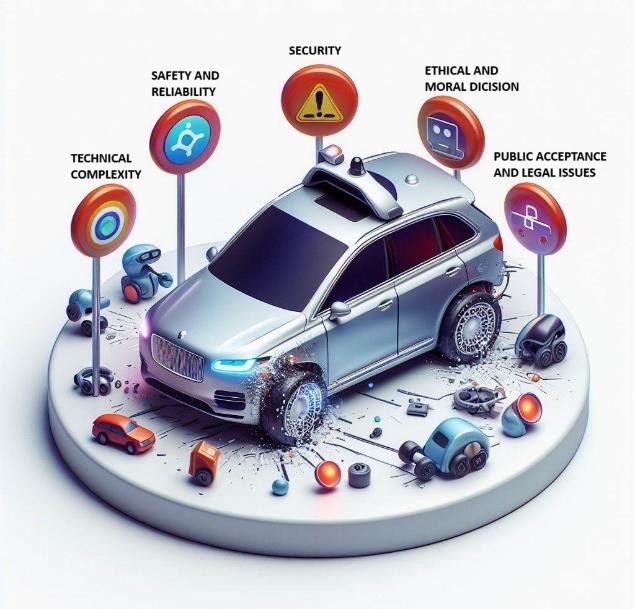
1.1.5 Ethical and Moral Decisions : Jain et al. [17] developed AI systems may need to make split-second decisionsinemergencysituations,raisingethicalquestions abouthowthesedecisionsareprogrammedandthevalues theyreflect.
1.1.6 Public Acceptance and Trust :Manchekaretal.[18] proposedGainingpublictrustinthesafetyandreliabilityof self-driving cars is a significant hurdle. Negative publicity from any accidents or malfunctions could set back public acceptance.
1.2.1 Personal Transportation: Thadeshwar et al. [19] proposedSelf-drivingcarscanprovidepersonalmobilityfor everyone, including those unable to drive due to age, disability, or other reasons. They offer the promise of a convenient,on-demandtransportationsolution.
1.2.2 Ridesharing and Taxis: Nugraha et al. [20] introduced Autonomous vehicles are expected to significantlyimpactthe ridesharing andtaxi industries by reducingthecostoftheseservicesandpotentiallyincreasing theirconvenienceandsafety.
1.2.3 Freight and Delivery:Guptaetal.[21]presentedSelfdrivingtechnologyisbeingappliedtofreightanddelivery services,promisingtoimproveefficiency,reducecosts,and addresstheshortageoftruckdrivers.
1.2.4 Public Transportation:Pahadiyaetal.[22]proposed autonomous vehicles could supplement or integrate with existingpublictransportationsystems,providing"lastmile"
International Research Journal of Engineering and Technology (IRJET) e-ISSN: 2395-0056
Volume: 11 Issue: 04 | Apr 2024 www.irjet.net p-ISSN: 2395-0072
solutionsthathelppeoplegetfromtransportationhubsto theirfinaldestinations.
1.2.5. Reduced Traffic Congestion: Gupta et al. [23] developed optimizing driving patterns and reducing the need for parking, self-driving cars could alleviate urban trafficcongestion.
1.2.6. Environmental Benefits:Guptaetal.[24]optimized drivingandthepotentialforelectricself-drivingvehiclesto bemorewidelyadoptedcouldleadtoreducedemissionsand a smaller environmental footprint for personal transportation.
The researchers have presented various papers based on machinelearninganddeeplearningontheself-drivingcar, buttherearestillsomechallengeswiththeself-drivingcar. Therefore,thispaperreviewsrecent10-yearpapersonselfdrivingcarsusingartificialintelligence.
Self-driving vehicles, also known as autonomous vehicles (AVs), have recently garnered significant attention due to theirpotentialtorevolutionizetransportationandimprove road safety. Gupta et al. [25] introduced these vehicles depend on artificial intelligence (AI) and deep learning to autonomously navigate, perceive their surroundings, and make driving decisions. This literature review examines pivotalresearchandprogressinemployingAIintherealm ofself-drivingcars.Weinvestigatethehistoricalbackdrop, technological base, challenges, and prospective developmentsintheareaofAVinnovation.Theconceptof autonomous driving has intrigued people for many years. Initial investigations in this arena set the stage for autonomous vehicle development. The early 2000s saw DARPA'sDAVE(DriverAssistanceforVisionEnhancement) project showcase the possibility of using cameras and steering instructions to train a model for autonomous driving. This endeavour signalled the start of end-to-end learningforautonomousnavigation.Afundamentalelement intheevolutionofself-drivingvehiclesistheapplicationof Convolutional Neural Networks (CNNs). These advanced deep learning models are tailored for processing visual information,makingthemextremelyvaluableforcomputer visiontasks,includingobjectdetection,imageclassification, andsegmentation.
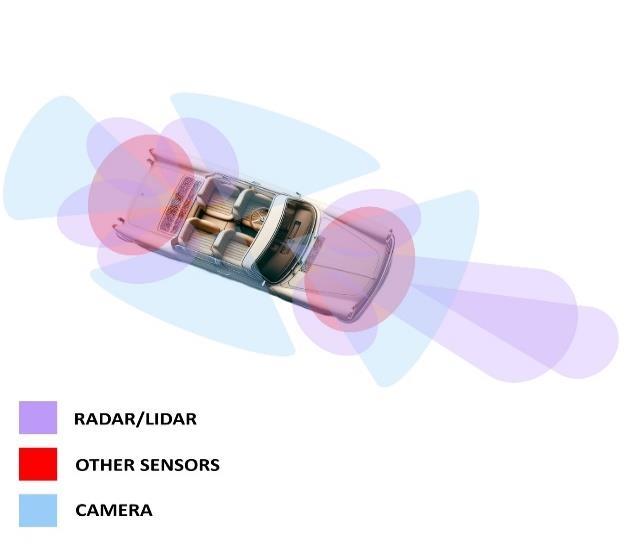
In the field of autonomous driving, CNNs (Convolutional NeuralNetworks)areinstrumentalinanalyzingimagesfrom thevehicle'ssensorstoidentifyobjects,lanemarkings,and othervital elementsinthe surrounding environment. The techniqueofend-to-endlearninghasshowngreatpromise
for this application. It involves directly training a neural networktoconvertsensoryinput,likeimages,intodriving decisions,suchassteeringangles,eliminatingtheneedfor handcrafted feature engineering and complex processing stages. This method's effectiveness was showcased in projectslikeNVIDIA'sself-drivingcar,whichusedaCNNto translatevisualinputfromcamerasintosteeringdecisions asseeninFig.3below.
Thecollectionofdataisacriticalcomponentindeveloping modelsforautonomousdriving.Thisdataisgatheredfrom both simulations and real-world driving conditions, with platforms like Udacity's offering a simulated environment forcollectingdataandtrainingmodels.Preprocessingthis dataisavitalsteptomaketherawimagessuitableforuseby themodel,involvingmethodssuchascropping,resizing,and converting colour spaces. Data augmentation techniques, which introduce variability in the data, are crucial for helping the model learn to navigate a range of driving conditionsmoreeffectively.Saxena etal.[26]developeda majorchallengeinthefieldisenhancingthemodels'ability torobustlygeneralize totheunpredictablenature of realworlddriving.Researchtodatehaslargelybeenconducted incontrolledenvironmentsorwell-definedsettings,whereas actual road conditions can vary widely due to different weather, traffic patterns, and unforeseen obstacles. Achieving a level of safety and reliability in AVs that can navigatethesecomplexandunstructuredenvironmentsisan ongoingandsignificantchallenge.
-Tosummarizetheexistingworkbasedonself-drivingcars usingartificialintelligence.
- Finding the research gap based on existing techniques
International Research Journal of Engineering and Technology (IRJET) e-ISSN: 2395-0056
Volume: 11 Issue: 04 | Apr 2024 www.irjet.net p-ISSN: 2395-0072
Author Year
1. Agnihotriet al.[1] CNN High Highly dependent on training data and conditions. CNNs have revolutionized image recognitionandpatternrecognition.
2. Kudakaetal. [2] StreamOriented Accelerator Framework Varies Limited information on specificimagerecognition implementation. The technology utilizes a streamorientedaccelerationframeworkfor self-drivingcars.
3. Alheetietal. [3] Fuzzy Petri NetModel High Dependent on features extractedfromtracefiles. The technology proposes an IDS systemforself-drivingandsemiselfdrivingcars.
4. Kangetal.[4] Social Generative Adversarial Network High Requires a large amount oftrainingdata. The technology focuses on predicting vehicle trajectories in self-driving car applications using deeplearning.
5. Soaresetal. [5] SVM, KNN, Adaboost, High Imbalanceddataset,Need forfeatureengineering. Highaccuracy,interpretablemodels, transparentlinguisticfuzzyrules.
6. Mihaleaetal. [6] CNN, ResNet backbone model Varies Difficulty in adapting to localbehavior. Higher autonomy with augmentation. Effectivewithaugmentation.
7. Gandhietal. [7] Blockchain Technology, Artificial Intelligence High Scalability challenges, energyconsumption. Efficient information sharing and decentralizedledger.
8. Rassõlkinet al.[8] Traction Effort Calculation. High Assumes constant parametersforsimplicity.
Usefulforassessingtractioneffortin differentdrivingconditions.
9. Novickisetal. [9] DNNs, Sensing Hardware Varies Limited to line-of-sight, reduced performance in adverseweather. Combinesmultiplesensormodalities forrobustperception.
10. Dongetal. [10] Vision-Based Self-Driving System. Varies Limited to specific road conditions and lighting conditions. Utilizes computer vision and deep learning for perception and decision-making.
11. Korkmazet al.[11] Fuzzy Logic, Computer Vision, Control Theory Varies Vision-based lane detection may have difficulties in certain conditions,suchasabrupt lane changes or adverse weather. Theresearchpresentsafuzzylogicbasedself-drivingcarcontrolsystem inagameenvironmentwithvisionbasedlanedetectionandfuzzylogicbasedcontrols.
12. Byeloborodo vetal.[12] Computer Vision, Machine Varies Dataavailability,theneed foralgorithmrefinement, andunspecifiedalgorithm Importanceofcontinuedresearchin thefieldofautonomousvehiclesto improvesafety
International Research Journal of Engineering and Technology (IRJET) e-ISSN: 2395-0056
Volume: 11 Issue: 04 | Apr 2024 www.irjet.net p-ISSN: 2395-0072
learning, Neural Networks accuracy.
13. Lietal.[13] Model-based pathplanning algorithm for self-driving cars in dynamic environments
14. Chernikova etal.[14] Deep Neural Networks (DNNs)
High Assumptions about constant obstacle velocitiesmaynotalways hold in real-world scenarios, and the algorithm's performance in complex traffic situations is not extensivelyvalidated.
Algorithm offers promise for enhancing self-driving car navigation and safety but requires further validation and refinement forreal-worldapplications.
15. Faragetal. [15] Computer Vision, Lane Detection
16. Huynh etal. [16] AC3R (Automatic Crash Constructor from Crash Report)
17. Jainetal.[17] CNN, Raspberry Pi, Arduino
18. Manchekaret al.[18] Deep Learning, CNN,LSTM
19. Thadeshwar etal.[19] ANN, Softmaxbased neural network,CNN
20. Nugrahaetal. [20] YOLO, Road Lane Detector, Convolutional Neural Network (CNN)
High Vulnerable to adversarial attacks Evasion attacks demonstrated for steering angle prediction in selfdrivingcars.Showsvulnerabilityin both classification and regression settings. Security implications for autonomousvehicles.
Fairly accurate Shadows affect precision insomescenarios
Accurate simulations Limited to information availableinpolicereports
LaneBDissuitableforADASorselfdrivingcars.
Proposed approach for generating crash simulations from police reportsfortestingself-drivingcars.
Varies Minor issues with car staying on track during operation
Varies Lackofreal-worlddatafor robustness testing. Focused on lanefollowing.
High Limited to lane detection andturns. CostlyLidarsensor,largescalecars
High Over-lighting can affect detection - Limitations in sharp-turned roadsLimited applicability in urbanroads
Proposed some of the working modelofself-drivingcarusingimage processing as well as machine learning.
Successfully trained a CNN for autonomous driving using a Unitybasedsimulator.
Usesgrayscaleimagesandislimited infunctionality.
Proposed system integrates YOLO, lane detection, and a controllerSuitableforhighwayconditions
International Research Journal of Engineering and Technology (IRJET) e-ISSN: 2395-0056
Volume: 11 Issue: 04 | Apr 2024 www.irjet.net p-ISSN: 2395-0072
3.1 Limited Real-world Testing:Guptaetal.[27]proposed alotofprogressinreplicatingreal-worldsituationsforselfdriving cars, thorough real-world testing is still lacking, especiallyindemandingenvironmentslikeextremeweather, intricatemetropolitanlandscapes,andunpredictabletraffic scenarios. To guarantee the security and dependability of self-driving automobiles, further research is required to close the performance gap between virtual environments andtherealworld.
3.2 Ethical and Legal Implications: Pahadiya et al. [28] deliveredautonomousvehicleshavethepotentialtolower traffic fatalities and accidents, there are still unanswered moral and legal questions. Pahadiya et al. [29] developed moreresearchtoaddressconcernsaboutdecision-making algorithms in emergency scenarios, responsibility, and accountability. Widespread deployment of autonomous vehicletechnologydependsonresearchintocreatingmoral frameworksandlegislativeguidelinestoregulateit.
3.3 Human-AI Interaction:Rassolkinetal.[30]introduced gaining acceptance and trust from users of self-driving automobiles requires an understanding of how people engagewiththesevehiclesasseeninFig.4below.
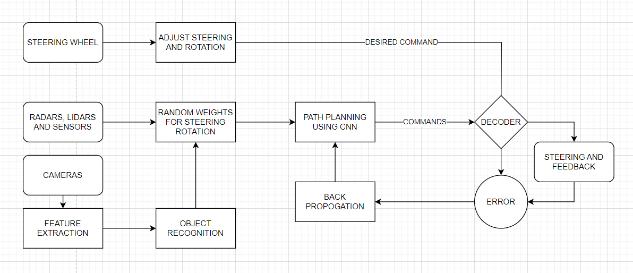
Fig.4. FlowchartandworkingofAICar
Gambi et al. [32] introduced a study in this field might examine what motivates people to behave, perceive, and have faith in autonomous vehicles. Sharma et al. [33] developed smooth integration into current transportation systems, it is also crucial to look into ways to enhance communication between self-driving cars and other road users,likepedestriansandhuman-drivenvehicles.
TheIntegrationofPython,PyTorch,TensorFlow,andUnity's ML-Agentsmarksasignificantadvancementinthefieldof autonomous vehicle technology. Holstein et al. [34] presentedthiscombinationprovidesapowerfulframework
fordevelopingintelligentagentsthatcannavigateinthereal world with unprecedented levels of autonomy and safety. Utilizing Unity's sophisticated 3D simulation capabilities, developers can rigorously test and enhance autonomous drivingsystems.Pythonservesasthecriticalintermediary, connectingUnity'ssimulationswiththeadvancedmachine learningcapabilitiesofPyTorchandTensorFlow.Ruixinet al.[35]proposedthisintegrationfacilitatesacomprehensive approach to autonomous system development, encompassing sensor simulation, deep learning for environmental perception, reinforcement learning for strategic decision-making, and extensive testing and evaluation using Python scripts. This architecture is instrumental in fostering the evolution of autonomous vehicles,pavingthewayforthewidespreadadoptionofselfdrivingcarsasareliableformoftransportationinthenear future.
[1] Agnihotri, Akhil, Prathamesh Saraf, and Kriti Rajesh Bapnad."Aconvolutionalneuralnetworkapproachtowards self-driving cars."2019 IEEE 16th India Council InternationalConference(INDICON).IEEE,2019.
[2]Kudaka,Shimon,etal."Self-DrivingCarApplicationofa Stream-Oriented Accelerator Framework."2019 International Conference on Field-Programmable Technology(ICFPT).IEEE,2019.
[3]Alheeti,KhattabM.Ali,etal."PredictionofDoSattacksin external communication for self-driving vehicles using a fuzzypetrinetmodel."2016IEEEInternationalConference onConsumerElectronics(ICCE).IEEE,2016.
[4]Kang,Li-Wei,etal."Vehicletrajectorypredictionbased onsocialgenerativeadversarialnetworkforself-drivingcar applications."2020internationalsymposiumoncomputer, consumerandcontrol(IS3C).IEEE,2020.
[5] Soares, Eduardo, et al. "Explainable density-based approachforself-drivingactionsclassification."201918th IEEE International Conference On Machine Learning And Applications(ICMLA).IEEE,2019.
[6]Mihalea,Andrei,etal."End-to-endmodelsforself-driving carsonUPBcampusroads."2019IEEE15thInternational Conference on Intelligent Computer Communication and Processing(ICCP).IEEE,2019.
[7] Gandhi, G. Meera. "Artificial intelligence integrated blockchain for training autonomous cars."2019 Fifth InternationalConferenceonScienceTechnologyEngineering andMathematics(ICONSTEM).Vol.1.IEEE,2019.
[8]Rassõlkin,A.,etal."Calculationofthetractioneffortof ISEAUTO self-driving vehicle."2018 25th International Workshop on Electric Drives: Optimization in Control of ElectricDrives(IWED).IEEE,2018.
International Research Journal of Engineering and Technology (IRJET) e-ISSN: 2395-0056
Volume: 11 Issue: 04 | Apr 2024 www.irjet.net p-ISSN: 2395-0072
[9] Novickis, Rihards, et al. "Functional architecture for autonomous driving and its implementation."2020 17th BiennialBalticElectronicsConference(BEC).IEEE,2020.
[10]Dong,Dong,XiaoyangLi,andXiaotongSun."Avisionbasedmethodforimprovingthesafetyofself-driving."2018 12thinternationalconferenceonreliability,maintainability, andsafety(ICRMS).IEEE,2018.
[11] Korkmaz, Berk, et al. "Fuzzy logic based self-driving racing car control system."2018 6th International Conference on Control Engineering & Information Technology(CEIT).IEEE,2018.
[12]Byeloborodov,Yevgeniy,andSherifRashad."Designof machine learning algorithms for behavioral prediction of objects for self-driving cars."2020 11th IEEE Annual UbiquitousComputing,Electronics&MobileCommunication Conference(UEMCON).IEEE,2020.
[13] Li, Chaocheng, et al. "A model based path planning algorithm for self-driving cars in dynamic environment."2015 chinese automation congress (CAC). IEEE,2015.
[14]Chernikova,Alesia,etal."Areself-drivingcarssecure? evasionattacksagainstdeepneural networksforsteering angle prediction."2019 IEEE Security and Privacy Workshops(SPW).IEEE,2019.
[15] Farag, Wael, and Zakaria Saleh. "An advanced roadlanesfindingschemeforself-drivingcars."(2019):48-6.
[16] Gambi, Alessio, Tri Huynh, and Gordon Fraser. "Automatically reconstructing car crashes from police reportsfortestingself-drivingcars."2019IEEE/ACM41st International Conference on Software Engineering: CompanionProceedings(ICSE-Companion).IEEE,2019.
[17]Jain,AdityaKumar."Workingmodelofself-drivingcar using convolutional neural network, Raspberry Pi and Arduino."2018 Second International Conference on Electronics, Communication and Aerospace Technology (ICECA).IEEE,2018.
[18]Manchekar,Shraddha,etal."SimulationofSelfDriving Car."
[19]Thadeshwar, Hiral,etal."Artificial intelligence based self-driving car."2020 4th International Conference on Computer,CommunicationandSignalProcessing(ICCCSP). IEEE,2020.
[20]Nugraha,BrilianTafjira,andShun-FengSu."Towards self-drivingcarusingconvolutionalneuralnetworkandroad lane detector."2017 2nd international conference on automation, cognitive science, optics, micro electromechanicalsystem,andinformationtechnology(ICACOMIT). IEEE,2017.
[21] Gupta, Kumod Kumar, et al. "Novel Feature Selection Using Machine Learning Algorithm for Breast Cancer Screening of Thermography Images."Wireless Personal Communications131.3(2023):1929-1956.[22]Pahadiya, Pallavi, et al. "Digital image based segmentation and classificationoftonguecancerusingCNN."WirelessPersonal Communications132.1(2023):609-627.
[23]Gupta,KumodKumar,etal."Useofnovelthermography featuresofextractionanddifferentartificialneuralnetwork algorithms in breast cancer screening."Wireless Personal Communications123.1(2022):495-524.
[24] Gupta, Kumod Kumar, et al. "Detection of cancer in breast thermograms using mathematical threshold based segmentation and morphology technique."International Journal of System Assurance Engineering and Management(2022):1-8.
[25]Gupta,KumodKumar,RituVijay,andPallaviPahadiya. "Detection of abnormality in breast thermograms using Canny edge detection algorithm for thermography images."International Journal of Medical Engineering and Informatics14.1(2022):31-42.
[26]Saxena,Shivani,etal."ClassificationofECGarrhythmia usingsignificantwavelet-basedinputfeatures."International JournalofMedicalEngineeringandInformatics15.1(2023): 23-32.
[27]Gupta,KumodKumar,RituVijay,andPallaviPahadiya. "Areviewpaperonfeatureselectiontechniquesandartificial neural networks architectures used in thermography for early stage detection of breast cancer."Soft Computing: Theories and Applications: Proceedings of SoCTA 2019(2020): 455-465. [28] Pahadiya, Pallavi, et al. "Contactless non-invasive method to identify abnormal tongue area using K-mean and problem identification in COVID-19 scenario."International Journal of Medical EngineeringandInformatics14.5(2022):379-390.
[29]Pahadiya,Pallavi,etal."ANovelmethodtogetproper tongueimageacquisitionandthresholdingforgettingareaof interest."InternationalJournalofInnovativeTechnologyand ExploringEngineering(IJITEE),ISSN(2020):2278-3075.
[30] Rassolkin, A., et al. "Propulsion motor drive topology selection for further development of iseauto self-driving car."2018IEEE59thInternationalScientificConferenceon Power and Electrical Engineering of Riga Technical University(RTUCON).IEEE,2018.
[31] Asmika, Boosarapu, G. Mounika, and P. Shobha Rani. "Deeplearningforvisionanddecisionmakinginselfdriving cars-challenges with ethical decision making."2021 International Conference on Intelligent Technologies (CONIT).IEEE,2021.
International Research Journal of Engineering and Technology (IRJET) e-ISSN: 2395-0056
Volume: 11 Issue: 04 | Apr 2024 www.irjet.net p-ISSN: 2395-0072
[32] Gambi, Alessio, Tri Huynh, and Gordon Fraser. "Automatically reconstructing car crashes from police reportsfortestingself-drivingcars."2019IEEE/ACM41st International Conference on Software Engineering: CompanionProceedings(ICSE-Companion).IEEE,2019.
[33]Sharma,HarivanshPrasad,etal."Self-directedrobotfor cardrivingusingGeneticAlgorithm."TechnologyInnovation inMechanicalEngineering:SelectProceedingsofTIME2021. Singapore:SpringerNatureSingapore,2022.75-82.
[34]Holstein,Tobias,GordanaDodig-Crnkovic,andPatrizio Pelliccione. "Real-world ethics for self-driving cars."Proceedings of the ACM/IEEE 42nd International Conference on Software Engineering: Companion Proceedings.2020.
[35]Du,Ruixin,HuiyingDu,andJia Wu."MediaandTrust InfluenceConsumers'AcceptanceofSelf-drivingCars."2022 10th International Conference on Traffic and Logistic Engineering(ICTLE).IEEE,2022.