
International Research Journal of Engineering and Technology (IRJET) e-ISSN: 2395-0056
Volume: 11 Issue: 04 | Apr 2024 www.irjet.net p-ISSN: 2395-0072
International Research Journal of Engineering and Technology (IRJET) e-ISSN: 2395-0056
Volume: 11 Issue: 04 | Apr 2024 www.irjet.net p-ISSN: 2395-0072
Pratiksha Chame1 , Abhishek Jadhav2 , Pranjal Deshmukh3, Prof. Supriya Lole4 .
1Student at Dept. of MCA, GHRREM, Pune
2Student at Dept. of MCA, GHRREM, Pune
3Student at Dept. of MCA, GHRREM, Pune
4Professor, Dept. of MCA, GHRCEM, Pune, Maharashtra, India
Abstract - In recent times, significant advancements have been made in the realm of road safety due to the alarming increase in accidents with one of the leading causes being driver in- attention. To mitigate the occurrence of accidents and ensure safety it is imperative to explore technological breakthroughs. One such approach involves the utilization of Lane Detection Systems, which operate by identifyinglaneboundaries on the road and notifying the driver if they deviate from the correct lane marking. Lane detection systems are pivotal components in various advanced transportation systems. However, achievingthisobjectiveprovestobechallenging due to the diverse roadconditionsencountered,especially during nighttime or daytime driving.By placingacamera at the front of the vehicle, it captures the road view and detects lane boundaries. Various techniques have been presented for detecting lane markings on theroad.In this study, the approach utilized involves partitioning the video image into smaller segments and extracting image characteristics for each segment. These characteristics are subsequently used to detect the lanes on the road. Keywords- lane Detection System, self-driving car assistant, Open CV, Road Accidents, Machine learning.
Key Words: Detection System, self-driving car assistant, Open CV, Road Accidents, Machine learning.
ALaneDetectionSystemisacriticalcomponentofartificial intelligence (AI), machine learning (ML), and computer vision,particularlyinintelligentvehiclesystems.Itsprimary objectiveistoaccuratelydetectlanelinesandissuealertsor messages when a vehicle is about to deviate from its lane. Additionally, it incorporates object detection to prevent accidents.AdvancedDrivingAssistanceSystems(ADAS)rely on lane detection to model road lanes and determine the vehicle'spositionaccurately.Thedevelopmentofintelligent vehicles aims to automate driving tasks, enhancing safety conditions.Roaddetectionisimportantindrivingassistance systemsasitprovidesinformationsuchaslanestructureand vehicle position which helps for drivers to drive safely. Performinglane detection in complex trafficdrivingscenes presentsnumerouschallenges[1].Asuggestionhasbeenput forwardthatspatialCNNscaneffectivelyacquireknowledge aboutthespatialconnectionsbetweenfeaturemapsandthe
seamless,uninterruptedassumptionsoflanelinesintraffic situations,surpassingthecapabilitiesofpreviouslydeveloped networks. Despite advancements, vehicle crashes remain a significant concern in Malaysia and other Asian countries with tens of thousands of fatalitiesand millionsof injuries annuallymostlyonhighways.TheUnitedNationshasranked Malaysiaamongthenationsfacingconsiderablechallengesin roadsafety.
According to the Topic overview, the Lane Detection Systemisextremelyimportantandessentialtogaincontrol overtherisingnumberofaccidentsandsavepeople'slives.It iswidelyknownthatthelackofadvancedfeaturesinvehicles andtheincreasingdriverdrowsinesscausedbyheightened stressareendangeringmanylives.Takingthisintoaccount,a solution needs to be designed. The existing lane detection systems are not accurate and fail to notify the user in any way. Additionally, the new system should be less timeconsuming and more effective. Therefore, this proposed systemmustbewell-developedandresponsive.
The existing lane line identification system relies on ConvolutionalNeuralNetworks(CNNs)andpreprocessingof rawimagestoextractlanemarkings.However,itsrelianceon annotated datasets may limit its performance in diverse driving conditions, where training examples are lacking. Additionally, CNNs may struggle to generalize to new environments, leading to reduced adaptability in varying lighting, road markings, and weather conditions. Despite multiple stages including data collection, preprocessing, training,and evaluation,the systemmayfacechallenges in accurately identifying lane lines across real-world driving scenarios[2].
Wehavedoneresearchfromdifferentresearchpapersand wehavefoundwhatmethodsareusedanddrawbacksinthe existingsystem.
International Research Journal of Engineering and Technology (IRJET) e-ISSN: 2395-0056
Volume: 11 Issue: 04 | Apr 2024 www.irjet.net p-ISSN: 2395-0072
A. RoadLaneLineDetectionSystembyUsingCnnand RnnAlgorithmsinDeepLearning.
This paper uses the CNN and RNN algorithms which helpinlanedetection.
1. The paperwork is concentrated on lane detection by using the Hough line transform method.
2. This system is not working in conditions like low lightning, and poor environmental conditions.
B. A Robust Lane Detection Using Vertical Spatial FeaturesandContextualDrivingInformation.
This paper proposed a system that uses consensus (RANSAC)andHoughtransformalgorithms.
1. Foridentifyinglanesincaseofcomplextraffic scenesbasedontheCULaneandTuSimplelane dataset.
2. Their lane detection system uses techniques like vertical spatial features and contextual drivinginformationforcomplextrafficscenes.
3. Thissystemcannotfulfillthereal-timeneeds. Does not perform well in the condition of curvedroads.
C. Robust Lane Detection for Complicated Road EnvironmentBasedonNormalMap
This paper uses the Normal map techniques for lane detections.
1. Despite encountering numerous significant challenges,particularlyinachievingresilience incomplexlightingconditionsandheavytraffic situations[3].
2. Intheproposedsystemchallengesare facedlikepoorvisibilitylanescratches.
3. In the proposed system challenges are faced likepoorvisibilitylanesscratches.
D. Road Lane-Lines Detection in Real-Time for AdvancedDrivingAssistanceSystems
1. This paper uses pipelines of algorithms like CannyedgedetectionandHoughtransform.
2. The suggested approach merely requires unprocessed RGB images captured by a sole CCD camera positioned behind the vehicle's frontwindscreen.
3. Theproposedsystemonlydetectsstraightlines andnotcurvedlinesontheroadwhichisthe challengingfactor.
In the proposed system we are going to use the CNN algorithmforlanedetectionandtheHaarcascadealgorithm for object detection. Our proposed system quickly and accuratelydetectsthelanesandobjectsontheroads.
Image Processing: the vehicle's camera captures road images,whicharesubsequentlyanalyzedforlanedetection.
Pre-processing: Before detection, the captured image undergoes pre-processing, converting it into grayscale to expeditecomputation
Edge detection module: An edge detector is used to generate an image with defined edges. This is achieved through machine-generated thresholding and the use of a Cannyfiltertoidentifyedges.
Lane detection module: A line detector is employed to recognize both the left and right portions of the lane boundaries. Identification of yellow and white lanes is achievedthroughtheutilizationofRGBcolorcodes.[4]
Implementation of neural networks in the system: To enhance the accuracy of lane detection, a multitask deep CNNdetectorcanbeimplemented.
Thelanelinesidentificationsystemisthemachinelearning model that is developed using Python and OpenCV. It's a software toolkit utilized for processing both images and videos.itisanopen-sourcelibrarythatisusedforcreating computer vision applications in sectors like machine learning and artificial intelligence. OpenCV is used to identifythelanelinesefficiently
In the realm of deep learning, the Convolutional Neural Network (CNN) stands out as a class of deep neural networks that finds extensive application in the field of imagerecognitionandanalysis.Thedistinguishingfeatureof CNN lies in its utilization of a unique technique called Convolution. Convolutional layers, which resemble a gridlike structure, are responsible for processing data that exhibits grid-like properties, such as images. An image, essentiallyavisualrepresentation,comprisesagridofpixels, with eachpixel beingassigneda valuethatdeterminesits brightnessandcolor.
International Research Journal of Engineering and Technology (IRJET) e-ISSN: 2395-0056
Volume: 11 Issue: 04 | Apr 2024 www.irjet.net p-ISSN: 2395-0072
ThedesignofConvolutionalNeuralNetworks(CNNs)draws inspirationfromtheintricateconnectivitypatternsobserved inthehumanbrain,particularlyinthevisualcortex.Inthis sector of the brain is important to determine visual informationandinterpretit.InCNNs,artificialneuronsare arrangedinamannerthatenablesefficientinterpretationof visual information, thus empowering these models to process entire images. Due to their exceptional ability to identify objects, CNNs are widely employed in computer vision tasks like image recognition, object detection, and evenincutting-edgeapplicationslikeself-drivingcars.CNN algorithm is classified into three layers Convolutions, PoolingandReLU.
1. Convolutions layers-
Theprocessofconvolutioninvolvesslidingthekernelacross the width and height of the image, gradually covering the entireimagethroughmultipleiterations.Ateveryposition, theweightsofthekernelareusedtocomputeadotproduct withthepixelvaluesoftheimagebelowit.[5]Thisprocess results in generating feature maps or convolved features, eachindicatingthepresenceandstrengthofspecificfeatures acrossvariouslocationswithintheimage.Todeterminethe size of the resulting volume, we can use the following formulawhengivenaninputsizeofNxNxW,manykernels withsizeF,astrideofS,andacertainamountofpadding[6].
2. Pooling layers-
As Convolutional layers extract features from images, Poolinglayersworktograduallydiminishspatialdimensions inrepresentations,effectivelyreducingparametercountand computational load. The feature map produced by Convolutional layers is inherently sensitive to object locationswithinimages.Ifanobjectshiftsevenslightly,the Convolutional layer may fail to recognize it. This suggests that the feature map maintains the exact positions of featuresfromtheinput.Poolinglayers,ontheotherhand, offer"TranslationalInvariance,"makingtheCNNcapableof recognizing features even if the input undergoes translation.[7]Twotypesofpoolingarecommonlyused:
1.Max pooling: Thisapproachpicksthehighestvaluefrom eachpool,thuspreservingthemostsignificantfeaturesof thefeaturemap,leadingtoacrisperimagecomparedtothe original.
2. Average pooling: Thismethodcalculatesthemeanvalue withineachpool.Averagepoolingpreservesageneralized representationofthefeaturemap.
3.ReLU-
TheRectifiedLinearUnit(ReLU)isanon-linearfunctionthat outputstheinputwhenit'spositive;otherwise,ityields0as a result. This function, denoted as f(K) = max(0, K), is six
timesmorecomputationallyefficientandreliablecompared tosigmoidandtanhfunctions[8].
ReLUeffectivelyeliminatesnegativevaluesbysettingthem to 0, making it beneficial for introducing nonlinearity in models.Italsoacceleratestrainingandcomputationspeed.
Rectangularregionswithinanimageareutilizedtoextract Haar features. These features are determined by the intensitiesofthepixelsandarecommonlycalculatedusinga slidingwindowtechnique.Thewindowdividestheareainto multiple rectangular regions, and the Haar feature is the discrepancyinpixelintensitysumsbetweentheseregions. To optimize efficiency, the rectangular regions in Haar features are typically aligned with the edges of the image rather than being tilted. Yet, employing diverse sizes and shapesofrectanglesisfeasibletocapturevariousfeatures and adapt to scale differences within an object. Consequently, Haar features possess the capability to representthreedistinctpatterns:
1. Edges: Thesecanbeverticalorhorizontaldependingon theorientationoftherectangularregion.Theyarevaluable foridentifyingboundariesbetweendifferentregionswithin animage.
2. Lines: Diagonal edges in an image are significant for detectinglinesandcontoursinobjects.
3. Center-surrounded applications: It involve the detectionofvariationsinintensitylevelsbetweenthecentral regionofarectangularareaanditssurroundingcontext.Itis handy for identifying objects with distinct shapes or patterns.
TodetectobjectsusingtheHaarcascadeclassifier,youcan utilizethedetectMultiScale()method.Forthistechniqueto work,you'llneedthefollowinginputs:
1. image: servesastheinputforobjectdetection.Ensurethe imageiseitheringrayscaleformatorcorrespondstothe"V" channelforimagesinHSVchannelformat.
2.scaleFactor: Itadjustsforthevariationinobjectsizesdue totheirdistancefromthecamera.Itdictatestheextent of reductioninimagesizeateachscalelevel.ThescaleFactor valuemustbegreaterthan1.AsmallerscaleFactorincreases detectiontimebutalsoincreasesthechancesofdetection. Typicalvaluesrangefrom1.01to1.3.
3. minNeighbors: This parameter specifies the minimum numberofneighborseachpotentialobjectshouldhavetobe considered a valid detection. Greater values yield fewer detections, albeit with superior quality. Conversely, lower values may increase the number of detections, albeit potentially accompanied by false positives. It's a balance betweenprecisionandrecall.[9]
International Research Journal of Engineering and Technology (IRJET) e-ISSN: 2395-0056
Volume: 11 Issue: 04 | Apr 2024 www.irjet.net p-ISSN: 2395-0072
4. minSize: This parameter sets the minimum size for an object. Any objects smaller than this specified size will be ignored. It's represented as a tuple in the format (width, height).
The lane detection system's methodology begins with capturingavideooftheroadsurfaceviaavehicle-mounted camera, followed by converting the video into a series of imagestoundergoprocessing.
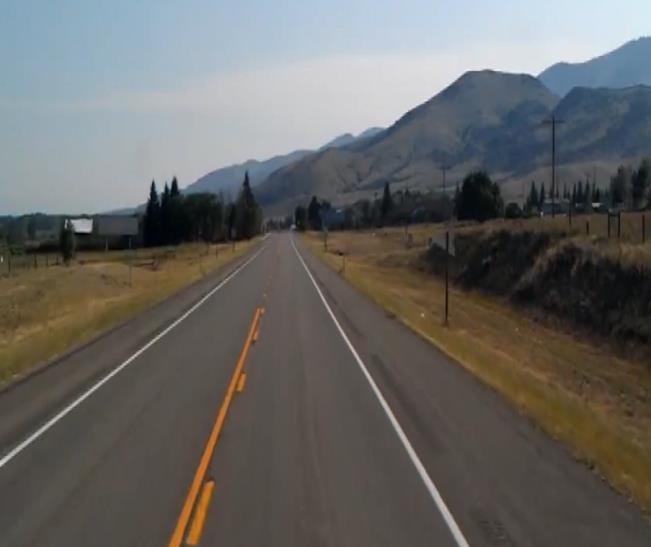
Fig-1: Input
By utilizing convolution and pooling filters, the process of filteringandpoolingiscarriedout.Oncethemodeltrainingis completed, if the model fails, it is redirected back to the preprocessingstage.
Moving on, after training the model, the next step involves making predictions and detecting lanes. If it is determined thatanobjectorcariscrossingthelanes,analertistriggered. Inthecasewhereacarisfoundwithinthelane,theprocess isrepeatedbyinputtingthedataagain.
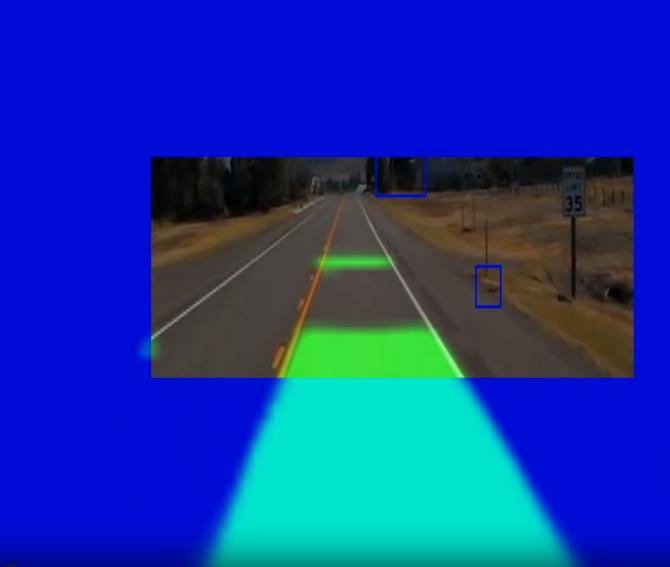
Fig-2: Output
1.Oursystemwillhavethecapabilitytoidentifycurvedlane markings.
2.Thedetectionoflanesfacesachallenge,especiallywhen they are not clearly visible. To address this issue, we will focus on strengthening our model and implementing improvementsinthefuture.
3.Detectinglinesontheroadcanbecomplexsincethereare variousmarkingspresent, including bothactual lanelines and other marks such as scratches. To ensure accurate detectionoflanelines,wewilltrainourmodelusingprecise andrelevantinformation.
IntelligentTransportationSystemshavedemonstratedthat lanedetectionisthemosteffectivemethod.Itappearsthatin studiesonlanedetection,manyresearchershaveoverlooked the challenges posed by fog, objects, and image noise. The Lane detection system promptly notifies the driver if their vehicleisveeringacrossthelaneboundary,therebyassisting inthepreventionorreductionofaccidents.Similartoother safetyfeatures,thedevelopersofthistechnologyclaimthatit willcontributetoadecreaseincaraccidentrates.
[1] Wenbo Liu,Fei Yan,Jiyong Zhangand Tao Deng”A RobustLaneDetectionUsingVertical Spatial Features andContextualDrivingInformation(2021)”.
[2] “A Comprehensive Guide to Convolutional Neural Networks? ?the ELI5 Way.” Medium, 16 Nov. 2022, Saha,Sumit.towardsdatascience.com/a-comprehensiveguide-to-convolutional-neural-networks-the-eli5-way3bd2b1164a53.
[3]ChangYuan,HuiChen,JuLiu,DiZhu“RobustLane DetectionforComplicatedRoadEnvironmentBasedon NormalMap”September2018IEEE
[4]“RoadLaneLineDetectionSystembyUsingCnnand RnnAlgorithmsinDeepLearning“January2023.
[5] “A Gentle Introduction to Pooling Layers for Convolutional Neural Networks” MachineLearningMastery.com,21Apr.2019Brownlee, Jasonmachinelearningmastery.com/pooling-layers-forconvolutional-neural-networks.
[6]Zhang,W.;Li,C.; Peng,G.;Chen, Y.;Zhang,Z. A deep convolutional neural network with new training methods for bearing fault diagnosis under noisy environment and different working load. Mech. Syst. SignalProcess.2018,100,439–453.
International Research Journal of Engineering and Technology (IRJET) e-ISSN: 2395-0056
Volume: 11 Issue: 04 | Apr 2024 www.irjet.net p-ISSN: 2395-0072 © 2024, IRJET | Impact Factor value: 8.226 | ISO 9001:2008
[7] Rafay Qayyum “Introduction to pooling layers in CNN”RafayQayyumTowardsAI“August16,2022.
[8]”EfficientRoadLaneMarkingDetectionwithDeep Learning.” In Proceedings of the IEEE International Conference on Digital Signal Processing, Shanghai, China,19–21November2018pp.1–5.[CrossRef]Chen, P,Lo,S.,Hang,H.,Chan,S.,Lin,J;
[9]“UsingHaarCascadeforObjectDetection”ByAdiran TamonJanuary30,2024inOpenCV.