
International Research Journal of Engineering and Technology (IRJET) e-ISSN: 2395-0056
Volume: 11 Issue: 04 | Apr 2024 www.irjet.net p-ISSN: 2395-0072
International Research Journal of Engineering and Technology (IRJET) e-ISSN: 2395-0056
Volume: 11 Issue: 04 | Apr 2024 www.irjet.net p-ISSN: 2395-0072
Aaditya Kurte1, Smital Nagap2 , Shivani Nalawade3 , Om Hule4 , Dr. Nitin Panaskar5
1Student, Dept. of Mechanical Engineering, Rajiv Gandhi Institute of Technology, Maharashtra, India
2Student, Dept. of Mechanical Engineering, Rajiv Gandhi Institute of Technology, Maharashtra, India
3Student, Dept. of Mechanical Engineering, Rajiv Gandhi Institute of Technology, Maharashtra, India
4Student, Dept. of Mechanical Engineering, Rajiv Gandhi Institute of Technology, Maharashtra, India
5Associate Professor, Dept. of Mechanical Engineering, Rajiv Gandhi Institute of Technology, Maharashtra, India ***
Abstract - The automotive industry has long been characterizedbyfiercecompetition,ever-evolvingconsumer expectations, and the need for continuous improvement. This project delves into the application of Lean Six Sigma methodologies to bring about a transformation in this sector. The primary objectives include enhancing quality, reducing costs, and streamlining processes throughout the automotive manufacturing and supply chain. Through the DMAIC (Define, Measure, Analyze, Improve, Control) framework, this project identifies critical fac-tors affecting product quality, resource utilization, and overall operational efficiency. It integrates Lean principles to eliminate waste, enhance productivity, and minimize defects, while incorporating Six Sigma strategies to reduce process variations and enhance quality control. The utilizationofvarioustoolsandtechniques,includingprocess mapping, statistical analysis, root cause analysis, and continuous monitoring, drives evidence-based decisionmaking. The expected outcomes of this project encompass substantial improvements in product quality, increased customer satisfaction, and significant cost reductions. Further-more, a cultural shift towards continuous improvement is anticipated, promoting a proactive approach to addressing issues and achieving long-term successintheautomotiveindustry.
Key Words: DMAIC, Critical Path Method, Optimization
1.INTRODUCTION
Six Sigma is a quality management approach with the primary goal of enhancing the quality of products and servicesthroughtheidentificationandremovalofdefects. It is used in the automotive industry to improve the quality of vehicles and manufacturing processes, reduce costs, and increase efficiency. This is a data-centric strategy that employs statistical tools and methodologies to pinpoint and eradicate sources of variation, ultimately enhancing overall performance. Six Sigma can be applied to various aspects of the automotive industry, such as design, engineering, production, and service. Companies like Motorola started using six sigma techniques in the 1980swhichwaslaterpopularizedbyToyotaandGeneral Electric.ThetermSixSigmareferstostatisticalmeasureof process performance where the goal Is to not have more
than3.4defectspermillionopportunities.SixSigmaoften usesvarioustechniquessuchasDMAIC,SPC,DOE,FMEA.
1. Brainstorming: Brainstormingisanintegralpartofthe problem-solving process and is frequently utilized in the "improve" phaseoftheDMAIC methodology.Itservesasa crucial preliminary step before the application of any specific tools. Brainstorming entails the exchange of ideas and the generationofcreative solutions throughopenand uninhibitedgroupdiscussions.Typically,afacilitator,often a lead Black Belt or Green Belt, moderates these brainstormingsessionsamongparticipants.
2. Root Cause Analysis/The 5 Whys: This technique is employedtouncoverthefundamentalcausesoftheissues under consideration and is an essential component of the "analyze" phase in the DMAIC cycle. In the 5 Whys technique,thequestion"why"isrepetitivelyasked,leading toadeeperunderstandingofthecoreissue.While"five"is aruleofthumb,theactualnumberofquestionscanvaryto obtainacomprehensiveinsight.
3. Voice of the Customer: This process is designed to capturecustomer feedback,often termed the "voice of the customer," through internal or external means. The aim is to provide customers with the best products and services by continuously understanding their evolving needs through direct and indirect methods. The voice of the customertechniqueisprimarilyusedinthe"define"phase of the DMAIC method, helping to refine the problem definition.
4. The 5S System: Rooted in Japanese workplace principles,the5SSystemfocusesoneliminatingwasteand streamlining inefficient tools, equipment, or resources in the workplace. It consists of five steps: Seiri (Sort), Seiton (Set In Order), Seiso (Shine), Seiketsu (Standardize), and Shitsuke(Sustain).
1.Improved Quality: Six Sigma methodologies focus on reducingdefectsanderrors,leadingtohigherproductand servicequality.
International Research Journal of Engineering and Technology (IRJET) e-ISSN: 2395-0056
Volume: 11 Issue: 04 | Apr 2024 www.irjet.net p-ISSN: 2395-0072
2. Data-Driven Decision-Making: It relies on data analysis to make informed decisions, enhancing accuracy andproblem-solving.
3.Increased Customer Satisfaction: Better quality products and services result in increased customer satisfactionandloyalty.
4.Process Efficiency: Six Sigma identifies and eliminates inefficiencies,streamliningprocessesandreducingwaste.
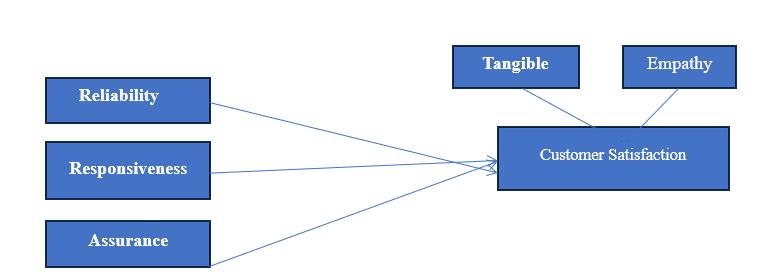
•Maintenaceandaftersalesdevelopmentisoneofthemost important aspect of automobile industry. The quality of after sales service can have a drastic effect on the popularity of the company and the development of customerrelations.
•The focus on quality of after sales service must be of priority for customer satisfactions, which is essential for theprofitsofanautomobileindustry.
•The automobile after sales service generally consists of periodic maintenance of vehicles, minor repairs, major repairs,washing,cleaningandpartsreplacements.
•To improve the after sales services, effective improvements must be done to the layout of the service centre and improving the process which takes the most amountoftime.
3. Problem Statement
This Research study will study and analyze the use of six sigmain theautomotiveindustryto achievethe following factorsinmanufacturing:
•ImprovedEfficiency
•Reducedcost
•Improvedquality
•Betterproductdesign
•Improvedemployeeengagement
Inthisresearchstudy,theprimaryobjectiveistoconduct anin-depthexaminationandevaluationoftheapplication of Six Sigma principles within the automotive industry. ThestudyaimstoinvestigatehowSixSigmacontributesto achieving the following key objectives in the manufacturingprocess.
The DMAIC framework is a structured problem-solving andprocessimprovementmethodologyusedinSixSigma. It stands for Define, Measure, Analyze, Improve, and Control.Eachphaserepresentsasetofactivitiesandsteps toguideaprojectfromproblemidentificationtosustained processimprovement.Here'sanexplanationofeachphase
Define:
Problem Statement: Clearly define the problem or opportunity for improvement. This should be stated in a way that is specific, measurable, achievable, relevant, and time-bound(SMART).
•Project Charter: Create a project charter that outlines the scope, objectives, team members, stakeholders, and high-leveltimelinesfortheproject.
•Voice of the Customer (VOC): Collect and analyze customer feedback and expectations to understand their requirementsandpriorities.
Measure:
Data Collection: Identify the critical process parameters and collect data on them. Ensure the data is accurate and reliable.
•Process Mapping: Create process maps to visualize the currentprocessandidentifyareasformeasurement.
•Baseline Performance: Establish the baseline performanceoftheprocess,oftenreferredtoasthe"as-is" state.
Analyze:
•Data Analysis: Analyze the collected data to identify patterns, trends, and variations in the process. Statistical toolsandtechniquesareoftenusedinthisphase.
•Root Cause Analysis: Determine the root causes of defects or problems by using tools like the Ishikawa diagram(Fishbonediagram)andthe5Whystechnique.
•Hypothesis Testing: Formulate and test hypotheses to confirm the relationships between variables and issues in theprocess.
Improve:
•Generate Solutions: Develop and evaluate potential solutionstoaddresstheidentifiedrootcauses.Brainstorm andprioritizeimprovementideas.
•PilotTesting:Implementtheselectedsolutionsonasmall scale to test their effectiveness without disrupting the entireprocess.
•Optimize Processes: Refine the solutions and make necessary adjustments to improve the process. Consider factorslikeefficiency,cost,andcustomersatisfaction.
Control:
•Standardization: Develop and implement standard operatingprocedures(SOPs)andcontrolstomaintainthe improvedprocessperformance.
International Research Journal of Engineering and Technology (IRJET) e-ISSN: 2395-0056
Volume: 11 Issue: 04 | Apr 2024 www.irjet.net p-ISSN: 2395-0072
•Statistical Process Control (SPC): Use SPC charts and toolstomonitorandcontrolprocessvariationandidentify issuesearly.
•Continuous Monitoring: Continuously monitor key performance indicators (KPIs) and process metrics to ensurethattheimprovementsaresustainedovertime.
•Documentation and Training: Document the changes made, and provide training to the team to ensure that everyoneunderstandsandfollowsthenewprocedures. The DMAIC framework is a data-driven approach to problem-solving and process improvement. It is designed to lead to sustainable improvements in quality, efficiency, and customer satisfaction. Throughout each phase, the emphasis is on data collection and analysis, enabling organizationstomakeinformeddecisionsandvalidatethe effectivenessofprocess.
Serviceplandiagramforaservicecenter,alsoknownas a service plan or service plan, is a well-known step-by-step processforprovidingcustomerservicegoods.Itdescribes the various stages of the delivery process, including the interaction between customers and service providers and theassociatedsupportorresources.
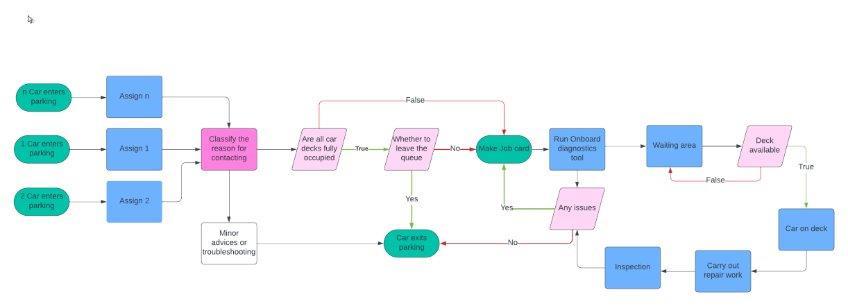
Critical Path method (CPM) is a project management technique used to identify the most important tasks and ensure that tasks are completed on time. Although it is often associated with construction and real estate, it can beadaptedtoavarietyofindustries,includingautomotive services. Here's how to use CPM to make Service centres more efficient: then deliver the car to the customer. This may include inspections, diagnostics, orders, repairs, qualitycontrolandcustomercommunications.
Table -1:CriticalPathMethod
International Research Journal of Engineering and Technology (IRJET) e-ISSN: 2395-0056
Volume: 11 Issue: 04 | Apr 2024 www.irjet.net p-ISSN: 2395-0072
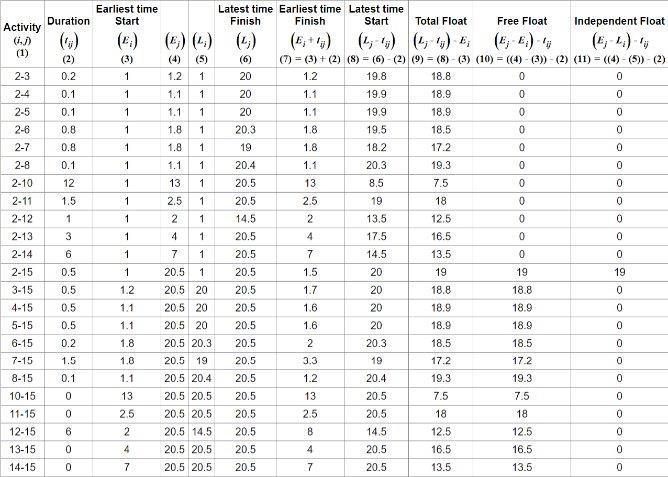
The Forward Pass method in Critical Path Method (CPM) is a technique used to calculate the earliest possible start (ES) and finish (EF) times for each activity in a project schedule. CPM is a step-by-step project management technique for process planning that defines critical and non-critical tasks with the goal of preventing time-frame problems and process bottlenecks. The Forward Pass is a crucial part of this process, helping to identify the minimumprojectdurationandtheearliestdatesbywhich eachactivitycanbecompleted.
E1=0
E2=E1+t1,2[t1,2=A=1]=0+1=1
E3=Max{Ei+ti,3}[i=1,2]
=Max{E1+t1,3;E2+t2,3}
=Max{0+0.2;1+0}
=Max{0.2;1}
=1
E4=Max{Ei+ti,4}[i=1,2]
=Max{E1+t1,4;E2+t2,4}
=Max{0+0.1;1+0}
=Max{0.1;1}
=1
E5=E2+t2,5[t2,5=F=0.1]=1+0.1=1.1
E6=E2+t2,6[t2,6=H=0.8]=1+0.8=1.8
E7=E2+t2,7[t2,7=J=0.8]=1+0.8=1.8
E8=E2+t2,8[t2,8=L=0.1]=1+0.1=1.1
E9=E2+t2,9[t2,9=N=1.5]=1+1.5=2.5
E10=E2+t2,10[t2,10=P=12]=1+12=13
E11=E2+t2,11[t2,11=Q=1.5]=1+1.5=2.5
E12=E2+t2,12[t2,12=R=1]=1+1=2
E13=E2+t2,13[t2,13=T=3]=1+3=4
E14=E2+t2,14[t2,14=U=6]=1+6=7
E15=Max{Ei+ti,15}[i=2,3,4,5,6,7,8,9,10,11,12,13,14]
=Max{E2+t2,15;E3+t3,15;E4+t4,15;E5+t5,15;E6+t6,15;E7 +t7,15;E8+t8,15;E9+t9,15;E10+t10,15;E11+t11,15;E12+t1 2,15;E13+t13,15;E14+t14,15}
=Max{1+0.5;1+0.5;1+0.5;1.1+0.5;1.8+0.2;1.8+1.5;1.1+0.1; 2.5+18;13+0;2.5+0;2+6;4+0;7+0}
=Max{1.5;1.5;1.5;1.6;2;3.3;1.2;20.5;13;2.5;8;4;7}
=20.5
This type of technique can provide a framework to small and medium scale automotive manufacturing plants. By using the DMAIC technique in the case study, production oftheTATANexoncanachieve93%defectfree.Theuseof Six Sigma is very important in different companies becauseitisusedtoimproveperformancethatfocuseson reducingthenumberofdefectsinproducts,processesand services and this is the case for this case study will improve the manufacturing defects. Six Sigma remains a very effective method adopted by many companies to improve their quality and productivity. This type of framework can help automotive companies to reduce wasteandimprovetheirqualitycontroldepartmenttoimprove their profits. A project aimed at improving the automotive sector using Lean Six Sig-ma methodologies has demonstrated significant benefits and transformative
International Research Journal of Engineering and Technology (IRJET) e-ISSN: 2395-0056
Volume: 11 Issue: 04 | Apr 2024 www.irjet.net p-ISSN: 2395-0072
outcomes. Lean Six Sigma, a combination of Lean principles focused on waste reduction and Six Sigma techniques for process improvement, has been a gamechanger in this industry. Through the systematic application of Lean Six Sigma, the automotive sector has seen substantial enhancements in various aspects Lean principles have streamlined processes, reduced unnecessary steps and minimized waste. This has led to quicker production cycles, reduced lead times, and cost savings. Manufacturers can produce more vehicles with the same or fewer resources. The implementation of the Critical Path Method (CPM) significantly optimized the process timeline, resulting in a substantial reduction in duration. The critical path of the project is : 1-2-9-15 and critical activities are A,N,O Initially, the process required 522 minutes for completion. After the application of CPM, a strategic scheduling and project management technique that focuses on task sequencing and critical path identification, the total process time was effectively reducedto205minutes.Thisrepresentsadecreaseofapproximately 60.7%, showcasing the efficacy of CPM in enhancing operational efficiency and minimizing time expenditureincomplex processes Theimplementation of theCriticalPathMethod(CPM)significantlyoptimizedthe process timeline, resulting in a substantial reduction in duration.
The authors can acknowledge any person/authorities in thissection.Thisisnotmandatory.
Automotive Component Manufacturers Association of India(ACMA)(2017).Presentationon“AutoandAuto ComponentsSectorProfile”.
Automotive Component Manufacturers Association of India(ACMA)(2021).Annualreport2020-21.
Noori, B., & Latifi, M. (2018). Development of Six Sigma methodologytoimprovegrindingprocesses:achange management approach. International journal of lean sixsigma.
Isa, M. F. M., & Usmen, M. (2015). Improving university facilities services using Lean Six Sigma: a case study. JournalofFacilitiesManagement.
Kabir, M. E., Boby, S. M. M. I., & Lutfi, M. (2013). Productivity improvement by using Six-Sigma. International Journal of Engineering and Technology, 3(12),1056-1084.
Gupta, N. (2013). An overview on six sigma: quality improvement program. International Journal of TechnicalResearchandApplications,1(1),29-39