
Volume: 11 Issue: 04 | Apr 2024 www.irjet.net p-ISSN: 2395-0072
Volume: 11 Issue: 04 | Apr 2024 www.irjet.net p-ISSN: 2395-0072
Sourabh Sidramappa Metre1 , Dr. Mahesh M. Wagh2
1 M. Tech., Student, Department of Technology, Shivaji University, Kolhapur, Maharashtra, India 2Professor, Department of Technology, Shivaji University, Kolhapur, Maharashtra, India
Abstract - Super capacitors have attracted a lot of attention due to their efficient energy storage. Compared to batteries, super capacitors have higher capacitance, energy, and power densities per unit mass than conventional capacitors. Carbon-based materials are most promising in super capacitor applications due to theiroutstandingphysical and electrochemical behaviour. This work demonstrated a facile method to synthesize a Nano composite electrode consisting of graphene from rGO and carbon black as active material. It was foundthat the Nano composite electrodewith 80 % graphene, 10 % carbon black and 10% PVDF as binder studied with NMP as solvent and PVP/LiClO4 as a gel-type electrolyte which acts as separator also due to which weight and size reduced compared to aqueous electrolyte super capacitor. It is expectedthat the current density willbehigher than pure graphene-based super capacitors since the carbon black is added, which increases the conductivity of the electrode andalso the thermal stability ofthe super capacitor device. A pouch cell super capacitor was fabricated using above mentioned materials with their proportions on the flexible steel current collector, and performance parameters will be evaluated.
Key Words: Super capacitor, grapheme, Energy Storage, ultra capacitors, Charge Discharge
Duetotheiradequateenergystorage,Supercapacitorshave received a lot of interest supercapacitors offer higher capacitance,energy,andpowerdensitiesperunitmassthan traditional capacitors. The most promising materials for supercapacitorapplicationsareCarbon-basedmaterialssince they have exceptional physical and electrochemical behaviour.Supercapacitorsareusedforapplicationswhere therequirementofpowerdensityishighforashortduration oftime,i.e.Theareaswherethereisaneedtoabsorborbear the high impulse of voltage like a hybrid transportation system, tostore the energygenerated during regenerative braking system, grid stabilization and nowadays in the criticaldomainslikespaceandmilitary.
Supercapacitors, often referred to as ultracapacitors or electric double-layer capacitors, are energy storage technologiesexhibitingextremelyhighcapacitanceandlow internal resistance. The separation of charges at the electrode/electrolytecontactservesastheenergystorage mechanism in this instance. In contrast to batteries, this device,inparticular,hascomparativelyhighenergystorage anddeliverycapacity.Asupercapacitormodelconsistsofa separator,twoelectrodes,andanelectrolyte,althoughthe device's performance largely depends on the electrode material. Supercapacitors have flexible packaging, high power,extendedlifecycle,wideoperatingranges(-400Cto 77 0C),arelightweight,andrequirelittlemaintenance
Modernelectricalandelectronicequipmenthasverystrict safety requirements for high current, energy, and power requirements.Onewaytosatisfytheseexcessivedemands forhighpowerdensityistousecapacitors,whichemitalot ofenergyquickly.Additionally,underidealcircumstances, capacitorscanreplacebatteriesinelectricvehiclesystems by fusing their high power density with the high energy density of batteries. The amount of energy stored as ions betweentheelectrolyteandtheelectrodeisthebasisofthe supercapacitor's working theory. As renewable energy sources represent a crucial component of such systems, distributed power generating networks and autonomous renewableenergysystemsaregainingappeal.
By integrating energy storage devices, such systems' dependabilityandefficiencycanbeconsiderablyimproved. Theusageofsupercapacitor-basedenergystoragesystems, whichcandelivercriticalenergyburstsforabriefduration, helpstoreducepowerqualityissues.Systemsforconverting windenergyorP.V.energystoragearenecessarytocontrol fluctuations.Tohandlethesevariationsandkeeptheoutput voltageconstant,supercapacitorscanbeutilisedasenergy storagedevices. International Research Journal of Engineering and Technology (IRJET) e-ISSN: 2395-0056
However, nano-based materialsshowed high performance concerningchargingability,capacity,andcyclability.Ithas theabilitytoprovidemorepowerdensityandcanchargeand dischargeinafractionofasecond.
International Research Journal of Engineering and Technology (IRJET) e-ISSN: 2395-0056
Volume: 11 Issue: 04 | Apr 2024 www.irjet.net p-ISSN: 2395-0072
flow chart
Studytheexisting supercapacitors
DatacollectionandReview ofliterature
Performexperimentallyworkon graphene-basedsupercapacitorfor economicandefficient
Analysetheperformanceof Supercapacitorforsmallscale Energystorageapplications.
Graphene–Grapheneisusedasactivematerialcoatedonthe electrode substrate or current collector since it has high active surface area and mesoporous nature, and ability to adsorb ions on its surface area when potential is applied. Beforeusingitforapplication,itiscrushedonamortarand pestle. The specific capacitance is given in terms of f/g or f/cm2, so it is clear the particular capacitance is inversely proportionaltotheareaoftheelectrode.Fromexperiments, itisclearthat2.065f/gspecificcapacitanceisobtainedfrom theelectrodeoftheareaof6.2cm2,i.e.ofthesize2.5cmx2.5 cm.Fortheapplicationofthedeviceat12V,consideringthe scopeoftheprojectandtheavailabilityofequipment,itis feasible to make a supercapacitor of 5 f/g specific capacitance,avoltageof1.45Vandacurrentof5mA.Now,to get around 5f/g specific capacitance,the electrode should possessanareaof16cm2,sothedimensionsoftheelectrode willbe4cmx4cm.Forthisapplication,therequiredvoltage is12Vwhichsupercapacitorscanbeachievedbyconnecting 13suchmanufactureddevices.Aswehave,q=cxv,For13 supercapacitors, the equivalent capacitance connected in parallelis13x0.85=11.05f andthetotalchargewhichgives thevoltageoutputwhenthethesupercapacitorisdischarged can be obtained by multiplying the voltage of the supercapacitordeviceandequivalentcapacitance,whichis, 11.05x1.1=12.15C.Itisclearfromtheabovevaluesthatthe parallelconnectedsupercapacitorswillhaveanequivalent capacitanceof11.05f,andthetotalchargestoredbytheseis 12.15C.Thefullvoltageitcandeliverafterdischargeisthe amountofpaymentstoredinit.Sothesystemcanprovidean
output voltage of 12 V. As per the design, the device is expectedtoshowthemeasurementsofcurrent,voltageand specific capacitance around 5 mA, 1.45 V and 4.61 f / g, respectively
Results of prepared device:
The device shows slightly lower parameters than the expectedvalues,whichareasfollows:
Specific capacitance = 3.42 f/g,
Voltage = 1.1 V and current = 5 mA, capacitance = 0.85 f.
The device's performance depends on various conditions, includingthematerialusedforpreparingthedevice,suchas activematerials,binder,electrolyte,solvent,andthecoating ofactivematerialonflexiblesteelsubstrate,etc.
Activematerialsusedforthedevice
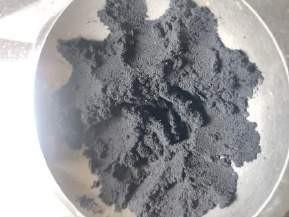
Graphene acts as an active material for the ultracapacitor device along with PVDF ( polyvinylidene difluoride ) as a binder or adhesive agent for the active material on the flexiblesteelsubstrateusedforthesupercapacitorelectrode
Graphene is used as active material coated on the electrode substrateorcurrent collector since ithas highactive surfacearea and mesoporous nature, and ability to adsorb ions on its surface area when potential is applied. Before using it for application, it is crushed on a mortar and pestle.
International Research Journal of Engineering and Technology (IRJET) e-ISSN: 2395-0056
Volume: 11 Issue: 04 | Apr 2024 www.irjet.net p-ISSN: 2395-0072
Preparationofflexiblesteelforcoating
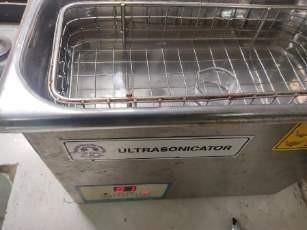
Figure 2: Ultrasonicationofflexiblesteel
Theflexiblesteelisfirstlycleanedusingzero-numberpolish paperbeforeundergoinganyfurtherprocess.Afterwards,it is cleaned using distilled water in the ultrasonicator, as shown in the picture. Again it is sonicated in the ultrasonicatorusingacetone,ethanolanddistilledwater.
Coatingofactivematerialonflexiblesteelsubstrate
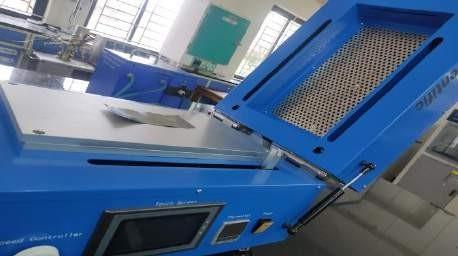
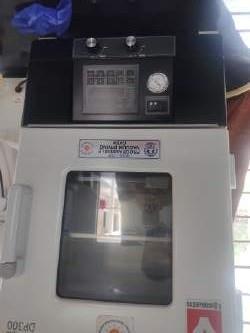
Figure 3: Coatingofactivematerial
The coating of active material is done on the flexible steel substrate using a hot vacuum rolling coater machine. The cleanedsubstrateisplacedasshowninthepicture,andthe vacuumisturnedonsothesubstratecanbestuckflatonthe surface.
Coatingofactivematerial
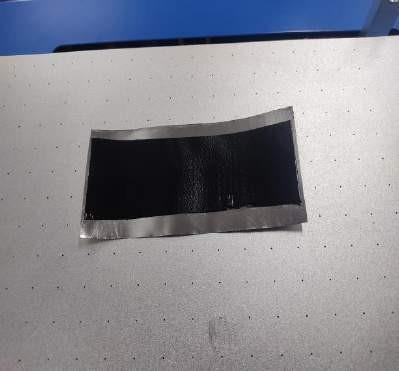
4: Coatinganddryingofelectrode
TheslurryispreparedusingactivematerialandN.M.P.(NMethyl-2-pyrrolidone) as required and poured before the coatingblade.Afterwards,theedgecoatstheslurryuniformly ontheflexiblesteelsubstrate,asshowninthepicture.Itis driedinthecoaterat60degreeCelsius,andthenitisdriedat 120degreeCelsiusinthepressurizedprogrammableoven.
Wrappingofdevice
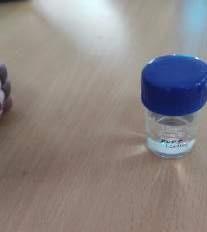
Figure 5: Applicationofelectrolyte
After drying, the gel-type electrolyte is applied to the preparedelectrodesurface,themixtureofPVPandLiClO4 (polyvinylpyrrolidone and lithium perchlorate). This gel electrolyte which acts as a separator for supercapacitor devices.
Amongthevarioustechniquesofcharacterization,thethree methodsareessentialareasfollows:
1. X-raypowderdiffraction(XRD)
International Research Journal of Engineering and Technology (IRJET) e-ISSN: 2395-0056
Volume: 11 Issue: 04 | Apr 2024 www.irjet.net p-ISSN: 2395-0072
2. RamanSpectroscopy
3. FourierTransformInfraredSpectroscopy(FTIR)
1. X-Ray Power Diffraction:
ThefigurealsoincludestheXRDpatternofgraphite,which demonstrates the existence of two distinctive peaks in the XRDpatternofthegrapheneproduct.(around12and26), From the XRD pattern, we can conclude revealed the structure of carbon atoms or molecules was preserved in graphene,butthediffractionpeakwidened,andtheintensity decreased. This is due to the fact that when graphite was convertedintographene,thelayer'ssizeshrunk. Also,itis suitablefortheapplicationofsupercapacitors
2. Raman Spectroscopy:
This is used to detect the polarity of the material, i.e. rotationalandotherstatesinthemolecularsystem.Here,the band of graphene was observed at 1587 cm-1, which may arise from certain defects such as vacancies and grain boundaries.Fromthespectradata,itisseenthatthereisa peakat2700cm-1, Thisrepresentsthequantityofgraphene layers. Due to a few layers of imperfect graphene in the producedmaterial,itisseenthatthebandhaswidenedin this case. It contains only lower defects and better graphitization, so it possesses good electrochemical properties.
3. Fourier Transform Infrared (FTIR):
It is a method used to obtain the infrared spectrum of the material'sabsorptionandemissionanddetectthedifferent functionalgroupspresentinthematerial.Fromthespectra data,wecanseethepeakat1200cm-1;nootherfunctional groupsarepresentexceptC-CandC=C.Thismaterialcanbe usedfortheapplicationslikesupercapacitors.
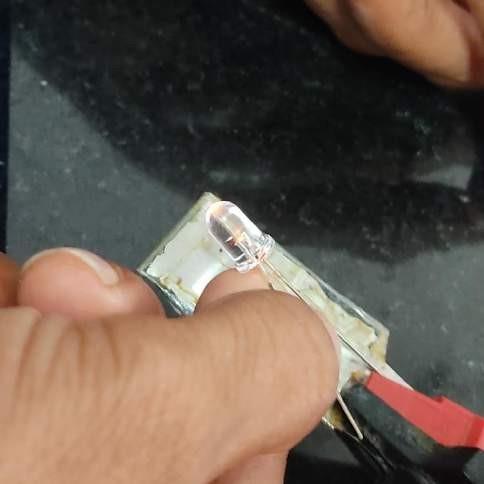
3.1
Theperformanceofthesupercapacitorisevaluatedbydoing several tests. The nature of the device is known by cyclic voltammetry, i.e. whether the device shows EDLC characteristics or Pseudo capacitance characteristics. The totallifecycleofthesupercapacitorandthepercentagedrop intheperformanceofthesupercapacitorafterprocessesare evaluatedbygalvanostaticcharge-discharge.
TheprimarytesttoevaluatesupercapacitorisGalvanostatic charge-discharge,CyclicVoltammetry,andElectrochemical ImpedanceSpectroscopy.
4.1
Itisanelectrochemicalmethodthatgaugesthecurrentthat formsinanelectrochemicalcell,wherethevoltageishigher than what the Nernst equation predicts. A working electrode'spotentialiscycledtoexecutetheoperation,and theresultingcurrentisthenmeasured.
TheshapeoftheCVtellsusthebehaviouroftheelectrode, whether it is showing pseudocapacitance or EDLC nature. ThisCVisperformedunderacyclingpotentialof0.01Vs-1 . TheaboveshapeoftheCVcurveitisclearlyshowingthatthe electrodeexhibitspseudocapacitivebehaviour.
4.2
It is an electrochemical multifrequency A.C. measuring method. It gauges the metal/solution interface's electrical resistance(Impedance)overabroadfrequencyrange.The system under investigation is described using a variety of models. The most popular and simple model for electrochemical capacitor E.I.S spectrum is a streamlined Randle'smodel,asseenintheFigure
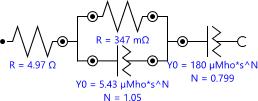
Figure 7: E.I.S.equivalentcircuit(simplifiedRandle's model)
TheaboveFigureshowsthattheinternalresistanceisabout 347mΩandthesolutionresistanceisabout4.97Ω.Thisdata helpsinchoosingmaterialforsupercapacitordevices.From the spectra, it is clear that the experimental curve slightly
International Research Journal of Engineering and Technology (IRJET) e-ISSN: 2395-0056
Volume: 11 Issue: 04 | Apr 2024 www.irjet.net p-ISSN: 2395-0072
deviatesfromtheidealangleofthefittedE.I.S.datasincethe idealsupercapacitordoesnotexistinreality,andanumberof outcomescauseflawsinthesystem.
4.3 Scan Rate:
Theelectrodepotentialrampslinearlyversustimeincyclic phases during cyclic voltammetry (CV). The experiment's scanrateisthepaceatwhichthevoltagechangesovertime in each of these phases. From the curve, it is seen that, as appliedpotentialisincreased,thecorrespondingcurrentis alsoincreased,exhibitingitsgoodcapacitivebehaviour.The potentialisincreasedfrom10mVto100mV.
4.4 Galvanostatic Charge Discharge:
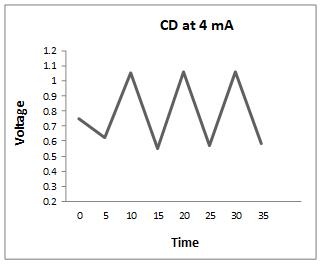
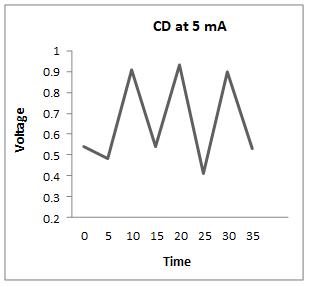
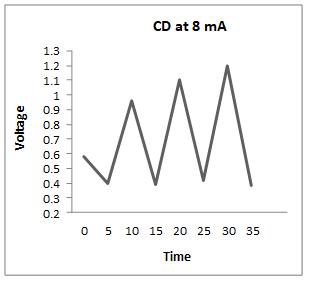
Bymeasuringthepotentialdifferenceacrossthecapacitoras afunctionoftime,thisexperimentaimstobetterunderstand howcapacitorschargeanddischarge.Theshorttimeconstant meansthattheCapacitorwillchargeanddischargeatafaster rateandviceversa.
Thecharge-dischargeiscarriedoutat4,5,8,and9mA,and theresultsareasfollows
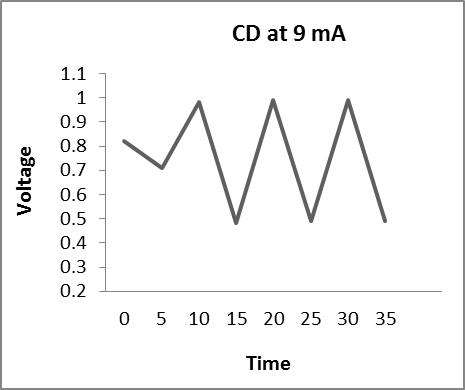
International Research Journal of Engineering and Technology (IRJET) e-ISSN: 2395-0056
Volume: 11 Issue: 04 | Apr 2024 www.irjet.net p-ISSN: 2395-0072
Fromtheabovegraphs,itisclearthatthedischargetimeis higherat5mA,sothestabilityisperformedatthiscurrent, i.e. at 5 mA, to calculate the specific capacitance, energy densityandpowerdensity.
Thestabilitycheckisdoneforaround1000cycles,andthe resultsareasFollows:
Depositedweightofelectrode–0.188g
Theemptyweightoftheelectrode-0.168g
Activeweightofelectrode–0.02g
Potentialwindow(∆V)–0.7V
Current(I)–5mA
SpecificcapacitanceCsp=Ix∆t/mxV
EnergydensityE=½CV2
PowerdensityP=E/t100th cycle-∆t=3.84s
Csp=1.37f/g,E=0.335Wh/Kg,P=314.6W/Kg
200th cycle-∆t=5.92s
Csp=2.11f/g,E=0.518Wh/Kg,P=315W/Kg
300th cycle-∆t=5s
Csp=1.78f/g,E=0.437Wh/Kg,P=314.9W/Kg
400th cycle-∆t=6.11s
Csp=2.18f/g,E=0.534Wh/Kg,P=315W/Kg
500th cycle-∆t=6.2s
Csp=2.21f/g,E=0.542Wh/Kg,P=314.9W/Kg
600th cycle-∆t=7.33s
Csp=2.61f/g,E=0.641Wh/Kg,P=314.96W/Kg
700th cycle-∆t=7.37s
Csp=2.63f/g,E=0.644Wh/Kg,P=314.96W/Kg
800th cycle-∆t=7.53s
Csp=2.68f/g,E=0.658Wh/Kg,P=314.9W/Kg
900th cycle-∆t=8.63s
Csp=3.08f/g,E=0.755Wh/Kg,P=314.9W/Kg
1000th cycle-∆t=8.71s
Csp=3.11f/g,E=0.762Wh/Kg,P=314.9W/Kg
From the outcomes above, the stability for 1000 cycles is calculatedataround65%.
5. DISCUSSION AND CONCLUSION
TheN.M.P.solventissuitablefortheactivematerialsandthe bindermixture.Slurrygetscoatedcorrectlyanduniformlyon the flexiblesteel substrate due to theaddition of N.M.P.to other organic solvents. Adding black carbon increases the conductivity and other performance parameters. Without addingblackcarbon,theactivematerialisnotcoatedonthe flexiblesteelsubstrateproperly.Duetotheuseofagel-type electrolyte,whichactsasaseparatorbetweentwoelectrodes, size and weight are reduced compared to aqueous electrolytes. The overall thermal stability of the device is enhancedduetotheadditionofblackcarbon.Theelectrode
exhibits a specific capacitance of 3.42 f / g. The discharge time we get from the galvanostatic charge-discharge experimentisabout8.75s.Thevoltageitcanprovideafter
discharge is about 1.1 V, and the device's current is 5 mA. From all the parameters, it is clear that by using different activematerials,substratesandelectrolytecombinations,the performance of the electrode can be increased by functionalizingtheactivematerial
Conclusion:
Itcanbeconcludedthat:
1. Grapheneisoneofthemost viableactivematerialsfor theflexiblesupercapacitordeviceduetoitsnatureand electrochemicalproperties.
2. Addingblackcarbonhelpsbindactivematerialonthe current collector, increases the conductivity, and improvesothercapacitance performancesandthermal stabilityoftheelectrode
3. Duetotheirflexiblenatureandhighperformance,these supercapacitorsareusedonavastscaleinthedomains like automobile, power, defence, consumer electronics etc.
4. The device shows results slightly lower than expected resultssincetheperformanceofthedevicedependson variousfactorssuchasexperimentalconditions,material etc.fromtheresultsoutcomesofthepreparedelectrode or supercapacitor device, it can be concluded that the device can be used in applications like microgrid fluctuation control where the bursts are needed for A shortdurationoftimeandapplicationswherethebackup isneededforsometimeandinconsumerelectronicsby compactingthesizeofit.
5. Theflexiblenatureofthedeviceleadstoawiderangeof opportunities for its applications. This initial goal achievement motivated me to further enhance the performance by altering each component of the
supercapacitorwhichincludeselectrodematerialandthe electrolytesolution.
[1] Zhang, G., Xu, Y., Huang, L., & Zhang, S. (2018). "Graphene-basedCarbonCompositesforSupercapacitor Applications:AComprehensiveReview."NanoEnergy, 52,78-104.
[2] Wang, J., Li, H., Chen, X., et al. (2017). "Polyvinyl Pyrrolidone/LiClo4 Gel Electrolyte for HighPerformance Supercapacitors." Electrochimica Acta, 317,192-201.
[3] Liu, S., Hu, L., He, M., et al. (2018). "Enhanced Supercapacitor Performance of Graphene-Carbon Composite Electrodes with Hierarchical Pore Structures."Carbon,131,1-10.
International Research Journal of Engineering and Technology (IRJET) e-ISSN: 2395-0056
Volume: 11 Issue: 04 | Apr 2024 www.irjet.net p-ISSN: 2395-0072
[4] Chen, Y., Wu, Y., Liu, G., et al. (2020). "Tailoring Graphene-based Electrodes for High-Performance Supercapacitors:AReview."NanoEnergy,69,104442.
[5] Wang, S., Liu, Q., Chen, H., & Zhang, L. (2020). "Graphene-Carbon Composite Electrodes for HighPerformance Supercapacitors with PVP/LiClo4 Gel Electrolyte."JournalofPowerSources,456,227987.
[6] Zheng, Y., Yang, C., Chen, Y., et al. (2019). "Recent Advances in Graphene-based Materials for Supercapacitor Applications: A Review." Nanotechnology,30(50),502002.
[7] Zhang,Q.,Zhang,W.,Wang,Y.,etal.(2019)."Polyvinyl Pyrrolidone/LiClo4 Gel Electrolyte for HighPerformance Supercapacitors." Electrochimica Acta, 317,192-201.
[8] Xu, J., Wang, J., Zhu, Y., et al. (2019). "Polyvinyl Pyrrolidone/LiClo4 Gel Electrolyte for HighPerformance Supercapacitors with Graphene-Carbon CompositeElectrodes."ElectrochimicaActa,302,157167.
[9] Li,J.,Zhang,Y.,Huang,X.,&Wang,H.(2019)."Enhancing thePerformanceofSupercapacitorsusingPVP/LiClo4 GelElectrolyte."JournalofElectroanalyticalChemistry, 850,113379.
[10] Liu,Q.,Chen,H.,Wang,S.,etal.(2021)."GrapheneCarbon Composite Electrodes for High-Energy Supercapacitors with PVP/LiClo4 Gel Electrolyte." ElectrochimicaActa,365,137377.
[11] Chen, X., Wang, Y., Zhang, J., et al. (2022). "Advancements in Gel Electrolytes for HighPerformance Supercapacitors." Journal of Energy Storage,53,102357.
[12] Zhang,L.,Wang,Y.,Liu,Q.,etal.(2020)."Advanced Characterization Techniques for Supercapacitor Materials: A Comprehensive Review." Journal of ElectroanalyticalChemistry,876,114561.
[13] Yang, S., Li, M., Zhang, J., et al. (2021). "Exploring Alternative Electrolyte Additives for Enhanced PerformanceinSupercapacitors."ElectrochimicaActa, 389,138621.