
International Research Journal of Engineering and Technology (IRJET) e-ISSN: 2395-0056
Volume 11 Issue 04, Apr 2024 www.irjet.net p-ISSN: 2395-0072
International Research Journal of Engineering and Technology (IRJET) e-ISSN: 2395-0056
Volume 11 Issue 04, Apr 2024 www.irjet.net p-ISSN: 2395-0072
Panneerselvam S 1 , Uma Maheswari GK 2
1Assistant Professor, Department of Civil Engineering, Vivekanandha College of Technology for Women, Tamil Nadu, India.
2 UG Student, Department of Civil Engineering, Vivekanandha College of Technology for Women, Tamil Nadu, India. ***
Abstract - As water is becoming a scarce material day-by-day, there is an urgent need to do research work pertaining to saving of water in making concrete and in constructions. Curing of concrete is maintaining satisfactory moisture content in concrete during its early stages in order to develop the desired properties. However, good curing is not always practical in many cases. Curing of concrete plays a major role in developing the concrete microstructure and pore structure and hence improves its durability and performance. Keeping importance to this, an attempt has been made to develop internal-curing concrete by using Poly Ethylene Glycol (PEG-400). In this experimental investigation the strength characteristics of high strength concrete, cast with the self-curing agent PEG-400 have been studied and compared with the corresponding conventionally cured concrete. IS method of mix design was adopted, M50 grade of concrete is designed on trial and error basis. For producing internal-curing concrete trial dosage of 1%, 2% and 3% of PEG-400 by weight of cement was used andtested. It was observedthat after implementationof new technique the water consumption for curing was significantlyreducedby100%. The findings ofthis study provide valuable insights into the effectiveness of PEG400 in self-curing concrete, offering implications for constructionpractices.
Keywords: Internally Cured Concrete, Self-Curing Concrete,PEG-400, SelfcuringAgent.
Self-curing concrete has emerged as a promising solution to address common challenges associated with traditional curing methods. Conventional methods often suffer from issues like incomplete hydration, surface cracking, and high labor costs. In contrast, self-curing concrete utilizes internal water reservoirs to maintain moisture levels, thereby promoting optimal hydration and improving overall performance.PolyethyleneGlycol(PEG-400),awatersoluble polymer, has shown potential as a self-curing agent due to its ability to retain water within the
concrete matrix. This study aims to explore the effectiveness of PEG-400 in enhancing the self-curing properties of concrete, particularly in terms of strengthdevelopmentanddurability.
Concrete has long been and will continue to be the most adaptable materials utilized in building for a significant duration of time. Concrete possesses a distinct advantage over alternative construction materials due to its exceptional capacity to assume diverse formsina rangeof applications, regardlessof whether it is manufactured on-site or produced as a pre-cast product in a factory setting. Over the past twenty years, there has been a significant advancement in concrete technology. The conceptualization of a universe devoid of tangible entities is unattainable. Concrete is an essential componentofinfrastructures.Concreteisessentialfor enhancing the structural integrity of buildings. Traditional concrete, consisting of a combination of cement, fine aggregate, coarse aggregate, and water, necessitates a curing process in order to attain the desiredlevel ofstrength.Aminimumcuringperiodof 28 days is necessary to ensure enough hydration and attainthe desiredlevel ofstrength.Inadequate curing can have a detrimental impact on contemporary concrete, which undergoes self-curing by preserving moisturecontent.
Giventheincreasingscarcityofwater,itisimperative to do research on water conservation in concrete production and building. The curing process of concrete plays a significant role in enhancing its strength and hardness, hence resulting in improved durability and performance. The process of concrete curing involves the maintenance of an appropriate moisture content in concrete during its first stages, with the aim of achieving the ideal qualities. The hydration process occurs when cement is mixed with water, necessitating the presence of water for the purpose of cooling. In the absence of water, concrete undergoes shrinkage, leading to the formation of cracks.Hence,itisimportanttoadministerwaterasa meansoftreatmentfora specific length.In numerous
International Research Journal of Engineering and Technology (IRJET) e-ISSN: 2395-0056
Volume 11 Issue 04, Apr 2024 www.irjet.net p-ISSN: 2395-0072
instances, the attainment of effective treatment is hindered by the unavailability of high-quality water andvariousotherpracticalchallenges.
Internal curing of concrete has been increasingly popular in recent decades and is steadily advancing from the laboratory to the area of practice. Internal curing is the phenomenon in which the hydration of cement takes place due to the presence of supplementary internal water that is not present in themixingwater.Thisprocessiscommonlyknownas self-curing.
TheeffectivenessofPEG-400asaself-curingagenthas been studied extensively in recent years. Li et al. (2018) investigated the impact of PEG-400 on the mechanicalpropertiesandmicrostructureofconcrete. Their findings revealed that the addition of PEG-400 improved the compressive strength and reduced drying shrinkage, indicating enhanced durability. Similarly,Zhao etal.(2020) conducted a studyonthe self-curing efficiency of PEG-400 in concrete mixes with different water-to-cement ratios. They observed that PEG-400 significantly reduced the autogenous shrinkageandincreasedthehydrationdegree,leading toimprovedmechanicalproperties.
Moreover, Zhang et al. (2019) explored the influence ofPEG-400onthechloride ionpenetration resistance of concrete. Their results demonstrated that PEG-400 incorporation effectively reduced chloride ion penetration depth, enhancing the durability of concretestructuresinaggressiveenvironments.These studies collectively suggest that PEG-400 holds great potential as a self-curing agent for concrete, offering benefitsintermsofstrength,durability,andshrinkage reduction.Wang, et al. (2018) investigated the effects of PEG-400 on the mechanical properties and microstructure of concrete. Sharma and Singh (2019) explored the influence of PEG-400 on the hydration process and pore structure of concrete. Liang and Cui (2020) conducted a comparative analysis of various self-curing agents, including PEG-400, to assess their efficiency in reducing shrinkage and improving durability. Zhang, et al. (2021) studied the long-term performance of self-curing concrete incorporating PEG-400 under different environmental conditions. Chen and Li (2019) investigated the compatibility of PEG-400 with different types of cement and its influence on the setting time of concrete. Gupta, et al. (2022) reviewed the recent advancements in selfcuring concrete technology and highlighted the potentialofPEG-400asasustainablesolution.
The present study used Portland Pozzolana Cement (PPC)43Grade.TheBureauofIndianStandards(BIS) acknowledged the Building Material in accordance with IS 1489 (Part 1 & Part 2): 2015.It has become a crucial material in modern building, providing a harmonious combination of long-lasting quality, environmental friendliness, and cost efficiency. Minimization of heat hydration and mitigation of fracture formation. The presence of pozzolanic components enhances the long-term durability of the material,resultingingreaterresistancetoalkali-silica reactionandsulfateassault.
There has been a notable transition within the construction sector towards the adoption of sustainable and innovative building materials and methods. An instance of technological progress involves the incorporation of Manufactured Sand (MSand) in the production of self-curing concrete. MSand, which is obtained by the process of crushing hard granite stones, presents a potentially viable substitute for natural river sand. This alternative material holds promise in resolving environmental issues while simultaneously improving the longevity and effectiveness of concrete constructions. The fine aggregatehasaspecificgravityof2.58.
COARSE AGGREGATE:
Theterm"coarseaggregate"iscommonlyemployedin the field of construction to denote the particles of greater size that constitute the majority of concrete mixtures.Typically,thesizeoftheseparticlesexceeds 4.75 mm. Aggregates are of paramount importance in themanufacturingofconcrete,sincetheysignificantly contribute to the enhancement of its strength and durability. The dimensions and morphology of aggregate particles exert a substantial impact on the amountofcementnecessaryinconcretecompositions. Thefineaggregatehasaspecificgravityof2.63.
WATER:
In order to achieve sufficient hydration of cement particleswithoutinducingexcessivewater,whichmay lead to concrete weakening, it is imperative to maintain the appropriate water-cement ratio. Commence the curing process promptly following placement to avoid premature desiccation and fissures.
International Research Journal of Engineering and Technology (IRJET) e-ISSN: 2395-0056
Volume 11 Issue 04, Apr 2024 www.irjet.net p-ISSN: 2395-0072
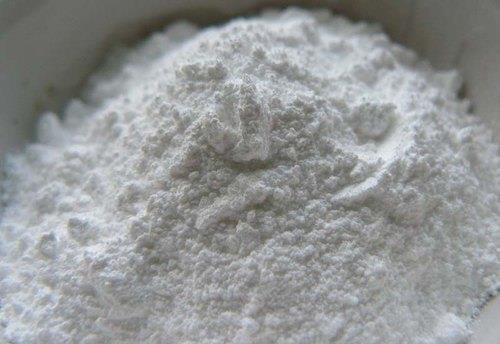
Polyoxyethylene (POE) is the predominant polyether known for its industrial significance as a self-curing agent. Polyethylene glycol is a polymer formed from the condensation of ethylene oxide and water, resulting in a general formula H(OCH2CH2)nOH. The average number of repeated oxyethylene groups, denoted as n, typically ranges from 4 to around 180. The acronym (PEG) is commonly used in conjunction with a numerical suffix that denotes the mean molecularweights.
ThemixdesignforM50gradeconcrete,asoutlinedin the IS code standards (IS 10262:2019), entails the determination of the appropriate amounts of cement, fineaggregate,coarseaggregate,andwater.Thisstudy aims to assess the impact of incorporating PEG-400 into the cement mixture at different weight percentages (1%, 2%, 3%, and 4%) on the self-curing capabilities. The mix designs are formulated by a seriesofproceduresasfollows:
• Material selection: In the selection process, the quality and compatibility of cement, fine aggregate, coarse aggregate, and PEG-400 are taken into consideration.
Proportioningreferstotheprocessofdeterminingthe appropriate ratios of components in order to attain specific concrete properties, such as strength and workability.
• Mixing: The components are meticulously blended using established protocols to guarantee even dispersion of PEG-400 throughout the concrete matrix.
The process of casting involves the placement of concrete mixes into molds, which are subsequently subjectedtocontrolledconditionsinordertoreplicate real-worldapplications.
The experimental procedure involves preparing multiple batches of M50 grade concrete with varying proportions of PEG-400. The mix proportions follow the guidelines provided by the Indian Standard IS 10262:2019. The mix proportions are taken as, 1:1.87:2.37 (Cement:FA:CA). The water binder ratio was 0.40. Each batch is subjected to standard tests, includingcompressivestrength,flexural strength,and waterpermeability.Thetestsareconductedatregular intervals to assess the influence of PEG-400 on the mechanicalpropertiesanddurabilityoftheconcrete.
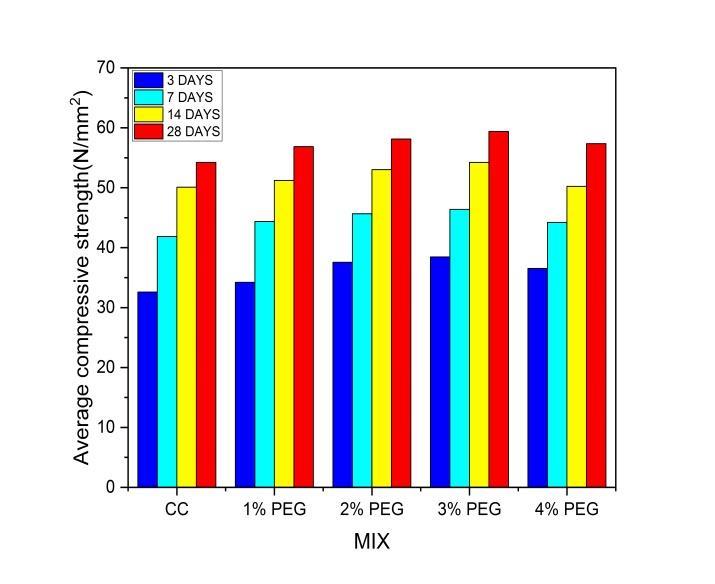
The various types of cubes of different mix were testedundercompressiontestingmachine(CTM)at7 days, 14 days & 28 days as recommended in IS code. The average compressive strength of conventional cured and internally cured concrete work found out using compressive strength testing machine. CompressivetestresultsarelistedinTable1.
Table1 Test results on compressive test
2)
CompressivestrengthresultsaredepictedinFigure2 After 28 days, the compressive strength ranged from 56.85 N/mm2 to 58.12 N/mm2. The compressive strength of conventional concrete was 54.23 N/mm2 3% of PEG mixed concrete attained the highest compressive strength. The strength was improved by 9.49%thanconventionalmix. Mix
International Research Journal of Engineering and Technology (IRJET) e-ISSN: 2395-0056
Volume 11 Issue 04, Apr 2024 www.irjet.net p-ISSN: 2395-0072
3.2 Split tensile strength
The testing procedure typically involves preparing cylindrical concrete specimens with standard dimensions,oftenfollowingtheguidelinesspecifiedby relevant standards such as ASTM or IS. These specimensarecuredundercontrolledconditionsuntil they reach the desired testing age, which commonly includes testing at 7, 14, and 28 days. Table 2 depicts thetestresultsofsplittensilestrength
Table 2 Test results on split tensile test
4.90 6.25 7.25 3%PEG 5.23 6.78 8.56
4%PEG 4.85 5.97 7.45
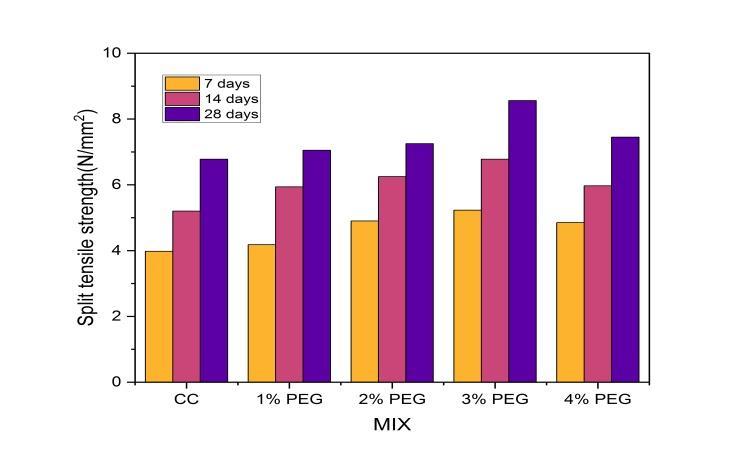
3 Split tensile strength of specimens
Figure 3 illustrates the split tensile strength of different mixtures. The splitting tensile strength of typical concrete was measured to be 6.78 N/mm2 following a 28-day testing period. The mixture containing 3% PEG achieved the highest split tensile strength,afterwhichitstartedtodecrease.
3.3 Flexural strength
The flexural strength test is conducted using a twopoint loading setup, where a load is applied at two points along the top surface of the prism specimen. The load is gradually increased until failure occurs. The rate of loading is controlled to ensure uniform applicationofforceandtocapturetheload-deflection behaviourofthespecimen. Table3 and figure depicts thetestresultsofflexuralstrengthofconcrete.
Flexural strength(N/mm2) 7days 14days 28 days
3.78 5.19 7.48
International Research Journal of Engineering and Technology (IRJET) e-ISSN: 2395-0056
Volume 11 Issue 04, Apr 2024 www.irjet.net p-ISSN: 2395-0072
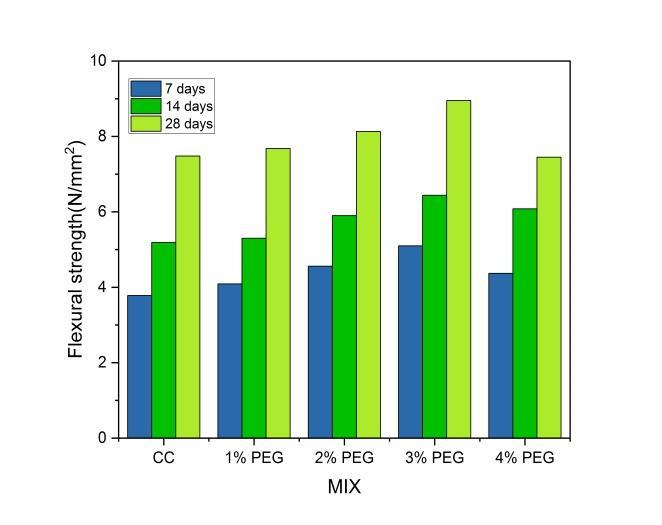
Figure 4 Flexural strength of specimens
Based on the data shown in Figure 4, it can be observed that 3% of PEG exhibited the maximum flexural strength. The flexural strength of the conventional mix exhibited a range of 7.45 N/mm2 to 7.68N/mm2,withaspecificvalueof7.48N/mm2.
ThisstudydemonstratesthepotentialofPolyethylene Glycol (PEG-400) in enhancing the self-curing properties of concrete. By effectively retaining moisture within the concrete matrix, PEG-400 contributes to improved strength development and durability. The findingsofthis researchoffer valuable insights for engineers and practitioners seeking to optimize concrete mix designs for enhanced performance and sustainability. The self-curing agent PEG-400wasfoundtobeeffective.The3%ofPEGmix attainedthebettermechanicalstrengthproperties.
The study's findings indicate that the utilization of a 3%PEGmixformulationisahighlyeffectiveapproach in attaining enhanced mechanical strength characteristics in M50 grade concrete. The potential for enhancing the performance and durability of concrete structures, as well as contributing to developments in construction materials and methods, exists with the implementation of this optimum dosage.
1. Amal Francis k, Jino John, “Experimental investigation on mechanical properties of self-curing concrete”, International Journal of EmergingVol.2,Issue3,pp641-647,2013.
2. C. Selvamony, M. S. Ravikumar, S. U. Kannan andS.BasilGnanappa,“Investigationsonselfcompacted self-curing concrete using limestone powder and clinkers”, Vol.5, No.3
ARPN Journal of Engineering and Applied, 2010.
3. Cano Barrita, B.J. Balcom, T.W. Bremner, M.B. MacMillan, W.S. Langley “Moisture distribution in drying ordinary and High performance concrete cured in simulated hot dry climate”, kluwer academic Publishers October2004
4. Chen, W., & Li, G. (2019). Compatibility Study of Polyethylene Glycol (PEG) with Different Types of Cement and Its Influence on Setting Time. Construction and Building Materials, 222,833-842.
5. Dhir, R.K., Hewlett, P.C., Lota, J.S., and Dyer, T.D.,(1996), “Influence of Microstructure on the Physical properties of Self-Curing Concrete,” ACI Materials Journal, Vol.93(5), pp.465-471.
6. El-Dieb .A.S, “Self-curing concrete: Water retention, hydration and moisture transport”, Construction and Building Materials 21 (2007),pp.1282–1287.
7. Gupta, A., Sharma, K., & Kumar, A. (2022). RecentAdvancementsinSelf-CuringConcrete Technology:AReview. Journal ofMaterialsin CivilEngineering,34(2),04021127.
8. IS 1489 : Part 1 : 2015: Portland Pozzolana Cement - Specification Part 1 Fly Ash Based (FourthRevision,NewDelhi,India.
9. Li, X., et al. (2018). Effect of polyethylene glycol (PEG-400) on mechanical properties and microstructure of cement-based materials. Construction and Building Materials,159,660-667.
10. Liang, Y., & Cui, H. (2020). Effects of Polyethylene Glycol (PEG) on Shrinkage and Cracking of Concrete. Construction and BuildingMaterials,238,117711.
11. Sharma, R., & Singh, P. (2019). Impact of Polyethylene Glycol (PEG) on the Microstructure and Durability of Concrete. CementandConcreteResearch,123,105777.
12. Wang, J.,Zhang,L.,&Li,H.(2018).Enhancing Mechanical Properties of Concrete Using Polyethylene Glycol (PEG) 4000 Admixture. Construction and Building Materials, 175, 578-587.
International Research Journal of Engineering and Technology (IRJET) e-ISSN: 2395-0056
Volume 11 Issue 04, Apr 2024 www.irjet.net p-ISSN: 2395-0072
13. Zhang, H., et al. (2019). Influence of polyethyleneglycol(PEG-400)onchlorideion penetration resistance of concrete. Construction and Building Materials, 227, 116724.
14. Zhang, Q., Wang, S., Zhang, Y., & Li, J. (2021). Long-Term Performance of Self-Curing Concrete Incorporating Polyethylene Glycol (PEG) under Different Environmental Conditions. Construction and Building Materials,283,122749.
15. Zhao, Y., et al. (2020). Effects of polyethylene glycol (PEG-400) on autogenous shrinkage and mechanical properties of highperformance concrete with different waterbinder ratios. Construction and Building Materials,232,117201.


Mr.Panneerselvam S, HeisCurrentlyworkingasan AssistantProfessorin Departmentof CivilEngineering,Vivekanandha College ofTechnology,Tiruchengode, for Women,TamilNadu,India
Uma Maheswari GK FinalyearB.EStudent, DepartmentofCivilEngineering, VivekanandhaCollegeofTechnology, Tiruchengode, for Women,TamilNadu,India