
International Research Journal of Engineering and Technology (IRJET) e-ISSN: 2395-0056
Volume: 11 Issue: 04 | Apr 2024 www.irjet.net p-ISSN: 2395-0072
International Research Journal of Engineering and Technology (IRJET) e-ISSN: 2395-0056
Volume: 11 Issue: 04 | Apr 2024 www.irjet.net p-ISSN: 2395-0072
Gaytri
Sirskar1 , Mrunali Wande2 , Bhagyashree Bobde3 , Dhanraj Morkhade4 , Nandan Pokale5, Prof. S. R. Gudadhe6
1,2,3,4,5 Students of Final Year, Sipna College of Engineering and Technology, Amravati, Maharashtra, India 6Assistant Professor, Department of Computer Science and Engineering, Sipna College of Engineering and Technology, Amravati, Maharashtra, India
Abstract – Digitalizeddataisrequiredinthemoderndayto enable speedier task completion and processing. Extracting the text from the images is the most effective technique to digitalizethem.Manytextidentificationtaskincluding image textrecognitionandopticalcharacterrecognitioncanbeused to process text. The technology of optical character recognition(OCR) was used to transform printed text into editable text. In a variety of applications, OCR is very helpful and popular approach Text preparation and segmentation techniquescaninfluenceOCRaccuracy. Itisatechnologythat recognizes text within a digital image.
These days, there is a huge need for information that may be found on paper, such books or newspapers. Information can currently be stored by scanning the desired text, but this method just saves the data as an image that cannot be processed further. For example, text recorded in scanned photos cannot be read line by line or word by word; we would have to completely redo the language included in these images before we could use them again. Text detection from papers when text is integrated in intricately colored document images is an extremely difficult problem. Many possible users would like to extract text from documents, archive documents, and other images. The user needs optical character recognition (OCR) because of this. Its goal is to identify textual areas in the document and distinguish them from the graphical section. obtaining data straight from application forms and greatly reducing time.
This study explains the basic ideas behind the OCR, including feature extraction strategies, picture preprocessing approaches, and recognition algorithms. It highlights significant turning points and innovations as it examines the development of OCR technology from early character recognition systems to contemporary deep learning-based techniques
Key Words: Optical Character Recognition, Tesseract, Python, Django, Image Preprocessing, OpenCV
Theneedforeffectiveandquickdocumentprocessingand digitization has increased in an increasingly digital
environment. Manual data entry and document handling techniques are time-consuming and error-prone, which reduces productivity and obstructs the smooth flow of information.Thisenvironmenthascompletelychangedwith the introduction of optical character recognition(OCR) technology,Whichmakesitpossibletoautomaticallyextract text from photographs and expedite the digitalization of documents.Tofulfilltheneedsofcontemporaryinformation processingrequirements,OCRsystemsspeedandefficiency arestillvitalcomponents.
OCRiscommonlyutilizedinbanking,whereitcanprocess demand drafts and checks without the need for human intervention.Withtheuseofasmartphonecamera,onecan instantaneouslyscanthewritingonademanddraftorcheck, transferring the exact amount of money. This method is fairlyaccurateforhandwrittendemanddraftsorchecksas well,howeversignatureverificationisnecessary.Itisalmost perfected for printed demand drafts or checks. A notable trendtowarddigitizingpaperdocumentshasalsoemerged inthelegalsector.Documentsarebeingdigitizedtoreduce storage requirements and do away with the need to go through bins of paper files. By enabling text searching for documents, OCR streamlines the process even further by makingit simpler to findandmanipulate them withinthe database. Legal practitioners can now quickly and easily search through a vast electronic document repository by onlyenteringafewkeywords.Numerousotherindustries, likeaseducation,banking,andgovernmentorganizations, heavilyrelyonOCR.Ourtechnologyisreadytoenable not justfastertransitionstopaperlesssettingsbutalsohigher levelsofdataaccessibilityandaccuracy,fromthelegaltothe financial,healthcareandgovernmentsectors.
Aneyecanrecognize,viewandextracttextfromimages,but person’sbrainmustanalyzeanytextthattheeyedetectsor extracts. Naturally, OCR technology is still not as sophisticatedashumantalent.Thequalityoftheinputthat the eye reads directly affects hoe well the brain functions when it comes to text recognition in humans. Numerous issues and difficulties may arise during the planning and execution of a computarized optical character recognition system. For instance some figures and letters differ just enoughfrmoneanotherforcomputerstoaccuratelyidentify
International Research Journal of Engineering and Technology (IRJET) e-ISSN: 2395-0056
Volume: 11 Issue: 04 | Apr 2024 www.irjet.net p-ISSN: 2395-0072
them and separate them from one another. For instance, computerscouldfinditdifficulttodistinguishbetweenthe numbers”0”and”o”,particurallywhenthischaractersare incorporatedintoaloud,extremelyblackbackground.
ProirOCRtechnologyresearchhasmostlyconcentratedon managing multilingual text, increasing accuracy, and connecting with different web application frameworks. TesseractOCRhasbecomeawell-likedoptionbecauseofits ongoingdevelopmentandopen-sourcenature.Researchhas demonstrated how well Tesseract OCR works to reliably extracttextfromimagesinavarietyoflanguages.
Although character recognition is not a brand-new issue, its origins can be found in earlier computerrelated technologies. The first optical character recognition (OCR) systems were mechanical devices rather than computers, and they could recognize characterswithrelativelylowprecisionandveryslow speed.OneoftheearliestexamplesofmodernOCRis the reading and robot GISMO, created in 1951 by M. Sheppard[1].GISMOisabletoreadindividualwordson aprintedpageaswellasmusicalnotation.Itcanonly identify 23 characters, though. A typewritten page could also be copied by the machine. In 1954, J. Rainbow invented a device that can read one capital typewrittenEnglishcharactereachminute.Thefaults andpoorrecognitionspeedoftheinitialOCRsystems drewcriticism.Asaresult,duringthe1960sand1970s, little research was done on the subject. The only developments were made to huge enterprises and governmentorganizations,suchasbanks,newspapers, airlines,andsoon.
It was decided that three OCR typefaces should be standardized in order to make the process of recognition for OCR easier due to the difficulties involved. As a result, in 1970, ANSI and EMCA establishedOCRAandOCRB,whichofferedrecognition ratesthatweregenerallyacceptable[2].
A significant amount of study has been done on OCR over the last thirty years. As a result, multilingual, handwritten,omni-font,anddocumentimageanalysis (DIA)haveemerged[2].Evenafterallofthisresearch, themachine'sreliabilityinreadingtextisstillfarbehind thatofahuman.Therefore,currentOCRresearchaims toincreaseOCRspeedandaccuracyfortextsauthored in a variety of styles and printed in unrestricted situations.Thereisn'tanycommercial oropensource softwareavailablefordifficultlanguageslikeSindhior Urdu,forexample.
“ExtractingTextfromImageDocumentandDisplaying ITS Related Information”, K. N. Natei[3], journal of
EngineeringResearchandApplication:Imagetextistext that has been written or inserted into an image in a variety of formats. Captured photos, scanned papers, periodicals, newspapers, posters, and other materials can all contain visual text. The representation, description,andtransmissionofinformationthatthese imagetexts whicharewidelyavailablethesedays help people with communication, problem-solving, availability, the creation of new job types, costeffectiveness, productivity, globalization, and cultural gaps, among other things. If these picture documents' content were transformed to text, it would be more accessibleandefficient.Textextractionisthemethodby whichimagetextistransformedintoplaintextsothata computercanidentifyitsASCIIcharacters.
“Text Recognition using Image Processing”, InternationaljournalofAdvancedResearchinComputer Science: Text recognition by optical character recognition(OCR)usesacomputersystemintendedto convert images of typewritten text into machineeditable text or photographs of characters into a commonencodingscheme.OCRwasfirstestablishedas a subject of study in computer vision and artificial intelligence.Textrecognitionisemployedinreal-world applicationswherewewishtoextractinformationfrom text written images, such as in post offices, banks, colleges,andotherformaltaskswherealotofdatamust betyped.
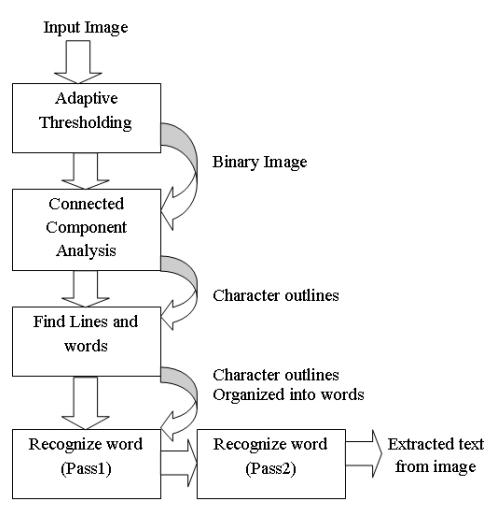
Tesseract is an open-source optical character recognition (OCR) engine. This flowchart shows the text extraction procedure[1].Tesseractisusedtoextracttextfromphotos andtranslateitintomachine-readableprogramming.
International Research Journal of Engineering and Technology (IRJET) e-ISSN: 2395-0056
Volume: 11 Issue: 04 | Apr 2024 www.irjet.net p-ISSN: 2395-0072
Theflowchartshowstheseveralstepsinthisprocess:
Theinputimageisthefirstpicturefromwhichyouwantto extractthetext.AdaptiveThresholding:Thisphasecreatesa binary picture from the supplied grayscale image. It is simpler to differentiate text from background in a binary imagesinceitsimplyhasblackandwhitepixels.Connected ComponentAnalysis:Inthiscase,theimageisexaminedto determineanddistinguishconnectedcomponents,whichare collections of black pixels that correspond to the text's letters.CharacterOutlines:Charactershapesarerefinedby creatingoutlinearoundtheconnectingcomponents.Locate LinesandWords:Theprogramlocatesanddividestextlines aswellasspecificwordsinsidethoselines.NametheWord (Pass1&2):Toprocessthedetectedwords,Tesseractusesa two-passrecognitionalgorithm.Itmakesanefforttoidentify eachwordseparatelyonthefirstpass.Highconfidenceword recognition is utilized to teach the OCR engine, increasing theaccuracyofthesecondrun.Inthesecondpass,Tesseract appliestheknowledgegainedfromthefirstruntoimprove its analysis of the remaining words. Extracted Text from Image: The output containing the identifiedtextisprovidedatthispoint.
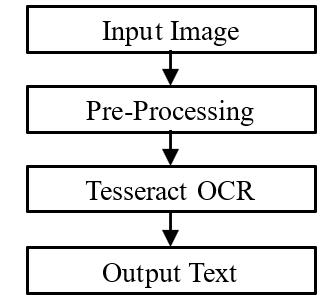
Fig-2 :Stepstogenerateoutputtextfrominputtext
Inordertodesign,construct,anevaluatethesuggestedOCR systemintegratedinsidetheDjangoframework,alongwith the integration of a prediction data, a methodical set of proceduresisusedinthisstudy.
4.1
The OCR systems architecture is painstakingly constructed withintheDjangoframeworkduringthefirst phase of system design.For text extraction, language selection, and accuracy analysis intregration, this means creating modular components that can be added to the systemtoguaranteesmoothoperationandcommunication.
4.2
Afterthatavarieddatasetisgatheredfortrainingand testing that includes pictures with text in Hindi, Marathi,
English.TheOCRsystemistrainedonthisdataset,whichis also used to access the system’s performance in variance languagesituations.
The collected photos are preprocessed before being usedinordertoimprovetextvisibilityandmaximizeOCR accuracy.
To ensure the best conditions for text extraction, this preprocessingprocessesmayincludecontrastmodification, noisereduction,andimageenhancement.
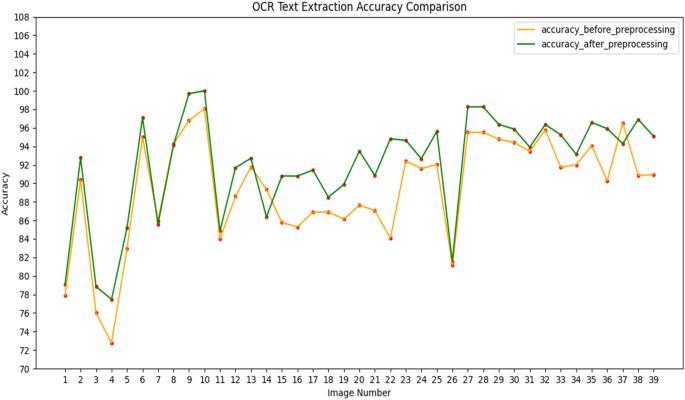
Chart-1 :AccuracyofImagePreprocessing
Tesseract OCR integration with Django for web application development constitutes the fundamental implementation phase. This includes creating strong functionsforlanguageselection,textextraction,andchatbot integration while combining the best features of both systems. In addition, language selection capability is designedtoimproveuserexperience byenablingusers to designatetheirpreferredlanguagefortextextraction.
To determine its correctness and effectiveness in a range of linguistic contexts, the developed system is put throughathoroughtestingandassessmentprocess.TheOCR systemsperformanceistestedusingavarietyofphotoswith textinvariouslanguages.
International Research Journal of Engineering and Technology (IRJET) e-ISSN: 2395-0056
Volume: 11 Issue: 04 | Apr 2024 www.irjet.net p-ISSN: 2395-0072
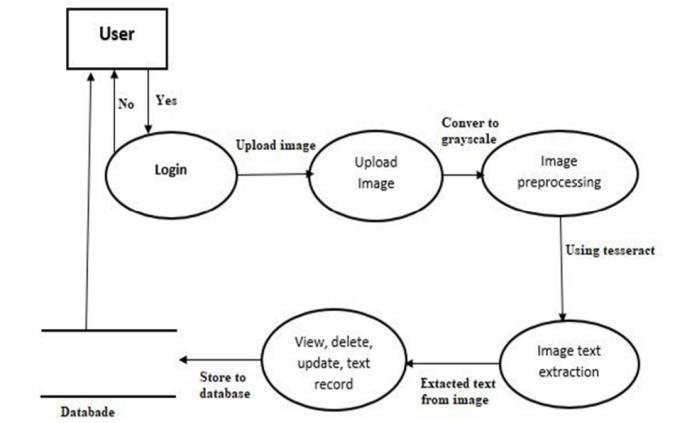
Fig-3:BlockDiagram
The process's steps are as follows, as depicted in the flowchart:
User: The user engages with the system to start the procedure.Loggingintoawebsiteorapplicationmaybe necessaryforthis.
Upload Image: The user uploads an image file to the systembychoosingitfromtheirdevice.
Yes/NoDecision:Theusermaybeaskedbythesystem iftheywouldliketopreprocesstheimage.Resizingthe image, changing its format, or adding filters are examplesofpreprocessing.
ConverttoGrayscale(Optional):Theimageisconverted to grayscale if the user selects "yes" in the preceding stage.Thiscanhelptheimage'sfile size decrease and improveitsdatabasestorageefficiency.
Image Upload: The database receives the submitted image. The picture data is kept in the database, along withanyotherdetailsabouttheimage,likethefilename, size,anduploaddate.
StoretoDatabase:Thedatabasecontainsacopyofthe uploadedpicturetogetherwithanyfurtherdetailsabout it.
View, Delete, Update, Text Record: The user has the ability to view, delete, or update the database-stored details about the image. A caption, tags, or other descriptivetextmaybeapartofthisinformation.
Theobjectivebehindthedevelopedmodelasitispresented is to take in a lot of photographs of people's identity
documents and categorize them into groups, like licenses andpassports.Thetextextractionmoduleisappliedtothe photosoncetheyhavebeenclassed.Fromthecategorized photos,thetextdataistakenout.Followingtheextractionof thecredentialsfromthepictures,keptwithinthedatabase. Extracting Texts The Tesseract OCR package is used to implementtextextraction.Itconsistsofthecommandline toolTesseractandtheopticalcharacterrecognition(OCR) enginelibtesseract.TheLongShort-TermMemory(LSTM) based OCR engine in Tesseract is a novel neural net that specializes in line recognition while also recognizing characterpatterns.Therecurrentneuralnetwork'sbuilding block is the LSTM network. Python-Tesseract is an OCR (opticalcharacterrecognition)toolfortextextraction.
Inpreviousyears,researchonOCRhasbeenconductedina widerangeofdirections Thissectionaddressesthevarious kinds of OCR systems that developed as a consequence of these studies.These systemscanbegroupedaccording to factorslikefontlimitations,characterconnection,andimage acquisition mode. Fig. 4 classifies the system of character recognition.
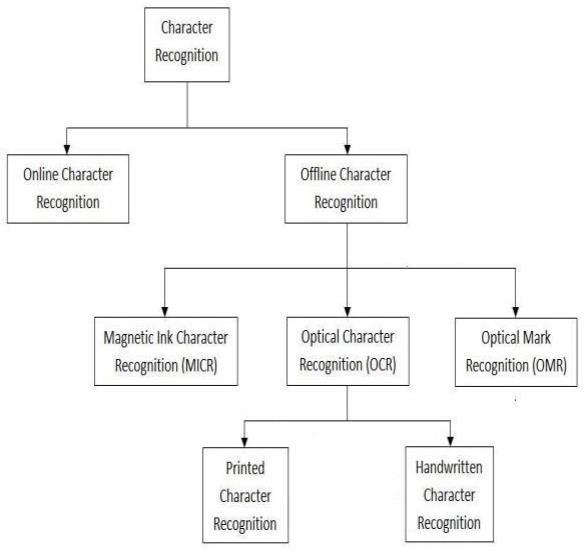
OCR systems fall into two categories: machine printed character recognition and handwriting recognition, depending on the type of input. Because characters in the former case are typically of a uniform dimensions and characterplacementsonthepagearepredictable[3].
Character recognition in handwriting is a particularly difficulttasksincevarioususershavedistinctwritingstyles andutilizediversepenmovementsforthesamecharacter. These systems can be further subdivided into online and offlinesystems. Whileusers are writing thecharacter,the former is done in real time. Because they may record
International Research Journal of Engineering and Technology (IRJET) e-ISSN: 2395-0056
Volume: 11 Issue: 04 | Apr 2024 www.irjet.net p-ISSN: 2395-0072
temporal or time-based data, such as speed, velocity, the quantity of strokes created, the direction in which the strokes are written, etc., they are less complicated. Additionally,sincethepen'straceisonlyafewpixelsbroad, thinning procedures are not necessary. The bitmap input usedbyofflinerecognitionsystemsisstaticdata.Asaresult, performingrecognitionisquitechallenging.
Due to their ease of development, high precision, and compatibility with tablets and PDAs, online systems have becomewidelyavailable[4].
OCRmakesagreatdealofbeneficialapplicationspossible. OCR wasfirstapplied in mail sorting,bank check reading, andsignatureverification[5].Organizationscanalsoutilize OCR for automated form processing in locations where a largeamountofdataisavailableinprintedform.OCRisalso used for automatic number plate recognition, pen computing,passportvalidation`,utilitybillprocessing,and otherpurposes[6].OCRisalsohelpfulformakingtexteasier toreadforblindandvisuallyimpairedindividuals[7].
9. SNAPSHOTS
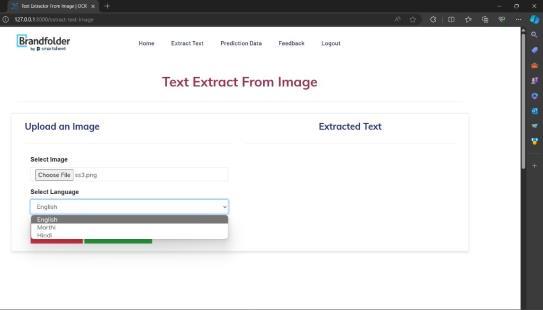
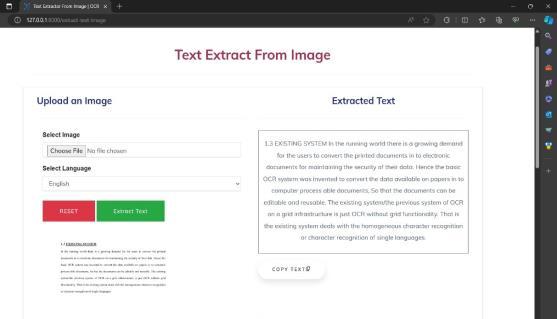
Accuracy Analysis
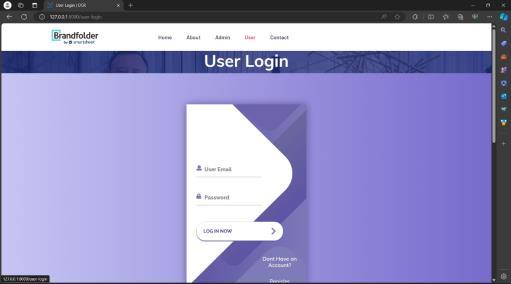
A. User Login Page B. Home Page

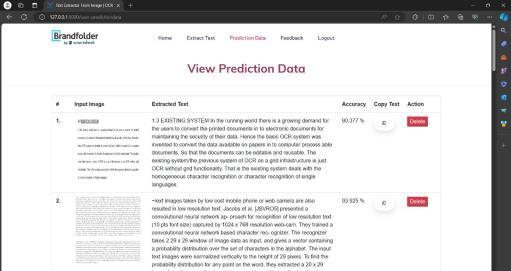

International Research Journal of Engineering and Technology (IRJET) e-ISSN: 2395-0056
Volume: 11 Issue: 04 | Apr 2024 www.irjet.net p-ISSN: 2395-0072
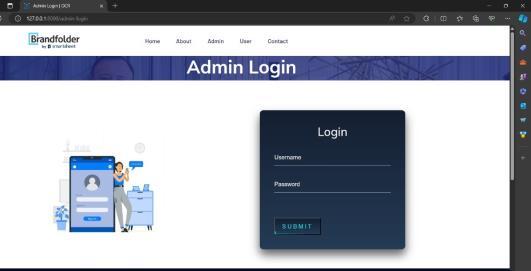
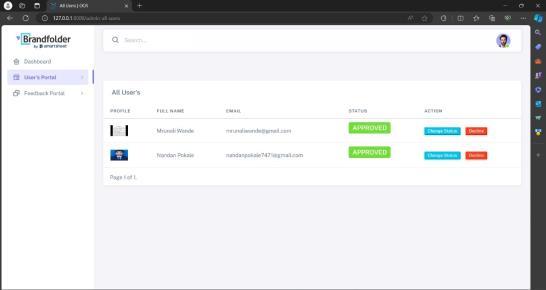
An OCR systems future score is predicted by taking into account a number of variables, such as technological developments,continuousR&Dinitiativesandprospective shifts in user needs and preferences. Even though it’s difficult to assign a precise numerical score for an OCR systemsfutureperformance,wemaymakeeducatedguesses aboutpossiblebreakthroughandareasforworkthatmight boostthesystemsoveralleffectiveness.Takingintoaccount thefollowingfactors.
TheOCRtechnologyhasadvanced.FutureversionsofOCR systemsareprobabilitygoingtogainforbetteralgorithms, more advanced image processing methods, and more languagesupportasOCRtechnologygetsbetter.Thismay resultinimprovedhandlingofvarioustextlayoutsandfonts, increasedaccuracyratesandquickerprocessingtimes.
Usingmachinelearning(ML)andartificialintelligence(AI) Methods in OCR systems has the protencial to increase performance and accuracy. Future optical character recognition(OCR)systemscouldbecomesmoreaccurateand efficient, especially in noisy or complicated contacts, by utilizing AI models for text interpretation and character recognition.
FuturesOCRsystemsareanticipatedtoprovideincreased languagesupport, incompassingawiderrangeoflanguages anddialects, thedemandformultilingualOCRsolutionsis driven by globalization. As a result user would be able to realiably and accurately extract text from images in their ownlanguages.
Userexperiencedweprobablywillbegiventoppriorityin future OCR systems, which will likely include more userfriendly interfaces, smooth work flow integration and improved accessibility features to make OCR technology more accessible to people with disability might involve support for assistive technologies like screen reader and voicecommands
The application which is proposed in this report can be effectivewhichwillsavealotoftimeandmoneyofcommon people The primary goal in creating this program was to automatetheprocessofcreatingasystemthatcanreliably andeffectivelyrecognizetextfrompictures,textimages,and scanned documents so that it can be used again at a later time.ThisarticleaimstoprovideanoverviewofWhatisthe purposeoftheproject,whattechnologiesarebeingutilized, whatdatabaseisbeingused,whytheapplicationneedstobe developed, and what methods are needed to make the projectwork
[1] Satti,D.A.,2013,OfflineUrduNastaliqOCRforPrinted TextusingAnalyticalApproach.MSthesisreportQuaidi-AzamUniversity:Islamabad,Pakistan.p.141.
[2] Mahmoud, S.A., & Al-Badr, B., 1995, Survey and bibliographyofArabic optical textrecognition. Signal processing,41(1),49-77.
[3] Bhansali,M.,&Kumar,P,2013,AnAlternativeMethod forFacilitatingChequeClearanceUsingSmartPhones Application. International Journal of Application or Innovation in Engineering & Management (IJAIEM), 2(1),211-217.
[4] Qadri, M.T., & Asif, M, 2009, Automatic Number Plate Recognition System for Vehicle Identification Using Optical Character Recognition presented at InternationalConferenceonEducationTechnologyand Computer,Singapore,2009.Singapore:IEEE.
[5] “Extractingtextfromimagedocumentanddisplaying its related information”, K.N. Natei journal of Engineering Research and Application (ISSN : 22489622,Vol.8,Issue5(Part-V)May2018
[6] K. Gaurav and Bhatia P. K., “Analytical Review of Preprocessing Techniques for Offline Handwritten CharacterRecognition”,2ndInternationalConference on Emerging Trends in Engineering & Management, ICETEM,2013.
[7] Shen,H.,&Coughlan,J.M,2012,TowardsARealTime System for Finding and Reading Signs for Visually
International Research Journal of Engineering and Technology (IRJET) e-ISSN: 2395-0056
ImpairedUsers.ComputersHelpingPeoplewithSpecial Needs.Linz,Austria:SpringerInternationalPublishing.
[8] Bhavani, S., & Thanushkodi, K, 2010, A Survey On Coding Algorithms In Medical Image Compression. International Journal on Computer Science and Engineering,2(5),1429-1434.
[9] Bhammar,M.B.,&Mehta,K.A,2012,Surveyofvarious imagecompressiontechniques.InternationalJournalon DarshanInstituteofEngineeringResearch&Emerging Technologies,1(1),85-90.
Volume: 11 Issue: 04 | Apr 2024 www.irjet.net p-ISSN: 2395-0072 © 2024, IRJET | Impact Factor value: 8.226 | ISO 9001:2008
|