
International Research Journal of Engineering and Technology (IRJET) e-ISSN: 2395-0056
Volume: 11 Issue: 04 | Apr 2024 www.irjet.net p-ISSN: 2395-0072
Akanksha

International Research Journal of Engineering and Technology (IRJET) e-ISSN: 2395-0056
Volume: 11 Issue: 04 | Apr 2024 www.irjet.net p-ISSN: 2395-0072
Akanksha
Kadu1 , Ankit Bais2 , Ansh Monga3 , Mrunmai Jawalekar4 ,Prof. Aditya Sable5
1Student, Dept. of CSE Engineering, PRMITR college Maharashtra, India
2Student, Dept. of CSE Engineering, PRMITR college Maharashtra, India
3Student, Dept. of CSE Engineering, PRMITR college Maharashtra, India
4Student, Dept. of CSE Engineering, PRMITR college Maharashtra, India
5Professor, Dept. of CSE Engineering, PRMIT&R college ,Maharashtra, India
Abstract - The agricultural sector is undergoing a significant transformation with the integration of modern technologies.Oneofthemostinfluentialtechnologiesinthis regard is the Internet of Things (IoT). The use of IoT in hydroponic farming is examined in this research, with a particular emphasis on remote monitoring and control systems.Thereportdelvesintothebenefits,challenges,and potential futuredevelopmentsof utilizingIoTfor efficient and sustainable agricultural practices. The integration of Internet of Things (IoT) technology further elevates hydroponic farming, enabling precise monitoring and control of crucial parameters such as nutrient levels, temperature,humidity,pHbalance,andlightexposure.The abstracthighlightsthebenefitsofIoTinhydroponicfarming, whilealsoaddressingthechallengesposedbyconnectivity, datasecurity,andcost.
Keywords: Hydroponic Farming, Internet of things (IoT), crucialparameters,connectivity,monitoring,controlsystem, crop.
AgricultureisvitalinIndia,whereasignificantportionofthe population depends on it for economic sustenance and development.Traditionalfarmingfaceschallengessuchas unpredictable weather and crop diseases, necessitating modernization.HydroponicFarming,aidedbydeviceslike NodeMCU,allowsforcontrolledcultivationenvironments. Distant monitoring and control are becoming common in businessandacademicresearchnowadays.IoTcanbeused to implement this. IoT has been employed in hydroponic farmingbyanumberofresearchers.
With the help of extra nutrients, plants are grown hydroponically without the need for soil. The roots of the plantsaredirectlyexposedtothemineralnutrientsolution. Thisguaranteestheplant'scontinued,healthygrowth.The irrigation system, and crucial parameters such as temperature,humidity,moistureandpHbalancearejusta few of the ways in which IoT can be used in hydroponic farming.
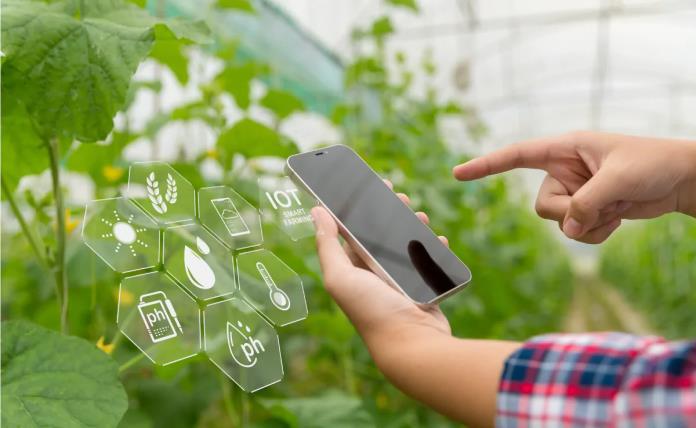
Traditionally, agricultural operations required significant physical presence, making it challenging for farmers to monitor vast fields or address issues promptly. With IoTenabled remote monitoring, farmers can gather real-time information about soil moisture levels, temperature variations, crop health, and livestock conditions without beingphysicallypresentonthefield.Moreover,IoTenables remote control, allowing farmers to adjust irrigation systems, apply fertilizers, and even manage automated machinery from a centralized location. This technology promotes sustainable agriculture by reducing chemical reliance, enhancing crop yield, and offering disaster preventioncapabilities.
Dr. Asawari Dudwadkar, et al. This research focuses on designingahydroponicsystemwhichensureshighergrowth rate with controlled environment. The main function of hydroponicsystemistomonitorandtocontrolparameters withthehelpofactuatorspresentinthesystem.Apartfrom that, remote monitoring and controlling of the artificial environmentisalsodoneusingIoTbasedapplications[1].
Rachana Reddy, et al. “Overview on precision agriculture usingIoTtechnology”.Itexploreshowsensordata,including temperature,andlightlevels,canbecollectedandprocessed foroptimizedirrigationandfertilization[2].
International Research Journal of Engineering and Technology (IRJET) e-ISSN: 2395-0056
Volume: 11 Issue: 04 | Apr 2024 www.irjet.net p-ISSN: 2395-0072
AdityaVishwakarma,etal.ThisresearchfocusesonanIoTbased smart greenhouse system for monitoring and controlling environmental factors. It covers aspects like temperature,humidity,light,andirrigationcontrolthrough sensor integration and remote access. The data collected from all the sensors are converted into digital signals and giventotheNodeMCUmoduleforprocessing[3].
DileepKumar,etal.Thisresearchhelpsinunderstandingthe scope of this project and how it is used to control the environmental parameters which affect the crop and to monitor the system remotely using a wireless network connection. It consists of micro controller, sensors and actuatorsforprocessing.Itmaybeusedtoproviderequired environmentalvariablesforcultivationofthenon-seasonal crops. The provision of suitable environment will also improvecropproduction[4].
Akshaya Krishna, et al. A project report on an automated hydroponicsystemwithIoTintegrationthatincludesremote monitoring and control capabilities. The report provides insightsintosystemarchitecture,sensorselection,andthe userinterface[5].
Smith, J., Johnson, A., & Williams, B. "IoT-Based Smart HydroponicSystemsforSustainableAgriculture".Thispaper discusses the implementation of IoT technology in hydroponic systems, focusing on remote monitoring and control.Itpresentsacasestudyofahydroponicfarmwhere IoT sensors and actuators are used to optimize resource utilization[6].
Garcia, R., Martinez, E., & Perez, T. "Wireless Sensor Networks for Precision Agriculture in Hydroponics". This researchpaperexplorestheuseofwirelesssensornetworks (WSNs) for data collection and control in hydroponic farming.Itemphasizestheimportanceofreal-timedatain makinginformeddecisionsforcropmanagement[7].
Amjad Rehman et, al. This research investigates IoT in agriculture, focusing on its applications, advantages and monitoringtechnologies.Itseekstoenhancecropyieldand resourcemanagement,includingwaterirrigation,crops,and fertilizers[8].
Patel, S., Sharma, A., & Gupta, R. "IoT-Based Automated NutrientDeliverySystemforHydroponicGreenhouses".This paperfocusesonthedesignandimplementationofanIoTbasedautomated nutrientdeliverysystemforhydroponic greenhouses.ItdiscusseshowIoTtechnologycanenhance nutrientmanagementforimprovedcropyields[9].
Kumar, P., & Kumar, S. "A Review of IoT Applications in Agriculture".Whilenotspecifictohydroponics,thisreview paper provides an overview of IoT applications in agriculture. It highlights the role of IoT in enhancing precision agriculture and remote monitoring in various farmingpractices[10].
Das,S.,&Bhattacharya,S."IoT-EnabledSmartGreenhouse:A Review of Recent Developments". This review paper discusses recent developments in IoT-enabled smart greenhouses, which are closely related to hydroponic farming. It covers various aspects, including remote monitoringandcontrol[11]
3.1
The hydroponic system's ability to monitor and control the system's settings is one of its many uses. In addition, one of the key objectives is to collect, store and analyze the data, and provide a user interface. The entire systemcanbedividedintotwosubsystems:Hardwareand theSoftware.
Thehardwareassemblyisresponsiblefortheprocessesand control over the system. This includes circuitry which containssensorsliketemperatureandhumiditysensor,pH sensor, moisture sensors, all of which will determine the conditionofwaterandtheenvironmentwheretheplantsare kept. Along with sensors, the circuitry also consists of actuatorslikethewaterpump,etc.Amicrocontrollerknown as NodeMCU is attached to each sensor and actuator. NodeMCUEsp8266isadevelopmentkitwhichcanconnect with a wifi network and process the data collected by the sensors.Itlooksafterthecontrolofthesystem.
Thesoftwarepartofthesystemincludesacloudserverand acontrollerwhichisconnectedtothemicrocontroller.This cloud server can also be connected to an online database whichupdatesthesensorvaluesandstatusoftheactuators. Becauseofthis,thesystemcanbemonitoredandcontrolled fromadistance.Allthisdatacanbeseenandcontrolledon ourAndroidApplication.
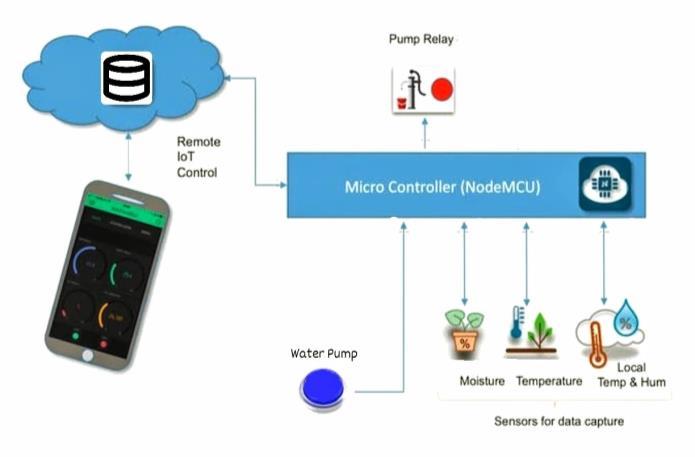
Fig -2: SystemOverview
Volume: 11 Issue: 04 | Apr 2024
1. Digital Humidity and Temperature (DHT11) sensor: DHT11isabasic,low-costdigitaltemperatureandhumidity sensor.Itusesanelectricalphenomenonhumiditydetector and a semiconductor device to measure the surrounding atmosphereandthendisplaysadigitalsignalonthedatapin. Inthissystem,itisusedtokeepacheckonthetemperature andhumidityintheartificiallyconcoctedenvironment.
2. pH sensor: A pH sensor is typically used to check the quality of water or any other solution. It measures the amount of alkalinity and acidity in solutions. When used correctly,pHsensorscanalsobeusedtocheckthequantity ofimpuritiesinthesolution.Inhydroponics,apHsensoris used to measure the acidity and alkalinity of solution showing a value between 0-14. pH value and what it indicates:
ApHof7indicatesthatthesolutionisneutral.
IfthepHisbetween0-7thenthesolutionisacidic.
pH is between 7 - 14 then the water is alkaline. In our system,thepHvalueofthewaterwillhelpustodetermine thequantityofnutrientspresentinwater.
3. Moisture sensor: Moisture sensor is used to measure watercontent.Itconsistsoftwoprobesforpassingcurrent throughthecocopeat,anditsensestheresistanceinorder toacquirethemoisturelevelfromthepeat.
4. Node MCU: NodeMCU(NodeMicroControllerUnit)isa microcontrollerwhichisusedto processdata thatis read fromsensorsandsendittothecloudplatformordatabase. The system's wifi functionality and overall operation are providedbyNodeMCU.
5. Relay Module: Used to regulate high voltage or high current loads, such as a water motor that serves as an actuator.Itismadetocommunicatewithmicrocontrollers liketheNodeMCU,amongothers.
Thissectiongivesthedetailsaboutthesoftwarebeingused inthissystemtocompiletheprogramonwhichthesystemis working.ThesoftwarewearegoingtouseisArduinoIDE which is a cross-platform application working over a differentplatformlikeWindows,Linux,etc.whichareused towritethefunctionsinCandC++programminglanguage.
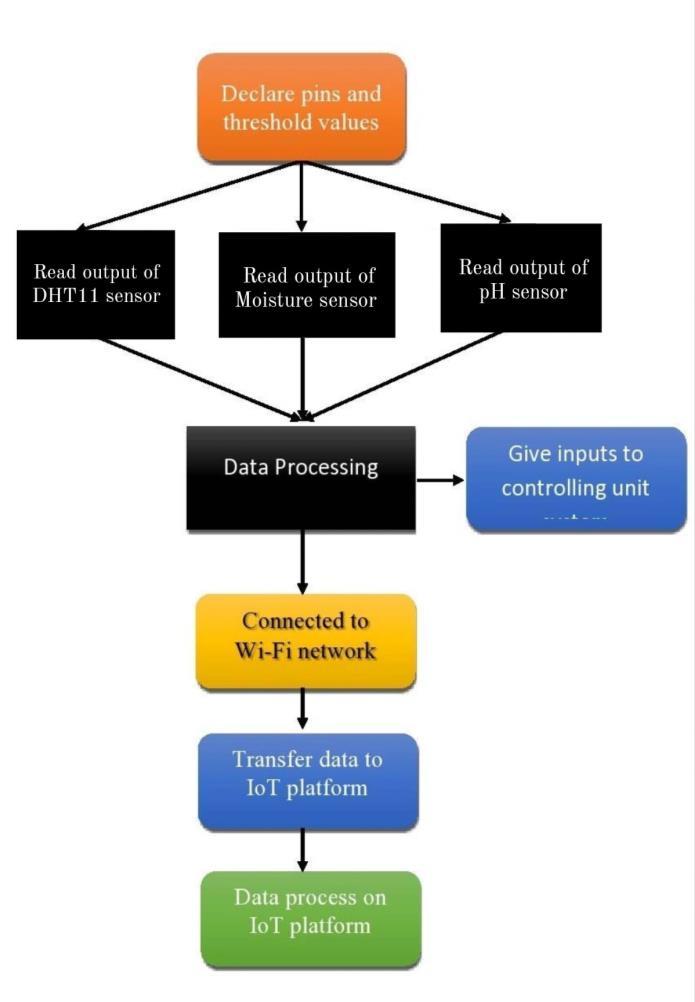
Table –1: SensorSpecification
Tomonitorallthesystemparametersdistantly,weaimto develop a web application using web technology. This application comes with an interactive-secured interface. Whenweopentheapplicationwewillfindalogin/signup page.Thepagewillhavea‘UserInterface’.Thisloginprocess willensurepropersecurityforthedatainthesystem.After enteringtherequiredcredentials,theuserwillberedirected tothenextpagetheApplication.Thenextpagewillconsistof menusfordifferentparametersi.e.Temperature,Humidity, PH-level,moisturelevelwhichwewillbemonitoringforthe plantsgrowinginthesystem.Eachparameterwillshowthe correspondingreading.
International Research Journal of Engineering and Technology (IRJET) e-ISSN: 2395-0056
Volume: 11 Issue: 04 | Apr 2024 www.irjet.net p-ISSN: 2395-0072
1. Urban and Indoor Farming:
Inurbanandindoorfarmingsetups,wherespaceislimited andenvironmentalconditionsarecritical,thisprojectcanbe invaluable.It ensures optimal conditionsfor plant growth withoutrelyingontraditionaloutdoorfarming.
2. Remote Farm Management:
The remote monitoring and control aspect is particularly beneficial for farmers who cannot be on-site all the time. They can monitor and manage their hydroponic systems fromanywherewithaninternetconnection.
3. Education and Training:
Educationalinstitutionsandhydroponictrainingcenterscan utilizethisprojectasateachingtooltoeducatestudentsand trainfuturehydroponicfarmers
4. Large-Scale Commercial Hydroponics:
Commercialhydroponicfarmscanbenefitfromthissystem by optimizing resource usage, reducing operational costs, andmaximizingcropyieldandquality.
5. Sustainable Agriculture:
The system's resource efficiency features align with sustainable agriculture practices by reducing water and nutrientwaste,makingitaneco-friendlysolution.
TheintegrationofIOTinhydroponicfarming,particularlyin remote monitoring and control systems, holds immense potentialforaddressingthechallengesofmodernfarming. Byprovidingreal-timeinsights,optimizingresourceusage, and improving overall efficiency, IoT can contribute significantly to sustainable and productive agricultural practices.Thiscanbeimplementedinhydroponicfarming whichhelpsinfastergrowthofplants.Thissystemnotonly breaks through the traditional methods of farming and improvestheentireprocessbutalsomakesitself-sufficient enoughtoproduceanythingatanytimeoftheseason.The softwareisintegratedtothehardwareoftheactualsystem such that it displays the various parameters like Temperature,Humidity,pHlevelsetc.ontheapplicationthat canbedownloadedonthesmartphoneswhichprovidethe possibilityofdistancemonitoringandcontrollingthesystem using IoT. However, addressing challenges related to connectivity,datasecurity,andaffordabilitywillbecrucialto realizingthefullbenefitsofIoTinhydroponicfarming
Theobjectiveofthissystemistoproduceaneffective, efficient, and economical model for successful monitoring andcontrollingthevegetationparameterssuchasmoisture, humidity, and inside temperature. Some future work can alsobedonetofurtheroptimizethemodel.
1. Every model needs some energy to run. Rather than workingonthedirectelectricityavailable,asmallseparate non-conventional renewal power plant can be set up to provideenergy,suchasasolarorwindpowerplant.
2.ApartfromtheDHT11,andsoilmoisturesensorusedin thisproject,someothersensorscanbefurtherintroduced suchassensorstodetectthecompositionofaircontent.
3. Irrigation technique used in this project is related to normalwaterflowthroughthepump.Buttofurtherenhance the system various irrigation techniques can be adopted suchasdripirrigation,etc.
4. The proposed model here in this project is just a small prototype,butthistechniquecanbeutilizedinsmallscale organichomefarmingtolargescaleacresoffarmingland.
5.Analysisoftheresultscanbedonetofurthergetamore accurate result, analyzing data suitable for getting the desiredoutcomewillbetheprimemottoafterthesuccessful establishmentofthemode.
1. Dr.AsawariDudwadkar,TaritDas,SakshiSuryawanshi, Rajeshwari Dolas, Tejas Kothawale, “Automated HydroponicswithRemoteMonitoringandControlusing IoT”, International Journal of Engineering Research & Technology(IJERT).Vol.9Issue06,June-2020
2. Rachana Reddy, Yash Bhojwani, Rishab Singh, “Crop SelectionandIoTBasedMonitoringSystemforPrecision Agriculture”, International Conference on Emerging Trends in Information Technology and Engineering, April2020
3. Aditya Vishwakarma, Ankit Sahu, Laxmi Shrivastava, NadeemSheikh,“IoTBasedGreenhouseMonitoringand Controlling System”, IEEE Students Conference on Engineering&Systems,July2020
4. Dileepkumar,WanodKumar,WajihaShah,“IoTbased Remote Monitoring and Control of an Agricultural Chamber”, 1st International Conference on ComputationalSciencesandTechnologies,April2019
5. Akshaya Krishna, Bivin Philip Kurian, Jain Abraham, Sojin George Sony, “Automatic Hydroponics System BasedonIoT”,July2023
International Research Journal of Engineering and Technology (IRJET) e-ISSN: 2395-0056
Volume: 11 Issue: 04 | Apr 2024 www.irjet.net p-ISSN: 2395-0072
6. Smith,J.,Johnson,A.,&Williams,B.,"IoT-BasedSmart Hydroponic Systems for Sustainable Agriculture”, International Journal of Agricultural Engineering and Technology,2017.
7. Garcia, R., Martinez, E., & Perez, T., "Wireless Sensor Networks for Precision Agriculture in Hydroponics", Sensors,2019.
8. Amjad Rehman, Tanzila Saba, Muhammad Kashif, Suliman Mohamed Fati, Saeed Ali Bahaj, Huma Chaudhry,“ARevisitofInternetofThingsTechnologies for Monitoring and Control Strategies in Smart Agriculture”,January2022.
9. Patel,S.,Sharma,A.,&Gupta,R.,"IoT-BasedAutomated NutrientDeliverySystemforHydroponicGreenhouses", InternationalJournalofAdvancedResearchinComputer Engineering&Technology,2020.
10. Kumar,P.,&Kumar,S.,"AReviewofIoTApplicationsin Agriculture",ComputersandElectronicsinAgriculture, 2019.
11. Das, S., & Bhattacharya, S., "IoT-Enabled Smart Greenhouse: A Review of Recent Developments", SustainableComputing:InformaticsandSystems,2021.