
Volume: 11 Issue: 04 | Apr 2024 www.irjet.net p-ISSN:2395-0072
Volume: 11 Issue: 04 | Apr 2024 www.irjet.net p-ISSN:2395-0072
Tukaram Bhavar1, Navnath B. Pokale2, Ashwini Garad3,Prashant Chavan4 , Rachana Varpe 5 , Sushen Gajare6
2 Assistant Professor TSSM BSCOER College of Engineering Narhe 1,3,4,56Undergraduate Students, Department of Computer Engineering, TSSM BSCOER, Savitribai Phule Pune University, Pune 411041, India
Abstract - The emergence of blockchain technology has paved the way for innovative solutions across various domains, and one such area ripe for disruption is the electoral process. In this research paper, we present a comprehensive study and implementation of a blockchainbased electronic voting (e-voting) system. Our system leverages thecapabilities ofleadingblockchaindevelopment tools such as Truffle, MetaMask, and Ganache to create a secure, transparent, and tamper-resistant platform for conductingelections.
The project involves creating a decentralized application (DApp)throughtheutilizationoftheTruffle framework.This framework streamlines the deployment and interaction with smart contracts on the Ethereum blockchain. MetaMask, a popular Ethereum wallet and browser extension, is integrated into our system to provide a user-friendly interface for voters to access and participate in elections securely. Additionally, Ganache, a personal blockchain for Ethereum development, is utilized for local testing and debugging purposes, ensuring the robustness and reliability of the e-voting system. Through this research, we aim to contribute to the advancement of e-democracy by proposing a practical solution that enhances the integrity and trustworthiness of electoral processes. By harnessing the power of blockchaintechnology. Our e-votingsystem offers a promising avenue for achieving fair and secure elections in thedigitalpage.
Key Words: Blockchain, Ethereum, D-Apps, Smart Contract,MetaMask,Ganache,TruffleFramework
1.
Blockchain solves those problems which the centralized application is facing, that’s why blockchain is a better choice for building a voting application[1]. In today's societal landscape, there is a pressing demand for equitable and transparent electoral processes that align with contemporary social norms. The current conventional voting method lacks transparency in the tabulation of votes, leaving it vulnerable to variousforms of electoral fraud, including the infiltration of counterfeit voters and fraudulent activities within polling stations. Consequently, the imperative to establish a secure, decentralized, and fraud-resistant voting system has emerged[2].
Traditional voting systems exhibit several limitations that undermine the integrity and trustworthiness of electoral processes. These shortcomings include a lack of transparencyinthevote-countingprocess,susceptibilityto various forms of fraud, centralization of control, security concerns, and the complexity and cost associated with administration [3] However, blockchain technology presents a promising solution to these challenges by offering a decentralized, transparent, and secure framework for conducting elections. Distributed ledger technology means that there's no single point of failure, reducingtheriskofattackstargetingacentralauthority.
While the concept of e-voting predates blockchain technology, it has primarily relied on centralized computationandstoragemodelsuntilnow.Estoniastands out as a notable example, with its government pioneering oneoftheearliestfullyonlineandcomprehensivee-voting systems. The discussion on e-voting began in Estonia around 2001, gaining official traction from national authorities in the summer of 2003.The e-voting system in Estonia remainsoperational,havingundergonenumerous enhancementsandadaptationssinceitsinception.Reports indicate that the system is now highly resilient and dependable. To ensure person-specific authentication, Estonia employs smart digital ID cards and personal card readersdistributedbythegovernment[4].
One of the key features of our e-voting platform is the implementation of a permissioned blockchain, where administratorshavetheauthoritytoapprovevotersbefore they are granted access to the voting system. This ensures that only eligible voters are able to participate in the election, thereby minimizing the risk of fraudulent or unauthorizedvoting[5].
Furthermore, our system utilizes blockchain-based digital identities for voters, allowing them to authenticate themselves securely and participate in the voting process. Once authenticated, each voter is granted a one-time-only voting privilege, ensuring the integrity and fairness of the election by preventing multiple votes from the same individual.Inthefuture,IoTandblockchainwillcombineto create secure, automated systems for tracking assets, managing supply chains, monitoring health data,
International Research Journal of Engineering and Technology (IRJET) e-ISSN:2395-0056
Volume: 11 Issue: 04 | Apr 2024 www.irjet.net p-ISSN:2395-0072
optimizing energyusage,protectingthe environment, and enhancingidentityauthentication[6].
Blockchain technology is a decentralized and distributed ledger system that records transactions across multiple computers in a secure and transparent manner. Each transactionisgroupedintoa"block"andaddedtoachain ofblocks,formingachronologicalandimmutablerecordof alltransactions.
Blockchain technology boasts several key features that distinguish it from traditional centralized systems[1], [7] .Decentralization lies at the heart of blockchain, as it operatesonapeer-to-peernetwork,removingtheneedfor a central authority to validate transactions. This decentralization enhances security[8] resilience, and transparency, as control is distributed among network participants rather than concentrated in a single entity. Transparencyisafundamentalcharacteristicofblockchain, astransactionsrecordedontheblockchainarevisibletoall participants,promotingaccountabilityandtrust.
Consider a voting system in which each and every vote is totally safe, locked in, and irreversible. That is the foundation of our suggested setup the power of blockchain. It's not only about security; fairness and opennessarealsoimportant.Blockchainmakessurethere is never a single point of failure and keeps everyone accountable by sharing power across a network of nodes. Thesystemis robustenoughto continuefunctioningeven in the event of malfunctions or assaults. To preserve the integrity of the democratic process, voters, Identification Authorities,andelectoralcommissionmembersmustwork together. To put it succinctly, our mission goes beyond a votingsystemandaimstorestorefaithinourdemocracyby utilizingblockchain'srevolutionarypotentialtoconstructa dependable,transparent,androbust.
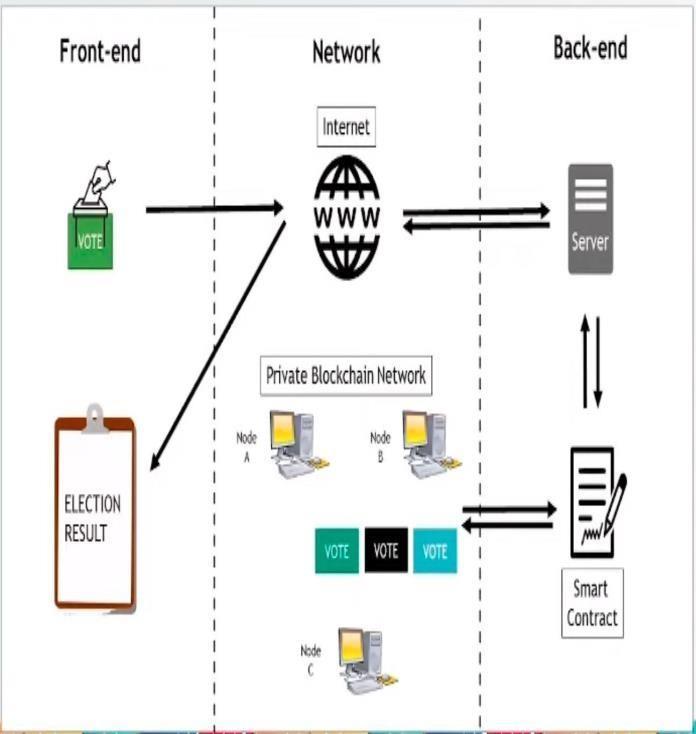
TheintricatearchitecturedepictedinFigure2encapsulates the collaborative dynamics among the principal actors Voters, VMS (Voting Management System), AA (Authentication Authority), and IA (Identification Authority) toorchestratetheintricateballetofthevoting process. Within this digital ecosystem, a decentralized application(dAPP)servesastheconduit,whetheraccessed through the familiar interface of a mobile app or the expansive canvas of a web portal, facilitating a direct and immersiveconnectionbetweenvotersandtheVMS.Atthe heart of this operation lies the Authentication Authority (AA),meticulouslysiftingthroughvoterregistrations,akin to a vigilant gatekeeper, ensuring that only the deserving find entry into the sanctum of the electoral process. Meanwhile,theIdentificationAuthority(IA)standssentinel, itsroleakintothatofameticulousscrutineer,verifyingeach voter's identity with painstaking precision, a crucial step validatedbytheVMSagainstthevastrepositoryofonlineIA records.WithinthehallowedconfinesoftheVMS,thedigital symphony of democracy unfolds, with each note meticulously composed registration, authentication, and thesecurecastingofvotes allharmonizedwiththerobust chordsofsecurity,ensuringthesanctityandintegrityofthe electoral process remains unwavering amidst the digital expanse.
3. Literature review
Sincethe1970s,electronicvotinghasbeenutilizedinmany forms, and it has several advantages over paper-based systems, including more efficiency and lower error rates. Numerous attempts have been made to investigate the viabilityofusingblockchaintosupportanefficientsolution toelectronicvotinginlightoftheremarkabledevelopment in the use of blockchain technologies. One such initiative, which uses the transparency and cryptographic underpinnings of blockchain technology to develop an
International Research Journal of Engineering and Technology (IRJET) e-ISSN:2395-0056
Volume: 11 Issue: 04 | Apr 2024 www.irjet.net p-ISSN:2395-0072
efficient e-voting solution, is discussed in this study. The suggested method has been put into practice using Multichain,anda thoroughanalysisofthemethodreveals its efficacy in meeting the essential conditions for an electronicvotingsystem.
As we move forward with this effort, our goal is to make blockchain technology more resistant to "double spending"[5],[9].
Ahybridsystemthatallowsforscenarioswherewhitelisted access is necessary but all transactions are visible to the publicisapermissioned,public,sharedblockchain.Thiswill bring about the transparency that democracies require. However, there are solutions for some of the additional issues that e-voting may bring about, such as maintaining privacy, particularly in the case of blockchains without publicapproval.OtherOneoftheissuesishowquicklythe transactions can be validated. Although blockchain technology is being hailed as the answer to many issues, computerized voting systems may be one area in which it ultimatelymakessense[10].
Comparedtothecurrentvotingmechanism,oursuggested blockchain-basedelectronicvotingofferedgreatersecurity andtransparency.Immutablecode,orsmartcontracts,are utilized to add functionality to the voting process. Web3 librariesofferanexcellentBlockchain-basedfoundationfor conductingelectronicvoting.Thevoter'svotewill bekept on file indefinitely, unaltered by anyone, and theirname will remain confidential. A blockchain-based smart contract safeguardsthevotes'confidentialityandanonymity.People rely on and trust this blockchain-based electronic voting systemtoensurethatvotesarecastforthecorrectperson andarenevertamperedwith[11].
Thisstudylooksattheadvantagesofblockchaintechnology and how it connects to the subject of online voting. The blockchainwillbepubliclyverifiedanddistributedinaway thatinhibitscorruption.Asofrightnow,attheendofthis essay, we can infer the following: We have come across a great deal of study papers about block chain technologybased electronic voting systems, and in the end, we have discovered that there are a lot of different methods and techniques for developing an electronic voting system utilizingblockchaintechnology.Thisprojecthasdeveloped intoablockchain-basedelectronicvotingsystemthatuses smartcontractsandvoteranonymityprotectiontoprovide secureandreasonablypricedelections[12].
Everycitizenwantsaclear,direct,andtransparentformof democracy, which may be had with this blockchain-based electronicvotingsystem.People'sfaithinthevotingsystem isheightened,which encouragesthemtocasttheirballots in large numbers, raising the percentage of voters. The election is conducted without the use of pens and paper, increasingvotingsystemaccuracy.Sinceeveryoneprefers time and money-efficient systems, this blockchain-based electronic voting system is appropriate for transparent democracies[13].
Numerous hundreds of transactions can be made in a secondontheEthereumPrivateBlockchain.Byusingsmart contracts, the blockchain's load is reduced. We have suggestedandputintoplaceanonlinevotingsystembased on blockchain technology to ensure people are protected duringelections.
TABLE1.Literaturesummary
SR NO.
NAME OF THEPAPER
AUTHOR SUMMARY
1. Secure Digital Voting System based on Blockchain Technology Kashif Mehboob Khan, Junaid Arshad, Muhammad Mubashir Khan cryptographic foundations and transparency toachievean effective solutiontoevoting, Multichain andin-depth evaluation
2. E-Voting systemusing Blockchain technology Aishwarya Indapwar , Manoj Chandak ,AmitJain
Structure of blockchain, challenges in votingsystem and technologies used for evoting
3. Review on Decentralized E-Voting SystemUsing Blockchain Sakshi Bachhav, Harshad Dhondge, Tejas Desale, Rohit Review on blockchain voting, flowchart for voting and registration
Deshmukh, Prof.Poonam Deokar and traditional voting vs blockchain basedvoting
4. A Review Paper on Blockchain EVotingSystem Abhimanyu Prajapati , Tanish Bankar, Rupam Patel, Prof. Ravishankar Bhaganagare
5. Online voting System Using Blockchain Kanchan Raipure, Aakansha Nakhate,Lina Ghormade, Mayuri Belkhade
Numerous ways and approaches to build an electronic votingsystem withtheaidof block chain technology.
Steps on how the system works – three phases
International Research Journal of Engineering and Technology (IRJET) e-ISSN:2395-0056
Volume: 11 Issue: 04 | Apr 2024 www.irjet.net p-ISSN:2395-0072
The Ethereum blockchain is used to provide safe and decentralizeddatastorageinthecreationofanEthereumbased electronic voting solution. The code for the application may be published to the blockchain using Ethereum'ssmart contractmechanism, guaranteeingits
shared and unchangeable nature among users. Ethereum's virtual machine smart contracts house the essential business logic of the E-voting application in this design. The application's core functions are handled by these smart contracts, which also take care of things like countingvotesanddistributingresults.Theymayruncode and enable interactions with the blockchain; they are similar to web-deployed microservices. The E-voting programme guarantees decentralization, security, and transparencyinthevotingprocessbyutilizingEthereum's features[14]. Data integrity is preserved by use of the unchangeable.
Several essential tools are required to build a Decentralized Application (DApp) and include:
A. node package manager: The node package manager (NPM). These are all included with the node.js Command Prompt.
B. Truffle Framework: Truffle may be thought of as an Ethereum blockchain developer's toolset. It assists programmers in utilizing Solidity, the Ethereum programming language, to write smart contracts. Additionally, truffle facilitates the testing and blockchain deploymentofthesesmartcontracts.Simplydo"npminstall -gtruffle"onyourterminaltoobtainTruffle.
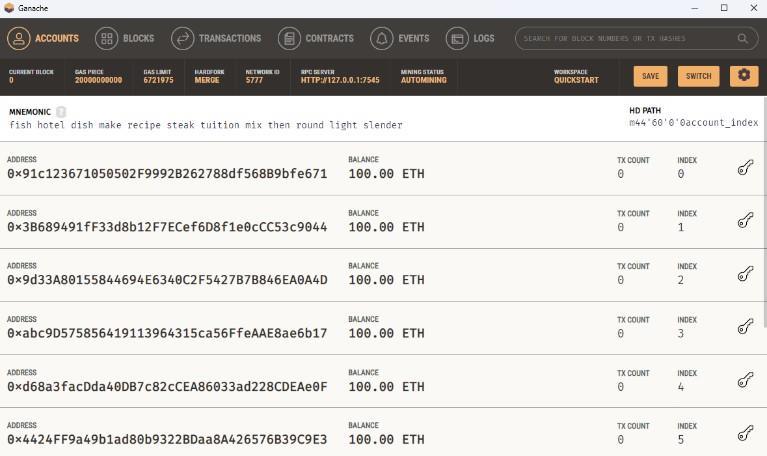
C. Ganache: As a personal blockchain designed for rapid Ethereum application development, Ganache is useful. As we create our e-voting DApp, Ganache serves as a local storage solution, giving us a comfortable environment to testandimproveourdecentralizedapplication.
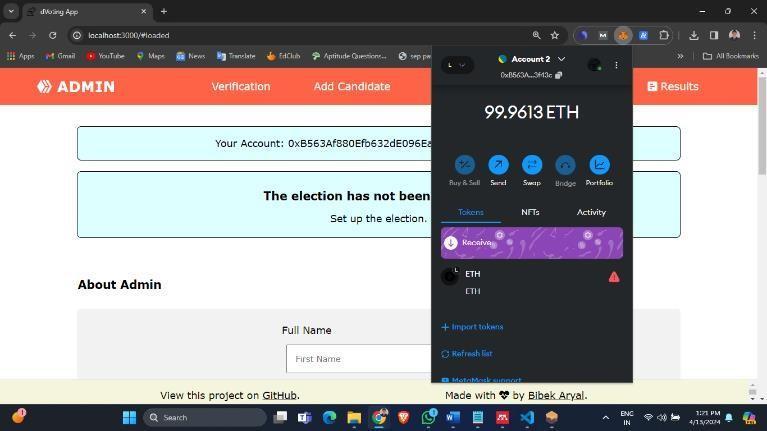
D. MetaMask: MetaMask functions similarly to an add-on for Google Chrome. It facilitates your connection to the Ethereumblockchain,amassiveonlineledger.MetaMaskis showndirectlyinyourbrowserafterinstallation.Youmay use your own account to interact with the smart contract applicationyou'vepreviouslyestablishedbyconnectingtoa local Ethereum network, which is similar to a smaller versionoftherealthing.
4.1.1 Setting up the Development Environment: First, youneedtoensureyourlocalmachineisequippedwiththe necessarytoolsforEthereumdevelopment.InstallNode.js, which includes npm, a package manager for JavaScript. Then,downloadandsetupGanache,apersonalblockchain emulator,onyourmachine.Ganacheprovidesasimulated
blockchain environment for testing your applications. Additionally, install Truffle, a development framework for Ethereum, which simplifies smart contract creation and deployment. Finally, add the MetaMask extension to your browser to interact with Ethereum-based applications directlyfromyourbrowser.
4.1.2 Creating the E-voting Smart Contract: Begin by initializing a new Truffle project in a directory of your choice.Thiscommandsetsupthebasicstructureforyour project.Withinthisproject,you'llwritethesmartcontract codeusingSolidity,Ethereum'sprogramminglanguagefor smartcontracts.Definefunctionswithinthesmartcontract tohandlevoting,tallying,andresultretrieval.Oncethecode iswritten,compileitusingTruffle'sbuilt-incompiler.
4.1.3 Configuring Ganache: Open Ganache, where you'll create a new workspace. This workspace provides a local blockchain environment for your development purposes. ConfigureGanachetouseacustomRPCserver,whichyou'll connecttofromyourTruffleproject.TakenoteoftheRPC server'sURLandportnumberforlateruse.
4.1.4Deploying the Smart Contract: Modify the configurationfile(truffle-config.js)inyourTruffleprojectto connect to Ganache's local blockchain. This file contains settings for various development environments. Next, migrate your smart contract to the Ganache blockchain using the truffle migrate command. This process deploys your smart contract to the local blockchain, making it availableforinteraction.
4.1.5 Interacting with the Smart Contract:UseMetaMask to connect your browser to the local Ethereum network providedbyGanache.ImportanaccountfromGanacheinto MetaMasktoaccessEthereumfundsfortransactions.Now, youcaninteractwiththedeployedsmartcontractthrough awebinterfaceorfrontendapplication.Utilizelibrarieslike web3.jsorethers.jstocommunicatewiththesmartcontract fromyourfrontend.
International Research Journal of Engineering and Technology (IRJET) e-ISSN:2395-0056
Volume: 11 Issue: 04 | Apr 2024 www.irjet.net p-ISSN:2395-0072
4.1.6 Testing the E-voting System: Simulate the voting process by sending transactions to the smart contract functions. These transactions will be recorded on the blockchain, and the smart contract will update its state accordingly. Verify that the smart contract accurately recordsvotesandupdatesthetally.Retrievevotingresults fromthesmartcontractanddisplaythemtousersthrough yourfrontendinterface.
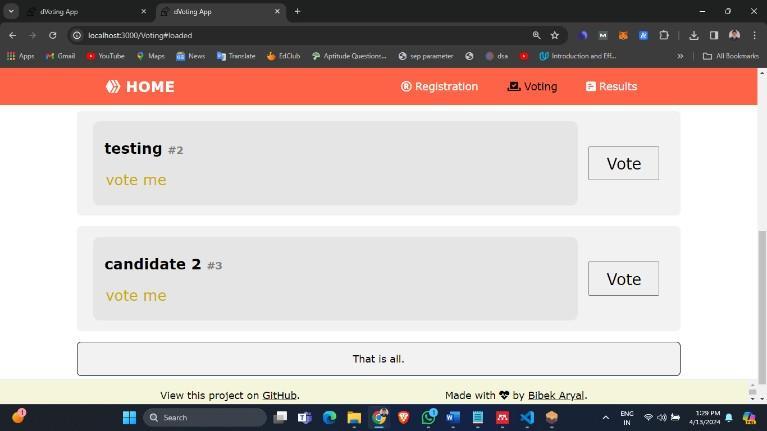
Our proposed E-voting based on Blockchain developed a decentralized voting application, coupled with the deployment of smart contracts on a local blockchain, underscores the potential of blockchain technology to revolutionizethewayelectionsareconducted.Leveraging Ethereum's blockchain network as a decentralized database, the system provides a secure and reliable platform for storing voter accounts, recording votes, and managing candidate details. As technology continues to evolve,furtherresearchanddevelopmentinthisfieldwill becrucialinrealizingthefullpotentialofblockchain-based e-votingsystemsinsafeguardingthedemocraticprocess.
[1] A.M.Al-Madani,A.T.Gaikwad,V.Mahale,andZ.A.T. Ahmed, “Decentralized E-voting system based on Smart Contract by using Blockchain Technology,” in Proceedings of the 2020 International Conference on Smart Innovations in Design, Environment, Management, Planning and Computing, ICSIDEMPC 2020, Institute of Electrical and Electronics Engineers Inc., Oct. 2020, pp. 176–180. doi: 10.1109/ICSIDEMPC49020.2020.9299581.
[2] D. Pawar, P. Sarode, S. Santpure, P. Thore, and P. Nimbalkar,“ImplementationofSecureVotingSystem usingBlockchain.”[Online].Available:www.ijert.org
[3] D. Rathore and V. Ranga, “Secure remote E- voting using blockchain,” in Proceedings - 5th International Conference on Intelligent Computing and Control Systems, ICICCS 2021, Institute of ElectricalandElectronicsEngineersInc.,May2021, pp. 282–287. doi: 10.1109/ICICCS51141.2021.9432249.
[4] A. Varol, M. Karabatak, C. Varol, Fırat Universitesi, Institute of Electrical and Electronics Engineers. Turkey Section, and Institute of Electrical and ElectronicsEngineers, 6th International Symposium on Digital Forensicand Security : proceeding book : 22-25March 2018,Antalya, Turkey.
[5] K. Mehboob Khan, J. Arshad, and M. M. Khan, “Secure Digital Voting System based onBlockchain Technology.”
[6] N. B. Pokale, P. Sharma, and D. T. Mane, “Deep hybrid model for attack detection in IoT-fog architecturewithimprovedfeaturesetandoptimal training,” Web Intelligence, pp. 1–20, Nov. 2023, doi:10.3233/web-230187.
[7] M. S. Farooq, U. Iftikhar, and A. Khelifi, “A Framework to Make Voting System Transparent UsingBlockchainTechnology,” IEEE Access,vol.10, pp. 59959–59969, 2022, doi: 10.1109/ACCESS.2022.3180168.
[8] N. B. Pokale, P. Sharma, and D. T. Mane, “Attack Detection and Mitigation in IoT-Fog Architecture: HandlingClassImbalanceProblem.”IntJIntellSyst ApplEng,vol.11,no.10s,pp.195–216,Aug.2023
[9] S. Al-Maaitah, M. Qatawneh, and A. Quzmar, “EVoting System Based on Blockchain Technology: A Survey,” in 2021 International Conference on Information Technology, ICIT 2021 - Proceedings, InstituteofElectricalandElectronicsEngineers
International Research Journal of Engineering and Technology (IRJET) e-ISSN:2395-0056
Volume: 11 Issue: 04 | Apr 2024 www.irjet.net p-ISSN:2395-0072
Inc., Jul. 2021, pp. 200–205. doi: 10.1109/ICIT52682.2021.9491734.
[10] A. S. Yadav, A. U. Thombare, and Y. V. Urade, “EVoting using Blockchain Technology Abhijeet Anil Patil.”[Online].Available:www.ijert.org
[11] S. Bachhav, H. Dhondge, T. Desale, R. Deshmukh, P. Poonam Deokar, and ] Student, “‘Review on Decentralized E-Voting System Using Blockchain,’” 2022.[Online].Available:www.ijcrt.org
[12] R. Kumar, L. Badwal, S. Avasthi, and A. Prakash, “A Secure Decentralized E-Voting with Blockchain & Smart Contracts,” in Proceedings of the 13th International Conference on Cloud Computing, Data Science and Engineering, Confluence 2023, Institute of Electrical and Electronics Engineers Inc., 2023, pp. 419–424. doi: 10.1109/Confluence56041.2023.10048871.
[13] K. Raipure, A. Nakhate, L. Ghormade, and M. Belkhade, “Issue 2 | ISSN: 2456-3315 IJRTI2302032 International Journal for Research Trends and Innovation,”2023.[Online]. Available:www.ijrti.org
[14] M.V.Vladucu,Z.Dong,J.Medina,andR.Rojas-Cessa, “E-Voting Meets Blockchain: A Survey,” IEEE Access, vol. 11, pp. 23293–23308, 2023, doi: 10.1109/ACCESS.2023.3253682.