
International Research Journal of Engineering and Technology (IRJET) e-ISSN: 2395-0056
Volume: 11 Issue: 04 | Apr 2024 www.irjet.net p-ISSN: 2395-0072

International Research Journal of Engineering and Technology (IRJET) e-ISSN: 2395-0056
Volume: 11 Issue: 04 | Apr 2024 www.irjet.net p-ISSN: 2395-0072
Amit Sodmise1 , Ashutosh Sathe2 , Prachi Laygude3, Vaibhav Pawar4, Shubham Vetal5
1Assistant Professor Civil Engineering, RMD Sinhgad School of Engineering, Warje, Pune, Maharashtra, India
2Student Civil Engineering, RMD Sinhgad School of Engineering, Warje, Pune, Maharashtra, India
3Student Civil Engineering, RMD Sinhgad School of Engineering, Warje, Pune, Maharashtra, India
4 Student Civil Engineering, RMD Sinhgad School of Engineering, Warje, Pune, Maharashtra, India
5Student Civil Engineering, RMD Sinhgad School of Engineering, Warje, Pune, Maharashtra, India ***
Abstract - Reinforced concrete columns are critical structural elements whose performance under axial compressive loading is of importance. Thisexperimentalstudy investigates the compressive behaviour of circularandsquare Reinforced concrete columns wrapped with Carbon Fibre Reinforced Polymer (CFRP) composites. CFRP wrapping is an effective retrofitting technique that enhances the strength of concrete columns. A total of 12 columns, with 6 circular and 6 squares in cross-section, were tested under axial compression load. For each shape, 3 columns were wrapped with CFRP, while 3 were left unwrapped as specimens.
The objectives were to evaluatetheinfluenceofcross-sectional geometry and CFRP confinement on the load-carrying capacity, failure modes. Previous research has indicated that circular columns exhibit higher confinement effectiveness compared to square columns due to the continuous curvature providing more uniform confining stresses. The experimental results were critically analysed and compared with findings from relevant literature to validate this observation.
Additionally, the CFRP confinement method was compared to other retrofitting techniques, such as concrete column jacketing in terms of ease of application, cost-effectiveness, and performance enhancement.
Key Words: Carbon Fibre Wrapping, Column, Experimental Testing, Reinforced Cement Concrete, Feasibility Study
1.INTRODUCTION
Structuralretrofittingreferstotheadditionandupgradeof structural components in existing buildings, bridges and infrastructure to make them safer, stronger and more resistant to forces. It enhances the load carrying capacity, stability,ductility,andservicelifeofstructures.
ConventionaltechniquesforstrengtheningRCcolumnslike concreteorsteeljacketinghaveseveraldrawbacks.Addition ofconcretejacketsincreasesthecolumnsizeandself-weight significantly.Italsorequirestemporaryformworksupport and longer construction time. Fibre-reinforced polymer (FRP) composites have emerged as an advantageous strengthening material in civil engineering applications
owing to their high strength-to-weight ratio, resistance to corrosion,excellentdurabilityandeaseofapplication.CFRP isparticularlysuitableforaxialstrengtheningofRCcolumns becauseofitsconfinementnature CFRPisanewtechnology whichisgainingtractioninIndiaforretrofittingofstructural members.
Fibre-reinforced polymer (FRP) composites have an importantapplicationinprovidingconfinementtoreinforced concrete(RC)columns,enhancingtheirload-carrying.This strengtheningmethodisbasedonthephenomenonthatthe axial compressivestrengthandultimateaxial compressive strain of concrete can be significantly increased through lateralconfinement.
ExternallybondingCFRPcompositesontothesurfaceof existingRCcolumnsthroughwetlayuporprecuredlaminates provides supplemental strength and stiffness. The CFRP confines the inner concrete core and enhances its compressive capacity. It also provides additional shear resistance. Moreover, the reinforcement continues to functionevenafterconcretecrushing.Manypreviousstudies have experimentally demonstrated that CFRP wrapping significantly increases the load carrying capacity of RC columns under axial, flexural and seismic loads. However, optimizationofparametersliketheCFRPstiffness,thickness, orientation, and layout is critical to maximize the strengthening efficiency. Various techniques have been employed to achieve confinement of columns using FRP composites. The most common method is in-situ FRP wrapping,whereunidirectionalfibresheetsorwovenfabric sheetsareimpregnatedwithpolymericresinsandwrapped aroundcolumnsinawetlay-upprocess,withthemainfibers orientedinthehoopdirection.Additionally,filamentwinding andprefabricatedFRPjacketshavealsobeenutilized.
Thisprojectaimstoinvestigatestructuralretrofittingof RCcolumnsusingexternallybondedCFRPcomposites.The effectiveness of CFRP retrofitting will be studied through experimentalmodelingofCFRPwrappedcolumns.
International Research Journal of Engineering and Technology (IRJET) e-ISSN: 2395-0056
Volume: 11 Issue: 04 | Apr 2024 www.irjet.net p-ISSN: 2395-0072
When an FRP-confined RC column is subject to axial compression, the concrete expands laterally and this expansionisconfinedbytheFRP.Forcircularcolumns,the concreteissubjecttouniformconfinement.
It has been well established that CFRP confinement is much less effective for square columns than for circular columns,evenwiththeroundingofcorners.Thisisbecause in the former, the confining pressure is non-uniformly distributedandonlypartoftheconcretecoreiseffectively confined. Failure generally occurs at the corners by FRP tensilerupture.Thestress–straincurvesaremorelikelyto feature a descending branch, but in such cases FRP confinementnormallyprovideslittlestrengthenhancement. Theeffectivenessofconfinementincreasesastheamountof FRPorthecornerradiusincreases,andastheaspectratioof thesectionreduces
2.
1.) To study the effects of parameters of carbon fibre reinforced polymer composite on square and circularshape.
2.) To compare experimental failure modes with previousresearchdata
3.) To perform cost analysis of CFRP strengthening solutionsagainstcommonalternatives
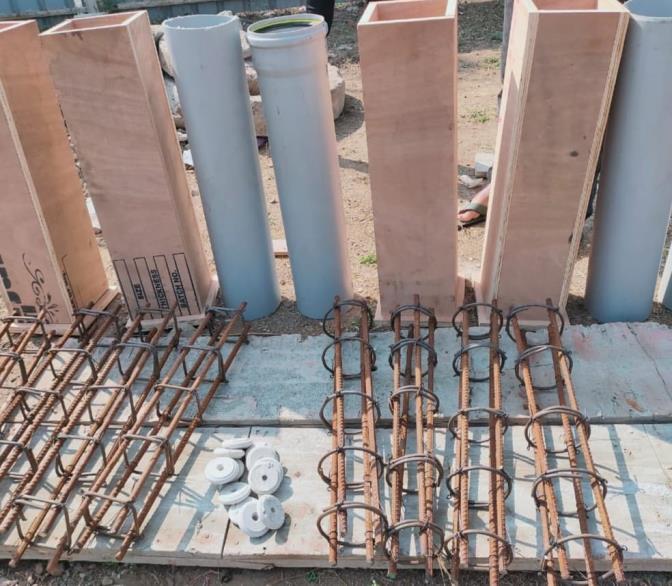
1.) Total12columnsofreinforcedconcretedesign
WerebuilttobetestedonUniversalTestingMachine(UTM). Thecolumns werecasted byusingsteel rebars(6mmand 8mm) and M20 grade of concrete for which 3 cubes of 150x150x150mm were tested again on UTM. 6 of the columns cast in lab were square of size 150x150x700mm and6werecircularcolumnsofsize150x160x700mm.Out the 6 square and circular columns, 3 of the columns were unwrappedwhiletheremaining3werewrappedwithCFRP of 400 microns single layer by using epoxy adhesive. The reinforcementforsquareandcircularcolumnwere12mm bars of main reinforcement and 8 mm bars for shear reinforcementwithappropriatecover.
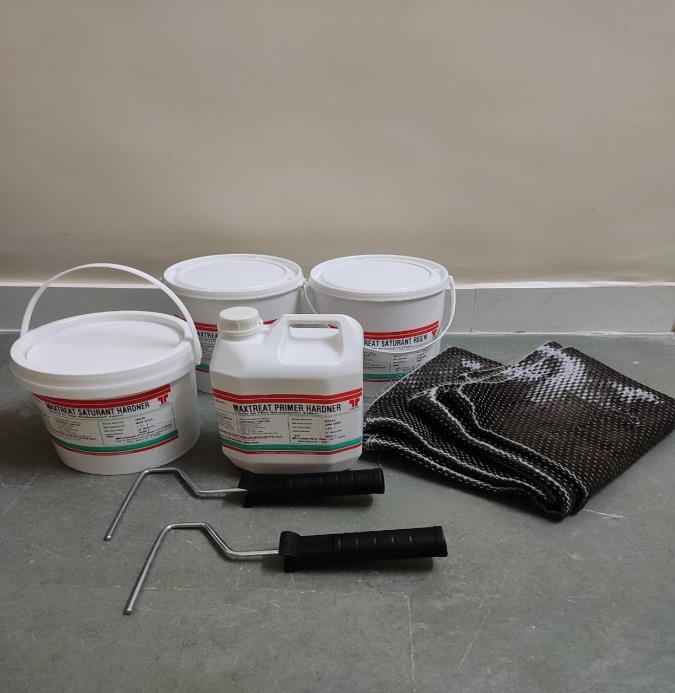
Theepoxyadhesivewascreatedbyusing2layersofPrimer andSaturantofThermaxcompany Theprimerwasformed aftermixingofbaseandhardenerinproperproportionand appliesoverthespecimensandlefttodryfor24hours.After 24hoursthesaturantwasformedagainbymixingbaseand hardenerofThermaxCompany.Immediatelyafterapplying saturant, carbon fibre of 1 layer was wrapped around the specimensbeforethesaturantdriedup.
MixDesnity
1.11±0.03gm/cc
VolumeofSolids 88-92%
Potlife ~25minutes
TouchDryTime 8-12hours
Table-1:PropertiesofPrimer
International Research Journal of Engineering and Technology (IRJET) e-ISSN: 2395-0056
Volume: 11 Issue: 04 | Apr 2024 www.irjet.net p-ISSN: 2395-0072
MixDesnity 1.40±0.05gm/cc
VolumeofSolids 100%
Potlife 60to90minutes
OpenTime 90to120minutes
Table-2:PropertiesofSaturant
FibreOrientation Unidirectional
WeightofFibre 400-430gm/m2
DensityofFibre 1.80gm/cc
FibreThickness 0.38-0.4mm
UltimateElongation 1.7%
TensileStrength 4000MPa
Table-3:PropertiesofMaxtreatFibrenetC400
After the application, all columns were tested to find the compressivetestforthemtocomparedtheeffectofshapeon increaseinloadcarryingcapacityduetoapplicationofCFRP. Visual observations weremadeto document failuremode likeconcretecracking,CFRPdebondingetc.
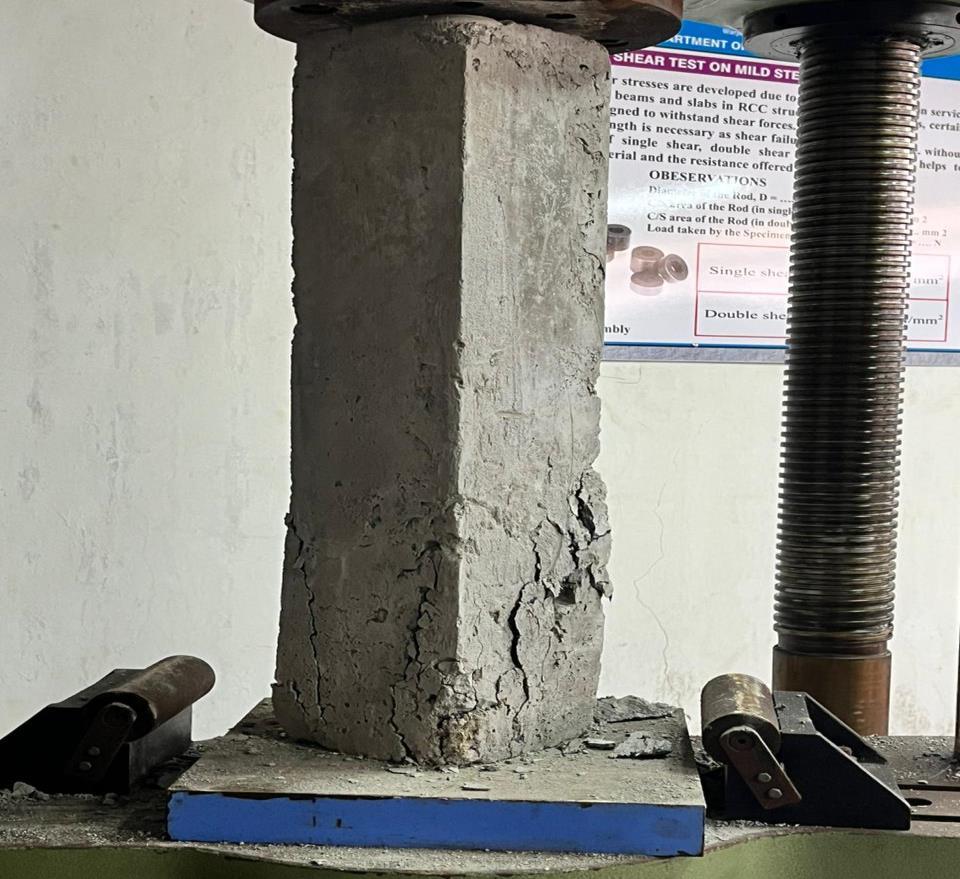
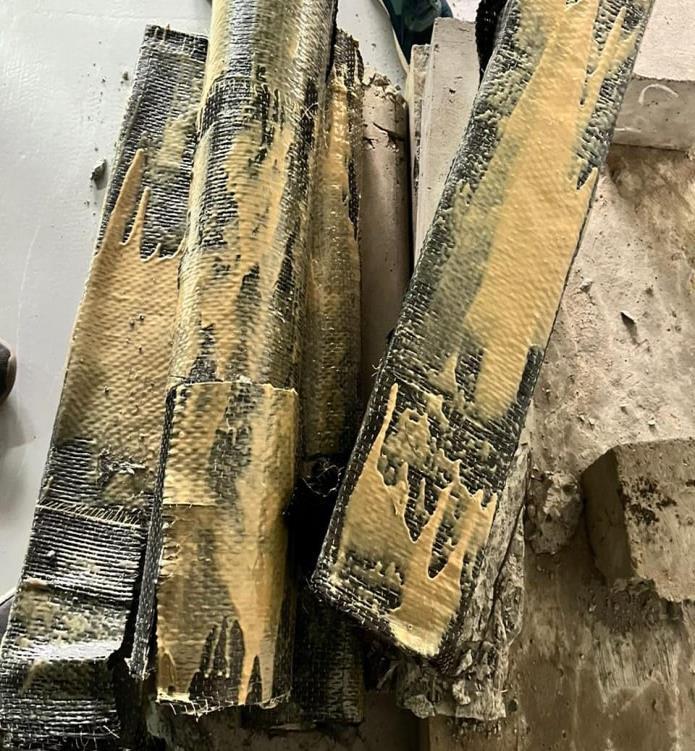
2.) Forcomparisonwithpreviousresearchdata,peer researchpaperisused.Notablyamongtheresearchpaper selected for comparison purposes are Riad Benzaid, and Habib-Abdelhak Mesbah, “Circular and Square Concrete Columns Externally Confined by CFRP Composite: ExperimentalInvestigationandEffectiveStrengthModels”, Fibre Reinforced Polymers - The Technology Applied for Concrete Repair, pp.167-201, 2013. The other research paper used by is Zhenyu Wang, Daiyu Wang, Dagang Lu, “Behavior of Large-Scale Circular and Square RC Columns Confined with Carbon Fiber-Reinforced Polymer under UniaxialCompression”, AdvancedMaterialsResearchVols. 163-167,pp3686-3693,2010
3.) Forfeasibilitystudy,itwascomparedtoanother popular method reinforced concrete column jacketing. Reinforced concrete jacketing is a method of column jacketingthatinvolvesencasinganexistingconcretecolumn with an additional layer of reinforced concrete. This technique is used to strengthen and increase the loadbearing capacity of the existing column. By adding new concretetothepreviousweb,thestructure'sdimensionsare increased.Additionalreinforcementcouldbeemployedto improve the structure's strength and ductility. The new reinforcementcanbediagonalbarsaswellas verticaland horizontalbarsthatcreatethereinforcementmesh.Thenew reinforcementshouldbeanchoredtothefoundationofthe structure.Placingthereinforcementinholesdrilledinthe foundation and grouting it with epoxy is one method of anchoring. After solidification, the new concrete is casted withthealteredproportionsandcured.
International Research Journal of Engineering and Technology (IRJET) e-ISSN: 2395-0056
Volume: 11 Issue: 04 | Apr 2024 www.irjet.net p-ISSN: 2395-0072
1.) Thetestingwasdoneafter28dayswhichgavethe followingresults:-
Table-4:TestResults
Here, the first alphabet refers to the cross-section of the specimen,thesecondalphabetreferstowhetherthecolumn is wrapped or unwrapped (U for unwrapped and W for wrapped),theendnumberreferstothespecimennumber.
Thesecondcolumnshastheaxialstressforeachspecimenin Mega-Pascal(Mpa). Total12columnsweretestedforonly axialcompressiontoplotspecimenvsaxialstresschart.
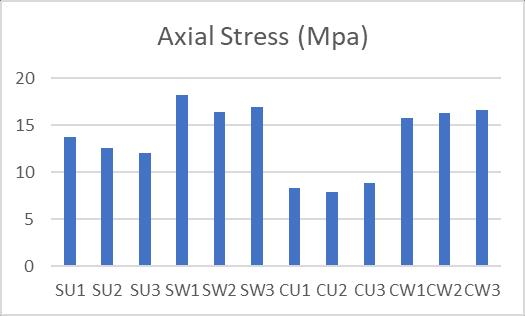
Chart-1:TestResults
Onaverage,theaxialstressforunwrappedsquarecolumnis 12.75Mpawhileforwrappedsquarecolumnis17.78Mpa. Also,forunwrappedcircularcolumn,theaxialstressis8.37 Mpaandforwrappedcircularcolumnitis16.23Mpa.
2.) Theaboveresultsshowonaverageanincreasefor circularandsquarecolumnsas93%and34%.Thehighest increase seen easily for the circular columns compared to squarecolumnsastheconfiningislesseffectiveforsquare columnsduetosharpedges.
For comparison two research paper were chosen. Among onedonebyRiad(2013)showsanincreaseforcircularand square sections were 69% and 22% respectively for specimensofsimilarnature Thespecimenlikeour,tested showedaninitialstrengthof29.51Mpaforcircularcolumn and 24.77Mpa for square column. After wrapping of one layercarbonfibre,itshowedanincreaseof52%forcircular columnand11%forsquarecolumn.
While,fortheresearchpaperdonebyWang(2010),itshows for a similar size specimen with similar reinforcement structurehadinitialstrengthof25.8Mpaforcircularcolumn and 29.9 Mpa for square column. After one layer of wrapping,itshowedanincrease100%forcircularcolumn and18%forsquarecolumn
3.) ThecolumnjacketingisextensivelyusedinIndiafor retrofitting of buildings as the engineers and workers are used to this method compared to FRP wrapping. If cost consideration is taken into account, concrete jacketing is cheaperthancarbonfibrewrappingtogainsimilarstrength afterwards. Thecarbonfibrewrappingcanbeascostlyas2 times the cost required for concrete jacketing due to high price of carbon fibre and high cost of epoxy resin. Also, specialhighlytrainedworkersareneededfortheapplication of CFRP due the nature of the product and its application method. As per market research, the reinforced concrete jacketingmethodismuchmorecost-effectiveandeasierto usethanCFRPwrappinginIndia.
It is useful to use CFRP in structures where overall maintenance time is limited and immediate recovery of strength is important such as bridges, highly deteriorated structuresduetocorrosion,orpost-disasterstructuresasit takes half the time and half the labours than concrete jacketing Also,itshouldbeconsideredformaintenanceof structure with historical value changing its cross-section shapeoreffectivefloorareamaydamagetheimportanceof thestructure.CFRPshould beconsideredto enhanceload carryingcapacityofstructureswhereNoiseandAirpollution isrestrictedasconcretejacketingprocessinvolvesusageof heavymachinery.CFRPalsotakeslessspacethanconcrete jacketing to achieve same strength after wrapping which increasestheusefulnessofCFRP.Inurbanarea,thecostof carpet area is very high, if concrete jacketing is used to increasestrength of the structural members of a building, thenthecarpetareaisreducedquitealot.
International Research Journal of Engineering and Technology (IRJET) e-ISSN: 2395-0056
Volume: 11 Issue: 04 | Apr 2024 www.irjet.net p-ISSN: 2395-0072
Inourproject,ittookusaroundRs1500forCFRPmaterials (actual carbon fibre piece + epoxy resin). If concrete jacketing was done to achieve similar strength (50% increase),thencostforitwouldhavebeenhalfofit.
1.) CFRPwrappingsignificantlyincreasedthestrength of both circular and square columns subjected to axial compression loads. The effectiveness of CFRP wrapping variesdependsontheshapeofthecolumn
2.) CFRPwrappingoncircularcolumnsshowsbetter results than on square columns of similar size, similar reinforcement, and similar grade of concrete due to the confining effect. The results showed that the increase in strengthofreinforcedconcreteonaverageis44%morethan squareshapedreinforcedconcretecolumns.
3.) Circularcolumnsarequiterareforbothresidential andbusiness/publicbuildings.Iftherearecircularcolumns, itisrecommendedtouseCFRPforretrofittingratherthan concretejacketingasitincreasesstrengthsubstantiallydue toitscross-sectional shape even whenthecostof CFRPis high.
Forsquarecolumns,theincreaseinstrengthisquitelowso for square columns if there is no issue of lowering carpet area (as in case of underground basement parking) then concrete jacketing can be used. Reinforced concrete jacketingprovidesexcellentprotectionagainstfire,impact, moisture and chemical exposure making it suitable for columnsinharshenvironments.
[1] Riad Benzaid, and Habib-Abdelhak Mesbah, 2013, “Circular and Square Concrete Columns Externally Confined by CFRP Composite: Experimental Investigation and Effective Strength Models”, Fibre Reinforced Polymers - The Technology Applied for ConcreteRepair,pp.167-201,
[2] ZhenyuWang,DaiyuWang,DagangLu,2010, “Behavior oflarge-caleCircularandSquareRCColumnsConfined withCarbonFiber-ReinforcedPolymerunderUniaxial Compression”, AdvancedMaterialsResearchVols.163167,pp3686-3693.
[3] Ziru Wang, Junlong Yang, Jizhong Wang, 2018, “RectangularHigh-StrengthConcreteColumnsConfined With Carbon Fibre-Reinforced Polymer (CFRP) Under Eccentric Compression Loading”, Construction and BuildingMaterials,ConstructionandBuildingMaterials, Volume193,30December2018,Pages604-622
[4] Prof Swati Maitra, July 2018, “Retrofitting and RehabilitationofCivilInfrastructure”NPETL.
[5] Jian-he Xie and Ruo-lin Hu, Jan 2013, “Experimental Study on Rehabilitation of Corrosion-Damaged Reinforced Concrete Beams with Carbon Fibere Reinforced Polymer”, Construction and Building Materials,Volume38,Pages708-716
[6] J.G.TengandL.Lam,Dec2002“CompressiveBehaviour ofCarbonFiberReinforcedPolymer-ConfinedConcrete InEllipticalColumns”, JournalofStructuralEngineering, Volume128Issue12
[7] Arvindan Sivasuriyan, June 2023, “Carbon FibreReinforced Polymer (CFRP) Composites In Civil Engineering Application-A Comprehensive Review”, MDPIJournals.
[8] L.P. Ye, K. Zhang, S.H. Zhao, P. Feng, Sept-Oct 2003, “Experimental Study On Seismic Strengthening of RC ColumnsWithWrappedCFRPSheet”,Constructionand BuildingMaterials,Vol17,Issues6–7,Pages499-506
[9] Stefan Kaeseberg,, Dennis Messerer and Klaus Holschemacher, July 2019, “Assessment Of Standards and Codes Dedicated to CFRP Confinement of RC Columns”,LeipzigUniversityofAppliedSciencesMDPI Journal.
[10] Guide for the Design and Construction of Externally Bonded FRP Systems for Strengthening Concrete Structures;ACI440.2R-17;AmericanConcreteInstitute (ACI):FarmingtonHills,MI,USA,2017.
[11] Len C. Hollaway, J.G. Teng, 2008, “Strengthening and Rehabilitation of Civil Infrastructures Using FibreReinforced Polymer (FRP) Composites (Woodhead PublishinginMaterials)”,CRCPress.
[12] Xilin Lu, 2010, “Retrofitting Design of Building Structures”CRCPress.
[13] SusanMacdonald,2002,“ConcreteBuildingPathologyWiley-Blackwell”,CRCPress.
[14] GeorgeSomerville,2008,“ManagementOfDeteriorating ConcreteStructures”,CRCPress.
[15] M. Haji, H. Naderpour, A. Kheyroddin, 2018, “Experimental Study On Influence of Proposed FRPStrengtheningTechniquesonRCCircularShortColumns Considering Different Types of Damage Index”, CompositeStructures
[16] Francesco Micelli, Rossella Modarelli, 2013, “Experimental And Analytical Study on Properties Affecting the Behaviour of FRP-Confined Concrete”, Composites Part B: Engineering, Volume 45, Issue 1, February2013,Pages1420-1431
International Research Journal of Engineering and Technology (IRJET) e-ISSN: 2395-0056
Volume: 11 Issue: 04 | Apr 2024 www.irjet.net p-ISSN: 2395-0072
[17] Amir Mirmiran, Mohsen Shahawy, Michel Samaan, HazemEIEchary, JuanCarlosMastrapa,andOdellPico, 1998, “Effect of Column Parameters on Frp-Confined Concrete”, Journal of Composites for Construction, Volume2,Issue4
[18] AnhDucMai,M.NeazSheikh&MuhammadN.S.Hadi, 2019,“PerformanceEvaluationofIntermittentlyCFRP Wrapped Square and Circularised Square Reinforced Concrete ColumnsUnderDifferentLoadingConditions” , StructureandInfrastructureEngineering,
[19] MumtazY,NasiriA,TetsuhiroS,2021,“AComparative Study on Retrofitting Concrete Column by FRPWrappingandRC-JacketingMethods:AFeasibilityStudy For Afghanistan”. Indian Journal of Science and Technology14(7):652-664.
[20] M.N.S.Hadi,2026,“BehaviourofFRPWrappedNormal StrengthConcreteColumnsUnderEccentricLoading”, Composite Structures Volume 72, Issue 4, Pages 503511
[21] Rocca, Silvia, 1997, "Experimental and Analytical Evaluation of FRP-Confined Large Size Reinforced ConcreteColumns"(2007).DoctoralDissertations.
[22] ManuelA.G.Silva,2021“BehaviorofSquareandCircular ColumnsStrengthenedWithAramidicorCarbonFibers” , ConstructionandBuildingMaterials,Volume25,Issue8, Pages3222-3228
[23] AkshayV.Sawdekar,Prof.Dr.PrakashS.Pajgade,Prof. MayurA.Banarase,2022,“RetrofittingTechniquesfor Reinforced Concretes Structural Members Using Different Materials - A Review”, Journal of Emerging TechnologiesandInnovativeResearch,Vol9,Issue2,pg 413-423.
[24] L.Lam, J.G.Teng, 2002. “Strength Models for FiberReinforcedPlasticConfinedConcrete”.ASCEJournalof StructuralEngineering,Volume128,Issue5,612-623.
[25] J. G.Teng, Y.Huang, L.Lam,, and Ye, L. P., 2007. “Theoretical Model for Fiber Reinforced PolymerConfined Concrete”. ASCE Journal of Composites for Construction, Volume11,Issue2,201-210.
[26] T.Jang.and J.G.Teng,2007. “Analysis-Oriented StressStrainModelsforFRP-ConfinedConcrete”.Engineering Structures,Volume29,2968-2986.
2024, IRJET | Impact Factor value: 8.226 |