
International Research Journal of Engineering and Technology (IRJET) e-ISSN: 2395-0056
International Research Journal of Engineering and Technology (IRJET) e-ISSN: 2395-0056
Sachin Yadav1 , Mohit Sawardekar2 , Jeet Gore3 , Prof. Sonali Karthik 4
1,2,3 Information Technology, Theem college of engineering, Mumbai, India
4 Professor, Dept. Information Technology, Theem college of engineering, Mumbai, India
Abstract - The rapid growth of urban populations worldwide has led to an escalating challenge in managing municipal waste effectively, posingenvironmental,health,and economic concerns. Inresponse to this issue, theintegrationof Internet of Things (IoT) technology has emerged as a promising solution. This paper presents an IoT-based waste management system designed to enhance the efficiency, sustainability, andoveralleffectivenessofwastecollectionand disposal processes in urban areas. The proposed system leverages a network of smart waste bins equipped with various sensors, including ultrasonic sensors for waste level detection, GPS modules for accurate binlocationtracking,and monitoring. These sensors enable real-time data acquisition, which is then transmitted to a central cloud-based platform. The platform employs data analytics and machine learning algorithms to optimize waste collection routes, predict fill levels, and schedule collection activities dynamically. Furthermore, the system integrates a user-friendly mobile application to access real-time information about nearby waste bins'filllevels andcollectionschedules.Thisencourages active citizen participation by promoting responsible waste disposal practices andreducingoverflowinstances.Municipal authorities benefit from reduced operational costs through optimizedcollectionroutes, minimizedfuel consumption, and improved resource allocation. The IoT-based waste management system showcased in this paper represents a significant step towardcreatingsmarterandmoresustainable cities. By harnessingthe power ofIoT, data analytics,anduser engagement, the systemoffers acomprehensivesolutiontothe pressing challenges of urban waste management. As cities strive for enhancedsustainability and improvedquality oflife for their residents, the implementation of such innovative technologies becomes imperative.
Key Words: IoT, Smart Bins, Firebase, Waste Management,MobileApplication,Sustainability,Urban Environment,SensorTechnology.
India's rapid urbanization has resulted in a significant increase in municipal waste generation, straining existing waste management systems. Traditional waste collection methodsoftenstruggletocopewiththeescalatingvolumeof waste, leading to environmental degradation and health
concerns.Totackletheseissues,theintegrationofInternet of Things (IoT) technology holds great promise. This overview explores how an IoT-based waste management system can be tailored to the Indian context to optimize wastecollection,promotesustainability,andcontributeto cleanerandsmarterIndiancitiesSmartwastesystemsare mandatorytoreducetheimpactsofgarbageongeneralwellbeing.SmartWasteBins:Atthecoreofthesystemaresmart wastebinsequippedwithsensors.
The motivation behind our project to create an IoT-based waste management system is to make our cities cleaner, healthier,andmoresustainable.Asmorepeopleliveincities, the amount of garbage produced is increasing, causing pollution and health problems. This saves money, reduces pollution,andmakessurebinsdonotoverflow.Ultimately, ourprojectaimstoimprovethequalityoflifeinourcities whilealsoprotectingtheenvironmentforfuturegenerations.
India'scitiesarestrugglingwithincreasinggarbage,leading topollutionandcosts.Weaimtousesmartbinsandtechto handle waste smarter, save money, and educate people about proper disposal. The goal is to make Indian cities cleaner,greener,andmoreeffective.
The Internet of Things (IoT) is intricately linked to innovation, presenting a clever extension of the Internet wherein various objects in our surroundings connect to exchange and organize data. However, there is a limited emphasis on citizen engagement in this context. With the escalating global population, the issue of solid waste has becomeaworldwideconcerninbothurbanandruralareas. Effective waste management strategies are essential, requiring appropriate decisions to address the mounting garbage generated from residential, commercial, and industrial sources. Yet, there is limited discussion on scalabilityandcostintheexistingliterature [1].Theconcept ofasmartcityrevolvesaroundintegratingInformationand CommunicationTechnology(ICT)andtheInternetofThings (IoT)toefficientlymanageacity'sassets,includinglocalin
Volume: 11 Issue: 04 | Apr 2024 www.irjet.net p-ISSN: 2395-0072 © 2024, IRJET | Impact Factor value: 8.226 | ISO 9001:2008 Certified Journal | Page1402
International Research Journal of Engineering and Technology (IRJET) e-ISSN: 2395-0056
Volume: 11 Issue: 04 | Apr 2024 www.irjet.net p-ISSN: 2395-0072
our daily lives. Developed countries employ various departments, information systems, libraries, schools, hospitals,andtransportationsystems.Unfortunately,there isminimalconsiderationgiventotheenvironmentalimpact ofimplementingsuchsmartcityinitiatives [2].Thecurrent state of the environment is threatened by the increasing accumulation of global waste, posing catastrophic consequencesforhumanlifeandsurroundings.Projections from the World Bank indicate a potential 70% growth in global waste by 2050 unless immediate measures for monitoringandcontrolareimplemented[3].Additionally,the risingglobalpopulationandurbanizationareanticipatedto resultinaglobalwastevolumeof3.4billiontonswithinthe nextthreedecades.Despitethesealarmingstatistics,thereis alackoffocusontheenvironmentalaspectsintheexisting literature. The surge in waste production from industries andhouseholds,fueledbythewidespreaduseofpackaged items, textiles, paper, food, plastics, metals, and glass, underscoresthecriticalimportanceofwastemanagement efficient techniques for waste management, but the literaturepredominantlyemphasizestechnology,neglecting socialaspectsofwastemanagement.
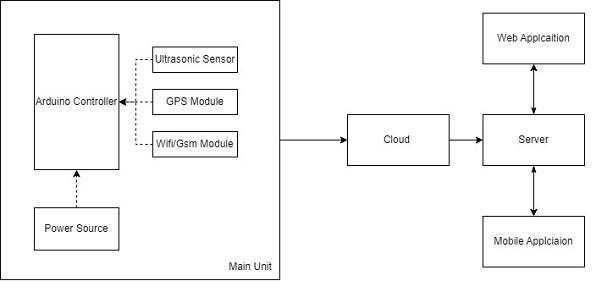
Thesystemisdevelopedforsmartandurbancities.TheIoT structureofthewastecollectionsystembasedonthecloud, includingthecloudserviceprovidertostoretheinformation. Thecentralserverdealswiththevolumeoftheaccumulation information such as the number of waste loads. This information is accessible through secure network portals. Thissmartsystemconsistsofvariouscomponentsincluding the central server for the information regarding the waste location,theArduinoconnectedtosensorswhichconsistofa precise control device for garbage collection system implementation,andtheAndroidapplication.Descriptionof thedesignComponents:Themaincomponentsofthedesign canbedividedintothreeunits.TheuseofIoTisseenwhere ESP32isconnectedtotheultrasonic sensortocollectdata fromthewastebinandtosenddatabacktothecloud.
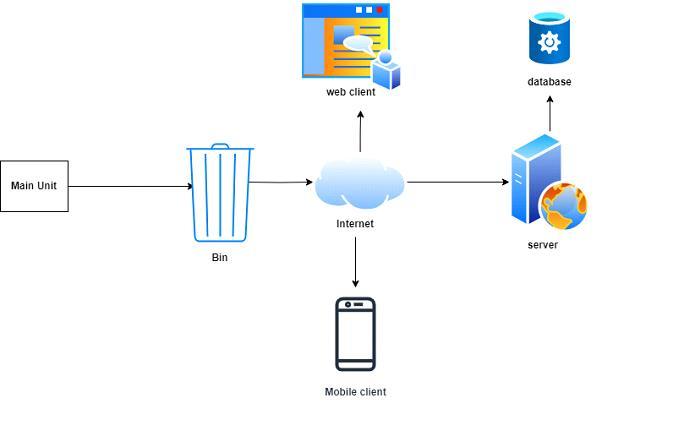
Theconnectionbetweenthehardware components ofthe proposedsystem.TheESP32isconnectedtotheultrasonic sensor and sends a 40 kHz ultrasonic wave. The period it takestohitthebodyandreturntothesensorisimportant forthedistance’smeasurementinESP32.TheEPS32sends the received data to the Internet databaseand is received throughthemobileapplication.Thehardwareconnectionof theotherbinsisdemonstrated.TheESP32isusedtoachieve theprocessingprocess,theUltrasonicSensortodetermine theremainingdistanceofthedevicevolume,andESP32to transmitdata.TheGNDisconnectedbyESP32,andtwoVCC and GND are connected to 5V. Each Arduino pin will be connectedbyanEchoandatrigonometric.ThefunctionAS of each pin is responsible for receiving and sending the signals. The RX and TX functions are connected to the ArduinothroughtheEPS32andoperateonlyat3.3Vforeach oftheeightpins.ForWi-Fienabled,theCH-PDandVCCare connectedatthesamevoltageasESP32.
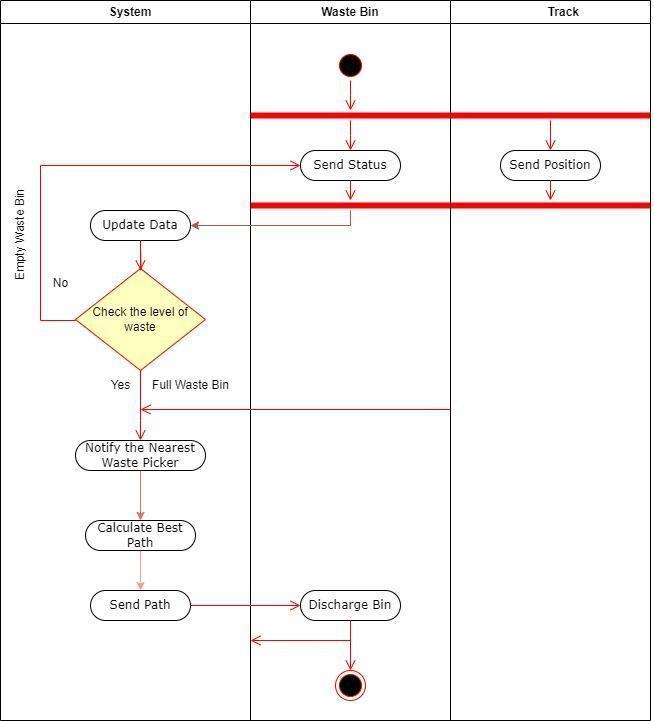
TheProcessStartswithFollowingSteps:
Step 1: - Data Collection by IoT Device: The IoT device installed in waste bins measures the fill level using an ultrasonicsensorandretrievestheGPScoordinatesusinga GPSmodule.ItsendsthisdataalongwiththebinIDtothe serverviaaSIMmodule.
Step 2: - Data Transmission to Firebase Server: The IoT deviceestablishesaconnectiontotheinternetandsendsthe collecteddatatotheFirebaseserver.
Step 3: - Data Storage in Firebase Database: The Firebase server receives the data and stores it in the database, associatingeachentrywiththecorrespondingbinID.
Volume: 11 Issue: 04 | Apr 2024 www.irjet.net p-ISSN: 2395-0072
Step 4: - waste picker Interaction via Mobile App: waste picker accesses the mobile app where they can log in, register,orviewtheirprofile.Theycanalsoviewthemap screen displaying the locations of waste bins and their fill levels.
Step5: - DisplayingBinStatus onMobileApp:The mobile app retrieves bin data from the Firebase database and displaysitonthemapinterface.wastepickercanseewhich binsarefullandneedattention.
Step6:-RoutingCalculationforWastePickers:Whenwaste pickersaccessthemobileapp,theycanviewthebins'status and request the shortest route. The app calculates the optimal route based on the location and fill level of bins usingagooglemap(API)routingalgorithm.
Step 7: - Alerts for Waste Pickers: Waste pickers receive alertsornotificationsthroughthemobileappaboutbinsthat arealmostfullorrequireimmediateattention.
Step 8: - Waste Collection: Waste pickers follow the route providedbytheapp,collectingwastefrombinsefficiently.
Step 9: - Update Data in Firebase Server: After waste collection,theIoTdevicesmayupdatethefilllevelofbinsin real-time,reflectingthechangesintheFirebasedatabase.
Step 10: - Continuous Monitoring and Maintenance: The system is continuously monitored for any issues or anomalies.Regularmaintenanceandupdatesareperformed toensurethesystemoperatessmoothlyandefficiently.
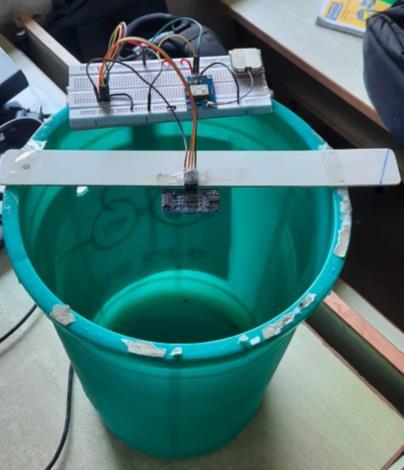
The prototype has been created by connecting all the componentsi.e.theESP32,UltrasonicSensor,GPStogether. The ESP32 microcontroller efficiently manages the communication between the ultrasonic sensor and GPS module. The ultrasonic sensor accurately measured the waste levels in the Dustbin, providing valuable data for wastemanagement.TheGPSmodulecontributedtolocation tracking,allowingforacomprehensivewastemanagement systemthatcanmonitorwastelevelsatspecificgeographical locations.
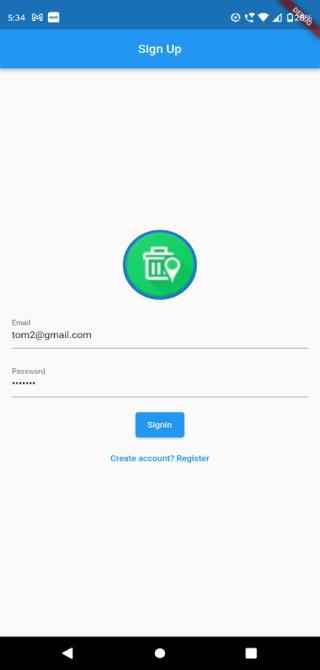
TheSign-upScreenservesastheinitialinterfacethatusers encounter when they open the waste management application. Elements describe the design elements incorporated, such as the sign-up Screen is used login in existingusertotheapplicationbyvalidatingthecredentials.
International Research Journal of Engineering and Technology (IRJET) e-ISSN: 2395-0056
Volume: 11 Issue: 04 | Apr 2024 www.irjet.net p-ISSN: 2395-0072
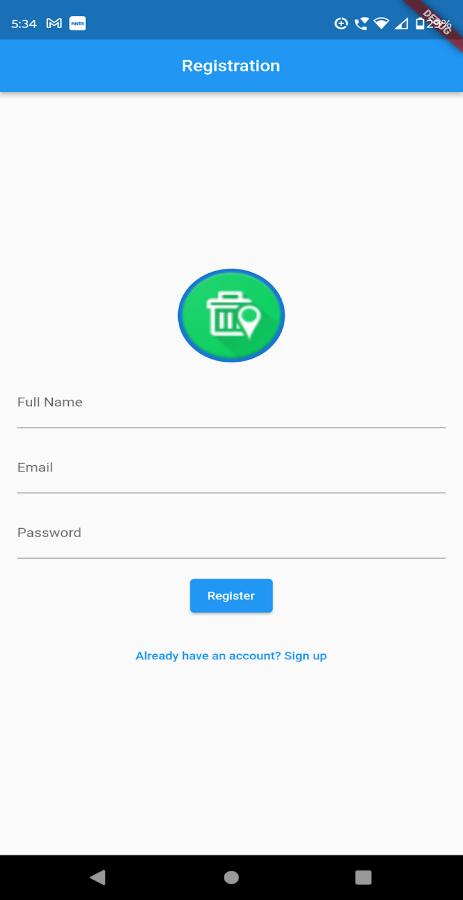
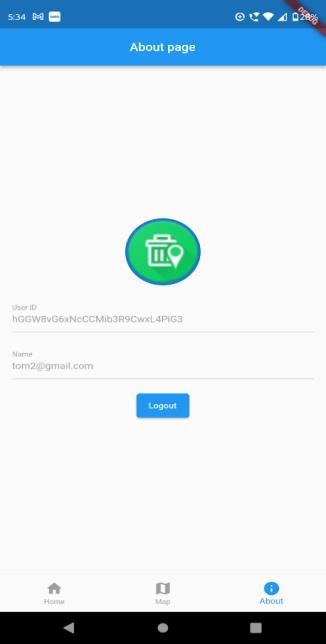
The Registration Screen enables new users to create an account for accessing the waste management system. The design elements present, such as registration fields (e.g., name,email,password),validationchecks,andsubmission controls.TheaboutpagedisplayuserI'dandnameinthetext filedwithasignoutbuttonatthebottomforsigningoutthe user.
The about page display user I'd and name in the text filed withasignoutbuttonatthebottomforsigningouttheuser.
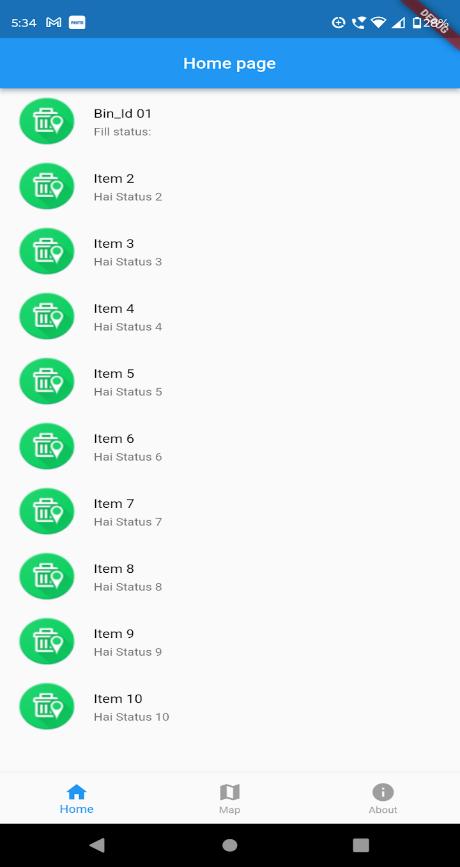
Thehomepagecontainslistbinbincardtitleeachrepenting abinwithuniqueI'daccordingtodifferentbinplacedinthe locality.
2024, IRJET | Impact Factor value: 8.226 |
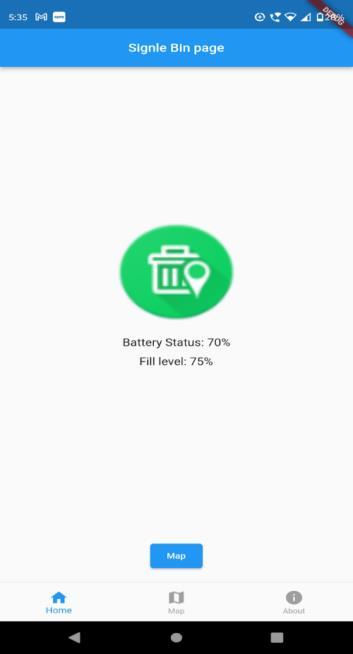
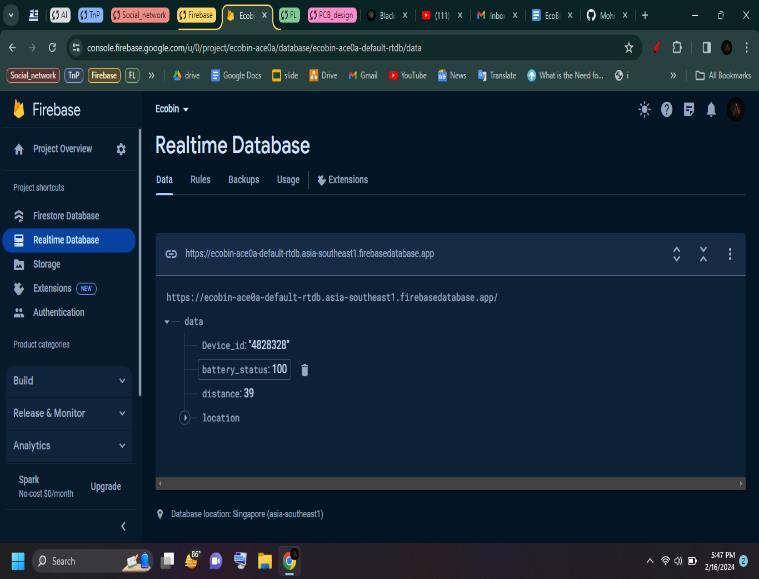
The single bin page detail view of list tile with bin I'd 101 withdisplaybatterystatusandfilllevelofthebintotheuser realtimeandamapbuttontonavigatetothemapscreen
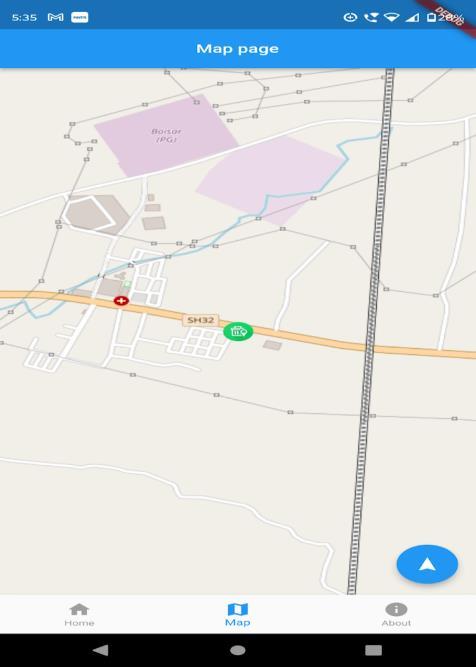
The map screen contains the overall location of the bin markedwithamarkertoidentifythelocationwherethebin ininstalledandadirectionnavigationbuttonsatthebottom rightside
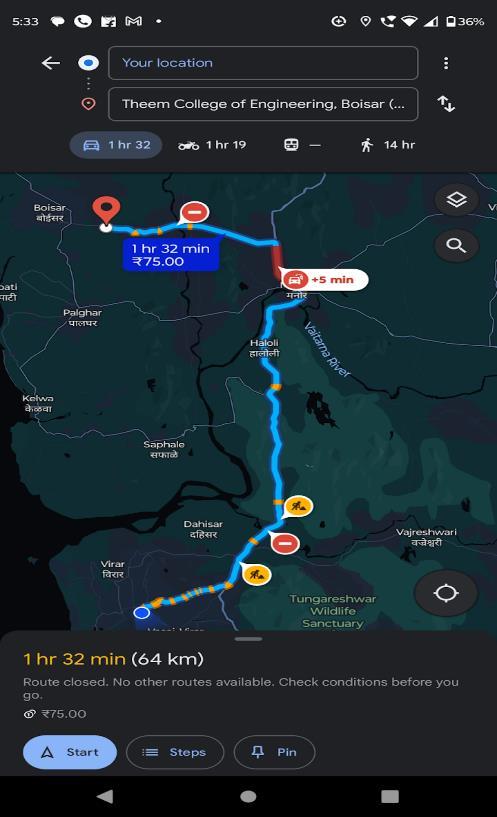
Afterclickingthenavigationbuttonstheuserinredirectto themapapplicationwhichhelptheusertofindtheshorted path /route form the current user location till the bin by showinglifetrafficstatustothedriver
International Research Journal of Engineering and Technology (IRJET) e-ISSN: 2395-0056
Volume: 11 Issue: 04 | Apr 2024 www.irjet.net p-ISSN: 2395-0072
RTDBServer:Itisusedforsortingthedatareceivedvia thebinmoduleinstalledinadustbininRealtimeviacloud functionality Overall, the RTDB server serves as the backbone of our smart waste management system, enabling data-driven decision-making, optimizing operational workflows, and enhancing the overall efficiencyofwastecollectionprocesses.
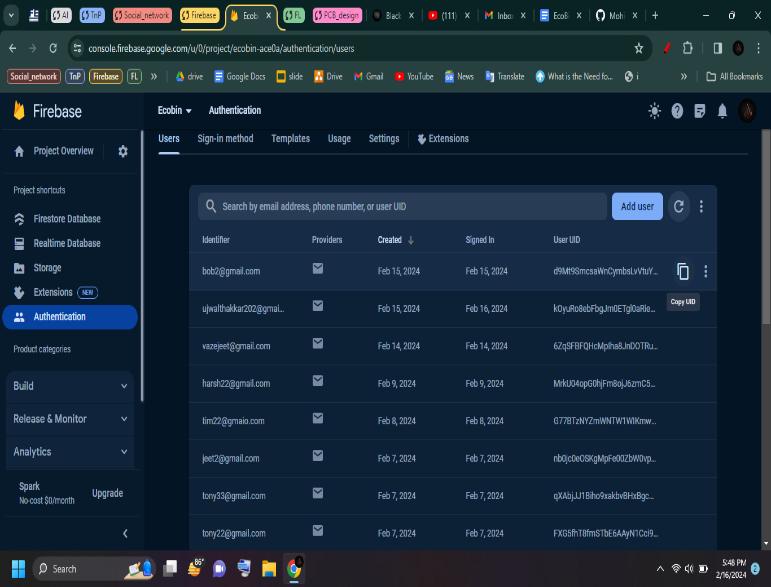
AuthenticationServerDB:Ittheauthserviceprovidedby firebase to save n authenticated every user sign in or register to the application help in managing user credentials.
WepresentedanintelligentwasteManagementsystem.The IoT-basedsmartbinsystem specificallytailoredforwaste collectors,seamlesslyintegratedwithamobileapplication. By harnessing ESP32 hardware, ultrasonic sensors, GPS modules, and Firebase integration, the system has demonstrated exceptional efficacy in waste collection optimization,real-timemonitoring,andcost-effectiveness. ThisreviewunderscoresthecriticalroleofIoTsolutionsin addressing the mounting challenges accompanying urbanizationandincreasedwastegeneration.Thisresearch significantly advances waste management practices by amalgamatingIoTtechnology,Firebasecommunication,and mobileapplicationintegration.Notably,theproposedsystem is meticulously designed to cater exclusively to waste collectors, streamlining their operations and enhancing efficiency.Byfocusingsolelyonwastecollectorneeds,the system offers tailored functionalities to optimize routes, improveresourceallocation,andminimizeoperationalcosts.
International Research Journal of Engineering and Technology (IRJET) e-ISSN: 2395-0056
Volume: 11 Issue: 04 | Apr 2024 www.irjet.net p-ISSN: 2395-0072
Our specialized approach underscores the paper's contribution to advancing waste management practices whileemphasizingtheimportanceofcustomizedsolutions inaddressingindustry-specificrequirements
Wewouldliketoexpressoursinceregratitudetoallthose whocontributedtothesuccessfulcompletionofthisproject. Firstandforemost,weextendourdeepestappreciationto ourprojectsupervisorProf.SonaliKarthikwhoseguidance, support, and invaluable insights have been instrumental throughout the entire duration of this project. Their expertise and encouragement have been indispensable in steering us in the right direction and overcoming various challengesalongtheway.Wearealsoimmenselygratefulto the entire team involved in the project, whose dedication, collaboration,andhardworkhavebeenvitalinbringingthis vision to fruition. Each team member's unique skills and contributionshaveplayedacrucialroleinthedevelopment, implementation,andtestingphasesoftheproject.
[1] SmartWasteManagementusingInternetofThings:A Survey: International conference on I-SMAC (IoT in Social,Mobile,AnalyticsandCloud)(I-SMAC2017).
[2] A New Smart Waste Managing System: 2020 International Conference on Computer Science and Software Engineering (CSASE), Duhok, Kurdistan Region–Iraq
[3] Smart Waste Management using Internet-of-Things (IoT): Gopal Kirshna Shyam, Sunilkumar S. Manvi, PriyankaBharti
[4] IOT-Enabled Smart Waste Management System for Smart cities: A Systematic Review, Publication year 2022,INNASOSUNOVA
[5] S.Paul, S. Banerjee, & S. Biswas, " Smart Garbage MonitoringUsingIoT.,"inIEEE9thAnnualInformation Technology, Electronics and Mobile Communication Conference(IEMCON),2019.
[6] K. M. Lee and T. Wu,Design and development waste managementsysteminHongKong,2014
[7] IoT-Enhanced Waste Management System, K. Lee, J. Kim,2022
[8] SmartWasteManagementSystemusingIOT:Tejashree Kadus1,PawankumarNirmal2,KartikeeKulkarni3Vol. 9Issue04,April-2020.