
International Research Journal of Engineering and Technology (IRJET) e-ISSN: 2395-0056
Volume: 11 Issue: 04 | Apr 2024 www.irjet.net

p-ISSN: 2395-0072

International Research Journal of Engineering and Technology (IRJET) e-ISSN: 2395-0056
Volume: 11 Issue: 04 | Apr 2024 www.irjet.net
p-ISSN: 2395-0072
Avantika
Pachghare1 , Dr.
Ruchita Kale
2 , Saloni Bansod3 , Vijaya Nandurkar4 , Rahul Unhale5
1Student, Dept. of CSE Engineering, PRMIT&R college ,Maharashtra, India
2Professor, Dept. of CSE Engineering, PRMIT&R college, Maharashtra, India
3Student, Dept. of CSE Engineering, PRMIT&R college, Maharashtra, India
4 Student, Dept. of CSE Engineering, PRMIT&R college, Maharashtra, India
5 Student, Dept. of CSE Engineering, PRMIT&R college, Maharashtra, India
Abstract – Emotion identification plays a crucial role in understanding human behavior, decision-making, and communication patterns. With the exponential growth of digital communication, sentiment analysis techniques have emerged as powerful tools for extracting emotional insights from textual data. Emotion identification through sentiment analysis has gained significant attention as a burgeoning interdisciplinary field that combines linguistics, psychology, and artificial intelligence. In today's data-driven landscape,theabilitytodiscernandinterpretemotionsfrom text has emerged as a pivotal tool for extracting valuable insights and understanding human sentiment. Sentiment analysis, often referred to as opinion mining, involves the automated process of analyzing and categorizing sentiments expressed within textual data. This paper provides comprehensive overview of emotion identification using sentiment analysis, encompassing its methodologies, applications,challenges,andethicalconsiderations.
Key Words: Emotion Identification, Sentiment Analysis,TextualData,NaturalLanguageProcessing, Machinelearning
Facial expressions serve as powerful indicators of underlying emotions, reflecting a person's mood, intentions,andmentalstate.Researchershavelongstudied the complex interplay between facial features and emotions, leading to the identification of basic universal emotionssuchashappiness, sadness,anger, surprise, fear, and disgust. However, accurately deciphering these emotions from raw facial data poses significant challenges due to variations in facial morphology, cultural influences, andcontextualcues.
Machine learning techniques have revolutionized the field of facial emotion detection by enabling computers to learn patternsandrelationshipsdirectlyfromdata.
Supervised learning algorithms, in particular, havebeen instrumental in training models to map facial features to corresponding emotional states. These models are trained on large datasets containing annotated images or videos, where each sample is labeled with the corresponding emotion(s)depictedinthefacialexpression.

Key to the success of facial emotion detection is the extraction and representation of relevant facial features. Traditional methods relied on handcrafted features suchas the distances between facial landmarks or intensity of facial muscle movements. However,with the advent of deep learning, convolutional neural networks (CNNs) have emerged as powerful tools for automatically learning hierarchical representations directly from raw pixel data. CNNs can effectively capture both low-level features (e.g., edges, textures) and high-level semantic information (e.g., facialexpressions)fromimages.
Training a facial emotion detection model involves optimizing its parameters to minimize the discrepancy between predicted and ground truth emotions. Common evaluation metrics include accuracy, precision, recall, and F1-score, which quantify the model's performance across different emotion classes. Additionally, techniques such as cross-validation and data augmentation are employed to improve the model's generalization ability and robustness tovariationsinfacialappearanceandpose.
Facial emotion detection has a wide range of applications across various industries. In healthcare, it can assist in diagnosingandmonitoring mental health disorderssuchas depression and anxiety by analyzing patients' facial expressions during therapy sessions. In education, it can personalize learning experiences byadapting instructional content based on students' engagement levels and emotional states. In customerservice, it can enhance user experience by enablingchatbots and virtual assistants to respond empatheticallytousers'emotions.
While facial emotion detection offers immense potential benefits, it also raises important ethical considerations regarding privacy, consent, and bias. Concerns have been raised regarding the potential misuse of facial emotion analysis for surveillance and manipulation purposes, as well as its impact on individual autonomy and psychologicalwell-being.

Volume: 11 Issue: 04 | Apr 2024 www.irjet net
Data Preprocessing: Textual data undergoes preprocessing steps, including lowercasing, tokenization, stop-word removal, and stemmito standardizeandcleanthetextEmoticons,emojis- and special characters are retained to capture emotional cues.
Feature Extraction: Various features are extractedfrom the pre-processed text. These include bag- of words representations, term frequency-inverse document frequency (TF-IDF) vectors, and word embeddings (e.g., Word2Vec or Glove) to capture semantic meaning and contextualinformation.
EmotionClassification: Multiple emotion classes (e.g., joy, sadness,anger,surprise)aredefinedbasedonestablished emotionlexicons.Supervisedmachinelearningalgorithms such as Support Vector Machines (SVM), Random Forest, anddeeplearningmodelslikeRecurrentNeural Networks (RNNs)aretrainedusinglabelleddata toclassifytextinto specificemotions.
Model Evaluation: The trained emotion classification models are evaluated using metrics like accuracy, precision, recall, F1-score, and confusion matrices. Crossvalidation techniques are employed to assess model generalizationandrobustness.
p-ISSN: 2395-0072
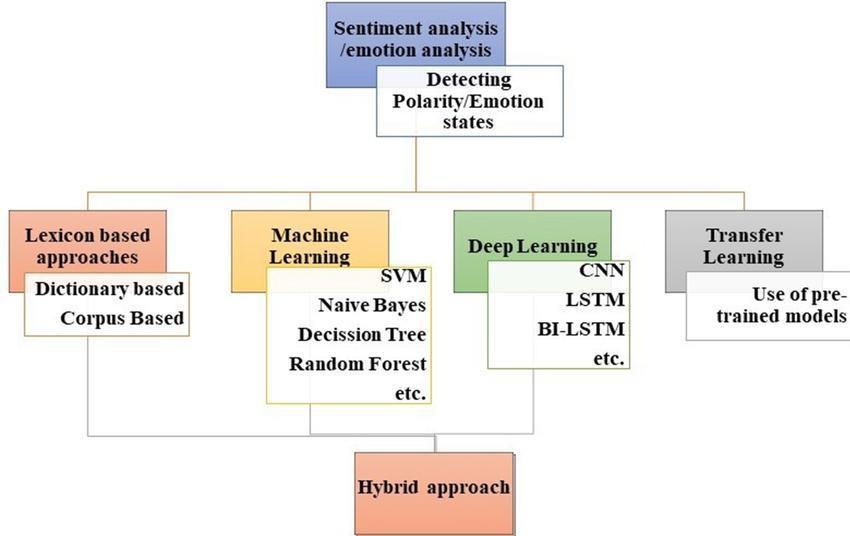
For affective computing, emotional analysis is essential. Emotions may be described as "affect," and the verb"to compute" implies to compute or quantify such feelings. In order to understand the human-machine interactions, we need to create devices or systems that can process and identify, interpret, and replicate human emotions. Text, speech, facial expressions, etc. are examples of this data. We can evaluate the well- being of a community, we can prevent suicides, and it may be extremely useful for enterprises to gauge the level of happiness of their consumers by studying the comments or feedback they makeviatheuseofsentimentanalysis.Asaconsequenceof thesentimentandemotionanalysis,wemayalsoutilisethe text collected from e-learning environments to conduct opinionminingforcorporateorganisations.Awidevariety of applications, including social assistance, assessing the wellbeing of a community, and even the identificationand treatment of suicidal inclinations,are among the many reasons why researchers find the detection of emotions from text to be a very fascinating topic. There are many levels of analysis that may be performed, including document,sentence,word,aswellasaspectlevels.
A wide variety of applications make use of sentiment analysis for purposes including recommendation aswell as feedback analysis. Sentiment analysis, sometimes known as SA, is a subfield in text mining that is actively being researched. SA refers to a computational approach to the handling of views, feelings, and the subjectivity of language. Many disciplines of study, including psychology and neuroscience, use sentiment analysis since it is a keycomponentofhumanbehaviour. Manycomputerscientistsare interested in this because of its broad variety of applications, including social support, communityevaluation,andeventheavoidanceof
Volume: 11 Issue: 04 | Apr 2024 www.irjet.net
suicidal ideation. As a result, models may be used to evaluate social media data and get insights from the general public about a product or a subject. Various suicide prevention and e-learning systems may also benefit from sentiment analysis. We chose to do a review of existing methods for detecting emotions in text and make it accessible to the scientificcommunity sincewewereexcitedaboutitsgreatpotential.SA refersto a computational approach to the handling of views, feelings,andthesubjectivityoflanguage.
•
Linguistic Foundations and Approaches: Researchers like PangandLee(2008)introducedfoundationalmethodsfor sentimentanalysis,classifyingtextintopositive, negative, and neutral sentiments. These polarity-based approaches laid the groundwork for more advanced emotion identification. Subsequent studies explored linguistic features, lexical resources, and syntactic patterns that contribute to emotion detection(Cambria etal.,2014).
• Emotion Lexicons and Sentiment Dictionaries: Emotion-specificlexiconsandsentimentdictionaries,such as SentiWordNet (Esuli & Sebastiani, 2006) and NRC EmotionLexicon(Mohammad&Turney,2013),havebeen pivotal in advancing emotion identification. These resources provide a structured framework for associating words with specific emotions, enabling more nuanced sentimentanalysis.
•Machine Learning and Deep Learning Techniques: The advent of machine learning and deep learning revolutionized sentiment analysis. Researchers applied techniques like Support Vector Machines (SVM), Naive Bayes, and more recently, recurrent and convolutional neural networks (RNNs and CNNs), to capture contextualandsequential patternsintext (dosSantos & Gatti, 2014;Kim,2014).
International Research Journal of Engineering and Technology (IRJET) e-ISSN: 2395-0056 p-ISSN: 2395-0072
Data Preprocessing:
Acquired facial data (images or videos) undergo preprocessingstepssuchasfacedetection,alignment, and normalizationtostandardizetheinput. Noisereductiontechniques maybe appliedto improve the quality of the facial images and remove irrelevant information.
Feature Extraction:
Featuresrepresentingfacialexpressionsareextractedfrom thepre-processeddata.
Deep learning techniques, such as convolutional neural networks (CNNs), may be used to automatically learn hierarchicalrepresentationsdirectlyfromrawpixeldata.
Model Training:
Supervised learning algorithms, such as CNNs, are trained on labeled datasets containing facial images or videos annotated with emotion labels. The model learns to map input features to corresponding emotional states during thetrainingprocess.
Model Evaluation:
The trained model is evaluated using benchmark datasets and standard evaluation metrics such as accuracy, precision,recall,andF1-score.
Cross-validation techniques may be employed to validate themodel'srobustnessandgeneralizationability.
1. Insight into Customer Sentiment: Businesses can gain valuable insights into customer opinions and sentiments about their products, services, or brand. By analyzing customerfeedback,reviews,andsocialmediainteractions, companies can tailor their strategies, improve offerings, andenhancecustomersatisfaction.
2. Effective Marketing and Advertising: Sentiment analysis enables marketers to gauge public reactionsto marketing campaigns and advertisements. This helps in optimizing messaging and targeting, ensuring that marketing efforts resonate positively with the intended audience.
3.Real-time Feedback and Monitoring: Emotion identification allows for real-time monitoring of public sentiment, enabling timely responses to emerging issues or trends. This proactive approach helps in reputation managementandcrisisresponse.
4. Data-Driven Decision-Making: Organizations can make informed decisions by integrating sentiment analysis insights into their decision-making processes. This datadriven approach extends beyond marketing and can
Volume: 11 Issue: 04 | Apr 2024 www.irjet.net
influence product development, market expansion, and strategicplanning.
1.Contextual Ambiguity: Sentiment analysis may struggle with capturing the contextual nuances of language, including sarcasm, irony, and cultural references. The automated algorithms might misinterpret or fail to accurately identify emotions when such nuances are present.
2.
Subjectivity and Individual Variation: Emotions are subjective and can vary widely among individuals. Sentiment analysis models maynotaccuratelycapture the diverse ways people express and perceive emotions, leadingtopotentialmisclassifications.
3.
Overgeneralization and Oversimplification: Some sentiment analysis models tend to oversimplify emotions intobroadcategorieslikepositive,negative,orneutral.This oversimplification may not adequately capture the complexityanddiversityofhumanemotionalexperiences.
4.DataQualityandBias:Sentimentanalysismodelsheavily relyonthequalityanddiversityoftrainingdata.Biasedor unrepresentative data can lead to biased or inaccurate emotion classifications, perpetuating existing societal biases.
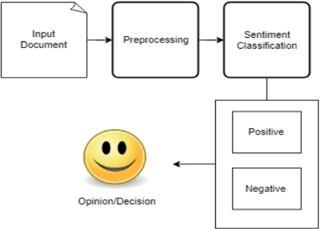
Sentiment classification at the document level, a single polarityisgiventotheentiredocument.Thereisn'talotof sentimentanalysislikethisoutthere.Usingthistechnique, the chapters or pages of a book can be classified as good, bad,orneutral.
Categorize text data into different emotional states (e.g., happiness, sadness, anger) to understand the emotional tone.
Determinethepolarityoftext(positive, negative, neutral) togaugeoverallsentimentconveyed.
Identify nuanced emotions (e.g., sarcasm, irony) for a comprehensiveunderstandingoftextsentiment.
Consider context to enhance accuracy in interpreting emotionsexpressedintext.
Tailor sentiment analysis for specific applications like customerfeedbackanalysisorsocialmediamonitoring.
Developsystemsforreal-timeemotionanalysistoprovide timelyfeedbackorresponse.
International Research Journal of Engineering and Technology (IRJET) e-ISSN: 2395-0056 p-ISSN: 2395-0072
Assessmodel accuracyusingmetricslikeprecision,recall, F1-score,forcontinuousimprovement.
Extend emotion identification to multiple languages to handlediversesourcesoftextdata.
Integrate emotion identification with other systems (e.g., chatbots)forenhancedfunctionality.
Facial Emotion Recognition: The primary objective is to design and implement machine learning models capable ofaccuratelyrecognizingandinterpretingemotionsfrom facial expressions. This involves training algorithms to classify facial images or videos into predefined emotion categories such as happiness, sadness, anger, surprise, fear,anddisgust.
Feature Extraction and Representation: An important challengeistoidentifyandextractrelevantfacialfeatures that effectively capture emotional cues. Traditional methods rely on handcrafted features, while modern approaches leverage deep learning techniques, such as convolutional neural networks (CNNs), to automatically learnhierarchicalrepresentationsfromrawpixeldata.
Model Training and Evaluation: The research involves training and fine-tuning machine learning models on labeled datasets containing facial images or videos annotated with corresponding emotion labels. Performance evaluation is conducted using metrics such as accuracy, precision, recall, and F1-score to assess themodel'sability to generalizeto unseen data and robustnesstovariationsinfacialappearanceandpose.
Applications and Deployment: Beyond model development, the research explores the diverse applicationsoffacialemotiondetectionacrossindustries, including healthcare, education, customer service, and entertainment. Consideration is given to the practical deployment of these systems, addressing ethical considerations such as privacy, consent, and potential biases.
EthicalConsiderations:Giventhesensitivenatureoffacial data and the potential for misuse or harm, the research also focuses on addressing ethical considerations associated with facial emotion detection. This includes ensuringtransparency,fairness,andaccountabilityinthe design, development, and deployment of these systems, aswellassafeguardingindividuals'rightsandprivacy.
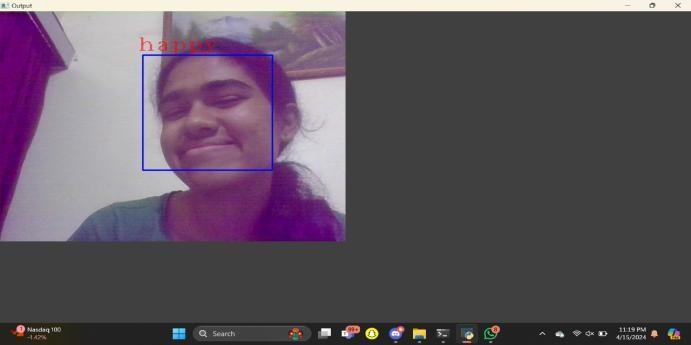
Theperformanceofthefacial emotiondetectionsystem is assessed based on the evaluation metrics obtained during testing.
Volume: 11 Issue: 04 | Apr 2024 www.irjet.net
Results indicate the system's accuracy in recognizing and classifyingemotionsfromfacialexpressions.
Depending on the dataset and model complexity, the system may achieve high accuracy rates in emotion detectionacrossdifferentemotioncategories.


In conclusion, the realm of emotion identification using sentiment analysis presents a captivating blend of possibilities and challenges. This innovative approach, situated at the intersection of linguistics, psychology, and artificial intelligence, has illuminated new pathways for understanding and harnessing the intricacies of human emotionswithintextualdata.Throughoutthisexploration,
International Research Journal of Engineering and Technology (IRJET) e-ISSN: 2395-0056 p-ISSN: 2395-0072
we have delved into the significance, methodologies, advantages, and disadvantages inherent in this field. The journey embarked upon in this study underscores the transformative potential of sentiment analysis. From its originsinpolaritydetection,sentimentanalysishasevolved intoa nuanced disciplinecapableofidentifying aspectrum ofemotions,fromjoyandsadnesstoanger Fand surprise. The linguistic foundations, machine learning algorithms, and deep learning techniques harnessed within this field have enabled the automated deciphering of emotional nuancesembeddedwithindiversetextualsources.
1.Adoma AF, Henry N-M, Chen W (2020) Comparative analyses of Bert, Roberta, distilbert, and Xlnet for textbasedemotionrecognition.In:202017thInternational ComputerConferenceonWaveletActiveMediaTechnology and Information Processing (ICCWAMTIP), IEEE, pp 117–121.
2. Ahmad Z, Jindal R, Ekbal A, Bhattacharyya P (2020) Borrow from a rich cousin: transfer learning for emotion detection using cross-lingual embedding. Expert System Application139:112851.
3. AhmedWM(2020)Stockmarketreactionstodomestic sentiment: panel CS-ARD evidence. Res Int Bus Finance 54:101240AhujaR,ChugA,KohliS,GuptaS,AhujaP(2019) Theimpactoffeaturesextractiononthesentimentanalysis. ProcediaComputerSci152:341–348.
4.Alqaryouti O, Siyam N, Monem AA, Shaalan K (2020) Aspect-based sentiment analysis using smart government reviewdata.ApplComputerInf.
5.AlswaidanN,MenaiMEB(2020)Asurveyofstate-of-theartapproachesforemotionrecognitionintext.Knowledge InfSystem62(8):1–51.
6.Abdi A, Shamsuddin SM, Hasan S, Piran J (2019) Deep learning-based sentiment classification of evaluative text based on multi-feature fusion. Inf Process Manag 56(4):1245–1259.
7.Al Amrani Y, Lazaar M, El Kadiri KE (2018) Random forestandsupportvectormachine-basedhybrid approach tosentimentanalysis.ProcediaComputerSci127:511–520.
8. Archana Rao PN, Baglodi K (2017) Role of sentiment analysis in the education sector in the era of big data: a survey.
9.B. Pang and L. Lee, "Opinion mining and sentiment analysis," Foundations and Trends® in Information Retrieval,vol.2,no.1-2,pp.1-135,2008.
Volume: 11 Issue: 04 | Apr 2024 www.irjet.net
10.A. Esuli and F. Sebastiani, "SentiWordNet: A publicly available lexical resource for opinion mining," in ProceedingsofLREC,vol.6,pp.417-422,2006.
11.S. Mohammad and P. Turney, "Crowdsourcing a word–emotion association lexicon," Computational Intelligence,vol.29,no.3,pp.436-465,2013.
12.C.dosSantosandM.Gatti,"Deepconvolutionalneural networksfor sentiment analysisof shorttexts," in ProceedingsofCOLING2014,pp.69-78,2014.
13.Y. Kim, "Convolutional neural networks for sentence classification," in Proceedings of the 2014 Conferenceon Empirical Methods in Natural Language Processing(EMNLP),pp.1746-1751,2014.
14.M.Pontikietal.,"SemEval-2016Task5:AspectBased SentimentAnalysis,"inProceedingsofSemEval,2016.
15.J.Bollen,H.Mao,andX.Zeng,"Twittermoodpredicts thestockmarket,"JournalofComputational Science, vol. 2,no.1,pp.1-8,2011
International Research Journal of Engineering and Technology (IRJET) e-ISSN: 2395-0056 p-ISSN: 2395-0072