
International Research Journal of Engineering and Technology (IRJET) e-ISSN: 2395-0056
Volume: 11 Issue: 04 | Apr 2024 www.irjet.net p-ISSN: 2395-0072
International Research Journal of Engineering and Technology (IRJET) e-ISSN: 2395-0056
Volume: 11 Issue: 04 | Apr 2024 www.irjet.net p-ISSN: 2395-0072
Mr.K. Srinivasan1, Gokul M2, Shasidhar P2, Sriram M2
1Assistant Professor, M. Tech, Department of Civil Engineering, Sri Manakula Vinayagar Engineering College, Madagadipet, Puducherry, India
2UG Students, Department of Civil Engineering, Sri manakula Vinayagar Engineering College, Madagadipet, Puducherry, India ***
Abstract – The construction sector is increasingly called upon to embrace eco-friendly methods, with a focus on diminishing the use of finite resources and lowering greenhouse gas emissions. In response, this paper details the creation of large-volume, lightweight interlocking composite blocks that surpass the size of standard bricks. These blocks are crafted to lock together without the need for cement mortar, which is a stapleintraditionalbuilding.Thematerials used include clay, cement, water, and organic fibers. The clay portion is substituted with 30% wood ash, 6% wheat straw, 6% wheat husk, and 28% M53 grade cement. The balance of 30% consists of clay. The paper examines wood ash sourced from industrial and factory waste, highlighting its role in enhancing the block's lightness and in the repurposing of waste. The use of natural fibers like wheat husk and straw is explored for their contribution to the block's reduced weight and structural reinforcement. These repurposed materials serveas a greenalternativeto traditionalcomponents, aiding the industry in achieving its sustainability objectives. The blocks underwent a battery of tests to assess compressive, tensile, and flexural strengths, along with overall endurance, heat resistance, and impermeability to water. The outcomes indicated compressive strength at 18.21 N/mm2, tensile strength at 0.879 N/mm2, and flexural strength at 3.45 N/mm2. This project signifies a significant stride in sustainable building, offering numerous benefits in terms of flexibility and ecological footprint.
Key Words: Wood Ash, Wheat Straw, Wheat Husk, LightweightInterlockingcompositeblock,Sustainability.
Innovationsineco-friendlybuildingtechniqueshaveledto the creation of lightweight interlocking composite blocks. Theseblocksareengineeredtoconnectseamlessly,boasting agreatervolumethantraditionalbricks.Theiruniquedesign forgoes the requirement for cement mortar, commonly employedinstandardmasonry.Thisadvancementtackles critical ecological issues related to the manufacturing of cementandthedegradationofsoil.Incorporatingadditives intobrickproductionnotonlyreducestheneedforclaybut alsoimprovestheirphysicalandmechanicalcharacteristics. The selection of additives is crucial for the construction industry’s move towards sustainability. A variety of
environmentally friendly materials, such as fly ash, wood ash,andagriculturalresidueslikewheatandricehusks,have been recognized for their potential to improve bricks’ thermalinsulation,reduceweight,andincreasecompressive strength. These enhancements depend on the specific proportionsofadditivesusedandthebrickfiringtechniques employed[1-9]
In practical and engineering scenarios, focusing on optimizing a single objective often leads to suboptimal outcomesforotherobjectives.Consequently,it’stypicalto amalgamatemultipleobjectivefunctionsintoone.Crafting anidealobjectivefunctionthatsimultaneouslyoptimizesall objectivesisanarduoustask.Therefore,forproblemswith multiple objectives, it’s advantageous to establish a satisfactory spectrum of solutions for each goal. Multiobjective evolutionary algorithms are widely used methodologies for developing a set of solutions that are Paretooptimal[10,11].Currently,theconstructionindustry employs a variety of interlocking dry-stacked blocks and bricks. These are tailored in diverse sizes, shapes, and compositions, reflecting the materials accessible in their placeofproductionandthepreferencesofthemanufacturer. Notableamongthearrayofinterlockingblocksaresystems liketheMecano,Sparfil,Haener,andSparlocksystem[12]. TheyalsointroducedSilblock-1andSilblock-2,composedof cement, sand, and 12 mm aggregate. These blocks are categorized into three-unit types: stretcher, jamb, and corner,averagingdimensionsof400mminlength,150mm inwidth,and200mminheight.
The manufacture of cement is a major environmental concern, contributing to roughly 4-5% of global CO₂ emissions. The ecological footprint of cement production extendsbeyondcarbonemissions,encompassingissuessuch aswaterpollutionfromrunoff,urbanheatislands,airborne particulatematter,andemissionsofhazardoussubstances like NOx, SO₂, and CO. In the context of residential construction, the use of cement mortar is notably substantial.Toillustrate,astandard1:4mortarmixrequires about 8 bags of cement, each weighing 50 kg (totalling approximately383kg),toprepare1cubic meter(1m³) of mortar.Theprocurementoftopsoilforthemanufactureof brickscontributestosoilerosionandlanddegradation.The operation of brick kilns involves the extraction of topsoil,
International Research Journal of Engineering and Technology (IRJET) e-ISSN: 2395-0056
Volume: 11 Issue: 04 | Apr 2024 www.irjet.net p-ISSN: 2395-0072
whichdiminishesagriculturalproductivityandescalatesthe expensesassociatedwithnutrientreplenishment.Inregions liketheGangeticplainsofIndia,wherefertilealluvialsoilis abundantandconstitutes65%ofthebrick-makingmaterial, suchpracticesjeopardizetheintegrityandfecundityofthe soil. Annually, an estimated 340 billion tons of clay are extracted worldwide for brick production [13]. This substantialextractionrateleadstoadecreaseinnaturalsoil levels, posing an environmental concern. Researchers globallyareinvestigatinginnovativesubstitutesforclayin brickcompositiontoaddressthisissue[14,15].
Plant fibers are extensively utilized across various industries,drawingfromaplethoraofsources.Themid-20th centurysawadramaticsurgeinsyntheticfibers,leadingtoa declineinthemarketsharefornaturalfiberindustries.To advocate for natural fibers and materials, 2009 was designatedastheInternationalYearofNaturalFiber(IYNF), providingsubstantialsupportforfarmers,agriculture,the environment,andmarketneeds.Thecompositemarketin the United States was reported to be between 2.7 and 2.8 billionpoundsfrom2006to2007.Withacompoundannual growth rate of 3.3%, it is projected to surpass 3.3 billion pounds [16]. There is a growing interest among scientists andengineerstodiscovernewsourcesofrawmaterialsthat offerphysicalandmechanicalpropertiessimilartothoseof syntheticfibers.Variousotherparameterstobeconsidered while selecting raw materials are being cheap, being ecofriendly [17], absence of health hazards, high degree of flexibility[18],lowerplantsage,easycollection,andregional availabilitywhichdirectlyinfluencethesuitabilityofnatural fibers [19, 20] Integrated within the blocks are organic fibers such as wheat straw and husk, selected for their notabletensilestrengthandendurance.Thesefibersfortify the composite blocks, lending them enhanced structural integrity.
Theblocksarecraftedfromablendofcompositematerials, designedtodemonstrateenhancedcharacteristicsincluding compressive strength, tensile strength, flexural strength, longevity,thermalinsulation,andweatherresistance.Such attributesrendertheseblocksversatilefordiversebuilding purposes.Thisinnovativemethodmergesthedisciplinesof material science and civil engineering to forge a groundbreakingconstructionmaterial.Itstandsoutnotjustforits efficiency and sustainability, but also for its role in preserving the environment. This breakthrough marks a substantial leap forward in sustainable construction, providing a multitude of advantages including userfriendlinessandreducedecologicalfootprint.Itsignifiesa
Lightweightinterlockingblocks(LICBs)haveemergedas a sustainable alternative to traditional building materials, leveragingadvancementsinmaterialsscienceandagrowing environmental consciousness. Developed to address the demandforefficientandeco-friendlyconstructionmethods,
LICBsaretypicallycraftedfromrecycledplasticsandrubber, showcasing a commitment to sustainability. Their interlocking design eliminates the need for mortar or adhesives during assembly, simplifying construction processes, reducing labor requirements, and streamlining logistics. Additionally, LICBs' lightweight nature facilitates easiertransportation,handling,andinstallationcomparedto conventional materials, while still offering durability, weatherresistance,andinsulationproperties.Theirmodular design allows for versatile configurations, making them suitableforawiderangeofindoorandoutdoorapplications. Asthedemandforsustainablebuildingsolutionscontinuesto rise, LICBs are poised to play a pivotal role in shaping the futureofconstruction,offeringaperfectblendofinnovation, sustainability,andfunctionality.
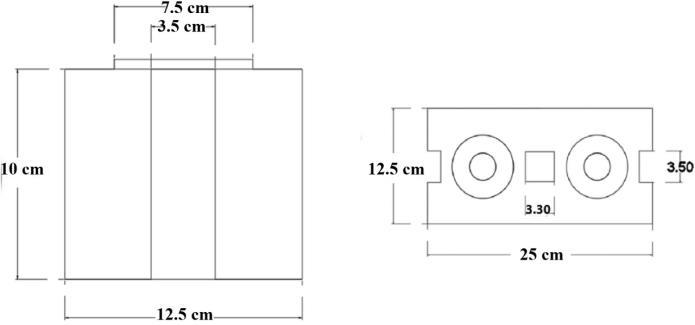
As the demand for sustainable building solutions continuestorise,LICBsarepositionedtoplayapivotalrolein shapingthefutureofconstruction,offeringaperfectblendof innovation,sustainability,and functionality. TheFig1 that SpecificstheDimensionoftheininterlockingBlockWhich wasof13typesofbrickswhichwasmanufacturedlocallyby ICEB Trading located in Kedah, Malaysia. However, this research only studied one type of the commonly used Structure with Experimenting then Mould with different compositionofcompositemixtures.
Thisresearchexploresthecreationofinterlockingcomposite blocks (LICBs) as an eco-friendly substitute for traditional clay bricks. Leveraging natural fibers, the study aims to diminish the environmental impact and soil degradation linkedwithstandardbrick-makingprocesses.
In this study, wood ash serves as a supplementary materialtocement.Theash,generatedfromthecombustion of wood in industrial and factory settings, is utilized to partially replace cement in concrete production. The materialsemployedincludeOPC43,53Grade,PPCcement, sand, coarse aggregate, and wood ash. The wood ash is incorporated in proportions ranging from 0% to 50%, relativetothecement’sweight.Aconsistent water-cement
International Research Journal of Engineering and Technology (IRJET) e-ISSN: 2395-0056
Volume: 11 Issue: 04 | Apr 2024 www.irjet.net p-ISSN: 2395-0072
ratioof0.45ismaintainedacrossallmixtures.Theconcrete samples undergo compressive strength and split tensile strength evaluations after 7, 14, and 28 days of curing. Findingsindicatethattheoptimalstrengthisattainedwhen theconcretecontainsawoodashcontentbetween20%and 25%,surpassing the strength of both thestandard control concreteandothermixvariations.
The chemical analysis of the wood ash, as detailed in Table1,revealsasignificantlimecontentofapproximately 60.55%. Experimental assessments have determined the specificgravityoftheashtobe3.1,withaparticlesizeof35 micrometers. For the paste to reach the desired standard consistency,about35%waterisnecessary,whichisachieved when clay is substituted by wood ash at a 20% rate. Exceeding this replacement threshold to more than 20% leads to an increased water demand, rising to 37.5% to maintainthepaste’sconsistency.
Fluorescence (XRF) tests, in line with the material characterizationnormsNM01.1.229–2006(SGG,1993).The clay is analyzed in its dry, powdered state as per the methodologyoutlinedbyLimamietal.,2020a.FortheXRD analysis, the powdered sample is placed in the diffractometer’ssamplemount,andwiththeaidofanX-Ray tubeanddivergenceslits,thecrystallinestructureoftheclay isidentified,adheringtoMoroccanstandardsNM01.1.333–2006(IMANOR,2006a),andincompliancewithASTMD5357 (Materials,2019).ThisissupportedbyX-RayFluorescence (XRF) test results shown in Table 1, where the silica component(SiO2)constitutes60.55%oftheclay’schemical makeup.ThehighSiO2concentrationsuggeststhattheclay is well-suited for construction purposes. The clay is composed mainly of Illite and Muscovite, with minor amountsofCalciteandDolomite.Table2confirmsthesoil’s clayey nature, with a substantial Aluminum oxide (Al2O3) contentof22.4%.TheclayisidentifiedasIllitetypedueto thePotassiumoxide(K2O) content of2.53%.Additionally, theFerricoxide(Fe2O3)contentinfluencestheredhueofthe brick samples, while Calcium oxide (CaO) impacts the structuralintegrityandsusceptibilitytocracking.
Table -2: ThePropertiesofclay
The study on interlocking claybricks incorporated with fiberslikewheatstrawandwheathuskshowedpromising results.Thesebricksexhibitednoshrinkagecracks,satisfied the minimum strength criteria set by various mud brick standards,anddemonstratedlowthermalconductivityalong with high insulation capabilities. Wheat straw and husk, which are by-products of agriculture rich in cellulose and lignin,wereusedinproportionsrangingfrom1%to6%by soilweightforeachtypeoffiber.Unlikethecontrolbricks that contained no fibers, the fiber-enriched bricks had a water content of 15% to 18%, compared to 13% in the control.
Theclayusedinthisresearchissourcedspecificallyfrom thePuducherryregion.Table2presentstheclay’sproperties as determined by X-Ray Diffraction (XRD) and X-Ray
OrdinaryPortlandCement(OPC),commonlyutilizedina variety of construction projects due to its robustness and optimal setting periods, is the focus of this investigation. Specifically,OPCofgrade53isemployed,knownforitshighstrength properties that provide resistance against substantialcompressiveforcesandsulphatecorrosion.The studyutilizesOPCofgrade53,whichhasaspecificgravityof 3.13, serving as the primary binding agent. The cement’s
International Research Journal of Engineering and Technology (IRJET) e-ISSN: 2395-0056
Volume: 11 Issue: 04 | Apr 2024 www.irjet.net p-ISSN: 2395-0072
chemical makeup was ascertained through X-ray fluorescence(XRF)analysis,withfindingsdetailedinTable 3. The cement’s fineness, determined via Blaine’s air permeability method, was recorded at 227 m2/Kg. Its soundness was evaluated using both the Le Chateliers methodandAutoclavetest,yieldingmeasurementsof10mm and0.7%,respectively.Thecement’ssettingdurationwas gauged with a Vicat apparatus, revealing an initial setting timeof42minutesandafinalsettingtimeof620minutes
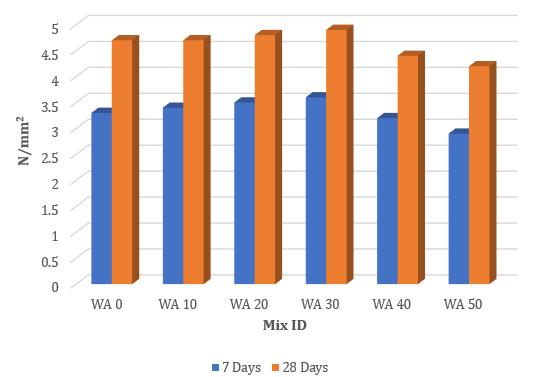
andthreedifferentmixeswithclayreplacedbyWheatStraw (WS) at 5, 10 and 15% levels was done and presented in Table 5 and Table 6 respectively. The cement was also replacedwithclaywithdifferentpercentage0,10,20,30,40% and found that 28% was the optimum The final mix was preparedwith30%ofwoodash,7%ofwheatstraw,6%of wheathusk,and28%ofcementM53gradeassubstitutesfor clay.Therest29%wasclay.Thedetailedmixproportioningof the final mix was also presented in finalTable.The studycovers the fresh properties such as consistency, setting time, soundness test, compressive strength, split tensile strength and flexural strength of the mixes according to IS 4031. Compressive strength, split tensile strength and flexural strength test was carriedoutwithinterlockingcompositeblockattheageof7-and 28-days curing
(CaO 0.7SO3/2.8SiO2 +1.2Al2O3 + 0.65Fe2O3)
2.5 Methodology
The characterization of Wood Ash, Wheat straw and WheatHuskcommencedwithacomprehensiveexamination of its chemical composition with detailed findings summarizedinTables.Particlesizeanalysiswasconducted using a range of sieves from 4.75mm to 50 micrometers. After 15 minutes of agitation, the weights of materials retained on each sieve were measured for deeper insight into the material's physical properties The Physical Propertiesofthematerialsarebeenperformedandstudied forthecontributiontostrengthanddurabilityoftheblock. Thentheoptimumratioofthemixofthedifferentelements are been considered and compare the strength with the conventionalmixcasted.
3.Experimental Investigation
Thedetailedmixproportioningofsixdifferentmixeswith clayreplacedbywoodashat0,10,20,30,40and50%levels wasdoneandpresentedinTable 4.Similarly,thedetailed mix proportioning of seven different mixes with clay replacedbywheathusk(WH)at1,2,3,4,5,6and7%levels
International Research Journal of Engineering and Technology (IRJET) e-ISSN: 2395-0056
Volume: 11 Issue: 04 | Apr 2024 www.irjet.net p-ISSN: 2395-0072
-5: ExperimentaldataforWheatStraw
Table -6: WheatHuskExperimentalAnalysis
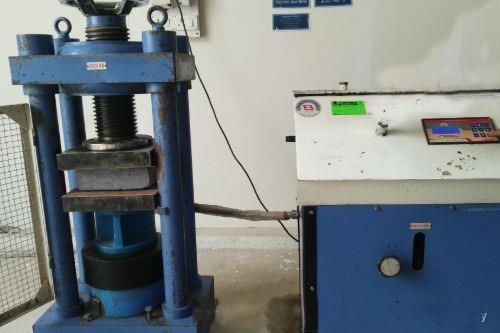
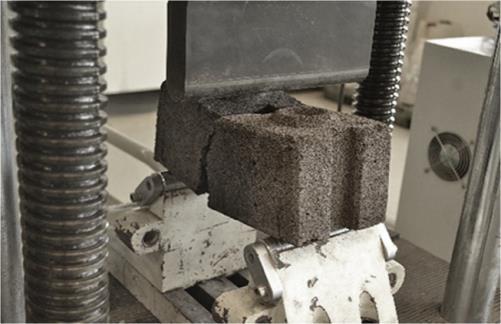
Table -4: ExperimentaldataforWoodAsh
Volume: 11 Issue: 04 | Apr 2024 www.irjet.net p-ISSN: 2395-0072
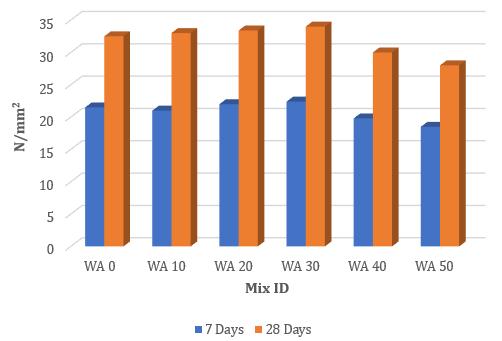
Thecompressivestrengthtestforlightweightinterlocking compositeblocks(LICBs)evaluatestheirabilitytowithstand axialloads.LICBsareplacedbetweensteelplatesandloaded untilfailure,followingIndianStandardIS516:1959.LICBsin thisstudyweremoldedinsteelformsandcuredfor28days inwater,meetingIS1077:1992specificationsforcommon burnt clay building bricks. Evaluating the compressive strengthofLICBsisessentialtodeterminetheirqualityand applicability in construction. In this research, around 100 LICBunitsweretested.ThemethodologyfollowedtheBSEN 772–1 guideline (British Standard Institution, 2011). To guarantee uniform compression, each sample was capped withasteelplateonbothsides.Priortotesting,thesamples wereoven-driedfor24hourstoensureaconsistentmass. The strongest block recorded a compressive strength of 18.21N/mm²,achievedthroughmanualcompressionwitha highrateandvibrationduringthecompactionprocess.This highpressureledtotheproductionofmorerobustmasonry units.Thestudyalsofoundthatbrickswithdeepergrooves weremorepronetofailureundermaximumloadduetothe increasedstressconcentration
The flexural strength test for the lightweight interlocking composite blocks (LICBs) involved evaluating randomly selectedsamples.Thesetestswereconductedinaccordance withASTMC67standards,whicharespecifictothetestingof masonry units for structural purposes. The LICB samples weretestedinboththebedandflatwiseorientationsdueto theiruniqueinterlockingshapes.Forthebeddirectiontest, theLICBsamplewithadowelwaspositionedwiththedowel facing upwards, while the groove faced downwards. Conversely,fortheflatwisedirectiontest,thepositionswere reversed. A load was applied at the midspan of the LICB, usingasteelbearingplatemeasuring6.4mminthickness and 38.1 mm in width. Flexural strength tests were conducted on lightweight interlocking composite blocks (LICBs) according to ASTM C67 standards. Samples were testedinbothbedandflatwiseorientationstoassesstheir structural integrity. Load application was performed at midspan using steel bearing plates, allowing for an even distributionofforce.Calculationsbasedonmaximumload, support distance, and dimensions yielded a maximum recorded flexural strength of 3.45 N/mm². Notably, LICBs exhibited higher strength in the bed direction than in the flatwisedirection.Thesefindingsdemonstratethesuitability of LICBs for various construction applications, meeting or surpassing the minimum threshold of 0.25 N/mm² for structuralefficacy,asrecommendedbySilvaetal.(2015).
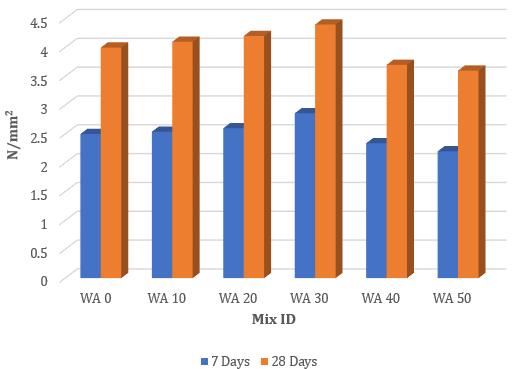
Thesplittingtensilestrengthtestforlightweightinterlocking compositeblocks(LICBs)examined100randomlyselected samplesinlinewithASTMC1006standards.Duringtesting, 10mmdiameterbearingrodswerepositionedatthecenter ofthetopandbottomsurfaces,withloadingappliedalong thebedsurface.Resultsrevealedahighestrecordedstrength of0.879N/mm²,wellsurpassingtheminimumrequirement of0.4N/mm²formasonrytensilestrength.LICBstypically failed due to splitting, with cracks forming parallel to the loadaxis.Notably,theblock'sshapeandcompressionrate duringmanufacturesignificantlyinfluencedtensilestrength, underscoring the importance of careful design and productionprocessesforstructuralintegrity.
Table -7: FinalMixIDCompression,SplittensileandFlexural Strength
The clay is replacedwith 30%ofWood ash, 6% of raw wheat straw, 6% of wheat husk, and 28% cement M53 grade. The remaining 30%isclay.
Thisresearch introduces a novel approachtoeco-friendly construction through the development of lightweight interlockingcompositeblocks(LICBs).Theseblocks,which aresignificantlylargerthanstandardbricks,areengineered to connect seamlessly, eliminating the need for cement mortar, which is a fundamental component in traditional brickwork.TheLICBsarecomposedofamixofclay,cement, water, and organic fibers. In this composition, 30% wood ash,6%wheatstraw,6%wheathusk,and28%M53grade cementwereused,withtheremaining30%beingclay.The blocks underwent a series of evaluations to assess their performance,includingdensity,weight,durability,strength, abrasion,andimpactresistance.Theresultsindicatedthat theblockspossessacompressivestrengthof18.21N/mm², splittensilestrengthof0.879N/mm²,andflexuralstrength of3.45N/mm² Thestudyhighlightslightweightinterlocking composite blocks (LICBs) as a promising alternative to traditionalbricks,offeringbenefitssuchasadaptabilityand reduced environmental impact. LICBs decrease carbon emissions and streamline construction processes while
International Research Journal of Engineering and Technology (IRJET) e-ISSN: 2395-0056
Volume: 11 Issue: 04 | Apr 2024 www.irjet.net p-ISSN: 2395-0072
saving costs. Future research includes exploring block shapes, refining mix proportions, and assessing thermoacousticproperties.
The authors express their sincere gratitude to the administration of Sri Manakula Vinayagar Engineering CollegeinMadagadipet605107,Puducherry,India,forthe essentialresourcesprovidedtofacilitatethisresearch.They alsoextendheartfeltthankstoalltheeducatorsandsupport staff from the Structural Engineering Lab, Concrete Technology Lab, and Environmental Engineering Lab for their unwavering support throughout the duration of the projectandresearchactivities.
[1] R.Ruparathna,K.Hewage,R.Sadiq,(2016),“Improving the energy efficiency of the existing building stock: A critical review of commercial and institutional buildings”,Renew.Sustain.EnergyRev.53,1032–1045.
[2] A.Martínez-Molina,I.Tort-Ausina,S.Cho,J.-L.Vivancos, (2016), “Energy efficiency and thermal comfort in historic buildings: A review”, Renew. Sustain. Energy Rev.61,70–85.
[3] S. Ahmad, Y. Iqbal, R. Muhammad, (2017),” Effects of coalandwheathuskadditivesonthephysical,thermal andmechanicalpropertiesofclaybricks”,Bol.SECV56 (3),131–138.
[4] T.P.Huynh,C.L.Hwang,K.L.Lin,S.H.Ngo,(2018),“Effect ofresidualricehuskashonmechanical-microstructural properties and thermal conductivity of sodiumhydroxide-activated bricks”, Environ. Prog. Sustain Energy37(5),1647–1656.
[5] S.M.S. Kazmi, M.J. Munir, I. Patnaikuni, Y.-F. Wu, U. Fawad,(2018),“Thermalperformanceenhancementof eco-friendlybricksincorporatingagro-wastes”,Energ. Buildings158,1117–1129.
[6] M. Sutcu, E. Erdogmus, O. Gencel, A. Gholampour, E. Atan,T.Ozbakkaloglu,(2019),“Recyclingofbottomash andflyashwastesineco-friendlyclaybrickproduction” , J.Clean.Prod.233,753–764.
[7] K.-Y. Chiang, H.-R. Yen, C.-H. Lu, (2019), “Recycled gypsum board acted as a mineral swelling agent for improving thermal conductivity characteristics in manufacturing of green lightweight building brick” , Environ.Sci.Pollut.Res.26(33),34205–34219.
[8] Parthiban Kathrine, George Amal Anik, Saravana Raja Mohan Kaliyaperumal. (2019), “Effect of partial replacementofcementwithProsopisjulifloraashonthe
strengthandmicrostructuralcharacteristicsofcement concrete”, Construction and Building Materials, Vol225,273-282.
[9] R.M.N.Arib,S.M.Sapuan,M.M.H.M.Ahmad,M.T.Paridah, H.M.D.KhairulZaman,(2006),“Mechanicalpropertiesof pineapple leaf fibre reinforced polypropylene composites”,MaterialsandDesign,Vol-27,391–396.
[10] A.Konak,D.W.Coit,A.E.Smith,(2006),“Multi-objective optimization using genetic algorithms: A tutorial” , Reliab.Eng.Syst.Saf.91(9),992–1007.
[11] H. Tamaki, H. Kita, and S. Kobayashi, (1996), “Multiobjectiveoptimizationbygeneticalgorithms:Areview”, Proceedings of IEEE international conference on evolutionarycomputation
[12] Anand,K.B.,Ramamurthy,K.,(2000),”Developmentand performanceevaluationofinterlocking-blockmasonry”, J.Architect.Eng.6(2),45–51.
[13] A.S.Pawar,D.B.Garud,EngineeringPropertiesofClay Bricks with Use of Fly Ash, Int.J. Res. Eng. Technol. 3 (2014)75–80.
[14] P.M. Velasco, M.P.M. Ortíz, M.A.M. Giró, L.M. Velasco, (2014), “fired clay bricks manufactured by adding wastesassustainableconstructionmaterial–Areview” , 6397–107.doi:10.1016/j.conbuildmat.2014.03.045.
[15] N. Nadia, A. Nik, M. Haziman, W. Ibrahim, A. Halim, A. Ghani, A. Zurisman, M. Ali, M.F. Arshad, (2017),” Compressive Strength of Construction Materials ContainingAgriculturalCropWastes:AReview”,1018. doi:10.1051/matecconf/201710301018.
[16] M.JawaidandH.P.S.AbdulKhalil,(2011),”Cellulosic /syntheticfiberreinforcedpolymerhybridcomposites: areview”,CarbohydratePolymers,vol.86,no.1,pp.118.
[17] M.S.Sreekala,M.G.Kumaran,andS.Thomas,(1997),”Oil palmfibers:morphology,chemicalcomposition,surface modification, and mechanical properties”, Journal of AppliedPolymerScience,vol.66,no.5,pp.821835.
[18] P.J.Herrera-FrancoandA.Valadez-Gonzalez,(2005),”A studyof´themechanicalpropertiesofshortnaturalfiber reinforced composites”, Composites Part B: Engineering,vol.36,no.8,pp.597608.
[19] M. Abdelmouleh, S. Boufi, M. N. Belgacem, and A. Dufresne, (2007),” Short natural-fibre reinforced polyethylene and natural rubber composites: effect of silanecouplingagentsandfibresloading”,Composites ScienceandTechnology,vol.67,no.7-8,pp.16271639.
[20] V. Tserki, N. E. Zafeiropoulos, F. Simon, and C. Panayiotou,(2005),“Astudyoftheeffectofacetylation
2024, IRJET | Impact Factor value: 8.226 | ISO 9001:2008 Certified Journal | Page1382
International Research Journal of Engineering and Technology (IRJET) e-ISSN: 2395-0056
Volume: 11 Issue: 04 | Apr 2024 www.irjet.net p-ISSN: 2395-0072
and propionylation surface treatments on natural fibers”, Composites Part A: Applied Science and Manufacturing,vol.36,no.8,pp.11101118.
[21] IMANOR,2006a.NM01.1.333-2006.
[22] IMANOR,2006b.NM00.6.125-2006.
[23] AeslinaAbdulKadir,K.,MustafaAlBakriAbdullah,M., NasrunMohdNawi,M.,VictorSanduGheorgheAsachi, A, (2018), “Properties Impact from Wastewater TreatmentSludgeUtilizedintoFiredClayBricks” .
[24] Materials,A.S.forT.,2019.ASTMD5357.
[25] SGG,1993.BulletinOfficiel.Rabat,Maroc.
[26] Limami, H., Khaldoun, A., Manssouri, I., Cherkaoui, K., (2019),“AStudyofthesuitabilityofunfiredclaybricks with polymeric HDPE & PET waste additives as a constructionmaterial”. J. Build. Eng. https://doi.org/10.1016/J.JOBE.2019.100956,100956.
© 2024, IRJET | Impact Factor value: 8.226 | ISO 9001:2008
| Page