
International Research Journal of Engineering and Technology (IRJET) e-ISSN: 2395-0056
Volume: 11 Issue: 04 | Apr 2024 www.irjet.net p-ISSN: 2395-0072
International Research Journal of Engineering and Technology (IRJET) e-ISSN: 2395-0056
Volume: 11 Issue: 04 | Apr 2024 www.irjet.net p-ISSN: 2395-0072
Prof. J. Kalidass1 , T. Dharshalini2 , R. Nivetha3 , AP. Subasri4
1Assistant Professor, Department of CSE, Government College of Engineering, Srirangam, Tamilnadu, India 2,3,4UG student, Department of CSE, Government College of Engineering, Srirangam, Tamilnadu, India ***
Abstract - House Price Prediction focuses on the development of methodsthatusemachinelearningalgorithms to accurately predict house prices. Random Forest and Gradient Boosting algorithms have lower mean square error (MSE) and are chosen as the best algorithms for predicting house price. Random forest algorithms handle relationships and provide reliable predictions. Gradient boosting algorithm is used to process large amounts of data to make accurate predictions. Ensemble combines all these individual predictions to produce a final and more accurate prediction The house information in the dataset also helps improve the estimated house price. This system will help people in the real estate market to make more informed decisions when buying or selling a house.
Keywords: Random Forest, Gradient Boosting, Machine Learning, Mean Square Error (MSE).
1. INTRODUCTION
Predictinghousepricesisanimportanttaskinreal estate market that affects the decisions of many stakeholders, from home buyers to sellers and investors. Traditional pricepredictionsareoftenbasedonhistorical trends, comparisons and expert opinions. However, these methods may not capture the dynamic and non-linear relationships that exist in the real estate market. Machine learning can predict key values using various data points. Thismayincludefeaturessuchaslocation,squarefootage, number of bedrooms and bathrooms, lot size, and other featuresthatmayaffecttheprice.Thissystemwillassimilate allthesefeaturesusingmachinelearningalgorithmssuchas RandomForest[1][2]andGradientBoosting[3],providing betterhousepricepredictionsthantraditionalmethods.This helps buyers and sellers to make better decisions and negotiate better prices. House price prediction using machinelearningalgorithmsisapowerfultoolforaccurate housepriceprediction.Machinelearningalgorithmscanbe usedtoidentifypatternsandrelationshipsinlargedatasets. Withthehelpofmachinelearningalgorithms,investorsand propertyownerscanleverageinsightsfrommodelstomake more informed decisions. The emergence of machine learningalgorithmshaschangedthedefinitionofpredictive modeling. Among these algorithms, combinations [4] [5] such as Random Forest [1] [2] and Gradient Boosting [3] havereceived widespreadattentiondue to theirability to improve the intelligence of multiple decision trees to increasetheaccuracyofprediction[6].Inthissystem,the
application of Random Forests and Gradient Boosting algorithmsaimstoexploretheireffectivenessincapturing the relationship between features and target value, thus facilitating accurate predictions [7]. The proposed system employs experimental analysis and real-world data comparison to elucidate the strengths and weaknesses of RandomForests[1][2]andGradientBoosting[3]forhouse price prediction. By describing the performance characteristics and trade-offs associated with these algorithms, the proposed system aims to provide informationthatcaninformdecisionmakingprocessesfor stakeholdersintherealestateindustry Finally,thisresearch helpstodevelopstate-of-the-artalgorithmsusingmachine learning for practical applications with implications for improving theefficiencyandaccuracyofthehouseprice predictionmodel.
TheHousePricePredictionUsingMachineLearning Techniques by John Smith, et al., [8] explores the use of machine learning algorithms to forecast housing prices by analysing factors like location, property features, and economicindicators.Researcherscollectandpreprocesslarge datasets of real estate transactions, then train machine learningmodelstopredictpricesbasedonthesefactors.Key challenges include feature selection and addressing data sparsity,withtechniqueslikeregression,decisiontrees,and neuralnetworkscommonlyusedtoimproveaccuracy.Overall, the research aims to provide practical applications in real estateinvestment,propertyvaluation,andurbanplanning.
Predicting House Prices Using Support Vector Machines by Andrew Wang, et al., [9] explores the use of Support Vector Machines (SVM) to forecast house prices. It likelycovershowSVMscanbetrainedonhousingdatasetsto predictpricesaccurately,discussingpreprocessingmethods, kernelfunctions,andhyperparametertuning.Thepaperaims todemonstrateSVM'seffectivenessinrealestateprediction andmayofferinsightsintobestpracticesforapplyingSVMsin thiscontext.
AComparativeStudyofRegressionModelsforHouse PricePredictionbyJohnSmith,etal.,[10]EmilyJohnson,etal., comparesdifferentregressiontechniquesforpredictinghouse prices. It evaluates models such as linear regression, ridge regression, lasso regression, and elastic net regression, analysing their predictive accuracy, robustness, and
International Research Journal of Engineering and Technology (IRJET) e-ISSN: 2395-0056
Volume: 11 Issue: 04 | Apr 2024 www.irjet.net p-ISSN: 2395-0072
computationalefficiency.Thestudyaimstoprovideinsights forresearchersandpractitionersinselectingthemostsuitable regressionmodelforhousepricepredictiontasks.
ThepaperbyMichaelBrownetal.,[11]exploreshow spatial factors impact house prices. They investigate how geographical elements influence housing prices by incorporating Geographic Information Systems (GIS) and spatialstatisticaltechniquesintomodelsforpredictinghouse prices, enabling the consideration of spatial patterns and interrelations. The study aims to improve accuracy and understandingofhousingmarketdynamicsbyincorporating spatialanalysistechniques.
TheTimeSeriesAnalysisforHousePricePrediction byChristopherWhite,etal.,[12]focusesonusingtimeseries analysis techniques to forecast future house prices. They analyse historical housing data to identify patterns and trendsovertime,applyingmethodslikeARIMAmodelsand exponentialsmoothing.Theprojectaimstoprovidevaluable insightsforunderstandingandpredicting housing market dynamicsusingtemporaldataanalysis.
Machine Learning based predicting house prices usingregressiontechniquebyManasa,etal.,[13]focuseson keyfactorsthatmightaffectthepriceincludearea,location and its amenities. Modelling explorations apply some regression techniques such as multiple linear regression, Lasso and Ridge regression models, support vector regression, and boosting algorithms to build a predictive model,andtopickthebestperformingmodelbyperforming acomparativeanalysis.
Predicting Future Housing Prices with Lasso Regression by Raghavendran, et al., [14] investigates the applicationoflassoregressioninforecastinghousingprices Thepaperaimstoshowcasetheefficacyoflassoregression in housing price prediction and may provide valuable insightsintotheoptimaluseofthistechniqueinrealestate valuation.
Exploring Predictive Models for House Prices by Nitish, at el., [15] delves into the intricacies of predicting housepricesandsignificanthousingcharacteristicswithin the real estate industry. Through literature research, the study identifies artificial neural networks, support vector regression, and linear regression as the most effective modellingtechniquesforpredictinghomeprices.
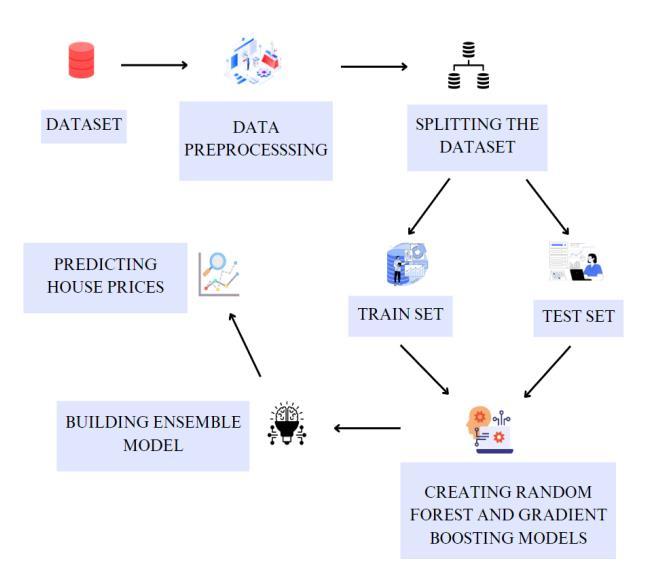
The system architecture diagram outlines the sequential flow of operations in the house price prediction system. Initially,thedatasetundergoespreprocessingtaskssuchas handlingmissingvaluesandencodingcategoricalvariables. Subsequently, the preprocessed data is divided into two subsets:atrainingsetutilizedformodeltrainingandatest
set for assessing model performance. Next, individual models for Random Forest and Gradient Boosting Algorithmsareconstructedusingthetrainingdatatopredict house prices based on various features. Following model creation, the ensemble model is built by combining the predictionsfrombothmodels,enhancingoverallprediction accuracy. Finally, the ensemble model is deployed into production, where it serves as a predictive tool for estimatinghouseprices Figure1demonstratestheoverall systemarchitectureofHousePricePredictionModel. This deployment phase involves integrating the model to monitoring its performance, and continuously updating it withnewdatatomaintainitsaccuracyandrelevanceover time.
4.1
House Price India dataset disponible on Kaggle, which contains comprehensive information on residential properties in India. This dataset offers a variety of characteristics that are valuable for analyzing and understanding the local housing market. These characteristicsareasfollows:Id,Date,numberofbedrooms, numberofbathrooms,livingarea,lotarea,numberoffloors, waterfront present, number of views, grade of the house, Area of the house (excluding basement), Area of the basement,BuiltYear,PostalCode,Latitude,Longitude,living area renovation, lot area renovation, Number of schools nearby,DistancefromtheairportandPrice.
Volume: 11 Issue: 04 | Apr 2024 www.irjet.net p-ISSN: 2395-0072
Analyzing the dataset before preprocessing is an important step in better understanding of data and its properties.Aspartoftheanalysis,acorrelationmatrixwas prepared to examine the relationship between various features.Thecorrelationmatrixhascorrelationcoefficients between+1and-1,indicatingthecorrelationbetweentwo variables.Positivecorrelationindicateslinearrelationship and the negative correlation indicates non-linear relationshipbetweenthefeatureswhichareindependent. Analyzing the correlation matrix helps to understand the interactionsbetweenfeaturesandtargetvariablesandmake informeddecisionswhenmodeltraining.
DataPreprocessingconsistsofcleaningthecollected data and preparing it for training the model. Perform tasks such as handling missing values, removing outliers, normalizing numeric features, and encoding categorical variables.Specificselectioncriteriacanbeusedtodetermine thefeatureswhicharemostimportanttoestimatethehouse price.
Trainingthemodelusingvariousmachinelearning algorithms on previous data by using most advanced methods include Random Forests and Gradient Boosting. The training process involves fitting the model to the training data, optimizing the hyper parameters, and evaluatingtheperformanceofthemodelusingappropriate metricssuchasmeansquarederrororR-squared.Training setsareutilizedtotrainthepredictionmodels,containing abundant information to show the relationship between practicalfeatures(suchasrooms,areas,squaremeter)and differentobjectives(suchashouseprice).Themodellearns fromthetrainingprocesstomakepredictions.
Oncethemodelistrained,itisevaluatedbytesting itspredictiveabilityontestdata.Themodel'sperformanceis measured by comparing its predictions to actual house prices in testing. Measures such as mean square error or rootmeansquareerrorcanbeusedtomeasuretheaccuracy offorecasts.Ontheotherhand,aseparatesetofdataisused to measure performance and predict results. During the trainingphasethequalityofthemodelpredictingthehouse priceisevaluatedbasedonnewdata.Dividingadatasetinto trainingandtestingsetsisusuallydonerandomlytoensure that the two subsets have similar distributions and properties.Approximately80%ofthedatatotrainingand theremaining20%tothetestingprocessisallocated.The numberoftrainingroundsdependsonmanyfactors,suchas the complexity of the dataset, the machine learning
algorithm chosen, and the task to be performed. More trainingcanimprovethemodel'saccuracyandimproveits performance.Trainingeachmodeliterativelycanconsume an incredible amount of time. Evaluate the relationship betweenthedecisiontreeandthemeansquareerror(MSE) ofthedataacross100trainingsessions.
Machine Learning (ML) is a branch of artificial intelligence (AI) where computer systems are trained to learn patterns and make decisions based on data without explicit programming instructions and accurately process largevolumesofdata,generatinginsightsandpredictions withminimalhumanintervention.MLenablesorganizations to streamline decision-making processes, improve productivity, and achieve better outcomes across various domains.MLincludesmanytechniquesthatallowsoftware applications to improve their performance as time progresses. It requires understanding mathematical and statistical concepts to select appropriate algorithms and trainingthemwithsufficientdatatoachieveaccurateresults. Prediction techniques leveraging machine learning algorithms across various industries to anticipate future outcomes, trends, and patterns based on historical data analysis.
Machine learning for house price prediction involves the use of computational algorithms to analyze multiplefactorsaffectingrealestatevalues,suchasproperty attributes, location details, economic indicators, and past sales data. Through advanced statistical methods and mathematicalmodels,thesealgorithmsidentifypatternsin the data to create accurate predictive models. By utilizing thesemodels,stakeholdersintherealestatesectorcanmake informed decisions regarding property investments, sales approaches, and market trends, leading to improved efficiency and optimized outcomes within the housing market. Overall, the incorporation of machine learning techniquesintohousepricepredictionsystemsrepresentsa significant advancement in the field, offering enhanced accuracy,efficiency,andadaptabilityforstakeholdersinthe realestateindustry.
RandomForestisacollectionofsupervisedlearning algorithmsforclassificationandregressionusedinpredictive modellingandlearning.Itcollectstheresultsandpredictions of various decision trees and finally selects the best result, whichistheclassortypeoftheaverageprediction(themost commonvalueindeterminingtheconfigurationofthetree). RandomForestworksbysplittingthedatasetintotwoparts: the training set and the test set. More examples are then selectedfromthetrainingprogram.Then,usingthedecision treeforeachexamplespliteachoptionintotwochildrenusing thebest-fitsplit.Afterthatthelaststepisrepeatedandallthe
International Research Journal of Engineering and Technology (IRJET) e-ISSN: 2395-0056
Volume: 11 Issue: 04 | Apr 2024 www.irjet.net p-ISSN: 2395-0072
predictionsarefinallyvotedandthepredictionwiththemost votes is chosen as the final result. The working of Random ForestRegressionisshowninFigure2.
Themainhyperparametersinrandomforestsare used to increase the predictive power of the model or to speed up the model. In this case, more trees can improve performance and make the prediction more stable, but unfortunatelytheprocessingtimewillbelonger.Inaddition tohaveaminimumnumberofnodestosplitinternalnodes, using more features can improve the performance of the algorithm.Oncethetrainingstepiscompleted,thetraining model can be applied to data not used for training. This methodallowstheforecasttobeestimatedandcompared withexpectedresults.
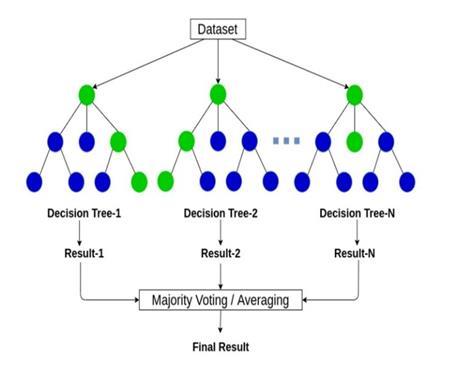
1. SelectrandomKdatapointsfromthetrainingset.
2. Buildthedecisiontreesassociatedwiththeselected datapoints(Subsets).
3. ChoosethenumberNfordecisiontreesyouwantto buildandrepeatsteps1and2.
4. Foranewdatapoint, findthepredictionsofeach decisiontreeandassignthenewdatapointtothe averageacrossallofthepredictedvalues.
Randomforestalgorithmisbasedoncombiningdecision trees and then applied to real estate data. This algorithm leveragestheabilitytocombinemultipledecisiontreesto make robust predictions. Its ability to capture both linear andnon-linearrelationshipsbetweenhousefeaturesmakes itasuitablechoiceforhousepricing.Thepredictiongraphof thisalgorithmisshowninChart1.
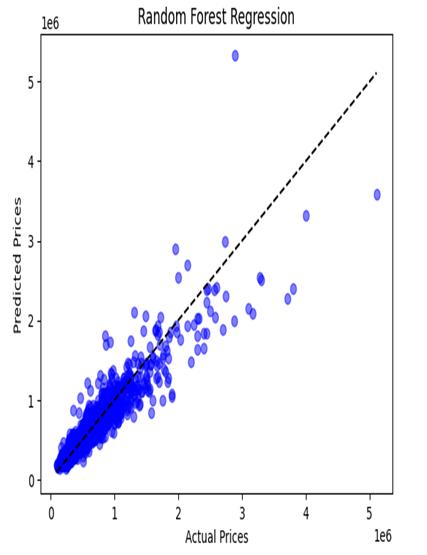
- 1: PredictedGraphofRandomForestRegression
Additionally, Random Forest has a proprietary selection process that improves its ability to identify the mostimportantaspectsofhouseprice.Inarandomforest, the decision tree uses the mean square error (MSE) and selects the features and values that result in the smallest MSE for each node. MSE is defined as the sum of the differencesbetweenactualandpredictedhouseprices.Chart 2showstherelationshipbetweenMSEandDecisionTrees.
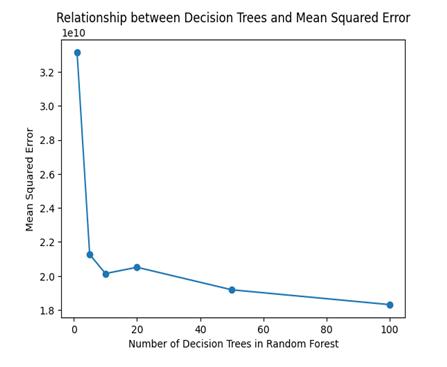
Chart - 2: RelationshipbetweenDecisionTreeandMean SquaredError
International Research Journal of Engineering and Technology (IRJET) e-ISSN: 2395-0056
Volume: 11 Issue: 04 | Apr 2024 www.irjet.net p-ISSN: 2395-0072
Gradient Boosting Regression Tree Algorithm involves learning by combining multiple regression trees (decisiontrees)todeveloppredictivemodels.Thisalgorithm reduces the error of weak learning models (regressor or classifier). Weak learning models are those in which the trainingdatahashighbias,variability,andirregularity,and their results can only be considered improvements over predictiontowersandareincredible.Generally,theBoosting algorithm has three components: an addictive Model, weak learners, and a loss function. The algorithm can represent non-linear relationships such as wind power curves using non-differentiablefunctionsandcanbelearnedthroughthe iterativeprocessofdevices.TheworkingofGradientBoosting AlgorithmisshowninFigure3.
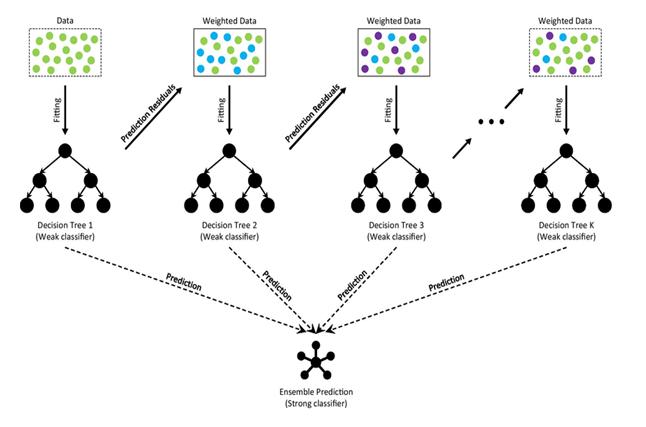
Gradient Boosting Machine (GBM) works by definingtheparametersofthemodelwithouttheinfluence of gradients. This is done with the help of an iterative method where the work is eventually added to the base learnertoreducethepredictionerror,wherethedecision treearecombined bytheadditivemodelandminimizesthe workbygradientdescent.
1. Consideradatasethavingdifferentdatapoints andinitializeit.
2. Now,giveequalweighttoeachofthedatapoints.
3. Assumethisweightasaninputforthemodel.
4. Identifythedatapointsthatareincorrectly classified.
5. Increasetheweightfordatapointsinstep4.
6. Ifyougetappropriateoutputthenterminatethis processelsefollowsteps2and3again.
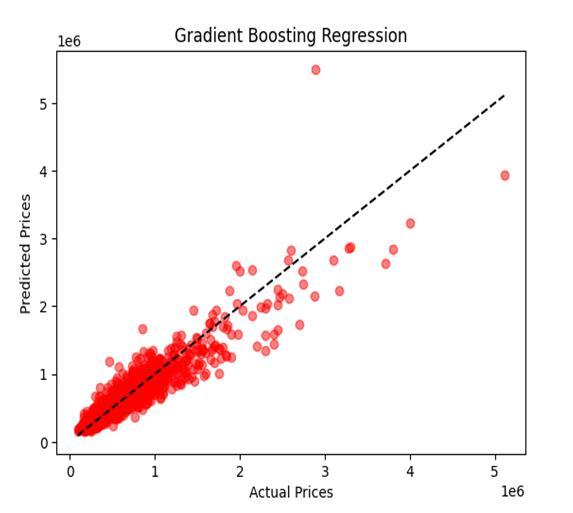
Arefinedmodelforpredictinghouseprices,employingthe Gradient Boosting technique, enhances the accuracy of forecasts within intricate real estate environments. This methodlearnsfromdata,continuallyenhancingpredictions
byanalyzingpasterrorsandrefiningitscomprehensionof thefactorsinfluencinghousingprices.Thepredictionresult ofthisalgorithmisshowninChart3.
Thelossfunctionforregressionmeasuresthesum of the squared differences between predicted and actual values. Chart 4 shows a graph between Deviance and BoostingIterations.
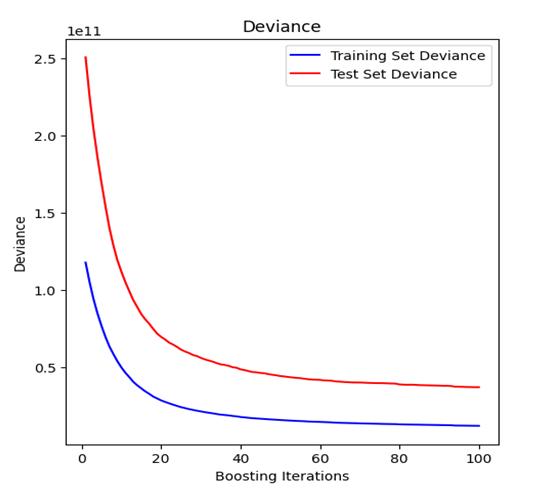
Chart - 4: AgraphbetweentheDevianceandBoosting Iterations
Finally, it provides an estimate of the house price based on the working model. This process allows informed decisionsintherealestateindustryandhelpsstakeholdersto predictthehousepriceaccurately.
International Research Journal of Engineering and Technology (IRJET) e-ISSN: 2395-0056
Volume: 11 Issue: 04 | Apr 2024 www.irjet.net p-ISSN: 2395-0072
Ensemblelearningisapowerfulmachinelearning technique in which multiple models are combined to improve performance. Unlike traditional approaches that relyona single model,integrationusestheintelligence of different models to produce more accurate predictions. A popularmethodisbagging,theensemblelearningmethod that is commonly used to reduce variance within a noisy dataset.InensemblethepredictionsofRandomForest(RF) and Gradient Boosting (GB) models involves aggregating their individual predictions by taking their average. By averagingtheirpredictionsinensemblelearningmitigates theriskofoverfittingandvariance,resultinginamorestable andreliableprediction.Chart5demonstratestheprediction graphofEnsembleLearning.
Ensemblelearningiswidelyusedinmanyfieldsand tasks, including classification, regression, and error detection. Its effectiveness lies in its ability to reduce overfitting, reduce bias, and improve generalization by combining predictions from multiple models. Combined methodsformthebasisofmodernengineeringpracticeand areoftenmoreefficientthansinglemodels.
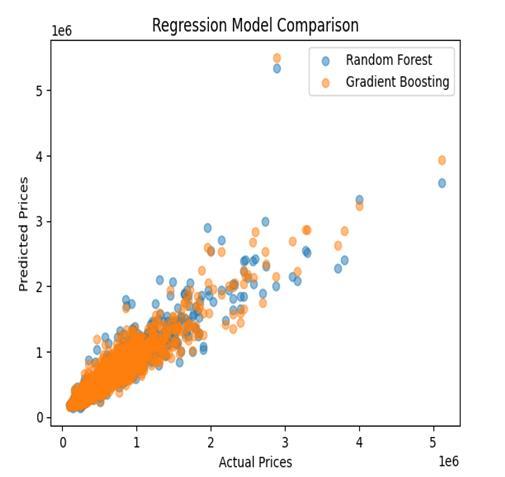
- 5: PredictedGraphofRegressionModels
6. EVALUATION METRICS
6.1 MSE (Mean Squared Error)
TheMSEmeasurestheaveragesquareddifference betweenthepredictedvaluesandtheactualvalues.Inthe contextofhousepriceprediction,if representstheactual
priceatthetime and representsthepredictedpriceat time ,thentheMSEiscalculatedfollows:

Where:
isthetotalnumberofobservations.
istheactualhousepriceattime
isthepredictedhousepriceattime .
TheRootMeanSquaredError(RMSE)isavariantof theMeanSquaredError(MSE)thatprovidesameasureof theaveragemagnitudeoftheerrorsinthepredictions,while stillconsideringthescaleofthedata.TheRMSEiscalculated asthesquarerootoftheMSE:
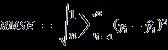
Where:
isthetotalnumberofobservations.
istheactualhousepriceattime .
isthepredictedhousepriceattime
(2)
TheMeanAbsoluteError(MAE)equationisametric used to evaluate the accuracy of a predictive model by measuring the average magnitude of errors between predictedandactualvalues.Itiscalculatedasfollows:

Where:
isthenumberofsamplesordatapoints.
(3)
representstheactualorobservedvalueforthethdatapoint.
representsthepredictedvalueforthe -thdata point.
denotestheabsolutevalue.
R2 represents the proportion of variance in the housepricesthatisexplainedbythemodel.Itrangesfrom0 to1,withhighervaluesindicatingabetterfit.Itiscalculated asfollows:
International Research Journal of Engineering and Technology (IRJET) e-ISSN: 2395-0056
Volume: 11 Issue: 04 | Apr 2024 www.irjet.net p-ISSN: 2395-0072
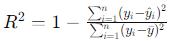
Where:
isthetotalnumberofobservations.
istheactualhousepriceattime .
isthepredictedhousepriceattime
isthemeanofobservedvaluesofthe dependentvariable.
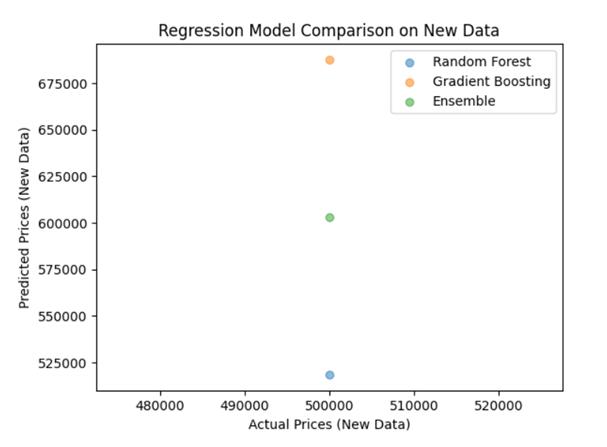
The combination of Random Forest (RF) and Gradient Boosting(GB)modelsinanensembleachievesanaccuracy of 88% in predicting house prices. This ensemble method integrates RF which handles complex interactions and outliersandGBwhichhelpsincapturingsubtlepatternsand boostingweakerlearners.Chart6showsthefinalpredicted pricegraphofeachmodel. Byaveraging theirpredictions, theensembleprovidesareliableframeworkforhouseprice prediction, reducing overfitting and improving generalizationperformance Table1demonstratesthefinal predictionresultofeachmodel.
Table – 1: FinalpredictionresultofeachModel
House price prediction utilizes machine learning algorithms such as Random Forest and Gradient Boosting involves advanced computational techniques to analyze variousfactorsinfluencinghousingprices.Thesealgorithms leveragedatasuchaspropertyfeatures,location,andmarket trendstogeneratepredictivemodelscapableofestimating house prices accurately. The prediction model will allow traders or home buyers to determine the real price of a house accurately in realestatemarket. In summary, the impact of this model is intended to help and assist other researcherstocreatemoreaccuratemodelsthatcaneasily and accurately predict the prices. More research on real modelsisneededtovalidateourfindings.Theutilizationof thismodelenablesstakeholderswithintherealestatesector to make well-informed decisions regarding property investments,sales,andpurchases.Thisenhancesoperational efficiency and optimizes overall outcomes within the housingmarketbyleveragingpredictiveinsightsgenerated throughmachinelearningalgorithms.
Furtherexplorationofdatawithadditionalfeatures should be conducted through comprehensive feature engineeringtoenhancethemodel'spredictivecapabilities. It's essential to investigate advanced ensemble methods such as stacking or blending to leverage the strengths of multiplemodelsforimprovedperformance.Additionally,the enhancing model interpretability through techniques like feature importance analysis and SHAP values can provide insightsintothefactorsinfluencinghouseprices.Toaddress imbalanced data issues, consider employing sampling techniquesoralternativeevaluationmetrics.It'scrucialto develop a robust deployment strategy for the model, ensuring scalability and efficient prediction handling. Implement continuous monitoring mechanisms to track
International Research Journal of Engineering and Technology (IRJET) e-ISSN: 2395-0056
Volume: 11 Issue: 04 | Apr 2024 www.irjet.net p-ISSN: 2395-0072
model performance over time and detect potential issues promptly.Enhancetheuser interfaceoftheapplicationto improveuserexperienceandusability.Lastly,incorporatea feedback loop to gather user feedback and iteratively improvethemodel.
[1] L.Breiman,“Randomforests,”inMachineLearning,vol. 45,issue1,pp.5–32,2001.
[2] C.C.Wang&H.Wu,“Anewmachinelearningapproach to house price estimation” , in New Trends in Mathematical Sciences, vol. 6, issue 4, pp. 165–171, 2018.
[3] C.H.RagaMadhuri,G.Anuradha,M.VaniPujitha,”House Price Prediction Using Regression Techniques: A ComparativeStudy”,2019,IEEE.
[4] J.S.Chou,D.B.Fleshman&D.N.Truong,“Comparisonof machine learning models to provide preliminary forecastsofrealestateprices” , Journal of Housing and the Built Environment, 37(4),2079-2114,2022
[5] SifeiLu,ZengxiangLi,ZhengQin,XuleiYang,RickSiow Mong Goh- “A hybrid regression technique for house pricesprediction”,2017,IEEE.
[6] AyushVarma,AbhijitSarma,SagarDoshi,RohiniNair“HousingPricePredictionUsingMachineLearningand NeuralNetworks”,2018,IEEE.
[7] A. S. Ravikumar, “Real estate price prediction using machinelearning”,2017.
[8] John Smith, “House Price Prediction Using Machine LearningTechniques”,2018.
[9] AndrewWang,“PredictingHousePricesUsingSupport VectorMachines”,2021.
[10] John Smith, Emily Johnson-“A Comparative study of RegressionModelsforHousePricePrediction”2020.
[11] MichaelBrown,SarahDavis“SpatialAnalysisofHouse pricepredictionmodel”,2019.
[12] ChristopherWhite,RachelAdams,“TimeSeriesAnalysis forHousePricePrediction”,2022.
[13] J.Manasa,R.Gupta,andN.Narahari,“MachineLearning based predicting house prices using regression techniques”,2020,IEEE.
[14] G.NagaSatish,Ch.V.Raghavendran,M.D.SugnanaRao, Ch.Srinivasulu“HousePricePredictionUsingMachine Learning”.IJITEE,2019.
[15] M. Jagan Chauhan, D. Nitish, G. Akash, Nelli Sreevidya and Subhani Shaik, “Machine Learning Approach for House Price Prediction”, Asian Journal of Research in ComputerScience,vol16,Issue2,pp.54-61,2023.