
International Research Journal of Engineering and Technology (IRJET) e-ISSN: 2395-0056
Volume: 11 Issue: 04 | Apr 2024 www.irjet.net p-ISSN: 2395-0072
International Research Journal of Engineering and Technology (IRJET) e-ISSN: 2395-0056
Volume: 11 Issue: 04 | Apr 2024 www.irjet.net p-ISSN: 2395-0072
Hardik D. Marathe
Prof. Dr. Matsagar Vilas Karbhari, Dept. of Mechanical Engineering, K. K. Wagh Institute of Engineering Education and Research, Nashik, Maharashtra, India
Abstract - The safety of driver and passenger is very important in a vehicle. more than 2,000 vehicles are damaged by fires every day, On a global scale. Main factor is the lack of fire safety system in automobiles. Due to unexpectedfire driver and passenger get panic and they unable to rescue their self. If fire burn electronic and electrical system of door, then driver and passenger unable to unlock the door and driver loose control over the car that causes major injury to driver and passenger. So, we have designed the vehicle control system in case of fire hazard to turn on buzzer, control the speed of vehicle and unlock the doors to escape the driver and passenger. The project aim is to control the vehicle for saving the life or avoid major injury of driver and passenger by using various fire/smoke sensors at high-risk zone and by designing secondary control system for door lock and car speed. Developed system result in safety of driver and passenger.
Key Words: Fire sensor, Smoke sensor, Door lock
1.INTRODUCTION
Therapidgrowthofelectricvehicles(EVs)inrecentyears has highlighted safety concerns, with EV fires becoming a significantissue.Chargingsafetyiscrucialduetopotential hazards like overloads and poor heat dissipation. These safetychallengesposeobstaclestothewidespreadadoption of new energy vehicles. Recognizing the importance of standards and testing facilities, the Government of India establishedtheAutomotiveIndustryStandardsCommittee (AISC)todevelopandapprovesafetystandardsforvehicles. Additionally,internationalefforts,suchastheFFI-program inSweden,aimtoenhancefiredetectionsystemsinheavy vehiclestomitigatefirerisksinenginecompartments.
1.1 Background
Inthepast,firealarmsreliedoncommunitymembersto spot fires and alert others using whistles or bells, but as townsgrew,thismethodbecameimpractical.Inthe1850s,an improved system with wooden rattles for waking people duringfireswasintroducedinAustralia.MosesFarmerand WilliamF.Channingfurtheradvancedfirealarmtechnology bycreatingtelegraphickeyfirealarmboxesin1852,enabling swifttransmissionoffirelocationstocentralalarmstations forfasterfiredepartmentresponse.
The safety of vehicle occupants is paramount, as over 2,000vehiclesaredamagedbyfiresgloballyeachdaydueto the lack of adequate fire safety systems. Fires can lead to panic and immobilize occupants, particularly if electronic systemsfail,posinggraverisks.Incidentslikeabusaccident inNashikandataxifireinGhanaunderscoretheurgencyof addressing this issue. Prompt response is crucial, as fire incidentsonmovingvehiclescanescalaterapidly,especially at night or in remote areas. Implementing early fire detectionsystemsalongsidefireextinguisherscanmitigate risks and aid emergency responders, ensuring timely assistancetopassengersandprotectionofproperty.
The main objective of the project is to develop a fire detectiontechniqueinrealtime.
Themainpointsoftheprojectobjectivesaregivenbelow:
•Toreducethepanicattacksofdriverandpassengers.
•Todetectfirewhiletheyarestillsmallandhavenotgrown toolarge.
•Todevelopalow-costfiredetectionsysteminrealtime.
• To develop a system that detects fire earlier than conventionalfiredetectorsandmoreaccurate.
•Toreducethepanicattacksofdriverandpassengers.
•Tomakesafervehicle.
•Tounlockdoorsofvehiclefasterincaseoffirehazard.
•Toreducespeedofvehicleincaseoffirehazard.
•Tooffersecuritytopeopleinsidethevehicle.
Fire detection systems employ various types of detectors, includingheatdetectors,smokedetectors,flamedetectors, andfire-gasdetectors,eachwithdistinctworkingprinciples. Heatdetectors,categorizedintofixedtemperatureandrateof-risetypes,activateupondetectingsignificanttemperature increases, making them reliable and cost-effective. Smoke detectors, utilizing photoelectric or ionization technology, detect smoke particles, with photoelectric detectors being effectiveforsmoulderingfires.Ionizationdetectors,although efficient for sudden flare-ups, pose safety risks due to radioactiveelementsandarediscouragedinsomeregions. Flamedetectors,suchasinfraredandultraviolettypes,detect
International Research Journal of Engineering and Technology (IRJET) e-ISSN: 2395-0056
Volume: 11 Issue: 04 | Apr 2024 www.irjet.net p-ISSN: 2395-0072
flames based on light wavelengths, with varying response timesfordifferenttypes,andrequireunobstructedviewsfor optimalperformance.
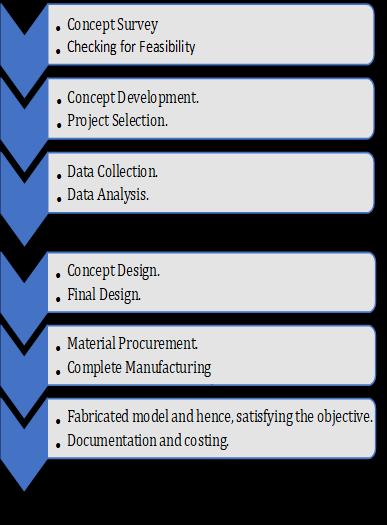
3. METHODOLOGY
If,PincreasethenFincreases Design of Pneumatic Cylinder:
Clavarino’sequationforclosedendcylinderatboth ends.Forductilematerialtodeterminethethicknessof cylinder.
Let,
4. CONCEPT DESIGN
MaterialofthecylinderisAluminium.

Sut=Ultimatetensilestrength=200N/mm2µ= Poisson’sRatioforthecylindermaterial=0.29(std-)di =Innerdiameterofcylinder=25mm
Consider,
DoubleactingcylinderØ25X100(DiameterX Stroke)ri=12.5mm
Byassumingpressureinworkingcylinderis,P=3bar =0.3N/mm2
SoaccordingtoClavarino’sequation, Forclosedendcylinderatbothendstodetermine thethicknessofcylinder.
Assume,p=3bar=0.3N/mm2
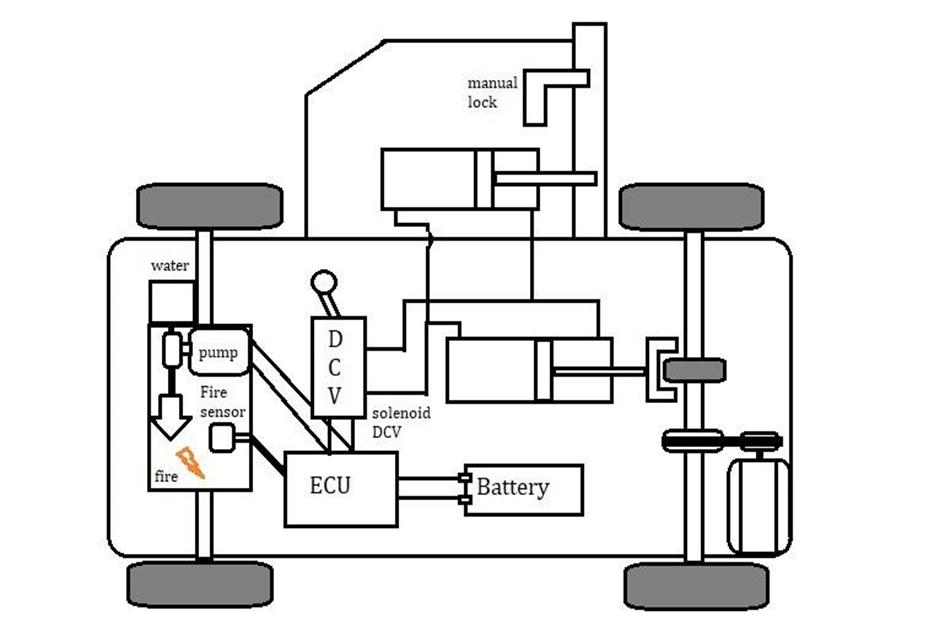
4.1 Block Diagram Fig 4.1 ExperimentalSetup.
5 DETAILED DESIGN
5.1 Design Consideration
5.1.1. Cylinder
Ifweincreasethepressureofairasperformulapressureis directlyproportionaltotheforce.
ByconsideringFactorofsafetyFOS=1.5
µ=0.29 ri=12.5mm.
��

t=0.0390mmFOS=1.5
t=1.5x0.0390mm=0.0580mm.
Availablethickness,t=1mm Pistondiameter(D2)=25mm Pistonroddiameter(d2)=10mm.
Let,
A=Forceareaofcross-sectionofpiston.
A=π/4*(D2)2 A=π/4*(25)2
A=490.87mm2
APR=Forceareaofcross-sectionofpistononrod side.
APR=π/4*(D2–d2)2mm2
APR=π/4*(252–102)mm2
APR=412.33mm2
International Research Journal of Engineering and Technology (IRJET) e-ISSN: 2395-0056
Volume: 11 Issue: 04 | Apr 2024 www.irjet.net p-ISSN: 2395-0072
Pistonforceactingduringforwardstroke.
Fa=P*A
=P*π/4(D2)2
=0.3X490.87
Fa=147.261N.
Pistonforceactingduringreturnstroke.
Fr=P*π/4*(D2–d2)2mm2 =0.3X412.33
Fr=123.7N
5.2 PIC Microcontroller
ThePICmicrocontrollerisalowcost‘computersonachip’ manufacturedbyMicrochip.Theyallowelectronicdesigners andhobbyistsimpartintelligenceandlogictoasinglechipfor special purpose applications and products. The PIC microcontroller programming is done using the popular software‘MicroC’.Thispowerfulyeteasytoprogramintoa 40-pinpackageisupwardscompatiblewiththePIC16C5X, PIC12CXXXandPIC16C7Xdevices.(Shoewu,2015)
5.2.1 Why PIC is used
• Highspeed
• High performance RISC (Reduced Instruction Set Computer)CPU
• InstructionSetsimplicity
• Integrationofoperationfeatures
• Programmabletimeroptions
• Interruptcontrol
• EPROM/OTP/ROMoptions
• Inbuiltmodules
• Lowpowerconsumption
• Wideoperationvoltagerange:2.5to6volt
• Programmablecodeprotectionmode
• Powersavingsleepmode
5.2.2 PIC Components
1. Powersupply
2. PIC16F877Amicrocontroller
3. Resistors¼watt(1kΩx2)
4. Capacitors(22pFx2)
5. Electrolyticcapacitor(1µF)
6. Pushbuttonswitch(forresettingthePIC)
7. Crystal(4MHz)
8. LED
5.2.3 Basic connection of PIC Microcontroller
Tostartamicrocontrollerprojectyouneedtoconfigurethe PICasfollows(Basicrequirements)
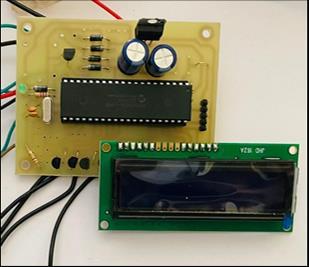
5.1 PICmicrocontroller
5.2.4 Core Architecture of PIC 16F877A
PICcontrollerarchitectureissimple.singlecycleexecution(4 clockcycles),TheRAMlocationofPICcontrollerfunctionas registers.ThedataspacemappedCPU,port,andperipheral registersinPIC16F877Amicrocontrollerandtheprogram counterismapped.(Limited,n.d.)
5.2.5 Performance of PIC 16F877A
Theclockspeedis20MHz.TheTACQoracquisitiontimeis 19.2 μs. The architectural decisions are directed at the maximizationoftop-endspeed,ormorepreciselyofspeedto costratio.PICarchitecturewasamongthefirstscalarCPU designs, and is still among the simplest and cheapest. The Harvard architecture in which instructions and data come conveniently from separate sources simplifies timing and microcircuitdesigngreatly.(Limited,n.d.)
Brakes are very crucial for stopping a vehicle. Without brakes,itisimpossibletodriveacaroranyvehicle.Brakes areofdifferenttypesandaccordingtotherequirement,the typesofbrakesarechosenfortheapplication.Sowechoose discbrakeaccordingtotorqueandspeed.
1. Brakepad:Itmakescontactwiththerotordiscand duetothefrictionbetweenthebrakepadandrotor discthevehiclespeedreducesanditstops.
2. Caliperbracket:supporttoassembly
3. Caliperframe:supporttopads
International Research Journal of Engineering and Technology (IRJET) e-ISSN: 2395-0056
Volume: 11 Issue: 04 | Apr 2024 www.irjet.net p-ISSN: 2395-0072
4. Piston:Itappliesthebrakeforceonthebrakepads whenbrakeleverispressed.
5. Slider pin: It is the sliding pin which slides in the holewhenbrakeisapplied.
6. Dust boots: It prevents the entry of dust into the caliperpinorsliderpinhole.
5.3.1 Working
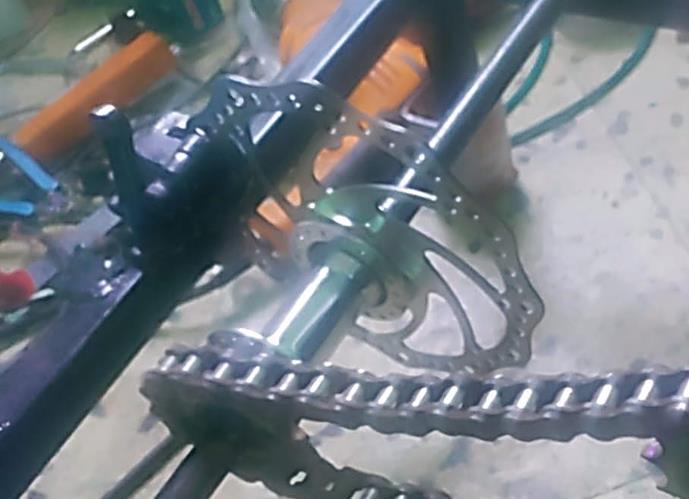
Fig. 5.2 DiscBrake
TheworkingofadiscbrakeisbasedonPascallaw:
1. The high pressure fluid from the master cylinder forcesthepistonoutwardwhenthebrakepedalis depressed.
2. Thepistonpushesthebrakepadagainsttherotating disc.
3. Thecallipertravelsinwardanddragstheoutward brakepadtowardstherotatingdiscuntilitreaches thediscasthefluidpressureexertsmoreforceas theinnerbrakepadmakescontactwiththerotor.
4. Now both the brake pads are pushes the rotating disc, a large amount of friction is generated in betweenthepadsandrotatingdiscandslowsdown thevehicleandfinallyletitstop.
5. Whenthebrakepadisreleased,thepistonmoves inward,thebrakepadmovesawayfromtherotating disc.Andthevehicleagainstartstomove.
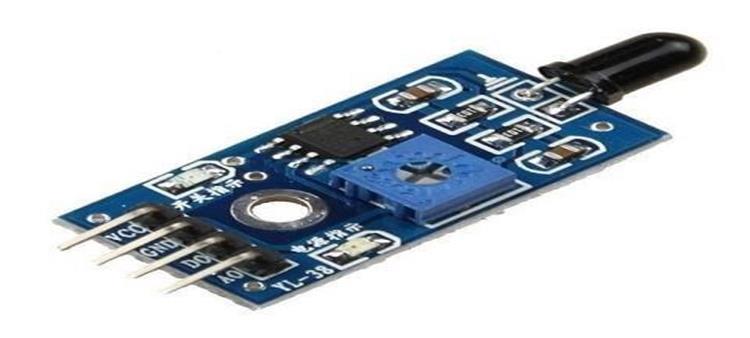
5.4 Flame Sensor
A flame sensor is a type of sensor that responds most stronglytoambientlight.Thissensormoduleisutilisedin flame alarms as a result. When the light source's wavelength is between 760 and 1100 nano meters, this sensor can detect flames. High temperatures have the potentialtoeasilyharmthissensor.So,aspecificdistance fromtheflamecanbechosenforthissensor'splacement. Theflamemaybedetectedfromadistanceof100cm,and thedetectionangleis600.
5.4.1 Working Principle
Thissensor/detectorcanbebuiltwithanelectroniccircuit usingareceiverlikeelectromagneticradiation.Thissensor uses the infrared flame flash method, which allows the sensortoworkthroughacoatingofoil,dust,watervapor, otherwiseice.
5.4.2
The pin configuration of this sensor is shown below. It includesfourpinswhichincludethefollowing.Whenthis moduleworkswitha microcontrollerunitthenthepins are
Pin1(VCCpin):Voltagesupplyragesfrom3.3Vto5.3V
Pin2(GND):Thisisagroundpin
Pin3(AOUT):Thisisananalogoutputpin(MCU.IO)
Pin4(DOUT):Thisisadigitaloutputpin(MCU.IO)
5.4.3 Features & Specifications
Thefeaturesofthissensorincludethefollowing.
• Photosensitivityishigh
• Responsetimeisfast
• Simpletouse
• Sensitivityisadjustable
• Detectionangleis600,
• Itisresponsivetotheflamerange.
• Accuracycanbeadjustable
• Operatingvoltageofthissensoris3.3Vto5V
• Analogvoltageo/psanddigitalswitcho/ps
• ThePCBsizeis3cmX1.6cm
• Powerindicator&digitalswitcho/pindicator Iftheflameintensityislighterwithin0.8mthentheflametest can be activated, if the flame intensity is high, then the detectionofdistancewillbeimproved.
5.5 Relay
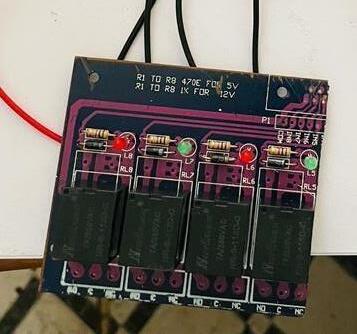
Weknowthatmostofthehighendindustrialapplication deviceshaverelaysfortheireffectiveworking.Relaysare simpleswitcheswhichareoperatedbothelectricallyand
International Research Journal of Engineering and Technology (IRJET) e-ISSN: 2395-0056
Volume: 11 Issue: 04 | Apr 2024 www.irjet.net p-ISSN: 2395-0072
mechanically.Relaysconsistofanelectromagnetandalso asetofcontacts.Theswitchingmechanismiscarriedout withthehelpoftheelectromagnet.Therearealsoother operating principles for its working. But they differ accordingtotheirapplications.Mostofthedeviceshave theapplicationofrelays.
5.5.1
Themainoperationofarelaycomesinplaceswhereonlya low-powersignalcanbeusedtocontrolacircuit.Itisalso usedinplaceswhereonlyonesignalcanbeusedtocontrol alotofcircuits.Theapplicationofrelaysstartedduringthe inventionoftelephones.Theyplayedanimportantrolein switching calls in telephone exchanges. They were also usedinlongdistancetelegraphy.Theywereusedtoswitch thesignalcomingfromonesourcetoanotherdestination. Aftertheinventionofcomputerstheywerealsousedto perform Boolean and other logical operations. The high endapplicationsofrelaysrequirehighpowertobedriven by electric motors and so on. Such relays are called contactors.
Thediagramshowsaninnersectiondiagramofarelay.An iron core is surrounded bya control coil. As shown, the power source is given to the electromagnet through a control switch and through contacts to the load. When current starts flowing through the control coil, the electromagnet starts energizing and thus intensifies the magnetic field. Thus the upper contact arm starts to be attracted to the lower fixed arm and thus closes the contactscausingashortcircuitforthepowertotheload. On the other hand, if the relay was already deenergized when the contacts were closed, then the contact move oppositelyandmakeanopencircuit.
5.5.2
You must note some factors while selecting a particular relay.Theyare
• Protection – Different protections like contact protection and coil protection must be noted. Contact protection helps in reducing arcing in
circuits using inductors. Coil protection helps in reducingsurgevoltageproducedduringswitching.
• Look for a standard relay with all regulatory approvals.
• Switchingtime–Askforhighspeedswitchingrelays ifyouwantone.
• Ratings – There are current as well as voltage ratings.Thecurrentratingsvaryfromafewamperes toabout3000amperes. Incaseofvoltageratings, theyvaryfrom300VoltACto600VoltAC.Thereare alsohighvoltagerelaysofabout15,000Volts.
• Typeofcontactused–WhetheritisaNCorNOor closedcontact.
• Select Make before Break or Break before Make contactswisely.
• Isolationbetweencoilcircuitandcontacts.
• RELAY,5A,SPDT,12V
• ProductRange:OMRON-G5SBSeries
• CoilVoltage:12VDC
• ContactCurrent:5A
• ContactConfiguration:SPDT
• CoilResistance:360ohm
• CoilCurrent:33.3mA
• CoilType:DC
• CoilVoltageVDCNom:12V
• ContactCurrentMax:5A
• ContactVoltageACNom:250V
• ContactVoltageDCNom:30V
• ExternalDepth:20.3mm
• ExternalHeight:15.8mm
• ExternalWidth:10.3mm
• RelayType:Powerrelay.
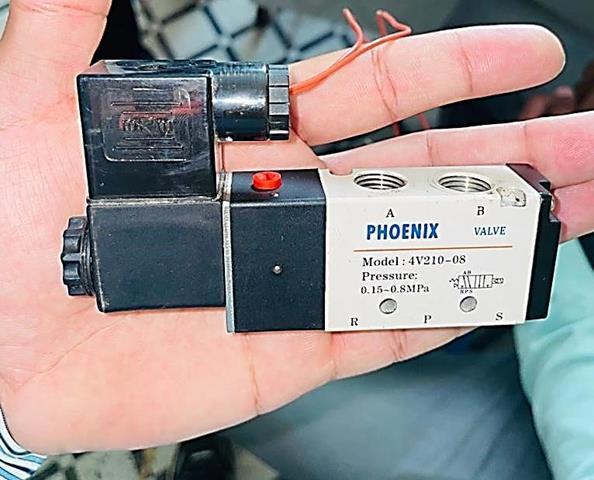
5/2-waypneumaticvalvehasfiveconnectionportsandtwo states. It has one pressure port (P,1), two ports (A,2) and (B,4)thatconnecttothedevicethatneedstobecontrolled, andtwoexhaustports(EA,3)and(EB,5).Thetwostatesof thevalveare:
• Pressure port (P,1) connects to port (A,2), while port (B,4)ventsthroughexhaustport(EB,5)
• Pressure port (P,1) connects to port (B,4), while port (A,2)ventsthroughport(EA,3).(TAMESON,2022)
International Research Journal of Engineering and Technology (IRJET) e-ISSN: 2395-0056
Volume: 11 Issue: 04 | Apr 2024 www.irjet.net p-ISSN: 2395-0072
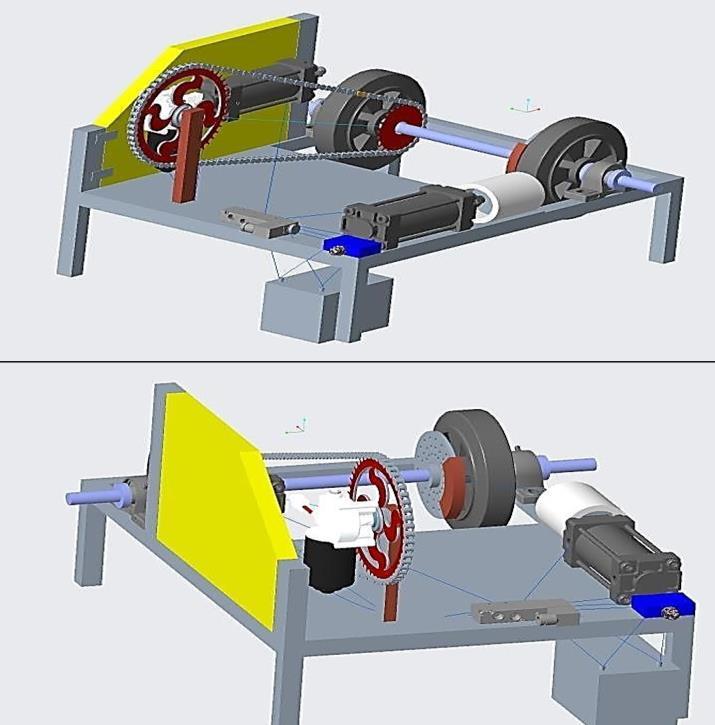
5.4 Design system modelling
Software used: Creo Parametric Student Version 3.0
6. PROJECT IMPLEMENTATION
6.1 Fabrication
6.1.1 Mounting Frame :
Weight=5kg
PartSize=(550X750)mm
PartMaterial=MSSquareBar
PartQuantity=1
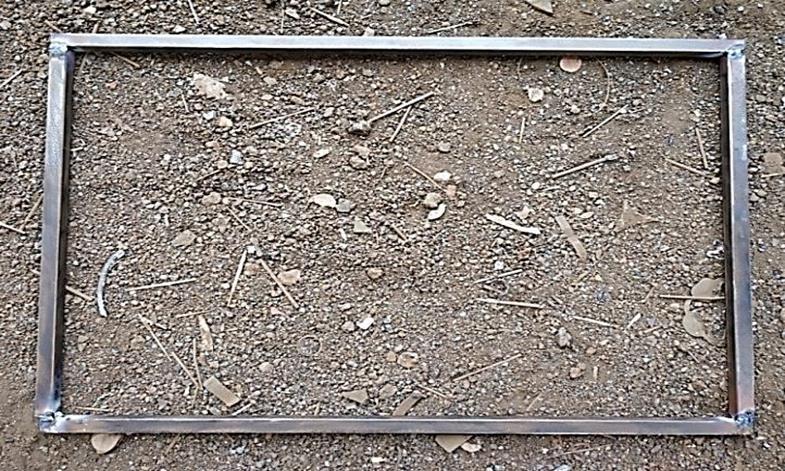
Framematerial:Mildsteel
Framedimension:30*24inch
Heightofframe:6inch
Table 6.1: FrameOperation
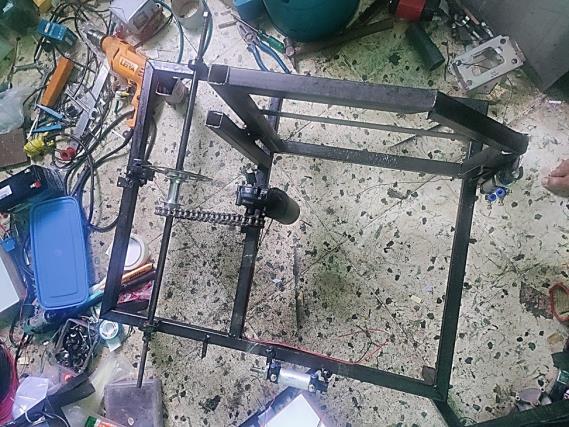
6.2. Fabricated Model
Weight=20kg
PartSize=(550X750)mm
PartMaterial=MSSquareBar
PartQuantity=1assembledmodel
Framematerial:Mildsteel
Frame dimension: 30*24 inch
Volume: 11 Issue: 04 | Apr 2024 www.irjet.net
7
1. Firesensor:Todetectthefire
2. Electronic control unit: Microchip (PIC16F877A) Take signal from fire sensor and transfers to solenoidvalveandpump
3. Solenoid DCV: Control direction of air to actuate pneumaticcylinder.
4. Double acting cylinder: Lash unlash and actuate brakelever.
5. Discbrake:Tocontrolspeedofvehicle.
6. Battery:12Vbatteryforpowersupply
7. Watertank:Tostorewater
8. Pump:Pumpsthewater
9. Chaindrive:Transferpowermotortowheel
10. Chainsprocket:Carrythechain
11. Doorlash:Operatebypneumaticcylinder.
12. Cardoor:Asshoneinfig.
13. Pipes:Passestheairtoactuator.
Operation
• Cuttingthematerial
• Welding
• Fastening
• Drilling
• Circuitbuilding
• Wiring
• Assembly Machine
• PowerHacksaw
• Welding
• Drillm/c
• Soldergun
• Welding,Fastening
Tool
• HacksawBlade
• ArcWelding
• Spanner
• Drillbit’s
• Leadwire
• Splitter,Plier
Technology
• FEAsoftware.
• Caliper
• Creo Parametric
• Ansys
The importance of prioritizing the safety of vehicle occupantshasledtothevirtualdesignofavehiclecontrol systemcapableofrespondingtofirehazards.Thissystem includes features such as activating a buzzer, controlling vehiclespeed,andunlockingdoorstofacilitatetherescueof drivers and passengers. Through extensive research, the projectteamhasgainedacomprehensiveunderstandingof the challenges and requirements involved. Utilizing a 3D model,variousparametershavebeencalculatedtoinform themanufacturingprocesseffectively.Additionally,analysis conducted using Creo analysis software has enabled the determination of permissible loads on the model's frame,
International Research Journal of Engineering and Technology (IRJET) e-ISSN: 2395-0056
Volume: 11 Issue: 04 | Apr 2024 www.irjet.net p-ISSN: 2395-0072
ensuring robustness and effectiveness in
• Electricvehiclespresentasignificantareaforfuture scope in enhancing safety systems due to their heightenedriskoffirehazards.
• Thereisagrowinginterestinvehiclesafetydesign, indicatingpotentialadvancementsandinnovations inthisfield.
• The adaptable nature of the system allows for modificationsbasedonvehicletypeandpassenger safetyrequirements,emphasizingitsimportance.
• Futuredevelopmentsmayinvolvetheapplicationof hybridtechnologyandsolar-poweredrechargeable batteriestoenhancesystemcapabilities.
• Expansion beyond vehicles to include residential andworkplacesettingspronetofireriskspresents anopportunityforbroaderimplementation.
• Consideration of scenarios where the vehicle batteryisimplicatedinthefirehighlightstheneed forseparatepowersourcestoensurefunctionality ofsafetymechanisms.
[1] 12killed,4.i.(2022,October8).THEHINDU.Retrieved fromTHEHINDU.COM:
https://www.thehindu.com/news/national/otherstates/bus-hits-truck-catches-fire-innashikmaharashtra-oct-82022/article65983606.ece?homepage=true
[2] Asante, B., Twum, B. O., & Osei, P. (October 2019). VehicleFireOutbreakDetectionCommunicationSystem. Ghana:IOSRJournalofElectronicsandCommunication Engineering(IOSR-JECE).
[3] AUTOMOTIVE INDUSTRY STANDARDS COMMITTEE. (2016). Fire Detection and Alarm System. PUNE: THE AUTOMOTIVE RESEARCH ASSOCIATION OF INDIA. K. Elissa,“Titleofpaperifknown,”unpublished.
[4] FlameSensorWorkingandItsApplications2013–2022 ElprocusElprocus.com
[5] Olawilstrand,p.k.(2015).Firedetection&firealarm systems in heavy duty vehicles. Sweden: SP Technical ResearchInstituteofSweden.
[6] PROTECT&DETECT.(2022).TheHistoryofFireAlarms and Smoke Detectors. Retrieved from PROTECT & DETECT:https://protectanddetect.co.uk/blog/historyfire-alarmssmoke-
detectors/#:~:text=In%201852%2C%20Moses%20Far mer%20and,to%20a%20central%20alarm%20station.
[7] Shoewu, E. D. (2015). Design and Development of a Microcontroller Based Stadiometer. ResearchGate.

Hardik Dattatraya Marathe,askilled mechanical engineer, currently serves asaGraduateEngineerTraineeinCAE at Thyssenkrupp Rothe Erde India Pvt Ltd. He achieved first-class distinction withhonorsinelectricvehiclesfromK. K. Wagh Institute of Engineering Education and Research, Nashik, in 2023,followingadiplomainmechanical engineering in 2020 from K. K. Wagh PolytechnicNashik.Hardik'sproficiency includesAnsysMechanical,AnsysAPDL, StaticAnalysis,PTCCreo,andAutocad, showcasinghisexpertiseinengineering design and analysis. With his comprehensiveeducationalbackground and practical skills, he contributes significantly to advancing projects in mechanicalengineering.