
International Research Journal of Engineering and Technology (IRJET) e-ISSN: 2395-0056
Volume: 11 Issue: 04 | Apr 2024 www.irjet.net p-ISSN: 2395-0072
International Research Journal of Engineering and Technology (IRJET) e-ISSN: 2395-0056
Volume: 11 Issue: 04 | Apr 2024 www.irjet.net p-ISSN: 2395-0072
Mr. Hemanth C 1 , Ms. Jyothi M2, Mr. L Adarsh3 , Ms. Shashikala H M4, Ms. Thejaswini N5
1 Assistant Professor, Dept. of Computer Science and Engineering, Maharaja Institute of Technology, Thandavapura, Karnataka, India
2-5Students, Dept of Computer Science and Engineering, Maharaja Institute of Technology, Thandavapura, Karnataka, India
Abstract - Sign language serves as a crucial mode of communication for individuals with hearing impairments, facilitating their interaction and integration into society. Recognizing the gestures and movements of Learning sign language is difficult because of the complexity of sign language. In this paper, we will introduce a new method of Kannada sign language recognition using machine learning. The proposed system is employs a comprehensive dataset of Kannadasignlanguagegestures,capturingadiverserangeof hand configurations and movements. Preprocessing techniquesareappliedtoenhancethequalityandconsistency data, including standardization and feature extraction. Machine learning algorithms, including CNNs, are used to train and classification tasks. CNNs are utilized for spatial feature extraction from image-based data. The system achieves high classification accuracy rates, thus showing promise for practical deployment in real-world applications. Furthermore,thesystem'sadaptabilityandscalabilitymakeit suitable for accommodating additional gestures and improvingperformanceovertime.Thisresearchmakesstrides in enhancing accessibility and inclusivity for people with hearingimpairments byoffering aneffectiveand dependable method. It employs machine learning techniques to aid in the recognition of Kannada sign language.
Key Words: Sign Language, CNN, Gesture, Machine Learning, Hand, Movements
Theintroductionoutlinestheimperativeforsystemscapable of recognizing Kannada Sign Language (KSL) gestures, highlightingtheexistinggapincommunicationbetweenKSL users and non-signers. KSL serves as a crucial mode of communicationfortheDeafcommunityinKarnataka,India, reflecting the region's linguistic and cultural heritage. However,developingaccuratesystemsforrecognizingKSL gestures poses a significant technological challenge. Integratingmachinelearninganddeeplearning,particularly throughframeworkslikeTensorFlowandMediaPipe,offers apromisingsolutiontobridgethiscommunicationgap.The complexity of KSL lies in its diverse gestures, involving variations in hand shapes, movements, and expressions, requiring advanced computational methods for real-time interpretation. Machine learning, combined with deep learningmodels,hasemergedasatransformativeapproach,
enablingthecreationofrobustsystemswithhighaccuracy in recognizing KSL gestures. TensorFlow, an open-source library, is notable for its flexibility and scalability in implementing deep learning architectures, particularly convolutional neural networks (CNNs), essential for understanding sequential and spatial patterns inherent in KSL.
Traditional Kannada sign language recognition relies on hand recognition, aiding communication between hearing anddeafindividuals.Ourprojectinnovativelycombinessign and behavioral signals, improving communication clarity andsecurity.Usingmultipleinstancelearningalgorithms,we attain higher accuracy in understanding signs, facilitating effective communication with deaf and mute individuals, conveying letters, words, or intentions. Our software recognizes hand gestures, computing parameters to interprethumancommunicationaccurately,determiningthe individual's communication state through static gestures analysis.
The main objective of our project is to ensure the communicationexperienceascompleteapossibleforboth hearing and deaf people. The work presented in Indian Regionallanguage,Kannada,thesystemtodevelopsystem’s forautomatictranslationandstaticgesturesofalphabetsin Kannadasign language.Signsofthedeafindividualcanbe recognized and translated in Kannada language for the benefitofdeaf&dumbpeople.
TheCommunicationformsaveryimportantandbasicaspect of our lives. Whatever we do, whatever we say, somehow doesreflectsomeofourcommunication,thoughitwantbe directly.Tounderstandtheveryfundamentalbehaviorofa human,wewillanalyzethiscommunicationthroughsome handgesture,alsocalled,theaffectdata. Datacanbesign, imageetc.Usingthiscommunicationaldataforrecognizing the gesture also forms an interdisciplinary field, called AffectiveComputing.This papersummarizesthe previous works done in gesture recognition based on various sign modelsandcomputationalapproaches.
International Research Journal of Engineering and Technology (IRJET) e-ISSN: 2395-0056
Volume: 11 Issue: 04 | Apr 2024 www.irjet.net p-ISSN: 2395-0072
[A]Title:- New Methodology for Translation of Static Sign SymboltoWordsinKannadaLanguage.
Authors:RameshM.Kagalkar,NagarajH.N
PublicationJournal&Year:-IRJET-2021.
Summary:Theobjectiveofthispaperistodesignasystem forautomaticallytranslatingstaticgesturesoftheKannada signlanguagealphabet.Thissystemaimstoassociateletters, words,andexpressionsinaspecificlanguagewithasetof hand gestures, facilitating communication for individuals through hand gestures rather than spoken language. Additionally,asystemcapableofrecognizingthesesigning symbols could serve as a means of communication with individualswhoarehardofhearing.
[B]Title:SignlanguageRecognitionUsingMachineLearning Algorithm.
Authors:Prof.RadhaS. PublicationJournal&Year:-IEEE,2022.
Summary:Handgesturerecognitionfaceschallengesdueto variations in shape and orientation among individuals. Various methodologies, including KNearest Neighbors (KNN), Support Vector Machine(SVM), and Convolutional NeuralNetwork(CNN),havebeenemployedtoaddressthis issue.Thispaperconductsacomparativeanalysisofthese algorithmsusingadatasetof29,000images.Resultsshow CNNoutperformsKNNandSVM,achieving98.49%accuracy comparedto93.83%and88.89%,respectively.
[C]Title-SignLanguageRecognitionUsingDeepLearningOn Static Gesture Images Authors: Aditya Das, Shantanu PublicationJournal&Year:2023
Summary: The image dataset used consists of static sign gestures captured on an RGB camera. Preprocessing was performed on the pictures, which then served as cleaned input.. The model consists of multiple convolution filter inputs that are processed on the identical input. The validationaccuracyobtainedwasabove90%Thispaperalso reviews the assorted attempts that are made at sign languagedetectionusingtheML anddepthdataofimages.It takesstockofthevariedchallengesposedintacklingsuchan Issue,anddescriptionsfuturescopealso.
[D]Title: Deeplearning- basedapproachforsignlanguage RecognitionwithefficientHandGesturerepresentation Authors:MuneerAl-Hammadi PublicationJournal&Year:-IEEE,2021
Summary:-Handgesturerecognition(HGR)hasemergedas asignificantresearcharea.Thispaperfocusesonclassifying single and double-handed Indian sign language gestures
usingmachinelearningalgorithmsimplementedinMATLAB, achievinganaccuracyrangingfrom92%to100%.
Indian sign language lags behind American due to lack of standarddatasets,withvaryinggesturesandmultiplesigns forthesamecharacter.KannadaSignLanguagerecognition lacks established deep learning techniques, but ongoing researchfocusesongeneralsignlanguagerecognitionand otherlanguages.
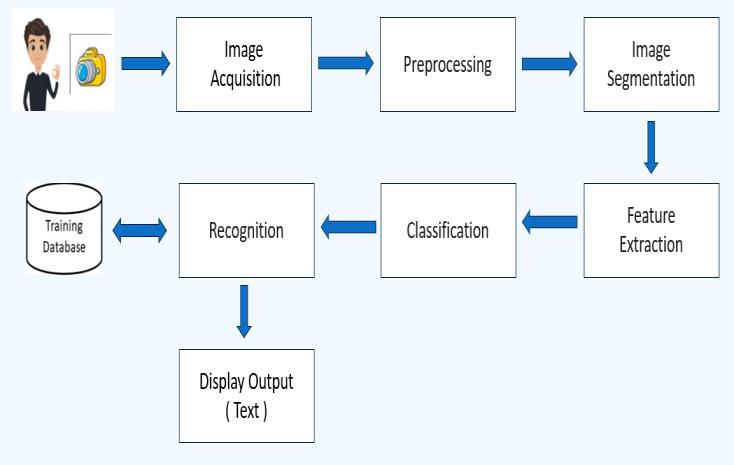
The Kannada Sign Language (KSL) Recognition system combines machine learning and deep learning methods, utilizingTensorFlowandMediaPipeforaccuracy.Extracted featuresfeedintoaTensorFlow-baseddeeplearningmodel. The deep learning architecture, possibly employing convolutional neural networks (CNN) will be trained on a comprehensive dataset of Kannada sign gestures to learn and recognize intricate within the gestures. Media pipe, a powerful library for real-time hand tracking and gesture recognition,willlikelyfacilitatethepreprocessingstepsby providing robust tools for hand landmark estimation and gesture analysis. The training set consists of 70% of the aggregate data and remaining 30% is for testing. We concentrate more on developing ISL along with Indian regional language, Kannada. KSL uses single hand for text recognition,providedinKSLKannadawords( ),isin under research and implementation. Implementing 2 letter,3,letter,4 letter words ( ) in Kannada , We totally implement 50 words ( ) and (೨, ೩, ೪ ), and Try recognizing giving the 80-90% accuracy.
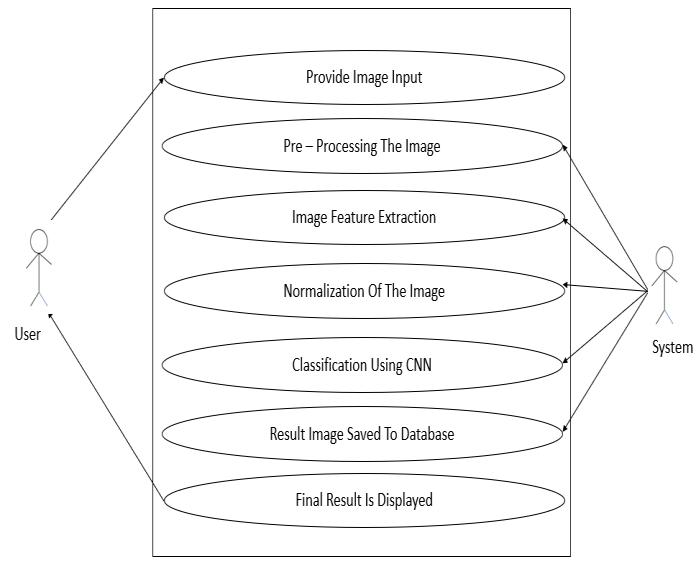
Fig. 1: Sequence Diagram
International Research Journal of Engineering and Technology (IRJET) e-ISSN: 2395-0056
Volume: 11 Issue: 04 | Apr 2024 www.irjet.net p-ISSN: 2395-0072
5.1 MediaPipe
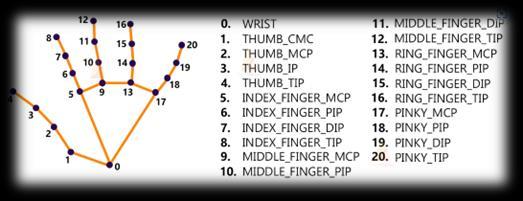
Fig. 3:21 Key-points of MediaPipe
MediaPipeintegrationiscrucialinKannadaSignLanguage Recognition, offering robust hand tracking for capturing intricategestures.Pre-trainedmodelsaccuratelydetecthand landmarks in real-time video, serving as key input for machine learning models. Media Pipe facilitates seamless integration with TensorFlow, enabling developers to customizetrackingpipelinesforoptimalperformance.This enhances accuracy and accessibility for individuals with hearingimpairments.
In the Kannada Sign Language Recognition project, TensorFlow enables the development of advanced ML models,particularlyconvolutionalneuralnetworks(CNN).It providestoolsfordesigning,training,anddeployingtailored neural network architectures. TensorFlow seamlessly integrateswithotherframeworkslikeMediaPipeforfeature extraction, ensuring a smooth workflow from data preprocessing to model deployment. TensorFlow is fundamental to this project, empowering the accurate
interpretation of sign language gestures and promoting inclusivityforindividualswithhearingimpairments.
Onthispaper,wehaveappliedoneclassifiertoassess theirperformancewithourapproach.Anoverviewof theseclassifiersisgivenbelow:
Machine learning encompasses various artificial neural network models, convolutional neural networks (CNNs), specifically designed for tasks like image recognition and signalprocessing.CNNs,structuredakintothehumanbrain, outperformpreviousnetworkswithimageandaudioinputs.
CNNLayers:
-ConvolutionalLayer:Performscomputationsandidentifies featuresbymovingkernelsovertheimage'sreceptivefields.
- Pooling Layer: Simplifies the network by reducing input parametersandretainsessentialinformation.
-FullyConnected(FC)Layer:Categorizesimagesbasedon extracted features, with connections between every activationunitfromtheprecedinglayer.
InCNNs,thecomplexityincreasesfromtheconvolutionalto theFClayer,enablingrecognitionofintricateimageaspects. However, not all layers are fully connected to prevent excessive network density, computational cost, and loss increase,thuspreservingoutputquality.
Gathering datasets for the recognition of Kannada Sign language through hand gestures from educational institutions catering to the speech and hearing impaired communitycanserveasavaluableendeavor.However,it's imperative to prioritize ethical considerations, such as securing appropriate consent and upholding privacy standards.
Weareprocuringdatasetsfromthefollowinginstitutions:
1.JSSPolytechnicForTheDifferentlyAbled,Mysuru
2.InstituteOfSpeechAndHearing,Mysuru.
3.AllIndiaInstituteOfSpeechAndHearing,Mysuru.
Our dataset encompasses 45 Kannada words, varying in lengthfromtwotofourletters,forwhichwearecapturing handgestures.Foreachword,wearerecording150images encompassing all feasible angles, with an additional 50 imagesreservedfortestingpurposes.
Eachimageadherestothefollowingspecifications:
1.Dimensions:300x300pixels
2.Filesize:25kb
International Research Journal of Engineering and Technology (IRJET) e-ISSN: 2395-0056
Volume: 11 Issue: 04 | Apr 2024 www.irjet.net p-ISSN: 2395-0072
3.Resolution:96dpi(Dotsperinch)bothhorizontallyand vertically.
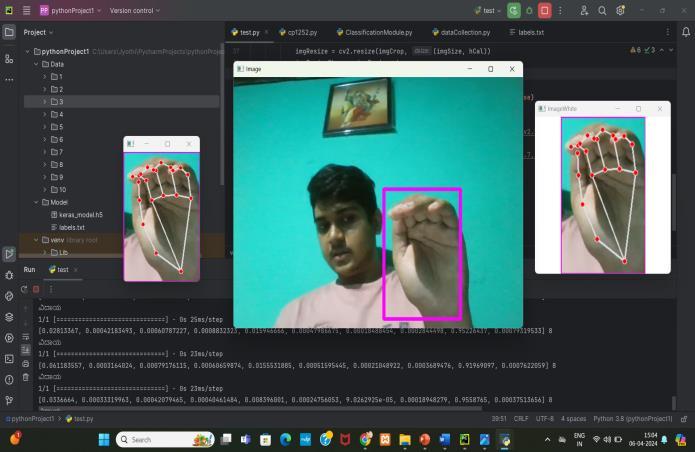
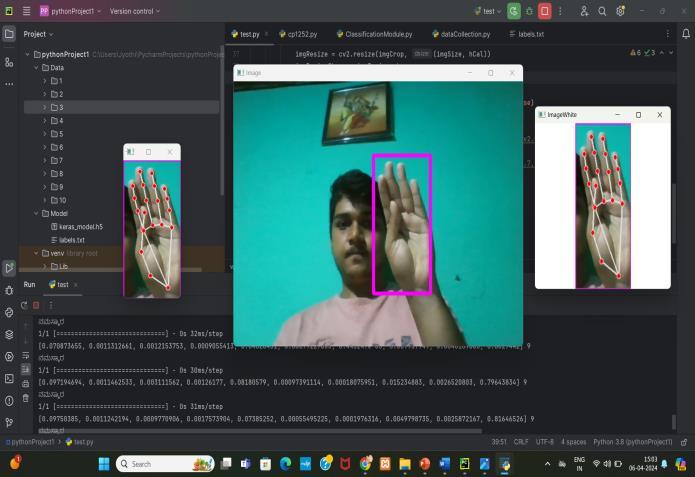
7. RESULTS
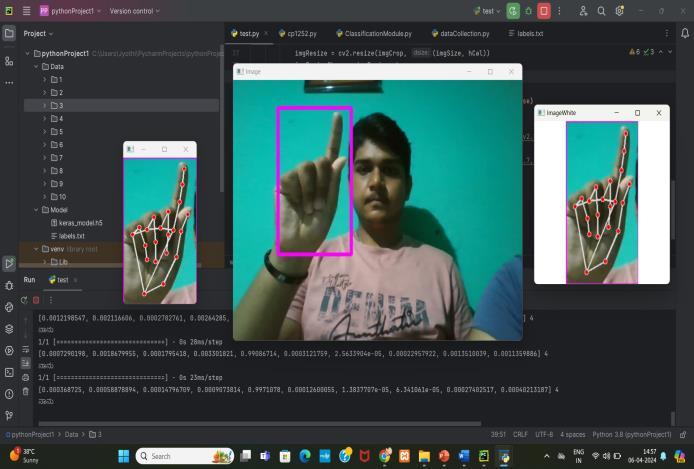
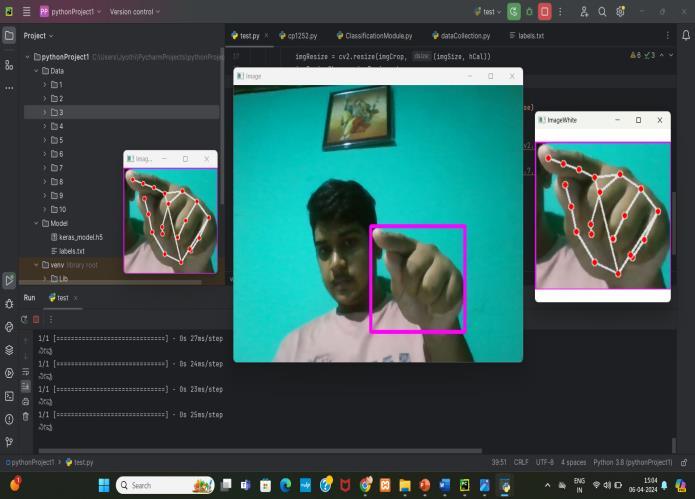
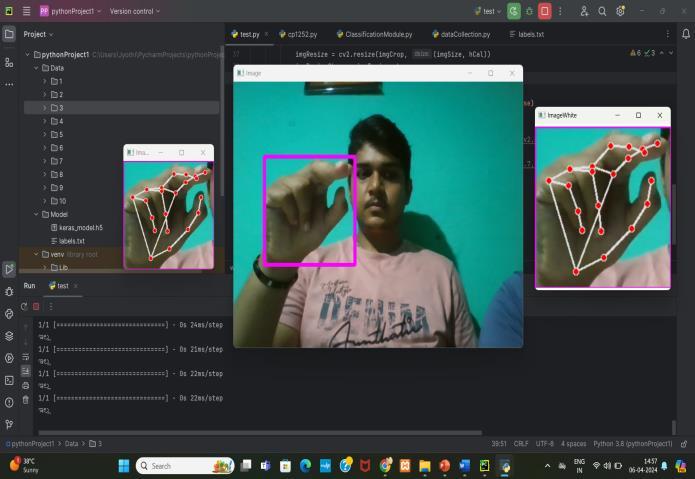
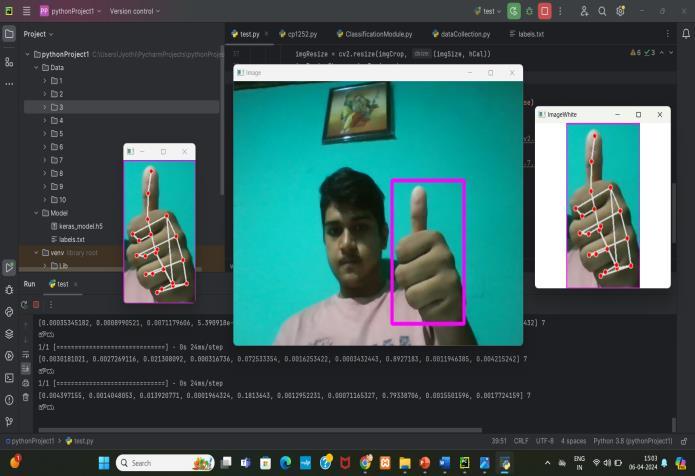
Followingarethescreenshotsoftheinterfaceandoutputof theproposedsystem.
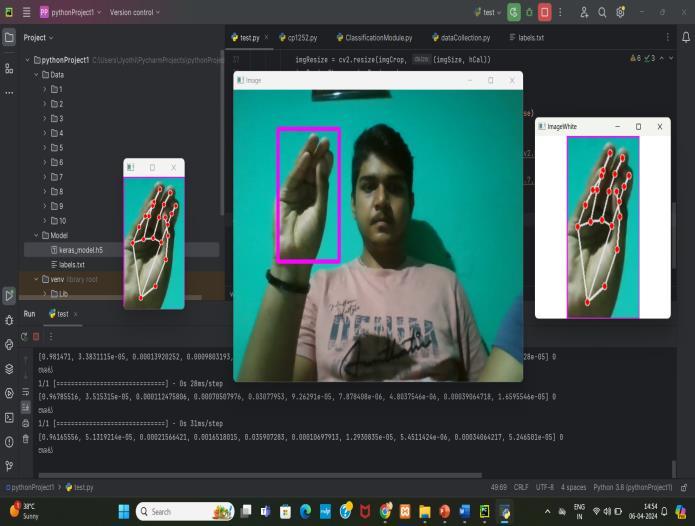
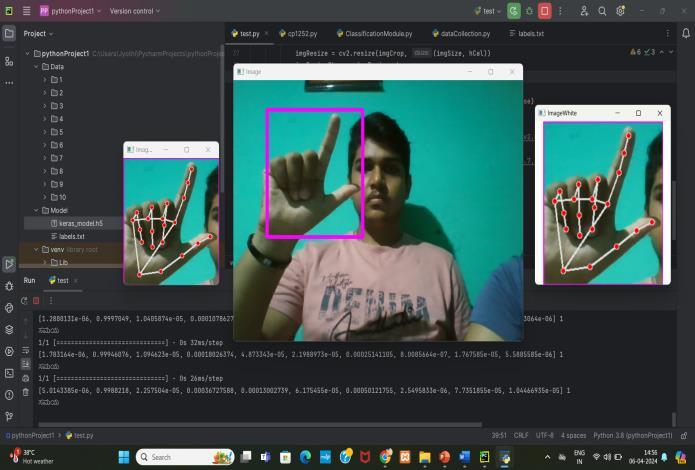
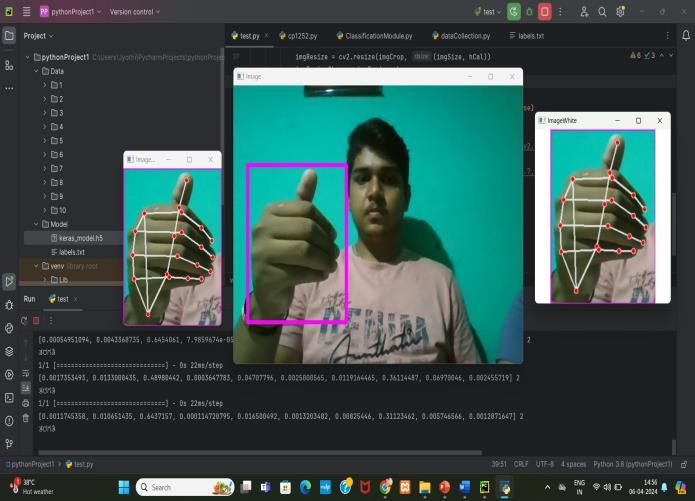
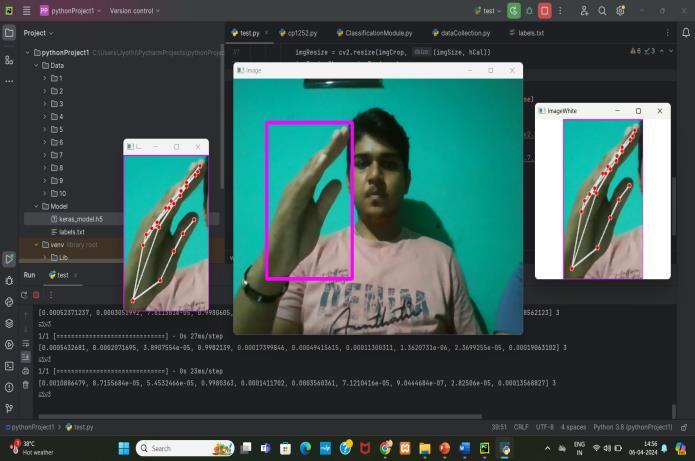
International Research Journal of Engineering and Technology (IRJET) e-ISSN: 2395-0056
Volume: 11 Issue: 04 | Apr 2024 www.irjet.net p-ISSN: 2395-0072
8. CONCLUSIONS
Inconclusion,thedevelopmentofKannada SignLanguage Recognition through Hand Gesture and machine learning, particularly utilizing convolutional neural network (CNN) classifiers, marks a significant advancement in bridging communication barriers for community. This innovative approach not only facilitates real-time interpretation of gestures but also holds the promise of enhancing accessibilitytovitalinformationandservicesforindividuals using Kannada sign language. To enable Kannada Sign Language(KSL)wordandsentencerecognition,weneedait is to temporal space analysis. This will involve detecting temporalchangesandmotioninsigns.Ourgoaltodevelopa comprehensiveproducttoaidspeechandhearing-impaired individuals, bridging communication gaps. We'll focus on converting gesture sequences into text, both words and sentences, and then synthesizing speech for auditory comprehension.
International Research Journal of Engineering and Technology (IRJET) e-ISSN: 2395-0056
Volume: 11 Issue: 04 | Apr 2024 www.irjet.net p-ISSN: 2395-0072
We wish to express our deepest appreciation to our esteemed Project Guide, Prof. Hemanth, whose invaluable guidanceandsuggestionshavepropelledourprojectbeyond ourexpectations.Weextendourheartfeltgratitudetoour Project Coordinator, Dr. HK Chethan, for his unwavering supportanddedicationinhelpinguscompletethisproject withinatighttimeframe.Wewouldalsoliketoacknowledge our Head of Department, Dr. Ranjit KN, for fostering an environment that encourages innovation and practical applicationofouracademiccurriculum.Finally,weextend oursincerestthankstoourPrincipal,Dr.YTKrishneGowda, for providing us with a golden opportunity to carry out projectonthetopicof'KannadaSignLanguageRecognition usingHandGesture',andforhisunwaveringsupportinour researchandlearningendeavors.
[1] Assaleh, K., Al-Rousan, M.: Recognition of Arabic sign language alphabet using polynomial classifiers. EURASIP JournalonAppliedSignalProcessing2015(2015)21362145
[2]Samir,A.,Aboul-Ela,M.:Errordetectionandcorrection approataforArabicsignlanguagerecognition.In:Computer Engineering&Systems(ICCES),201,SeventhInternational Conferenceon,IEEE(2022)117123
[3] Tolba, M., Elons, A.: Recent developments in sign languagerecognitionsystems.In:ComputerEngineering& Systems(ICCES),20138thInternationalConferenceon,ΙΕΕΕ (2023)
[4]Tolba.M.Samir.A..Aboul-Ela.M.:Arabicsignlanguage continuous sentences recognition using pen and graph matching. Neural Computing and Applications 23(3- 4) (2022)9991010
[5] Al-Jarrah, O., Halawani. A.: Recognition of gestures in Arabic sign language using neuro-fuzzy systems. Artificial Intelligence133(1)(2011)117138
[6] Albelwi, N.R., Alginahi, Y.M.: Real-time Arabic sign language(arsl)recognition.In:InternationalConferenceon CommunicationsaInformationTechnology(ICCIT-2022), Tunisia,2022.(2022)497501
BIOGRAPHIES

HemanthC AssistantProfessor, DeptofCS&E, MITT

JyothiM 8thsem, DeptofCS&E, MITT LAdarsh 8thsem, DeptofCS&E, MITT
ShashikalaHM 8thsem, DeptofCS&E, MITT
ThejaswiniN 8thsem, Dept ofCS&E,MITT