
International Research Journal of Engineering and Technology (IRJET) e-ISSN:2395-0056
Volume: 11 Issue: 04 | April 2024 www.irjet.net
p-ISSN:2395-0072
International Research Journal of Engineering and Technology (IRJET) e-ISSN:2395-0056
Volume: 11 Issue: 04 | April 2024 www.irjet.net
p-ISSN:2395-0072
Prasanth M A1, Rahul Ravi2
1,2Assistant Professor, Department of Mechanical Engineering, Toc H Institute of Science and Technology, Arakkunnam, Ernakulam - 682313, Kerala, India
Abstract - This study provides a thorough examination of transesterified grape seed oil (TGSO), neem oil (TNO), and waste cooking oil (TWCO) as potential biolubricants. The oils were chemically changed via a transesterification technique to produce their corresponding methyl esters. The physicochemical, rheological, and tribological properties of both modified and untreated oils were thoroughly examined. The physicochemical investigation found that transesterification generally improved oil characteristics. TWCO had lower acid value (0.53 mgKOH/g), peroxide value (1.87 meq/kg), tox value (4.27), and density (0.734 g/cm³) than untreated waste cooking oil (WCO). TGSO and GSO had lower acid and peroxide levels, indicating higher oxidative stability. The rheological properties, particularly the viscosity-temperature relationship, were also examined in this study. WCO had considerably higher viscosity values over the temperature range, whereas transesterified oils had lower viscosities. Tribological studies were carried out to determine the coefficient of friction (COF) and wear scar diameter (WSD). WCO had the lowest COF (0.0372) and WSD (541.009 μm), indicating enhanced lubrication and wear resistance. However, transesterified oils had greater COF and WSD values than their untreated counterparts, indicating a possible trade-off between oxidative stability and tribological performance. Thermal performance and energy efficiency were assessed using the flash temperature parameter (FTP) and energy consumption (TE). GSO had the highest FTP value (71.78), showing greater thermal stability, whereas WCO had the highest TE value (0.0525), indicating increased energy consumption. The study concludes that transesterification can increase the physicochemical qualities of vegetable oils, but it may impair tribological performance. Waste cooking oil had appealing tribological capabilities due to its high viscosity and polar components, but its physicochemical properties were quite poor. The thermal conductivities of unmodified oils were higher than that of the chemically modified oils. WCO was found to have the highest thermal conductivity and the least thermal conductivity was observed for TGSO. Lubricant compositions should be optimised by balancing their physicochemical and tribological qualities using additive packages or blending procedures.
Key Words: Transesterification, Totox Value, Flash Temperature Parameter, Energy Consumption, Thermal Conductivity.
Lubricants have a significant role in reducing friction between surfaces in contact. Bio lubricants manufactured from vegetable oils such as soybean, sunflower, and rapeseed offer an environmentally benign alternative to petroleum-based lubricants. These bio lubricants have a higher viscosity than mineral oils and provide benefits such as biodegradability, renewableresourcesandimprovedanti-frictionqualities.However,someconstraints,suchaslowoxidationstabilityand heat stability, must be addressed. Several research investigations have looked into how these bio lubricants are made, theirproperties,andthechallengesthattheyconfront.
Grapeseedoil (GSO),a byproductofthewineindustry,hasnumerous potential applicationsinhealthcareandbeyond. Packed with beneficial nutrients and compounds that act as antioxidants, grape seed oil is being explored as a source of nutraceuticals [1]. Researchers have also investigated its lubricating properties, particularly when combined with SiO2 and TiO2 nanoparticles. The findings revealed that this blend of grapeseed oil and nanoparticles exhibited exceptional tribological properties, making it a promising environmentally friendly lubricant [2]. Additionally, studies have explored alternativeusesforgrapeseedoilthatdonotinvolveconsumption.Onesuchstudydemonstratedthatgrapeseedoilcan be transformed into eco-friendly materials. Two specific processes were examined: converting grape seed oil into biodiesel when mixed with methanol, which remains liquid in cold temperatures, and adding oxygen to grape seed oil through an epoxidation reaction. Both processes have the potential to create biodegradable lubricants. Grape seed oil holds promise in creating eco-friendly lubricants that can easily decompose [3]. Additionally, this oil has proven to be advantageousfortheskinandisfreeofanyscentorflavour,makingitapopularchoicefornaturalpersonalcareproducts [4]. As a result, grape seed oil has demonstrated its versatility and potential in a range of applications, especially as a
International Research Journal of Engineering and Technology (IRJET) e-ISSN:2395-0056
Volume: 11 Issue: 04 | April 2024 www.irjet.net
p-ISSN:2395-0072
lubricant.Itsadaptabilitywhencombinedwithnanoparticlesanditsabilitytocontributetotheproductionofsustainable materialsfurtheremphasiseitsbenefits.
Extracted from the seeds of the Azadirachta indica tree, neem oil (NO) is renowned for its potential as a bio-lubricant. This is due to its composition of fatty acids, namely oleic and stearic acids [5]. A recent investigation has demonstrated that cutting fluids formulated with neem oil can effectively lessen the force required for machining. By utilising cutting fluids derived from vegetable oils, productivity can be enhanced, resulting in higher machining rates. Interestingly, the utilisation of plain water, without any lubricant, can actually improve machining performance. Vegetable oils possess inherentlubricatingpropertiesthatcanbeharnessedtocreatecuttingfluidsthatoutperformtraditionalmineraloil-based counterparts. These cutting fluids have proven to be effective in reducing cutting forces during machining. Additionally, theyhavebeenfoundtoenhancethesurfacequalityofmachinedsurfaces,resultinginsuperiorsurfacefinishes.Ithasalso been observed that the implementation of bio cutting fluids based on neem oil can extend the lifespan of tools by diminishing the rate of tool wear [6]. Extensive studies have shown that the incorporation of stearic acid into neem oil significantly enhances wear resistance and diminishes the coefficient of friction, rendering it a superior alternative to conventional mineral oil options [7]. Research has found that neem oil has potential applications in the production of biodiesel and biolubricants, as well as in machining processes. The oil was extracted using a solvent extraction method with N-hexane as the solvent, and its chemical and physical properties such as density, pour point, acid value, and free fattyacid(FFA)levelwereanalysed.Theresultsindicatethatneemoilshowspromiseinlubricationfields.Thepresenceof fatty acids like oleic and stearic acids in neem seed oil makes it suitable as a lubricant for machining mild steel. Furthermore,theuseofneemseedoilasalubricantreducesfrictionbetweenthetoolandworkpiece,asevidencedbythe steady decrease in the coefficient of friction related to chip formation [8]. Additionally, neem oil-based biolubricants exhibitsuperiortribological,thermal,rheologicalproperties,andbiodegradability[9].
Wastecookingoil(WCO)isaby-productofthefoodindustrythatcanbeusedtomakebiofuel.WCOconsistsofvarious compoundsliketriacylglycerols,glycerols,freefattyacids(FFAs),andpolymerizationcompounds.Itisdark,thick,andhas a low smoking point [10]. In a detailed review by Manikandan et al., the health effects of using used cooking oil were discussed,alongwiththepotentialforgeneratingincomefromWCO.ThereviewfoundthatblendingWCO withdieselup to 20% reduces pollutants without requiring significant engine modifications. Additionally, the study suggests that rural farmers could benefit from a circular economy and create sustainable income [11]. Another study focused on chemically modifying WCO to produce bio-lubricants. The study showed that through chemical reactions, WCO's characteristics can be improved, making it suitable for use as a bio-lubricant in various industries [12]. Abdulbari et al.'s research explored theuseofwaste,specificallyfrompalmoilindustries,tocreateanewmulti-purposegrease.Theutilisationofbaseoiland guar gum as a thickening agent in a recently formulated grease has been thoroughly examined. This article extensively analyses the characteristics of the resulting grease [13]. Additionally, a comprehensive review of existing literature was conductedtoaddressvariousconcernssurroundingtheapplicationofnewlydevelopedlubricantsderivedfromvegetable oils. The potential of utilising waste cooking oil as a lubricant for tribological purposes was also explored [14] Furthermore,aseparatestudyinvestigatedthecreationofcompositematerialsforconstructionapplicationsusingwaste cookingoilasabindingagent.Thestudyexaminedtheprocessparametersinvolvedinincorporatingsolidmaterialswith vegetableoilasabinder,aswellasevaluatedtheirstrengthandabsorbency[15]
Thisstudyexaminesthetransformationofgrapeseed oil,neemoil,andwastecookingoilintomethyl estersthrougha transesterification reaction. The chemically modified oils are then subjected to physicochemical, rheological, tribological and thermal analyses, which are compared to the unmodified oils. The uniqueness of this research lies in its comprehensive investigation of three different vegetable oil sources, assessing their properties before and after transesterification. The study evaluates various properties of these oils and highlights the potential trade-offs between improved stability and optimum tribological performance. To achieve a balance for specific bio-lubricant applications in differentindustries,thestudysuggeststheneedforoptimizationthroughadditivepackagesorblendingstrategies.
2.1 Materials
Grape seed oil was purchased from BRM Chemicals, Delhi. Neem oil was procured from Krishna Ayurvedics, Thiruvananthapuarm, Kerala. Waste cooking oil was obtained from Toc H Institute Canteen, Kochi, Kerala. The corresponding neet oil was coconut oil and was replaced when used for frying for two consecutive times at a maximum temperature of 100°C. This oil was taken as waste cooking oil for this study. All chemicals used in this study such as Potassiumhydroxide,MethanolanddistilledwaterwerepurchasedfromNiceChemicalsLtd,Kochi,Kerala.
International Research Journal of Engineering and Technology (IRJET) e-ISSN:2395-0056
Volume: 11 Issue: 04 | April 2024 www.irjet.net p-ISSN:2395-0072
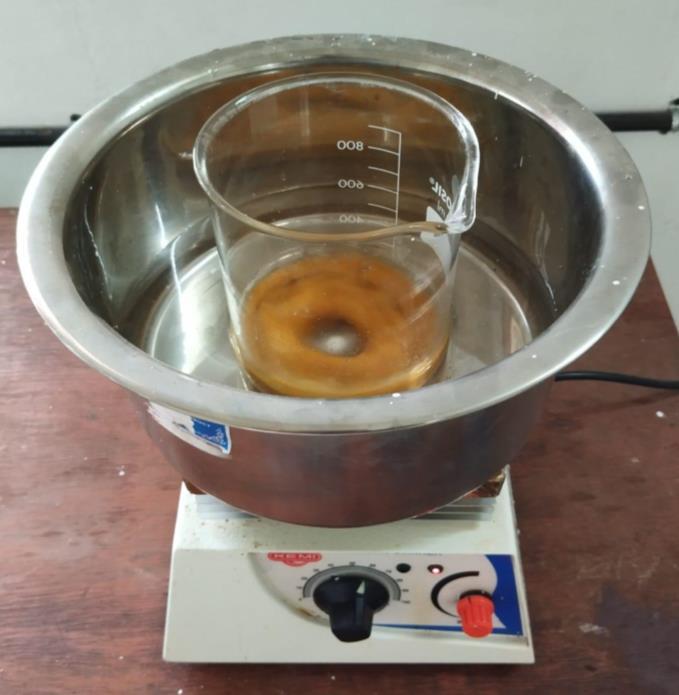
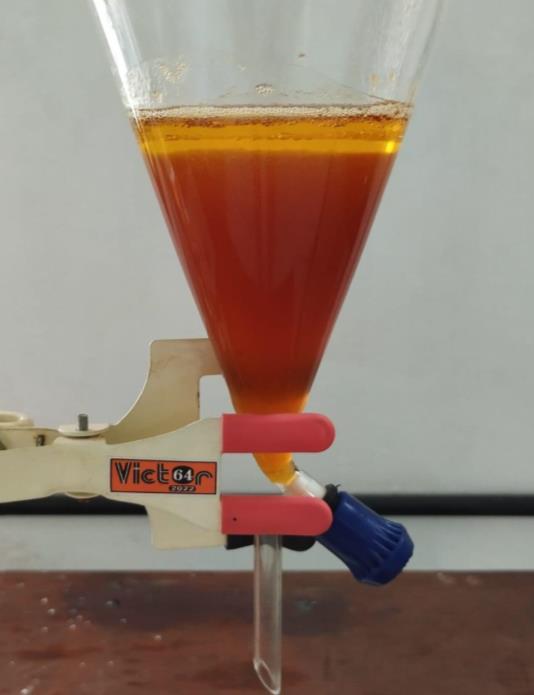
A known quantity of the oil was filtered using Whatman filter paper, taken in a beaker, heated to 80°C in a hot air oven with constant air flow for 30 minutes and was left to cool gradually to room temperature. This was done to remove any moisturecontentpresentintheseoilsamples.Aftercooling,knownquantitiesofpotassiumhydroxideandmethanolwere addedtoitandwerekeptforstirringinawaterbathat60°Cforonehour(Fig.1).Followingthisthemixturewaskeptina separating funnel overnight. Separation of the mixture takes place slowly and two layers are formed. The upper layer is the methyl ester of the oil and the lower layer is glycerol (Fig. 2). The methyl ester was separated out and was water washedfivetimesusingwarmdistilledwater(60°C).Thiswasdonetoremoveanyunreactedchemicalsandimpuritiesin thesample.Followingthisthesamplewasheatedundervacuumtoremovetheremainingmoistureandthefinalsampleof the methyl ester was obtained. The final products were Transesterified Grape seed oil (TGSO), Transesterified Neem oil (TNO) and Transesterified Waste cooking oil (TWCO). The chemical reaction taking place is depicted by the chemical formulaasshownbelow.
2.3 Physicochemical properties of GSO, NO, WCO and TGSO, TNO, TWCO
Physical properties such as colour, density and pH were measured for both modified and unmodified samples. Colour of the oil samples were identified by visual inspection. Density was measured at room temperature as per ASTM D369. pH was measured using a standard pH paper. Chemical properties such as Acid value (AV), Peroxide value (PV) and Iodine value(PV)weredeterminedasperIS548part1(1964)standards.Totoxvalue(TV)wascalculatedusingtheequation TV = AV + 2.PV
2.4 Rheological properties of GSO, NO, WCO and TGSO, TNO, TWCO
Rheological properties such as kinematic viscosity for all the samples were evaluated using Canon Fenske viscometer as perASTMD445standards.
2.5 Tribological properties of GSO, NO, WCO and TGSO, TNO, TWCO
TribologicalpropertiessuchasCoefficientoffriction(COF)andWearscardiameter(WSD)weredeterminedusingafour ball tribo tester as per ASTM D4172 standard. The test conditions were 392 N load, 1200 rpm spindle speed, 75°C temperatureand3600secondsrunningtime.
International Research Journal of Engineering and Technology (IRJET) e-ISSN:2395-0056
Volume: 11 Issue: 04 | April 2024 www.irjet.net p-ISSN:2395-0072
Flash temperature parameter (FTP) and Energy consumption (Total energy consumed (TE)) are two important parametersinevaluatingtheperformanceandenergyefficiencyoflubricantsandfuelsincombustionprocesses.FTPisa measure of the maximum temperature attained by a lubricant film during transient elastohydrodynamic lubrication conditions, such as those encountered in gear tooth contacts or rolling element bearings. A higher FTP value generally indicatesbetterlubricantperformanceandresistancetothermaldegradation[16].FTPiscalculatedusingtheequation
FTP = W/(d1.4)
……….(2)
Where,d=meanwearscardiameter(mm)andW=appliedload(kg).
TErepresentstheamountofenergyrequiredfora givenprocessoroperation.Inthecontextoflubricantsandfuels,itis often associated with the energy losses due to friction and other inefficiencies. Lower TE values are desirable as they indicatebetterenergyefficiencyandreducedenergyconsumption[17].TEiscalculatedusingtheequation
TE = fgwr/1000
……….(3)
Where,TE=thermalenergygenerated(Joules),g=accelerationduetogravity(m/s2),f=coefficientoffriction,w=load applied(kg)andr=distancebetweenthecentreofthecontactsurfaceonthelowerballsandtheaxisofrotation(i.e.3.67 mm).
The thermal conductivity of the oil samples (GSO, NO, WCO, TGSO, TNO, and TWCO) was determined using the liquid thermal conductivity apparatus according to ASTM D7896. The apparatus was set up and the water circulation was established to maintain a steady flow rate through the test section. The cooling water flow rate was measured and recorded.Usingtherecordedtemperaturesandtheknowndimensionsofthetestsection(thicknessoftheliquidfilmand areaofthetestsection),thethermalconductivityoftheliquidsamplewascalculatedusingtheformula
Q = K.A. (T1- T2)/Δx ………(4)
WhereQistherateofheattransfer,kisthethermalconductivityoftheliquid,Aistheareaofthetestsection,T1andT2 arethetemperaturesmeasuredbeforeandafterthetestsection,respectively,andΔxisthethicknessoftheliquidfilm.The experiment was repeated for each oil sample (GSO, NO, WCO, TGSO, TNO, and TWCO) to obtain their respective thermal conductivityvalues.
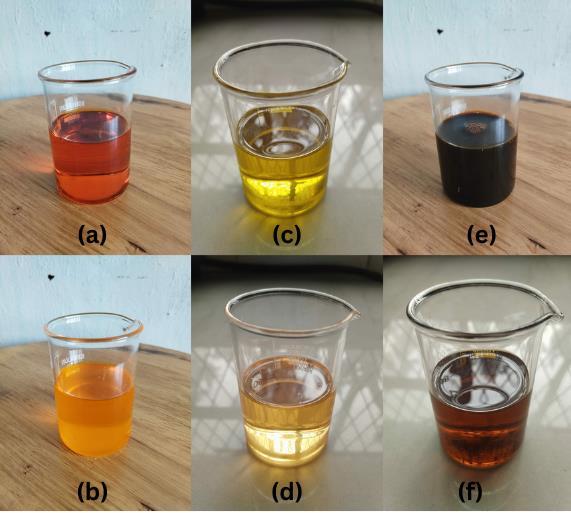
Table1showsthephysicochemicalpropertiesofvariousoilsamples.Thecolouroftheoils(Fig.3)indicatesthepresence of impurities, oxidation products, and other chemical components. For instance, WCO's dark brown colour results from exposuretohightemperaturesduringcooking,whichleadstotheformationofoxidationproducts [18].ThepHvaluesof all the oil samples range from 6 to 8, which is typical for vegetable oils. A slightly acidic or neutral pH is preferred for lubricant applications to prevent corrosion and compatibility issues [19]. The density values range from 0.612 g/cm³ (TGSO) to 0.876 g/cm³ (WCO). Higher densities generally suggest the presence of heavier molecular components or impurities [20]. The transesterification process decreases density by converting triglycerides (the denser part of the oil) intolighterfattyacidesters[21].
Table -1: PhysicochemicalpropertiesofGSO,NO,WCOandTGSO,TNO,TWCO
International Research Journal of Engineering and Technology (IRJET) e-ISSN:2395-0056
Volume: 11 Issue: 04 | April 2024 www.irjet.net p-ISSN:2395-0072
The quantity of unbound fatty acids present in the oil is indicated by the acid value. Increased acid values, such as 7.83 mgKOH/gforNO,canresultinelevatedlevelsofcorrosionandoxidation[22].Throughthetransesterificationprocess,the acidvalueistypicallyreducedbytransformingunboundfattyacidsintoesters [23].Theperoxidevalueservesasagauge for the extent of oxidation in the oil. Elevated peroxide values, like 9.78 meq/kg for WCO, indicate the existence of oxidation products that can have a negative impact on the performance of lubricants [24]. The peroxide value can be decreasedthroughtransesterificationandtheinclusionofantioxidants [25].Thetotoxvaluecombinestheacidvalueand peroxidevaluetoofferacomprehensiveassessmentoftheoil'soxidativedeterioration.Highertotoxvalues,suchas21.01 forWCO,signifygreateroxidationandpotentialinstability[26].Theiodinevaluemeasuresthelevelofunsaturationinthe oil.Higheriodinevalues,like109gI/100gforGSO,indicatealargerproportionofunsaturatedfattyacidswhichcanaffect propertieslikeoxidativestabilityandviscosity[27].
The transesterification process, which converts triglycerides into fatty acid esters, can improve the properties of the oils for lubricant applications by reducing the acid value, peroxide value and density [28]. The data suggests that Waste cooking oil (WCO) has inferior qualities when compared to the other oil samples. It has higher levels of acid value (1.45 mgKOH/g),peroxidevalue(9.78meq/kg),totoxvalue(21.01),anddensity(0.876g/cm³).Thesevaluesindicateagreater extent of oxidation and degradation, likely due to exposure to high temperatures during cooking. The process of transesterification, which converts triglycerides into fatty acid esters, generally enhances the properties of oils. For instance, transesterified waste cooking oil (TWCO) exhibits lower acid value (0.53 mgKOH/g), peroxide value (1.87 meq/kg), totox value (4.27), and density (0.734 g/cm³) compared to untreated WCO. Grape seed oil (GSO) and its transesterifiedform(TGSO)haveloweracidvalues(1.13and0.67mgKOH/g,respectively)andperoxidevalues(7.71and 1.39meq/kg, respectively) comparedto theother oilsamples.This indicates betterstability againstoxidation andlower
International Research Journal of Engineering and Technology (IRJET) e-ISSN:2395-0056
Volume: 11 Issue: 04 | April 2024 www.irjet.net p-ISSN:2395-0072
levelsoffreefattyacids,makingthempotentiallysuitableforlubricantformulations.Neemoil (NO)hasa relatively high acid value (7.83 mgKOH/g), which can cause increased corrosion and oxidation problems. However, its transesterified form(TNO)showsasignificantimprovementinthisproperty,withamuchloweracidvalue(1.25mgKOH/g).Thelevelsof unsaturation, which indicate the amount of double bonds, differ among the oil samples. GSO has the highest value (109 gI/100g), while TGSO has the lowest value (67 gI/100g). Higher iodine values can affect properties such as stability againstoxidationandthickness,whichcanimpacttheperformanceoflubricants.
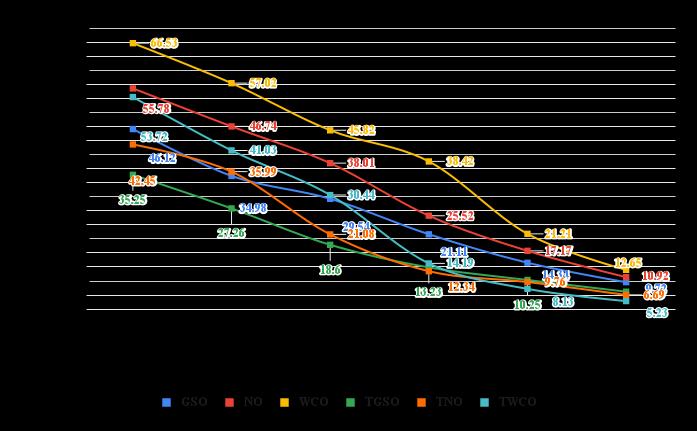
Chart - 1:KinematicViscosityvsTemperatureofvariousoilsamples
Chart 1 displays how the viscosity of different oil samples (GSO, NO, WCO, TGSO, TNO, and TWCO) changes as the temperature increases. This temperature-viscosity relationship is a common behaviour observed in lubricating oils. The viscosity of these oils is greatly influenced by temperature. As the temperature rises, the movement of molecules within theoilincreases,causingadecreaseinintermolecularforcesandasubsequentdecreaseinviscosity.Thistrendisevident for all the oil samples shown on the graph. The viscosity-temperature behaviour of the oils is affected by their chemical composition,includingthepresenceoftriglycerides,fattyacidesters,andothercomponents.Forexample,WCOhashigher viscosity values throughout the temperature range due to its higher molecular weight and the formation of polar compoundsduringcooking.Ontheotherhand,transesterifiedoils(TGSO,TNO,andTWCO)generallyhavelowerviscosity values compared to their untreated counterparts (GSO, NO, and WCO) at the same temperatures. This is because the transesterification process converts triglycerides into lighter fatty acid esters, resulting in a decrease in viscosity. WCO demonstrates elevated levels of viscosity throughout various temperatures, making it a potential choice for applications thatneedlubricantswithhigherviscosity.Transesterifiedoils(TGSO,TNO,andTWCO)havelowerviscositycomparedto their untreated counterparts, which can be beneficial for applications that require lubricants with lower viscosity or improvedperformanceinlowtemperatures.
Table -2:TribologicalPropertiesofGSO,NO,WCOandTGSO,TNO,TWCO OilSample TribologicalProperties
International Research Journal of Engineering and Technology (IRJET) e-ISSN:2395-0056
Volume: 11 Issue: 04 | April 2024 www.irjet.net p-ISSN:2395-0072
Table 2 displays the tribological characteristics of the different oil samples, specifically the average coefficient of friction (COF)andaveragewearscardiameter(WSD).Thesepropertiesareessentialforassessingthelubricatingperformanceof the oils and their potential for use in creating biodegradable lubricants. COF measures the level of friction between two surfaces that are sliding against each other. Lower COF values are preferred because they signify better lubrication and reduced friction, resulting in lower energy losses and wear. Waste cooking oil (WCO) has the lowest average COF of 0.0372, which can be attributed to its high viscosity and the formation of polar compounds during the cooking process, contributing to improved lubrication [29]. Transesterified oils (TGSO, TNO, TWCO) exhibit higher average COF values compared to their untreated counterparts (GSO, NO, WCO). This is due to the decrease in viscosity and removal of polar componentsduringthetransesterificationprocess,whichaffectthelubricatingability [30].Neemoil(NO)hasarelatively lowaverageCOFof0.0456,thankstothepresenceofnaturalantioxidantsandpolarcompoundsthatenhancelubrication [31].ItisidealfortheWSDtohavesmallervalues,asthisindicateslowerwearandbetterprotectionfor thesurfacesthat come into contact. In comparison to the other samples, GSO and NO have relatively high WSD values of 649.109 μm and 667.220 μm, suggesting lower wear resistance. On the other hand, WCO has the lowest WSD of 541.009 μm, which indicates better wear protection. This is attributed to its high viscosity and the presence of polar compounds that are formed during the cooking process [32]. The transesterified oils (TGSO, TNO, TWCO) generally have higher WSD values compared to their untreated counterparts. This suggests a potential decrease in wear resistance due to the removal of polar compounds during transesterification [33]. Among all the samples, WCO demonstrates the most promising performance in terms of tribological properties, with the lowest COF (Coefficient of Friction) and WSD values. This is mainlyduetoitshighviscosityandthepresenceofpolarcompoundsformedduringcooking.However,itshouldbenoted thatWCO'sphysicochemicalproperties,suchasitshighacidvalueandperoxidevalue,maylimititsdirectapplicationasa lubricantwithoutfurthertreatmentortheadditionofadditives.

Fig4.showsthewearscarimageofTWCOsample.Thewearscariscircularinshapewitharelativelysmoothappearance within the scar region, suggesting uniform wear during the testing process. The outer periphery of the scar exhibits a distinct boundary, separating the worn area from the surrounding unworn surface. In order to enhance the quality of lubricants, it is crucial to find a harmonious combination of certain properties like oxidative stability and tribological performance. This can be achieved by using suitable additive packages or blending strategies, which help maintain the balance between physicochemical properties and tribological properties such as coefficient of friction (COF) and wear resistance.
International Research Journal of Engineering and Technology (IRJET) e-ISSN:2395-0056
Volume: 11 Issue: 04 | April 2024 www.irjet.net p-ISSN:2395-0072
Chart -2:FTPandTEvaluesforvariousoilsamples
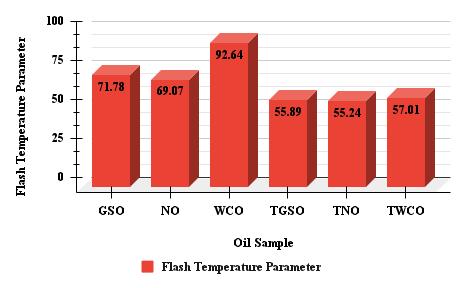
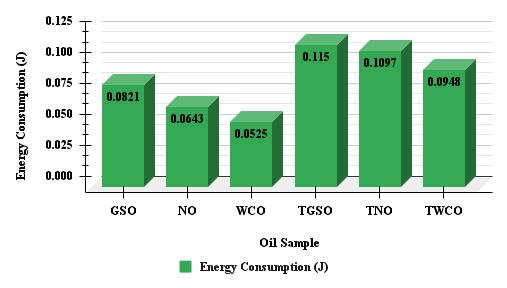
Chart 2 shows the flash temperature parameter (FTP) and energy consumption (TE) values for various oil samples. The data reveals that GSO has the highest FTP value of 71.78, implying superior thermal stability and performance in hightemperature situations. Conversely, the WCO sample has the highest TE value of 0.0525, indicating greater energy consumption compared to the other samples. Higher FTP values are generally preferable for enhanced thermal stability and lubricant performance, particularly in high-temperature conditions. Lower TE values signify improved energy efficiencyandreducedenergyconsumption,whichcanresultincostsavingsandenvironmentalbenefits.
Chart -3:ThermalConductivityofGSO,NO,WCOandTGSO,TNO,TWCO
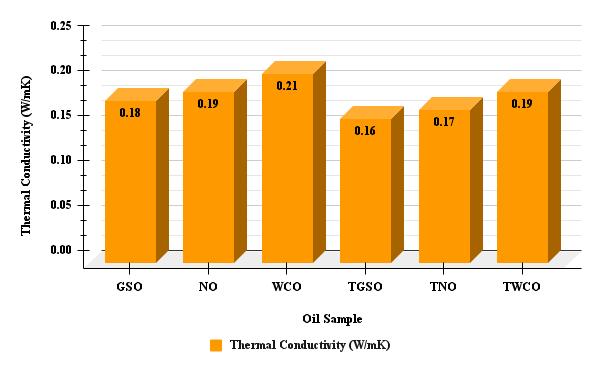
Chart 3 shows the thermal conductivity values of various oil samples. Due to the formation of polar compounds and increased molecular interactions during the cooking process, Waste cooking oil (WCO) exhibited the highest thermal conductivity (≈0.21 W/m.K). The transesterification process generally led to a slight decrease in thermal conductivity caused due to the changes in molecular structure and intermolecular forces after the conversion of triglycerides to fatty acid esters. The differences in thermal conductivity values among the samples can impact their performance in applications where heat transfer is crucial, such as lubricants or heat transfer fluids. Higher thermal conductivity can improveheatdissipationandthermalmanagement,whilelowervaluesmayresultinpoorerheattransfercharacteristics.
4. CONCLUSIONS
● Transesterified oils (TGSO, TNO, TWCO) exhibited lower physicochemical properties like acid values, peroxide values, and densities compared to their untreated counterparts (GSO, NO, WCO). This reduction in physicochemical properties enhances the oxidative stability and reduces corrosion tendency of these transesterifiedoils.
● Transesterified oils (TGSO, TNO, TWCO) displayed lower viscosity values compared to their untreated counterpartsmakingtheseoilspotentiallybeneficialforlow-temperatureapplications.
International Research Journal of Engineering and Technology (IRJET) e-ISSN:2395-0056
Volume: 11 Issue: 04 | April 2024 www.irjet.net p-ISSN:2395-0072
● Waste cooking oil (WCO) demonstrated the lowest coefficient of friction (COF) and wear scar diameter (WSD), indicating improved lubricity and wear resistance. However, its physicochemical properties, such as high acid value and peroxide value, may limit its direct application without further treatment or additive formulation. Transesterified oils generally exhibited higher COF and WSD values compared to their untreated counterparts, suggestingapotentialdecreaseintribologicalperformance.
● Grapeseedoil (GSO)had thehighestFTPvalue, indicating betterthermal stabilityandperformance underhightemperature conditions. Waste cooking oil (WCO) had the highest TE value, suggesting higher energy consumptioncomparedtoothersamples.
● Appropriate additive packages or blending strategies should be explored to achieve the desired combination of propertiesforspecificapplications.
● Furtherresearchanddevelopmentareneededtoaddress thelimitationsandtrade-offsidentified,andtoexplore theviabilityofthesebio-basedlubricantsinreal-worldapplications.
[1] Martin, M.E.; Grao-Cruces, E.; Millan-Linares, M.C.; Montserrat-de la Paz, S. Grape (Vitis vinifera L.) Seed Oil: A FunctionalFoodfromtheWinemakingIndustry.Foods2020,9,1360.https://doi.org/10.3390/foods9101360
[2] Ortega,Javier.(2022).InvestigatingtheRheologicalBehaviorandLubricationPerformanceofGrapeseedOilModified with SiO2 and TiO2 Nanoparticles for Industrial Applications. Juniper Online Journal Material Science. 7. http://dx.doi.org/10.19080/JOJMS.2022.07.555706
[3] Haro, J. C. de, Rodríguez, J. F., Carmona, M., & Pérez, Á. (2018). Revalorization of Grape Seed Oil for Innovative NonFoodApplications.InTech.http://dx.doi.org/10.5772/intechopen.71710
[4] Beducated. (2023, April 18). Natural Oil As Lubricants – Which Ones Are Safe to Use? Retrieved from https://beducated.com/mag/natural-oil-as-lubricants/
[5] CamposEVR,deOliveiraJL,PascoliM,deLimaRandFracetoLF(2016)NeemOilandCropProtection:FromNowto theFuture.Front.PlantSci.7:1494.https://doi.org/10.3389/fpls.2016.01494
[6] Srinivas,M.S.,Panneer,R.,Suvin,P.S.,Kailas,S.V.(2021).SynthesisandTestingofNovelNeemOil-BasedCuttingFluid with Ionic Liquid Additives. In: Chakrabarti, A., Arora, M. (eds) Industry 4.0 and Advanced Manufacturing. Lecture NotesinMechanicalEngineering.Springer,Singapore.https://doi.org/10.1007/978-981-15-5689-0_27
[7] Fratila,D.(2013).SustainableManufacturingThroughEnvironmentally-FriendlyMachining.In:Davim,J.(eds)Green Manufacturing Processes and Systems. Materials Forming, Machining and Tribology. Springer, Berlin, Heidelberg. https://doi.org/10.1007/978-3-642-33792-5_1
[8] Rahul Katna, M. Suhaib & Narayan Agrawal (2020) Non Edible vegetable oil-based cutting fluids for machining processes–areview,MaterialsandManufacturingProces,1-32,https://doi.org/10.1080/10426914.2019.1697446
[9] Agrawal,N.,Katna,R.(2019).AssessmentofCuttingForcesinMachiningwithNovelNeemOil-BasedCuttingFluid.In: Mishra, S., Sood, Y., Tomar, A. (eds) Applications of Computing, Automation and Wireless Systems in Electrical Engineering.LectureNotesinElectricalEngineering,vol553. Springer,Singapore.https://doi.org/10.1007/978-98113-6772-4_74
[10] Mannu,A.;Vlahopoulou,G.;Urgeghe,P.;Ferro,M.;DelCaro,A.;Taras,A.;Garroni,S.;Rourke,J.P.;Cabizza,R.; Petretto, G.L. Variation of the Chemical Composition of Waste Cooking Oils upon Bentonite Filtration. Resources 2019, 8, 108. https://doi.org/10.3390/resources8020108
[11] Manikandan, G.; Kanna, P.R.; Taler, D.; Sobota, T. Review of Waste Cooking Oil (WCO) as a Feedstock for Biofuel IndianPerspective.Energies2023,16,1739.https://doi.org/10.3390/en16041739
[12] Joshi, J.R., Bhanderi, K.K., Karve, M. et al. Chemical modification of waste cooking oil for the bio lubricant production throughepoxidationprocess.BiomassConv.Bioref.(2023).https://doi.org/10.1007/s13399-023-05174-w
International Research Journal of Engineering and Technology (IRJET) e-ISSN:2395-0056
Volume: 11 Issue: 04 | April 2024 www.irjet.net p-ISSN:2395-0072
[13] Abdulbari,H.A.,Rosli,M.Y.,Abdurrahman,H.N.,&Nizam,M.K.(2011).Lubricatinggreasefromspentbleachingearth and waste cooking oil: Tribology properties. International Journal of the Physical Sciences, 6(20), 4695-4699. DOI: 10.5897/IJPS11.561.
[14] Alotaibi,J.G.,Yousif,B.F.(2016).BiolubricantsandthePotentialofWasteCookingOil.In:Davim,J.(eds)Ecotribology. MaterialsForming,MachiningandTribology.Springer,Cham.https://doi.org/10.1007/978-3-319-24007-7_5
[15] Staroń, A. Composite Materials Based on Waste Cooking Oil for Construction Applications. Buildings 2023, 13, 994. https://doi.org/10.3390/buildings13040994
[16] Hamrock, B. J., Schmid, S. R., & Jacobson, B. O. (2004). Fundamentals of fluid film lubrication (Vol. 169). New York: MarcelDekker.https://doi.org/10.5860/choice.31-6068
[17] Holmberg, K., Andersson, P., & Erdemir, A. (2012). Global energy consumption due to friction in passenger cars. TribologyInternational,47,221-234.https://doi.org/10.1016/j.triboint.2011.11.022
[18] Choe, E., & Min, D. B. (2007). Chemistry of deep-fat frying oils. Journal of Food Science, 72(5), R77-R86. https://doi.org/10.1111/j.1750-3841.2007.00352.x
[19] Frankel, E. N. (2005). Lipid oxidation. Bridgwater: The Oily Press. https://www.sciencedirect.com/book/9780953194988/lipid-oxidation#book-info
[20] Gunstone,F.D.(2004).Thechemistryofoilsandfats:sources,composition,propertiesanduses.BlackwellPublishing Ltd.https://doi.org/10.5860/choice.42-5870
[21] Srivastava,A.,&Prasad,R.(2000).Triglycerides-baseddieselfuels.RenewableandSustainableEnergyReviews,4(2), 111-133.https://doi.org/10.1016/S1364-0321(99)00013-1
[22] Sharma, B. K., Biresaw, G., & Erhan, S. Z. (2007). Gelfree and biodegradable lubricants from thermally rearranged vegetable oil-based esters. Journal of Agricultural and Food Chemistry, 55(18), 7543-7548. https://doi.org/10.1201/9781315373256
[23] Cerce, T., Tan, S., & Raman, A. D. (2011). Synthesis and characterization of vegetable oil-based lubricant base stocks. GreenChemistryLettersandReviews,4(2),109-118.https://doi.org/10.3390%2Fantiox9111147
[24] Erhan, S. Z., Adhvaryu, A., & Perez, J. M. (2002). Oxidation kinetic studies of vegetable oils using pressurised differential scanningcalorimetryandnuclearmagnetic resonancespectroscopy.Thermochimica Acta,394(1-2),211226.https://doi.org/10.1016/S0040-6031(00)00626-2
[25] Erhan, S. Z., Sharma, B. K., & Perez, J. M. (2006). Oxidation and low temperature stability of vegetable oil-based lubricants.IndustrialCropsandProducts,24(3),292-299.https://doi.org/10.1016/j.indcrop.2006.06.008
[26] Abdalla, A. L., Mohdaly, A. A., & Assiri, A. M. (2021). Spectroscopic analysis and evaluation of physicochemical properties of some vegetable oils for food and industrial applications. Molecules, 26(16), 4875. https://doi.org/10.1016/j.saa.2020.118877
[27] O'Brien, R. D. (2009). Fats and oils: formulating and processing for applications. CRC Press. https://doi.org/10.1201/9781420061673
[28] Srivastava, A., & Sahai, D. (2013). Vegetable oils as lube base stocks: A review. African Journal of Biotechnology, 12(47),6475-6489.https://academicjournals.org/article/article1380788394_Srivastava%20and%20Sahai.pdf
[29] AhmadAL,IsmailS,BhatiaS.Optimizationofcoagulation-flocculationprocessforpalmoilmilleffluentusingresponse surfacemethodology.EnvironSciTechnol.2005Apr15;39(8):2828-34.https://doi.org/10.1021/es0498080
[30] Adhvaryu, A., Erhan, S.Z., Liu, Z., & Perez, J.M. (2000). Oxidation kinetic studies of oils derived from unmodified and genetically modified vegetables using pressurised differential scanning calorimetry and nuclear magnetic resonance spectroscopy.ThermochimicaActa,364,87-97.https://doi.org/10.1016/S0040-6031%2800%2900626-2
2024, IRJET | Impact Factor value: 8.226 | ISO 9001:2008 Certified Journal | Page1250
International Research Journal of Engineering and Technology (IRJET) e-ISSN:2395-0056
Volume: 11 Issue: 04 | April 2024 www.irjet.net p-ISSN:2395-0072
[31] Srivastava, A., & Sahai, D. (2013). Vegetable oils as lube base stocks: A review. African Journal of Biotechnology,12(47),64756489.https://academicjournals.org/article/article1380788394_Srivastava%20and%20Sahai.pdf
[32] Fox,N.J.,&Stachowiak,G.W.(2007).Vegetableoil-basedlubricants Areviewofoxidation.TribologyInternational, 40(7),1035-1046.https://doi.org/10.1016/j.triboint.2006.10.001
[33] Sharma, B. K., Adhvaryu, A., & Erhan, S. Z. (2009). Lubricant base stock potential of epoxidized soybean oil and epoxidizedsoybeanoil-basedesters.Energy&Fuels,23(6),3013-3019.https://doi.org/10.1021/jf801463d
© 2024, IRJET | Impact Factor value: 8.226 | ISO 9001:2008
| Page