
International Research Journal of Engineering and Technology (IRJET) e-ISSN: 2395-0056
Volume: 11 Issue: 04 | Apr 2024 www.irjet.net p-ISSN: 2395-0072
International Research Journal of Engineering and Technology (IRJET) e-ISSN: 2395-0056
Volume: 11 Issue: 04 | Apr 2024 www.irjet.net p-ISSN: 2395-0072
Heramb Parag Velde1 , Aditya Rahul Bhandarkar2 , Aditya Tanaji Gaikwad3 , Atharv Atul Khedkar4 , Litesh Nishikant Kingaonkar5 , Amita N. Dubey6
1,2,3,4,5Department of Electronics & Telecommunication Engineering, JSPM’s RSCOE Polytechnic, Tathawade, Pune 6Head of Department, Department of Electronics & Telecommunication, JSPM’s RSCOE Polytechnic Tathwade, Pune
Abstract - This research paper introduces a futuristic innovation, the "Sahayaak : A Smart Blind Stick for the Visually Impaired," developed to address the safety and independence hardships faced by visually impaired individuals during mobility. Traditional white canes often fall short in ensuring complete protection, leaving users vulnerable to undetected obstacles. In response, we present a meticulously engineered system comprising an ultrasonic sensor integrated into the user's cane, coupled with Arduino nano and uno microcontrollers, along with these there is a GPS and GSM Module for distress signaling and a speakerbased distress call system based on an APR33A3 voice recorder Module. As the user navigates, the sensor actively scans the environment for obstacles, triggering tactile or auditory feedback upon detection. This responsive technology empowers visually impaired individuals to confidently traverse their surroundings, offering real-time obstacle recognition and enhancing their overall safety. The implementation of this cutting-edge navigation aid marks a significant leap towards fostering autonomy and security for visually impaired people, making strides in the realm of assistive technology.
Key Words: Arduino Uno and Nano, Ultrasonic Sensor – HC-SR04, Mobility Aid, Smart Blind Stick, Distress Signal, APR33A3 Module, GPS Tracking, Visually Impaired Persons
1.INTRODUCTION
In the realm of mobility aids for visually impaired individuals,thetraditionalwhitecanehaslongservedasa symbolofindependenceandnavigation.However,despite its ubiquitous presence, the traditional white cane poses several limitations and challenges for users, hindering their ability to navigate safely and efficiently in various environments. As technology continues to advance, there arisesanopportunitytoaddresstheselimitationsthrough the development of smart blind sticks equipped with cutting-edgefeaturesandfunctionalities.
As of the latest available data from the World Health Organisation (WHO), there are around 2.2 billion people worldwide living with vision impairment or blindness. Amongthem,about1billionhaveavisionimpairmentthat
couldhavebeenavoidableorisyettobelookafter.Visual impairment significantly impacts the quality of life of individuals, including their ability to perform daily activities, engage in education and employment, and participatefullyintheircommunities.
Here's a breakdown of key statistics and real-world situationsrelatedtovisuallyimpairedindividuals:
1.PrevalenceofVisualImpairment:
• According to WHO, around 253 million people globally arevisuallyflawed,ofwhom36millionaresight-less.
• Visual impairment affects people of all ages, with a higher prevalence among older adults. Approximately 65% of visually impaired individuals are aged 50 and above.
• The leading sources of visual impairment include ignored refractive errors, cataracts, age-based macular degeneration,glaucoma,anddiabeticretinopathy.
2.GlobalDistributionandentrytoEyeCareServices:
• Visual impairment extremely affects low-income and middle-income countries, where access to eye care servicesisveryless.
• In many regions, there is a sparseness of eye care professionals, including ophthalmologists, optometrists, andtrainedpersonnelforvisionrehabilitation.
• Lack of awareness about eye health, financial constraints, and inadequate infrastructure contribute to disparitiesinaccesstoeyecareservices.
3.ImpactonEducationandEmployment:
• Visual impairment can significantly impact educational attainment and employment opportunities. Many blind individualsfacebarrierstoaccessinginclusiveeducation andvocationaltraining.
• According to the International Labour Organisation (ILO), the global employment rate for people with disabilities,includingvisualimpairments,issignificantly lowerthanthatofthegeneralpopulation.
Volume: 11 Issue: 04 | Apr 2024 www.irjet.net p-ISSN: 2395-0072
4.MobilityandAccessibilityChallenges:
• Visuallyimpairedindividualsoftenencounterchallenges related to mobility and accessibility in their daily lives. Navigating public spaces, transportation systems, and built environments can be daunting due to obstacles, lackoftactilemarkers,andinadequatesignage.
Traditional mobility aids such as white canes provide basic assistance but have limitations in addressing the diverse needs of users, especially in technologic
5.PsychosocialImpactandMentalHealth:
• Visual impairment can have profound psychosocial effects, including increased risk of depression, anxiety, andsocialisolation.
• Stigma and discrimination associated with disability further exacerbate mental health challenges for visually impaired individuals, impacting their overall well-being andqualityoflife.
6.EconomicBurdenandSocietalCosts:
• Visualimpairmentimposesasignificanteconomicstress on individuals, families, and societies at large. Direct costs include expenses related to medical treatment, assistivedevices,andrehabilitationservices.
• Indirect costs arise from lost productivity, reduced earning potential, and the need for caregiver support. The economic impact of visual impairment underscores theimportanceof investing inpreventivemeasures and comprehensiveeyecareservices.
The traditional white cane, though iconic in its representation of independence and navigation for the visually impaired, has inherent limitations. Primarily relying on physical contact to detect obstacles, it offers limited awareness of the surrounding environment. This lack of environmental awareness poses significant safety risks,asusersmayencounterobstaclesbeyondthecane's detection range, leading to potential collisions or accidents.
In response to these challenges, the integration of ultrasonic sensors into smart blind sticks presents a promisingsolution.Thesesensors,strategicallypositioned onthedevice,detectobstacles inthecustomer's path and providereal-timeresponsethroughauditory.Byofferinga wider detection range compared to traditional canes, ultrasonic sensors enhance environmental awareness, enabling users to detect obstacles at a distance and navigate complex environments more effectively. This feature significantly improves safety during navigation,
reducingtheriskofcollisionswithoverheadobstructions, drop-offs,orprotrudingobjects.
Furthermore,theincorporationofadistressalarmsystem adds anadditional layerofsafety andsupport forvisually impaired individuals. Activated through a designated button, the distress alarm allows users to summon assistance in emergency situations or when facing obstacles beyond their ability to navigate independently. Upon activation, the distress alarm alerts the nearby crowd and passersby of the distress the user is in, by playingaloudAudiochosenbytheuser.
TheGPStrackingfeaturefurtherenhancesthecapabilities of smart blind sticks by providing users with accurate real-time location information. The GPS Tracking module is made of a GPS and GSM integration through which just at a push of a button the exact detailed location coordinates of the visually impaired person reach their loved ones on their registered mobile number, offering a safercommuteforthevisuallyimpaireduserandfostering independencewhiletravellingamongusers.
First,theliteraturesurveyonsmartblindsticks,spanning studies by Kim et al., Chaurasiya et al., Zahrani et al., Pradhanetal.,Rautetal.,andVijayalakshmietal.,offersa comprehensive examination of advancements and limitations in assistive technology for the visually hindered. While these studies collectively showcase the evolution of smart vision enabling sticks, they also underscore significant limitations in earlier models. Common drawbacks include the reliance on rudimentary obstacle detection methods, such as basic electronic aids or vibration feedback (Vijayalakshmi et al.), which may scant sufficient details about the user's surrounding environment. Additionally, the lack of integration with advancedfeatureslikeIoTconnectivity(Chaurasiyaetal.) or GPS tracking systems (Raut et al.) limits the functionality and scope of earlier models. Furthermore, issues related to affordability, user customisation, and global accessibility are prevalent themes, suggesting a need for more inclusive and user-centric design approaches in future iterations. Despite the strides made in assistive technology, the existing literature highlights persistent challenges in creating smart blind sticks that trulyempowervisuallyimpairedindividualswithboosted mobility, safety, and liberation. Moving forward, addressing these limitations will be crucial in driving innovation and ensuring the widespread adoption of smart blind stick technology as a transformative tool for thevisuallyimpairedcommunity.
International Research Journal of Engineering and Technology (IRJET) e-ISSN: 2395-0056
Volume: 11 Issue: 04 | Apr 2024 www.irjet.net p-ISSN: 2395-0072
3.1
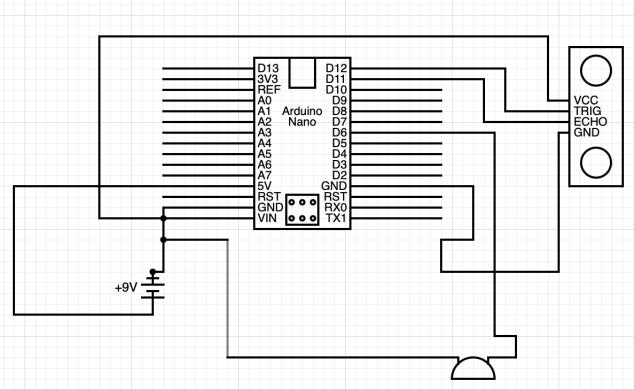
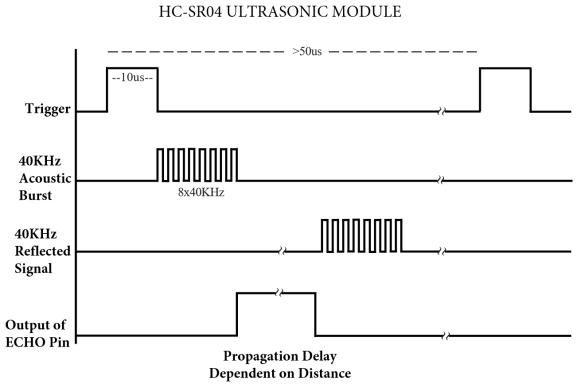
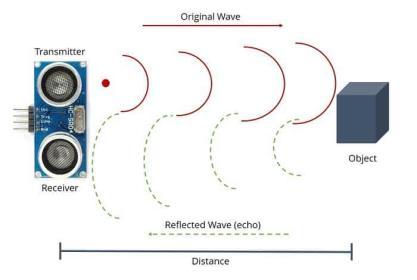
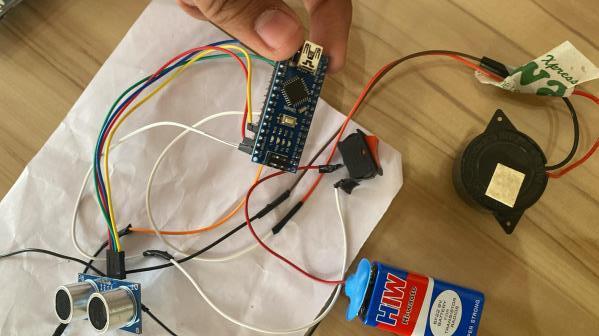
Forthefrontanddepth sensing model wemajorly use theultrasonicHC-SR04sensor.Wehaveused2sensorsfor front and depth sensing respectively. Each of these sensors is paired with an Arduino Nano microcontroller. The HC-SR04 ultrasonic sensor operates on the principle ofsound wavereflectionto measuredistance. Comprising a transmitter and a receiver, the sensor initiates measurement when a short trigger pulse, lasting at least 10 microseconds, is sent to its Trigger pin. This triggers the emission of an ultrasonic pulse from the transmitter, whichtravelsthroughthespaceuntilitdetectsanobstacle in its path. Upon striking the object, the ultrasonic wave reflects back towards the sensor. The sensor's receiver then detects this reflected wave, causing its Echo pin to produce a pulse. The microcontroller connected to the sensor measures the time span of this pulse on the Echo pin, which compliments the time taken for the ultrasonic wave to travel from the sensor to the object and back. Utilisingtheknownspeedofsoundinair,typicallyaround 343 meters per second at room temperature, the microcontrollercalculatesthedistancetotheobjectusing theformula:Distance=(Pulseduration*Speedofsound) / 2. This calculated distance can then be utilised for various applications, such as obstacle shunning, distance calculation, or object detection, making the HC-SR04 sensor a versatile and valuable component in robotics, automation, and proximity sensing projects. The Front ObstacleSensorhasa3-levelalertingsystemwhichbeeps thebuzzerwithdifferentaudionotesaccording tochange indistanceoftheobstaclefromthesensor.Thecloserthe stickistotheobjectshrilleris thesoundthatengages the blind person to act accordingly. Next is the depth sensor, which on detecting depths more than 5cm beeps to alert the user of a possible pothole, staircase or sudden declination.
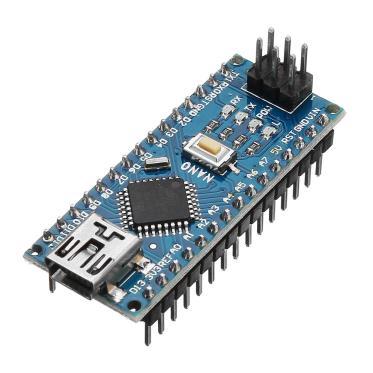
TheArduinoNanoisasmallandversatilemicrocontroller board based on the ATmega328P or ATmega168 microcontroller.Designedwithsizeefficiencyinmind,the Nano offers a wide array of features packed into a small form factor, making it ideal for projects with less space requirements. Despite its compact size, the Nano retains the core functionality of larger Arduino boards, featuring digital and analog input/output pins, PWM (Pulse Width Modulation) support, serial communication capabilities, and onboard voltage regulation. Its integrated USB interface simplifies programming and power supply, eliminating the need for external programmers or power sources. With its 14 digital pins, 8 analog pins, and a 16 MHz crystal oscillator, the Nano provides sufficient flexibility and performance for a variety of applications, including robotics, sensor interfacing, automation, and
prototyping. Additionally, its breadboard-friendly layout facilitateseasyprototypingandexperimentation,allowing users to quickly iterate and develop their projects. The Arduino Nano is supported by a vast ecosystem of libraries, examples, and community resources, making it accessible to beginners and advanced users alike. Its affordability, ease of use, and compact design make the Nano a popular choice for hobbyists, educators, and professionals seeking a powerful yet compact microcontrollerplatformfortheirprojects.
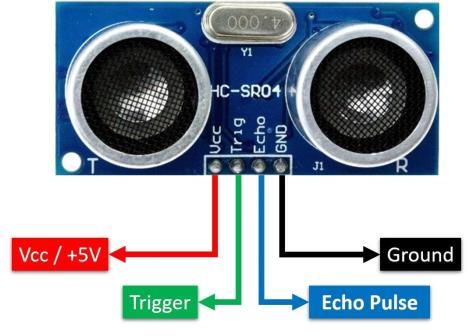
The HC-SR04 ultrasonic sensor is a widely used module for distance measurement and proximity sensing in various electronic applications. Comprising a transmitter and receiver, the sensor operates on the principle of ultrasonic sound waves, utilising echolocation similar to that of bats or dolphins. Upon receiving a trigger signal, typically a short pulse of at least 10 microseconds, the sensor emits a barrage of ultrasonic waves through its transmitter. These waves travel through theair until they encounter an obstacle or object in their path. Upon strikingtheobject,theultrasonicwavesarereflectedback towardsthesensor'sreceiver.
The HC-SR04 sensor's receiver detects these reflected waves and measures the time taken for them to return to the sensor. This time interval, known as the echo time, is directly proportional to the distance between the sensor and the object. The sensor then calculates the distance usingthespeedofsoundintheair,whichisapproximately 343meterspersecondatroomtemperature.Withitshigh sensitivity and 56 kHz operating frequency, the HC-SR04 sensor can accurately detect objects within a range of 2 centimetres to 4 meters, making it suitable for a wide rangeofdistancemeasurementapplications.
The HC-SR04 sensor typically communicates with a microcontroller or Arduino board through digital input/output pins, with one pin used for triggering the sensor(Trigger)andanotherforreceivingtheechosignal
International Research Journal of Engineering and Technology (IRJET) e-ISSN: 2395-0056
Volume: 11 Issue: 04 | Apr 2024 www.irjet.net p-ISSN: 2395-0072
(Echo). By measuring the duration of the echo pulse, the microcontroller can determine the distance to the object and perform various actions based on this information. Additionally,thesensor'scompactsize,lowcost,andease of use make it a popular choice for robotics, automation, andIoTprojects.Whetherdeployedinobstacleavoidance systems, smart parking solutions, or autonomous navigationplatforms,theHC-SR04ultrasonicsensoroffers a reliable and efficient means of detecting and measuring distanceswithprecisionandaccuracy.
CALCULATIONS:
distance=time*speed
distance=(traveltime/2)xspeedofsound
Thespeedofsoundis:343m/s
Incms:-0.0343cm/uS=1/29.1cm/uS
Ininches:-13503.9in/s=0.0135in/uS=1/74in/uS
International Research Journal of Engineering and Technology (IRJET) e-ISSN: 2395-0056
Volume: 11 Issue: 04 | Apr 2024 www.irjet.net p-ISSN: 2395-0072
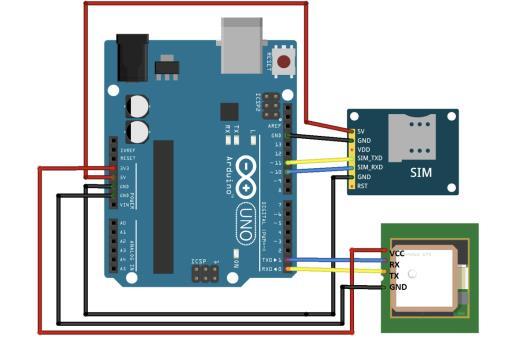
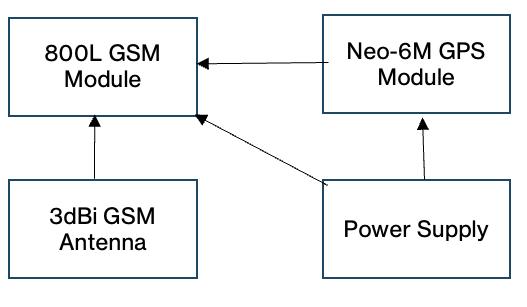
The Neo 6M GPS module and SIM800L module, when integrated, can function as a GPS location tracker with precise accuracy. The Neo 6M module utilises the Global NavigationSatelliteSystem(GNSS)toreceivesignalsfrom satellites orbiting the Earth. It comprises a receiver that processes these signals to determine the device's geographical coordinates, including latitude, longitude, altitude, and time. With its 56-channel receiver and high sensitivity, the Neo 6M module can acquire and track satellitesignalseveninchallengingenvironments,suchas urban canyons or dense foliage. It communicates with a microcontroller or a microprocessor through serial communication, typically using UART (Universal Asynchronous Receiver-Transmitter) protocol. On the other hand, the SIM800L module serves as a communicationgateway,enablingthetransmissionofGPS locationdataoverthecellularnetwork.
In operation, the Neo 6M GPS module continuously receives signals from multiple satellites and calculates its position. It then outputs the GPS data, including latitude and longitude, in the form of NMEA (National Marine Electronics Association) sentences, which are standardised data strings used in GPS systems. These sentences are transmitted serially and can be parsed by a microcontrolleroracomputerforfurtherprocessing. The SIM800L module,integrated with the GPS tracker system, allows for the transmission of this GPS data to a remote serverora monitoring centervia theGSM (Global System forMobileCommunications)network.
To track the location using this system, the Neo 6M GPS module is configured to output the desired NMEA sentences containing the latitude and longitude data. The SIM800L module is then programmed to establish a connection to the cellular network using an inserted SIM card. Once connected, it sends AT commands to the Neo 6M module to retrieve the GPS data. This data is then encapsulated into a message format, such as JSON (JavaScript Object Notation), and transmitted over the cellularnetworktoadesignatedserverorcloudplatform.
Attheserverend,thereceivedGPSdataisprocessedand stored in a database, allowing users to track the device's location in real-time or view historical location data. By periodically retrieving and transmitting GPS coordinates, the system enables continuous tracking of the device's movement, making it suitable for applications such as assettracking,vehiclemonitoring,orpersonalsafety.With the combined capabilities of the Neo 6M GPS module and SIM800Lmodule,userscandeployareliableandaccurate GPSlocationtrackersystemthatoperatesseamlesslyover thecellularnetwork, providing real-timelocationupdates andmonitoringcapabilities.
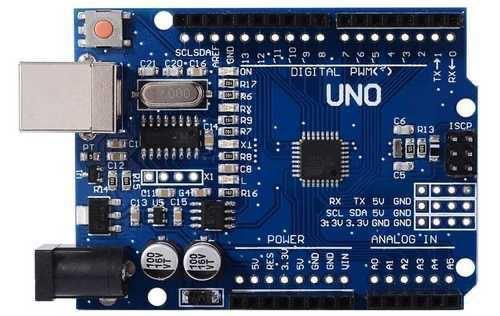
The Arduino Uno is a popular microcontroller board renowned for its versatility and ease of use in a wide range of projects. At its heart lies the Atmega328P microcontroller, offering ample computing power and memory for various applications. The board features a straightforward layout, comprising digital and analog input/output pins, PWM (Pulse Width Modulation) pins, anddedicatedpowerandgroundpins,providingflexibility for interfacing with sensors, actuators, and other electronic components. Additionally, the Uno includes a USBinterfaceforprogrammingandpower,allowingusers touploadcodefromtheircomputersandpowertheboard simultaneously. This USB connection utilizes the widely supported serial communication protocol, simplifying the process of programming the Uno for both beginners and experienced users alike. Furthermore, the Uno supports a vast ecosystem of libraries and shields, extending its capabilities to include functionalities such as wireless communication, motor control, and data logging, among others. With its combination of robust hardware, userfriendly design, and extensive community support, the Arduino Uno continues to be a go-to choice for hobbyists, educators, and professionals seeking to bring their creative ideas to life in the domain of electronics and arduinosystems.
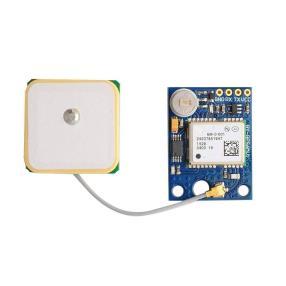
The Neo 6M GPS module is a widely used and highly versatiledevicedesignedforaccurateglobalpositioning.It employs the Global Navigation Satellite System (GNSS) to receive signals from multiple satellites orbiting the Earth. Equipped with a high-performance receiver chipset, the Neo 6M module can acquire and track signals from up to 56 satellites simultaneously, ensuring robust and reliable positioning even in challenging environments. Its small form factorandless power consumption makeit ideal for integrationintoa widerangeofapplications,fromvehicle navigation systems and asset tracking devices to outdoor recreational equipment and unmanned aerial vehicles (UAVs). The Neo 6M module communicates with a host microcontroller or computer via serial communication, typically using the Universal Asynchronous ReceiverTransmitter(UART)protocol.Itoutputsstandardizeddata
Volume: 11 Issue: 04 | Apr 2024 www.irjet.net p-ISSN: 2395-0072
strings known as NMEA (National Marine Electronics Association) sentences, containing essential information such as latitude,longitude, altitude, speed,andtime. With its fast time-to-first-fix (TTFF) and high sensitivity, the Neo 6M module provides accurate and real-time positioningdata,enablingprecisenavigationandlocationbased services. Additionally, it supports various satellite constellations, including GPS (Global Positioning System), GLONASS (Global Navigation Satellite System), and BeiDou, enhancing its coverage and reliability in different regionsaroundtheworld.Overall,theNeo6MGPSmodule stands out for its exceptional performance, adaptability, and ease of integration, making it a famous choice for a widerangeofGPS-enabledapplications.
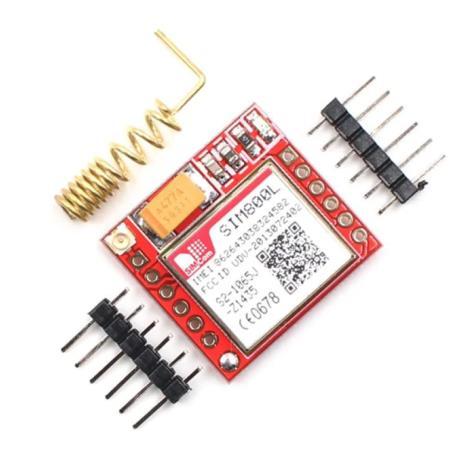
The SIM800L GSM module is a compact and versatile communication device that enables GSM (Global System for Mobile Communications) connectivity in various electronic projects. It serves as a bridge between embedded systems and cellular networks, allowing devices totransmitandreceivedata,makecalls,andsend SMS messages. The module integrates a GSM/GPRS (General Packet Radio Service) modem along with other essential components, including a SIM card slot, antenna connector, and serial interface. With its small form factor andlowpowerconsumption,theSIM800Lmoduleiswellsuited for applications where space and energy efficiency are paramount, such as IoT (Internet of Things) devices, remotemonitoring systems,vehicletrackingsystems,and mobile communication devices.The SIM800L module supportsquad-bandGSM/GPRScommunication,makingit compatible with GSM networks worldwide. It operates within the frequency bands of 850/900/1800/1900 MHz, ensuring broad coverage and reliable connectivity across different regions. The module features a UART (Universal Asynchronous Receiver-Transmitter) interface for communication with external microcontrollers or host devices, facilitating seamless integration into various projects. Additionally, itsupports AT commands, allowing users to control and configure the module's functionality programmatically.
One of the key features of the SIM800L module is its supportforbothdataandvoicecommunication.Itenables devices to establish TCP/IP connections for data transfer overthecellularnetwork,facilitatinginternetconnectivity in remote or mobile applications. Moreover, the module can make and receive voice calls, providing a means of communication beyond traditional text-based messaging. Furthermore, the SIM800L module includes features such as SMS functionality, embedded TCP/IP stack, integrated Bluetooth functionality (optional), and onboard audio processing capabilities, enhancing its versatility and applicability in diverse scenarios. In terms of power consumption, the SIM800L module operates efficiently, consuming relatively low power during idle and standby modes.Itsupportsvarious power-savingfeatures,suchas sleep mode and power-down mode, enabling further optimization of energy usage in battery-powered applications. Additionally, the module incorporates advanced features for network and signal quality monitoring, ensuring reliable performance and seamless handoverbetweendifferentcellularnetworks.
Overall,theSIM800LGSM moduleoffersacomprehensive solution for adding GSM/GPRS connectivity to embedded systems and electronic devices. Its compact size, broad compatibility, and extensive feature set make it an ideal choice for applications requiring cellular communication capabilities, ranging from simple SMS-based alerts to sophisticated IoT deployments. Whether used in remote monitoring systems, asset tracking devices, or mobile communication gadgets, the SIM800L module provides a reliableandefficientmeansofestablishingconnectivityin awiderangeofscenarios.
Volume: 11 Issue: 04 | Apr 2024 www.irjet.net
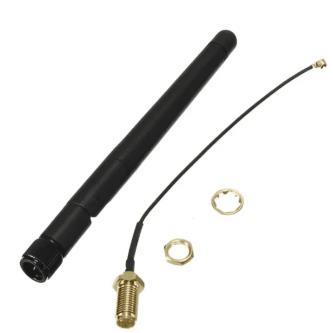
The 3dBi GSM antenna is a specialised antenna designed to enhance the performance of GSM (Global System for Mobile Communications) communication systems. With its specific gain rating of 3dBi, this antenna offers improved signal reception and transmission capabilities compared to standard antennas. The term "dBi" refers to decibels relative to an isotropic radiator, serving as a measure of the antenna's effectiveness in focusing radio frequency energy in a particular direction. The 3dBi gain indicates that the antenna can concentrate the signal in a narrower beam, resulting in stronger signal strength and better coverage in the desired direction. Typically, the 3dBiGSMantennaoperates withinthefrequencyrangeof GSM networks, ensuring compatibility with existing GSM infrastructure. It features a compact and lightweight design, making it suitable for installation in various environments, including indoor and outdoor settings. The antenna is equipped with standard connectors, such as SMA or RP-SMA, facilitating easy integration with GSM devices, such as routers, modems, or communication modules.
The 3dBi GSM antenna's enhanced signal strength and directional capabilities make it particularly advantageous in applications where reliable GSM communication is essential, such as remote monitoring, telemetry, vehicle tracking, or industrial automation. By improving signal reception and transmission quality, the antenna contributes to more stable and efficient communication, minimizing the risk of signal dropout, data loss, or connectivityissues.Additionally,theantenna'sdirectional properties allow users to optimize signal coverage in specific areas or align the antenna towards nearby GSM towers for maximum signal strength. Overall, the 3dBi GSM antenna serves as a valuable accessory for GSMbased communication systems, offering improved performance, reliability, and coverage compared to standard antennas. Its compact design, compatibility with GSM frequencies, and directional gain make it a versatile solution for enhancing GSM communication in various applications, ensuring seamless connectivity and data
transmissionindiverseenvironments.
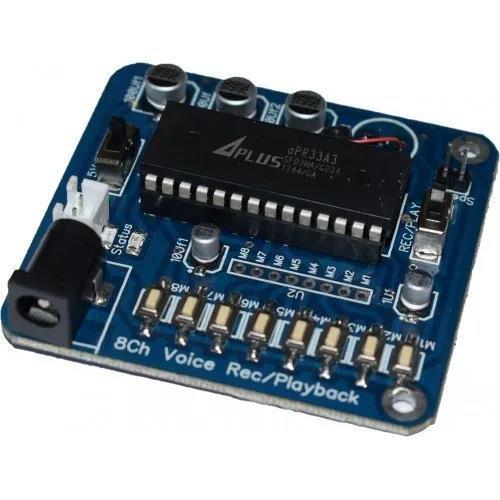
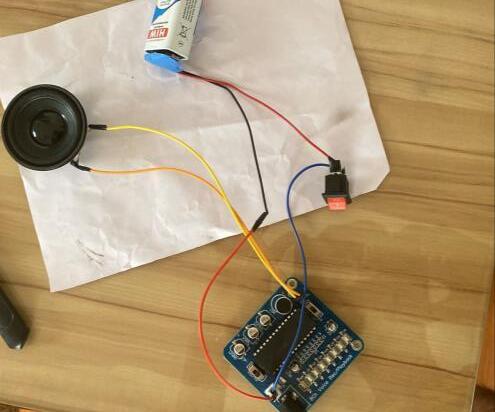
The APR33A3 voice recorder module is a versatile device capable of recording and playing back audio messages. When configured as a distress signal system, this module can be a vital component in emergency situations. The operation of the APR33A3 module begins with the recording of a distress message. The module typicallyoffersseveralrecordingmodes,allowingusersto selectthedesiredaudioqualityandduration.Forinstance, with a recording time of 80 seconds, the module can capture a concise distress message, ensuring clarity and brevityinemergencycommunication.
Once the distress message is recorded, the APR33A3 modulestores itinits non-volatilememory, ensuring that the message remains intact even in the event of a power loss. When activated, the distress signal system triggers the playback function of the APR33A3 module. This activationcanbeinitiatedbyavarietyofmethods,suchas pressing a button, activating a sensor, or sending a commandfromaremotecontrolunit.
Upon activation, the APR33A3 module retrieves the recorded distress message from its memory and begins playback through an attached speaker or audio output device. The module's output capabilities, with a typical outputpowerof500mW,ensurethatthedistressmessage is audible even in noisy or adverse environments. Additionally, the module's built-in amplifier and speaker driver circuitry facilitate direct connection to a speaker, simplifyingthesystem'ssetupandintegration.
International Research Journal of Engineering and Technology (IRJET) e-ISSN: 2395-0056
Volume: 11 Issue: 04 | Apr 2024 www.irjet.net p-ISSN: 2395-0072
In a distress situation, the APR33A3 module serves as a reliable means of broadcasting the distress message to nearby individualsorrescueteams.Theclearandconcise nature of the recorded message, coupled with the module's robust playback capabilities, ensures that the distress signal is effectively communicated,increasing the likelihood of a timely response. With its low power consumption, compact form factor, and straightforward operation, the APR33A3 voice recorder module provides an essential tool for enhancing safety and security in emergency scenarios. Whether deployed in maritime, aviation, outdoor recreation, or industrial settings, the APR33A3 distress signal system offers a versatile and reliable solution for alerting others to critical situations andfacilitatingswiftassistanceandrescueoperations
4. EXPERIMENTATION AND RESULTS
The earlier sticks had a much more basic approach regarding obstacle detection. We give them a more conscious two layered approach. These sticks have
sensors that mostly use a basic single arduino – single sensor approach which may help in obstacle detection in frontofthestick but won't givetheusermuch idea about how further he can go. Whereas in our case we have provided a 3-level alert system just for the front obstacle detection sensor which allows the user to explore the
obstaclesfurthersuchasstairs,etc.whichmakesthestick much more usable in a real-life scenario. These 3 levels beepin3conditionswhichwe ’lllistfurther.Next,wehave also provided a depth sensor which beeps if anything deeper than 5cm, alerting the user if he comes across stairstogodown.Nowtheblindpersonmay requirehelp andmaywanttoalertthepassersbywhichhecandousing thedistress signal systemthatcanplay a loud soundona speaker for up to 80s. This audio can be set according to the user’s choice. Finally, most blind people are scared to venture alone so we have provided a SIM based GPS Modulethatonaclickofabuttoncaneasilysendtheexact coordinates of the stick in the form of an SMS to the registered mobile number which eliminates the issue of needing an internet connection for the stick. Now, while workingontheobstacledetectionsystemwerealisedthat the whole module shouldn’t be bulky for the user so, instead of the bigger mega and uno boards the nano perfectly fits inside our stick design thereby appealing to the looks of the stick as well as mobility. Following is the condition code for 3-level alerting system for frontal
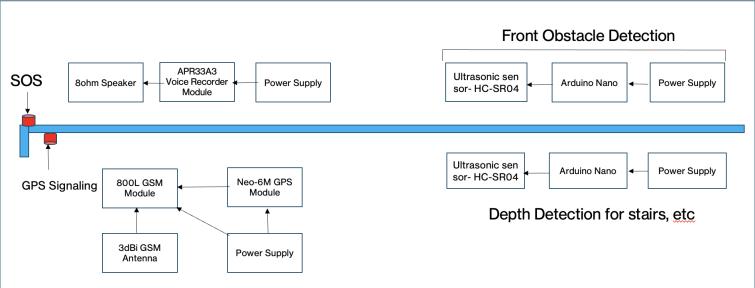
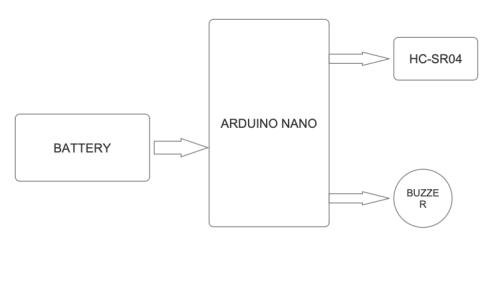
Fig 14- BlockDiagramofSmartStick
Volume: 11 Issue: 04 | Apr 2024 www.irjet.net
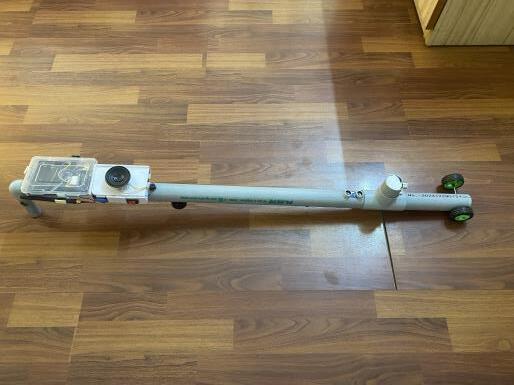
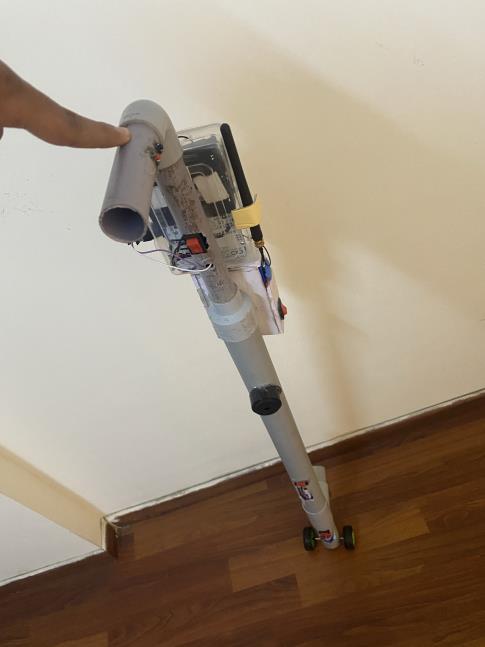
In conclusion, the research paper has demonstrated the efficacy and potential impact of the smart blind stick equipped with advanced features including an ultrasonic sensor HC-SR04-based front and depth obstacle detection system, a GPS location alert system, and a distress signal system. Through comprehensive testing and analysis, it has been established that the device offers significant enhancementsinaidingthemobilityandsafetyofvisually impairedindividuals.
The findings reveal that the smart blind stick effectively alerts theusertofrontal obstacles witha sophisticated 3level system, providing timely and actionable feedback to navigate their environment with greater confidence. Additionally, the depth obstacle detection feature, which notifies the user of objects deeper than 5cm, further enhances situational awareness and minimises the risk of collisionsoraccidents.
Furthermore, the integration of a GPS location alert system enables the user to quickly and accurately relay their location in case of emergencies or navigation assistanceneeds.Withjustaclickofabutton,preciseGPS coordinates are sent to a registered mobile number, facilitating prompt response and assistance from caregiversoremergencyservices.
Moreover, the customisable distress signal system offers an added layer of security and peace of mind for users, allowing them to discreetly signal for help in precarious situations.
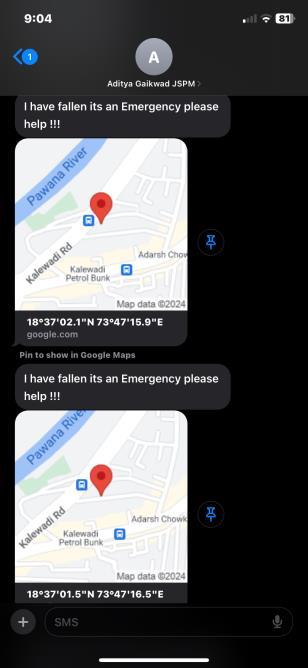
Overall, the research underscores the transformative potential of technological innovations in augmenting the autonomy, safety, and quality of life for visually impaired individuals By harnessing the capabilities of smart sensors and communication technologies, the smart blind stick represents a significant advancement in assistive devices, paving the way for a more inclusive and accessiblesociety.
The authors would like to thank Vayve Technologies Pvt. Ltd. for providing us with the financial aid required for this project. We would also like to thank C V Rane Ma’am from Electronics and Telecommunication department of JSPM’s RSCOE for her significant guidance in publishing these works We would also like to thank our college faculty members and other guides for their considerable inputsregardingthisproject International Research Journal of
International Research Journal of Engineering and Technology (IRJET) e-ISSN: 2395-0056
Volume: 11 Issue: 04 | Apr 2024 www.irjet.net p-ISSN: 2395-0072
1. Tirupal,Talari,B.VenkataMurali,M.Sandeep,K.Sunil Kumar, and C. Uday Kumar. "Smart blind stick using ultrasonic sensor." Journal of Remote Sensing GIS Technology 7,no.2(2021):34-42.
2. Dey, N., Paul, A., Ghosh, P., Mukherjee, C., De, R. and Dey, S., 2018, March. Ultrasonic sensor based smart blind stick.In 2018 international conference on current trends towards converging technologies (ICCTCT) (pp. 1-4).IEEE.
3. Elsonbaty, A.A., 2021. Smart blind stick design and implementation. International Journal of Engineering and Advanced Technology (IJEAT), 10(5),pp.17-20.
4. Gbenga, D.E., Shani, A.I. and Adekunle, A.L., 2017. Smartwalkingstickforvisuallyimpairedpeopleusing ultrasonic sensors and Arduino. International journal of engineering and technology, 9(5),pp.3435-3447.
5. Bele,S.,Ghule,S.,Gunjal,A.andAnwat,N.,2020,April. Design and implementation of smart blind stick. In 2nd International Conference on Communication & Information Processing (ICCIP)
6. Nahar, V.V., Nikam, J.L. and Deore, P.K., 2016. Smart blind walking stick. International Journal of Modern Trends in Engineering and Research, 2349,pp.645-652.



Heramb Parag Velde, currently pursuing diploma in Electronics &Telecommunication Engg. JSPM’s RSCOE Polytechnic, Tathawade,Pune



Atharv Atul Khedkar, currently pursuing diploma in Electronics & Telecommunication Engg. JSPM’s RSCOE Polytechnic, Tathawade,Pune
Aditya Rahul Bhandarkar, currently pursuing diploma in Electronics & Telecommunication Engg. JSPM’s RSCOE Polytechnic, Tathawade,Pune
Aditya Tanaji Gaikwad, currently pursuing diploma in Electronics & Telecommunication Engg. JSPM’s RSCOE Polytechnic, Tathawade,Pune
Litesh Nishikant Kingaonkar, currently pursuing diploma in Electronics & Telecommunication Engg. JSPM’s RSCOE Polytechnic, Tathawade,Pune
Amita N. Dubey, HeadofDepartment,Electronics& TelecommunicationEngg. JSPM’s RSCOE Polytechnic, Tathawade,Pune