
International Research Journal of Engineering and Technology (IRJET) e-ISSN: 2395-0056
Volume: 11 Issue: 04 | Apr 2024 www.irjet.net p-ISSN: 2395-0072
International Research Journal of Engineering and Technology (IRJET) e-ISSN: 2395-0056
Volume: 11 Issue: 04 | Apr 2024 www.irjet.net p-ISSN: 2395-0072
P. BHUVANESWARI1 , K. MELVIN CHRISTOPHER2 , V. RISHI MAHESH RAJ3 , M. AJITHKUMAR4
1234 Dept. of Computer Science and Engineering, Government College of Engineering Srirangam, Tamilnadu, India
Abstract – Digital signatures are widely adopted by organizations, both public and private, in recent times due to theirlegalvalidityandeaseofhandlingandstorage.Theyfind extensive usage in e-commerce websites for customer authentication during deliveries, bank procedures, government organizations, and various other businesses. Governments also utilize digital signatures for contract signing and document verification. However, with advancementsinInformationTechnology(IT),thereareboth advantagesanddisadvantages. Whiledigitalsignaturesoffer convenience, security, and cost savings, they also pose risks, suchaspotentialforgeryormanipulation.Toaddresstherisk of signature forgery, researchers are exploring deep learning algorithms like VGG16. These algorithms analyze signature data to differentiate between genuine and fake signatures by learningpatternsandfeaturesfromadataset.Bytrainingand testing these algorithms on diverse signature samples, researchers aim to develop robust systems for detecting and mitigating signature forgery attempts. In summary, digital signatures play a vital role in modern organizational operations, offering benefits like legal validity, convenience, and enhanced security. However, addressing potential risks, such as forgery, requires ongoing research and technological advancements, including the application of deep learning algorithms like VGG16.
Key Words: Security risks, forgery, manipulation, deep learningalgorithms,VGG16.
The handwritten signature stands as a critical biometric trait used for identity verification across legal, financial, and administrative domains [1], [2]. Manual authenticationprocessescanbebothtime-consumingand pronetoerrors.Recentadvancementsindeeplearningand computervisionhaveopenedupavenuesformoreaccurate and efficient automated signature recognition systems. Thesesystemsholdpotentialapplicationsinsectorssuchas banking,lawenforcement,andgovernmentalorganizations. However,despitetheirpromise,theyencounterchallenges, particularlyinaccuratelydetectingforgedsignaturesdueto variationsinstyles,penpressure,andangles.Totacklethis issue, recent research has turned to Convolutional Neural Networks (CNNs), achieving high levels of accuracy in signature recognition, reaching up to 98.8%, and forgery detection,upto89%[3],[4].ArchitectureslikeGoogLeNet’s Inception-v1andInception-v3,employingCNNmodels,have alsoshownpromise,withvalidationratesof83%and75%,
respectively [5]. This study utilizes CNNs to enhance the accuracy and reliability of the proposed signature recognition system. The primary objective is to develop a deeplearning-basedsystemcapableofnotonlyidentifying genuine signatures but also detecting forgeries, thereby reducingthe needformanual intervention.Thisapproach aims to save time and costs associated with traditional methods.Toaccomplishtheseobjectives,thestudyfocuses onassemblingandpreprocessingacomprehensivedataset ofsignatures[1].Preprocessingstepsincludenoiseremoval to facilitate the implementation of a deep learning architecture for signature recognition. Evaluation metrics suchasaccuracy,precision,recall,andF1scoreareutilized, andthesystem'sperformanceisbenchmarkedagainstother state-of-the-art methods. In summary,this study provides valuable insights into model performance, dataset requirements,andpotential areasfor improvementinthe fieldofsignaturerecognition.Thefindingsunderscorethe significanceoftrainingondiversedatasetsandemphasize thecapabilitiesofdeeplearningapproaches.
A.Inthefieldofhandwrittensignatureidentification, researchersfrequentlyemployedtheResNetarchitecture,as discussedinthestudybyIshikawaetal.(2020).Theyutilized digital signal processing (DSP) for preprocessing tasks. ResNet architecture proved beneficial in overcoming limitationsencounteredwithConvolutionalNeuralNetworks (CNNs), particularly the vanishing gradient problem. This challengewaseffectivelyaddressedbyResNetsignaturedata, highlightingtheimportanceofensuringdataaccuracyand consistencyinsuchapplications.
B.Rateria andAgarwal (2018) introduceda novel approach in their paper on handwritten signature authentication. They combined a traditional Convolutional Neural Network (CNN) with a Siamese neural network to authenticate handwritten signatures. Two configurations wereemployedfordetectinghandwrittensignaturesintheir study. The first configuration acted as a feature extractor, crucial for discerning the authenticity of a signature. The second configuration functioned as a classifier, utilizing a Siameseneuralnetwork.Thisinnovativesetupinvolvedthe use of twin identical networks within the Siamese architecture,representingapioneeringeffortinutilizingdual networks to extract features and distinguish between authenticandforgedsignatures.
International Research Journal of Engineering and Technology (IRJET) e-ISSN: 2395-0056
Volume: 11 Issue: 04 | Apr 2024 www.irjet.net p-ISSN: 2395-0072
C.In2021,GhoshexploredtheutilizationofRecurrentNeural Networks (RNNs) for authentic signature detection, leveraging various deep learning techniques for image classification. The study involved the extraction of local features from handwritten signatures, followed by the generationoffeaturemapsusedintwotypesofRNNmodels: Long Short-Term Memory (LSTM) and Bidirectional Long Short-TermMemory(BiLSTM).Theresearchdemonstrated that RNNs outperformed other state-of-the-art models, typicallybasedonConvolutional NeuralNetworks(CNNs), underscoringtheefficacyofRNNsinthisdomain.
Ourproposedsystemaimstodeveloparobustand efficientsolutionforfakesignaturedetectionusingadvanced techniques. It leverages the strengths of pretrained visual geometry group (VGG) for classify the signature is real or fake.
2.1
FortheSignatureverification,datawasgatheredfrom theKagglewebsite.ThesignsareinEnglishandcontainboth real and fake handwritten signatures. The Model will be trained on 2 classes, with another 2 classes set aside for testing.It’spublicsourcedatasetforhandwrittensignature authenticationstemsfromtheKagglewebsiteandcomplies withallGeneralDataProtectionRegulation(GDPR).
A.
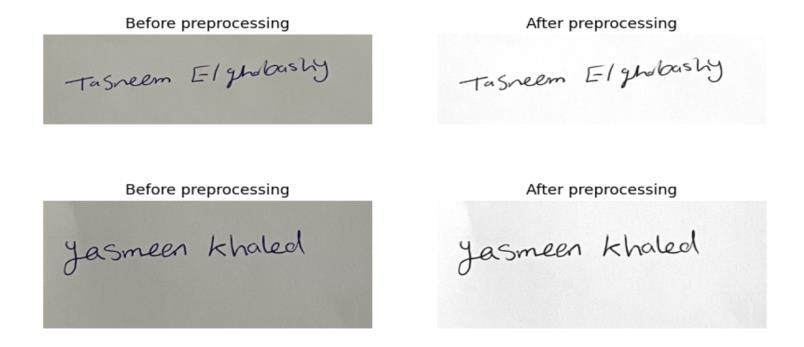
Resizingallimagestoafixedsize(224x224pixels) is crucial in the VGG Net neural architecture to ensure consistencyininputdimensions.Whenimagesareresizedto fit into the model's correct dimensions, there is less distortionanddeformationintheimage. Thispreservation oftheimage'soriginalproportionsensuresthatallfeatures are captured accurately, which is particularly critical for taskssuchashandwrittensignaturedetection.
B. Grayscale conversion:
The next step involves converting the images to grayscale.Thisprocesssimplifiesthe images by removing colorinformation,whichcanaidinreducingcomputational complexity and potentially improve model performance, particularlyincaseswherecolorisnotasignificantfactorfor signatureverification.Theimagepreprocessingforsignature verificationbeginswithorganizingtheforgedandgenuine signaturesdataintotrainingandtestingsets.Thedatasetis randomlydivided,with80%allocatedtothetrainingsetand theremaining20%tothetestingset.
VGG16 is a convolutional neural network configuration used in various profound learning image classification whose architecture is shown in Figure 2. VGG16 is trained with Imagenet dataset which has 1000 classeswith10millionimages.Byapplyingtransferlearning methodtoVGG16pretrainedmodeltoverifytheSignatureof 60 different users is achieved. This model consists of 16 layers with 3x3 size filters which uses sequential model whichmeansthatallthelayersareconnectedinsequence. At the end it has two fully connected layer followed by OutputlayerwithSoftmaxactivationhaving60outputs,each output activation represents one user signature. All the hiddenlayersusedRELUactivationfunction.Whenapplying preprocessedimagesasinputtothemodel,itproduced99% as accuracy whereas produced only 76% for unprocessed inputimages.
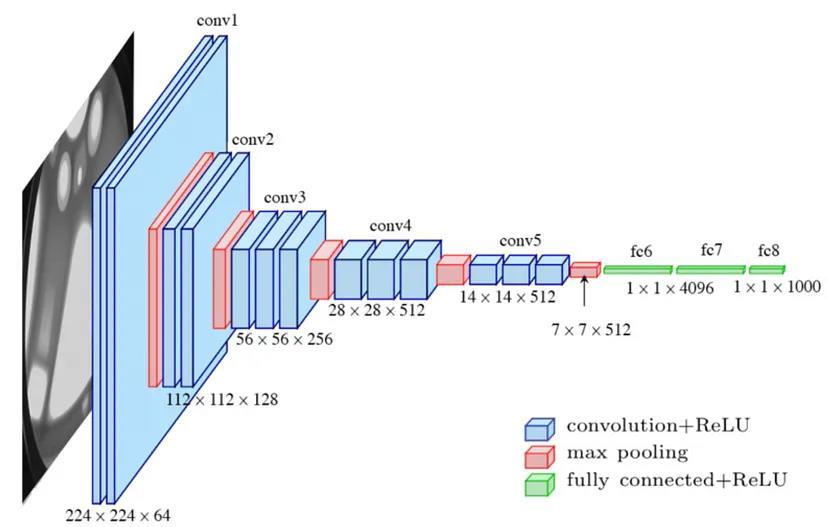
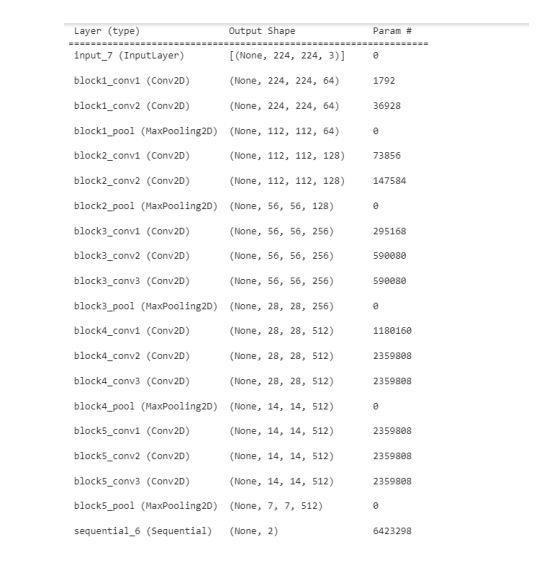
In the VGGNet neural network, the convolutional layer is crucial for extracting features and reducing the dimensionality of handwritten signature images. It uses filters to capture important characteristics from the input images, transforming them into feature vectors. Conv2D layers allow movement in two directions, facilitating this process.Thecasestudyemploys3x3filters,startingwith64 filters in the first layers and progressively increasing.
International Research Journal of Engineering and Technology (IRJET) e-ISSN: 2395-0056
Volume: 11 Issue: 04 | Apr 2024 www.irjet.net p-ISSN: 2395-0072
Element-wise operations with these filters extract key features. The Add function combines layers, and after convolution,theoutputisflattenedforfurtherprocessing. Thenetworkconsistsof13convolutionallayersand3fully connectedlayers.Filtersizesvaryacrosslayers,with64-bit filtersinitially,followedby128-bitand256-bitfilters,and finally512-bitfiltersinsubsequentlayers.Figure3outlines thelayersusedintheVGG16model.
3.2 Activation
TheActivationlayerintroducesnonlinearityintothe output of neural network neurons. In this case study, the RectifiedLinearUnit(ReLu)activationfunctionisutilized. ReLureturnszerofornegativeinputsandtheinputitselffor positive inputs. This function is chosen to linearly modify image data, aiming to enhance linear separability. Additionally, ReLu helps address the vanishing gradient problempresentinotheractivationfunctions.Theequation describingtheReLuactivationfunctionis:
f(x)=max(0,x)wheref(x)representstheoutputoftheReLu functionandxistheinputtothefunction.
3.3 Pooling layers:
Poolinglayersplayavitalroleinreducingthesizeof imageswhilepreservingessentialfeaturesinhandwritten signatureimages.Theyalsoaidinminimizingthelearning parametersofthenetworkandpreventingoverfittingwhile retainingimportantproperties.Unlikeconvolutionallayers, which maintain detailed information such as coordinates, poolinglayersensurethatchangesresultingfromoperations likeresizing,shuffling,orrotationdonotsignificantlyaffect
thefeaturemap.Inthiscasestudy,maximumpoolingwas used,extractingthemaximumvaluefromeachpatchinthe feature map. Specifically, four max-pooling layers were employedintheauthenticationofhandwrittensignatures.
In this case study, the fully connected layer, also known as a dense layer, establishes connections with all preceding levels in the neural network. Its activation functioninvolveskeyparameterssuchasweightsandbiases. BothSoftmaxandReluactivationfunctionsareemployed. Softmax is chosen for its suitability in scenarios with multiple class labels, as seen in this research. The input formatforaDenselayerremainsconsistentat(batchsize, input dimension), while the output format is (batch size, units).Atotalof3fullyconnectedlayersareutilizedinthis casestudy.
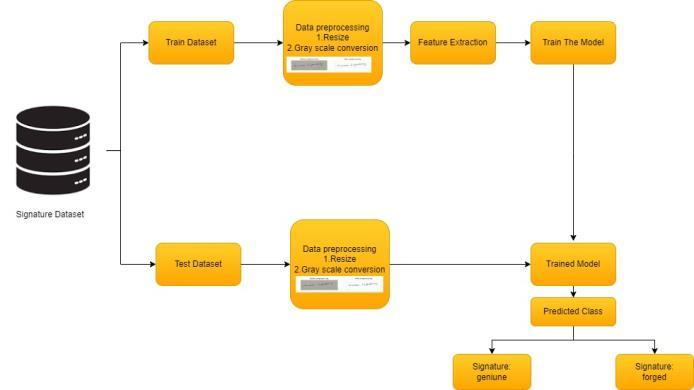
Thedatasetcomprises2689images,ofwhich2050 wereallocatedfortrainingthemodeland604fortestingthe VGGNetmodel.Thus,inpercentageterms,80%oftheimages wereutilizedfortrainingand20%fortesting.Belowarethe hyperparametersemployedforoptimizingthemodel.
In deep neural networks, ADAgrad and RMSProp serveasalternativestostochasticgradientdescent.These optimizationtechniqueseffectivelyaddressnoisepresentin patchesofhandwrittensignatureimages.Backpropagationis employed to facilitate the learning process of the model, adjustingitsweightsusinglearningparameters(alpha).
Callbacksareutilizedeffectivelyinthiscasestudyto enhance the training process of a VGG16 Model. Their implementationservesseveralcrucialpurposes,including smoothingthelearningcurveandacceleratingthetraining process significantly. Additionally, callbacks contribute to preventingoverfittinginthemodel.Thesebenefitshighlight
International Research Journal of Engineering and Technology (IRJET) e-ISSN: 2395-0056
Volume: 11 Issue: 04 | Apr 2024 www.irjet.net p-ISSN: 2395-0072
theimportanceofemployingcallbacksinneuralnetworks. Early stopping is a technique implemented to prevent overfitting by specifying a large number of epochs in the neural network training process and halting the training whenthereisnoimprovementinthemodel'sperformance. Inthisstudy,earlystoppingisbasedonthevalidationloss parameter. If the validation loss fails to improve over consecutive epochs, training of the VGG16 model is terminated.ReduceLROnPlateauisamethodusedtoadjust the learning rate of the VGGNet neural network when the accuracyofthemodelisnotincreasing.
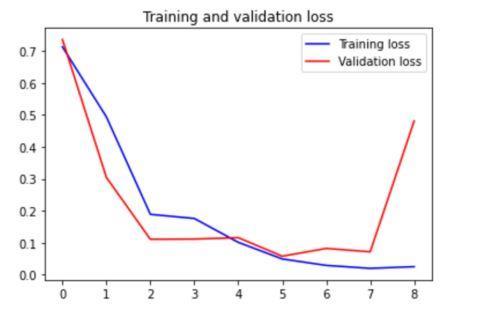
The proposed model significantly enhances the performance of the handwritten signature verification system. It is structured upon the VGG16 architecture and employsapre-trainedbasemodelwiththelastfewlayers made trainable. During training, the model achieves impressive accuracy scores of 99.78% for training and 99.75%forvalidation,withatestaccuracyof98.96%.The model demonstrates a false acceptance rate (FAR) of 0.0, indicatingpreciseidentificationofgenuinesignatures,anda false rejection rate (FRR) of 2.77%, showcasing effective detection of impostor signatures. Its precision stands at 98.9%, while the F1 score attains 0.986, reflecting the model'sstrongoverallperformance
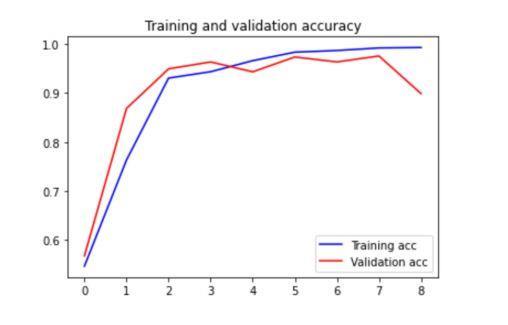
Theoutcomesshowcasethemodel'scapabilityin accurately categorizing and validating handwritten signatures.Itsminimalfalseacceptancerateandacceptable falserejectionratebolsteritsreliabilityandcredibility.The model exhibits considerable potential for real world utilizationscenarioswhereprecisesignatureverificationis paramount.Thissignifiesanotableprogressionandharbors the potential to fortify the dependability and resilience of signatureverificationsystems.Fig.4illustratesthetraining andvalidationaccuracy,whileFig.5showcasesthetraining and validation loss, providing insights into the model’s learningprogress.
5.1 Environment specifications:
The experimental configuration employed in the study. The research work takes place on an AMD Ryzen 7 CPU. Furthermore, the machine has 16GB of RAM and an Nvidia graphics card. The models are constructed using Python and are executed using deep learning frameworks suchasKera’sandTensorFlow.
5.2 Dataset:
For the Signature verification, data was gathered from the Kaggle website. The signs are in English and contain both real and fake handwritten signatures. The Modelwillbetrainedon2classes,withanother2classesset asidefortesting.It’spublicsourcedatasetforhandwritten signatureauthenticationstemsfromtheKagglewebsiteand complies with all General Data Protection Regulation (GDPR).
The conclusion of this study underscores advancementsinhandwrittensignaturerecognition,aiming to develop a deep learning-based system capable of discerning genuine from forged signatures. The project involved the collection and preprocessing of a dataset, implementationoftheVGG16modelwithtransferlearning for signature recognition, and assessment of the system's performancethroughdiversemetrics.Theprimaryfindings underscorethesignificanceoftrainingonlargerandmore diversedatasetstoenhancerobustnessandgeneralization capabilities. The models were developed and trained on a mergeddataset. ComparedtoGuptaYetal.'sVGG16model, thesemodelsexhibitedsuperioraccuracy,achieving98.96% accuracyonthecollecteddatasetFutureendeavorsshould exploretheutilizationoflocalmachinesetups,broadenthe
International Research Journal of Engineering and Technology (IRJET) e-ISSN: 2395-0056
Volume: 11 Issue: 04 | Apr 2024 www.irjet.net p-ISSN: 2395-0072
datasettoencompassawiderarrayofsignaturestyles,and augment the dataset to bolster the model's robustness. Furthermore,thedevelopmentofauser-friendlyinterface forthesystemwouldaugmentitsaccessibilityandusability. Addressingtheseareasofenhancementwouldoptimizethe system'sefficacy,adaptability,anduserengagement,thereby propelling advancements in automated signature recognitiontechnologyacrossvariousapplications.
[1] Bharkav Rajyagor, Rajinish Rakhlia Hand Written character reconition using Deep Learning, International journal of recent technology and engineering (IJRTE) ISSN:2277-3878.
[2] Cherri Ishikawa; Jeff Allen U.Marasigan Cloud-based signature validation using CNN inception-Resnet architecture, IEEE 12th International conference on Humanoid,2020.
[3] F. Noor, A. E. Mohamed, F. A. Ahmed, and S. K. Taha, “Offline handwritten signa ture recognition using convolutional neural network approach,” in 2020InternationalConferenceonComputing,Networking, Telecommunications & Engineering Sciences Applications (CoNTESA),pp.51–57,IEEE,2020.
[4] J. A. Lopes, B. Baptista, N. Lavado, and M. Mendes, “Offline handwritten signature verification using deep neuralnetworks,”Energies,vol.15,no.20,p.7611,2022.
[5]J.Poddar,V.Parikh,andS.K.Bharti,“Offlinesignature recognition and forgery detection using deep learning,” ProcediaComputerScience,vol.170,pp.610–617,2020.
[6] O. Tarek and A. Atia, “Forensic handwritten signature identification using deep learning,” in 2022 IEEE 9th International Conference on Sciences of Electronics, Technologies of Information and Telecommunications (SETIT),pp.185–190,IEEE,2022.
[7] P.William Implementation of Hand Written based Signature Verification Technology using Deep Learning, International conference on intelligent engineering and management,2023 IEEE.
[8]S.Bonde,P.Narwade,andR.Sawant, “Offlinesignature verificationusingconvolutional neural network,”in2020 6th International Conference on Signal Processing and Communication(ICSC),pp.119–127,IEEE,2020.
[9]T.VenkatNarayanaRao,R. Balasubramanian,andK.S. Seshan,Real-TimeHandwrittenSignatureVerificationusing CNN and Siamese Network, International Conference on Computing, Communication, and Intelligent Systems (ICCCIS),IEEE-2019.
[10] Y. Gupta, S. Kulkarni, and P. Jain, “Handwritten signature verification using trans fer learning and data augmentation,”inProceedingsofInternationalConference onIntelligentCyber-PhysicalSystems:ICPS2021,pp.233–245,Springer,2022.