
International Research Journal of Engineering and Technology (IRJET) e-ISSN: 2395-0056
Volume: 11 Issue: 04 | Apr 2024 www.irjet.net p-ISSN: 2395-0072
International Research Journal of Engineering and Technology (IRJET) e-ISSN: 2395-0056
Volume: 11 Issue: 04 | Apr 2024 www.irjet.net p-ISSN: 2395-0072
Asso Prof. Varaprasad KSB1 , Durgasai Jeeru2 , B.Devi3,V.Shanmukhi⁴,B.Vasanth⁵, B.Govardhan ⁶
1Head of Deparment,Dept. of EEE, Visakha Institute of Engineering and Technology, Andhra Pradesh,India
2Student, Dept. of EEE, Visakha Institute of Engineering & Technology, A.P, India
3Student, Dept. of EEE, Visakha Institute of Engineering & Technology, A.P, India
4Student, Dept. of EEE, Visakha Institute of Engineering & Technology, A.P, India
5Student, Dept. of EEE, Visakha Institute of Engineering & Technology, A.P, India
6Student, Dept. of EEE, Visakha Institute of Engineering & Technology, A.P, India
Abstract - The Renewable energy sources (RESs) more utilized because of its abundant availability everywhere. The Wind Energy is gaining interest because of technology enhancement and significant power cost reduction. In order to enhance the efficiency of a wind energy conversion system (WECS), the maximum power point tracking (MPPT) algorithm is usually employed. This paper presents to extract the maximum available power under a sudden wind speed change condition, which is applied in a permanent magnet synchronous generator (PMSG)-based WECS and in order to eliminate the dependence on the characteristic curve of wind turbine, a conventional perturbation and observation (P&O) method has been proposed. This method perturbs a control variable in a certain step size, and then observes the changes of output power until the MPP can be obtained. Since the P&O method does not require the wind speed sensor as well as the prior information on wind turbine, it is known to be a reliable and flexible method. Beside theoretical analyses, the simulation results are provided to prove the effectiveness of the proposedMPPTalgorithm.
Key Words: Maximum Power Point Tracking (MPPT), Permanent Magnet Synchronous Generator (PMSG), Torque Observer, Wind Energy Conversion System (WECS), Hill Climb Search (HCS) , Perturbation and Observation (P&O).
1.INTRODUCTION
Inrecentyears,renewableenergyresourcesareattracting greatattentionduetothescarcityoffossilenergyandthe requirement of restricting carbon dioxide emission in worldwide. Among renewable energy resources, wind energy is considered as one of the most potential and promisingresources.Ina windenergyconversionsystem (WECS),thekineticenergyofwindistransformedintothe mechanical energy via a wind turbine, and then, this energy is converted into the electrical energy by using a generator.
Even abundance of wind power ,the output power is unstable in wind turbine due to the variation of wind speed. To overcome this challenge, the maximum power point tracking (MPPT) algorithm is mainly employed to enhance the efficiency of WECS. By this algorithm to maintain the output power of wind turbine at the maximum power point (MPP) irrespective of the wind speedvariation.
Until now, various MPPT algorithms have been proposed forthepurposeoftrackingtheMPPinaWECS.Toachieve the maximum power of wind turbine at a given wind speed, according to characteristic curve the torque of a permanent magnet synchronous generator (PMSG) is controlled. The main drawback is the difficulty in determining the optimal power-speed curve of wind turbine which significantly varies by each wind turbine. Moreover, the optimal curve would be varied as the operatingenvironmentischanged.
A perturbation and observation (P&O) method has been proposed due to independent of wind turbine design and information. This method perturbs a control variable in a certainstepsize,andthenobservesthechangesofoutput power until the MPP can be obtained. Since the P&O methoddoesnotrequirethewindspeedsensoraswellas thepriorinformationonwindturbine,it isknowntobea reliableandflexiblemethod.However,themainlimitation of this algorithm is its poor MPP tracking performance undertherapidvariationofwindspeed.
This paper proposes an MPPT algorithm for a WECS only to eliminate the need of wind speed sensor and wind turbine parameters The proposed algorithm uses the instantaneous powerof windturbineandtherotorspeed of generator as inputs to produce an optimal rotor speed as the output, which enables to obtain the MPP of wind turbine at a given wind speed. The output power of wind turbine can be generally obtained by measuring the mechanicaltorqueandangularspeedofshaft.
International Research Journal of Engineering and Technology (IRJET) e-ISSN: 2395-0056
Volume: 11 Issue: 04 | Apr 2024 www.irjet.net p-ISSN: 2395-0072
Awindturbineturnswindenergyintoelectricityusingthe aerodynamicforcefromthe rotorblades,whichwork like an airplane wing or helicopter rotor blade. When wind flowsacross theblade,theairpressureon oneside ofthe blade decreases. The difference in air pressure across the twosidesofthebladecreatesbothliftanddrag.Theforce of the lift is stronger than the drag and this causes the rotor to spin. The rotor connects to the generator, either directly (if it’s a direct drive turbine) or through a shaft andaseriesofgears(agearbox)thatspeeduptherotation and allow for a physically smaller generator. This translationofaerodynamicforcetorotationofagenerator createselectricity.
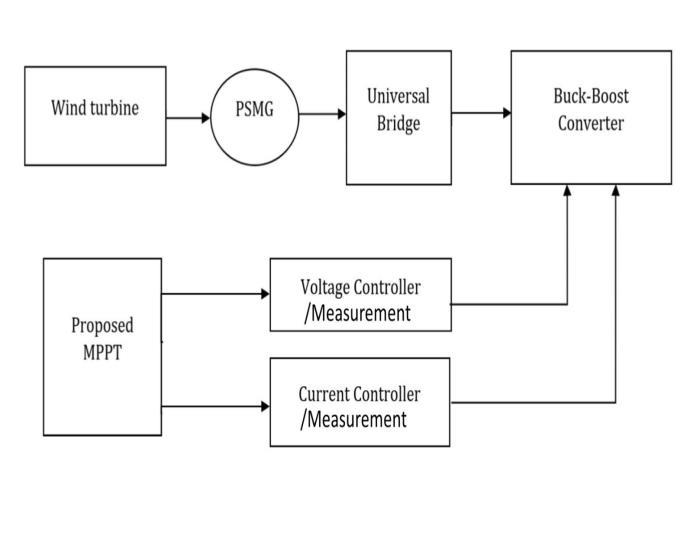
Fig-1: BlockDiagramofWindEnergyConversionSystem usingMPPTAlgorithm.
Themechanicalpowergeneratedbyawindturbinecanbe expressedas

where ���� is the mechanical power of the wind turbine, �� is the air density, �� is the radius of the blades, ���� is the power coefficient, �� is the blade pitch angle, and �� is the windspeed.Thetipspeedratio��isdefinedbytherelation betweenthewindspeedandtherotorspeedofturbine���� as
1 1 0.035
A permanent magnet synchronous generator (PMSG) isa type of electrical generator that uses permanent magnets instead of traditional field windings in the rotor.PMSGs are used in wind energy conversion because they have several advantages over traditional electric generators, including with high efficiency because there are no losses associatedwithrotorexcitation andlowMaintenancedue to the absence of slip rings and brushes ensures low maintenance and high reliability. SoFlexible active and reactive power control and PowerHigher power factor. ThisPMSGhasnogearboxsystem.
Thedynamicequationofageneratorisgivenas

where���������� isthemechanicaltorqueofgenerator, ���������� is the electromagnetic torque of generator, �� is the generatorrotorspeed,��istheinertia,and��istheviscous frictioncoefficient.Assumingthatthereisnogearbox,the mechanical torque of wind turbine ���� will be directly transmittedtogenerator.Hence,itcanberewrittenas

Generally, the information on ���� would be obtained by using a torque sensor. However, this approach is not desirablebecauseitsignificantlyincreasesthetotalcostof a WECS. A disturbance observer is introduced as an alternative solution to estimate the mechanical torque of windturbine.
Thepowercoefficientisdescribedbyanonlinearfunction ofboththetipspeedratioandthebladepitchangleas

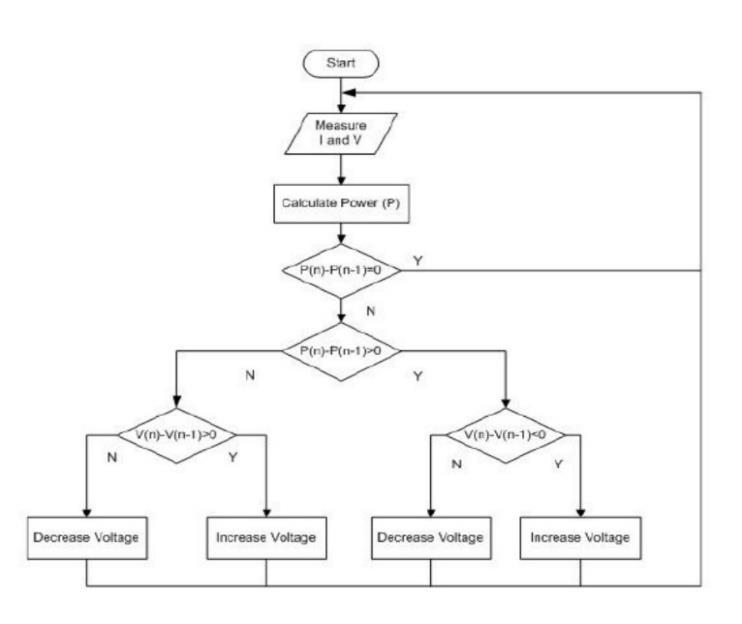
TheHillClimbSearch(HCS)isalsocalledperturbationand observation (P&O) since it observes the perturbation in powerandaccordingtothatitprovidesthecorrectionsin the particular parameter like duty cycle of the DC–DC converter to control the dc voltage or to regulate current inordertoadjusttherotorspeedandtracktheMPP.This method is based on perturbing control variable in arbitrarysmallsteps,andthenextperturbationisdecided onobservingthechangesinpowercurveduetopreceding perturbation. P&O approach is a widely used MPPT algorithm because of its simplicity and absence of mechanical speed sensor or anemometer for implementation.
International Research Journal of Engineering and Technology (IRJET) e-ISSN: 2395-0056
Volume: 11 Issue: 04 | Apr 2024 www.irjet.net p-ISSN: 2395-0072
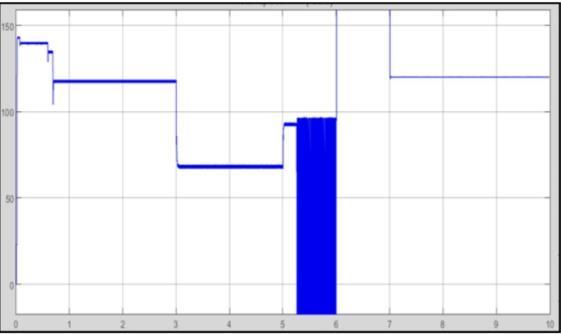
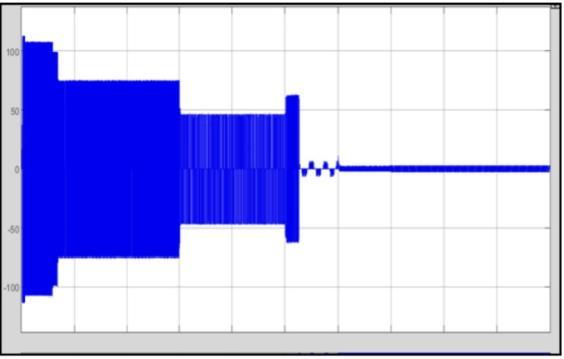
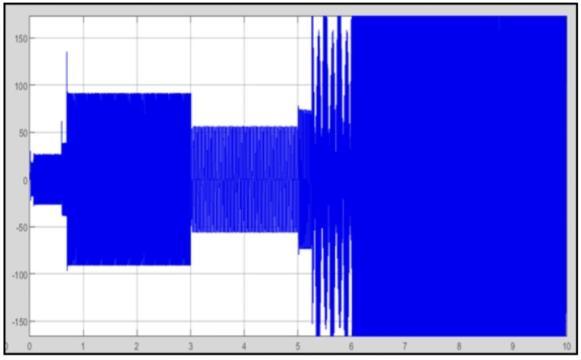
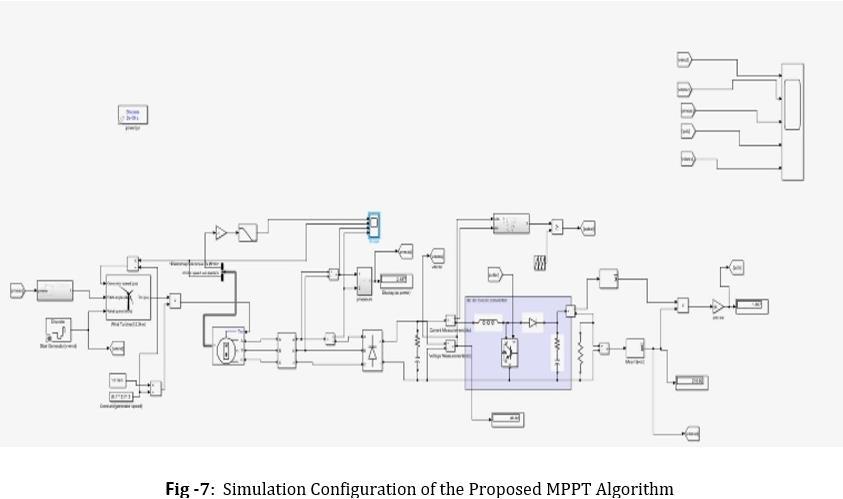
To validate the effectiveness of the proposed MPPT algorithm,thesimulationshavebeencarriedoutusingthe SIMULINK software. The simulation configuration of the proposed algorithm which consists of a wind turbine model,aPMSG,andaBuck-Boostconverterisconstructed as depicted in Fig.3. The PSMG Model, wind turbine model, and the proposed MPPT algorithm are implementedbyusingtheMATLABblocks.
International Research Journal of Engineering and Technology (IRJET) e-ISSN: 2395-0056
Volume: 11 Issue: 04 | Apr 2024 www.irjet.net p-ISSN: 2395-0072
Enhancingtheefficiencyof a PMSGwindturbinethrough Maximum Power Point Tracking (MPPT) holds significant promise for improving renewable energy generation. By continuously optimizing the turbine's operating point to extract maximum power from varying wind conditions, MPPT enables higher energy yields and better overall performance. This technology not only maximizes energy output but also enhances the economic viability and sustainability of wind power systems. As we continue to advance MPPT algorithms and integrate them seamlessly into wind turbine control systems, we can expect even greater efficiency gains and broader adoption of wind energyasacleanandreliablepowersource.
[1] Thanh Van Nguyen and Kyeong-Hwa Kim, “Maximum Power Point TrackingMethodforPSMGBased Wind Energy Conversion Systems using Torque Observer, 232 Gongneung-ro, Nowon-gu, Seoul,01811,Korea,2018.
[2] H.G.Jeong,R.H.Seung,andK.B.Lee,“Animproved maximum power point tracking method for wind power systems,” Energies, vol. 5, no. 5, pp. 13991354,May.2012.
[3] J. F. Manwell, J. G. McGowan, and A. L. Rogers, Wind Energy Explained: Theory, Design and Application, 2nded.,NewYork,Wiley,2002.
[4] C.Wei,Z.Zhang, W.Qiao, andL.Qu,“Reinforcement learning-based intelligent maximum power point tracking control for wind energy conversion systems,” IEEE Trans. Ind. Electron., vol. 62, no. 10, pp.63606370,Oct.2015.
[5] A. Kadri, H. Marzougui, and F. Bacha, “MPPT control methods in wind energy conversion system using DFIG,”4thInter.Conf.onContr.Engin.&Infor.Tech. (CEIT),pp.1-6,Dec.2016.