
International Research Journal of Engineering and Technology (IRJET) e-ISSN: 2395-0056
Volume: 11 Issue: 04 | Apr 2024 www.irjet.net p-ISSN: 2395-0072

International Research Journal of Engineering and Technology (IRJET) e-ISSN: 2395-0056
Volume: 11 Issue: 04 | Apr 2024 www.irjet.net p-ISSN: 2395-0072
Padmini Mishra1 , Amolina Mohanty2, Snehanjali Dash2, Jyotirmayee Sahu2, Jyotirmayee
Panigrahi2
1Assistant Professor, ECE department, GIETU, Gunupur, Odisha, India 2UG Scholar, ECE department, GIETU, Gunupur, Odisha, India
Abstract - The Smart Blind Stick, an assistive device powered by the Arduino Nano microcontroller, represents a ground breaking advancement in aiding individuals with visual impairments. This innovative technology-driven solutionis designedtoenhancethemobilityandsafetyofthose navigating a world predominantly designed for the sighted. Visual impairment can present significant challenges to daily life. The Smart Blind Stick is engineered to empower individuals with visual impairments, facilitating greater independence and enhanced safety. At the heart of this device istheArduinoNano, offering acompact yetversatileplatform for processing sensor data. This document provides an indepth exploration of the Smart Blind Stick, focusing on its design, sensor integration, and operational principles. It underscores how Arduino Nano technology drives this innovativesolution, withthe potentialtosignificantlyimprove the quality of life for those with visual impairments, enabling safe,independent navigation inaworldpredominantlyvisual.
Key Words: ArduinoNano,sensor,audiosignals,voltage regulator(7805)
1.INTRODUCTION
The"SmartBlindStick"attemptstomakevisuallyimpaired people'slifebetterbyincreasingtheirsafetyandmobility. This assistive device, built around the versatile Arduino Nanoplatform,combinessensortechnologywithreal-time feedbacktoprovideacomprehensivesolutionforthosewith visual impairments. This project integrates cutting-edge sensors,microcontrollers,and communicationmodulesto create a device that not only detects obstacles but also provides real-time feedback to the user. The smart blind stickutilizesultrasonicsensors[1][2]todetectobjectsinthe user'spathandemployshapticfeedbackorauditorysignals toconveyinformationaboutthesurroundings. ArduinoNano as the Core: AttheheartofthisdeviceistheArduinoNano microcontroller[3],knownforitscompactsizeandpowerful capabilities.Itinterfacesseamlesslywitharangeofsensors todetectobstacles,irregularitiesintheterrain,oreventhe proximity to other objects or individuals. Real - time Feedback: The device offers real-time feedback through a combination of audible alerts and haptic feedback. Vibrationsandsoundsignalsguidetheuser,alertingthemto
obstacles or hazards in their path. This feedback system ensuresenhancedawarenessandsafety. EnhancedMobility: By providing a "virtual vision" of the surroundings, the SmartBlind Stick empowersuserstoconfidentlynavigate unfamiliar terrain, avoid obstacles, and maintain their freedom of movement. The simulation analysis plays a crucial role in refining the design and optimizing the performanceofthesmartblindstick.Throughsimulations, wecanassessvariousscenarios,environmentalconditions, and potential challenges faced by visually impaired users. Thisiterativeprocessallowsustofine-tunethetechnology for maximum reliability and usability. By combining hardware innovation with simulation-driven refinement, this project seeks to improve the quality of life for individualswithvisualimpairments,empoweringthem to navigatetheirsurroundingswithincreasedconfidenceand safety.
TheliteraturesurroundingtheSmartBlindStick,equipped with the Arduino Nano microcontroller, demonstrates the profound impact of assistive technology on the lives of individualswithvisualimpairments.Thisliteraturereview synthesizes existing research, highlighting key advancementsinthefieldandunderscoringthecriticalrole ofthisdeviceinenhancingmobilityandsafety.Innovative SensorIntegration[4]:Studieshaveconsistentlyunderlined thesignificanceofintegratingadvancedsensors,including ultrasonic and infrared sensors, in the Smart Blind Stick. These sensors enable real-time obstacle detection and environmentalperception,providingaheightenedsenseof awarenesstousers[5].ArduinoNanoEmpowerment:The utilizationofArduinoNanoasthecoremicrocontrollerhas proven instrumental in providing a compact yet robust platformforprocessingsensordataandenablingreal-time feedback mechanisms [6]. Environmental Adaptability: Researchers have emphasized the device's adaptability to changingenvironmentalconditions,includingvariationsin lighting,terrain,andweather.Thisadaptabilityensuresthe SmartBlindStick'sreliabilityacrossdiversescenarios[7]. User-Centric Design: A user-centric approach has been a recurring theme, ensuring that the device's design and feedbackmechanismscatertouserpreferencesandusability [8].Itismadeupofafoldablestickwithtwoinfraredlight
International Research Journal of Engineering and Technology (IRJET) e-ISSN: 2395-0056
Volume: 11 Issue: 04 | Apr 2024 www.irjet.net p-ISSN: 2395-0072
detectorsattachedtoit.Itisconnectedtoanearpiecesothat the blind can be warned of detected obstacles through speech alerts, Infrared Sensor types [9]. Alternatively, gadgets that use ultrasonic sensors like K sonar might protecthimfromchallengesratherthanguidinghim[10]. Theseinnovationsgivetheblindtheassistancetheyneedto movearoundinunfamiliarenvironments,whichincreases their confidence and ensures their safety. Various visual toolshavebeendeveloped.[11],[12].
Themotivationbehindcreatinga"BlindStickusingArduino Nano" is to provide assistance and enhance the independence of visually impaired individuals. This innovative project aims to use technology to help blind individuals navigate their surroundings more safely and confidentlybydetectingobstaclesorobjectsintheirpath.By utilizinganArduinoNano,sensors,andothercomponents, this project can offer real-time feedback and alerts to the user,therebyimprovingtheirmobilityandreducingtherisk of accidents. It's a practical application of technology to addressaspecificneedinthevisuallyimpairedcommunity.
We have used Proteus 8.13 for our circuit simulation, and havecompletedthiscircuitbyusingArduinoNano,Ultrasonic Sensor,LDR,ModuloRx,ModuloTx[13].Forgeneratinghex codeforArduinoNano,ArduinoIDEsoftware[14]isused.It hasaremotecontrollerwhichhasapushbuttonfortaking inputandthebatteryandModuloTxisused.
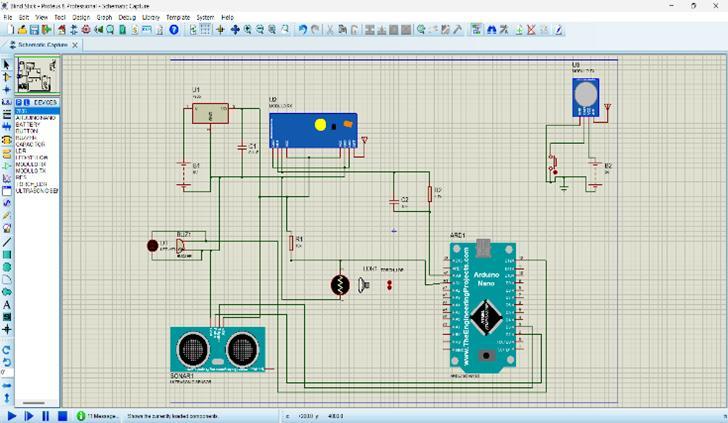
Here,7805voltageregulatorisused,thatprovides+5volts powersupply.ThisArduinoNanohas8analogpinsandhas6 PWMpinsamongthedigitalpins.Itcomeswith16MHzclock speedviaacrystaloscillator,itsoperatingvoltagevariesfrom 5vto12v.Abatteryof7to12voltsisusedandabuzzeris usedtoprovideauditoryalertsandfeedback.Additionally, resistor,capacitor,LDR[15]andultrasonicsensor(HC-SR04)
is also applied for circuit stability and operation. This UltrasonicSensorconsistsofareceiverandtransmitter.The sensorhelpinmeasuringabouthowfarthingsarebywithout touching them, and it uses sound waves to get the right measurements.Itworksverywellwhenthingsare2to4cm away.

SIMULATION PARAMETER
SL NO. COMPONENTS TYPE RANGE
1. Voltageregulator 7805 1no.
2. Arduinonano 1no.
3. Battery 9V 2nos.
4. Buzzer 1nos.
5. Capacitor Capacitor (2nos.) 0.1uF(1no.) 1nF(1no.)
6. LDR 24.0 1no.
7. LED-yellow 1no.
8. Resistor (2nos.) 4.7k(1no.) 10k(1no.)
9. Ultrasonicsensor HC-SR04 1no.
2.2.
The result analysis of the "Smart Blind Stick" circuit involvesassessingitsperformanceandfunctionality.Itcan detect obstacle by determining the blind stick’s ultrasonic sensors and can analyse the obstacle over a range of distances. It can evaluate between sensors range and sensitivity to identify a variety of obstructions, at various angles.FromFig3,thesensorisobserved,whennoobstacles arefoundnearby(whichmeanstheBuzzerdoesn’tgiveany audiosignalsandforthisproteuscircuit,theLEDisofforsay doesn’tglow).Now,inFig4.,theProteuscircuitshowsthe sensor when any obstacle is found (Buzzer gives auditory signalsandforthisproteuscircuit,theLEDbulbglows).
International Research Journal of Engineering and Technology (IRJET) e-ISSN: 2395-0056
Volume: 11 Issue: 04 | Apr 2024 www.irjet.net p-ISSN: 2395-0072


Fig 4: Sensorwhenanyobstacleisfound
3.
The Smart Blind Stick with Arduino Nano serves as an exampleofhowtechnologyhasthepotentialtosignificantly improvethelivesofpeoplewhohavevisualimpairments.It represents inclusivity and advancement by providing improvedmobility,independence,andsafety.Wearemaking iteasierforamoreinclusive,accessible,andequitablefuture for all of us, as we continue to innovate and improve this assistivetechnology.Ademonstrationofhowtechnological advancement can improve the lives of people with visual impairmentsistheSmartBlindStick,whichispoweredby theArduinoNanomicrocontroller.Withreal-timefeedback, obstacle detection, and environmental adaptability, this assistive device has become an influential partner in the attemptforincreasedmobilityandsafety.Theconclusions highlightitstransformationalroleanditsongoingpromise tohelptheblind.
[1] Arun Francis, G. Arulselvan, M., Elang kumaran, P., Keerthi Varman, S., & Vijaya Kumar, J. (2020). Object detection using ultrasonic sensor. Int. J. Innov. Technol. Explor.Eng,8,207-209.
[2] Latha, N. A., Murthy, B. R., & Kumar, K. B. (2016). Distance sensing with ultrasonic sensor and Arduino. International Journal of Advance Research, Ideas and InnovationsinTechnology,2(5),1-5.
[3]Ismailov,A.S.,&Jo’Rayev,Z.B.(2022).StudyofArduino microcontrollerboard.ScienceandEducation,3(3),172-179.
[4] Mitiche, A., & Aggarwal, J. K. (1986). Multiple sensor integration/fusion through image processing: a review. Opticalengineering,25(3),380-386.
[5] Ghosh, S., Das, P., & Bhattacharya, S. (2019). "A Novel Smart Blind Stick for Visually Impaired People." In Proceedings of the 4th International Conference on Electrical, Computer and Communication Technologies (ICECCT),Coimbatore,India.
[6] Hossain,M.,Paul,S.,Mahmud,M.H.,&Hasan,M.(2021). "DevelopmentofaSmartBlindStickwithObjectDetection Capability."InProceedingsoftheInternationalConference on Electrical and Electronics Engineering (ICEEE), Dhaka, Bangladesh.
[7] Behera,R.,&Pradhan, M.(2019)."Developmentof an Obstacle Detection System for Visually Impaired." In Proceedingsofthe3rdInternationalConferenceonRecent AdvancesinInformationTechnology(RAIT),Dhanbad,India.
[8] Islam, S. M. T., & Banik, M. (2019). "Design and Development of a Low-Cost Smart Walking Stick for the Blind." In Proceedings of the International Conference on Robotics, Electrical and Signal Processing Techniques (ICREST),Dhaka,Bangladesh.
[9] Pandey, M., & Mishra, G. (2019). Types of Sensor and their applications, advantages, and disadvantages. In Emerging Technologies in Data Mining and Information Security: Proceedings of IEMIS 2018, Volume 3 (pp. 791804).SpringerSingapore.
[10]Kim,S.Y.,&Cho,K.“Usabilityanddesignguidelinesof smart canes for users with visual impairments,” InternationalJournalofDesign7.1,2013.
[11]Bangali,J.,&Shaligram,A.“DesignandImplementation of Security Systems for Smart Home based on GSM technology,” International Journal of Smart Home, 7(6), 2014.
[12]Kumar,A.,Patra,R.,Manjunatha,M.,Mukhopadhyay,J., &Majumdar,A.K.“Anelectronictravelaidfornavigationof visuallyimpairedpersons,”InCommunicationSystemsand Networks (COMSNETS), 2011 Third International ConferenceonIEEE,2011.
International Research Journal of Engineering and Technology (IRJET) e-ISSN: 2395-0056
Volume: 11 Issue: 04 | Apr 2024 www.irjet.net p-ISSN: 2395-0072
[13]Kim,S.,&Chun,J.(2008,March).Networkcodingwith linear MIMO pre-equalizer using modulo in two-way channel. In 2008 IEEE Wireless Communications and NetworkingConference(pp.517-521).IEEE.
[14]Halim,D.K.,Ming,T.C.,Song,N.M.&Hartono,D.(2019, October).Arduino-basedIDEforembeddedmulti-processor system-on-chip.In 20195thInternationalConferenceonNew Media Studies (CONMEDIA) (pp.135-138).IEEE.
[15]Kumar,V.S.S.,&Suryanarayana,S.(2014).Automatic dual Axis sun tracking system using LDR sensor. International Journal of Current Engineering and Technology, 4(5),3214-3217.