
International Research Journal of Engineering and Technology (IRJET) e-ISSN: 2395-0056
Volume: 11 Issue: 04 | Apr 2024 www.irjet.net p-ISSN: 2395-0072
International Research Journal of Engineering and Technology (IRJET) e-ISSN: 2395-0056
Volume: 11 Issue: 04 | Apr 2024 www.irjet.net p-ISSN: 2395-0072
K. Nagaprakash1, P. Vandana2,M. Saikrishna3 , P. Hari Manikanta4, N. Gowtham Naidu5
1Professor, Department of ECE, Seshadri Rao Gudlavalleru Engineering College, Gudlavalleru 2,3,4,5Student, Department of ECE, Seshadri Rao Gudlavalleru Engineering College, Gudlavalleru
Abstract - Parkinson's disease (PD) diagnosis and prognosisarepivotalforeffectivepatientmanagement.In thisstudy,weexploretheutilityofageneticalgorithm(GA) for feature selection to enhance machine learning models applied to PD datasets. Our methodology encompasses datasetpreprocessingtohandlemissingvaluesandensure dataintegrity.Subsequently,aGA-drivenfeatureselection process is employed to identify salient features for classification tasks. Utilizing various classifiers, including Decision Trees (DT), Random Forest (RF), Logistic Regression(LR),AdaBoost,KNearestNeighbors(KNN),and Support Vector Machines (SVM), we evaluate model performance with and without feature selection. Performance metrics such as accuracy are employed for rigorous evaluation. Our results demonstrate that models trainedwithfeatureselectionconsistentlyoutperformthose without. Notably, Decision Tree and Gradient Boosting classifiers achieve peak accuracies of 97% with feature selection, while maintaining accuracies of 92% without. Logistic Regression and Linear SVM exhibit slightly lower accuracies of 89% and 87%, respectively, without feature selection. These findings underscore the significance of feature selection in optimizing model accuracy for PD diagnosis and prognosis. In summary, our investigation underscores the effectiveness of genetic algorithm-based featureselectioninenhancingmachinelearningmodelsfor the analysis of medical data, with particular emphasis on researchrelatedtoParkinson'sdisease(PD).
Key Words: PD,Machinelearning(ML),SVM,LR,DT,Gradient boosting,KNN.
Parkinsonian syndrome manifests as a degenerative neurological condition, progressively impairing motor functions like tremors, bradykinesia, and muscle rigidity. Additionally,itpresentsaspectrumofnon-motorsymptoms that impact cognitive abilities, mood regulation, and autonomic processes. As the second most prevalent neurodegenerativedisorderworldwide,PDposessignificant challengestohealthcaresystemsandnecessitatesaccurate diagnosisandprognosisforoptimalpatientcare.
In recent years, the utilization of machine learning (ML) methods has surged within medical research, presenting robust capabilities to bolster diagnostic precision and prognostic forecasting in various healthcare domains. By leveraging large-scale datasets containing diverse patient information,MLmodelscanextractmeaningfulpatternsand associationstoaidindiseaseclassificationandprediction.
Inthispaper,wepresentastudyaimedatimprovingPD diagnosis and prognosis through the application of ML techniques,specificallyfocusingontheutilizationofagenetic algorithm (GA) for feature selection. Effective feature selectionispivotalinthedevelopmentofmachinelearning models, as it discerns the most relevant features from a dataset, thereby trimming down dimensionality and computationalintricacies.Byselectingrelevantfeatures,ML modelscanachievebettergeneralizationandperformanceon unseen data, thereby enhancing their utility in clinical settings.
Ourstudyencompassesseveralkeycomponents.Firstly, we preprocess a dataset comprising various clinical and demographicfeaturesrelatedtoPDpatients,ensuringdata qualityandconsistency.Subsequently,weemployafeature selection method powered by genetic algorithms (GA) to pinpointthemostdiscriminativefeaturesforclassification tasks. Following this, we proceed to train and assess an assortmentofmachinelearningclassifiers,includingDT,RF, LR,AdaBoost,KNN,andSVMleveragingboththeidentified featuresandtheentirefeatureset.
Through rigorous evaluation and comparison, we demonstratetheeffectivenessofGA-drivenfeatureselection inoptimizingMLmodelsforPDdiagnosisandprognosis.Our findingsunderlinehowchoosingtherightfeaturescanmake ourcomputermodelsbetteratpredictingandunderstanding Parkinson'sdisease.Thishelpsdoctorsandresearchersuse computerprogramsmoreeffectivelyinstudyingthedisease andcaringforpatientswithParkinson's.
In conclusion, our study adds to the expanding field of researchdedicatedtoutilizingmachinelearningmethodsto improve medical diagnosis and personalized healthcare, especiallyinmanagingParkinson'sdisease.
International Research Journal of Engineering and Technology (IRJET) e-ISSN: 2395-0056
Volume: 11 Issue: 04 | Apr 2024 www.irjet.net p-ISSN: 2395-0072
ResearchbyTsanasetal.(2012)utilizedmachinelearning algorithmssuchasSVM,DT,andRFtoclassifyParkinson's diseasepatientsbasedongaitdataobtainedfromwearable sensors. They achieved high accuracy in discriminating betweenhealthycontrolsandParkinson'sdiseasepatients, demonstratingthepotentialofmachinelearningmodelsin diagnosis[1].
Genetic algorithms have been widely used for feature selectioninParkinson'sdiseasediagnosis.AstudybyArun andYasin(2017)employedageneticalgorithmtoselectthe most relevant features from Parkinson's disease datasets, improving classification accuracy and reducing computationalcomplexity[2].
Various studies have compared the performance of different classification algorithms in Parkinson's disease diagnosis. For instance, a study by Liu et al. (2016) comparedSVM,DT,KNN,andLRinclassifyingParkinson's diseasebasedonvoicefeatures.Theirfindingshighlighted thesuperiorperformanceofSVMinaccuratelydiagnosing Parkinson'sdisease[3].
Ensemblelearningtechniques,suchasRandomForestand AdaBoost,havealsobeenexploredforParkinson'sdisease diagnosis. Research by Tsipouras et al. (2010) employed ensemble classifiers to discriminate between healthy individuals and Parkinson's disease patients using voice recordings.Theirresultsdemonstratedtheeffectivenessof ensemblemethodsinimprovingclassificationaccuracy[4]. GradientBoostingalgorithmshaveshownpromisingresults in various medical applications, including Parkinson's disease diagnosis. A study by LeWitt et al. (2018) utilized Gradient Boosting classifiers to analyze patient data from wearabledevicesandaccuratelyidentifyParkinson'sdisease symptoms. Their research highlighted the robustness and accuracyofGradientBoostingindiseasediagnosistasks[5].
The proposed methodology for this study involves a structured approach to harness machine learning techniquesforimprovingParkinson’sdisease(PD)diagnosis and prognosis. Initially, the PD dataset is loaded and preprocessedtoensuredataquality,includingtheremoval ofirrevalentcolumnsandexplorationoffeaturecorrelations through visualizations. Subsequently, Different machine learningalgorithms,suchasDT,RF,LR,Adaboost,KNNand SVMarechoosentoassesstheireffectivenessinthestudy.In the below Fig-1 is the block diagram of proposed methodology.
Parkinson’s
Diseasedataset
Preprocessing
FeatureSelection (GeneticAlgorithm)
MachineLearning
Classifiers
ModelEvaluation andAnalysis
Classifiers
The dataset comprises a range of biological voice metrics collectedfromacohortof31individuals,ofwhich23have beendiagnosedwithParkinson’sdisease(PD).Eachentryin the dataset represents a distinct voice recording uniquely identifiedbyaspecificname.Whilevariousvocalattributes arerepresentedbydifferentcolumns.Theprimaryobjective ofthisdatasetistodistinguishbetweenhealthyindividuals andthoseaffectedbyParkinson’sdisease(PD).
Thisclassificationisdemonstratedbythe‘status’column,In thisdataset,anumericalvalueof0indicatestheabsenceof Parkinson’s disease, Where as value of 1 denotes the presence ofthe condition. Thecollectionaimsto facilitate the identification of voice biomarkers that aid in the diagnosisofParkinson’sdisease.
International Research Journal of Engineering and Technology (IRJET) e-ISSN: 2395-0056
Volume: 11 Issue: 04 | Apr 2024 www.irjet.net p-ISSN: 2395-0072
4.1.1Dataset
Table -1:
Mention
Multidirectional voiceprogram :Fo(Hz)
Multidirectional voice program:Fhi(Hz)
Multidirectional voice program:Flo(Hz)
Multidirectional voice program:Jitter(%)
Multidirectional voice program:Jitter(Abs)
Multidirectional voiceprogram: RAP
Multidirectional voiceprogram: PPQ
Jitter:Three-Point PeriodPerturbation Quotient
Multidirectional voice program:Shimmer
Multidirectional voice program:Shimmer( dB)
Shimmer:APQ3
Shimmer:APQ5
MDVP:APQ
Shimmer:Discrete DifferenceAverage
Thespecialvariableisacombination of an ASCII marking code and serial number.
Mean speaking essential pitch (measurableparameters).
Greatestspeakingessentialpitch (measurableparameters).
Lowest speaking essential pitch (measurableparameters).
A number of measurements of diversity on essential pitch (measurableparameters).
A number of measurements of diversity on amplitude (measurable parameters).
NHR Evaluationsforthevoice'snoise-totonetheelementsratio(measurable parameters). HNR
status Normal=0andPositive=1
RPDE
Measuresofunpredictable dynamiccomplexity(measurable parameters).
DFA Exponentofdatafractalgrowth (measurableparameters).
spread1
spread2 PitchPeriod Entropy
Negativedatacollectionforan essentialpitchvariant (measurableparameters).
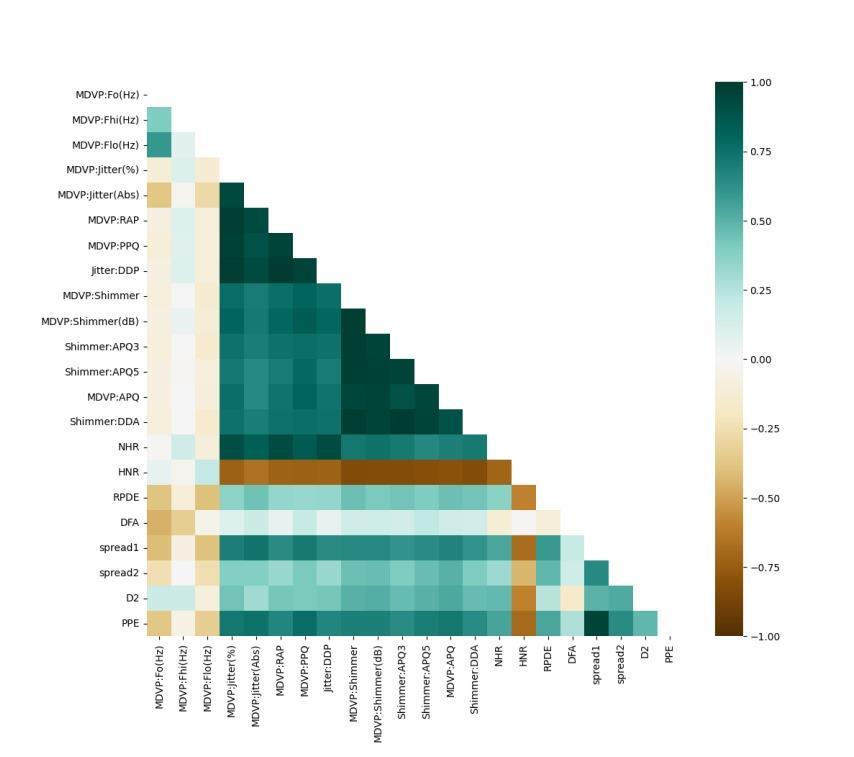
Data preprocessing steps to prepare the dataset for classificationtasks.Initially,thedatasetisloadedfromaCSV file using the Pandas library. Following this, irrelevant features such as the "status" and "name" columns are droppedfromthedatasetastheyare not essential forthe classificationtaskathand.
Next,thedatasetissplitintoinputfeaturesandtargetlabels using the train_test_split function from scikit-learn. This division is crucial for training and evaluating machine learning models effectively. Subsequently, a genetic algorithm-based feature selection technique is applied to identifythemostinformativefeaturesforclassification.This process aids in reducing dimensionality and enhancing modelperformance.
While the provided code encompasses essential data preprocessingsteps,itnotablylacksexplicitnormalization or standardization of the data, which could potentially improve the performance of certain machine learning
International Research Journal of Engineering and Technology (IRJET) e-ISSN: 2395-0056
Volume: 11 Issue: 04 | Apr 2024 www.irjet.net p-ISSN: 2395-0072
algorithms. Incorporating such preprocessing techniques could further refine the dataset and contribute to more robustmodeloutcomes.
A genetic algorithm (GA) for feature selection, which is a processofidentifyingthemostinformativefeaturesfroma dataset while reducing dimensionality and computational complexity.Thisapproachbeginsbyinitializingapopulation of potential solutions, where each solution represents a subset of features. Then, the fitness of each solution is evaluated by training machine learning models, including DT, RF, LR, AdaBoost, KNN and SVM, using the selected features.Theaccuracyscoreofeachmodelonavalidation datasetisusedasthefitnessscoreforeachsolution.Next, the top-performing solutions are selected based on their fitness scores to proceed to the next generation. Through crossoverandmutationoperations,newpotentialsolutions aregeneratedbycombiningandmodifyingthefeaturesof selectedsolutions. Thisprocesscontinuesiterativelyfora specifiednumberofgenerations,allowingthepopulationto evolveandpotentiallyimproveitsperformance.Ultimately, thegoalistoidentifythemostdiscriminativefeaturesthat contributetothepredictiveaccuracyofthemachinelearning models, thereby enhancing their utility in Parkinson's diseaseresearchandpatientcare.
Themachinelearningmodelsareselectedand trainedfor classificationtasksrelatedtoParkinson'sdiseasediagnosis. The models include Linear SVM, Radial SVM, LR, RF, AdaBoost, DT,KNN and Gradient Boosting. Each model is importedfromthescikit-learnlibraryandinstantiatedwith defaulthyperparametersorspecificconfigurations.
For model selection, the code initializes instances of each classifier and appends them to a list of models. This approach allows for a comparative evaluation of different algorithms to determine which one performs best for the given dataset. The choice of models is crucial as each algorithmhasitsstrengthsandweaknesses,whichmayvary depending on the characteristics of the dataset and the natureoftheclassificationproblem.
Once the models are selected, the code proceeds to train them using the provided dataset. The dataset consists of features related to Parkinson's disease, such as various biomedicalmeasurements.Thedatasetispreprocessedby removing the 'status' and 'name' columns, which are unnecessary for training the models. Additionally, the dataset is split into training and testing sets using the train_test_splitfunctiontofacilitatemodelevaluation.Each modelistrainedonthetrainingdataandevaluatedonthe testingdatausingaccuracyastheperformancemetric.
Our study aimed to evaluate various machine learning modelsforParkinson'sdiseasediagnosis.Weobservedthat employing feature selection techniques notably enhanced theaccuracyofourmodels.
When utilizing feature selection, the Decision Tree and gradientboostingmodelsareachievedthehighestaccuracy at97%.LogisticRegressionandK-NearestNeighbors(KNN) models also demonstrated substantial improvements, achievingaccuraciesof92%and94%,respectively.
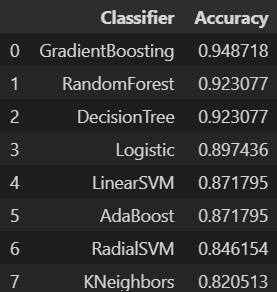
Conversely, when feature selection was not applied, the accuracyofthemodelsdecreased.Forinstance,theaccuracy oftheDecisionTreeandGradientBoostingmodelsdropped to92%, while Logistic Regression decreasedto 89%. This underscores the critical role of feature selection in improvingdiagnosticaccuracy.
In summary, our findings emphasize the importance of selecting relevant features in medical datasets. By integratingfeatureselectiontechniques,wecanenhancethe performance of machine learning models in diagnosing Parkinson'sdisease,leadingtomoreaccurateandreliable diagnosticoutcomes
Classification using all
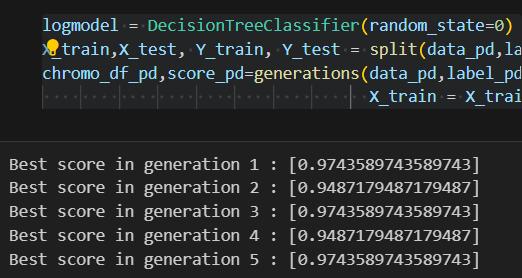
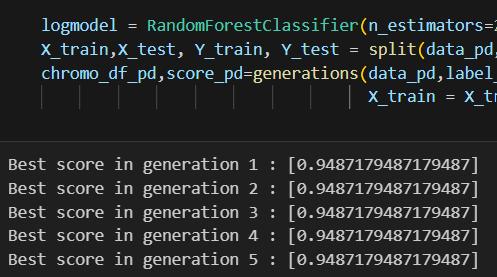
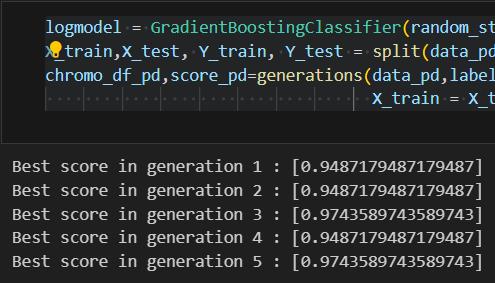
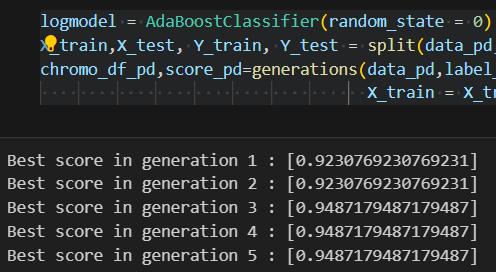
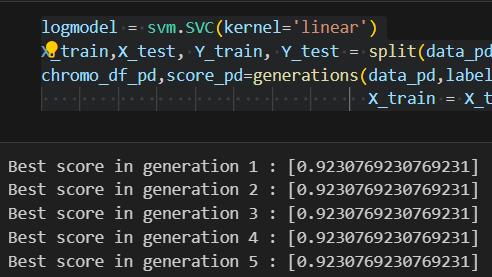
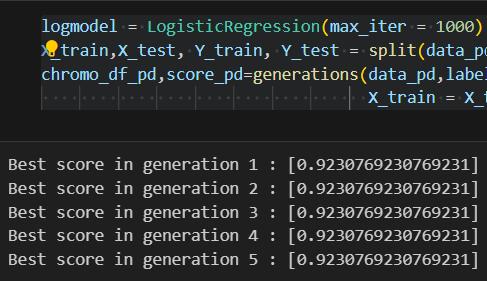
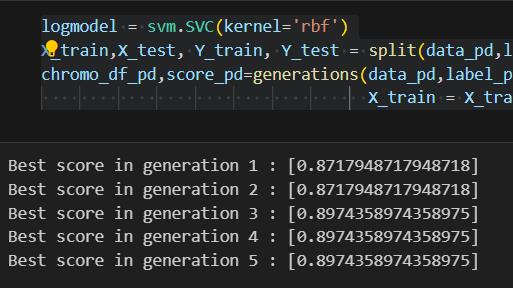
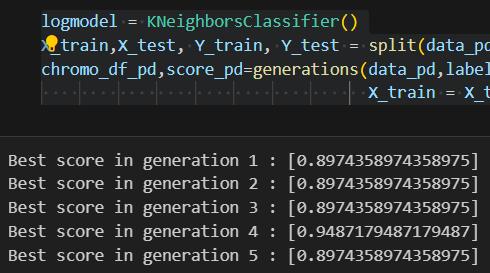
Our study evaluated the performance of various machine learningmodelsindiagnosingParkinson'sdisease,bothwith andwithoutfeatureselection.Remarkably,weobserveda substantial enhancement in model accuracy with feature selection.TheDecisionTreeandGradientBoostingmodels emerged as top performers, achieving an impressive accuracyof97%.Additionally,RandomForestandK-Nearest Neighbors (KNN) models demonstrated commendable accuracies of 94%. Logistic Regression and Linear SVM exhibited competitive accuracies of 92%. Conversely, without feature selection, model accuracies slightly
International Research Journal of Engineering and Technology (IRJET) e-ISSN: 2395-0056
Volume: 11 Issue: 04 | Apr 2024 www.irjet.net p-ISSN: 2395-0072
decreased,emphasizingthecriticalroleoffeatureselection inoptimizingmodelperformance.Nonetheless,evenwithout feature selection, the models maintained relatively high accuracies,withRandomForest,DecisionTree,andGradient Boostingallachieving92%.Overall,ourfindingsunderscore the importance of feature engineering in enhancing the reliability and effectiveness of diagnostic systems for Parkinson'sdisease.
[1]Harris,C.R.,Millman,K.J.,vanderWalt,S.J. etal.Array programming with NumPy. Nature 585, 357–362 (2020). https://doi.org/10.1038/s41586-020-2649-2
[2]McKinney,W.DataStructuresforStatisticalComputingin Python.Proceedingsofthe9thPythoninScienceConference, 51-56(2010).
[3] Waskom, M. et al. mwaskom/seaborn: v0.11.1 (September 2020). Zenodo. http://doi.org/10.5281/zenodo.592845.
[4] Hunter, J.D. Matplotlib: A 2D Graphics Environment. Comput. Sci. Eng. 9, 90–95 (2007). https://doi.org/10.1109/MCSE.2007.55
[5] Pedregosa, F. et al. Scikit-learn: Machine Learning in Python.J.Mach.Learn.Res.12,2825–2830(2011).
[6]Espay,A.J.,Lang,A.E.Parkinsondiseasesinthe2020sand beyond: Replacing clinico-pathologic convergence with systemsbiologydivergence.J.Parkinsons.Dis.10,441–449 (2020).https://doi.org/10.3233/JPD-202251
[7] Tsanas, A., Little, M. A., McSharry, P. E., & Ramig, L. O. (2010). Accurate telemonitoring of Parkinson’s disease progressionbynoninvasivespeechtests.IEEETransactions onBiomedicalEngineering,57(4),884-893.
[8]Orozco-Arroyave, J. R., Hönig, F., Arias-Londoño, J. D., Vargas-Bonilla, J. F., Daqrouq, K., Skodda, S., ... & Nöth, E. (2016). Automatic detection of Parkinson’s disease in running speech spoken in three different languages. The Journal of the Acoustical Society of America, 139(1), 481500.
[9]Martínez-Sánchez,F.,Meilán,J.J.G.,Carro,J.,López,D.E., &Alvarez,J.R.(2015).AutomateddetectionofParkinson’s diseaseinsustainedphonationsamples.TheJournalofthe AcousticalSocietyofAmerica,137(5),2680-2687.
[10]Tsanas,A.,Little,M.A., McSharry,P.E., Spielman, J., & Ramig, L. O. (2012). Novel speech signal processing algorithms for high-accuracy classification of Parkinson's disease. IEEE Transactions on Biomedical Engineering, 59(5),1264-1271.